Su Jok Therapy: Navigating Palmar-Plantar Somatotopic Projections, Byol Meridian Dynamics, and Precision Acupressure Protocols
1. Opening — A Problem This Solves Today
If you have ever spent an arduous afternoon anchored to an office chair, only to feel a tight, vice-like constriction creeping up your cervical spine into the base of your skull, or a dull, burning ache across your lumbar vertebrae that resists stretching, you are intimately acquainted with somatic stasis. When sudden musculoskeletal tension, mid-afternoon cognitive fatigue, or post-prandial gastrointestinal bloating strikes, the default societal response is pharmacological: a non-steroidal anti-inflammatory capsule or an antacid. Yet these systemic interventions often carry visceral side effects while blunting the nervous system's endogenous feedback loops.
Traditional clinical paradigms, particularly East Asian meridian medicine, offer a radically different framework. When codified through the lens of modern distal reflexology and cybernetic biology, your body possesses an exquisitely detailed, readily accessible biological control panel. If you examine the palms of your hands and the soles of your feet, you are not merely looking at mechanical grasping tools; you are observing a high-resolution, fractal somatotopic map.
Developed in the late 20th century by the South Korean scientist and philosopher Professor Park Jae Woo, Su Jok therapy (Su meaning hand, Jok meaning foot in Korean) synthesizes centuries of classical channel theory with contemporary neuroanatomy and bio-holographic physics. By understanding how the distal extremities act as high-density remote controls for the viscera, musculoskeletal axis, and central nervous system, we gain a non-invasive, drug-free methodology for rapid pain alleviation and autonomic regulation that can be engaged anywhere, at any moment.
2. The Meridian Path & Bio-Holographic Architecture — A Journey Through the Body and Hand
To appreciate the clinical mechanics of Su Jok, one must examine its foundational philosophy: the Homo-Hetero-Neutro-Neuto dimensional matrix (the Triorigin model). In Professor Park's cosmological and physiological paradigm: * Hetero represents the forces of change, expansion, dispersal, and acute divergence. * Homo represents the forces of stability, contraction, consolidation, and morphological preservation. * Neutro provides the harmonizing, adaptive, and functional equilibrium that integrates Hetero and Homo into dynamic life. * Neuto serves as the underlying zero-point source and latent potential.
In human anatomy, the Homo force preserves structural symmetry and organismal coherence by projecting the macrocosm of the entire human form onto the microcosms of the hands and feet. Because the hands and feet are the most mobile, functionally complex, and neurologically rich distal structures of the human organism, they act as primary cybernetic feedback terminals for the central nervous system.
       HUMAN BODY MACROCOSM              SU JOK PALMAR SOMATOTOPY

             [ HEAD ]                             (Thumb Distal)
                ||                                       ||
        [ CERVICAL SPINE ]                      (Thumb Proximal Phalanx)
          /     ||     \                          /      ||      \
     [ARM] [THORAX/HEART] [ARM]            (Digit II) [THENAR] (Digit V)
               /  ||  \                                /   ||   \
          [ABDOMINAL CAVITY]                      [CENTRAL PALMAR DISK]
               /      \                                /        \
           [LEG]      [LEG]                       (Digit III)  (Digit IV)
The Three Interlocking Somatotopic Projections
Professor Park Jae Woo categorized the somatotopic interface into three primary, nested correspondence systems:
-
The Primary Main Correspondence System: When the hand is held facing forward with the thumb pointing upward, its morphology directly reflects the upright human figure. * The Thumb projects the head and neck: the distal phalanx corresponds to the cranium, sensory organs, and brain, while the proximal phalanx maps the cervical spine, pharynx, and thyroid. * The Thenar Eminence (the fleshy muscular base of the thumb) represents the thoracic cage, containing the lungs, mediastinum, and myocardium. * The Central Palm encompasses the sub-diaphragmatic abdominal cavity, housing the stomach, liver, gallbladder, spleen, pancreas, and small and large intestines. * The Third and Fourth Digits (middle and ring fingers) project the lower extremities (legs), with their three joints corresponding sequentially to the hip, knee, and ankle. * The Second and Fifth Digits (index and little fingers) project the upper extremities (arms), mapping sequentially to the shoulder, elbow, and wrist joints. * The Dorsal Surface of the Hand corresponds to the posterior aspect of the body: the spinal column traverses the midline groove between the third and fourth metacarpal bones, flanked by the renal and adrenal zones.
-
The Secondary Mini-System: Operating upon fractal mathematics, the Mini-System projects the entire human body onto the distal phalanx of each individual finger and toe. The nail bed represents the posterior cranium and spine, the palmar pad maps the ventral organs, and the lateral borders reflect the limbs. This system provides ultra-high-resolution access for micro-needling and micro-magnetic stimulation.
-
The Insect System: In this linear somatotopy, each digit is conceptualized as an independent, vertical biological column: * The Distal Phalanx governs the head and neck. * The Middle Phalanx governs the thoracic organs and upper back. * The Proximal Phalanx governs the abdominal cavity, lumbar-sacral spine, and urogenital sphere.
+===================================================================================+
|                    SU JOK CORRESPONDENCE SYSTEMS ARCHITECTURE                     |
+=========================+=========================================================+
| System                  | Anatomical Mapping & Somatotopic Orientation            |
+=========================+=========================================================+
| Main System (Su)        | Thumb = Head/Neck; Palm = Abdomen; Thenar = Thorax;     |
|                         | Digits II/V = Arms; Digits III/IV = Legs; Dorsum = Spine|
+-------------------------+---------------------------------------------------------+
| Insect System           | Linear projection per digit: Distal = Cephalic;         |
|                         | Middle = Thoracic; Proximal = Abdomino-Pelvic           |
+-------------------------+---------------------------------------------------------+
| Mini-System             | Entire organism mapped exclusively onto individual      |
|                         | distal phalanges for high-precision micro-intervention  |
+-------------------------+---------------------------------------------------------+
| Byol Meridian System    | 12 paired micro-meridians + 2 central vessels running   |
|                         | along the digits, resonating with primary body channels |
+=========================+=========================================================+
Neuroreflexive and Bio-Holographic Rationale
The neurophysiological validity of Su Jok rests upon the disproportionate cortical representation of the hands and feet within the postcentral gyrus of the parietal cortex, famously mapped as the Cortical homunculus. The cutaneous tissues of the human palm and palmar digital surfaces exhibit the highest concentrations of low-threshold mechanoreceptors (Meissner’s corpuscles, Merkel nerve endings) and polymodal nociceptors in the human body.
When visceral inflammation or musculoskeletal trauma occurs at a macro-anatomical site, retrograde axonal reflexes and dorsal horn spinal gating establish a localized, hyper-sensitized neuro-vascular nexus at the corresponding distal somatotopic point. These tender reactive loci—termed Ah-Shi or correspondence points—manifest altered electro-dermal impedance, localized capillary dilatation, and intense tenderness upon palpation, functioning as bidirectional neuro-energetic terminals.
The Byol Micro-Meridian System
Beyond purely structural reflexes, Professor Park mapped the Byol Micro-Meridians (Byol meaning "star" or "micro" in Korean). These pathways represent an energetic microcosm running along the phalanges and metacarpal lines that maintain continuous bidirectional resonance with the classical 12 primary channels and the Eight Extraordinary Vessels codified in traditional Meridian theory.
For example, the central palmar axis acts as the micro-scale Ren Mai (Conception Vessel), regulating the Yin viscera, while the dorsal midline acts as the micro-scale Du Mai (Governing Vessel), regulating the Yang musculoskeletal axis and neuro-spinal axis.
3. Key Micro-Acupressure Points You Can Press Right Now
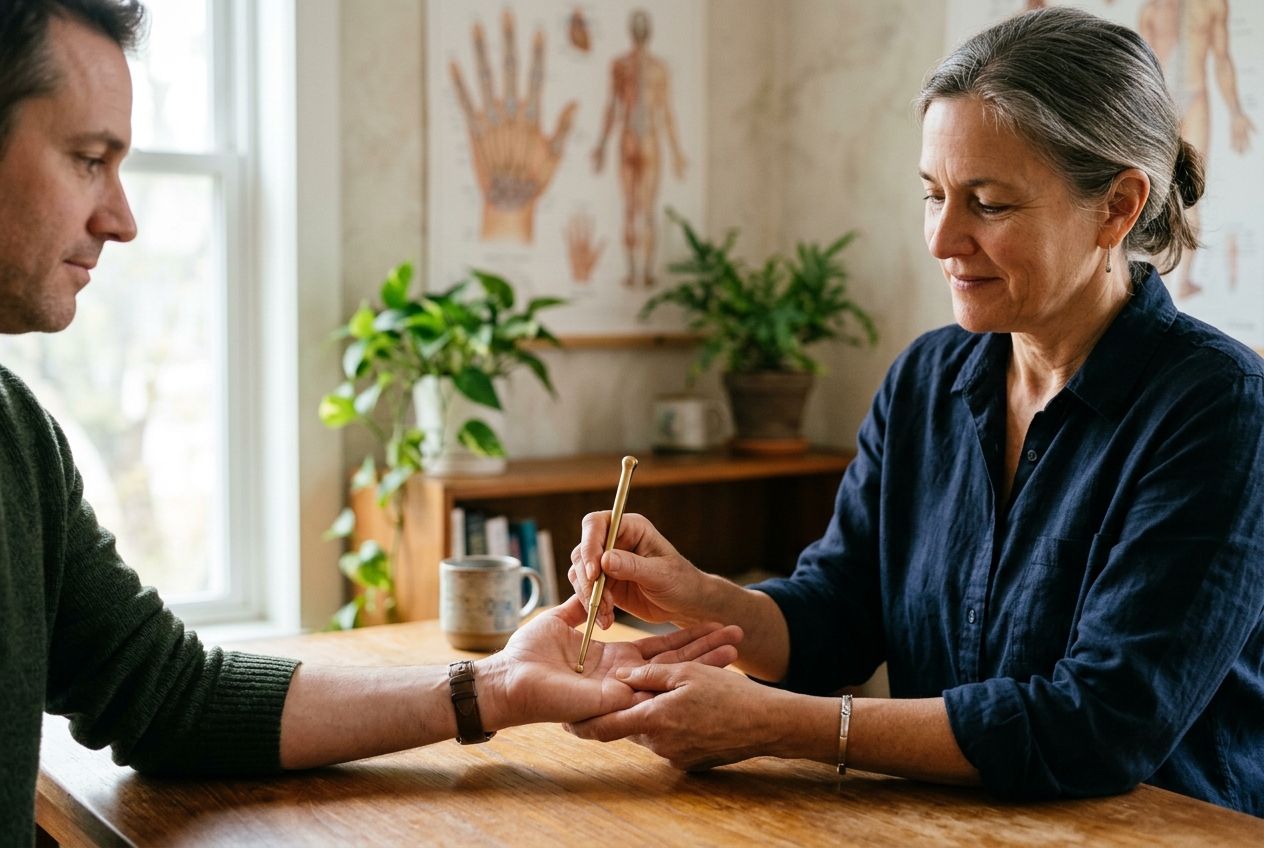
To directly experience the clinical efficacy of Su Jok therapy, one does not require specialized equipment. You can utilize the rounded tip of an ordinary ballpoint pen, a probe, or the edge of a thumbnail to explore and stimulate these key reactive zones.
            PALMAR SURFACE (YIN)                  DORSAL SURFACE (YANG)

                .-""""-.                              .-""""-.
               /  (..)  \                            /        \
              |  CRANIAL |                          | POSTERIOR|
               \  POINT /                            \ CRANIUM/
                '-....-'                              '-....-'
                   || (Cervical)                         || (C1-C7)
               .---||---.                            .---||---.
             /    THENAR  \                        /            \
            /  (Cardio-    \                      /   SPINAL     \
           |    Pulmonary)  |                    |    COLUMN      |
           |   .--------.   |                    |     AXIS       |
           |  /          \  |                    |   (Metacarpal  |
           | |  EPIGASTRIC| |                    |     Groove)    |
           | |   MASTER   | |                    |                |
           |  \  POINT   /  |                    |    LUMBAR /    |
           |   '--------'   |                    |    SCIATIC     |
            \              /                      \   ZONE       /
             '------------'                        '------------'
              /  |    |  \                          /  |    |  \
             /   |    |   \                        /   |    |   \
           (II) (III)(IV) (V)                    (II) (III)(IV) (V)
           Arm   Leg  Leg Arm                    Arm   Leg  Leg Arm
1. The Su Jok Cranial and Cervical Apex (Thumb Distal & Proximal Phalanges)
- Physical Location: Examine the palmar pad of your thumb. The rounded, central swirl of the thumbprint corresponds directly to the fronto-nasal facial area and the Yintang (third eye) locus. The proximal phalanx, bridging the thumb joint to the thenar eminence, corresponds precisely to the anterior and posterior cervical spine (C1 through C7).
- Sensory Feedback: When sliding a blunt probe across the midline of the proximal thumb phalanx, individuals suffering from postural neck stiffness will encounter an exquisitely sharp, pinpoint sensation—often described as a tiny, bruised grain of sand beneath the skin.
- Stimulation Technique: Apply firm, perpendicular pressure with a blunt probe or fingernail. Maintain continuous pressure while executing micro-rotational kneading for 60 to 90 seconds.
- Clinical Indications: Cervical spondylosis, tension cephalalgia, occipital neuralgia, and acute cognitive fatigue.
2. The Epigastric and Solar Plexus Master Point (Central Palmar Disk)
- Physical Location: Trace the midline of your palm to the geometric center, located roughly halfway between the base of the middle finger and the proximal wrist crease. This point corresponds to Conception Vessel 12 (Zhongwan) and the celiac nerve plexus in classical acupuncture, as codified in standard clinical reference texts by the World Health Organization.
- Sensory Feedback: Deep palpation reveals a distinct, heavy ache or a radiating sensation that reflects autonomic tension across the diaphragm and upper digestive tract.
- Stimulation Technique: Using the knuckle of an opposing finger or a smooth diagnostic probe, exert steady, moderate-to-firm downward pressure accompanied by slow, rhythmic clockwise circular friction for 2 minutes.
- Clinical Indications: Functional dyspepsia, emotional anxiety, epigastric distension, shallow breathing, and stress-induced tachycardia.
3. The Lumbar-Sciatic Bifurcation Point (Dorsal Metacarpal Valley)
- Physical Location: Turn your hand over to view the dorsum. Locate the soft depression between the third and fourth metacarpal bones, just proximal to the knuckle junction of your middle and ring fingers. This channel corresponds to the lumbar spine (L1–L5) and the bifurcation of the sciatic nerve pathways.
- Sensory Feedback: In cases of low-back tightness or prolonged sitting, this groove yields a sharp, localized sensitivity that mirrors lumbar paraspinal tension.
- Stimulation Technique: Angle your probe or thumb edge at 45 degrees toward the wrist, gliding through the inter-metacarpal groove with deep, linear stroking motions for 2 to 3 minutes on each hand.
- Clinical Indications: Acute lumbago, sacroiliac joint irritation, sciatica, and morning spinal stiffness.
4. A Multi-Point Su Jok Protocol for Common Clinical Syndromes
When confronted with the classic modern symptom triad—intense cervical tension, retro-orbital eye strain, and cognitive exhaustion following prolonged digital screen exposure—rely on this structured clinical protocol.
+===================================================================================+
|               CLINICAL INTERVENTION MATRIX: CERVICAL & CEPHALIC RESET             |
+======+=========================+====================+==============+==============+
| Step | Target Zone             | Tool / Modality    | Dynamics     | Duration     |
+======+=========================+====================+==============+==============+
|  01  | Dorsal Proximal Thumb   | Diagnostic Probe   | Linear Scan  | 60 Seconds   |
|      | Phalanx (C1-C7 Axis)    | (Blunt Tip)        | & Hold       | per Hand     |
+------+-------------------------+--------------------+--------------+--------------+
|  02  | Distal Thumb Apex       | Manual Pinch /     | Dynamic      | 60 Seconds   |
|      | (Fronto-Ocular Pad)     | Acupressure Probe  | Compression  | per Thumb    |
+------+-------------------------+--------------------+--------------+--------------+
|  03  | Inter-Metacarpal Groove | Buckwheat Seed     | Sustained    | 4 to 8 Hours |
|      | (Upper Thoracic T1-T4)  | Tape Fixation      | Micro-Press  | (Overnight)  |
+------+-------------------------+--------------------+--------------+--------------+
|  04  | Epigastric Center       | Byol Micro-Magnet  | South-Pole   | 20 to 30     |
|      | (Palm Midline)          | / Deep Pressure    | Tonification | Minutes      |
+===================================================================================+
The Step-by-Step "Do This Tonight" Protocol
-
Step 1: Systematic Diagnostic Probing (1 Minute per Hand) * Seat yourself comfortably with your forearms resting on a flat surface. * Grasp a blunt-ended probe (or the smooth end of a pen). * Begin scanning the dorsal aspect of the thumb's proximal phalanx (the neck zone). Apply uniform, perpendicular pressure in a 1-millimeter grid pattern. * Locate the single point that produces an immediate, involuntary sharp reflex (the Ah-Shi correspondence point).
-
Step 2: Dynamic Decompression Stimulation (90 Seconds) * Once identified, press the probe into this point at a 90-degree angle with firm, steady force. * While maintaining this pressure, gently perform active ranges of motion with your actual neck: rotate your head slowly from left to right, and flex forward and backward. * You will often note an immediate increase in cervical range of motion and a reduction in localized muscular spasm due to rapid neuro-reflexive modulation.
-
Step 3: Seed Therapy (Bija Application) for Sustained Stimulation * Mechanism: Seeds are living biological units rich in latent bio-electrochemical energy. In Su Jok, seeds provide both continuous mechanical stimulation and subtle energetic resonance matching the organ's shape or element. * Application: Take a round, intact black peppercorn or a buckwheat seed. Place it directly over the primary Ah-Shi point discovered in Step 1. * Fixation: Secure the seed firmly to the skin using standard breathable hypoallergenic paper tape (micropore tape). * Action: Press on the seed for 10 seconds every 30 minutes throughout the evening, or leave it applied overnight. The mechanical pressure continuously fires low-threshold mechanoreceptors, inhibiting central pain transmission via gate control mechanisms.
-
Step 4: Central Palmar Grounding (2 Minutes) * Conclude by using your opposite thumb pad to apply slow, deep, circular compressions to the center of the palm (Solar Plexus point). * Pair each circular rotation with a four-second inhalation and a six-second exhalation to engage parasympathetic vagal outflow and down-regulate sympathetic arousal.
5. Neurophysiological Mechanics, Safety Parameters, and Clinical Sense
Non-Invasive Therapeutic Modalities in Su Jok
Su Jok offers diverse modalities adapted to varying pathological states:
-
Seed Therapy (Spermotherapy): Seeds are selected based on morphology, color, and elemental nature. * Kidney Beans: Utilized for renal, adrenal, and lumbar spine dysfunctions due to morphological congruence. * Black Pepper / Mustard Seeds: Provide acute, fiery (Hetero) stimulation ideal for cold stasis, joint stiffness, and acute pain. * Apple Seeds / Flax Seeds: Applied to the thenar eminence to support cardiopulmonary and bronchial regulation.
-
Micro-Magnetic Polarity Stimulation: Using miniature permanent Byol magnets: * White (North) Pole Facing Skin: Induces Tonification (strengthening deficient organ function, corresponding to Homo consolidation or Neutro harmonization). * Yellow (South) Pole Facing Skin: Induces Sedation (dispersing inflammatory excess, heat, and acute pain, corresponding to Hetero reduction).
-
Targeted Acupressure & Moxibustion: Miniaturized thermal stimulation (micro-moxa cigars) or diagnostic probe friction delivers concentrated local hyperthermia and micro-trauma, driving micro-circulation without damaging peripheral tissues.
+===================================================================================+
|               COMPARATIVE PHYSIOLOGICAL AND CLINICAL PROFILE                      |
+=========================+================================+========================+
| Parameter               | Classical Body Acupuncture     | Su Jok Micro-System    |
+=========================+================================+========================+
| Primary Anatomy         | Full-body somatic points       | Hands and feet only    |
|                         | (361 classical points)         | (Distal projections)   |
+-------------------------+--------------------------------+------------------------+
| Invasiveness            | Invasive filiform needles      | Primarily non-invasive |
|                         | (Dermal penetration)           | (Probes, seeds, magnets)
+-------------------------+--------------------------------+------------------------+
| Neuro-Receptor Density  | Variable across trunk & limbs  | Extremely high         |
|                         | (Lower mechanoreceptor ratios) | (Palmar glabrous skin) |
+-------------------------+--------------------------------+------------------------+
| Safety & Organ Risk     | Risk of pneumothorax /         | Zero risk of internal  |
|                         | deep organ perforation         | organ injury           |
+-------------------------+--------------------------------+------------------------+
| Onset of Reflex Relief  | 10 to 30 Minutes               | Immediate (Seconds)    |
|                         |                                | via direct gating      |
+=========================+================================+========================+
Safety Guidelines, Contraindications, and Clinical Sense
While Su Jok is intrinsically safe due to its peripheral and distal application, rigorous clinical standards must be maintained:
- Pregnancy Precautions: Avoid aggressive, deep diagnostic probing or strong magnetic sedation on the palmar base and wrist junction corresponding to the pelvic cavity, uterus, and lower lumbar spine. These correspondence zones can stimulate uterine contractions, analogous to classical points like SP6 and LI4, whose contraindications in pregnancy are documented across peer-reviewed trials indexed in the NCBI PubMed Database.
- Dermatological Integrity: Never apply seeds, probes, or magnets over broken skin, open wounds, burns, or active fungal infections of the hand or foot.
- Appropriate Pressure Thresholds: Stimulation should be firm and elicit a distinct De-Qi-like sensation (a localized dull ache, tenderness, or thermal release), but it must never cause tissue bruising or severe capillary rupture.
- When to Seek Immediate Medical Evaluation: Su Jok is an adjunctive, reflex-modulating discipline. It is not a substitute for emergency medicine. Severe crushing substernal chest pain, acute neurological deficits (such as sudden unilateral weakness or speech slurring), suspected surgical acute abdomen, severe trauma, or persistent unexplained high fevers require immediate emergency hospitalization. For general scientific overviews of distal acupressure mechanics, consult scientific reviews on Acupressure and clinical trials on peripheral neuro-stimulation on PubMed Central.
6. Today's Clinical Takeaway
The Two-Minute Palmar Reset for Instant Focus and Stress Relief
If your energy is plummeting or stress is escalating right now, do not reach for another stimulant. Perform this rapid two-minute Su Jok reset: 1. Identify the Point: Locate the center of your dominant palm (the Solar Plexus / Epigastric Master Point). 2. Apply Pressure: Place the thumb of your opposite hand into this depression. 3. Engage the Reflex: Press down firmly until you encounter a distinct, deep, comforting ache. 4. Synchronize: Maintain continuous pressure while performing 10 slow, circular clockwise rotations. Inhale deeply through your nose for 4 counts, expanding your diaphragm, and exhale slowly through your mouth for 6 counts.
Within 120 seconds, this targeted stimulation reduces sympathetic tone, enhances peripheral cerebral perfusion, and resets your somatic equilibrium.
Authoritative References & Scientific Reading
- World Health Organization Standard Acupuncture Point Locations: WHO Western Pacific Publications
- Neuroanatomical Basis of Distal Reflexology and Cortical Representation: Cortical Homunculus - Parietal Somatosensory Architecture
- Mechanisms of Distal Acupressure and Pain Gate Control: Acupressure Physiology & Neuro-Modulation
- Classical Channel Pathways and Bio-Energetic Systems: Meridian Systems in East Asian Medicine
- National Center for Biotechnology Information Clinical Studies on Micro-Acupuncture: NCBI PubMed Biomedical Database