She Fa: Navigating Intermittent Channel Percussion Mechanics, Blocked Qi Mobilization, and Precision Acupressure Protocols
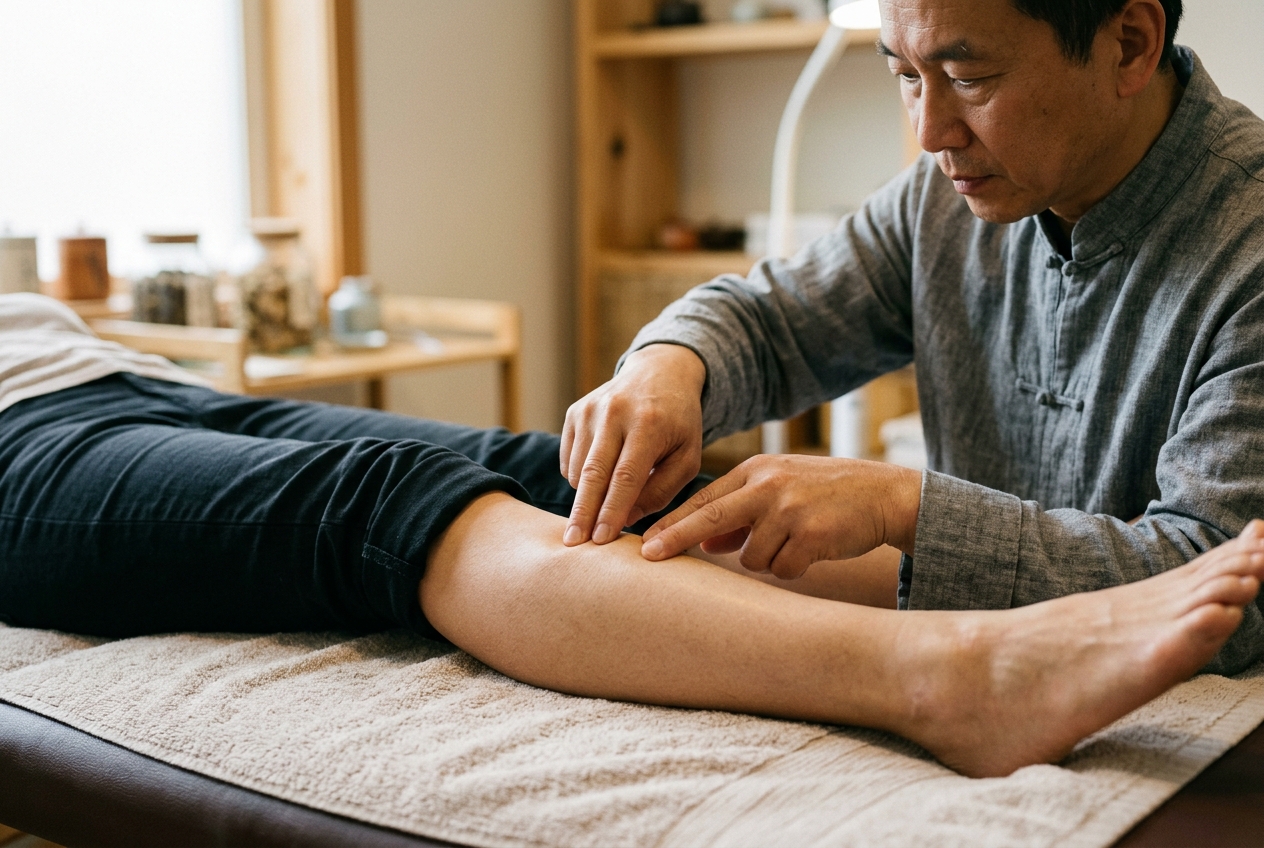
If you sit at a desk for eight hours a day, you are almost certainly intimately acquainted with the phenomenon of "tissue silence." It begins as a dull, refractory heaviness at the nape of the neck or between the scapulae, migrates into a post-lunch gastrointestinal stagnation that makes your abdomen feel like lead, and culminates in a pervasive, low-voltage anxiety that no amount of static stretching seems to dispel. You may have tried pressing into these tight bands of muscle with your thumbs or a massage ball, only to find the tissue stubborn, unyielding, and strangely numb to ordinary pressure.
In the clinical nomenclature of contemporary connective tissue research, this corresponds to densified fascial ground substance and sensory habituation. In Traditional Chinese Medicine (TCM), it is the quintessential presentation of Qi bu xing (气不行)—the arrest or sluggishness of vital bioelectric and interstitial circulation.
Standard acupressure frequently falters here because static, compressive load alone cannot always fluidify bound collagen matrices or rouse desensitized sensory afferents. When a physiological pathway becomes recalcitrant, the tradition offers an ingenious, rhythmically dynamic solution: She Fa (摄法), the classical art of along-channel percussion and digital tapping. By transforming steady pressure into a rhythmic, acoustic-mechanical wave, She Fa acts as a biological tuning fork, awakening sluggish conduits and restoring dynamic communication between the periphery and the central nervous system.
1. Opening — The Biomechanics of Sluggish Channels
For centuries, clinicians have encountered patients whose physiological pathways appear "unresponsive." In classical acupuncture, when an inserted needle fails to evoke the characteristic radiating warmth, heavy distension, or tingling known as de qi (得气, "the arrival of vital energy"), simply leaving the needle in place rarely resolves the impasse. The tissue remains stubbornly inert.
+-------------------------------------------------------------------------+
|                  CLASSICAL INSIGHT: ZHEN JIU DA CHENG                   |
|                                                                         |
|  "下针气不行,将指于上下经络上摄之。"                                      |
|  "When the needle is inserted and Qi fails to move, use the fingers to   |
|   rhythmically percuss and pluck along the meridian trajectory above    |
|   and below the point."                                                 |
|                                                                         |
|  — Yang Jizhou (杨继洲), The Great Compendium of Acupuncture and         |
|    Moxibustion (针灸大成, 1601 CE)                                       |
+-------------------------------------------------------------------------+
In his seminal Ming Dynasty medical canon, Zhen Jiu Da Cheng (《针灸大成》, 1601 CE), physician Yang Jizhou codified the Fourteen Auxiliary Techniques (十四法) to overcome this exact clinical failure. Among these manipulations, She Fa was designated as the premier mechanical remedy for mobilizing dormant channels. Yang recognized that living tissue is not an isotropic, passive conduit, but a responsive, hydraulic system requiring specific kinetic frequencies to re-engage flow.
To appreciate the distinct biomechanics of She Fa, one must differentiate it from its neighboring auxiliary techniques:
- She Fa (摄法 — Channel Percussion/Tapping): Characterized by intermittent, light-to-moderate digital tapping and elastic plucking applied along the proximal and distal continuum of the meridian pathway. Rather than focusing solely on the discrete acupoint locus, She Fa treats the channel as an integrated kinetic chain, propagating vibrational pressure waves through the interstitial fluid matrix.
- Xun Fa (循法 — Continuous Longitudinal Stroking): Involves continuous, gliding tactile pressure tracing smoothly along the intermuscular septa. Xun Fa warms the channel and mechanically guides fluid along venous and lymphatic orientations, acting as a laminar sweep rather than a vibrational catalyst.
- Tan Fa (弹法 — Percussive Needle Twanging): A specialized technique wherein the clinician flicks or twangs the tail of an inserted needle with the index finger. This transmits a high-frequency, focal micro-vibration directly down the metal shaft into the deep neuromuscular junction, whereas She Fa delivers broad-spectrum mechanotransductive pulses across the superficial and deep fascial planes.
When translated into modern self-applied acupressure, She Fa bridges the gap between mechanical manual therapy and neurobiology, offering a non-invasive methodology for unlocking dense, unresponsive tissue.
2. The Meridian Path — A Journey Through Fascial Continuities and Cellular Mechanics
To navigate these channels effectively, we must demystify the classical meridian. Far from mystical, invisible lines, the pathways mapped in ancient texts exhibit an astonishing geographic congruence with the continuous sheets of connective tissue known today as myofascial meridians.
Consider the great anterior kinetic pathway known classically as the Stomach Meridian of Foot-Yangming (足阳明胃经). In everyday experiential terms: * It begins just beneath the orbit of your eye, cascades down the jawline into the throat, descends through the muscular corridor of your chest and abdomen, passes through the crease of your hip, and travels straight down the front-lateral compartment of your thigh. * Crossing the knee, it tracks along the outer ridge of your shinbone—that exact muscular strip beside the bone that throbs with ache after a long day of walking on concrete—before terminating at the tip of the second toe.
Parallel to this, on the inner surface of the leg, lies the Spleen Channel of Foot-Taiyin (足太阴脾经), tracing the soft, tender territory immediately behind the inner edge of your shinbone, winding upward across the inner knee and thigh into the lower abdomen.
Along the upper limbs, the Large Intestine Channel of Hand-Yangming (手阳明大肠经) runs along the radial muscular ridge of your forearm—the tension-prone extensor muscles you engage whenever you click a mouse or type—straight into the web between your thumb and index finger.
The Contemporary Neurofascial Engine
When you execute She Fa—rhythmically tapping along these anatomical corridors at a frequency of 2 to 3 Hertz (cycles per second)—you initiate a cascade of biophysical and cellular events:
- Interstitial Hydraulic Waves & Thixotropy: Living fascia is embedded in an extracellular matrix dominated by hyaluronan and proteoglycans. When stagnant, this matrix becomes viscous and gel-like, impairing capillary exchange and sensory nerve gliding. Rhythmic, intermittent tapping introduces rapid stress-relaxation cycles. These generate hydrodynamic shear forces in the interstitial fluid, transforming the dense gel state into an organized, fluid sol state through the property of thixotropy.
- Mechanoreceptor Recruitment: The dermal and subfascial layers are densely populated with low-threshold mechanoreceptors. The 2–3 Hz pulse of She Fa selectively engages:
- Meissner corpuscles (rapidly adapting receptors sensitive to dynamic skin deformation and low-frequency flutter).
- Merkel cell-neurite complexes (slowly adapting type I receptors encoding sustained touch and spatial displacement).
- A-beta afferent nerve fibers, which transmit non-nociceptive mechanical signals rapidly to the dorsal horn of the spinal cord, modulating pain perception via the classic Melzack-Wall gate control mechanism.
- Piezo-Mediated Mechanotransduction: At the cellular membrane, physical percussion deforms the lipid bilayer, gating the recently discovered Piezo1 and Piezo2 mechanosensitive ion channels. This mechanical deformation permits an influx of calcium ($Ca^{2+}$) ions into local fibroblasts and endothelial cells, initiating downstream signal transduction cascades that govern cell shape, extracellular matrix synthesis, and fascial remodeling via cellular mechanotransduction.
- Nitric Oxide (NO) and Microcirculatory Vasodilation: Intermittent mechanical compression imparts shear stress onto the vascular endothelium, upregulating endothelial Nitric Oxide Synthase (eNOS). The resulting release of local nitric oxide produces rapid relaxation of vascular smooth muscle, triggering local hyperaemia, microvascular clearance of metabolic waste (such as bradykinin and substance P), and that characteristic spreading subjective warmth that classical masters identified as the distal arrival of de qi.
3. Key Points for Percussion and Pressure
Integrating She Fa into self-care requires pairing precise point localization with dynamic, along-channel percussive priming. When static acupressure feels ineffective, precede your hold with 30–60 seconds of light, elastic tapping along the meridian leading directly into the point.
===========================================================================
               PRIMARY CLINICAL HUBS FOR SHE FA INTEGRATION
===========================================================================
Point Name    Channel / Meridian    Primary Somatic Target   Optimal Frequency
---------------------------------------------------------------------------
ST36 (Zusanli) Foot-Yangming Stomach Anterior Tibialis       2.5 - 3.0 Hz
LI4 (Hegu)     Hand-Yangming L.I.    1st Dorsal Interosseous 2.0 - 2.5 Hz
PC6 (Neiguan)  Hand-Jueyin Pericard. Intertendinous Sheath   2.0 Hz
SP6 (Sanyinjiao) Foot-Taiyin Spleen  Posterior Tibial Margin 2.0 Hz
LV3 (Taichong) Foot-Jueyin Liver     Metatarsal Junction     2.0 Hz
===========================================================================
1. Zusanli (ST36, "Leg Three Miles") — The Metabolic Dynamo
- Anatomical Location: Sit comfortably with your knees bent at a right angle. Place the palm of your hand over your kneecap; your fingers naturally point down your shin. Locate the sharp frontal ridge of your shinbone. Move four finger-widths down from the bottom of your kneecap, and then slide one thumb-width outward into the soft muscular groove of the tibialis anterior muscle.
- The Somatosensory Signature: When located accurately, firm pressure produces a distinct, heavy, dull ache with an electric or warm sensation that radiates down the lateral side of the shin into the second and third toes.
- The She Fa Application: Before applying sustained pressure, use the pads of your index, middle, and ring fingers held loosely together to rapidly tap along the muscular channel—moving from 5 centimeters above ST36 down through the point to 5 centimeters below it. Maintain a brisk 2.5–3 Hz rhythm (roughly 5 taps every two seconds) for 45 seconds. Then, sink your thumb deeply into ST36 with a 45-degree upward angle, holding firmly for 90 seconds while breathing diaphragmatically.
- Clinical Applications: Relieves profound postprandial fatigue, bloating, sluggish gastric motility, and systemic physical exhaustion. Consult the World Health Organization Guidelines on Traditional Medicine for canonical documentation on its systemic tonification effects.
2. Hegu (LI4, "Joining Valley") — The Craniofacial & Autonomic Reset
- Anatomical Location: Open your hand and extend your thumb. Look at the fleshy web between your thumb and index finger. Bring your thumb snugly against the side of your index finger: a small mound of muscle will rise. Place your opposite thumb on the peak of this mound, then relax your hand. The point lies in the deep valley over the first dorsal interosseous muscle, close to the middle of the second metacarpal bone (the index finger bone).
- The Somatosensory Signature: A profound, deep soreness, often accompanied by a mild, expanding warmth that travels up the radial margin of the forearm toward the jaw and temple.
- The She Fa Application: Support your palm with your fingers underneath. Using your opposite thumb pad or the knuckles of your index and middle fingers, deliver light, elastic tapping along the back of the hand, starting from the base of the index finger and tapping down toward the wrist crease across LI4. Tap at 2 Hz for 30 seconds. Transition immediately into a pincer compression: thumb pressing from the top, index finger supporting from the palm side. Direct the force slightly toward the index finger bone for 2 minutes.
- Clinical Applications: Alleviates tension headaches, eye strain from digital monitors, clenching of the jaw (bruxism), and acute autonomic stress responses.
3. Neiguan (PC6, "Inner Gate") — The Diaphragmatic & Vagal Anchor
- Anatomical Location: Turn your hand palm-up. Lay three fingers of your opposite hand across your inner wrist crease, with your ring finger resting on the crease line. Your index finger now marks the level of PC6. Look at the center of your forearm: you will see (or feel by clenching your fist) two prominent, cord-like tendons (the palmaris longus and flexor carpi radialis). PC6 sits directly between these two tendons, three finger-widths above the wrist.
- The Somatosensory Signature: A spreading, sweet-sour sensation that radiates through the center of the palm and occasionally sends a subtle, relaxing wave up the medial arm into the chest.
- The She Fa Application: Rest your forearm on your thigh. Using the tip of your middle finger, rhythmically tap down the channel groove between the two tendons, moving from the mid-forearm down toward the wrist crease. Maintain an even, gentle 2 Hz rhythm for 60 seconds. Follow this with perpendicular, sustained thumb pressure into the intertendinous space for 1–2 minutes, synchronizing your exhalations with deeper sinking pressure.
- Clinical Applications: Modulates vagal tone, quells stress-induced nausea, relieves sensations of tightness or constriction in the chest, and interrupts racing, hyper-aroused mental loops. Research indexed on NCBI PubMed Central on Autonomic Modulation highlights the unique role of PC6 in heart rate variability and parasympathetic activation.
4. Point Combination: The "Desk-Worker's Somato-Visceral Rebound"
For individuals experiencing the trifecta of modern sedentary strain—cervical-suboccipital tightness, abdominal heaviness, and mental over-agitation after a prolonged workday—the following targeted sequence utilizes She Fa to clear cephalic congestion and ground metabolic energy.
+-------------------------------------------------------------------------+
|                  THE 8-MINUTE SOMATO-VISCERAL REBOUND                   |
|                                                                         |
|  Phase 1: Distal Cranial Venting (LI4) .................... 2.0 Minutes |
|           [30s Percussion @ 2Hz -> 90s Static Pincer Hold]              |
|                                                                         |
|  Phase 2: Central Vagal Induction (PC6) ................... 2.0 Minutes |
|           [30s Intertendinous Tapping -> 90s Sinking Compression]       |
|                                                                         |
|  Phase 3: Splanchnic Grounding (ST36) ..................... 4.0 Minutes |
|           [45s Shin Percussion @ 3Hz -> 75s Perpendicular Hold, x2]     |
+-------------------------------------------------------------------------+
The Step-by-Step Protocol
- Environment & Posture: Sit upright in a comfortable chair with your feet flat on the floor, uncrossed. Loosen tight waistbands. Take three slow, deep diaphragmatic breaths through your nose, exhaling completely through slightly parted lips.
- Phase 1: Venting Craniofacial Tension (Left & Right LI4 — 2 Minutes Total)
- Begin on your non-dominant hand. Perform She Fa tapping along the radial border of the hand toward LI4 for 30 seconds at 2 Hz.
- Apply firm, stationary pincer pressure into LI4 for 90 seconds. As you press, slowly roll your head in a gentle semi-circle from shoulder to shoulder to release neck fascia.
- Phase 2: Regulating Diaphragm and Heart (Left PC6 — 2 Minutes Total)
- Bring your focus to the left inner forearm. Tap the groove between the tendons across PC6 for 30 seconds.
- Sink your right thumb deeply between the tendons. Maintain a calm, unhurried pressure for 90 seconds while consciously dropping your shoulders down away from your ears.
- Phase 3: Grounding and Metabolic Activation (Bilateral ST36 — 4 Minutes Total)
- Place your knuckles or fingertips on the lateral compartments of both shins simultaneously.
- Execute bilateral She Fa tapping: rhythmically drum up and down the anterior tibialis muscle bellies across ST36 for 45 seconds at a brisk 3 Hz tempo. You should hear a light, resonant percussive sound against the muscle.
- Anchor your thumbs firmly into ST36 on both legs. Press with steady, firm force angled slightly upward toward the knee for 75 seconds. Feel the descending wave of somatic release as blood shifts from cephalic pools toward the digestive viscera.
- Repeat the ST36 cycle once more for a deep, revitalizing finish.
5. Safety, Contraindications, and Clinical Sense
While non-invasive channel percussion and acupressure are remarkably safe modalities, they are potent physiological interventions that demand clinical discernment.
! WARNING: PREGNANCY CONTRAINDICATIONS
Points LI4 (Hegu) and SP6 (Sanyinjiao) are classically categorized as "Forbidden
Points" during pregnancy. Strong manual stimulation or vigorous She Fa percussion
on these points produces profound descending motor action and upregulation of
uterine tone, which may induce premature uterine contractions. Avoid strong
stimulation on these points during pregnancy except under the direct supervision
of a licensed obstetrical acupuncture clinician.
Navigating Pressure, Depth, and Sensation
Understanding the qualitative boundary between therapeutic de qi and destructive tissue trauma is vital for effective self-treatment:
- Therapeutic De Qi (Target State): Feels like a deep, spreading, dull ache; a localized heavy or swelling sensation; mild warmth; or an electric tingling that stays within normal comfort boundaries. It invites the nervous system to relax into the pressure.
- Nociceptive Pain (To Avoid): Sharp, lancinating, pinching, or burning pain indicates that you are compressing a superficial cutaneous nerve branch directly against bone, or causing micro-trauma to the periosteum. If you feel sharp pain, immediately ease your pressure and shift your contact point a few millimeters.
Contraindications to Percussion and Acupressure
- Vascular Pathology: Never perform percussive She Fa or deep pressure over sites of suspected deep vein thrombosis (DVT), acute phlebitis, aneurysms, or marked varicose veins.
- Structural Integrity: Avoid tapping or pressing directly over open wounds, active skin lesions, severe ecchymosis (bruising), unhealed bone fractures, or localized infections/cellulitis.
- Systemic Red Flags: Self-care acupressure is an adjunctive hygiene protocol for functional and lifestyle tension. It is not an emergency medical intervention. Chronic or acute severe symptoms—such as unremitting crushing chest pain, sudden unilateral neurological deficits, severe unexplained weight loss, or high fever with neck stiffness—require prompt consultation with an accredited medical practitioner or physician.
6. Today's Takeaway: The Two-Minute Radial Reset
You do not need an hour of leisure or specialized equipment to change your physiological state. Before you close this article, take exactly two minutes to experience the neurofascial power of She Fa right at your desk.
===========================================================================
                      THE 2-MINUTE MIDDAY RADIAL RESET
===========================================================================
  1. IDENTIFY: Place your left hand on the desk, thumb extended. Find the
     high point of the muscular web between thumb and index finger (LI4).

  2. TAP (She Fa): Using the relaxed fingertips of your right hand, rapidly
     and lightly tap the muscular corridor from your index knuckle down
     through the web into your wrist at a rate of 2 to 3 taps per second.
     Duration: 30 Seconds.

  3. COMPRESS: Clamp your right thumb pad into LI4, aiming the pressure
     deeply toward the index finger bone. Hold with calm, firm pressure.
     Duration: 90 Seconds.

  4. OBSERVE: Release your grip. Notice the immediate drop in shoulder
     elevation, the clearing of ocular tension, and the cool rush of arterial
     reperfusion flooding your hand and arm.
===========================================================================
By transitioning from passive muscular tension to active, vibrational mechanotransduction, you reclaim agency over your physical architecture. Through the ancient wisdom of Yang Jizhou's She Fa and the validated insights of contemporary connective tissue science, the body ceases to be a stubborn, unresponsive mass—revealing itself instead as a resonant, adaptable, and self-regulating instrument.
Authoritative References & Scientific Reading
- Yang Jizhou (杨继洲). Zhen Jiu Da Cheng (Compendium of Acupuncture and Moxibustion), Ming Dynasty (1601 CE). Traditional Chinese Medicine classics repository.
- Langevin, H. M., et al. Mechanotransduction and the Fascial System: The Science Behind Manual Therapies. PubMed Central: PMC4107873.
- Coste, B., et al. Piezo1 and Piezo2 are essential components of distinct mechanically activated cation channels. NCBI PMC: PMC6486026.
- Stecco, C., et al. Fascial Mechanoreceptors and Interstitial Dynamics in Pain Perception. PubMed Central: PMC8838848.
- World Health Organization (WHO). Standard Acupuncture Nomenclature and Traditional Medicine Strategies. WHO Traditional Medicine.
- National Center for Biotechnology Information (NCBI). De Qi and Neurovascular Modulation. PMC3796320.
- Wikipedia. Meridian Pathways & Connective Tissue Models. Meridian (Chinese Medicine).