Shao Shan Huo and Tou Tian Liang: Navigating Thermal Sensation Dynamics, Vasomotor Microcirculation Modulation, and Precision Acupressure Protocols
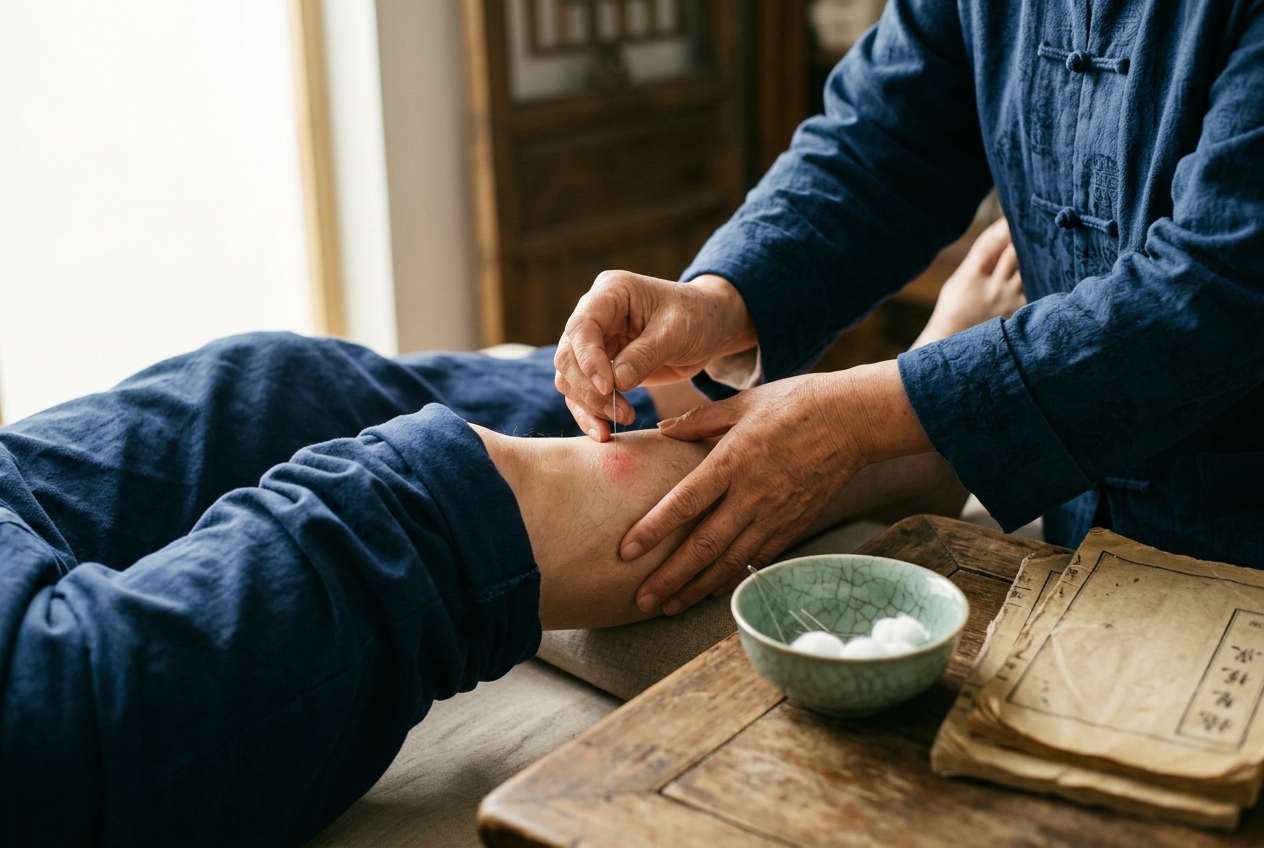
For over five centuries, practitioners of classical Chinese medicine have addressed these divergent systemic dysregulations through two celebrated, sophisticated manipulation protocols: Shao Shan Huo (烧山火, "Setting the Mountain on Fire") and Tou Tian Liang (透天凉, "Penetrating Heaven Coolness"). First codified systematically by the Ming dynasty master Xu Feng in his seminal 1439 CE treatise, the Jin Zhen Fu (Ode to the Gold Needle), these composite thermal methods were designed to physically induce palpable sensations of warmth or coolness across remote meridians.
While historical texts explained these phenomena in terms of Qi dynamic adjustments, modern biomedical science reveals an intricate neurovascular reality. Tiered mechanical manipulation directly activates Transient Receptor Potential (TRP) ion channels, modulates local endothelial nitric oxide release, and resets autonomic vasomotor tone via the hypothalamic-preoptic thermoregulatory axis.
Understanding these classical protocols illuminates how targeted mechanical deformation of neuromuscular junctions can alter peripheral microcirculation and visceral physiology—and how these exact principles can be adapted into non-invasive acupressure protocols for clinical practice and self-care.
1. The Living Meridian Highways: A Tactile Journey Through the Body
To understand thermal needle manipulation and its acupressure analogs, one must first trace the living anatomical pathways along which these thermal sensations propagate. Far from esoteric lines, the primary conduits—specifically the Yangming (Stomach and Large Intestine) and Taiyin (Spleen) systems—trace major neurovascular bundles, fascial intermuscular septa, and muscular chains.
The Stomach Pathway (Foot Yangming)
The Stomach conduit begins on the face just below the orbit of the eye, drops to the corner of the mouth, loops along the lower jaw angle, and sweeps upward to the temple. It then descends along the front of the throat, enters the supra-clavicular fossa, passes down through the nipple line of the chest, and continues down the abdomen roughly two inches lateral to the midline.
Continuing past the groin, the path travels along the anterior midline of the thigh through the rectus femoris, crosses the kneecap, and tracks down the outer crest of the shinbone—the muscular belly of the tibialis anterior that aches after prolonged standing. It terminates at the lateral edge of the second toe nail. Because the Yangming system is recognized in traditional theory as unusually abundant in both blood (Xue) and metabolic energy (Qi), points along this pathway serve as primary levers for altering core thermal dynamics.
The Large Intestine Pathway (Hand Yangming)
Originating at the radial corner of the index fingernail, this channel runs along the top seam of the finger, crosses the prominent muscle mound between the thumb and index finger, and travels up the outer lateral edge of the radius bone in the forearm. Passing the lateral crease of the elbow, it climbs the anterior border of the shoulder muscle (deltoid), ascends the side of the neck, crosses the cheek, and terminates at the opposite side of the nostril base. It functions as a rapid-response channel for clearing cranial heat and regulating systemic arterial resistance.
The Spleen Pathway (Foot Taiyin)
Beginning at the medial corner of the great toe, the Spleen meridian traces the arch of the foot where the pale plantar skin meets the darker dorsal skin. It rounds the front of the inner ankle bone, climbs the inner edge of the shinbone directly behind the medial tibia, ascends the inner thigh, crosses the inguinal region, and traverses the abdomen and ribcage. As the primary yin counterpart to the Stomach, this channel controls fluid distribution and deep tissue perfusion.
2. Classical Mechanical Framework: The Geometry of the Jin Zhen Fu
The Jin Zhen Fu establishes precise physical algorithms for thermal needle techniques. These methods do not rely on static placement, but on precise dynamic mechanical interactions across three distinct anatomical depths, coordinated with patient respiration and explicit manipulation ratios.
The Sancai (Three Powers) Depth Vector
Both methods subdivide the total operational depth of an acupuncture point into three equal strata: 1. Heaven (Tian, 天): The superficial stratum, encompassing the dermis, superficial fascia, and subcutaneous areolar tissue. 2. Human (Ren, 人): The intermediate stratum, residing within the core contractile muscle belly and deep neurovascular fascial sheaths. 3. Earth (Di, 地): The profound stratum, situated adjacent to the deep epimysium, interosseous membrane, or periosteal margin.
The Thermal Protocols: Mechanics at a Glance
| Parameter | Shao Shan Huo (Setting the Mountain on Fire) | Tou Tian Liang (Penetrating Heaven Coolness) |
|---|---|---|
| Therapeutic Intent | Tonify Yang; generate visceral & peripheral warmth | Clear Pathogenic Heat; purge inflammation & hyperpyrexia |
| Insertion Trajectory | Sequential descent: Heaven ($Tian$) $\rightarrow$ Human ($Ren$) $\rightarrow$ Earth ($Di$) | Direct plunge to Earth ($Di$), step-wise retreat to Heaven ($Tian$) |
| Thrust-to-Lift Ratio | Ninefold (9): Heavy, fast thrusting; light, slow lifting | Sixfold (6): Heavy, fast lifting; light, slow thrusting |
| Respiratory Synchronization | Manipulate during Exhalation; advance during Inhalation | Manipulate during Inhalation; retract during Exhalation |
| Aperture Management | Rapid withdrawal on exhalation; immediate digital sealing | Slow withdrawal with wide oscillation; aperture left open |
Detailed Mechanics of Shao Shan Huo (Setting the Mountain on Fire)
- Tiered Insertion: The needle penetrates the skin and engages the Tian level. Upon eliciting Deqi (a localized dull ache or heaviness), the practitioner performs nine lifting and thrusting cycles, emphasizing a forceful, rapid downward thrust and a gentle, slow upward lift.
- Stepwise Advancement: The needle is driven deeper into the Ren level, repeating the ninefold reinforcement cadence, before advancing to the Di level for a final nine cycles (totaling $9 \times 3 = 27$ manipulations per operational block).
- Breath Coordination: Thrusts occur while the patient exhales through the mouth, aligning with autonomic downregulation and parasympathetic opening.
- Thermal Containment: Upon completion, the needle is withdrawn swiftly in a single continuous movement from the deep layer directly out of the skin, and the practitioner immediately places their thumb firmly over the insertion site (Ji Bi, 疾闭—rapid closing) to lock the generated metabolic heat within the body.
Detailed Mechanics of Tou Tian Liang (Penetrating Heaven Coolness)
- Deep Insertion: The needle bypasses superficial strata directly into the deep Di layer.
- Upward Manipulation: The practitioner conducts six reducing cycles, characterized by a rapid, forceful lifting motion and an extremely soft, slow downward thrust.
- Stepwise Retraction: The needle is drawn upward to the Ren stratum for six cycles, and finally to the superficial Tian stratum for six cycles ($6 \times 3 = 18$ manipulations per block).
- Breath Coordination: Manipulation is coordinated with the patient's inhalation through the nose, drawing cool external atmospheric air inward.
- Venting the Aperture: Upon completion, the needle is rotated with a wide conical displacement (Yao Da, 摇大) to enlarge the needle channel and left unsealed upon withdrawal, allowing trapped pathogenic heat to vent out of the somatic matrix.
3. Neurophysiological, Molecular, and Biophysical Substrates
Modern research demonstrates that the physical manipulations of the Jin Zhen Fu correspond to precise cellular, molecular, and neurovascular signaling pathways.
Ion Channel Activation: The TRP Channel Paradigm
Mechanical deformation of dermal and intramuscular collagen fibrils by needle rotation or rhythmic acupressure applies physical shear stress to mechanosensitive receptors on primary afferent nerve terminals.
- TRPV1 (Vanilloid 1 Receptors): Activated by mechanical stretching, local interstitial acidosis, and the heat-generating method of Shao Shan Huo. According to research published on PubMed on TRPV1 neurovascular signaling, mechanical stimulation of unmyelinated C-fibers and thinly myelinated A-delta fibers triggers the peripheral release of Calcitonin Gene-Related Peptide (CGRP) and Substance P. This induces neurogenic vasodilation, elevating regional tissue temperature by up to 1.5–2.0°C.
- TRPM8 (Melastatin 8 Receptors): The primary thermal transducers for environmental cold. Rapid lifting manipulations (Tou Tian Liang) alter local fluid pressures, exciting fast-adapting A-beta and A-delta mechanoreceptors without stimulating deep unmyelinated nociceptive C-fibers. This suppresses local neurogenic inflammation and produces a sensation of coolness.
Purinergic Signaling and Perivascular Nitric Oxide Dynamics
Mechanical manipulation physically deforms subcutaneous mast cells along fascial planes. This mechanical shear triggers purinergic signaling cascades, releasing extracellular adenosine triphosphate (ATP), which rapidly hydrolyzes to ADP, AMP, and adenosine. Adenosine binds to local $A_1$ receptors to suppress pain and binds to $A_{2A}$ receptors on vascular endothelial cells to induce microvascular smooth muscle relaxation.
Simultaneously, directional fluid shear stresses activate endothelial nitric oxide synthase (eNOS), yielding a transient, concentrated surge of local perivascular nitric oxide (NO). The rapid, forceful downward thrusting of Shao Shan Huo generates a concentrated NO accumulation that dilates deep intramuscular vascular beds, delivering warm core arterial blood to the periphery. In contrast, the rapid upward lifting of Tou Tian Liang creates an outward interstitial drainage gradient, venting superficial microvascular congestion and lowering skin temperature.
Autonomic Central Realignment via the Preoptic Area
Ascending afferent signals from needle-deformed muscle spindles and Golgi tendon organs travel via the spinothalamic tract to the Preoptic Area (POA) of the Anterior Hypothalamus, the central thermoregulatory clearinghouse of the mammalian brain.
Studies detailing the autonomic mechanisms of acupuncture show that: - Deep, rhythmic, 9-cadence thrusting engages the sympatho-excitatory reflex arc, increasing visceral perfusion, stabilizing core metabolic heat generation, and promoting systemic Yang energy. - High-frequency, light-cadence lifting triggers transient beta-endorphin release and dampens sympathetic vasoconstrictor tone, providing systemic cooling and anti-inflammatory effects.
4. Non-Invasive Acupressure Translation: Three Key Points
The complex multi-layered mechanics of needle manipulation can be adapted into non-invasive manual acupressure protocols. By substituting progressive digital compression for depth-strata, rhythm ratios for needle thrusts, and breath entrainment for needle sealing, anyone can apply these thermal principles using the WHO Standardized Acupuncture Point Locations.
Point 1: ST36 (Zusanli — Leg Three Miles)
Living Landmark Location
Sit with your knees bent at a 90-degree angle. Place the palm of your hand over your kneecap so your fingers point downward. Feel for the bony prominence on your upper shinbone (the tibial tuberosity). Move four finger-widths down from the bottom edge of your kneecap, and one finger-breadth outward (lateral) into the soft, fleshy belly of the muscle (tibialis anterior).
Tactile Deqi Signature
When properly engaged, you will not feel a sharp, cutaneous prick, but rather a deep, radiating, dull ache that often travels down the shin to the top of the foot or reflects internally into the lower abdomen.
Manual Thermal Manipulation Protocols
ST36 WARMING PROTOCOL (Shao Shan Huo Translation):
1. Inhale deeply through the nose; rest thumbs on the skin surface (Heaven layer).
2. As the patient exhales, press firmly downward through the fat layer (Human layer)
   into the deep muscle belly (Earth layer).
3. Execute 9 rapid, deep micro-pumps (pressing firmly down, easing up slightly without
   losing contact).
4. On the final stroke, hold deep compression for 5 seconds.
5. Quickly lift your thumb and immediately cover the point with the warm palm
   to seal the heat.
- Firmness: Firm and deep ($3.5 - 5.0\text{ kg/cm}^2$ of pressure).
- Primary Clinical Applications: Intractable abdominal distension, post-prandial chills, chronic fatigue, metabolic sluggishness, and cold-type gastrointestinal distress.
Point 2: LI4 (Hegu — Joining Valleys)
Living Landmark Location
Look at the back of your hand. Bring your thumb and index finger together; a small muscle mound will form in the webbing between them. Relax the hand. Place your opposite thumb on this mound, directly beside the midpoint of the second metacarpal bone (the long bone leading to your index finger). Angle your pressure slightly under this bone rather than straight down.
Tactile Deqi Signature
An intense, electric spreading sensation, often accompanied by a distinct distending ache that can travel up the forearm or directly to the jawline.
Manual Thermal Manipulation Protocols
LI4 COOLING PROTOCOL (Tou Tian Liang Translation):
1. Press your thumb deeply beneath the metacarpal bone (Earth layer).
2. As the patient inhales, perform 6 rapid, brisk upward lifting releases,
   pulling outward away from the bone, followed by slow, light returns.
3. Repeat for three full cycles of 6 pumps (18 total).
4. Withdraw your thumb with a rolling, circular motion, leaving the skin
   uncovered to disperse heat.
- Firmness: Moderate to firm, focusing on quick release rather than deep compaction.
- Primary Clinical Applications: Acute frontal headaches, inflammatory sinus congestion, facial flushing, stress-induced hypertension, and upper-body heat syndromes.
Point 3: SP6 (Sanyinjiao — Three Yin Intersection)
Living Landmark Location
Locate the highest, most prominent point of your inner ankle bone (the medial malleolus). Lay four finger-widths horizontally across your lower leg above this point. SP6 is located just behind the rear edge of the shinbone (the posterior border of the medial tibia) in a small, tender groove.
Tactile Deqi Signature
A pronounced, tender soreness that resonates upward along the inner calf line and radiates into the pelvic floor.
Manual Thermal Manipulation Protocols
- To Build Yin Fluids & Quench Empty Fire: Apply slow, rhythmic compression-decompression cycles at a neutral 1:1 cadence (hold for 4 seconds, release for 4 seconds) for 2 to 3 minutes, coordinating with slow, diaphragmatic breaths.
- Firmness: Gentle to moderate; avoid overly aggressive force, as this intersection of three major Yin channels (Spleen, Liver, Kidney) is physiologically sensitive.
- Primary Clinical Applications: Insomnia with night sweats, menstrual cramping, pelvic circulatory stasis, restless legs, and autonomic anxiety.
5. Point Combinations & Integrative Bedside Protocols
Scenario A: The "Metabolic Igniter" Protocol (For Systemic Chill and Cold Stasis)
Targeting the winter chill, cold-induced menstrual pain, and post-prandial gut slowing.
- Position: Recline comfortably with knees bent at a 45-degree angle and lower legs supported by pillows to relax the tibialis anterior.
- Step 1 — ST36 (Zusanli): Apply the Shao Shan Huo warming technique to both legs simultaneously. Maintain the 9-thrust rapid compression cadence during exhalations for three 9-count cycles (27 pumps per leg). Hold the deep phase on the final count, release, and immediately cup warm hands over the points for 30 seconds.
- Step 2 — SP6 (Sanyinjiao): Transition to SP6 on both legs. Apply firm, steady, perpendicular compression for 90 seconds while practicing diaphragmatic belly breathing.
- Clinical Outcome: This sequence stimulates splanchnic circulation, activates the gastrocolic reflex, and elevates peripheral extremity temperature through nitric-oxide-mediated vasodilation.
Scenario B: The "Cranial Heat Drain" Protocol (For Agitation, Sinus Pressure, and Insomnia)
Targeting end-of-day tension headaches, eye strain, facial heat, and mental restlessness.
- Position: Sit upright in a comfortable chair with feet resting flat on the floor.
- Step 1 — LI4 (Hegu): Apply the Tou Tian Liang cooling technique to the right hand first, then the left. Execute 6 rapid upward lifting motions during patient inhalations for three sets (18 lifts per hand). Do not seal the points upon release.
- Step 2 — ST36 (Zusanli): Apply downward-stroking, dispersional acupressure along the tibialis anterior muscle for 2 minutes to encourage blood redistribution away from the cranial vault.
- Clinical Outcome: Reduces sympathetic tone, lowers microvascular resistance in the external carotid artery branches, and relieves trigeminal tension.
6. Differential Diagnosis, Safety, and Clinical Contraindications
Accurate pattern recognition is essential for applying these thermal protocols safely. Applying a warming technique to an underlying heat condition can exacerbate inflammation, while applying a cooling technique to a deficient condition can worsen systemic fatigue.
Differential Diagnostic Markers
- Vacuity Cold (Xu Han, 虚寒): Manifests as pale skin, cold limbs, poor appetite, loose stools, clear abundant urine, deep slow pulse, and a pale tongue with a moist white coating. Requires the warming, reinforcing manipulations of Shao Shan Huo to tonify Yang.
- Repletion Heat (Shi Re, 实热): Manifests as facial flushing, foul breath, acute thirst for cold beverages, constipation, dark concentrated urine, rapid surging pulse, and a red tongue with a dry yellow coating. Requires the clearing, reducing manipulations of Tou Tian Liang to evacuate pathogenic heat.
Absolute and Relative Contraindications
- Sensory Boundaries: Therapeutic pressure should induce a satisfying, dull, distending ache (Deqi), never sharp, stabbing pain, neurogenic burning, or peripheral bruising.
7. Today's Takeaway: The Two-Minute Desk Reset
If you are reading this while feeling afternoon fatigue, eye strain, or tension building at the base of your neck, pause and complete this two-minute protocol right now:
- Minute 1 (Clear the Cranial Heat): Locate LI4 (Hegu) in the webbing between your thumb and index finger. Inhale deeply through your nose and perform 6 rapid upward lifting pumps against the bone. Repeat three times on your left hand (30 seconds), then switch to your right hand (30 seconds). Feel the sinus cavities open and the forehead tension release.
- Minute 2 (Ignite the Digestive Core): Reach down to ST36 (Zusanli), four finger-widths below your kneecap and one finger-width to the outside of the shinbone. As you exhale through your mouth, deliver 9 deep, rhythmic downward compressions into the muscle belly. Repeat on both legs.
Take one final deep breath. Notice the subtle return of warmth to your hands and feet, the clearing of your head, and the restoration of systemic balance through centuries of refined clinical wisdom.