Scalp Acupuncture Techniques (Tou Zhen Fa) Meridian Dynamics: Governing Cerebral Cortical Somatotopy, Transcranial Micro-Channel Stimulation, Neuromotor Rehabilitation, and Central Neurovascular Homeostasis in Traditional Chinese Medicine
1. Opening Scene — A Moment You’ll Recognise
Consider the clinical scene of a post-stroke rehabilitation ward: a patient sits upright, willing their contralateral hemiparetic hand to unclench. The intention is palpable, yet the neural impulse dissipates across an ischemic cerebral watershed, failing to elicit motor firing in the peripheral flexors. In conventional biomedicine, this presentation reflects an interruption of the upper motor neuron corticospinal tract, where ischemic necrosis in the motor cortex leaves peri-infarct tissue functionally silenced. In the paradigm of Traditional Chinese Medicine (TCM), this acute disconnection represents an occlusion of the Sea of Marrow (Sui Hai, 髓海) and a devastating disruption in the distribution of ancestral Yang Qi across the cranium.
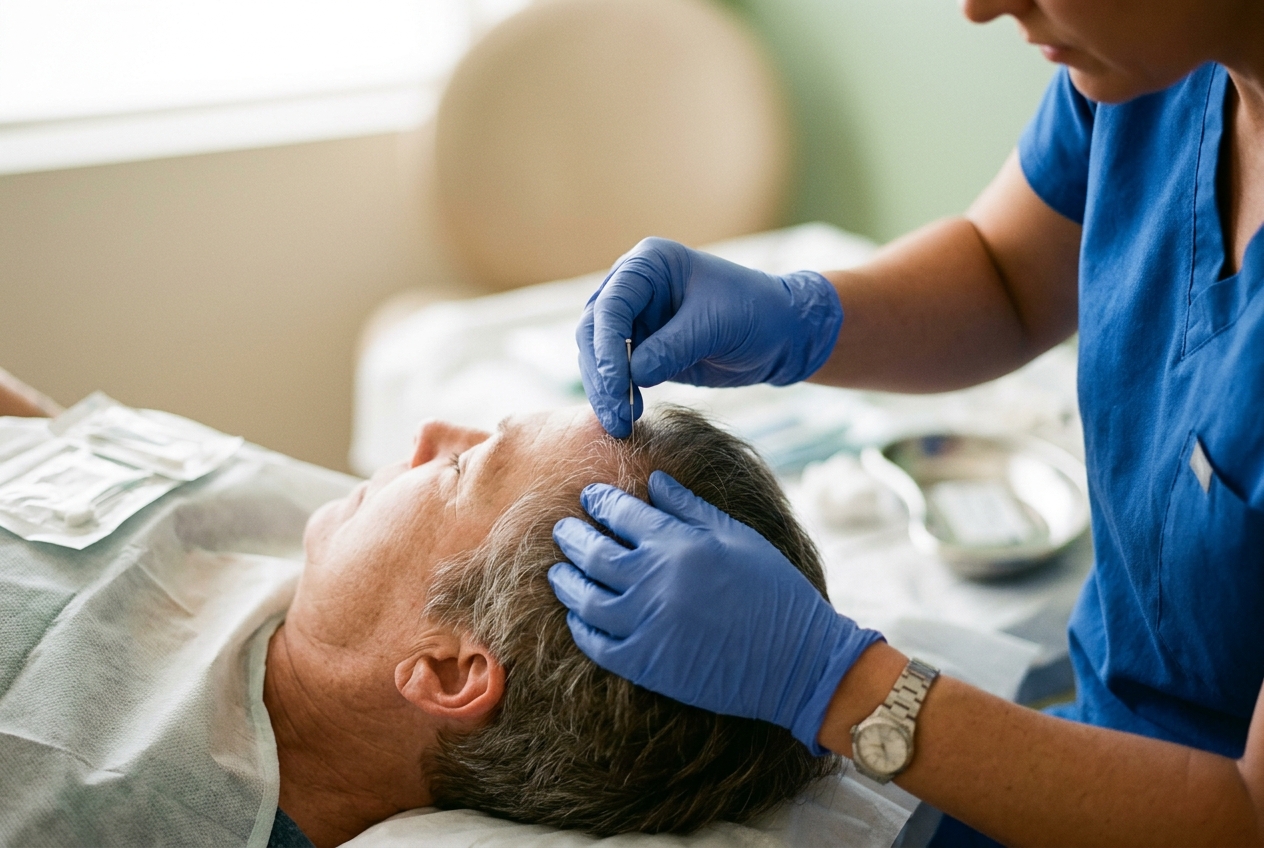
The clinician does not insert needles into the paralyzed limb alone. Instead, their fingers palpate the scalp along a calculated line traversing the coronal suture. With a swift, practiced flick of the wrist, a ultra-fine stainless steel filiform needle penetrates the epidermis at a 20-to-30-degree angle, gliding smoothly beneath the dense epicranial aponeurosis into the subaponeurotic loose connective tissue. The practitioner initiates rapid, high-frequency rotational micro-twirling—exceeding two hundred revolutions per minute. Within minutes, a sensation of localized radiant warmth spreads through the scalp, followed by subtle involuntary twitches in the patient’s paretic fingers.
This is the clinical reality of Tou Zhen Fa (头针法, Scalp Acupuncture). By transforming the human cranium into a dynamic neuro-energetic microsystem interface, scalp acupuncture operates simultaneously as an ancient energetic intersection and an advanced method of reflex-corticotopic neuromodulation.
2. Dual Energetic and Anatomical Foundations: What Tou Zhen Fa Represents
Scalp acupuncture represents a profound synthesis between classical channel theory and modern neuroanatomy. To understand its therapeutic power, one must analyze its dual foundations: the classical cranial meridian topology and the anatomical architecture of the cranium.
                  ===========================================
                  DU MAI (Governor Vessel) — Sea of Yang
                  ===========================================
                                       |
                  +--------------------+--------------------+
                  |                                         |
     Foot Taiyang Bladder                  Foot Shaoyang Gallbladder
   (Ascends forehead to vertex,           (Covers lateral/temporal cranium,
    branches to lateral occiput)           regulates pivot dynamics)
                  |                                         |
                  +--------------------+--------------------+
                                       |
                            Hand Shaoyang San Jiao
                          (Temporal-auricular network)
                                       |
                  ===========================================
                    THE SEA OF MARROW (Sui Hai / 髓海)
                    Cranial Subaponeurotic Microvasculature
                  ===========================================
Classical Meridian Dynamics: The Meeting of All Yang
Classical texts state unequivocally that "the head is the confluence of all Yang" (Tou Wei Zhu Yang Zhi Hui, 头为诸阳之会). Every primary Yang meridian directly ascends to or transverses the cranial vault: 1. The Governor Vessel (Du Mai, 督脉): Known as the "Sea of the Yang Channels," it ascends along the posterior midline over the skull, penetrating the vertex at Baihui (GV-20) to communicate directly with the brain (Nao, 脑). 2. Foot Taiyang Bladder Channel (Pang Guang Jing, 足太阳膀胱经): Originates at the inner canthus, traverses the forehead, ascends to the vertex, enters the cranial vault to communicate with the brain, and bifurcates down the occiput. 3. Foot Shaoyang Gallbladder Channel (Dan Jing, 足少阳胆经): Dominates the lateral, temporal, and parietal expanses of the cranium through an intricate zig-zag trajectory, governing lateral motor dynamics and sensory coordination. 4. Hand Shaoyang San Jiao Channel (San Jiao Jing, 手少阳三焦经): Curves around the auricle and disperses over the temporal and lateral parietal regions, governing fluid and metabolic circulation in the cranial fascia.
In classical physiology, the brain is categorized as one of the Six Extraordinary Organs (Qi Heng Zhi Fu), filled by the Sea of Marrow (Sui Hai). Chapter 33 of the Spiritual Pivot (Ling Shu) notes: "The brain is the Sea of Marrow. When the Sea of Marrow is abundant, the body is light, strong, and full of vitality; when it is deficient, there is dizziness, tinnitus, blurred vision, and motor languor."
The scalp is the physical and energetic boundary where the Sea of Marrow can be directly stimulated via its Yang conduits.
Anatomical Layering and Biomechanical Glide Planes
The cranium consists of five distinct soft-tissue layers, remembered anatomically by the mnemonic SCALP: - S: Skin (epidermis and dermis) - C: Connective tissue (dense subcutaneous superficial fascia, highly vascular and innervated) - A: Aponeurosis (Galea aponeurotica, a tough sheet of dense fibrous tissue) - L: Loose subaponeurotic connective tissue (the "danger zone," an avascular glide plane rich in interstitial fluid) - P: Pericranium (periosteum of the skull bones)
========================================================================
[SKIN]               Epidermis & Dermis (Rich nerve supply)
------------------------------------------------------------------------
[CONNECTIVE TISSUE]  Dense vascular network & fibrous septa
------------------------------------------------------------------------
[APONEUROSIS]        Galea Aponeurotica (Tough fibrous sheet)
------------------------------------------------------------------------
[LOOSE CONNECTIVE]   <--- NEEDLE TARGET PLANE (15°–30° insertion)
------------------------------------------------------------------------
[PERICRANIUM]        Periosteum over Calvarial Bone
========================================================================
Crucially, modern scalp acupuncture needles are never driven perpendicularly into calvarial bone. Instead, they are inserted at a shallow angle of 15° to 30°, piercing the skin and galea aponeurotica before advancing horizontally within the loose subaponeurotic layer.
This loose layer provides an uninterrupted, low-resistance biomechanical conduit for needle manipulation, allowing deep mechanical coupling with interstitial collagen fibrils without tearing the overlying cutaneous vascular plexuses or irritating the periosteum.
3. Primary Microsystem Mapping Models & Functional Cortical Zones
During the late 20th century, Chinese clinical researchers identified that stimulating precise cranial vectors elicited immediate neurofunctional changes corresponding directly to cortical homuncular maps. Three primary mapping paradigms emerged, culminating in international standardization.
                    === CRANIAL SOMATOTOPIC CORRELATIONS ===

ANTERIOR                                                POSTERIOR
          [Forehead]                                              [Occiput]
              |                                                       |
   Vasomotor Area ---- Chorea-Tremor Area ---- Motor Area ---- Sensory Area
  (1.5cm ant. to CT)   (1.5cm ant. to MA)     (Precentral)    (Postcentral)
                                                    |
                              +---------------------+---------------------+
                              |                     |                     |
                         Upper 1/5              Middle 2/5             Lower 2/5
                      (Leg & Trunk)             (Upper Limb)        (Face & Speech I)
Major Microsystem Mapping Paradigms
- Dr. Jiao Shunfa’s Model (焦顺发, 1971): The seminal somatotopic system, directly correlating functional cerebral cortical areas (precentral gyrus, postcentral gyrus, superior temporal gyrus) with scalp surface landmarks determined by cranial reference lines.
- Dr. Fang Yunsheng’s Model (方云鹏): A distinct regional microsystem utilizing micro-somatotopic holographic projections (the "Cranial Fetus" model), emphasizing focal sub-cranial energetic nodes across the frontal, parietal, and occipital bones.
- World Health Organization (WHO) International Standard Scalp Acupuncture (ISSA): Formulated in 1984 to standardize nomenclature into 14 distinct functional lines (Standard Lines MS 1 to MS 14), combining Jiao’s cortical projections with classical meridian pathways.
Detailed Comparative Matrix of Functional Cranial Zones
| Functional Zone | Surface Anatomical Landmark & Meridian Correlation | Underlying Cortical Projection | Primary Clinical Indications |
|---|---|---|---|
| Motor Area (Dingnie Qianxiexian, MS 6) | Line from Qianshencong (anterior EX-HN1) to Xuanli (GB-6). Divided into: • Upper 1/5: Vertex to trunk level • Middle 2/5: Middle cranial band • Lower 2/5: Inferior temporal border |
Precentral Gyrus (Primary Motor Cortex, Brodmann Area 4) | • Upper 1/5: Contralateral lower-limb paralysis, lumbar spasticity. • Middle 2/5: Contralateral upper-limb hemiplegia, hand motor deficit. • Lower 2/5: Central facial paralysis, motor aphasia, dysarthria, drooling. |
| Sensory Area (Dingnie Houxiexian, MS 7) | Line parallel to Motor Area, 1.5 cm posteriorly, from Baihui (GV-20) to Qubin (GB-7). | Postcentral Gyrus (Primary Somatosensory Cortex, Brodmann Areas 1, 2, 3) | Contralateral paresthesia, sensory loss, central neuropathic pain, phantom limb syndrome, somatic numbness. |
| Chorea-Tremor Control Area | Linear vector parallel to and 1.5 cm anterior to the Motor Area line. | Premotor Cortex and Subcortical Extrapyramidal Modulatory Circuits | Parkinsonian resting tremor, chorea, intention tremors, Sydenham chorea, muscular dystonias, cerebellar ataxia. |
| Vasomotor Area | Linear vector parallel to and 1.5 cm anterior to the Chorea-Tremor Area line. | Prefrontal Vasomotor Autonomic Cortical Projections | Essential hypertension, post-stroke cerebral edema, central vasomotor instability, cortical circulatory insufficiency. |
| Speech Zone I | Corresponds to the lower 2/5 of the Motor Area (Dingnie Qianxiexian lower segment). | Broca’s Motor Speech Area (Inferior Frontal Gyrus, Brodmann Areas 44/45) | Motor (expressive) aphasia, verbal apraxia, cortical anarthria, post-stroke expressive language deficit. |
| Speech Zone II | Vertical line 3 cm in length originating 2 cm posterior-inferior to the parietal tuber. | Angular & Supramarginal Gyri (Parietotemporal junction) | Receptive (Wernicke’s/Sensory) aphasia, nominal aphasia, central auditory comprehension deficit. |
| Speech Zone III | Horizontal line 4 cm in length originating from the midpoint of Speech Zone II, extending anteriorly. | Superior Temporal Gyrus / Auditory Association Cortex | Amnestic (anomic) aphasia, receptive semantic paraphasia, associative speech-processing deficits. |
4. Biomechanical Needle Dynamics and Neurobiological Mechanisms
The clinical efficacy of Tou Zhen Fa depends directly on precise biomechanical execution and resulting cellular and hemodynamic cascades.
       ===============================================================
       BIOMECHANICAL INSERTION & CELLULAR TRANSDUCTION CASCADE
       ===============================================================
       [1] Needle insertion into loose subaponeurotic connective tissue
                              |
       [2] Rapid Micro-Twirling (200+ RPM Spindle Manipulation)
                              |
       [3] Mechanical Shear Stress on Perivascular Fibroblasts
                              |
       [4] Nitric Oxide & Endothelial VEGF Release
                              |
       [5] Cerebral Hemodynamic Augmentation (rCBF via Collaterals)
                              |
       [6] Upregulation of [BDNF](https://en.wikipedia.org/wiki/Brain-derived_neurotrophic_factor) & Downregulation of Apoptosis
                              |
       [7] Enhanced Synaptogenesis & Corticomotor Remapping ([Neuroplasticity](https://en.wikipedia.org/wiki/Neuroplasticity))
       ===============================================================
Biomechanical Technique and Insertion Dynamics
- Needle Gauge and Selection: High-tensile stainless steel needles, typically 0.25 mm to 0.30 mm in diameter, with lengths of 25 mm to 40 mm (1.0 to 1.5 cun).
- Angle and Depth: The needle is positioned at a 15° to 30° angle relative to the scalp surface. Once the epidermis and galea aponeurotica are pierced, the needle angle is lowered to 5° to 10°, parallel to the calvarium, advancing 25 mm to 35 mm into the subaponeurotic loose connective tissue.
- High-Frequency Micro-Twirling: The needle shaft is rotated rapidly between the thumb and index finger at frequencies $\ge 200\text{ rotations/min}$. The practitioner performs bidirectional rotation (twirling back and forth through 360°) without lifting or thrusting (Ti Cha), which prevents wrapping the fibrous epicranial aponeurosis around the needle shaft while maintaining sustained mechanical shear stress on local mechanoreceptors.
- Modern Electroacupuncture Parameters: When replacing manual twirling with electrical stimulation, paired leads are attached along the functional line: - Waveform: Dense-disperse (alternating between 2 Hz and 100 Hz) or continuous low-frequency (2–10 Hz) for spasticity; dense high-frequency (100 Hz) for acute neuropathic pain and tremor suppression. - Intensity: Sub-maximal motor threshold, generating rhythmic fibrillations along the scalp line without painful periosteal discomfort. - Duration: 30 to 45 minutes per treatment session.
       +-------------------------------------------------------------+
       |             ELECTROACUPUNCTURE STIMULATION MODES            |
       +-------------------------------------------------------------+
       | Frequency: 2 Hz / 100 Hz (Dense-Disperse Wave)              |
       | Current:   0.5 – 2.5 mA (Patient-tolerated sensory threshold)|
       | Pulse:     0.2 ms square biphasic pulse                     |
       | Duration:  30–45 minutes continuous retention               |
       +-------------------------------------------------------------+
Cellular, Molecular, and Hemodynamic Mechanisms
Extensive contemporary laboratory investigations published across NCBI PubMed demonstrate that scalp acupuncture triggers distinct central neurorestorative pathways:
5. Concrete Clinical Protocols: Somato-Cranial Integration
   =========================================================================
                        CLINICAL PROTOCOL INTEGRATION
   =========================================================================

[DISEASE PATHOLOGY]              [SCALP FOCUS]              [SOMATIC CONCOMITANTS]
   Post-Stroke Hemiplegia   ------> Contralateral Motor Line -> LI-11, LI-4, ST-36, GB-34
   Expressive/Motor Aphasia ------> Speech Zone I (MS 6 Inf) -> CV-23, Tongli (HT-5)
   Parkinsonian Tremors     ------> Chorea-Tremor Area (MS 14) -> Taichong (LR-3), KI-3
   TBI & Central Vertigo    ------> Sensory / Balance Area   -> GV-20, Taiyang, GB-20
   =========================================================================
Protocol 1: Post-Stroke Ischemic Hemiplegia
- Scalp Lines (Contralateral to Hemiparesis):
- Motor Area (Dingnie Qianxiexian, MS 6): Upper 1/5 (lower limb) and Middle 2/5 (upper limb).
- Sensory Area (Dingnie Houxiexian, MS 7): Upper 1/5 and Middle 2/5 (if sensory deficits coexist).
- Needling Dynamics: Rapid micro-twirling at 200 RPM for 2 minutes every 10 minutes, or dense-disperse electroacupuncture (2/100 Hz) for 40 minutes.
- Somatic Distal Points:
- Upper limb: Quchi (LI-11), Waiguan (TE-5), Hegu (LI-4).
- Lower limb: Zusanli (ST-36), Yanglingquan (GB-34), Sanyinjiao (SP-6), Taichong (LR-3).
- Course & Frequency: Daily sessions for the first 14 days, followed by 3 sessions weekly for 8 weeks.
Protocol 2: Expressive (Broca's) and Receptive (Wernicke's) Aphasia
- Scalp Lines:
- Expressive (Motor) Aphasia: Speech Zone I (lower 2/5 of Motor Area, MS 6 bilateral or dominant left hemisphere) and Motor Area Lower 2/5.
- Receptive (Sensory) Aphasia: Speech Zone II (posterior-inferior parietal) and Speech Zone III (temporal auditory projection).
- Needling Dynamics: Bilateral horizontal transfixion; 200+ RPM twirling combined with active patient phonation exercises during needle retention.
- Somatic Distal Points: Lianquan (CV-23), Tongli (HT-5), Zhaohai (KI-6), Fengchi (GB-20).
- Course: 5 consecutive days per week, 30-minute retention, for 6–12 weeks.
Protocol 3: Parkinsonian Resting Tremor and Extrapyramidal Dysfunction
- Scalp Lines:
- Chorea-Tremor Control Area (bilateral, 1.5 cm anterior to Motor Line).
- Balance Area (Foot Motor Sensory Area, MS 8) for postural instability.
- Needling Dynamics: Continuous high-frequency electro-stimulation (100 Hz) to inhibit hyperactive basal ganglia oscillatory loops.
- Somatic Distal Points: Fengchi (GB-20), Hegu (LI-4) paired with Taichong (LR-3) (The Four Gates / Si Guan), Shenshu (BL-23), Taixi (KI-3).
- Course: 3 sessions weekly; evaluated in 10-session courses with 5-day intervals between courses.
6. Mind-Body Practices, Acupressure & Lifestyle Rehabilitation
Cranial neuro-energetic regulation is not confined to clinical needle insertion; patients and practitioners can stimulate the cranial Yang channels through targeted self-care, acupressure, and qigong practices.
       ===============================================================
       CRANIAL REPAIR QIGONG SEQUENCE: "BATHING THE JADE CRANIUM"
       ===============================================================
       1. Alignment: Wu Ji stance, tongue at roof of mouth, spine elongated.
       2. Breath Phase: 4-second nasal inhalation drawing Qi up Du Mai to vertex.
       3. Dynamic Movement: Palms sweep along gallbladder channels (GB-20 to Taiyang).
       4. Discharge Phase: Exhale 6 seconds through mouth, settling Qi into Lower Dantian.
       5. Duration: 12 slow cycles (approx. 5 minutes total).
       ===============================================================
Step-by-Step Movement Practice: Cranial Awakening (Xǐ Nǎo Qì Gōng, 洗脑气功)
- Starting Posture & Setup: Stand in Wu Ji (feet shoulder-width apart, knees slightly softened, spine lengthened, tip of the tongue resting against the hard palate behind the upper incisors).
- Breath Timing & Sweep: - Inhale (4 seconds): Slowly raise both hands up the front midline, visualizing clear Yang Qi ascending the Governor Vessel (Du Mai) from the base of the spine directly into the vertex (Baihui, GV-20). - Retain & Sweep (2 seconds): Cup the hands slightly over the crown without touching the skin. Rub the palms together vigorously to generate warmth, then lightly comb the fingertips from the hairline, over the vertex, down the Gallbladder channel pathways around the ears, down to Fengchi (GB-20) at the base of the skull. - Exhale (6 seconds): Push the palms down toward the earth, visualizing turbid Qi and stasis draining down through the Yongquan (KI-1) points on the soles of the feet.
- Repetitions: Complete 12 continuous breath cycles.
- Sensation to Monitor: A noticeable sensation of lightness and tingling clarity at the vertex, accompanied by release of tension at the suboccipital triangle, signaling the clearing of cranial Yang stagnation.
Key Acupressure Points for Daily Cranial Regulation
                           [GV-20 Baihui]
                           (Crown Vertex)
                                 |
              [EX-HN1 Sishencong] + [EX-HN1 Sishencong]
                    (1 cun anterior, posterior, lateral)
                                 |
                     [GB-20 Fengchi] (Suboccipital base)
- Baihui (GV-20, 百会) — "Hundred Convergences": - Location: On the midsagittal line of the head, at the intersection of the midline and the line connecting the apexes of both auricles. - Technique: Apply firm, sustained circular pressure with the thumb or middle finger for 2–3 minutes while taking slow, deep diaphragmatic breaths. - Clinical Utility: Clears the sensory orifices, lifts sagging Yang Qi, relieves mental fatigue, brain fog, tension headaches, and dizziness.
- Sishencong (EX-HN1, 四神聪) — "Four Alert Spirits": - Location: A group of four points situated 1.0 cun anterior, posterior, and bilateral to Baihui (GV-20). - Technique: Use all four fingertips of one hand or both hands to press simultaneously in rhythmic, pulsing circular motions for 2 minutes. - Clinical Utility: Enhances cerebral perfusion, calms the spirit (Shen), relieves insomnia, improves cognitive recall, and stabilizes mood.
- Fengchi (GB-20, 风池) — "Wind Pool": - Location: In the depression between the upper portion of the sternocleidomastoid muscle and the trapezius, level with the inferior border of the occipital bone. - Technique: Place both thumbs into the bilateral depressions, pressing upward and inward toward the opposite eye with firm, steady pressure for 2 minutes. - Clinical Utility: Dispels internal and external pathogenic wind, clears cerebral vascular spasm, relieves neck rigidity, hypertension, and post-concussive headaches.
Dietary & Lifestyle Foundations for the Sea of Marrow
To nourish the physical substrate of the Sea of Marrow (Sui Hai), dietary strategies prioritize Kidney-Jing nourishing foods that modern nutritional science identifies as rich in essential fatty acids, polyphenols, and trace minerals: - Foods to Emphasize: Black sesame seeds (Hei Zhi Ma), walnuts (Hu Tao Ren—noted in classical doctrine of signatures for their cerebral resemblance), bone broths rich in collagen and glycine, wild-caught cold-water fish (DHA/EPA omega-3 fatty acids), blueberries, and dark leafy brassicas. - Substances to Minimize: Refined pro-inflammatory sugars, excessive saturated fats, and alcohol, all of which generate internal "Damp-Heat" and phlegm stasis (Tan Zhuo), obstructing the microvasculature of the cranial channels.
7. Today’s Takeaway: Five-Minute Cranial Activation
To immediately activate cranial circulation and tonify the Sea of Marrow without any clinical equipment, perform the Five-Point Cranial Sweep:
Sit upright with your spine unsupported and eyes gently closed. Vigorously rub the palms of your hands together for fifteen seconds until friction generates substantial warmth. Place your fingertips at the anterior hairline and, with firm, sweeping pressure, comb your fingers back over the crown of your head (Baihui), down the lateral temporal regions, and firmly cup your thumbs into the suboccipital hollows at the base of the skull (Fengchi). Hold firm upward pressure at the base of your skull for five full diaphragmatic breaths, exhaling slowly through an open jaw. Perform this sequence five times daily to instantly discharge neuro-fascial tension, stimulate cranial Yang flow, and sharpen mental clarity.
Authoritative References & Scientific Reading
- World Health Organization: A Proposed Standard International Acupuncture Nomenclature
- NCBI PubMed Central: Neurobiological Mechanisms of Scalp Acupuncture in Neurological Disorders
- Wikipedia: Brain-Derived Neurotrophic Factor (BDNF) Physiology
- Wikipedia: Neuroplasticity & Cortical Remapping
- Wikipedia: Galea Aponeurotica and Cranial Anatomy