Ryodoraku Meridian Diagnostics: Navigating Electro-Conductive Channel Topography, Autonomic Electro-Permeability, and Precision Acupressure Protocols
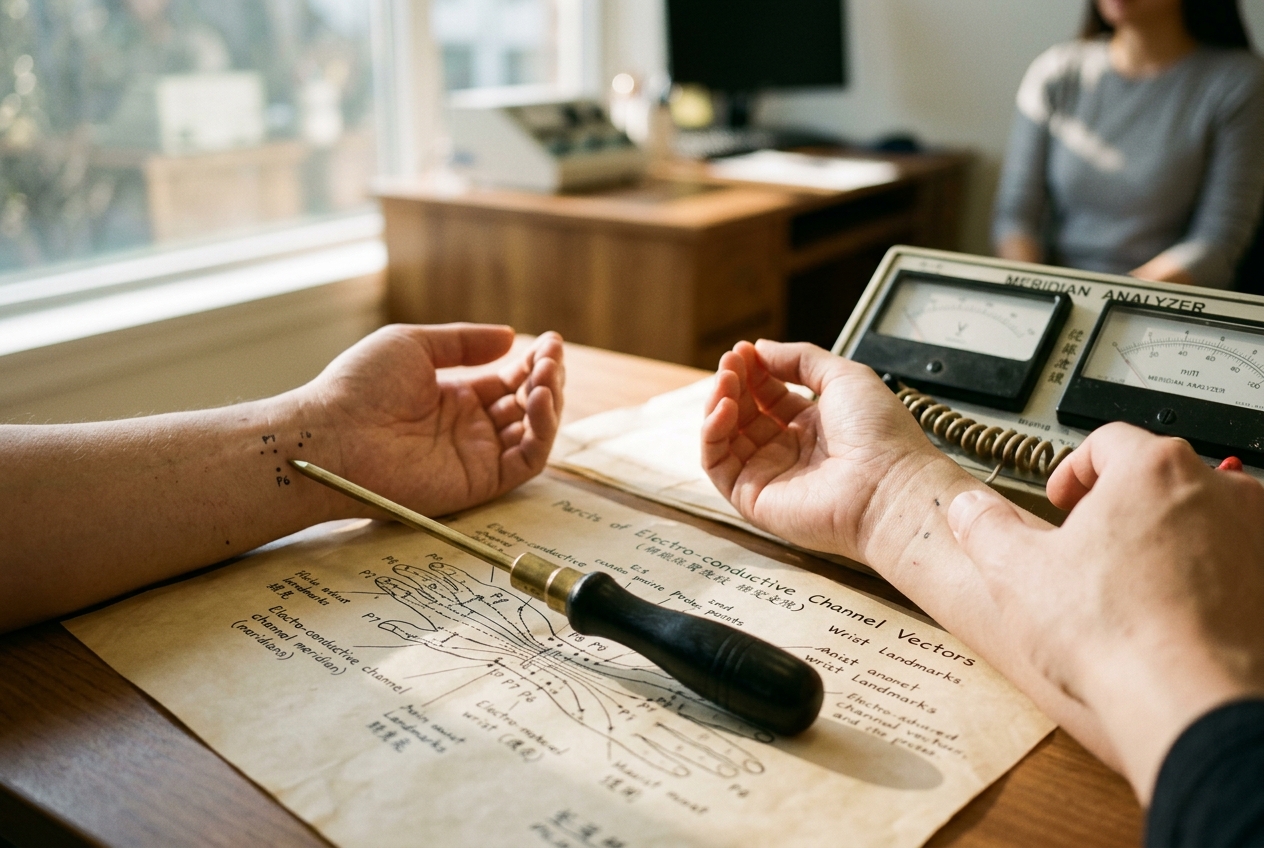
If you have ever spent an evening oscillating between physical exhaustion and a racing, hyper-vigilant mind—your neck stiff, your breathing shallow, your digestion stalled in an uncomfortable bloat—you have experienced the silent distress of autonomic dysregulation. In our contemporary clinical landscape, millions live trapped in a state of chronic sympathetic nervous system overdrive. Conventional diagnostic tools frequently fail to capture these functional, sub-clinical imbalances; standard blood panels return within normal limits, yet the patient feels palpably depleted, irritable, and physically unaligned.
Traditional East Asian Medicine has long understood this state as a disturbance in the smooth flow of systemic Qi and Xue (blood) throughout the channel network. Yet for decades, modern science struggled to bridge the conceptual chasm between these ancient energetic riverbeds and Western biophysical models. The bridge arrived in 1950 at Kyoto University, spearheaded by the physician and biophysicist Dr. Yoshio Nakatani.
Dr. Nakatani discovered that the body's functional health is reflected in an objective, quantifiable electrical landscape: lines of low electrical resistance and high conductance that trace the classical primary meridian pathways with uncanny anatomical precision. By learning to measure, interpret, and manually stimulate this bioelectric network—a clinical methodology known as Ryodoraku—we gain an extraordinary therapeutic tool to recalibrate autonomic equilibrium, clear visceral stagnation, and restore somatic homeostasis.
The Meridian Path: A Biophysical Journey Through the Body
To understand Ryodoraku, one must first dismantle the misconception that acupuncture meridians are esoteric, disembodied pathways. In 1950, while researching the electrophysiology of patients suffering from acute renal disease, Dr. Yoshio Nakatani noticed something remarkable using a simple direct-current (DC) microammeter: specific patches of skin demonstrated a dramatic drop in electrical impedance compared to surrounding tissue. When he systematically mapped these electro-reactive points—which he designated Ryodoten (literally "electro-conductive points")—he observed that they linked together in continuous, linear tracks of heightened conductance, termed Ryodoraku ("good electro-conductive pathways").
To Nakatani’s astonishment, these conductive tracks demonstrated an over 90% geographical concordance with the classical twelve primary meridians codified millennia ago in texts such as the Huangdi Neijing.
The biophysical mechanisms underpinning this phenomenon are grounded in the neuroanatomy of the autonomic nervous system and the physiology of electrodermal activity and galvanic skin resistance. The human epidermis, specifically the cornified outer layer (stratum corneum), acts as a high-resistance electrical capacitor. However, this resistance is dynamic, regulated by the density and secretory activity of sweat glands and the underlying microvascular beds, both of which are densely innervated by unmyelinated sympathetic C-fibers via sudomotor axon reflexes.
When internal viscera experience physiological strain, ischemia, or inflammatory irritation, autonomic afferent signals travel to the spinal cord, triggering localized sympathetic efferent discharge at corresponding dermatomes. This cholinergic sympathetic excitation increases ionic fluid flow within the micro-ducts of the eccrine glands, creating microscopic, low-resistance ionic salt bridges straight through the high-resistance stratum corneum.
Furthermore, contemporary biophysical research indexed across the National Center for Biotechnology Information (NCBI) confirms that these conductive pathways correspond to deep fascial cleavage planes enriched with hyaluronic acid, collagenous liquid-crystal arrays, and gap junctions that facilitate rapid proton and ion conduction across interstitial planes, as detailed in extensive studies on the bioelectrical impedance of acupuncture meridians.
Rather than visualizing an abstract network of mystical conduits, we can trace these conductive pathways using visible, palpable anatomical landmarks across our own limbs:
- The Upper Limb Yin Channels (Hand Ryodoraku H1, H2, H3): Begin on the chest, glide across the fleshy front of the shoulder, travel down the soft, sun-protected inner side of your biceps, cross the tender crease of the inner elbow, and track between the prominent flexor tendons of your forearm into the palm, terminating at the thumb, middle finger, and pinky. These tracks govern the respiratory, cardiovascular, and autonomic stress-regulation networks.
- The Upper Limb Yang Channels (Hand Ryodoraku H4, H5, H6): Trace the sun-exposed outer boundary of the arm. They run from the index finger, ring finger, and outer pinky along the back of the hand, climbing the outer surface of the forearm between the two forearm bones (radius and ulna), skimming past the bony point of the elbow, ascending the rear deltoid, and traversing the upper trapezius ridge at the base of the neck. These channels manage systemic digestion, fascial tension, and immune defense.
- The Lower Limb Channels (Foot Ryodoraku F1 through F6): Form an expansive bi-directional matrix. The inner channels sweep upward from the sole and medial arch of the foot, wrapping behind the inner ankle bone, ascending the flat inner edge of the shinbone, and rising along the inner thigh into the lower abdomen. Conversely, the outer pathways run down the muscular belly of the outer shin and front of the leg, crossing the anterior ankle and terminating in the toes. These pathways directly regulate visceral clearance, fluid homeostasis, and hepatic metabolism.
The Standardized 24 Representative Measurement Points (RMPs)
To convert this electrical topography into a standardized clinical diagnostic modality, Dr. Nakatani identified 24 specific cutaneous loci—six on each hand and six on each foot, assessed bilaterally—termed the Representative Measurement Points (RMPs). These points, primarily situated at classical Yuan-Source and distal energetic junctions, act as stable electrical transfer terminals that reflect the aggregate bioelectric status of their corresponding organ-meridian circuits.
=========================================================================================
          THE 24 STANDARDIZED RYODORAKU REPRESENTATIVE MEASUREMENT POINTS (RMPs)
=========================================================================================
 CHANNEL CODE    ANATOMICAL MERIDIAN     CLASSICAL POINT     PRIMARY DERMATOMAL LOCUS
-----------------------------------------------------------------------------------------
 H1 (Bilateral)  Lung Channel            LU9 (Taiyuan)       Radial wrist crease, radial artery
 H2 (Bilateral)  Pericardium Channel     PC7 (Daling)        Midline wrist crease, between flexors
 H3 (Bilateral)  Heart Channel           HT7 (Shenmen)       Ulnar wrist crease, pisiform border
 H4 (Bilateral)  Small Intestine Channel SI4 (Wangu)         Ulnar border of hand, 5th metacarpal
 H5 (Bilateral)  Triple Energizer (TE)   TE4 (Yangchi)       Dorsal wrist crease, extensor notch
 H6 (Bilateral)  Large Intestine Channel LI5 (Yangxi)        Anatomical snuffbox, radial wrist
-----------------------------------------------------------------------------------------
 F1 (Bilateral)  Spleen Channel          SP3 (Taibai)        Medial foot, 1st metatarsal base
 F2 (Bilateral)  Liver Channel           LR3 (Taichong)      Dorsal foot, 1st-2nd metatarsal valley
 F3 (Bilateral)  Kidney Channel          KI3 (Taixi)         Medial ankle, depression near Achilles
 F4 (Bilateral)  Urinary Bladder Channel BL65 (Shugu)        Lateral foot, 5th metatarsal head
 F5 (Bilateral)  Gallbladder Channel     GB40 (Qiuxu)        Anteroinferior to lateral malleolus
 F6 (Bilateral)  Stomach Channel         ST42 (Chongyang)    Highest point of dorsal foot arch
=========================================================================================
In standard clinical examination, an examiner applies a spring-loaded, wet-cotton testing probe delivering a constant direct-current micro-voltage (typically 12V DC or 21V DC regulated, limited to 200 microamperes) to each of the 24 RMPs. The patient holds an inert brass grounding cylinder in the contralateral hand. As the probe touches each point, the electrical current penetrates the stratum corneum, registering an objective microamperage ($\mu\text{A}$) value that quantifies the local electrodermal conductance.
Clinical Diagnostic Mathematics: The Ryodoraku Chart
The core intellectual breakthrough of Ryodoraku diagnostics lies in its mathematical normalization of systemic electrical measurements. The human body’s overall electrical conductivity varies significantly based on atmospheric humidity, core hydration, ambient temperature, skin moisture, and acute emotional stress. Therefore, an absolute reading of $45\,\mu\text{A}$ may signify severe deficiency in an environment of high humidity, yet indicate profound excess on a cold, arid winter day.
To establish clinical objectivity, Nakatani developed the Ryodoraku Charting Algorithm:
- Collection of Microamperage Values: The 24 individual RMP measurements ($I_1, I_2, \dots, I_{24}$) are recorded in microamperes ($\mu\text{A}$).
- Calculation of the Systemic Baseline Mean: The arithmetic mean current ($\bar{I}$) across all 24 channels is calculated: $$\bar{I} = \frac{1}{24} \sum_{i=1}^{24} I_i$$
-
Construction of the Physiological Normal Band: On the standardized semi-logarithmic Ryodoraku graph, the calculated baseline $\bar{I}$ is plotted as a horizontal central axis. A physiological tolerance corridor (the "Physiological Normal Band") is delineated by drawing two parallel horizontal lines at an allowable physiological deviation above and below this mean.
In Nakatani's clinical metric, this band corresponds to a vertical deviation of $\pm 0.5\text{ cm}$ on the standardized graph paper, which equates to an allowable physiological variance corridor of approximately $\pm 10\text{--}14\,\mu\text{A}$ around the mean.
Diagnostic Interpretation: Jitsu and Kyo
The physiological status of any meridian is defined strictly by its spatial relationship to this dynamic normal band:
- Jitsu (Excess / Shi): Any channel whose measured electrical current soars above the upper boundary of the physiological band indicates localized electrodermal hyper-permeability. Pathophysiologically, this corresponds to localized sympathetic hyperactivity, acute myofascial spasm, inflammatory exudation, or severe visceral hyperfunction.
- Kyo (Deficiency / Xu): Any channel whose electrical conductance drops below the lower boundary of the normal band denotes abnormal electrodermal resistance. This reflects neurovegetative exhaustion, impaired tissue microcirculation, structural hypofunction, or chronic organ depletion.
- Autonomic Left-Right Asymmetry (Ryodoraku Left/Right Disparity): When a single bilateral pair exhibits a disparity exceeding $15\text{--}20\,\mu\text{A}$ between the left and right sides (e.g., Left H6 = $75\,\mu\text{A}$, Right H6 = $35\,\mu\text{A}$), it signals severe unilateral musculo-skeletal compensation, structural nerve entrapment, or lateralized visceral pathology.
+-------------------------------------------------------------------------------------------+
|                              RYODORAKU CLINICAL STATUS MATRIX                             |
+-------------------+-----------------------------------+-----------------------------------+
| CLINICAL METRIC   | KYO (DEFICIENCY / XU)             | JITSU (EXCESS / SHI)              |
+-------------------+-----------------------------------+-----------------------------------+
| Bioelectric State | Markedly High Electrical Skin     | Markedly Low Electrical Skin      |
|                   | Resistance (Conductance < Lower)  | Resistance (Conductance > Upper)  |
+-------------------+-----------------------------------+-----------------------------------+
| Autonomic Profile | Parasympathetic predominance or   | Sympathetic segmental hyper-      |
|                   | local neurovascular exhaustion    | excitation; active sudomotor reflex|
+-------------------+-----------------------------------+-----------------------------------+
| Physical Symptom  | Cold extremities, dull aching,    | Sharp pain, active inflammation,  |
| Presentation      | tissue flaccidity, chronic fatigue| spasms, heat sensation, tightness |
+-------------------+-----------------------------------+-----------------------------------+
| Therapeutic Aim   | Tonification: Gentle, sustained   | Sedation: Strong, dispersing      |
|                   | pressure; rhythmic, warming inputs| friction; deep static compression |
+-------------------+-----------------------------------+-----------------------------------+
3 Key Points You Can Press Right Now: Hands-On Bioelectric Calibration
You do not need an electronic microammeter to interact with this bioelectric network. Highly conductive Ryodoten points are richly supplied with mechanoreceptors (Merkel discs, Meissner's corpuscles, and Pacinian corpuscles) that communicate directly with the central nervous system. When compressed, these points emit a distinct, palpable somatic sensation—a combination of dull tenderness, subtle electric tingling, and spreading warmth known in classical acupuncture as Deqi.
1. The Systemic Bioelectric Clearer: Large Intestine 4 (Hegu / Hand Ryodoraku H6)
- Location Using Body Landmarks: Open your hand with your palm facing downward and bring your thumb and index finger close together. Look for the small mound of muscle that bulges outward between their bases. Now relax the hand. Place your opposite thumb into the webbing on the back of the hand, resting it directly against the midpoint of the second metacarpal bone (the bone supporting the index finger).
- What You Will Feel: Upon firm pressure, you will encounter a sharp, spreading ache that often feels like a gentle electric current radiating across the back of the hand toward the index finger.
- How to Press: Apply firm, angled pressure directed inward toward the bone of the index finger. Hold continuously while breathing deeply through the nose for 90 to 120 seconds. Use small, circular kneading motions without sliding your thumb over the surface of the skin.
- Everyday Indications: Highly effective for extinguishing tension headaches, facial and jaw clenching (bruxism), acute sinus pressure, and downregulating acute mental stress.
2. The Autonomic and Visceral Modulator: Pericardium 6 (Neiguan / Hand Ryodoraku H2)
- Location Using Body Landmarks: Turn your hand so your palm is facing toward you. Locate the main crease running across the inside of your wrist. Lay the width of your index, middle, and ring fingers across your wrist, starting just below that crease. The point sits directly beneath where the edge of your index finger lands, nestled squarely between the two prominent, cord-like tendons that tighten when you make a fist and flex your wrist inward (flexor carpi radialis and palmaris longus).
- What You Will Feel: A distinct, spreading fullness, dull pressure, or light tingling sensation that travels upward along the midline of the forearm.
- How to Press: Use the tip of your thumb to exert direct, vertical downward pressure between the two tendons. Maintain steady, firm compression without wavering for 2 minutes per arm.
- Everyday Indications: Clinically documented through World Health Organization Traditional Medicine Strategy guidelines for rapidly alleviating nausea, motion sickness, stress-induced palpitations, thoracic tightness, and emotional anxiety.
3. The Lower-Body Homeostatic Node: Spleen 6 (Sanyinjiao / Foot Ryodoraku F1)
- Location Using Body Landmarks: Sit in a comfortable cross-legged position. Find the most prominent bony point on the inside of your ankle (the medial malleolus). Lay four finger-widths vertically upward along the inner side of your lower leg, starting from the apex of that ankle bone. The point is located immediately behind the back edge of the shinbone (the tibia).
- What You Will Feel: This is often one of the most electro-reactive and tender spots on the lower extremity; expect a noticeable, bruised ache that quickly softens into an expansive warming sensation.
- How to Press: Hook the pad of your thumb or index finger behind the bone, applying firm pressure angled slightly forward toward the back surface of the tibia. Maintain this compression for 1 to 3 minutes while maintaining slow diaphragmatic breaths.
- Everyday Indications: Essential for counteracting lower abdominal bloating, digestive stagnation, menstrual cramping, cold feet due to peripheral vasoconstriction, and restless evening insomnia.
A Point Combination for One Common Issue: The Nocturnal De-Stressing & Gastrointestinal Homeostasis Protocol
When a demanding workday ends, our physiology often refuses to downshift. Cortisol levels remain elevated, the stomach feels tight and bloated, and the mind loops through unresolved tasks. The following sequential acupressure protocol activates a targeted Ryodoraku circuit designed to quiet sympathetic hyper-arousal, stimulate vagal efferent tone, and promote restorative sleep.
+-----------------------------------------------------------------------------------------+
|                  THE 10-MINUTE NOCTURNAL AUTONOMIC RESET PROTOCOL                       |
|                                                                                         |
|   Step 1: Grounding & Digestion  -->  Step 2: Vagal Cardiorespiratory  --> Step 3: CNS  |
|            [ST36 / F6]                      [PC6 / H2]                   [HT7 / H3]     |
|          (3 mins / Outer Shin)            (2 mins / Inner Wrist)       (2 mins / Ulnar) |
+-----------------------------------------------------------------------------------------+
Step-by-Step Clinical Sequence
- Posture: Lie flat on your back on a firm surface or recline comfortably in bed with your knees supported by a small pillow. Inhale deeply through your nose for a 4-second count, hold for 2 seconds, and exhale smoothly through your mouth for 6 seconds.
- Step 1: Ground the Kinetic Axis at Stomach 36 (Zusanli / Foot Ryodoraku F6)
- Location: Place your hand over your kneecap; four finger-widths below the lower edge of the patella, one finger-width outside the sharp crest of the shinbone, in the soft muscular groove of the tibialis anterior.
- Action: Apply firm, downward circular friction using your thumb knuckle for 3 minutes per leg.
- Physiological Effect: Stimulates parasympathetic gastrointestinal motility, enhances splanchnic blood perfusion, and grounds somatic tension away from the cranium.
- Step 2: Induce Vagal Entrainment at Pericardium 6 (Neiguan / Hand Ryodoraku H2)
- Location: Two thumb-widths above the inner wrist crease between the central flexor tendons.
- Action: Hold static, deep, continuous compression for 2 minutes per arm, synchronizing the pressure with your long, 6-second exhalations.
- Physiological Effect: Downregulates adrenergic heart rate acceleration and relaxes the diaphragm.
- Step 3: Quiet Cortical Excitability at Heart 7 (Shenmen / Hand Ryodoraku H3)
- Location: On the inner wrist crease, right along the outer border, tucked into the small hollow immediately on the inside of the hard pisiform bone.
- Action: Apply gentle, rhythmic, pulsing pressure with the tip of your thumbnail or index finger for 2 minutes on each wrist.
- Physiological Effect: Quiets hyperactive thalamocortical loops, soothing emotional distress and inviting natural drowsiness.
Safety, Sense & Physiological Boundaries
Acupressure and electro-dermal therapies are non-invasive, safe, and effective modalities, yet they require clear clinical discernment:
- Calibrating Therapeutic Pressure: "Firm pressure" should never cross into agonizing or sharp pain. The optimal sensations to seek are Deqi signs: a deep, dull ache, pleasant distension, or spreading warmth. If you notice yourself tensing your jaw or holding your breath in response to point compression, you have exceeded the therapeutic threshold and are triggering a protective sympathetic reflex rather than inducing parasympathetic relaxation.
- Local Cutaneous Integrity: Never apply firm acupressure over broken skin, open wounds, local rashes, active infections, severe varicose veins, phlebitic lesions, or areas of acute traumatic bone injury.
- Clinical Red Flags: While bioelectric acupressure excels at resolving functional imbalances, it is not a replacement for emergency medicine. Sudden severe chest pain, radiating left-arm discomfort, unremitting neurological deficits, acute abdominal rigidity, or sudden visual disturbances require immediate emergency medical evaluation.
Today’s Takeaway: The 120-Second Sympathovagal Reset
You do not need an hour of free time to reset a dysregulated nervous system. Before moving on to your next task, take two minutes right now to experience the electro-reactive reality of your own body:
+-----------------------------------------------------------------------------------------+
|                          YOUR 2-MINUTE BIOELECTRIC RESET                                |
|                                                                                         |
|  1. Find your LEFT Neiguan (PC6): 2 finger-widths above inner wrist, between tendons.   |
|  2. Drop your shoulders away from your ears; exhale completely.                         |
|  3. Apply firm, steady downward thumb pressure.                                         |
|  4. Maintain this steady hold for 60 seconds while breathing in for 4s, out for 6s.     |
|  5. Switch to your RIGHT wrist and repeat for 60 seconds.                               |
+-----------------------------------------------------------------------------------------+
As the spreading, dull warmth radiates through your forearm, notice how your breathing deepens, your pulse calms, and your jaw naturally releases its tension. In just one hundred and twenty seconds, you have translated Nakatani's clinical biophysics into immediate somatic balance.