Quchi Cavity Pool at the Crook: Lateral Cubital Fascial Decompression, Radial Recurrent Vasculature Perfusion, and Upper-Limb Kinetic Vectoring in Classical Neigong
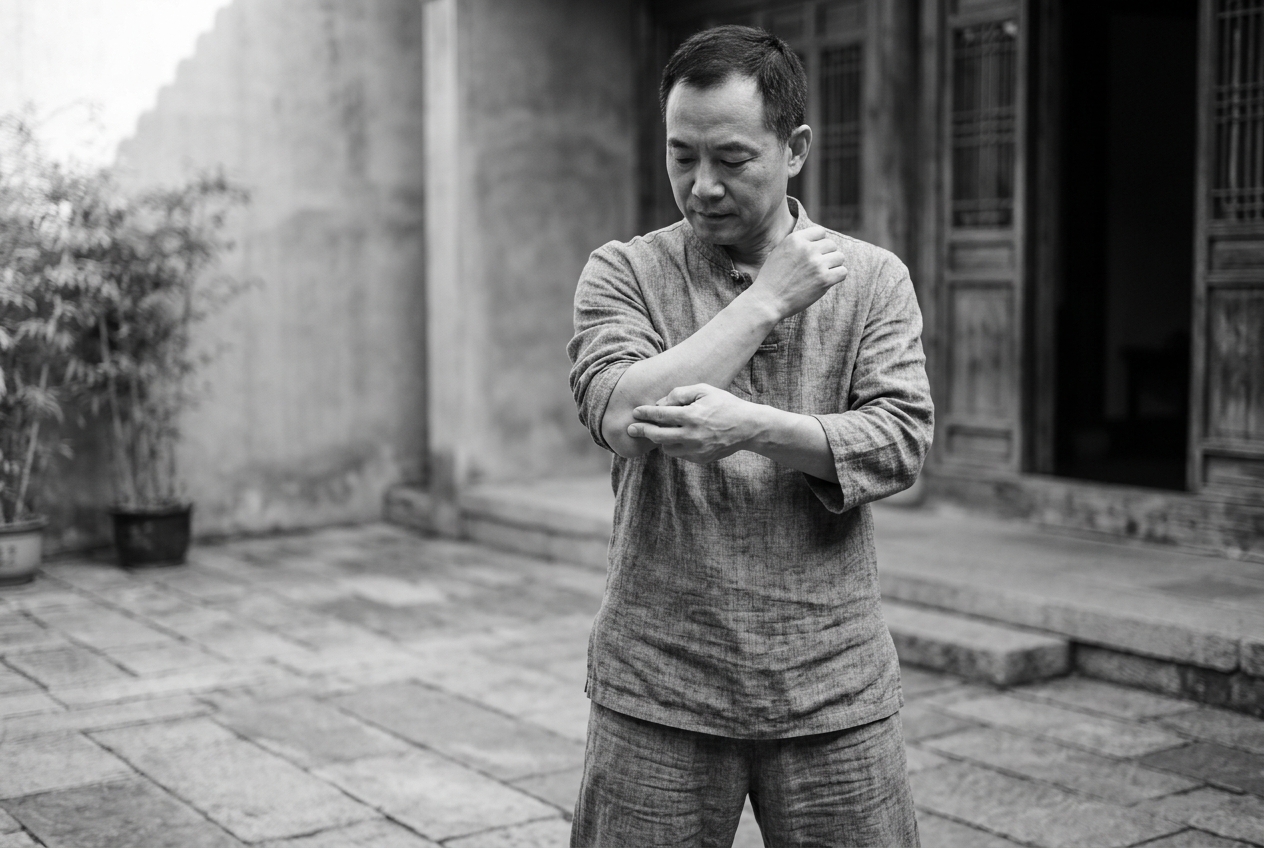
In classical somatic traditions, this process is known as opening the Quchi cavity—the eleventh point along the Hand Yangming Large Intestine meridian. Once the physical experience of unclenching the joint is established, traditional theory illuminates why it feels so restorative: Quchi is classified as the "He-Sea" (uniting) and "Earth" point of its meridian, an energetic reservoir where bodily heat is naturally dispelled and systemic vitality is balanced. By consciously opening this pool, you bridge the dynamic dexterity of the hand—anchored at the Hegu point (LI4) in the web of the thumb—directly into the stability of the shoulder girdle and neck, anchored at Jianjing (GB21). The result is an integrated, buoyant upper body that moves with unified, spring-like elasticity rather than disconnected muscular effort.
       [ Jianjing (GB21) - Shoulder Girdle ]
                       |
                       |  (Deep Fascial Track / Brachial Chain)
                       v
         === [ Quchi (LI11) - The Elastic Pivot ] ===
         \      (Radial Head / Recurrent Loop)     /
          \                                       /
           v                                     v
   [ Hegu (LI4) - Distal Vector ]    [ Palm Center (PC8 / Laogong) ]
Step-by-Step Practice Guide: Mobilization, Standing Posture, and Dynamic Spiral
Engaging the Quchi cavity requires progressive somatic calibration, moving from tactile localization to static postural integration and finally to dynamic multidirectional transmission. Follow these structured stages without forcing or straining the connective tissues.
1. Precision Anatomical Localization and Tactile Awakening
Begin in a comfortable seated or standing posture. Flex your elbow to a ninety-degree angle with the palm facing medially toward your chest. Locate the outer end of the transverse cubital crease. Place your thumb or middle finger in the depression between the lateral epicondyle of the humerus and the prominent belly of the brachioradialis and extensor carpi radialis longus muscles, directly over the radiohumeral joint line.
Apply slow, sustained circular pressure with an intention directed slightly medially toward the coronoid process. Inhale for four counts, visualizing breath filling the joint capsule. Exhale for six counts, allowing the muscular fibers beneath your finger to soften and yield. Perform this tactile priming for one to two minutes on both arms until a warm, spacious sensation emerges within the cubital fossa.
2. Static Integration in Zhan Zhuang (Standing Like a Tree)
- Base Alignment: Stand with your feet parallel, hip-to-shoulder-width apart, knees unlocked and gently buoyant. Allow your tailbone to drop as if resting on a high stool, lengthening your lumbar spine while maintaining the crown of your head lifted toward the sky (Xu Ling Ding Jin).
- Embracing the Sphere: Slowly float both arms upward to chest height as if holding a wide, buoyant paper lantern or sphere. The palms face inward toward your chest, wrists relaxed and neutral, with the centers of the palms (Laogong, PC8) softly hollowed.
- Suspending the Elbows (Chen Jian Zhui Zhou): Rather than holding the arms up through muscular tension in the upper trapezius, drop the shoulders down and let the tips of your elbows sink toward the floor. Simultaneously, project the lateral crook of each elbow—the Quchi region—outward and forward, creating a rounded, supportive arch (Yuan Chi).
- Coordinated Breath-Intention (Yi) Circulation: Inhale through your nose into the lower abdomen (Dan Tian), feeling the lateral expansion of your lower ribs and pelvic floor. As you exhale, direct your mental focus (Yi) from the lower belly, up through the spine, dividing across the scapulae, traveling down the outer arm, and gently pooling into Quchi before flowing freely outward through the index fingers.
- Duration: Maintain this suspended posture for five to ten minutes, focusing continuously on maintaining a cavernous, uncompressed feeling in both elbows.
                  (Crown / Baihui Lifted)
                            ^
                            |
           [Jianjing] -------------- [Jianjing]
            (Depressed)             (Depressed)
              /                             \
    [Quchi Opening]                     [Quchi Opening]
       <--- (Outer Arch / Tensegrity) --->
            \                                 /
             \------- [ Dan Tian ] ----------/
                         |       |
                         |       |
                       [Kua]   [Kua]
                         |       |
                      [Yongquan / Feet Grounded]
3. Dynamic Kinetic Transmission in Silk Reeling (Chansijin)
- Preparation: Shift seventy percent of your weight to your right leg while turning your torso forty-five degrees to the right. Allow your right arm to follow this rotation, ascending gently to solar-plexus level.
- Spiraling Inward (Prone Spiral): As you begin shifting your weight back to the left leg, rotate your right forearm inward. Ensure the elbow does not pull backward or pinch against the ribs; instead, keep Quchi floating outward as an open hinge around which the radius rotates over the ulna.
- Spiraling Outward (Supine Spiral): As the weight settles into the left hip (Kua), unwind the right arm outward, rotating the palm upward while leading the movement from the center of the body. The Quchi cavity acts as the primary elastic link, absorbing rotational torque from the trunk and directing it cleanly through the wrist without buckling or collapsing.
- Breath Synchronization: Inhale during the drawing-in phase of the spiral; exhale smoothly as the kinetic wave releases outward through the open arm. Practice eight continuous, fluid repetitions per side.
4. Common Beginner Errors and Biomechanical Corrections
- The Collapsed Crook (Over-Flexion/Pinching): Beginners frequently squeeze the forearm too tightly toward the bicep, mechanically compressing the neurovascular bundle at Quchi. Correction: Imagine a soft, inflated rubber ball resting inside the crook of your elbow; maintain expansive spherical volume at all times.
- The Winged Shoulder (Trapezius Compensation): Elevating the shoulder girdle when lifting the arms cuts off fascial continuity from the torso. Correction: Consciously depress the scapulae and anchor the latissimus dorsi, allowing the downward gravitational pull on the elbow point to suspend the arm effortlessly.
- Joint Hyperextension and Locking: Straightening the arm completely during extension phases jams the olecranon process into the olecranon fossa, arresting energy transmission. Correction: Maintain a persistent micro-bend (the "bow-string principle"), ensuring Quchi remains rounded, receptive, and elastic.
5. Somatosensory Indicators and Energetic Milestones
As you cultivate this structural dynamic, observe the unfolding phases of sensation known in classical practice as Deqi (the arrival of vital kinetic communication): * Microvascular Warmth: A spreading, radiant thermal sensation at the elbow and palms resulting from local arterial vasodilation. * Hydraulic Distension (Zhang): A distinctive feeling of fullness, as if the arm were pressurized with warm water or springy air, signaling the decompression of the deep fascial retinacula. * Effervescent Tingling: A gentle bioelectrical hum along the radial distribution to the index finger, reflecting uninhibited neural conduction and interstitial fluid circulation. * Thermal Release: A systemic sensation of clearing heat or tension from the chest, throat, and head, confirming the activation of the point's classical systemic heat-dispersing properties.
Why It Works — The Neurovascular Interface and Fascial Tensegrity
The remarkable therapeutic and kinetic efficacy of Quchi is fully supported by modern structural biomechanics, functional neuroanatomy, and myofascial continuity theories. Far from an esoteric abstraction, opening this cavity directly modulates measurable physiological systems.
+-------------------------------------------------------------------------------+
|                       KEY NEURO-FASCIAL CORRELATIONS                          |
+-------------------------------------------------------------------------------+
| Classical Designation   | Modern Anatomical Substrate                         |
|-------------------------+-----------------------------------------------------|
| Quchi (LI11) Cavity     | Radiohumeral articulation / Cubital soft tissue gap |
| He-Sea (Earth Point)    | Microvascular confluence of Radial Recurrent Loop   |
| Meridian Pathway        | Superficial / Deep Front & Back Arm Fascial Lines   |
| Qi/Blood Harmonization  | Radial Nerve sensory decompression & Vagal Tone     |
+-------------------------------------------------------------------------------+
1. Topographical Anatomy and Neurovascular Decompression
Topographically, Quchi sits precisely in the depression between the lateral epicondyle of the humerus, the radial head, and the medial border of the brachioradialis. In this delicate corridor lies the radial nerve as it bifurcates into its superficial sensory branch and the deep motor branch (the posterior interosseous nerve), accompanied by the anastomotic network of the radial recurrent artery.
When the elbow joint is habitually hyperextended, rotated with excessive muscular grip, or held in chronic static flexion (such as during prolonged computer use), these soft tissues undergo mechanical impingement and ischemic stress. Opening the Quchi cavity through postural alignment decompresses the radial tunnel, alleviates cubital joint shear, and stimulates local microcirculation via the radial recurrent vascular loop, as documented in clinical studies on acupuncture neurobiology available via NCBI PubMed.
                      [ Humerus Shaft ]
                              |
                     (Lateral Epicondyle)
                            /   \
                           /     \
    [Brachioradialis] --- *       * --- [Biceps Brachii Tendon]
                          |       |
                     [ QUCHI / LI11 ]
                  (Radial Nerve Passage)
                  (Radial Recurrent Art.)
                          |       |
                     (Radial Head)|
                            \   /
                              |
                       [ Radius Bone ]
2. Fascial Tensegrity and Kinetic Chain Mechanics
Human movement relies on biotensegrity—a structural architectural principle where continuous tensile elements (fascial sheets, tendons, ligaments) balance discontinuous compressive struts (bones). Within the kinetic mapping developed by modern fascial researchers, Quchi occupies a strategic crossroad along the arm fascial chains, connecting the deep investing fascia of the forearm with the lateral intermuscular septum of the arm.
When an internal martial artist opens Quchi during standing or striking, they prevent local tissue pinching and convert the limb into an elastic spring. Kinetic energy generated from the lower body's ground reaction force passes cleanly through the pelvis, traverses the spiral fascial lines of the torso, flows through the open arch of Quchi, and discharges with high efficiency through the hand without energy dissipation or local joint trauma.
3. Autonomic Regulation and Systemic Thermal Dynamics
Classical Chinese medical texts characterize the Hand Yangming channel as being exceptionally abundant in both Qi and Blood (Duo Qi Duo Xue). Because Quchi is the He-Sea Earth point of this channel, it acts as a primary homeostatic valve for dispelling exterior pathogenic heat and reducing systemic inflammation.
In modern physiological terms, slow diaphragmatic breathing combined with myofascial decompression at major neurovascular hubs downregulates the sympathetic fight-or-flight response while stimulating the parasympathetic nervous system via vagal pathways. This physiological shift improves heart rate variability, promotes peripheral microvascular perfusion through nitric oxide synthesis, and alleviates neurogenic inflammation, principles emphasized by the World Health Organization Traditional Medicine Programme and the National Center for Complementary and Integrative Health.
Classical Lineage & Historical Context
The systematic cultivation of the Quchi cavity traces back over two millennia, evolving through the dialogue between classical medical treatises and esoteric martial lineages.
The earliest comprehensive codification of Quchi appears in the seminal Han Dynasty medical canon, the Huangdi Neijing (The Yellow Emperor's Inner Classic). In the Lingshu (Spiritual Pivot, Chapter 2), the point is designated as the He-Sea point of the Large Intestine channel, defined as the location where the channel's energetic stream deepens, slows, and plunges inward toward the organ systems like a river entering an expansive sea. Classical physicians recognized that stimulating this point could clear febrile diseases, cool inflamed cutaneous tissues, and restore structural mobility to paralyzed or painful upper limbs.
+-------------------------------------------------------------------------------+
|                       CHRONOLOGICAL LINEAGE OF QUCHI                          |
+-------------------------------------------------------------------------------+
| ~200 BCE  | Mawangdui Silk Texts (Daoyin Tu) illustrate early elbow           |
|           | decompressing postures for systemic health.                       |
|-----------+-------------------------------------------------------------------|
| ~100 BCE  | Huangdi Neijing (Lingshu) codifies LI11 as the He-Sea Earth point |
|           | of the Hand Yangming channel.                                     |
|-----------+-------------------------------------------------------------------|
| 652 CE    | Sun Simiao's Beiji Qianjin Yaofang documents Quchi's role in      |
|           | dispelling wind-heat and clearing upper-limb blockages.           |
|-----------+-------------------------------------------------------------------|
| 1600s+    | Chen-style Taijiquan formalizes "Sink Shoulders, Drop Elbows"     |
|           | (Chen Jian Zhui Zhou) as a core tenet of Silk Reeling.            |
+-------------------------------------------------------------------------------+
Concurrently, physical cultivation traditions preserved in the famous Daoyin Tu (Guiding and Pulling Chart), excavated from the second-century BCE Mawangdui tombs in Hunan Province, depict ancient practitioners performing dynamic postures with rounded, softly held elbow arches designed to regulate breath and promote joint longevity. By the Tang Dynasty, the renowned physician-cultivator Sun Simiao documented the clinical supremacy of Quchi in his masterpiece Beiji Qianjin Yaofang (Essential Formulas Worth a Thousand Gold Pieces), noting its capacity to dispel constitutional stagnation and clear wind-heat disorders.
During the late Ming and early Qing dynasties, these medical and Daoyin principles were integrated into the internal martial arts of Chen-style Taijiquan, Baguazhang, and Xingyiquan. Masters recognized that muscular tightness in the arms isolated the limbs from the torso's core power. They formulated the canonical principle of Chen Jian Zhui Zhou ("Sink the Shoulders and Drop the Elbows") and Yuan Chi ("Round the Crooks"), identifying Quchi as the exact mechanical fulcrum required to manifest Peng Jin—the expansive, omnidirectional spring-force that defines internal mastery. This rich lineage is preserved and taught today across global somatic institutions, including the National Qigong Association and documented comprehensively in classical encyclopedias of traditional acupuncture points.
Today's Practice Commitment
Transforming intellectual understanding into embodied somatic architecture requires short, consistent daily practice. Begin rewiring your kinetic habits tomorrow morning with this focused seven-minute calibration protocol before engaging with your digital screens:
- Minute 0–2 (Tactile Decompression): Sit upright, breathe smoothly into your lower belly, and spend one minute per arm applying gentle, circular pressure to the Quchi cavity, softening the lateral cubital crease and feeling the tissue space expand.
- Minute 2–5 (Zhan Zhuang Standing): Assume the standing posture with your arms embracing an imaginary sphere. Concentrate entirely on dropping your shoulder blades, suspending your elbows, and projecting the open space of Quchi outward like a rounded arch. Coordinate this with slow abdominal breathing.
- Minute 5–7 (Dynamic Silk Reeling Spirals): Execute eight continuous, conscious inward and outward spirals on each arm, verifying that the elbow remains open, spacious, and buoyant throughout every phase of the movement.
Notice the immediate shift in your physical state over the subsequent hour: the absence of neck tension, the warmth in your palms, and a clear, grounded mental presence. By turning your attention to this ancient biological pool, you restore natural tensegrity to your body and tap into a timeless tradition of integrated health.