Summer-Heat Clearing Formulas (Qu Shu Ji) Prescription Dynamics: Governing Seasonal Heat Clearance, Turbid Dampness Transformation, Qi-Fluid Restoration, and Exterior-Venting Mechanics in Traditional Chinese Medicine
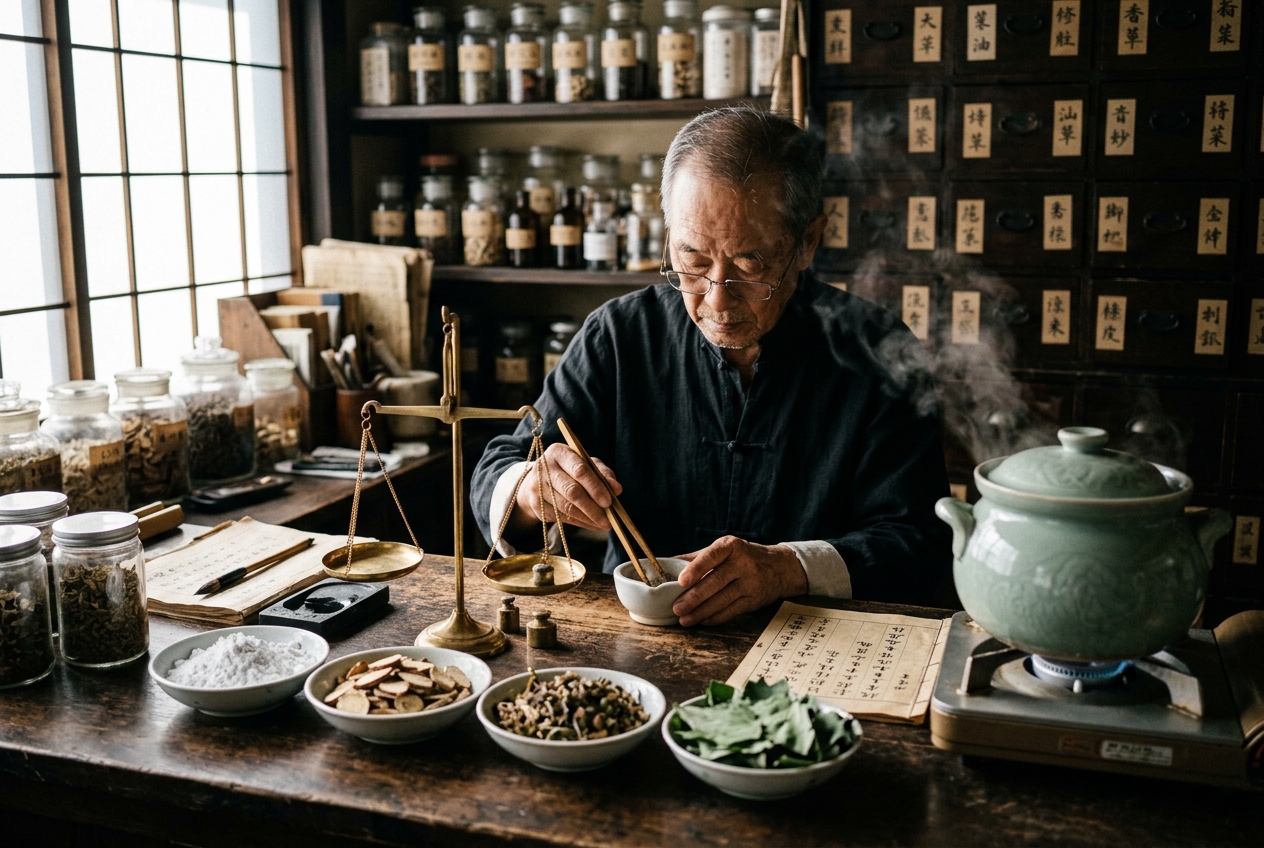
1. Opening Scene — A Moment You’ll Recognise
It is three o’clock on a stifling August afternoon. You step out from an aggressively air-conditioned office into a wall of thick, humid heat. Within minutes, a suffocating heaviness settles across your chest. Your limbs feel as though they have been cast in wet sand; your head is enveloped in a dull, vice-like ache, and an unquenchable thirst emerges alongside an unsettling lack of appetite. Even after drinking litres of ice water, the dryness in your throat persists, while your stomach feels sloshing, bloated, and lethargic.
In modern vernacular, we dismiss this state as "summer fatigue," heat exhaustion, or the midsummer slump. In the classical framework of Traditional Chinese Medicine (TCM), however, this familiar bodily collapse represents a precise bio-energetic crisis: an invasion of Summer-Heat (Shu Xie), complicated by the pervasive infiltration of Turbid Dampness (Shi Xie).
Rather than viewing the body as a simple thermodynamic engine overwhelmed by ambient temperature, classical Chinese medicine understands this condition as a simultaneous dual injury—a rapid hyper-thermal ascent that scatters vital defensive Qi and consumes essential fluids, while sticky, terrestrial moisture binds the physiological conduits of the Triple Burner (San Jiao). Resolving this intricate pathology requires far more than generic cooling; it demands the architectural mastery of Summer-Heat Clearing Formulas (Qu Shu Ji).
2. What This Organ System and Seasonal Dynamic Does
To comprehend how summer-heat clearing formulas operate, one must first explore the unique nature of the seasonal pathogen and the specific organ networks charged with processing it. According to the foundational canon Huangdi Neijing (Inner Canon of the Yellow Emperor), Summer-Heat is the only strictly seasonal external pathogen among the "Six Evils" (Liu Yin). Unlike Wind, Cold, Dryness, or Dampness—which can manifest across varying seasons—Summer-Heat occurs exclusively between the Summer Solstice (Xia Zhi) and the Autumn Equinox (Qiu Fen).
The Cardinal Energetic Characteristics of Summer-Heat (Shu Xie)
- Extreme Yang Nature and Upward Flaming (Sheng Shan): Summer-Heat is characterized by intense thermal energy. It naturally moves upward and outward, targeting the head, eyes, and sensory portals, causing sudden dizziness, facial flushing, and splitting headaches.
- Dispersion of Qi and Fluid Consumption (Hao Qi Shang Jin): Because Summer-Heat forces the body’s cutaneous pores (Pimao) wide open, it triggers profuse sweating. In TCM physiology, fluids (Jin Ye) and vital energy (Qi) share a common origin; as sweat pours forth unrestrained, Qi escapes alongside it, resulting in sudden, profound prostration and short-windedness.
- Pervasive Coalescence with Dampness (Shu Bi Jia Shi): High summer is characterized not merely by heat, but by torrential rains and high atmospheric humidity. Consequently, Summer-Heat rarely strikes in isolation. It almost universally binds with dampness, creating a viscous, stubborn pathogen that obstructs the Middle Burner (the Spleen and Stomach digestive hub) and clogs the Triple Burner water passages.
The Affected Organ Networks
- The Heart and Pericardium (Xin / Xin Bao): As the sovereign organ governing Blood and housing the Mind (Shen), the Heart corresponds directly to the Fire element and the summer season. Extreme Summer-Heat directly threatens the Pericardium, driving agitated delirium or sudden cognitive clouding.
- The Spleen and Stomach (Pi / Wei): The Spleen is the physiological engine of fluid transformation and hates dampness (Xi Zao E Shi). When summer dampness enters, the Spleen’s ascending mechanism is suffocated, producing nausea, heavy limbs, loss of appetite, and loose stools.
- The Triple Burner (San Jiao) and Bladder (Pang Guang): The Triple Burner acts as the systemic irrigation network for fluid and metabolic circulation. When heat and dampness congest this conduit, urination becomes scanty, dark, and burning, signaling that the lower sluice gates are blocked.
3. How You Can Feel It — Signs of Balance and Imbalance
When your body is in seasonal equilibrium, your thermoregulatory mechanisms adapt smoothly to high ambient temperatures. Your vitality remains resilient, your digestion stays light and efficient, your perspiration is moderate and refreshing, and your mind remains clear and sharp despite the midday heat.
When Summer-Heat and Dampness breach your physiological defenses, specific symptom constellations manifest across different layers of the body:
| Diagnostic Domain | Signs of Seasonal Balance | Signs of Summer-Heat & Damp Imbalance |
|---|---|---|
| Energy & Vitality | Sustained stamina; natural wakefulness throughout daylight hours. | Sudden, crushing exhaustion; sensation that the body is soaked in lead; breathlessness upon minimal exertion. |
| Head & Cognition | Clear perception; sharp mental focus; calm demeanor. | Heavy "band-around-the-head" headache; mental fog; dizziness; irritability; restlessness (Fan Zao). |
| Digestion & Appetite | Healthy appetite; smooth gastric emptying; regular bowel habits. | Epigastric fullness; aversion to food; greasy mouthfeel; nausea; watery or foul-smelling loose stools. |
| Fluid Dynamics | Regular, pale-yellow urination; quenching thirst satisfied by room-temperature water. | Unquenchable thirst with desire for cold drinks; profuse perspiration followed by dry skin; dark, scanty, burning urination. |
| Tongue Presentation | Pale red tongue body with a thin, moist white coating. | Crimson tongue body with thick, yellow, greasy coating, or peeled red tongue indicating fluid collapse. |
| Pulse Presentation | Moderate, harmonious, and supple (Huan Mai). | Rapid and slippery (Hua Shu), or surging and deficient (Hong Xu), collapsing under deep pressure. |
4. Prescription Taxonomy and Architectural Synergies (Jun-Chen-Zuo-Shi)
In the pharmacopeia of Traditional Chinese Medicine, Summer-Heat Clearing Formulas (Qu Shu Ji) are categorized according to the exact clinical presentation of the patient: whether dampness or heat predominates, whether exterior cold has trapped interior heat, whether vital Qi has collapsed, or whether the pathogen has penetrated into the central cognitive core.
A. Clearing Summer-Heat and Dispelling Dampness (Qing Shu Hua Shi)
The Archetype: Liu Yi San (Six-to-One Powder)
Recorded in Liu Wan-su’s Jin-dynasty classic Huangdi Suwen Xuanming Fanglun (1172 CE), Liu Yi San represents one of the most elegant mathematical formulations in Asian medicine. Its name derives from its strict 6:1 stoichiometric ratio between its two constituent ingredients:
$$\text{Formulation Ratio} = \frac{\text{Hua Shi (Talcum)}}{\text{Gan Cao (Radix Glycyrrhizae)}} = \frac{6}{1}$$
- Architectural Mechanics:
- Sovereign (Jun) — Hua Shi (Talcum, 6 parts): Sweet, bland, and cold. It glides through the Stomach and Bladder channels to clear summer-heat from the Qi level, while its bland property leaches dampness downward, guiding heat out of the body through the urine.
- Deputy / Assistant (Chen / Zuo) — Gan Cao (Radix Glycyrrhiza uralensis, 1 part): Raw licorice root clears heat, moderates the draining action of Talcum, tonifies Middle Burner Qi, and protects the Stomach from cold injury.
-
Synergistic Dynamic: When sweet (Gan) and cold (Han) are united, they generate fluids (Sheng Jin); when sweet and bland (Dan) are combined, they promote urination without depleting vital reserves. Heat and dampness are eliminated via the lower orifice without injuring Yin.
-
Classic Variations of Liu Yi San:
- Yi Yuan San: Adds Chen Sha (Cinnabar) to anchor the Heart and calm the spirit when Summer-Heat causes extreme irritability and insomnia.
- Bi Yu San: Adds Qing Dai (Indigo Naturalis) to target Liver and Gallbladder fire, clearing scorching heat in the eyes and ears.
- Gui Ling Gan Lu San: Combines Liu Yi San with ingredients from Wu Ling San (Fu Ling, Ze Xie, Zhu Ling, Bai Zhu, Gui Zhi) plus Shi Gao (Gypsum) and Han Shui Shi. This formula clears intense internal heat while opening systemic fluid pathways across all three burners.
B. Clearing Summer-Heat and Tonifying Qi (Qing Shu Yi Qi)
The Archetype: Li Dong-yuan’s Qing Shu Yi Qi Tang
Formulated by Li Dong-yuan in his seminal work Pi Wei Lun (Treatise on the Spleen and Stomach, 1249 CE), this formula addresses cases where Summer-Heat and dampness have severely damaged the patient's baseline Yang Qi and Yin fluids.
- Architectural Mechanics:
- Sovereign (Jun) — Huang Qi (Astragalus Root) and Ren Shen (Ginseng Root): Powerful tonification of Spleen and Lung Qi to reverse summer prostration and stabilize the exterior.
- Deputies (Chen) — Bai Zhu (White Atractylodes) and Cang Zhu (Black Atractylodes): Dry dampness and strengthen the Spleen's transformational functions. Mai Men Dong (Ophiopogon japonicus) and Wu Wei Zi (Schisandra Berry) form the classical Sheng Mai San core with Ginseng, preserving fluids, constraining sweat, and generating Lung Yin.
- Assistants (Zuo) — Huang Bai (Phellodendron) clears damp-heat; Shen Qu (Medicated Leaven) aids digestion; Qing Pi and Chen Pi regulate stagnant Qi; Ze Xie (Alisma) drains dampness via the urine; Ge Gen (Kudzu) and Sheng Ma (Cimicifuga) raise clear Spleen Yang to the head and quench thirst.
- Envoy (Shi) — Gan Cao harmonizes the fourteen individual medicinals.
C. Releasing Exterior Summer-Heat (Qu Shu Jie Biao)
Differentiating Yang Summer-Heat vs. Yin Summer-Heat
In clinical practice, one must distinguish between two fundamentally opposite presentations of summer pathology:
- Yang Summer-Heat (Yang Shu): Caused by direct, prolonged exposure to scorching solar radiation and working in hot environments. Characterized by high fever, profuse perspiration, bounding pulse, and severe thirst.
- Yin Summer-Heat (Yin Shu): Pathological summer-cold. It occurs when an individual, already hot and sweating, seeks sudden cooling—such as sitting directly in front of sub-zero air conditioning, sleeping on cold surfaces, or consuming large quantities of iced beverages. The surface pores constrict abruptly, trapping summer-heat and dampness inside while pathogenic Cold binds the exterior.
The Archetype: Xiang Ru San (Mosla Powder)
Recorded in the imperial formulary Taiping Huimin Heji Jufang (1151 CE), Xiang Ru San is designed specifically for Yin Summer-Heat.
- Constituent Architecture:
- Sovereign (Jun) — Xiang Ru (Elsholtzia ciliata, 6g–10g): Known in classical lore as the "Summer Ma Huang." It is acrid and slightly warm. It releases the exterior through diaphoresis, dispelling trapped cold while transforming internal summer dampness.
- Deputy (Chen) — Hou Po (Magnolia Bark, 6g): Bitter, acrid, and warm. It descends Qi, eliminates fullness, and dries internal damp turbidity.
- Assistant (Zuo/Shi) — Bai Bian Dou (White Hyacinth Bean, 10g): Sweet and neutral. It fortifies the Spleen, harmonizes the Stomach, and clears residual summer dampness.
D. Clearing Summer-Heat and Opening Orifices (Qing Shu Kai Qiao)
Emergency Triage for Summer-Heat Stroke (Zhong Shu)
When extreme Summer-Heat bypasses the exterior and penetrates directly into the Nutritive (Ying) and Blood (Xue) levels, it attacks the Pericardium. This represents an emergency condition characterized by sudden collapse, loss of consciousness, clenched jaw, high pyrexia, and delirium.
- Clinical Strategy:
- Immediate administration of aromatic, cold orifice-opening formulas such as Zi Xue Dan (Purple Snow Powder) or An Gong Niu Huang Wan.
- Utilizing ingredients like Niu Huang (Calculus Bovis), She Xiang (Moschus / synthetic equivalent), Shui Niu Jiao (Cornu Bubali), and Borneol (Bing Pian) to clear internal fire, extinguish liver wind, arrest convulsions, and restore consciousness.
5. Modern Pharmacological and Physiological Parallels
Contemporary biomedical research cataloged in the National Center for Biotechnology Information (NCBI) provides clear physiological correlates for the classical mechanisms of Qu Shu Ji. When analyzed through systemic pathophysiology, these herbal formulations target thermoregulatory control centers, fluid homeostasis, and microvascular integrity.
1. Thermoregulatory Hypothalamic Modulation
In heat illness and exertional heat stroke, hyperthermia triggers autonomic dysfunction within the preoptic area of the anterior hypothalamus. - Research indicates that flavonoids and triterpenoids found in formulas such as Gui Ling Gan Lu San and Qing Shu Yi Qi Tang downregulate pro-inflammatory pyrogens (including Tumor Necrosis Factor-alpha [TNF-$\alpha$] and Interleukin-6 [IL-6]), modulating central heat-dissipation pathways. - The volatile oils in Xiang Ru (Elsholtzia ciliata) interact with peripheral transient receptor potential (TRP) channels, encouraging diaphoresis and facilitating heat loss through cutaneous microvascular vasodilation.
2. Renal Osmoprotection and Aquaporin Regulation
The classical mechanism of Liu Yi San—clearing heat by promoting urination—mirrors renal solute and water clearance: - Talcum (Hua Shi) acts as a gentle, non-irritating osmotic diuretic. It modulates renal tubular epithelial permeability without inducing potassium wasting. - Glycyrrhizin from Gan Cao exhibits mineralocorticoid-like activity, helping preserve fluid balance in vascular spaces during heat-induced dehydration while buffering against sudden drops in arterial blood pressure.
3. Protection Against Systemic Endotoxemia
Under severe thermal stress, blood is shunted from the splanchnic circulation to the skin to facilitate evaporative cooling, resulting in intestinal ischemia. This hypoperfusion degrades the gut mucosal barrier, allowing bacterial lipopolysaccharides (LPS) to leak into the portal circulation and triggering a systemic inflammatory cascade. - Medicinals such as Huang Bai, Bai Bian Dou, and Hou Po exhibit direct barrier-protective, anti-endotoxin, and antimicrobial properties within the gastrointestinal tract, preventing the transition from simple heat exhaustion to systemic shock.
6. Differential Diagnostic Matrix and Clinical Guidelines
To ensure accurate clinical deployment of these formulas, practitioners must analyze the etiology, depth, and balance of heat versus dampness:
| Formulation | Primary Etiology / Syndrome | Core Symptoms | Architectural Highlights (Jun-Chen) | Administration & Decoction Rules | Contraindications |
|---|---|---|---|---|---|
| Liu Yi San | Interior Summer-Heat with Mild Dampness (Qi level) | Scanty, burning urine; unquenchable thirst; diarrhea; irritability; yellow tongue coat. | Hua Shi (6) : Gan Cao (1). Sweet-cold leaching via Bladder. | Grind to fine powder. Take 9–12g wrapped in cloth bag (Bao Fen) in decoction. | Pure cold patterns; severe Yin fluid depletion without dampness; pregnancy. |
| Gui Ling Gan Lu San | Severe Summer-Heat with Heavy Dampness across Triple Burner | High fever; headache; intense thirst with vomiting after drinking; oliguria; edema. | Hua Shi, Shi Gao, Han Shui Shi + Wu Ling San core. Dual mineral clearing and fluid routing. | Decocted as a powder or strained tea; drink lukewarm throughout the day. | Weak, deficient patients without heat accumulation; cold Spleen deficiency. |
| Qing Shu Yi Qi Tang | Summer-Heat Injury with Severe Qi and Fluid Exhaustion | High fever; profuse sweating; extreme fatigue; shortness of breath; dry mouth; weak pulse. | Huang Qi, Ren Shen (Qi) + Mai Dong, Wu Wei Zi (Fluid) + Cang/Bai Zhu (Damp). | Standard water decoction; consume warm in divided doses after meals. | Early-stage acute exterior syndromes where pathogenetic evil has not resolved. |
| Xiang Ru San | Yin Summer-Heat (Interior Heat/Damp trapped by Exterior Cold) | Chills; fever without sweating; heavy head; abdominal pain; vomiting; diarrhea. | Xiang Ru (Sweat exterior) + Hou Po (Transform damp) + Bai Bian Dou (Harmonize). | Must be administered cold or at room temperature to prevent gastric rejection. | Yang Summer-Heat with profuse sweating, deep thirst, and absence of exterior cold. |
| Zi Xue Dan | Heat Sinking into Pericardium (Zhong Shu Stroke) | High pyrexia; convulsions; loss of consciousness; clenched teeth; delirium; crimson tongue. | Minerals (Gypsum, Magnetite) + Aromatics (Moschus, Borneol) + Cornu Bubali. | Fine powder taken with warm water or spoon-fed via nasogastric route in emergencies. | Cold collapse syndromes; weak, flaccid coma with profuse cold sweating. |
7. Qigong and Somatic Movement Practice
Practice: Turning the Palms to Cool the Triple Burner (Yun Shou Qing San Jiao)
This accessible somatic exercise helps vent trapped heat from the chest, clear mental agitation, and encourage the downward descent of stagnant fluids.
Step-by-Step Instructions
-
Starting Position and Setup: - Stand with your feet flat on the floor, shoulder-width apart, knees slightly softened. - Rest your arms comfortably at your sides. Relax your shoulders, tuck your chin slightly to lengthen the back of the neck, and rest the tip of your tongue against the upper palate behind your front teeth. - Take three grounding diaphragmatic breaths, feeling your weight sink into the soles of your feet.
-
Movement and Breath Synchronization: - Inhale (4 counts): Slowly bring your hands in front of your lower abdomen, palms facing upward. Float your palms up the centerline of your torso toward your chest, imagining you are drawing cool water upward from the earth. - Pause (1 count): At the level of the Heart, rotate your palms outward away from your chest, relaxing your elbows. - Exhale (6 counts): Gently push your palms outward and downward to the sides at a 45-degree angle while softly vocalizing the sound "Haaaa" (the classical Heart-clearing sound in the Six Healing Sounds / Liu Zi Jue). Visualize trapped, humid heat venting out through your skin and fingertips. - Inhale (4 counts): Sweep your arms back to the starting position at your lower abdomen.
-
Duration and Repetitions: - Perform this sequence smoothly for 8 to 12 repetitions, lasting approximately 5 to 7 minutes.
-
Somatic Shifts to Look For: - A distinct sensation of coolness in the palms, followed by light, refreshing moisture across the skin rather than sticky sweat. - A release of pressure around the temples and an easing of tension in the diaphragm and epigastrium.
8. Acupressure Points You Can Try Today
Targeted stimulation of classical acupuncture points helps clear heat, harmonize the Middle Burner, and encourage proper fluid metabolism.
1. Neiguan (Pericardium 6 / PC-6) — The Inner Gate
- Location: On the inner forearm, three finger-widths above the transverse wrist crease, nestled precisely between the two prominent tendons (palmaris longus and flexor carpi radialis).
- Technique: Apply firm, steady pressure with your thumb perpendicular to the arm until a dull, spreading sensation (De Qi) develops. Maintain this pressure while making small circular motions for 2 minutes per arm.
- Therapeutic Action: Clears heat from the Pericardium, calms the spirit, and relieves summer nausea, chest oppression, and motion sickness.
2. Quchi (Large Intestine 11 / LI-11) — The Pool at the Bend
- Location: With your elbow bent at a 90-degree angle, locate the point in the depression at the lateral (outer) end of the transverse cubital crease.
- Technique: Press firmly inward toward the bone using your thumb. Maintain firm, even pressure for 1 to 2 minutes on each side while taking slow, deep breaths.
- Therapeutic Action: One of the most effective points in TCM for clearing systemic heat, reducing feverish sensations, relieving itchy skin flare-ups, and soothing sore throats.
3. Yinlingquan (Spleen 9 / SP-9) — The Yin Mound Spring
- Location: On the inner side of your lower leg, in the tender depression directly below the large rounded head of the shinbone (tibia).
- Technique: Use the pad of your thumb or index finger to knead upward and inward into the tender notch for 2 to 3 minutes.
- Therapeutic Action: Opens the water passages of the lower body, drains turbid dampness, relieves heavy leg swelling, and eases sluggish digestion and urinary discomfort.
9. Food and Lifestyle — Small Changes for Today
Dietary and lifestyle adjustments help maintain internal equilibrium when external temperatures and humidity rise. According to the World Health Organization Traditional Medicine Strategy, integrating traditional dietary wisdom with evidence-based wellness practices offers accessible self-care strategies.
Functional Foods to Integrate
- Watermelon Rind and Flesh (Xi Gua): Known in classical materia medica as "Natural Gypsum Decoction" (Tian Ran Bai Hu Tang), watermelon flesh and its white inner rind clear summer-heat, generate fluids, and promote urination. Enjoy fresh slices at room temperature.
- Mung Bean Tea (Lu Dou Tang): Simmer green mung beans in water for 15 to 20 minutes until the liquid turns a clear, vibrant green. Drink the broth at room temperature to clear toxic summer-heat from the Blood level.
- Lotus Leaf (He Ye) and Cucumber Infusions: Fresh lotus leaf or cucumber slices steeped in cool water clear the Spleen, lift clear Yang, and alleviate head heaviness.
- Bitter Melon (Ku Gua): Bitter flavors drain heat downward and dry internal dampness, helping clear summer heart-fire.
Foods and Habits to Reduce
- Iced Drinks and Ice Cream: Gulping freezing liquids while overheated shocks the Spleen and Stomach, freezing digestive enzymes and trapping heat inside the body (triggering Yin Summer-Heat).
- Heavy, Greasy, and Fried Foods: Deep-fried foods and rich dairy burden the Spleen, compounding internal dampness into sticky phlegm.
- Direct Draft Exposure: Avoid allowing cold air conditioning to blow directly onto your neck, shoulders, and lower back when sweating.
10. Today’s Takeaway
If you do just one thing today to protect your body from the midsummer swelter, make a simple room-temperature infusion of fresh cucumber slices, crushed mint leaves, and a thin slice of fresh watermelon rind. Sip it slowly through the afternoon rather than gulping ice water.
This simple step utilizes sweet, bland, and cooling properties to soothe your stomach, protect vital fluids, and gently clear summer-heat through the body's natural pathways—without shocking your digestion. Combine this with five minutes of gentle breathwork to keep your energy balanced and your mind clear throughout the summer months.
Authoritative References and Further Academic Reading
- World Health Organization (WHO) — Traditional, Complementary and Integrative Medicine
- National Center for Biotechnology Information (NCBI) — Thermoregulation, Heat Stress, and Pathophysiology
- NCBI PMC — Modern Research on Herbal Therapeutics for Thermal Shock and Inflammation
- Wikipedia — Traditional Chinese Medicine: Theory, Diagnostics, and Medicinals
- Wikipedia — Pathophysiology and Clinical Management of Heat Stroke
- Wikipedia — Botanical Profile and Pharmacology of Glycyrrhiza uralensis
- Wikipedia — Botanical Characteristics and Active Constituents of Elsholtzia ciliata