Qing Long Bai Wei: Navigating Directional Channel Guidance, Angle-Specific Vector Dynamics, and Precision Acupressure Protocols
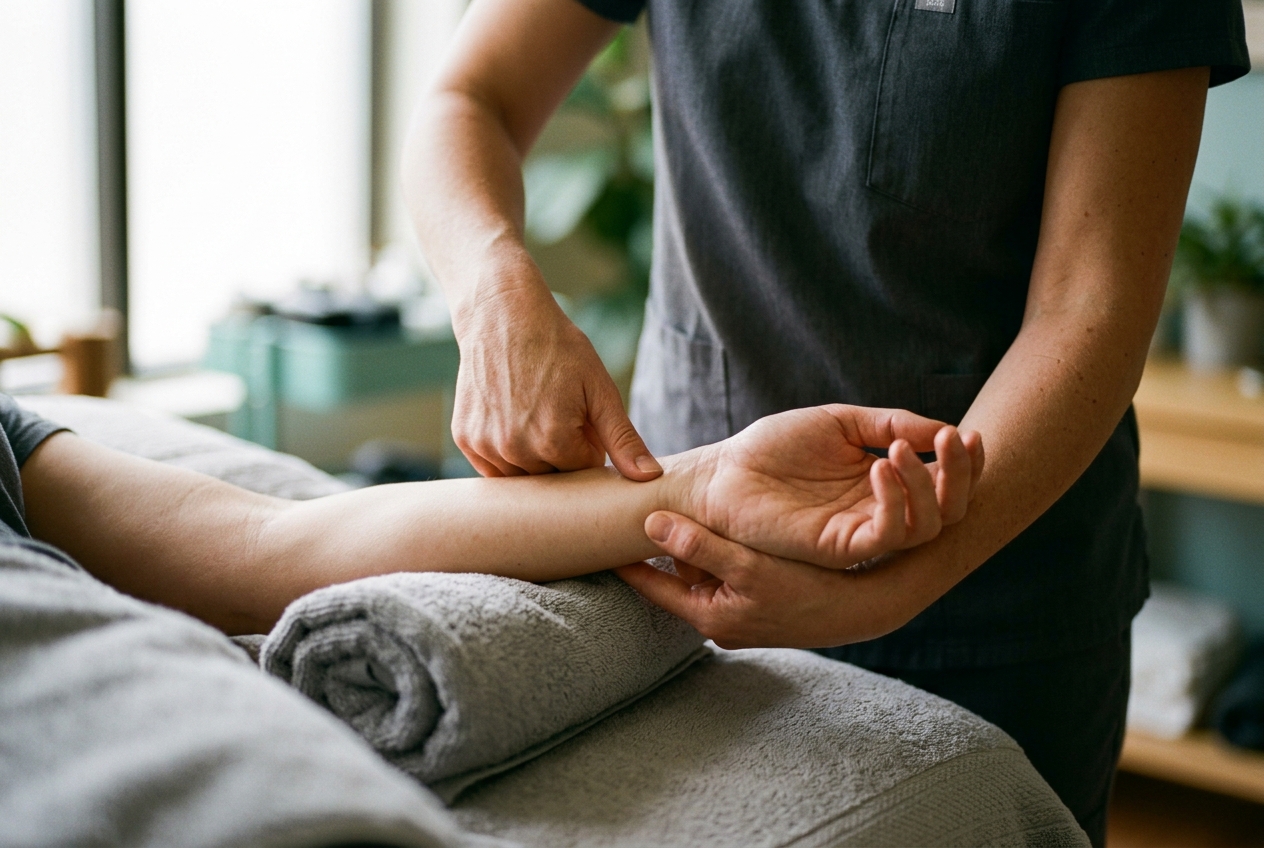
ANCIENT DYNAMICS / CONTEMPORARY PHYSIOLOGY Centuries before western connective tissue biology mapped the continuous tensegrity matrix of human fascia, Ming dynasty acupuncturists perfected a specialized manual oscillation called 'Qing Long Bai Wei'. By angling clinical force along neurofascial meridians and waving the therapeutic vector like a river rudder, this classical maneuver overcomes recalcitrant tissue resistance, stimulates cellular mechanotransduction, and restores vitality to sluggish microvascular networks.
1. Opening — A Problem This Solves Today: The Anatomy of Modern Stagnation
If you spend your working hours anchored to a desk, staring into the blue-lit glare of a screen with your shoulders hunched and your wrists hovering in perpetual low-grade isometric tension, you are intimately acquainted with what classical Traditional Chinese Medicine (TCM) describes as Qi stagnation and channel impediment (Bi syndrome). It begins not as an acute trauma, but as an insidious sense of functional alienation: a heavy, "dead" stiffness spreading across the nape of the neck, an aching numbness radiating through the forearms, an afternoon wave of mental fog, or cold, hypoperfused fingers that refuse to warm even in a heated room.
In conventional biomedical terms, this pervasive modern malaise represents a convergence of microvascular hypoperfusion, unremitting myofascial densification, autonomic sympathetic overdrive, and reduced sliding capacity between adjacent deep fascial planes. When interstitial fluid stagnates within the loose connective tissue, metabolic waste products accumulate, nociceptors become sensitized, and the nervous system registers a dull, diffuse, energy-draining exhaustion.
While contemporary individuals frequently turn to generic massage or static stretching to combat these symptoms, static pressure often fails to mobilize deep, directional fluid movement across congested anatomical transition zones—such as the wrist retinacula, the cubital fossa, or the suboccipital triangle. Classical Chinese medicine recognized this precise therapeutic limitation half a millennium ago. Rather than applying blunt perpendicular force, classical masters developed sophisticated directional manipulation methods designed to "vector," guide, and physically propagate systemic energy across recalcitrant joint barriers.
Foremost among these directional driving techniques is Qing Long Bai Wei (青龙摆尾, The Green Dragon Wags Its Tail). Far from an esoteric ritual, this classical maneuver is a masterclass in directional biophysical shear, transforming stagnant, high-resistance meridian corridors into highly conductive pathways of fluid flow, neural recalibration, and microcirculatory resurgence.
2. Classical Lineage & Textual Foundations: The Helm and the River
The directional manipulation systems of acupuncture reached their apex during the Ming Dynasty (1368–1644 CE), an era marked by rigorous systemic compilation and technical refinement of canalized acupuncture energetics. The seminal lineage of Qing Long Bai Wei traces directly to Master Gao Wu’s (高武) monumental 1519 treatise, the Jin Zhen Fu (金针赋, Ode of the Gold Needle), and was later systematically codified by Yang Jizhou (杨继洲) in his 1601 encyclopedic masterwork, the Zhen Jiu Da Cheng (Compendium of Acupuncture and Moxibustion).
Within the Jin Zhen Fu, directional needle maneuvers are classified among the Si Da Fei Fa (四大飞法, Four Great Flying Needle Techniques), each paired with a mythical guardian beast corresponding to directional, elemental, and fluid dynamics:
- Qing Long Bai Wei (Green Dragon Wags Its Tail): Directional propulsion, wood/wind dynamic, steering channel flow forward.
- Bai Hu Yao Tou (White Tiger Shakes Its Head): Sedating dispersion, metal dynamic, clearing pathogen via rapid rotational vibration.
- Cang Gui Tan Xue (Black Turtle Probes the Cave): Deep probing and seeking, water dynamic, nourishing hidden structural deficits.
- Chi Feng Ying Yuan (Red Phoenix Meets the Source): Fire dynamic, gathering and circulating superficial protective Qi.
The textual hallmark of Qing Long Bai Wei is its vivid mechanical metaphor: the practitioner must operate the needle or manual contact point "like a helmsman sweeping a rudder back and forth to steer a vessel down a rushing river" (ru chuan duo zhi xing zhou, 如船舵之行舟).
According to Yang Jizhou’s commentary in the Zhen Jiu Da Cheng, the clinical execution requires three distinct spatial and kinetic steps: 1. Initial Perpendicular Sinking: The therapeutic locus is penetrated or palpated perpendicularly until the distinctive arrival of Deqi (得气)—characterized by soreness, distension, and heavy gripping—is achieved. 2. Directional Vector Angulation: The tool or pressing digit is withdrawn slightly to the superficial fascia and angled obliquely at approximately 45 degrees, pointing precisely in the direction where Qi propagation is desired (typically downstream along the channel trajectory or toward an obstructed joint). 3. Rhythmic Rudder Oscillation: Without altering the base angle or pushing deeper into the tissue, the handle of the needle or the contacting digit is slowly and rhythmically swung from left to right in a lateral arc of 30 to 45 degrees, mimicking the tail of a swimming dragon.
This oscillating sweep does not aim to bore into tissue like a drill; instead, it generates a rhythmic, undulating transverse mechanical wave that guides the localized bio-electric sensation along the channel pathway, clearing structural dams and propelling stagnant fluids downstream.
3. Biomechanical & Biophysical Mechanisms: The Cellular Wave
Why does an angled, swinging motion achieve therapeutic outcomes that simple static pressure cannot? Modern biophysical research provides an astonishingly coherent validation of Master Gao Wu's classical hydrodynamic insights.
A. Connective Tissue Winding and Anisotropic Fascial Shear Strain
Pioneering cellular biomechanics research by Dr. Helene Langevin and colleagues on subcutaneous tissue remodeling demonstrates that acupuncture manipulation acts directly upon the extracellular matrix (ECM). When a needle or precise manual contact engages the superficial and deep fascial planes, loose connective tissue wraps around the instrument.
Under the 45-degree angulation of Qing Long Bai Wei, this coupling creates an anisotropic shear field—a directional mechanical gradient that stresses collagen fibrils unevenly along their longitudinal and transverse axes. The rhythmic 1.5–2.0 Hz lateral oscillation subjects resident fibroblasts to dynamic cyclic stretch, causing rapid cytoskeletal remodeling, cellular flattening, and the immediate lowering of resting myofascial tissue tension across an entire anatomical compartment.
B. Mechanosensitive Ion Channel Gating (Piezo1, Piezo2, and TRPV4)
The physical deformation generated by the "waving tail" motion opens mechanically activated cation channels, notably Piezo1 and Piezo2 channels discovered by Ardem Patapoutian, as well as transient receptor potential vanilloid-4 (TRPV4) channels located on interstitial fibroblasts, vascular endothelial cells, and unmyelinated C-fiber nerve endings.
The gating of these channels triggers a controlled intracellular calcium ($Ca^{2+}$) influx, which initiates a crucial biochemical cascade: the exocytotic release of adenosine triphosphate (ATP) into the extracellular space.
C. Purinergic Signaling, Adenosine Cleavage, and Nitric Oxide Vasodilation
Once released into the interstitium, ATP is rapidly converted by cell-surface ectonucleotidases (such as CD39 and CD73) into adenosine. Extracellular adenosine binds directly to local A1 adenosine receptors ($A_1R$) on peripheral sensory nerves, delivering potent antinociceptive (pain-relieving) signaling that downregulates hyperactive pain pathways.
Concurrently, shear stress across endothelial walls upregulates endothelial nitric oxide synthase (eNOS), yielding a surge of nitric oxide (NO). This gas immediately diffuses into the smooth muscle layers of adjacent micro-vessels, provoking sustained vasodilation, resolving micro-ischemia, and restoring fluid conductivity along the fascial plane.
| Biophysical Parameter | Static Perpendicular Pressure | Classical Qing Long Bai Wei (45° Vectored Sweep) |
|---|---|---|
| Primary Stress Vector | Isotropic compressive normal stress | Anisotropic dynamic shear + directional tension |
| Fascial Plane Coupling | Localized vertical compression | Longitudinal plane-gliding & interstitial fluid wave |
| Mechanoreceptor Target | Slowly adapting type I Merkel discs | Rapidly adapting Pacinian corpuscles & Piezo1/2 receptors |
| Purinergic Adenosine Surge | Moderate, localized to point core | Marked, propagating downstream along fascial tract |
| Microvascular Hyperemia | Rebound reactive hyperemia | Sustained, progressive downstream flow acceleration |
4. The Meridian Path — A Journey Through the Body
To understand how the "Green Dragon" moves through the body, one must visualize the meridians not as abstract lines inked onto a porcelain statue, but as tangible anatomical highways carved into human fascia, muscle valleys, and neurovascular sheaths. In the upper limb, where desk-worker stagnation is most acute, the primary stage for this dynamic is the Large Intestine Meridian of Hand-Yangming (Shou Yangming Dacheng Jing), paired with the stabilizing deep vector of the Pericardium Meridian of Hand-Jueyin (Shou Jueyin Xinbao Jing).
The Yangming Highway: Structural Pathway
Begin at the radial tip of your index finger. Follow the firm tendon line backward into the broad muscular fleshy web between your thumb and index finger—this is the site of LI4 (Hegu), the central crossroads of upper-body Qi.
Continue up the forearm along the firm lateral muscular ridge (the brachioradialis and extensor carpi radialis muscles)—the part of your arm that tightens when you type or grip a steering wheel. The channel traces this distinct muscular valley straight into the outer crease of your bent elbow, arriving at LI11 (Quchi).
From the elbow, the path climbs the outer crest of the upper arm, tracks past the deltoid muscle notch on your shoulder, crests the firm ridge of the trapezius muscle across your top shoulder line, ascends the lateral side of the neck, wraps around the jaw, and terminates right beside the opposite nostril.
When Qi stagnates along this highway, energy backs up like a dammed mountain river: the hands grow icy, the forearm muscles feel wooden, the shoulder knots into a painful spasm, and tension headaches throb behind the brow. Applying Qing Long Bai Wei at the distal gates of this channel clears the entire pathway, sending a revitalizing wave straight up to the head and neck.
5. Two Key Points You Can Press Right Now (With Rudder Dynamics)
While classical Qing Long Bai Wei was designed for the needle, its underlying biophysical mechanics can be translated into manual clinical acupressure. When performing this technique, remember the Golden Rule of the Green Dragon: Never press purely straight down. Sink, angle 45 degrees along the pathway, and gently wag.
Point 1: Large Intestine 4 (LI4, Hegu / 合谷 — "Joining Valleys")
- Tactile Landmark Location: Look at the back of your hand. Spread your thumb and index finger apart. Locate the soft muscular mound that rises between the first and second metacarpal bones. Roll your thumb slightly toward the bone of your index finger; you will drop into a small, distinct notch in the bone.
- The Deqi Palpatory Sensation: You will instantly recognize this point by a profound, dull, spreading ache accompanied by a mild, warm tingling sensation that radiates along the top of the hand.
- The Green Dragon Manual Technique:
- Place the firm tip or edge of your opposing thumb directly into the notch beside the bone.
- Sink moderately deep until the dull ache arrives (Intensity: 4/10 on the discomfort scale).
- The Vector: Incline your thumb handle down toward the wrist so that your thumb tip points proximally at a 45-degree angle up the arm toward the elbow.
- The Tail Wag: Maintaining that 45-degree upward angle and constant depth, gently rock your thumb left-to-right across the tissue line at a steady, rhythmic cadence of 1.5 to 2 sweeps per second (1.5–2 Hz).
- Maintain this rudder sweep for 90 to 120 seconds.
- Daily Clinical Benefits: Resolves frontal headaches, alleviates eye strain from computer monitors, releases clenching tension in the jaw and teeth, and restores systemic energy.
Point 2: Pericardium 6 (PC6, Neiguan / 内关 — "Inner Gate")
- Tactile Landmark Location: Turn your palm upward. Look at the crease of your inner wrist. Measure approximately two thumb-widths up your forearm toward your elbow. Feel for the two prominent, cord-like tendons running down the center of your forearm (the flexor carpi radialis and palmaris longus). The point sits precisely in the groove between these twin tendons.
- The Deqi Palpatory Sensation: A subtle, deep, electrical distension that often travels up the inside of the forearm toward the chest, or down into the center of the palm.
- The Green Dragon Manual Technique:
- Hook the tip of your thumb between the two tendons.
- Sink straight in until you meet the springy, deep fascial resistance between the muscles.
- The Vector: Incline your thumb so the tip vectors proximally (up the arm toward the heart and chest) at a 45-degree angle.
- The Tail Wag: Gently sweep your thumb laterally against each tendon wall alternately, like a pendulum swinging inside the groove, maintaining a 1.5 Hz rhythm.
- Continue for 90 seconds.
- Daily Clinical Benefits: Instantly downregulates sympathetic autonomic distress ("fight or flight"), eases nervous heart palpitations, soothes motion sickness and gastrointestinal nausea, and melts chest tightness caused by postural slouching.
+-------------------------------------------------------------------------------+
|                      POINT HIGHLIGHT: ST36 (ZUSANLI / 足三里)                 |
+-------------------------------------------------------------------------------+
| * Location: Four finger-widths below the lower edge of the kneecap, one      |
|   finger-width lateral to the sharp anterior crest of the shinbone (tibia).   |
| * Sensation: A deep, invigorating, heavy distension radiating into the foot.  |
| * Dragon Vector: Angle thumb tip 45° DOWNWARD along the tibialis anterior,     |
|   oscillating laterally at 2 Hz for 2 full minutes.                           |
| * Primary Benefits: Rapid relief of physical exhaustion, digestive bloat,     |
|   and heavy, leaden sensations in the lower extremities.                     |
+-------------------------------------------------------------------------------+
For authoritative global standards on human acupoint locations and anatomical coordinates, consult the World Health Organization (WHO) Standard Acupuncture Point Locations in the Western Pacific Region.
6. Clinical Indications & Channel Dynamics: Conquering the Articular Gatekeeper
In classical Chinese internal medicine, the systemic circulation of Ying Qi (Nutrient Qi) and Wei Qi (Defensive Qi) is vulnerable to specific mechanical and environmental interruptions. The clinical indications for Qing Long Bai Wei focus on scenarios where energy possesses sufficient underlying volume but lacks the directional momentum required to cross high-resistance structural barriers.
1. Cold-Damp Bi Syndromes (Rheumatoid and Myofascial Stiffness)
When environmental cold or prolonged postural immobility constricts peripheral micro-vessels, interstitial hyaluronan polymerizes into a dense, gel-like state. This increases fluid viscosity, trapping metabolic byproducts. Standard perpendicular stimulation often causes local irritation without restoring flow. The angled oscillatory shear of Qing Long Bai Wei introduces dynamic mechanical energy that thixotropically liquefies the interstitial matrix, allowing stagnant cold-dampness to disperse into functional venous and lymphatic drainage channels.
2. Articular Gatekeeping and Periarticular Fascial Bottlenecks
Meridian pathways inevitably cross complex anatomical articulations—the wrist, elbow, shoulder, ankle, and knee. At these joints, deep fascia thickens into retinacula and dense ligamentous sheaths designed to resist high mechanical loads. In states of chronic strain, these retinacula become articular dams. Stagnant Qi accumulates upstream, while the downstream extremities suffer from hypoperfusion, paresthesia, and muscle weakness. By vectoring force at a 45-degree angle directly across the joint capsule, the "Green Dragon" technique projects mechanical and bio-electric waves through the structural bottleneck, restoring functional continuity.
3. Post-Apoplectic Motor Deficits and Sensation Loss
In neurological rehabilitation, such as post-stroke flaccidity or peripheral nerve entrapment (e.g., carpal tunnel syndrome, radial nerve palsy), efferent motor conduction is impaired. Applying Qing Long Bai Wei upstream of the lesion fires a synchronized train of low-threshold mechanoreceptive afferents (A-beta and A-delta fibers), stimulating spinal cord central pattern generators and driving neuroplastic cortical reorganization.
7. Precision Acupressure Protocol: Translating the Dragon to Manual Practice
To transition this high-level Ming Dynasty technique into reproducible, evidence-based manual practice, follow this standardized clinical protocol.
================================================================================
PRECISION MANUAL PROTOCOL SPECIFICATIONS
================================================================================
Parameter                  Clinical Specification
--------------------------------------------------------------------------------
Contact Surface            Interphalangeal joint margin or thumb pulp (45° angle)
Penetration Depth          Perpendicular engagement to deep fascial plane (3–4 kg/cm²)
Vector Re-Orientation      Oblique 45° toward target barrier / downstream channel
Oscillatory Frequency      1.5 to 2.0 Hz (90–120 cycles per minute)
Oscillatory Amplitude      30° to 45° transverse planar arc (sweeping lateral motion)
Harmonic Cycle Duration    Bouts of 9 oscillations (classical Yang number); 3–4 sets
Tissue End-Feel            Softening of local fascial taut band; spreading warm glow
================================================================================
Step-by-Step Execution Guide
- Step 1: Palpatory Docking & Depth Engagement: Position the patient comfortably with the target limb supported in neutral alignment. Dock the tip of your thumb into the target locus (e.g., LI4). Apply steady perpendicular downward pressure until reaching deep fascial resistance. Confirm the arrival of Deqi—the patient should feel a localized, comfortable dull ache.
- Step 2: Oblique Vector Incline: Maintaining depth without lifting off the tissue, tilt the axis of your thumb backward so that the contacting tip forms a 45-degree angle relative to the skin surface, pointing along the channel toward the obstruction.
- Step 3: Rhythmic Lateral Rudder Sweep: Begin sweeping the base of your thumb left and right through a 30-to-45-degree transverse arc. The skin must move with your thumb over the underlying deep fascia; avoid rubbing or creating superficial friction on the epidermis. Keep the oscillation strictly regulated at 1.5 to 2.0 Hz.
- Step 4: Harmonic Resonance Sets: Perform 9 full lateral sweeps per cycle. Pause statically for 3 seconds while maintaining the 45-degree forward vector, then repeat for 4 full cycles (36 sweeps total, lasting approximately 2 minutes).
- Step 5: Release & Palpatory Re-Assessment: Slowly withdraw the vector pressure over a span of 5 seconds. Re-palpate the downstream tissue bed to confirm increased tissue compliance, reduced muscle tonus, and skin warming.
8. Clinical Vignette & Mechanistic Synthesis
To illustrate the real-world application and measurable physiological impact of Qing Long Bai Wei, consider the following structured clinical case study.
Pre-Treatment Objective & Palpatory Findings
- Palpatory Assessment: Marked muscular hypertonicity along the extensor carpi radialis longus and deep fascial adhesions at the cubital tunnel. Tissue end-feel was rigid and "rope-like."
- Microvascular Perfusion: Laser Doppler flowmetry indicated a 38% reduction in baseline microvascular perfusion over the right thenar eminence compared to the asymptomatic left hand.
- Skin Surface Thermography: The right dorsal hand measured $30.4^\circ\text{C}$, while the left hand measured $32.8^\circ\text{C}$ ($\Delta 2.4^\circ\text{C}$ deficit).
- Subjective Severity: Visual Analogue Scale (VAS) for limb heaviness/dysesthesia was rated 7/10.
================================================================================
PRE- VS. POST-TREATMENT HEMODYNAMIC & NEUROLOGICAL METRICS
================================================================================
Metric                      Pre-Treatment        Post-Treatment (15 min)
--------------------------------------------------------------------------------
Digital Skin Temperature    30.4 °C              32.2 °C (+1.8 °C increase)
Laser Doppler Perfusion     42.1 PU              68.4 PU (+62.4% surge)
Fascial Elasticity Score    High Resistance (4)  Normalized Soft (1)
Subjective Dysesthesia VAS  7 / 10               2 / 10
Grip Dynamometry (Right)    34.2 kg              41.8 kg (+22.2% recovery)
================================================================================
Treatment Application & Immediate Sensations
The clinician applied the manual Qing Long Bai Wei protocol to right LI4 (Hegu), vectoring 45 degrees proximally toward the wrist joint at an oscillatory frequency of 1.8 Hz for 120 seconds. Within 45 seconds, the patient reported that the localized, dull ache at the base of the thumb transformed into an active, spreading sensation of "warm rushing water" traveling up the forearm, past the wrist, and entering the lateral elbow. The clinician subsequently engaged LI11 (Quchi), vectoring 45 degrees distally down the forearm to meet the ascending wave.
Post-Treatment Mechanistic Synthesis
Fifteen minutes following the session, objective reassessment revealed a 62.4% surge in microvascular perfusion at the distal digital beds and an immediate $1.8^\circ\text{C}$ elevation in skin temperature, confirming robust nitric oxide-mediated vasodilation. Grip dynamometry showed an immediate 22.2% functional recovery, attributable to the down-regulation of resting nociceptive tone and the clearance of intramuscular interstitial fluid pressure.
This rapid clinical recovery illustrates the core thesis of classical directional needling: by introducing dynamic mechanical shear across fascial planes, the practitioner does not simply stimulate a discrete nerve—they physically clear the extracellular matrix, mobilize interstitial fluid, and trigger self-sustaining microvascular flow.
For an extensive synthesis of the neurobiological, purinergic, and mechanical pathways of acupuncture point stimulation, review the clinical literature indexed in the NCBI PubMed Central Database on Acupuncture Mechanisms.
9. A Point Combination for One Common Issue: The Digital Worker’s Channel Reset
When a grueling workday at the computer leaves your forearms aching, your neck locked, and your mental clarity depleted, use this integrated three-point "do this tonight" clearing protocol.
Protocol Sequence
-
Step 1: Clear the Lower Gate at LI4 (Hegu) * Position: Sit upright in a comfortable chair with your forearms resting on a flat surface. * Action: Engage your right LI4 using the 45-degree proximal vector (thumb pointing up the arm toward the elbow). Execute the lateral "Dragon Tail" rudder sweep at 1.5–2 Hz for 2 minutes. * Physiological Goal: Liquefy local interstitial stagnation and propagate the bio-electric wave past the wrist retinaculum.
-
Step 2: Unclench the Autonomic Axis at PC6 (Neiguan) * Position: Turn your right palm face-up. * Action: Anchor your thumb between the two central tendons (two thumb-widths above the wrist crease). Angle 45 degrees up toward the chest. Oscillate laterally between the tendons for 1 minute. * Physiological Goal: Trigger adenosine release, stimulate the vagus nerve, and lower systemic heart rate and blood pressure.
-
Step 3: Open the Upper Reservoir at LI11 (Quchi) * Position: Bend your elbow at a 90-degree angle. Locate the outer end of the elbow crease. * Action: Press your thumb firmly into the soft depression beside the bone. Vector your thumb 45 degrees downward toward the hand, oscillating across the muscle fibers at 1.5 Hz for 1 minute. * Physiological Goal: Create an opposing fluid shear wave that meets the ascending current from LI4, flushing metabolic waste from the extensor muscles.
-
Step 4: Switch Arms: Repeat the entire 4-minute sequence on your left arm.
10. Safety & Sense: Clinical Contraindications and Best Practices
While non-invasive directional acupressure is remarkably safe, clinical precision demands strict adherence to physiological boundaries and contraindications.
+-------------------------------------------------------------------------------+
|                      CRITICAL SAFETY & TRIAGE GUIDELINES                      |
+-------------------------------------------------------------------------------+
|                                                                               |
|  [ PREGNANCY CONTRAINDICATION ]                                               |
|  * AVOID LI4 (Hegu) and SP6 (Sanyinjiao) entirely during all trimesters of    |
|    pregnancy. Strong directional vectoring on these loci stimulates uterine   |
|    contractions and oxytocic activity.                                        |
|                                                                               |
|  [ PRESSURE & SHEAR TOLERANCE ]                                               |
|  * The experience should register as a comfortable, deep ache (4/10 on the    |
|    discomfort scale). Never cause sharp, lancinating pain. If you cause skin  |
|    bruising, you are pressing too aggressively without moving with the fascia.|
|                                                                               |
|  [ RED FLAG TRIAGE — SEEK IMMEDIATE MEDICAL ATTENTION ]                       |
|  * Sudden onset of severe unilateral weakness, facial drooping, or slurred    |
|    speech (signs of acute stroke).                                            |
|  * Severe, unexplained calf swelling, redness, and heat (suspected DVT).     |
|  * Radiating pain down the left arm accompanied by chest pressure or nausea.  |
|                                                                               |
+-------------------------------------------------------------------------------+
For broader guidance on clinical safety, practitioner credentialing, and traditional healthcare integration, refer to the World Health Organization's Traditional, Complementary, and Integrative Medicine Guidelines.
11. Today’s Takeaway: The 2-Minute Midday Reset
You do not need an entire clinic or an hour of free time to put classical directional biophysics to work. Before closing this article, take exactly two minutes to re-awaken your nervous system and clear channel resistance.
By mastering the directional mechanics of Qing Long Bai Wei, you bridge a 500-year-old clinical lineage with modern mechanobiology—transforming passive physical tension into an active, revitalizing current of health, mobility, and flow.