Qihai Cavity Sea of Qi: Infraumbilical Fascial Decompression, Lower Dantian Yuan Qi Consolidation, and Hypogastric Kinetic Anchoring in Classical Neigong
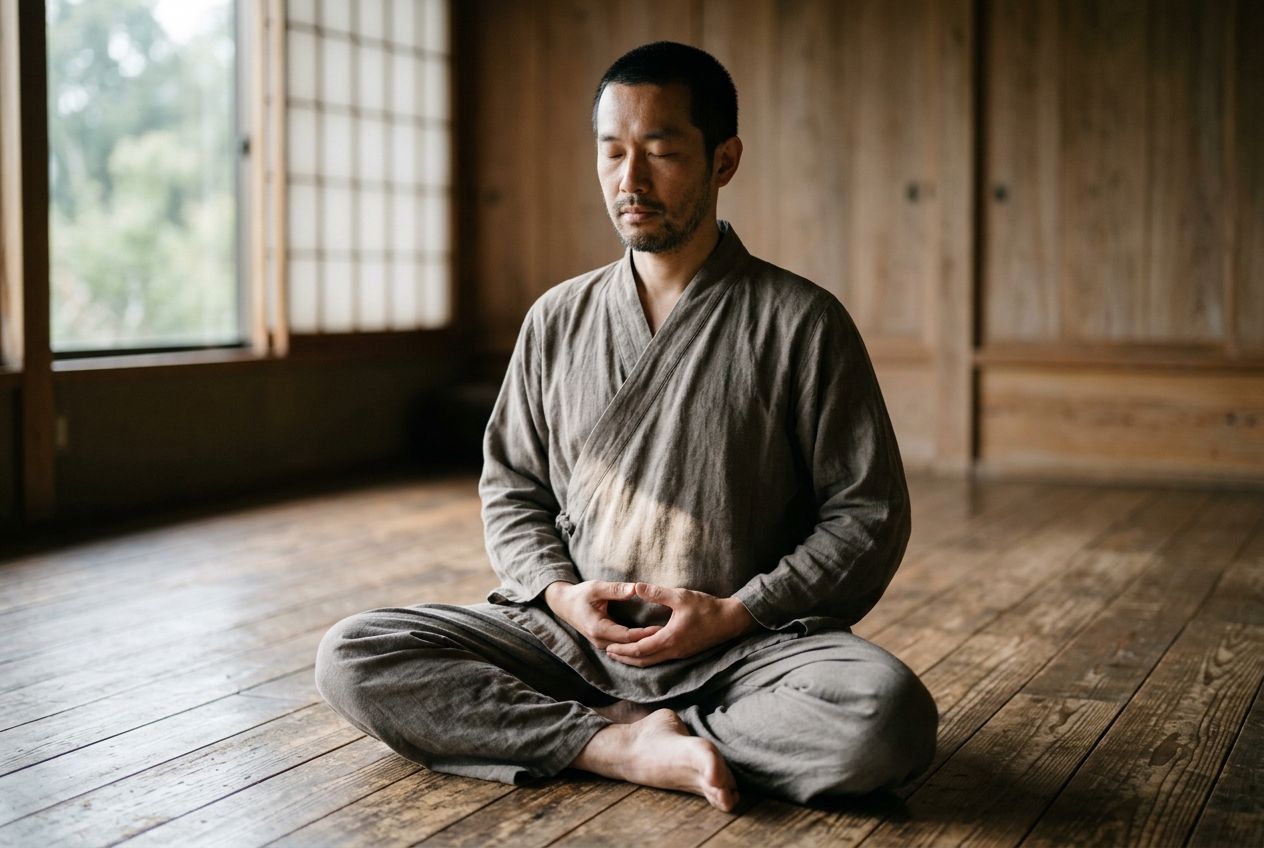
While popular literature often conflates the entire lower abdominal cavity with the Lower Dantian (Xia Dantian), classical lineages draw a precise anatomical and energetic distinction. Qihai is the dynamic anterior threshold—the "oceanic gate"—through which ancestral vitality (Yuan Qi, or original life force) is mobilized, circulated, and integrated with the physiological rhythms of breath and blood.
       ================ ANTERIOR MIDLINE (REN MAI) ================
                                    |
                             [ Shenque / Ren 8 ] (Umbilicus)
                                    |
                                    | ~ 1.5 Cun (Approx. 2 finger-widths)
                                    |
                              * [ QIHAI / Ren 6 ] *  <--- Oceanic Gateway (Yuan Qi)
                                    |
                                    | ~ 1.5 Cun
                                    |
                             [ Guanyuan / Ren 4 ]   <--- Primordial Gate (Jing-Essence)
                                    |
                             [ Zhongji / Ren 3 ]
                                    |
                             [ Qugu / Ren 2 ]       (Superior Pubic Symphysis)
                                    |
                                    v
ANATOMICAL TOPOGRAPHY AND BIOMECHANICAL HYDRODYNAMICS
To appreciate the profound systemic leverage of Qihai, one must explore its rigorous gross and micro-anatomical topography. Located precisely 1.5 cun (the proportional anatomical measurement based on the interphalangeal width of the subject's thumb) inferior to the umbilicus along the anterior median line (linea alba), the locus sits directly over the fusion of the anterior and posterior lamellae of the rectus abdominis sheath.
+---------------------------------------------------------------------------------------+
|                       FASCIAL AND NEURAL ARCHITECTURE OF REN 6                        |
+---------------------------------------------------------------------------------------+
| Layer 1: Epidermis and Superficial Adipose Fascia (Camper's & Scarpa's Fascia)        |
| Layer 2: Linea Alba (Aponeurotic decussation of external/internal obliques & TA)      |
| Layer 3: Rectus Abdominis Sheath and Transversalis Fascia                             |
| Layer 4: Extraperitoneal Adipose Matrix & Parietal Peritoneum                         |
| Neural Pathways: Anterior cutaneous branches of T10–T11 & Iliohypogastric Nerve (L1)   |
| Autonomic Nexus: Inferior Mesenteric & Superior Hypogastric Plexus (Enteric Axis)     |
+---------------------------------------------------------------------------------------+
Deep to the subcutaneous adipose tissues (Camper’s and Scarpa’s fascia), the needle or somatic focus at Qihai traverses the fibrous intertwining collagen bundles of the linea alba. Beneath this aponeurotic junction lies the rectus abdominis muscle bellies, bound by the transversalis fascia and the preperitoneal adipose space immediately anterior to the parietal peritoneum and the convolutions of the small intestine.
Hydrostatic Pressure Modulation and Lumbar Decompression
In classical Tu Na (breath-regulation protocols), respiration is differentiated into two foundational methodologies: 1. Natural Abdominal Breathing (Zheng Hu Xi): The respiratory diaphragm descends during inhalation while the transversus abdominis, pelvic floor (diaphragma pelvis), and infraumbilical rectus relax eccentrically, creating a spherical expansion of the lower abdomen. 2. Reverse Abdominal Breathing (Ni Hu Xi): During inhalation, the diaphragm descends against a gently contracted lower abdominal wall (drawing Qihai subtly inward), followed by an expansive release during exhalation.
       NATURAL RESPIRATION (Zheng Hu Xi)          REVERSE RESPIRATION (Ni Hu Xi)
       ---------------------------------          ------------------------------
       Inhale:                                    Inhale:
         - Thoracic Diaphragm -> Descends           - Thoracic Diaphragm -> Descends
         - Qihai / Transversus -> Expands           - Qihai / Transversus -> Gently Draws Inward
         - Intra-Abdominal Pressure -> Disperses    - Intra-Abdominal Pressure -> Condenses Internally
       Exhale:                                    Exhale:
         - Thoracic Diaphragm -> Recoils Upward     - Thoracic Diaphragm -> Recoils Upward
         - Qihai / Transversus -> Passive Sinking   - Qihai / Transversus -> Elastic Rebound & Warmth
When an untrained individual breathes with thoracic dominance or chronic abdominal tension, the intra-abdominal pressure (IAP) vectors upward against the mediastinum and backward into the lumbar lordosis. This produces persistent mechanical traction and shear stress across the L4–L5 and L5–S1 disc junctions.
Conversely, the intentional fascial decompression of the Qihai zone during diaphragmatic descent fundamentally alters the hydrodynamic properties of the abdominal cylinder. By softening the infraumbilical linea alba and transversalis fascia, the descent of the diaphragm increases hydrostatic pressure uniformly across the peritoneal fluid, turning the abdominal cavity into a buoyant, fluid-filled support structure known in biomechanics as the hydraulic amplifier. This hydraulic stabilization offloads axial compressive strain from the lumbar vertebrae, redistributes kinetic load into the thoracolumbar fascia, and permits the sacrum to settle into its natural plumb alignment (Zhong Ding).
THE CLASSICAL ENERGETIC ARCHITECTURE: YUAN QI AND DANTIAN ALCHEMY
In the canonical taxonomy of the Huangdi Neijing (The Yellow Emperor's Classic of Internal Medicine) and the Nan Jing (Classic of Difficulties), the lower abdomen is designated as the root of human existence—the seat of the Moving Qi Between the Kidneys (Shen Jian Dong Qi). Within this matrix, the Conception Vessel (Ren Mai) acts as the primary reservoir for all Yin channels of the body.
+=======================================================================================+
|                 COMPARATIVE ENERGETIC TAXONOMY OF INFRAUMBILICAL CAVITIES            |
+=======================================================================================+
| Point Name  | Location   | Primary Energetic Function       | Clinical / Alchemical Role |
+-------------+------------+----------------------------------+----------------------------+
| Shenque     | Center of  | Reconnects primordial umbilical  | Moxibustion sanctuary;     |
| (Ren 8)     | Umbilicus  | connection; warms Yang collapse  | strictly forbidden to needle|
+-------------+------------+----------------------------------+----------------------------+
| QIHAI       | 1.5 Cun    | Master sea of Qi; mobilizes,    | Dynamic consolidation and  |
| (Ren 6)     | Inferior   | tonifies, and circulates Yuan Qi | oceanic circulation of Qi  |
+-------------+------------+----------------------------------+----------------------------+
| Guanyuan    | 3.0 Cun    | Gate of Origin; stores Jing,     | Deep constitutional tonics;|
| (Ren 4)     | Inferior   | anchors Kidney Yin and Yang      | root stabilization of Jing |
+=======================================================================================+
While Guanyuan (Ren 4) is the static reservoir where primordial Jing (essence) is conserved and anchored, Qihai (Ren 6) is the functional, dynamic engine that transmutes stored essence into active, circulating bio-energetic movement. If Guanyuan is the deep subterranean well, Qihai is the ocean tide that ebbs and flows with every respiratory cycle.
In Daoist Internal Alchemy (Neidan), practitioners utilize the Qihai gateway to ignite the alchemical cauldron (Lu). By uniting the fiery awareness of the Heart-Mind (Shen) with the watery essence of the Kidneys at Qihai, the practitioner initiates the transformation of coarse matter (Jing) into refined energy (Qi), and ultimately into unconditioned awareness (Shen).
NEURO-FASCIAL TRANSDUCTION: THE SCIENCE OF VISCERAL AROUSAL REGULATION
Modern neurobiology and fascia research published through the National Center for Biotechnology Information provide an astonishing mechanistic validation for the somatic claims of classical Neigong masters. The infraumbilical abdominal wall and preperitoneal matrix surrounding Qihai represent one of the densest neurological crossroads in the human body.
       =================== NEUROLOGICAL PATHWAYS OF REN 6 ===================

[ Somatic Sensory Afferents ]          [ Enteric Nervous System (ENS) ]
       T10-T11 Cutaneous / Iliohypogastric     Auerbach's & Meissner's Plexuses
                    \                                /
                     \                              /
                      v                            v
               +------------------------------------------+
               |  HYPOGASTRIC & CELIAC PLEXUS ENTRAINMENT |
               +------------------------------------------+
                                    |
                                    v
               +------------------------------------------+
               |   VAGAL NERVE UP-REGULATION (CN X)       |
               |   Parasympathetic Dominance / High HRV   |
               +------------------------------------------+
                                    |
                                    v
               +------------------------------------------+
               |   HYPOTHALAMIC-PITUITARY-ADRENAL AXIS    |
               |      Down-regulation of Cortisol        |
               +------------------------------------------+
- Iliohypogastric and Ilioinguinal Neural Dynamics: The sensory innervation of the Qihai locus is supplied by the anterior cutaneous branches of the lower intercostal nerves (T10–T11) and the iliohypogastric nerve arising from the lumbar plexus (L1). Chronic hypertonicity in the lower rectus abdominis pinches these peripheral branches against the rigid fibrous edge of the rectus sheath, generating low-grade, unconscious nociceptive feedback that sustains sympathetic nervous system arousal. Decompressing this site releases mechanical nerve entrapment and breaks the chronic pain-spasm cycle.
- Enteric Nervous System (ENS) Entrainment: Immediately deep to Qihai sits the "second brain"—the enteric nervous system, containing over 500 million neurons embedded in the walls of the gastrointestinal tract. Rhythmic, low-frequency diaphragmatic excursion against a relaxed Qihai acts as an internal mechanical pump, rhythmically stimulating the myenteric (Auerbach’s) and submucosal (Meissner’s) plexuses.
- Vagal Tone and Heart Rate Variability (HRV): Clinical studies registered at PubMed Central demonstrate that slow, low-frequency respiration (0.05 to 0.1 Hz) centered in the infraumbilical zone maximizes respiratory sinus arrhythmia (RSA). This somatic practice directly up-regulates the vagal nerve (Cranial Nerve X), shifting autonomic balance from fight-or-flight sympathetic overdrive to restorative, parasympathetic ventral-vagal dominance.
STEP-BY-STEP PRACTICE GUIDE
To experience the systemic power of the Sea of Qi, practice this three-phase protocol combining classical somatic intention (Yi Dao Qi Dao—"where intention goes, Qi arrives"), standing pole meditation (Zhan Zhuang), and dynamic mobilization (Daoyin).
+=======================================================================================+
|                     SYSTEMIC CULTIVATION SEQUENCE: REN 6 ACTIVATION                  |
+=======================================================================================+
| Stage 1: Seated Somatic Intention (Yi Dao Qi Dao)           Duration: 5–10 Minutes   |
| Stage 2: Standing Pole Rooting (Zhan Zhuang - Wuji Stance)   Duration: 10–15 Minutes  |
| Stage 3: Dynamic Ocean Wave Mobilization (Daoyin)           Duration: 5–10 Minutes   |
+=======================================================================================+
Phase 1: Seated Somatic Intention (Yi Dao Qi Dao)
- Posture Setup: Sit on the forward third of a firm, level chair or meditation cushion. Establish three points of balance: the bilateral ischial tuberosities (sitting bones) and the perineum (Huiyin, Ren 1). Allow your spine to lengthen upward naturally, imagining the crown of your head (Baihui, DU 20) suspended by a thread of silk from the heavens.
- Hand Placement: Rest your dominant hand over the lower abdomen, placing the thumb over the umbilicus (Shenque) and the middle finger directly over Qihai (1.5 cun lower). Rest the non-dominant hand lightly over the dominant hand.
- Breath Coordination: - Inhale smoothly through the nose for a count of four. Do not pull air into your upper chest. Feel the breath glide down the back of your throat, bypass the ribcage, and gently press outward against your middle finger at Qihai. - Hold the breath in absolute stillness for a count of two, feeling a quiet pressure accumulate in the pelvic basin. - Exhale through the nose for a count of six. Allow the abdominal wall to sink inward effortlessly, but maintain an inner sense of spaciousness within the pelvic bowl.
- Cognitive Focus: Do not visualize complex imagery. Simply maintain undivided tactile awareness of the tissue beneath your middle finger.
       INHALATION:                          EXHALATION:
       Breath descends to Qihai             Tension dissolves downward
       Infraumbilical fascial expansion     Visceral settling into pelvic basin
       [ Head Suspended: Baihui ]           [ Sacrum Grounded: Huiyin ]
                  |                                    |
                  v                                    v
       ( O ) <-- QIHAI EXPANDS              ( . ) --> QIHAI CONDENSES WARMTH
Phase 2: Standing Pole Rooting (Zhan Zhuang — Embracing the Primordial Ocean)
- Foundation Setup: Stand with your feet parallel, precisely shoulder-width apart. Distribute your body weight evenly across the Yongquan points (Kidney 1, located in the depression behind the ball of the foot).
- Joint Decompression: - Unlock your knees slightly, ensuring they track in the direction of your second toes without collapsing inward. - Release the inguinal creases (Kua) by allowing the pelvis to settle like a heavy bronze bell, gently flattening the excessive lumbar curve without mechanically tucking the tailbone.
- Arm Positioning: Raise your arms in front of your lower abdomen, forming an open, relaxed circle as if embracing a large sphere of water resting at the height of Qihai. The fingertips of both hands point toward each other, separated by approximately three inches, directly aligned with Ren 6.
- The Somatic Wave: With each inhalation, allow the fascia of the lower abdomen to gently press toward the palms of your hands. With each exhalation, feel the gravity of your upper body drain downward through Qihai, down the medial inseams of your legs, and deeply into the earth. Maintain this posture for 10 to 15 minutes.
Phase 3: Dynamic Ocean Wave Mobilization (Daoyin)
- Starting Form: From the standing position, rest both palms flat against Qihai, left over right (for men) or right over left (for women), in accordance with classical somatic polarity.
- Circular Fascial Uncoiling: - On an exhalation, gently massage your abdomen in a clockwise spiral starting from Qihai, expanding outward across the ascending, transverse, and descending colons for 36 slow revolutions. - Inhale as the hands glide up the right side; exhale as they descend down the left side. - Reverse the direction, spiraling inward from the periphery back to the precise point of Qihai for 24 revolutions, consolidating the refined thermal sensation into the center of the cavity.
+---------------------------------------------------------------------------------------+
|                    COMMON PRACTITIONER ERRORS AND CORRECTIONS                         |
+---------------------------------------------------------------------------------------+
| ERROR 1: Muscular Bracing (Rigid Abs)                                                 |
| - Manifestation: Forcibly pushing the abdominal wall outward with the rectus muscles. |
| - Correction: Soften the throat and jaw; allow expansion to be hydraulic, not muscular.|
+---------------------------------------------------------------------------------------+
| ERROR 2: Structural Collapsing                                                        |
| - Manifestation: Slouching the thoracic spine to compress the belly.                  |
| - Correction: Elevate the occiput (*Baihui*); suspend the spine from above.           |
+---------------------------------------------------------------------------------------+
| ERROR 3: Upward Qi Counterflow (*Qi Ni*)                                              |
| - Manifestation: Sensation of fullness or heat in the chest, throat, or temples.      |
| - Correction: Open the mouth, exhale with a soft "Ha" sound, and drop awareness to K1.|
+---------------------------------------------------------------------------------------+
Diagnostic Indicators of Energetic Transduction
As the Qihai locus opens and somatic stagnation dissolves, practitioners will systematically encounter four distinct tiers of physiological sensations: - Thermal Genesis (Warmth): A gentle, glowing heat originating deep within the preperitoneal space, indicating localized microvascular vasodilation mediated by the sympathetic-parasympathetic transition. - Micro-Tingling and Fascial Vibrations: A sensation akin to mild effervescence or buzzing under the skin, reflecting the recruitment and depolarization of cutaneous and unmyelinated C-fiber mechano-receptors. - Hydraulic Heaviness (Chen): A pronounced somatic sense that the center of gravity has dropped into the lower pelvis, providing immense structural stability. - Involuntary Borborygmi: Soft gurgling sounds within the digestive tract, signaling the activation of peristalsis and the relief of chronic visceral spasm.
HISTORICAL LINEAGES AND ALCHEMICAL EVOLUTION
The historical transmission of Qihai cultivation spans over two millennia of documented somatic exploration in Chinese medical and philosophical literature. The foundational taxonomy was first codified during the Han Dynasty (206 BCE – 220 CE) within the Huangdi Neijing and the Nan Jing, where Bian Que (circa 4th century BCE) famously declared that the space below the navel represents the origin of all Twelve Meridians and the ancestral gateway of human life.
During the Tang Dynasty (618–907 CE), the legendary physician and Daoist master Sun Simiao (孙思邈) integrated Qihai acupuncture and moxibustion protocols directly with longevity exercises (Yangsheng). Sun documented that heating or breathing into Ren 6 was an incomparable sovereign remedy for constitutional exhaustion, visceral prolapse, and chronic metabolic decline.
+=======================================================================================+
|                   HISTORICAL CHRONOLOGY OF THE QIHAI TRADITION                        |
+=======================================================================================+
| 4th Century BCE  | Classic of Difficulties (*Nan Jing*): Establishes the Lower       |
|                  | Dantian as the foundation of Moving Qi Between the Kidneys.        |
+------------------+--------------------------------------------------------------------+
| Tang Dynasty     | Master Sun Simiao codifies Daoyin and moxibustion on Qihai for     |
| (618–907 CE)     | constitutional longevity and reproductive vitality.                |
+------------------+--------------------------------------------------------------------+
| Song Dynasty     | Zhang Boduan pens the *Wuzhen Pian* (Awakening to Reality),         |
| (960–1279 CE)    | detailing the precise transmutation of Yuan Qi in the lower Lu.    |
+------------------+--------------------------------------------------------------------+
| Modern Era       | Integration into global clinical standards via the                 |
|                  | [National Qigong Association](https://www.nqa.org) & medical Neigong.|
+=======================================================================================+
In the Song Dynasty (960–1279 CE), the Complete Reality (Quanzhen) school of Daoist internal alchemy elevated Qihai from a therapeutic point to the sacred alchemical vessel of immortality. In the masterwork Wuzhen Pian (Awakening to Reality) by Zhang Boduan, Qihai is described as the place where the Kan (Water) and Li (Fire) trigrams are inverted.
Rather than allowing the vital warmth of the upper body to dissipate outward through intellectual overthinking and emotional volatility, the alchemist draws fire down into the ocean of water at Qihai, creating a restorative alchemical steam that ascends the governor vessel (Du Mai) to nourish the brain (Niwan Palace).
CLINICAL SOMATIC DIAGNOSTICS: OPEN VERSUS OBSTRUCTED FLOW
For clinical acupuncturists, bodyworkers, and advanced Neigong practitioners, the physical state of the Qihai locus serves as an infallible diagnostic mirror of the patient’s constitutional balance.
+=======================================================================================+
|                CLINICAL PALPATORY DIAGNOSTICS: QIHAI ASSESSMENT                       |
+=======================================================================================+
| Somatic Parameter     | Obstructed / Deficient State     | Open / Consolidated State  |
+-----------------------+----------------------------------+----------------------------+
| Tissue Tone           | Rigid/wooden resistance or flaccid| Resilient, elastic rebound |
|                       | emptiness (lack of root)         | like a semi-inflated ball  |
+-----------------------+----------------------------------+----------------------------+
| Local Temperature     | Cold to touch; persistent chill  | Warm, radiant, isothermal  |
|                       | radiating to the lower back      | with surrounding tissues   |
+-----------------------+----------------------------------+----------------------------+
| Respiratory Excursion | Locked; no expansion on inhale   | Effortless, 360-degree     |
|                       | (paradoxical chest breathing)    | spherical expansion        |
+-----------------------+----------------------------------+----------------------------+
| Radial Pulse (Cun/Chi)| Deep, weak, or wiry Chi position | Rolling, supple, rooted    |
|                       | (Kidney/Bladder deficiency)      | Chi pulse with clear vigor |
+=======================================================================================+
Clinical Remediation Strategies for Vital Energy Rehabilitation
When severe obstruction or constitutional depletion is detected at Qihai, modern clinical practice utilizes a layered rehabilitative approach: 1. Direct Moxibustion (Ai Jiu): Applying indirect mugwort (Artemisia vulgaris) moxibustion over Qihai for 15 to 20 minutes induces deep infrared thermal penetration, mobilizing dormant Yuan Qi, warming the cold uterus or intestines, and reversing chronic metabolic exhaustion. 2. Acupressure Fascial Unwinding: Gentle, sustained ischemic compression with the thumb placed directly at Ren 6, sustained for 90 to 120 seconds while guiding the patient through diaphragmatic sighs, releases chronic aponeurotic adhesions across the linea alba. 3. Internal Martial Arts Integration: Practicing internal styles such as Taijiquan or Baguazhang, supported by educational guidelines from the National Qigong Association, grounds systemic kinetic force directly through the Qihai-Mingmen axis, restoring functional vitality across all physical activities.
TODAY’S PRACTICE COMMITMENT
To begin opening the Sea of Qi and reclaiming your organism’s natural reservoir of vitality, commit to the following concrete exercise:
Tomorrow morning, immediately upon waking and before consuming your first cup of water or coffee, lie flat on your back with your knees bent and feet flat on the mattress. Place both hands over Qihai (1.5 cun beneath the navel). Perform exactly 24 slow, silent, diaphragmatic breaths, feeling your hands rise and fall purely on the tide of your lower abdominal expansion.
Observe the qualitative shift in your mental clarity, postural ease, and calm physical vitality over the subsequent two hours. You have begun the timeless process of decompressing the Sea of Qi—returning home to the biological and energetic root of your being.