Pu Bu Crouching Stance Qigong: Deep Coxofemoral Abduction, Adductor Fascial Elongation, and Asymmetric Ground Reaction Vectoring in Classical Daoyin
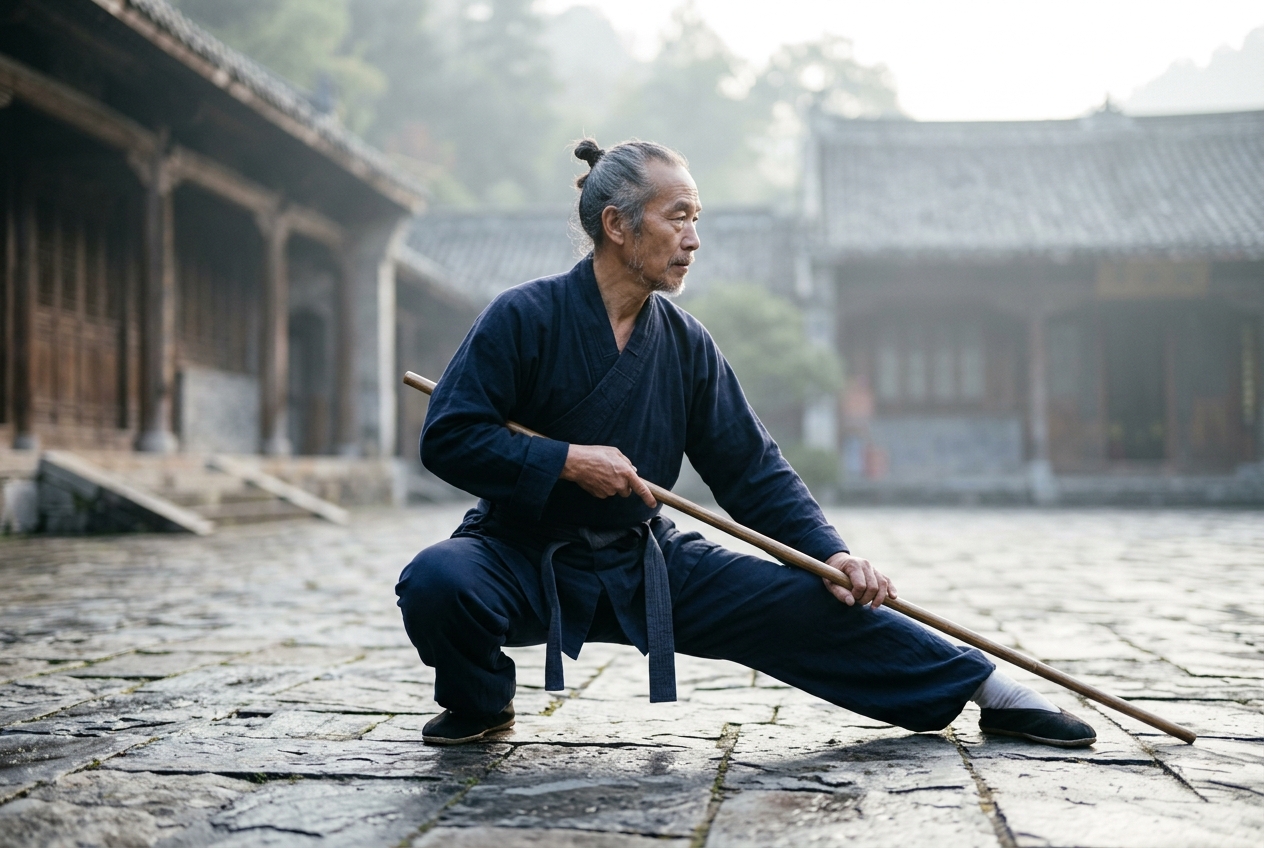
While modern observers often encounter this shape during contemporary martial arts demonstrations, its architectural origins belong to the classical health preservation systems known as Daoyin (literally "guiding and pulling") and internal energy cultivation (Qigong). In these contemplative somatic traditions, physical postures are never static calisthenics; they are hydraulic valves designed to compress, mobilize, and direct the flow of somatic vitality (Qi) throughout the neurovascular and myofascial systems.
To understand the internal mechanics of Pu Bu without becoming entangled in esoteric abstractions, one can begin with an accessible anatomical model. In classical Chinese medicine, the lower abdomen—specifically the area roughly two inches below the navel, known as the lower Dantian (丹田) or "field of elixir"—is conceived as the gravitational and energetic pump of the physical vessel. When you drop into a full crouching stance, you are essentially folding the lower body into an asymmetrical hydraulic press. The compressed hip crease (Kua) acts as a temporary dam, accumulating pressure in the pelvic basin, while the elongated inner leg opens a wide myofascial highway through which blood, lymphatic fluid, and neural impulses surge the moment the stance is released or shifted.
What appears from the outside to be an austere test of lower-body flexibility is, in anatomical reality, a sophisticated tool for opening the deep connective tissues of the pelvis, strengthening the stabilizing muscles of the spine, and regulating the autonomic nervous system through mechanical pressure and deep diaphragmatic breath.
Step-by-Step Practice Guide: Architectural Alignment and Protocols
Executing the classical Pu Bu with orthopedic safety and maximum therapeutic benefit requires systematic, progressive setup. The posture demands synchronous engagement of the foot tripod, the hip socket, the pelvic floor, and the respiratory diaphragm. Follow this structured protocol to experience the full mechanics of the crouch.
+-------------------------------------------------------------------------+
|                  PU BU ALIGNMENT & SAFETY MATRIX                        |
+-------------------+-----------------------------------------------------+
| Critical Vector   | Biomechanical Standard                              |
+-------------------+-----------------------------------------------------+
| Supporting Knee   | Tracks over 2nd/3rd toe; ZERO medial valgus collapse|
| Supporting Heel   | 100% ground contact; maintain posterior tripod root |
| Extended Leg      | Full knee extension; patella and toes face forward  |
| Pelvic Orientation| Level horizontal basin; avoid lateral pelvic torsion|
| Axial Spine       | Upright, crown floating (Baihui), lumbar neutral    |
| Breath Cadence    | Inhale (4s) descent -> Exhale (6s) hydraulic settle |
+-------------------+-----------------------------------------------------+
1. The Ground Setup and Initial Stance Base
Begin in a wide parallel stance, stepping your feet approximately two to two-and-a-half times the width of your shoulders. Ensure the outer lateral borders of both feet are completely parallel to one another, pointing directly forward rather than flaring outward. Distribute your weight evenly across the three primary weight-bearing points of each foot: the base of the first metatarsal (ball of the foot), the base of the fifth metatarsal (outer edge), and the center of the calcaneus (heel). Place your hands lightly upon your hips, soften your knees, and lengthen your spine upward from the sacrum through the crown of your skull (Baihui, 百会).
2. The Inguinal Fold and Controlled Descent
Initiate the movement by taking a slow, continuous four-second nasal inhalation that draws air deep into your pelvic floor, expanding your lower abdomen in a full 360-degree circumference. Without rounding your lower back, hinge directly from your hip crease (Kua), shifting your center of mass sideways toward your designated supporting leg (for example, the left leg). As your left knee bends, sit your left hip backward and downward as though descending onto a low stool placed behind your heel.
Keep your right leg straight, actively extending it outward to the right side. Ensure the entire sole of the straight right foot remains grounded flat on the floor, with the inner arch lifted and the toes facing forward or angled slightly inward. As your left hip sinks into its deepest available compression, exhale smoothly through your nose over six seconds, allowing your pelvis to descend as close to the left ankle as your mobility comfortably permits.
3. Isometric Suspension and Perineal Engagement
Once you reach your terminal active depth, do not collapse passively into your joint capsules. Maintain an active muscular engagement: press the floor away through your left heel and the ball of your left foot, while simultaneously pulling the inner edge of your extended right foot toward your midline through active adductor tension.
Bring your hands together at the center of your chest in a prayer posture, or extend the left arm forward and the right arm along the extended right leg to balance your torso. Gently draw the center of your perineum (Huiyin, 会阴) subtly upward, creating a supportive muscular hammock beneath your pelvic viscera. Hold this position for three to five full cycles of diaphragmatic breath, feeling the reciprocal tension between the compressed left groin and the lengthened right inner thigh.
4. The Spiral Transition into Gong Bu (Bow Stance)
To exit or transition dynamically from Pu Bu, use the ground reaction force generated by your supporting leg. Inhale deeply, pressing firmly through your left heel to initiate a forward driving force. As your hips begin to rise slightly, rotate your entire pelvis ninety degrees toward the left, pivoting on the balls and heels of both feet.
Your left leg becomes the forward, bent pillar of a classical Gong Bu (弓步, Bow Stance), with the left knee bent at a right angle directly above the ankle, while your right leg straightens completely behind you, anchoring through the rear heel at a forty-five-degree angle. Exhale fully as you settle into this forward lunging stance, experiencing the immediate release of compressed pelvic fluid and the dynamic forward projection of your body's structural center.
TRANSITIONAL PROGRESSION:
[ Pu Bu: Low Lateral Crouch ] ===(Shift & Spiral 90°)===> [ Gong Bu: Forward Bow Stance ]
  - Deep Inguinal Compression                               - Anterior Hip Opening
  - Medial Yin Meridian Stretch                             - Posterior Yang Driving Force
  - Centripetal Energy Storage                              - Centrifugal Kinetic Release
Diagnostic Corrections for Common Beginner Errors
- Medial Knee Collapse (Valgus Fault): Beginners frequently allow the knee of the squatting leg to cave inward past the big toe, placing dangerous shear forces on the medial collateral ligament (MCL) and meniscus. Correction: Actively recruit the gluteus medius and deep lateral hip rotators to draw the knee outward, ensuring the kneecap tracks strictly over the second and third toes throughout the descent.
- Elevation of the Supporting Heel: Restricted ankle mobility often forces the heel of the bent leg to lift off the floor, transferring excessive pressure onto the patellar tendon and destabilizing balance. Correction: Widen your initial stance base slightly, or place a half-inch wooden wedge or folded yoga blanket beneath the heel to preserve full ground contact while gradually building dorsiflexion capacity.
- Excessive Forward Torso Pitch (Lumbar Collapse): Tipping the chest excessively forward to compensate for tight hips rounds the lumbar spine and disrupts diaphragmatic breathing. Correction: Keep your chest lifted, draw the shoulder blades gently downward along the ribcage, and hinge purely from the coxofemoral joint rather than the lower back.
Somatic Sensations and Their Meanings
As you maintain the isometric hold in Pu Bu, several distinct neurovascular and energetic sensations will typically arise: - Intense Radiating Warmth in the Inguinal Crease and Pelvis: This represents vasodilation and the rapid perfusion of microcapillary beds following deep compression of the femoral triangle. - Fine Tingling or Vibrational Sensation Along the Inner Thigh: This indicates mechanical decompression and fascial shearing along the adductor lines, stimulating peripheral nerve pathways. - Profound Sensation of Gravitational Heaviness in the Feet: Known in classical texts as "sinking the root," this sensation reflects the downregulation of sympathetic nervous tone and the activation of mechanoreceptors across the plantar fascia. - Spontaneous Release of Diaphragmatic Tension: A natural, involuntary deepening of the breath occurs as the pelvic floor releases chronic holding patterns in response to sustained isometric grounding.
+-------------------------------------------------------------------------+
|                  SOMATIC SENSATION INTERPRETATION GUIDE                 |
+-------------------+----------------------+------------------------------+
| Physical Sensation| Classical TCM View   | Modern Western Physiology    |
+-------------------+----------------------+------------------------------+
| Inguinal Warmth   | Qi accumulation in   | Post-compression arterial    |
|                   | the Lower Dantian    | reactive hyperemia / flushing|
+-------------------+----------------------+------------------------------+
| Medial Tingling   | Opening of the Three | Fascial glide & peripheral   |
|                   | Leg Yin Channels     | neuro-vascular decompression |
+-------------------+----------------------+------------------------------+
| Plantar Heaviness | Sinking of Kidney Qi | Downregulation of postural   |
|                   | to Yongquan (K1)     | sympathetics via plantar Ruffini|
+-------------------+----------------------+------------------------------+
Why It Works: The Biomechanical, Fascial, and Meridian Science
The remarkable health benefits attributed to Pu Bu across classical treatises find direct validation in contemporary orthopedic biomechanics, neurophysiology, and connective tissue research. When analyzed through the lens of modern anatomy, this posture functions as an advanced exercise in closed-chain joint mechanics, myofascial tensegrity, and autonomic regulation.
                      BIOMECHANICAL FORCE VECTORS

                      Torso Mass Center (Gravity Down: F_g)
                                   |
                                   v
             [Supporting Hip] <----+----> [Extended Hip]
              /             \              \
             / (Eccentric    \              \ (Tensile
            /   Load: F_m)    \              \  Elongation: F_t)
           v                   v              v
      [Plantar Heel Root]  [Knee Stable]   [Plantar Floor Lock]
      (Ground Reaction: R1)                (Ground Reaction: R2)
Biomechanical and Orthopedic Architecture
From an orthopedic standpoint, Pu Bu demands and develops extreme joint mobility and eccentric muscular control across three primary lower-limb complexes: 1. Deep Coxofemoral Joint Abduction and Flexion: The supporting hip undergoes near-maximal flexion combined with external rotation, loading the gluteus maximus, gluteus medius, and deep external rotators (piriformis, obturator internus, and quadratus femoris) under high eccentric tension. Simultaneously, the contralateral hip experiences extreme lateral abduction, requiring complete passive and active compliance from the hip adductor complex. 2. Extreme Talocrural Ankle Dorsiflexion: Achieving a flat-heeled Pu Bu requires significant closed-chain dorsiflexion at the talocrural joint. This actively stretches the soleus, gastrocnemius, and Achilles tendon complex while strengthening the anterior tibialis, preserving long-term ankle mobility and preventing plantarfascial rigidity. 3. Eccentric Quadriceps and Gluteal Loading: The supporting leg acts as a single-limb shock absorber. The vastus medialis oblique (VMO), vastus lateralis, and rectus femoris undergo profound isometric and eccentric loading, stabilizing the patellofemoral tracking mechanism and reinforcing connective tissues within the knee capsule.
Myofascial Tensegrity and the Deep Front Line
In the structural framework developed by modern myofascial researchers, the inner leg pathways stretched so intensely in Pu Bu correspond precisely to the Deep Front Line (DFL). This major fascial meridian runs from the plantar surfaces of the toes, ascends through the posterior tibialis along the medial lower leg, continues through the gracilis, adductor magnus, adductor longus, and pectineus, traverses the pelvic floor, and connects directly into the psoas major, the respiratory diaphragm, and the deep cervical fascia of the neck.
THE DEEP FRONT LINE CONTINUUM:
[ Plantar Fascia / Posterior Tibialis ]
                 |
[ Gracilis & Adductor Magnus / Longus ]  <--- Primary stretch vector in Pu Bu
                 |
[ Pelvic Diaphragm / Psoas Major ]      <--- Hydraulic center / Lower Dantian
                 |
[ Respiratory Diaphragm & Pericardium ]  <--- Parasympathetic breath regulator
When you sink into Pu Bu, you exert a powerful, sustained longitudinal traction along this entire myofascial line. Because the Deep Front Line forms the core stabilizing sleeve for the human skeleton, releasing chronic hypertonicity within the adductors directly alleviates compressive strain on the lumbar spine and sacroiliac joints. Under sustained stretch, fibroblasts within these fascial sheets undergo mechanotransduction, remodeling the extracellular collagen matrix, improving tissue elasticity, and releasing bound hydration into previously stagnant connective layers.
Traditional Chinese Medicine Meridian Mechanics
In the bioenergetic framework of Traditional Chinese Medicine (TCM), the medial aspect of the lower limb is traversed by the Three Leg Yin Channels (San Yin Jing, 足三阴经):
+-------------------------------------------------------------------------+
|                  THE THREE LEG YIN MERIDIAN VECTORS                     |
+-------------------+-------------------+---------------------------------+
| Meridian Channel  | Primary Path      | Functional & Somatic Action     |
+-------------------+-------------------+---------------------------------+
| Liver (Jueyin)    | Medial thigh,     | Regulates smooth Qi flow,       |
|                   | inner groin seam  | releases chronic tendon tension |
+-------------------+-------------------+---------------------------------+
| Spleen (Taiyin)   | Antero-medial leg,| Transforms fluid stagnation,    |
|                   | inner calf border | strengthens fascial integrity   |
+-------------------+-------------------+---------------------------------+
| Kidney (Shaoyin)  | Plantar foot sole,| Anchors postural root, regulates|
|                   | postero-medial leg| endocrine & pelvic vitality     |
+-------------------+-------------------+---------------------------------+
- The Liver Channel of Foot-Jueyin (足厥阴肝经): Ascending along the inner seam of the calf and thigh directly into the pubic and inguinal regions, this channel governs the tendons and the smooth distribution of somatic energy throughout the body. Modern sedentary living causes severe energetic stagnation in the inguinal folds. The expansive adductor elongation in Pu Bu opens the Liver channel, resolving emotional irritability, muscular rigidity, and pelvic congestion.
- The Spleen Channel of Foot-Taiyin (足太阴脾经): Running along the antero-medial aspect of the lower leg and thigh, the Spleen meridian regulates fluid metabolism, connective tissue integrity, and blood containment. Stretching this line stimulates tissue drainage and clears metabolic wastes.
- The Kidney Channel of Foot-Shaoyin (足少阴肾经): Originating on the plantar surface of the foot at acupoint Yongquan (Kidney 1, 涌泉) and winding behind the medial malleolus up the deep postero-medial thigh, the Kidney channel anchors the primal vitality (Jing) and governs the health of bones, marrow, and lower joints.
By maintaining full ground contact through the extended foot, Pu Bu powerfully stimulates Yongquan (K1), drawing agitated, rising somatic heat downward into the earth. Simultaneously, the stretch activates Sanyinjiao (Spleen 6, 三阴交)—the profound anatomical intersection where the Liver, Spleen, and Kidney meridians converge on the medial lower leg. The synergistic compression and elongation of these channels expels latent "damp-heat" (Shi-Re, 湿热)—a traditional clinical term describing chronic, stagnant pelvic inflammation, sluggish microcirculation, and lymphatic congestion in the urogenital basin.
ACUPOINT ACTIVATION ARCHITECTURE:
- Yongquan (K1): Plantar center -> Sinks ascending Yang, grounds postural tension
- Sanyinjiao (SP6): 3 cun above medial malleolus -> Harmonizes Liver, Spleen, Kidney
- Huiyin (CV1): Perineal floor -> Balances Conception & Governing vessels, pelvic pump
For those interested in exploring modern research on acupuncture mechanisms and clinical evidence, the World Health Organization maintains extensive documentation on traditional and integrative medical modalities.
Pelvic Floor Reciprocal Tension and Lower Dantian Hydraulics
The true somatic engine of Pu Bu resides in its dynamic relationship with the pelvic diaphragm and intra-abdominal pressure. In classical Neigong texts, the perineum is designated as Huiyin (Conception Vessel 1, 会阴)—the meeting point of the Yin vessels and the structural floor of the lower Dantian. When an untrained individual performs a deep squat, the pelvic floor muscles frequently either collapse into passive flaccidity or contract into rigid spasm.
In classical Pu Bu, however, the practitioner maintains an active, gentle reciprocal tension across the levator ani and coccygeus muscles. As the respiratory diaphragm descends during inhalation, intra-abdominal pressure rises against the sealed pelvic floor, gently compressing the internal organs. Upon exhalation, the elastic recoil of the perineum assists in pumping venous blood and lymphatic fluid out of the deep pelvic reservoirs back toward the vena cava and thoracic duct. This rhythmic somatic pump creates what classical lineages term "hydraulic grounding"—a state where the body feels rooted like an iron pillar yet internally buoyant, fluid, and responsive.
THE HYDRAULIC DANTIAN PUMP:
[ Inhalation (4s) ] ===> Diaphragm descends ===> Intra-abdominal pressure rises ===> Visceral massage
                                                                                           |
[ Exhalation (6s) ] <=== Huiyin gently lifts <=== Venous/Lymphatic fluid ascends <=========+
Autonomic Regulation and Vagal Tone
From a neurophysiological perspective, holding an asymmetrical stance such as Pu Bu while maintaining slow, resonant diaphragmatic breathing forces a rapid shift in autonomic nervous system balance. The sustained isometric demand initially challenges the sympathetic nervous system; however, because the practitioner consciously pairs this muscular load with slow nasal exhalations (which stimulate the vagus nerve and increase heart rate variability), the brain receives conflicting signals of physical exertion and visceral safety. The result is a unique state of "relaxed alertness" or sympathetic-parasympathetic co-activation.
Modern clinical investigations compiled by the National Center for Biotechnology Information (NCBI) demonstrate that regular practice of traditional mind-body postures significantly enhances cardiovascular regulation, reduces systemic inflammatory markers, and balances neuroendocrine output. Additional research indexed on PubMed highlights how low-stance postures in Chinese internal arts augment lower-extremity bone mineral density, enhance proprioceptive joint reflexes, and optimize neuromuscular recruitment patterns. Organizations like the National Qigong Association continue to bridge these classical somatic methodologies with modern clinical application.
Classical Lineage, Historical Context, and Martial Neigong
The historical lineage of Pu Bu stretches across more than two millennia of documented Chinese somatic culture, standing at the crossroads where ancient shamanic dances, Daoist longevity arts, and martial combat systems converge.
THE HISTORICAL EVOLUTION OF PU BU:
[ Warring States / Han Dynasty ] -> Mawangdui Daoyin Tu (168 BCE): Animal forms & lunges
             |
[ Shaolin Monastic Lineage ]     -> Wu Bu (Five Stances): Structural conditioning & low sweeps
             |
[ Wudang Daoist Neigong ]        -> Snake Creeps Down (Xia Shi): Sinking Qi to the Dantian
             |
[ Modern Somatic Science ]       -> Fascial tensegrity, neuro-vascular health, and longevity
The earliest visual evidence of low, crouching therapeutic postures appears in the famous Mawangdui Daoyin Tu (马王堆导引图), a painted silk scroll excavated from Tomb Number 3 at Mawangdui in Changsha, Hunan Province, dated precisely to 168 BCE during the Western Han Dynasty. Among the forty-four human figures depicted performing dynamic stretches, animal-mimic movements, and breathing exercises, several illustrations show practitioners sinking into wide, asymmetrical lunges and low crouches designed to expel pathogenic breath, loosen stiff joints, and harmonize the internal organs. In these early Han contexts, dropping low to the earth was recognized as an essential method for "pulling" open the sinews (Jin, 筋) and "guiding" the vital breath (Qi, 气).
During the subsequent development of Chinese martial arts within both Buddhist and Daoist monastic traditions, the crouching stance transformed from a purely therapeutic exercise into a supreme test of structural integrity and combat utility: - The Shaolin Temple Tradition: In the Northern Shaolin martial systems, Pu Bu became codified as one of the indispensable Five Stances (Wu Bu, 五步)—alongside Ma Bu (Horse Stance), Gong Bu (Bow Stance), Xie Bu (Resting Stance), and Xu Bu (Empty Stance). For Shaolin monks, hours spent in low stances were not merely physical preparation for executing low-level sweeping kicks and dodging incoming strikes; they were an ascetic form of moving meditation designed to forge an unshakeable somatic root and burn away internal mental agitation through physical endurance. - Wudang Daoist Martial Arts and Taijiquan: In the internal martial arts (Neijiaquan) cultivated in the Wudang Mountains and later popularized through the Chen and Yang family styles of Taijiquan, Pu Bu took on an even more refined energetic role. In the famous classical sequence known as "Snake Creeps Down" (Xia Shi, 下势), the practitioner descends smoothly into a full Pu Bu, mimicking the low, coiling trajectory of a serpent gliding through grass. Within this internal tradition, Pu Bu is used to cultivate Chansijin (缠丝劲, Silk-Reeling Energy)—a dynamic, helical force generated from the feet, spiraling through the pelvis and waist, and expressing through the hands. - Baguazhang and Xingyiquan: In the circular stepping arts of Baguazhang and the linear power generation of Xingyiquan, crouching postures were incorporated into the ancient Yijinjing (Muscle-Tendon Changing Classic) training protocols. The stance was employed to systematically remodel the dense fascial sheaths surrounding the hips and sacrum, converting rigid muscular tension into elastic, spring-like tendon power.
Across all these classical lineages, the philosophical premise remained unified: a tree can only reach high toward the heavens if its root system penetrates deep into the dark, nourishing earth. Sinking physical mass into the floor in Pu Bu mirrors the psychological process of grounding an overactive, anxious mind, transmuting scattered mental energy into calm, centered somatic presence.
Regressions and Scaled Modifications for Restricted Mobility
For many modern individuals accustomed to chairs and sedentary work, sinking into a full, flat-footed Pu Bu on the first attempt is neither realistic nor orthopedically advisable. Forcing tight hips and stiff ankles into extreme ranges can strain the knee ligaments or lower spine. Use these three progressive regressions to safely cultivate the necessary mobility and strength over time.
MOBILITY PROGRESSION LADDER:
[ Level 1: Elevated Chair / Wall Support ] -> Unloads 50% body weight; focuses on alignment
                     |
[ Level 2: Half-Depth / 45° Angle Stance ] -> Builds isometric strength in supporting quadriceps
                     |
[ Level 3: Heel-Elevated Wedge Crouch ]   -> Accommodates restricted talocrural dorsiflexion
                     |
[ Level 4: Full Classical Pu Bu ]         -> Full flat-foot ground root, complete pelvic fold
Level 1: The Elevated Support Regression (Chair or Wall Assisted)
Place a sturdy chair in front of you, or stand an arm’s length away from a wall. Take a wide stance. Place both hands firmly on the chair back or wall surface to support approximately thirty to fifty percent of your upper body weight. Slowly shift your weight to one side, bending the knee while keeping the other leg straight. Because your hands bear a portion of your weight, you can safely explore the deep hip crease without overloading your knee or collapsing your arch.
Level 2: The Half-Depth Crouch (Supported Forty-Five Degree Angle)
Without external hand support, widen your stance and lower your hips only halfway down, bending the supporting knee to approximately a forty-five or sixty-degree angle rather than a full deep fold. Focus entirely on maintaining a vertical spine, keeping the supporting knee tracking strictly over your middle toes, and ensuring the extended foot remains flat on the floor. Hold for fifteen seconds, then slowly press back up to standing.
Level 3: The Heel-Elevated Wedge Modification
If your inner thighs possess sufficient flexibility but your calves and Achilles tendons are too tight to keep your squatting heel on the floor, place a one-inch wooden wedge, a weight plate, or a tightly rolled yoga mat beneath your supporting heel. This slight elevation accommodates limited ankle dorsiflexion, allowing your pelvis to sink to maximum depth while maintaining a neutral, decompression-focused spine.
Today's Practice Commitment: A Seven-Day Somatic Protocol
To experience the transformative physiological and energetic benefits of classical Pu Bu, abstract intellectual knowledge must be converted into direct cellular experience. Commit to the following five-minute daily protocol for the next seven consecutive days, performing it in the morning shortly after waking or in the early evening to release the postural compression of the workday.
DAILY 5-MINUTE REPETITION PROTOCOL:
+-------------------------------------------------------------------------+
| Phase 1: Dynamic Inguinal Preparation (60 Seconds)                      |
| - 5 slow, wide-stance hip circles in each direction                     |
| - 5 gentle lateral lunges per side, keeping torso tall                  |
+-------------------------------------------------------------------------+
| Phase 2: Isometric Pu Bu Immersion (3 Minutes Total)                    |
| - Set 1: Left Leg Bent (30s hold) -> 5 deep diaphragmatic breaths      |
| - Transition: Inhale, pivot through Gong Bu, return to center (15s)     |
| - Set 2: Right Leg Bent (30s hold) -> 5 deep diaphragmatic breaths     |
| - Rest: Stand tall in Wuji posture, hands on Dantian (30s)              |
| - Set 3: Left Leg Bent (30s hold) -> Focus on Yongquan grounding       |
| - Transition: Pivot smoothly (15s)                                      |
| - Set 4: Right Leg Bent (30s hold) -> Focus on Huiyin pelvic lift       |
+-------------------------------------------------------------------------+
| Phase 3: Standing Integration / Wuji Stance (60 Seconds)                |
| - Feet parallel, shoulder-width apart, knees soft                       |
| - Palms resting over lower abdomen (Dantian)                            |
| - Observe sensations: warmth, tingling, grounded equilibrium            |
+-------------------------------------------------------------------------+
As you complete each day's practice, spend one quiet minute noting how your body responds over the subsequent hour. Observe whether your stride feels longer and more fluid as you walk, whether the chronic tension in your lower back feels diminished, and whether a calm, grounded clarity settles over your mental state. By dropping low to the earth in this ancient crouch, you reclaim the natural architectural strength, fascial elasticity, and deep physical calm that have defined the somatic masteries of Daoyin and Neigong for more than two millennia.