Liver-Calming and Wind-Extinguishing Herbs (Ping Gan Xi Feng Yao) Pharmacodynamics: Governing Internal Wind Pacification, Hyperactive Liver Yang Subduing, Anticonvulsant Spasmolysis, and Neurological Stabilization in Traditional Chinese Medicine
1. Opening Scene — A Moment You'll Recognise
It is 4:15 on a demanding Thursday afternoon. You are staring at an unrelenting cascade of deadlines, unread emails, and escalating demands. Suddenly, you feel a sharp, involuntary twitch in your left eyelid. Within minutes, a dull, throbbing pressure gathers behind your temples and climbs toward the crown of your head. Your jaw clamps shut, your shoulders hitch toward your ears, and a subtle, vibrating tremor seems to hum beneath the surface of your skin. If you try to stand quickly, a brief wave of lightheadedness washes over you, accompanied by an inexplicable surge of acute irritability.
In modern biomedical terms, this is a textbook manifestation of acute autonomic dysregulation: sympathetic nervous system hyperarousal, vasoconstriction mediated by catecholamine surges, and heightened neuromuscular excitability. In Traditional Chinese Medicine (TCM), however, you are experiencing the onset of an "Inner Tempest."
This phenomenon marks the uprising of hyperactive Liver Yang (Gān Yáng Shàng Kàng) and the subtle stirring of endogenous "Liver Wind" (Gān Fēng Nèi Dòng). Far from being a poetic abstraction, this ancient clinical framework describes a precise neurovascular and somatic state where the body's dynamic equilibrium is lost, generating symptoms that modern science recognizes as neurogenic hypertension, muscle fasciculations, tension cephalalgia, and central nervous system hyper-reactivity.
2. What This Organ System Does
To understand why tension manifests as internal turbulence, one must explore the physiological architecture of the Liver (Gān, 肝) in classical Chinese medical theory. Unlike the Western anatomical definition, which confines the liver primarily to metabolic filtration, glycogen storage, and bile synthesis, the TCM Liver represents an expansive functional neurovascular and psycho-emotional network.
The Free Course of Qi (Shū Xiè, 疏泄)
The paramount physiological responsibility of the Liver is maintaining the smooth, unimpeded flow of Qi (vital energy and physiological movement) throughout the entire organism. Think of the Liver as the central traffic controller of the autonomic nervous system. When the Liver functions harmoniously, circulation proceeds without friction, digestion operates rhythmically, and emotional responses adapt fluidly to environmental stressors. When this dredging function is obstructed—often by chronic emotional repression, psychological stress, or unremitting cognitive overexertion—Qi stagnates (Gān Qì Yù Jié), creating friction that rapidly transforms into metabolic heat and ascending Yang.
Storing and Regulating the Blood (Cáng Xuè, 藏血)
The Liver serves as the body’s primary blood reservoir. In periods of physiological quiescence or sleep, blood retreats to the Liver for restorative processing; during physical exertion, the Liver redistributes blood volume to the skeletal musculature and periphery. If Liver Blood is deficient (Gān Xuè Xū), peripheral tissues, ocular structures, and motor units are deprived of adequate nourishment, predisposing the neuromuscular system to irritability and spontaneous spasming.
Governing the Sinews and Manifesting in the Nails (Zhǔ Jīn, 主筋; Róng Yú Zhǎo, 荣于爪)
In TCM physiology, the "sinews" encompass the tendons, ligaments, and deep neuromotor coordination pathways. The structural integrity, flexibility, and contractile precision of these tissues rely directly upon the moistening and cooling influence of Liver Blood and Liver Yin. When Liver Yin and Blood are abundant, movements are fluid, supple, and coordinated. When depleted or scorched by heat, the sinews contract, seize, or tremble.
Opening into the Eyes (Kāi Qiào Yú Mù, 开窍于目)
The sensory portal of the Liver is the visual apparatus. Visual acuity, conjunctival hydration, and intraocular pressure equilibrium depend on Liver vascular perfusion. Blurry vision, photophobia, dry eyes, and visual auras are classical clinical heralds of Liver disharmony.
Housing the Ethereal Soul (Hún, 魂)
On a psycho-spiritual plane, the Liver houses the Hún—the cognitive and subconscious faculty governing vision, long-range planning, creative ideation, and dream states. When the Liver is agitated by heat or wind, the Hún becomes unanchored, provoking restless dreaming, midnight awakenings (particularly between 1:00 AM and 3:00 AM, the zenith of the Liver meridian), sleep-talking, and pervasive mental restlessness.
3. How You Can Feel It — Signs of Balance and Imbalance
The state of your Liver network dictates whether you navigate life with grounded resilience or oscillate between explosive irritability and somatic exhaustion.
The Four Pathological Patterns of Endogenous Liver Wind
When Liver disharmony deepens, it manifests as Endogenous Liver Wind (Gān Fēng Nèi Dòng). Wind in Chinese medicine is characterized by rapid onset, erratic mobility, tremors, dizziness, and involuntary movement. Modern research, accessible via NCBI PubMed, correlates these patterns with distinct stages of neurovascular excitotoxicity, autonomic neuropathy, and blood-brain barrier dysfunction.
1. Hyperactive Liver Yang Ascending Stirring Wind (Gān Yáng Shàng Kàng)
- Pathomechanism: Long-standing emotional stress or chronic exhaustion depletes the cooling Yin of the Kidneys and Liver. Without sufficient Yin to anchor it, Liver Yang (bioelectric and vascular energy) surges unchecked toward the upper orifices.
- Somatic Presentation: Severe, throbbing headaches at the vertex or temples, red eyes, high-pitched tinnitus resembling rushing wind, bitter taste in the mouth, facial flushing, and a hard, wiry pulse (Xián Mài).
2. Extreme Heat Stirring Wind (Rè Jí Shēng Fēng)
- Pathomechanism: Severe acute febrile illness or intense metabolic toxicity enters the deep nutritive (Yíng) and blood (Xuè) stages of the body, consuming bodily fluids and scorching the Liver channels.
- Somatic Presentation: High fever, delirium, neck rigidity, acute tetanic convulsions, locked jaw (trismus), upward-turned eyes, and arched back (opisthotonos).
3. Liver Blood Deficiency Stirring Wind (Gān Xuè Xū Shēng Fēng)
- Pathomechanism: Chronic blood loss, malnutrition, or prolonged illness depletes Liver Blood. The sinews and peripheral motor nerves lose their structural lubrication and nutritional substrate; "empty wind" occupies the vacant channels.
- Somatic Presentation: Subtle, chronic muscle twitches, eyelid flutter, paresthesias (numbness or tingling in the extremities), brittle nails, dull dizziness, postural instability, and a pale, thin tongue.
4. Liver-Kidney Yin Depletion Stirring Wind (Gān Shèn Yīn Xū)
- Pathomechanism: Degenerative senescence or severe chronic disease exhausts the foundational water element (Kidney Yin), leaving the Liver Wood parched, dry, and brittle.
- Somatic Presentation: Persistent low-grade afternoon fevers, malar flushing, night sweats, hot sensations in the palms and soles ("five-palm heat"), slow resting tremors, profound cognitive fatigue, and a crimson tongue stripped of its coating.
Self-Assessment: Is Your Inner Wind Stirring?
Take a moment to evaluate your current physical state: 1. Are your eyes dry, strained, or involuntarily twitching? 2. Do you experience tension localized across the crown of your head or the nape of your neck? 3. Do you awaken consistently between 1:00 AM and 3:00 AM with racing thoughts? 4. Do you notice fine tremors in your hands when stressed or dehydrated? 5. Does your pulse at the radial artery feel tight and rigid, like a plucked guitar string?
If you answered yes to three or more, your neurovascular system is exhibiting signs of Liver Yang elevation and emergent Wind.
4. Qigong & Movement Practice
To pacify ascending Liver Yang and disperse internal wind, movement must be deliberate, smooth, and deeply rooted. The following somatic exercise combines the principles of classical medical Qigong with biomechanical fascial release to drain excess cranial heat and anchor neuromuscular energy into the lower abdomen (Dān Tián).
Practice: Anchoring the Heaven-Earth Axis (Píng Gān Chén Qì Fǎ)
Starting Position and Setup
- Find a quiet space with stable, flat ground. Stand barefoot or in flat shoes.
- Separate your feet shoulder-width apart, parallel to each other.
- Unlock your knees slightly; do not hyperextend.
- Tuck your pelvis gently so your coccyx points toward the floor, lengthening your lumbar spine.
- Drop your shoulders, rest your tongue softly against the roof of your mouth behind the front teeth, and maintain an unfocused, soft gaze directed at the horizon.
- Rest your hands over your lower abdomen (two inches below the navel).
Movement and Breath Coordination
- Inhalation (Ascending Phase): Inhale slowly through your nose for a count of 4. Slowly raise both arms out to the sides with elbows soft and palms facing upward, drawing the hands up to collarbone height. As you inhale, visualize drawing cool, clear terrestrial energy upward through the soles of your feet.
- Transition: At the top of the breath, pause for 1 second. Rotate your wrists so that the fingertips point toward each other in front of your chest, palms facing downward toward the floor.
- Exhalation (Subduing Phase): Exhale slowly and smoothly through slightly parted lips for a count of 6, softly producing the subvocal sound "XŪ" (pronounced Hsuuuuu, the ancient Liver healing sound). As you exhale, press your palms downward through the centerline of your torso toward your hips, visualizing a warm, descending cascade that draws tension, headaches, and cranial heat down into the earth.
- Rooting: As your hands pass your navel, gently bend your knees another half-inch, feeling your physical weight sink into your heels and the center of your feet.
Duration and Repetitions
- Perform this sequence 12 complete cycles (approximately 8–10 minutes).
- Practice once in the morning to stabilize daytime autonomic tone, and once in the late afternoon (around 4:00–6:00 PM) to counteract work-induced Yang uprising.
Sensory Shift: What to Look For
During repetitions 6 through 12, observe a distinct sensation of heavy warmth moving down the back of your neck, down your spine, and into the soles of your feet. Your saliva will become thinner and more abundant (a sign of parasympathetic reactivation), your jaw will spontaneously relax, and the constriction behind your eyes will dissipate. In TCM, this confirms that the buoyant Liver Yang has been anchored back into its constitutional root.
5. Acupressure Points You Can Try Today
Targeted stimulation of classical acupoints modulates somatosensory reflexes, dampens sympathetic outflow, and clears channel heat. These three accessible points form a powerful clinical protocol for subduing ascending Liver tension.
1. Taichong (LV 3, 太冲) — "Great Surge"
- Anatomical Location: Located on the top of the foot. Slide your finger backward along the webbing between your big toe and second toe until your finger drops into the deep hollow just before the junction of the two metatarsal bones.
- Technique: Apply firm, deep pressure with your thumb angled slightly toward the ankle bone. Maintain this pressure while executing small, slow circular kneadings for 2 to 3 minutes per foot. The sensation should be deeply distending, heavy, and slightly achy (Dé Qì sensation).
- Daily Application: Use immediately during episodes of acute stress, throbbing temporal headaches, ocular strain, or emotional rage. It rapidly unblocks stagnant Liver Qi and lowers systemic vascular resistance.
2. Fengchi (GB 20, 风池) — "Wind Pool"
- Anatomical Location: Located at the base of the skull in the back of the neck. Interlock your fingers behind your head and place your thumbs in the two distinct depressions beneath the occipital bone, situated between the upper trapezius and sternocleidomastoid muscles.
- Technique: Press your thumbs firmly upward and inward toward the center of your head, as if aiming toward the opposite eye. Maintain continuous, steady pressure for 2 minutes while breathing deeply and closing your eyes.
- Daily Application: The premier point for extinguishing cranial wind. Highly effective for vertex dizziness, ocular fatigue, sudden stiff neck, tension-type headaches, and sensory overload.
3. Yongquan (KD 1, 涌泉) — "Gushing Spring"
- Anatomical Location: Located on the sole of your foot. If you curl your toes downward, a natural depression forms in the upper-middle third of the sole, between the bases of the second and third metatarsal joints.
- Technique: Use the knuckle of your thumb or a rounded massage tool to apply strong, descending, stationary pressure directly into the point for 2 to 3 minutes.
- Daily Application: As the root water point, stimulating KD 1 draws runaway neurological firing and rising heat straight down to the earth, arresting nighttime panic, racing thoughts, and severe insomnia.
6. Food, Lifestyle & Pharmacological Science
Part A: Dietary and Circadian Therapeutics
Somatic equilibrium begins with what we consume and how we structure our diurnal rhythms. The Liver thrives on hydration, clean plant bioflavonoids, and balanced sour-cooling dietary inputs.
- Foods to Prioritize:
- Celery & Celery Juice: Rich in the flavonoid apigenin, which exhibits potent antihypertensive and neuroprotective properties by modulating GABA receptors.
- Chrysanthemum Flower Infusion (Jú Huā, 菊花): A classic botanical tea that clears Liver heat, brightens the eyes, and dampens ascending Yang.
- Dark Leafy Greens (Spinach, Dandelion, Watercress): Provides bioavailable magnesium and chlorophyll to soothe smooth muscle tone and nourish Liver Blood.
- Mild Sour Infusions (Goji berries with a squeeze of fresh lemon): Nourishes Liver Yin and tones hepatic tissue without creating dampness.
- Foods to Eliminate or Reduce:
- High-proof alcohol and deep-fried, greasy foods (which generate damp-heat, fueling internal wind).
- Excessive pungent stimulants (chili, cayenne, excessive coffee) that blast open the vascular channels and agitate Liver Yang.
- Circadian Alignment:
- The Liver and its paired organ, the Gallbladder, govern the body between 11:00 PM and 3:00 AM. Engaging in deep, restorative sleep during this 4-hour window is non-negotiable for hepatic blood restoration and glymphatic waste clearance. Late-night screen exposure overtaxes the eyes, exhausting Liver Blood and inviting wind disturbances.
Part B: Deep Pharmacodynamics of Liver-Calming and Wind-Extinguishing Herbs (Píng Gān Xī Fēng Yào, 平肝息风药)
When endogenous wind becomes entrenched, classical herbal pharmacopoeia provides a sophisticated set of therapeutic tools. The primary didactic objective of this pharmacodynamic group is the restoration of neuromuscular stability, downregulation of excitotoxic neurochemical cascades, and the mechanical and bioelectric anchoring of surging Yang.
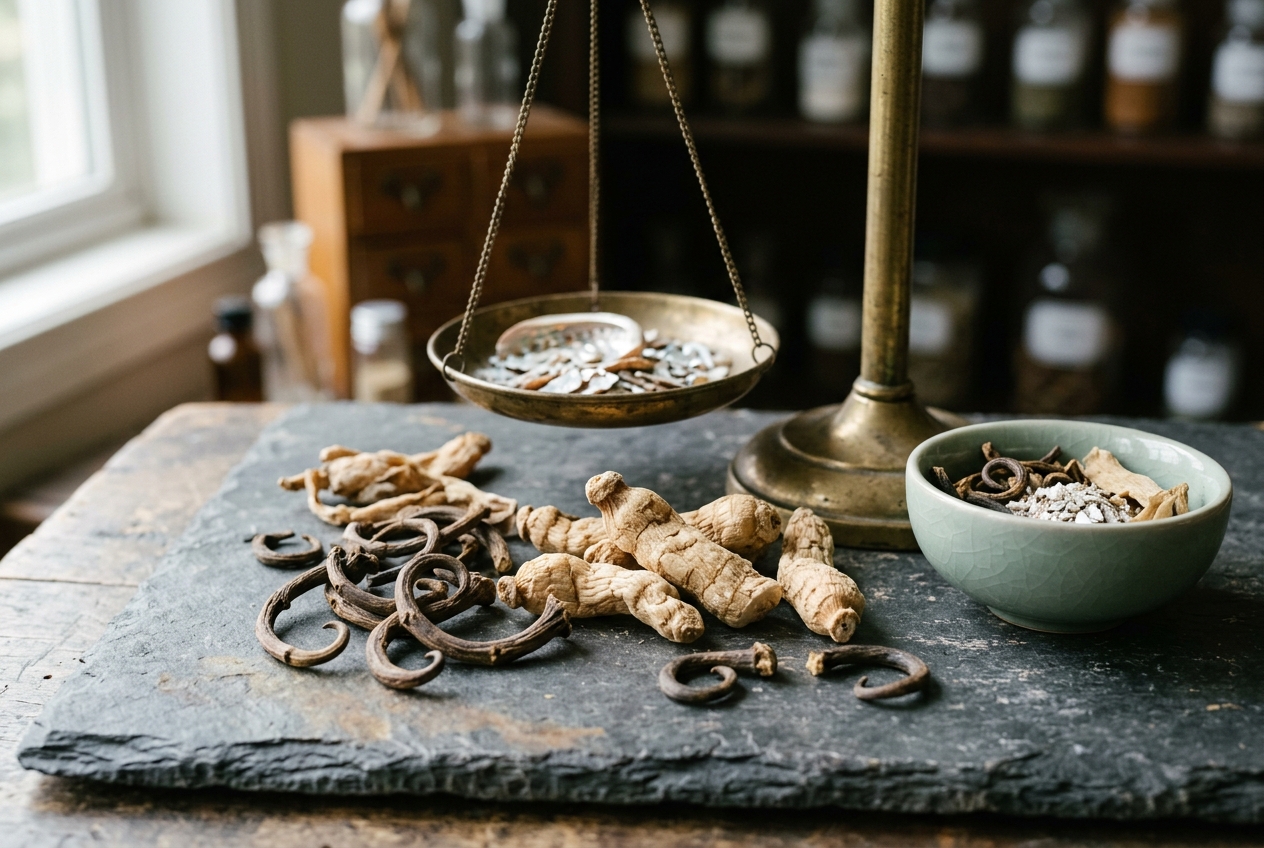
Subgroup 1: Herbs That Pacify the Liver and Anchor Yang (Píng Xī Gān Yáng Yào, 平熄肝阳药)
These agents consist predominantly of dense marine shells and heavy mineral ores. Their physical mass and chemical composition endow them with a sinking, descending therapeutic vector (Chén Jiàng), directly addressing root vacuity with branch excess.
- Shi Jue Ming (Concha Haliotidis, Abalone Shell):
- TCM Energetics: Salty, Cold. Enters the Liver meridian. Extinguishes Liver Yang and clears heat affecting the ocular apparatus.
- Biomedical Chemistry: Composed primarily of calcium carbonate ($CaCO_3$), matrix proteins, and trace minerals (magnesium, iron, silica).
- Zhen Zhu Mu (Concha Margaritifera, Mother of Pearl):
- TCM Energetics: Salty, Cold. Anchors buoyant Yang, pacifies the Heart, and arrests palpitations and terror.
- Biomedical Chemistry: High concentrations of bioavailable calcium, conchiolin, and amino acid complexes that exert anxiolytic, sedative effects on the central nervous system.
- Mu Li (Concha Ostreae, Oyster Shell):
- TCM Energetics: Salty, Astringent, Slightly Cold. Enters Liver and Kidney meridians. Anchors floating Yang, softens hardness (Ruǎn Jiān), and prevents the leakage of essential fluids.
- Dai Zhe Shi (Haematitum, Hematite Ore):
- TCM Energetics: Bitter, Cold. Enters Liver and Pericardium. The heaviest of the downward-directing agents. Drives rebelling stomach Qi and ascending Liver fire down to the lower burner.
- Biomedical Chemistry: Ferric oxide ($Fe_2O_3$); exhibits powerful gastro-protective and central down-regulating dynamics.
Subgroup 2: Herbs That Extinguish Wind and Arrest Tremors (Xī Fēng Zhǐ Jìng Yào, 息风止痉药)
These agents comprise potent botanical roots, vining hooks, and specialized fauna with high bio-permeability. They pierce the network vessels (Tōng Luò), resolve hypertonicity, and directly suppress neuromuscular spasming.
- Tian Ma (Rhizoma Gastrodiae, Gastrodia Rhizome):
- TCM Energetics: Sweet, Neutral. Enters exclusively the Liver meridian. The supreme herbal sovereign for all forms of wind—whether generated by cold, heat, excess, or deficiency.
- Key Constituent: Gastrodin (gastrodigenin 4-$\beta$-D-glucopyranoside) and its active metabolite 4-hydroxybenzyl alcohol (4-HBA). As detailed in comprehensive pharmacological reviews on Gastrodia elata at NCBI, it attenuates excitotoxic signaling.
- Gou Teng (Ramulus Uncariae cum Uncis, Uncaria Stem and Hook):
- TCM Energetics: Sweet, Slightly Cold. Enters Liver and Pericardium. Clears Liver heat, sedates vascular spasm, and arrests pediatric convulsions.
- Key Constituent: Rhynchophylline and Isorhynchophylline (monoterpene indole alkaloids).
- Quan Xie (Scorpio, Scorpion) & Wu Gong (Scolopendra, Centipede):
- TCM Energetics: Pungent, Toxic, Warm/Neutral. Extremely powerful tracking agents that penetrate the micro-collaterals to dismantle deep-seated wind-phlegm and stubborn contractures.
- Key Constituents: Specialized polypeptide neurotoxins (scorpine, scolopendrid toxins, and hyaluronidases).
- Di Long (Pheretima, Earthworm):
- TCM Energetics: Salty, Cold. Clears high heat, unblocks collateral channels, relaxes the bronchial tree, and lowers vascular resistance.
- Key Constituent: Lumbrokinase, hypoxanthine, and trace organic bases.
Neuropharmacological Mechanisms & Biomedical Correlates
The classical mechanisms of Ping Gan Xi Feng Yao align closely with modern neurobiology and autonomic physiology:
1. Modulation of GABAergic Pathways and Prevention of Excitotoxicity
The primary biological defense against neurological "wind" is gamma-aminobutyric acid (GABA), the major inhibitory neurotransmitter of the mammalian brain. In states of Liver Wind, excessive glutamate release triggers overactivation of N-methyl-D-aspartate (NMDA) receptors, flooding neurons with intracellular calcium and causing neuronal apoptosis.
As explored in peer-reviewed research on GABAergic signaling and neuroprotection, therapeutic agents that enhance inhibitory tone provide substantial clinical protection. Gastrodin upregulates glutamic acid decarboxylase (GAD)—the rate-limiting enzyme responsible for GABA biosynthesis—while inhibiting GABA transaminase (GABA-T), which degrades it. The resulting increase in synaptic GABA concentrations restores physiological inhibition across the cerebral cortex and basal ganglia, effectively stopping the bioelectric equivalent of internal wind.
2. Modulation of Voltage-Gated Ion Channels and Blood Pressure Regulation
Rhynchophylline from Gou Teng acts as a potent natural calcium channel antagonist, as evidenced in research detailing Rhynchophylline pharmacodynamics on ion channels. By blocking Cav1.2 channels in arterial smooth muscle, it inhibits calcium influx, promoting peripheral vasodilation and reducing elevated mean arterial pressure without provoking reflex tachycardia. Simultaneously, polypeptide neurotoxins derived from Quan Xie and Wu Gong interact with voltage-gated sodium channels ($Na_v1.7$ and $Na_v1.8$), preventing the runaway depolarization cascades that manifest clinically as muscle spasms, chorea, and neuropathic pain.
3. Attenuation of Neuroinflammation and Microglial Activation
Endogenous wind patterns are frequently driven by neuroinflammatory states. Pro-inflammatory cytokines ($TNF\text{-}\alpha$, $IL\text{-}1\beta$) activate microglia, provoking structural degradation of the blood-brain barrier. Active components of Di Long and Tian Ma inhibit the NF-$\kappa$B transcriptional pathway and suppress NLRP3 inflammasome assembly in microglial cells, providing a clear biological basis for the classical action of "clearing Liver heat and calming internal wind."
Archetypal Prescription Architectures
Classical Chinese medicine rarely relies on single substances; instead, it combines herbs into synergistic formulas where each ingredient serves a specific role within the formula hierarchy: Sovereign (Jūn), Minister (Chén), Assistant (Zǔo), and Envoy (Shǐ).
1. Tian Ma Gou Teng Yin (天麻钩藤饮) — Gastrodia and Uncaria Decoction
- Formula Composition: Tian Ma, Gou Teng, Shi Jue Ming, Zhi Zi, Huang Qin, Chuan Niu Xi, Du Zhong, Sang Ji Sheng, Ye Jiao Teng, Fu Shen, Yi Mu Cao.
- Synergy & Strategy: The modern benchmark for hypertensive encephalopathy, vertex migraines, and hyperactive Liver Yang progressing toward Wind. Tian Ma and Gou Teng calm the wind (Sovereigns); Shi Jue Ming anchors ascending Yang (Minister); Zhi Zi and Huang Qin clear channel heat; Chuan Niu Xi guides the blood volume downward; and Ye Jiao Teng with Fu Shen anchor the disturbed Hún.
2. Zhen Gan Xi Feng Tang (镇肝息风汤) — Sedate the Liver and Extinguish Wind Decoction
- Formula Composition: Dai Zhe Shi, Huai Niu Xi, Sheng Long Gu, Sheng Mu Li, Sheng Gui Ban, Sheng Bai Shao, Xuan Shen, Tian Men Dong, Chuan Lian Zi, Sheng Mai Ya, Yin Chen, Gan Cao.
- Synergy & Strategy: Designed for severe cases where deep Yin exhaustion permits an explosive, ascending surge of blood and Yang toward the brain (pre-stroke aura or cerebrovascular accident). Dai Zhe Shi and Huai Niu Xi heavily anchor the ascending current; Long Gu, Mu Li, and Gui Ban provide deep mineral weight to restrain buoyant Yang; while Bai Shao, Xuan Shen, and Tian Dong restore the exhausted Yin reserves.
3. Ling Jiao Gou Teng Tang (羚角钩藤汤) — Antelope Horn and Uncaria Decoction
- Formula Composition: Ling Yang Jiao (or modern botanical/mineral substitutes), Gou Teng, Sang Ye, Ju Hua, Bai Shao, Sheng Di Huang, Chuan Bei Mu, Zhu Ru, Fu Shen Mu, Gan Cao.
- Synergy & Strategy: Specifically structured for the pattern of Extreme Heat Stirring Wind (e.g., febrile convulsions or acute infectious meningitis). It aggressively extinguishes wind, cools heat at the deepest physiological levels, moistens tissue dryness, and clears heat-phlegm obstructing the pericardium.
Crucial Decoction Protocols and Preparation Science
The physical and chemical diversity of Ping Gan Xi Feng Yao demands precise, time-tested decoction methods. Phytochemical extraction efficiency varies significantly across minerals, animal toxins, and heat-labile botanical alkaloids.
1. Pre-Decocting Heavy Mineral Shells (Xiān Fén, 先煎)
- Target Herbs: Shi Jue Ming, Zhen Zhu Mu, Mu Li, Dai Zhe Shi, Long Gu.
- The Scientific Rationale: The dense, crystalline calcium carbonate and mineral matrices of these shell and ore agents exhibit exceptionally slow dissolution kinetics in boiling water.
- Protocol: Crush the raw shells/ores into a coarse powder. Place them in the decoction vessel with water and boil vigorously for 30 to 45 minutes prior to introducing the standard botanical ingredients. This pre-extraction phase fractures the mineral lattice, allowing therapeutic calcium ions, micro-colloids, and trace elements to fully dissolve into the liquid medium.
2. Short Post-Decocting for Heat-Sensitive Alkaloids (Hòu Xià, 后下)
- Target Herb: Gou Teng (Ramulus Uncariae cum Uncis).
- The Scientific Rationale: The primary therapeutic alkaloids responsible for its antihypertensive and neuroprotective effects—rhynchophylline and isorhynchophylline—contain heat-sensitive ester linkages. Prolonged thermal exposure causes thermal isomerization, hydrolysis, and degradation into inactive metabolites, reducing the herb's clinical potency.
- Protocol: Introduce Gou Teng into the boiling decoction only during the final 10 to 15 minutes of the process. This duration extracts the active monoterpene indole alkaloids while preserving their pharmacological stability.
3. Processing Fauna and Resolving Toxicity
- Quan Xie and Wu Gong should be gently dry-sautéed or steamed with rice wine (Jiǔ Zhì) to attenuate excessive hemolytic proteins while preserving the integrity of their therapeutic, neuro-modulatory peptide chains. Furthermore, their powerful nature requires low, carefully controlled dosages (typically 1–3 grams in classical decoctions, or 0.6–1 gram when pulverized into ingestible powders).
The World Health Organization Traditional Medicine Strategy emphasizes these systematic extraction protocols as vital components in the global standardization and safe clinical integration of traditional herbal preparations.
7. Today's Takeaway
If you do only one thing today to pacify your Liver and prevent the stirring of internal wind, make it this 5-minute grounding reset: step away from all illuminated screens, drink a warm cup of pure water or chrysanthemum tea, remove your shoes, and spend 3 minutes applying firm, downward circular pressure to the Taichong (LV 3) point on the top of your foot while practicing 6-second exhalations with the soft, subvocal "XŪ" sound. This simple, equipment-free practice directly engages your parasympathetic nervous system, lowers systemic peripheral resistance, and anchors rising cranial tension back into the earth—instantly restoring harmony to the inner landscape of your body.