Phlegm-Transforming and Cough-Relieving Herbs (Hua Tan Zhi Ke Ping Chuan Yao) Pharmacodynamics: Governing Mucociliary Clearance, Bronchial Spasmolysis, Turbid Sputum Resolution, and Rebellious Lung Qi Descent in Traditional Chinese Medicine
Every winter morning, millions of people wake to the same involuntary ritual: a heavy, adhesive tightness across the sternum, a scratch at the bifurcating juncture of the trachea, and a dry, raspy cough that rattles against the ribcage without bringing relief. We clear our throats reflexively, reaching for a glass of water to dissolve the stubborn, viscous sensation clinging to the posterior pharyngeal wall. In the biomedical clinic, this presentation is readily catalogued as hypersecretion of tracheobronchial mucin, compromised mucociliary clearance, or airway hyperreactivity secondary to viral insult or ambient particulate matter.
Yet, step into the diagnostic paradigm of Traditional Chinese Medicine (TCM), and this mundane sensation becomes the visible crest of a profound systemic imbalance. Within classical Chinese pneumology, the lungs do not operate in physiological isolation. The respiratory tract is the canopy of an interconnected fluid ecosystem. When this fluid dynamic falters, the result is Tan (phlegm)—a pathological entity that ranges from tangible bronchial secretions to subtle, systemic metabolic obstructions that cloud the mind and congest the somatic channels.
Understanding how to transform this pathogen requires exploring one of the most sophisticated botanical categories in global pharmacopeia: Hua Tan Zhi Ke Ping Chuan Yao (Phlegm-Transforming, Cough-Relieving, and Wheezing-Calming Herbs). By bridging traditional thermal energetics and channel tropism with modern molecular pharmacology—from calcium oxalate raphide degradation to steroidal alkaloid receptor binding—we reveal an integrated science of respiratory therapeutics.
1. Opening Scene — A Moment You'll Recognise
Imagine walking up a flight of stairs on a damp, chilly November morning. Halfway to the landing, your chest feels uncomfortably compressed, as if wrapped in a damp woollen band. With every deep inhalation, an irritating tickle triggers a shallow, barking cough, yet coughing fails to clear the obstruction. Your limbs feel strangely heavy, your mental focus is sluggish, and your head carries a dull, cotton-wool fog.
In modern terms, you might dismiss this as mild post-viral bronchitis or seasonal fatigue. In Chinese medicine, however, you are experiencing the dual manifestation of fluid stagnation: the tangible congestion in your bronchi represents substantial phlegm, while the heaviness in your legs and the cognitive fogginess reflect insubstantial phlegm.
Your body is demonstrating a foundational axiom first inscribed over a millennium ago: "The Spleen is the source of phlegm production; the Lung is the reservoir for phlegm storage" (脾为生痰之源,肺为贮痰之器). What feels like a localized throat irritation is, in reality, a macroscopic breakdown in how your body transforms, circulates, and clears biological fluids.
2. What This Organ System Does: The Lung-Spleen Axis and the Fluid Matrix
To understand how phlegm forms, we must examine the physiological partnership between the Lung (Fèi) and the Spleen (Pí). In the classical framework of Chinese medicine, these two organ systems govern the synthesis and propulsion of Qi (vital bioenergy) and Jin-Ye (physiological body fluids).
The Spleen functions as the body's digestive and metabolic processing engine. It is responsible for extracting nutritive essence from food and fluid, refining it, and ascending the pure moisture upward to the thoracic cavity. When the Spleen is compromised—whether by chronic psychological stress, physical exhaustion, or a diet excessive in cold, greasy, or refined foods—its transformative capacity declines. Unrefined fluid stagnates, condensing first into Dampness (Shī) and subsequently congealing into Phlegm (Tán).
The Lung, occupying the uppermost anatomical position among the Zang organs (often referred to as the "Delicate Organ" or the "Imperial Canopy"), is responsible for two fundamental vectorial dynamics: 1. Dispersing (Xuān Fā): The outward and upward distribution of defensive Qi (Wèi Qì) and lighter, mist-like fluids (Jīn) to the skin, musculature, and upper respiratory tract. 2. Depurative Descending (Sù Jiàng): The downward directing of inspired air and heavier physiological fluids (Yè) toward the Kidneys and Urinary Bladder.
When congealed phlegm from the Spleen migrates into the pulmonary canopy, it blocks the delicate bronchial passages, obstructing the Lung's natural descending trajectory. Robbed of its downward vector, Lung Qi rebels upward (Fèi Qì Shàng Nì), manifesting clinically as spasmodic coughing, wheezing, tachypnea, and thoracic oppression.
Substantial vs. Insubstantial Phlegm: The Somatic Continuum
A foundational diagnostic contribution of World Health Organization-recognized Traditional Medicine frameworks is the clear delineation between two distinct presentations of phlegmatic pathology:
- Substantial Phlegm (Yǒu Xíng Zhī Tán): Tangible, physical secretions produced by the respiratory mucosa. This includes productive sputum, viscous tracheobronchial exudates, post-nasal mucus, and inflammatory airway plugs. It is readily observable, expectorated, and directly auscultated as rhonchi or coarse crackles.
- Insubstantial Phlegm (Wú Xíng Zhī Tán): Intangible or occult fluid stagnation that has congealed within tissues, fascial planes, meridians, and visceral parenchymas. Insubstantial phlegm manifests as subcutaneous lipomas, thyroid nodules (Yīng Lìu), scrofula, lymphatic enlargement, atheromatous vascular plaques, and the neurological phenomenon known as "Phlegm Misting the Heart Orifices" (Tán Mí Xīn Qiào)—which presents as cognitive slowing, brain fog, vertigo, emotional dysregulation, and sensory dulling.
3. How You Can Feel It: Signs of Balance and Imbalance
The diagnostic brilliance of traditional pneumology lies in thermal and qualitative differentiation. Not all phlegm is identical; resolving it requires identifying whether the internal terrain is dominated by cold stagnation, inflammatory heat, or dryness.
+----------------------------------------------------------------------------------------------------+
|                               CLINICAL PHLEGM DIFFERENTIATION MATRIX                               |
+----------------------+-----------------------------------+-----------------------------------------+
| Diagnostic Parameter | Cold-Phlegm (Hán Tán)             | Heat-Phlegm (Rè Tán)                    |
+----------------------+-----------------------------------+-----------------------------------------+
| Sputum Quality       | Copious, thin, watery, or foamy   | Thick, tenacious, sticky, clumped       |
| Sputum Colour        | Clear to translucent white        | Dark yellow, green, or rusty brown      |
| Sensation in Chest   | Fullness, coldness, water-gurgle  | Burning sensation, sharp constriction   |
| Systemic Signs       | Aversion to cold, cold extremities| Thirst for cold drinks, flushed face    |
| Tongue Body & Coat   | Pale, swollen with white-wet coat | Red body with thick, greasy-yellow coat |
| Radial Pulse Profile | Slow, slippery, or wiry (Chí/Huá) | Rapid, slippery, or surging (Shuò/Huá)  |
+----------------------+-----------------------------------+-----------------------------------------+
Self-Assessment Checklist
Take a moment to assess your own respiratory and fluid dynamics: * Optimal Pulmonary Balance: Unimpeded nasal breathing; clear, unencumbered vocal resonance; absence of post-nasal drip; steady morning mental clarity; a tongue that is light pink with a thin, translucent white coating. * Cold-Damp Pattern: Tendency toward morning throat clearing of clear mucus, physical heaviness in the limbs, digestive bloating after cold beverages, intolerance of draughts, and a scalloped, wet tongue. * Heat-Phlegm Pattern: Recurrent sticky yellow mucus that is difficult to expectorate, persistent dry or scratchy throat, restless sleep with vivid dreaming, dry stools, and a tongue with a yellow coating concentrated at the root and center.
4. Qigong & Movement Practice: "Drawing the Bow to Open the Pulmonary Canopy"
To physically mobilize stagnant fluids within the thoracic cavity, traditional medical gymnastics relies on targeted biomechanical stretching and vocalized vibratory frequencies. The following exercise adapts the classical movement Zuǒ Yòu Kāi Gōng Sì Shè Diāo (Drawing the Bow to Shoot the Hawk) from the ancient Ba Duan Jin (Eight Brocades) sequence, specifically optimized for mucociliary mobilization.
Step-by-Step Exercise Guide
- Starting Position & Alignment: Stand with feet parallel, shoulder-width apart, knees softly unlocked. Drop your tailbone slightly so your lower back feels open and broad. Suspend the crown of your head as if drawn upward by an invisible silk thread. Rest your tongue lightly against the hard palate behind your upper front teeth. Take three long, abdominal breaths to settle your nervous system.
- Inhalation (The Draw): Cross your wrists in front of your chest at the level of the sternum (the Dan Zhong / CV-17 point), right wrist outside left. Slowly step your left foot outward into a wider stance. Inhale smoothly through your nose over four seconds as you extend your left arm horizontally to the left, shaping the left hand into an "L" or "Sword Finger" posture (index finger pointing straight up, thumb extended backward). Simultaneously, draw your right hand back toward your right shoulder as if pulling a taut bowstring, keeping the elbow elevated level with the shoulder.
- Expansion & Vibration: Turn your head to gaze intently along the left index finger. Feel the gentle stretch running from the subclavicular depression (Zhong Fu, LU-1) down the inner arm to the radial edge of the thumb (Shao Shang, LU-11). As you hold this full expansion for two seconds, emit a soft, sub-vocalized "Ssssssshhhh" sound (the classical healing sound of the Lung) on a gentle, controlled exhalation, vibrating the bronchial bifurcations.
- Return: Inhale smoothly as you relax your hands, sweeping both arms in a wide arc back to the central chest crossing, and step your left foot back to shoulder-width.
- Repetitions & Timing: Perform 8 repetitions to the left and 8 to the right, alternating sides, for a total duration of 5 to 7 minutes each morning.
- Sensations to Monitor: You should feel a warm, tingling sensation across the pectoral muscles and down the inner seam of the arms, followed by an immediate involuntary deepening of diaphragmatic excursion and spontaneous moistening of the dry pharynx.
5. Acupressure Points You Can Try Today
Targeted stimulation of classical acupoints acts via neuro-reflexive arcs, modulating autonomic tone to reduce bronchospasm and stimulate ciliary motility.
Point 1: Chǐ Zé (LU-5) — "Cubit Marsh"
- Anatomical Location: Located on the cubital crease of the elbow, in the palpable radial depression situated immediately lateral to the prominent tendon of the biceps brachii muscle.
- Application Technique: Flex your elbow slightly. Using the firm tip of your opposite thumb, apply perpendicular pressure angled slightly toward the bone. Maintain firm, steady pressure accompanied by small circular friction for 2 to 3 minutes per arm.
- Clinical Utility: As the He-Sea (Water) point of the Lung channel, LU-5 clears pulmonary heat, subdues counterflow rebellious Qi, and relieves acute, spasmodic coughing accompanied by yellow, sticky sputum or throat soreness.
Point 2: Liè Qūe (LU-7) — "Broken Sequence"
- Anatomical Location: Interlock the webs of your thumbs and index fingers of both hands. With your upper index finger resting along the lateral border of the opposite wrist, the point lies directly beneath the tip of the index finger, in a distinct notch superior to the styloid process of the radius (approximately 1.5 anatomical inches / two finger-widths proximal to the distal wrist crease).
- Application Technique: Press with the edge of your thumbnail or thumb tip, applying pressure obliquely upward toward the elbow joint for 1 to 2 minutes until a mild, spreading distension or achiness is felt.
- Clinical Utility: The Luo-Connecting point of the Lung meridian and the opening point of the Conception Vessel (Ren Mai). It dispels external pathogenic wind, relieves post-nasal drip, opens nasal passages, and calms persistent tickling coughs triggered by changes in ambient temperature.
Point 3: Fēng Lóng (ST-40) — "Abundant Bulge"
- Anatomical Location: Located on the anterolateral aspect of the lower leg, exactly midway between the lateral popliteal crease of the knee and the prominence of the lateral malleolus (outer ankle bone), approximately two horizontal finger-widths lateral to the anterior crest of the tibia.
- Application Technique: Using the reinforced tip of your thumb or middle finger knuckle, apply deep, steady circular pressure. Because this point accesses deep fascial planes, firm pressure is required for 3 minutes per leg.
- Clinical Utility: ST-40 is celebrated across classical and modern literature as the single most potent empirical acupoint on the human body for resolving all forms of phlegm, whether substantial pulmonary mucus, channel-obstructing nodules, or insubstantial mental heaviness and brain fog.
6. Pharmacological Breakdown & Botanical Therapeutics
The clinical pharmacopeia of Traditional Chinese Medicine categorizes respiratory agents into precise functional sub-groups based on their thermal properties, dynamic vectors, and chemical constituents. Understanding these botanicals bridges classical empirical formulas with contemporary molecular bioscience.
Category 1: Warm Herbs that Transform Cold-Phlegm (Wēn Huà Hán Tán Yào)
These botanicals possess acrid, warming, and drying characteristics. They directly target cold, damp, and stagnant fluids rooted in Spleen hypofunction and pulmonary cold.
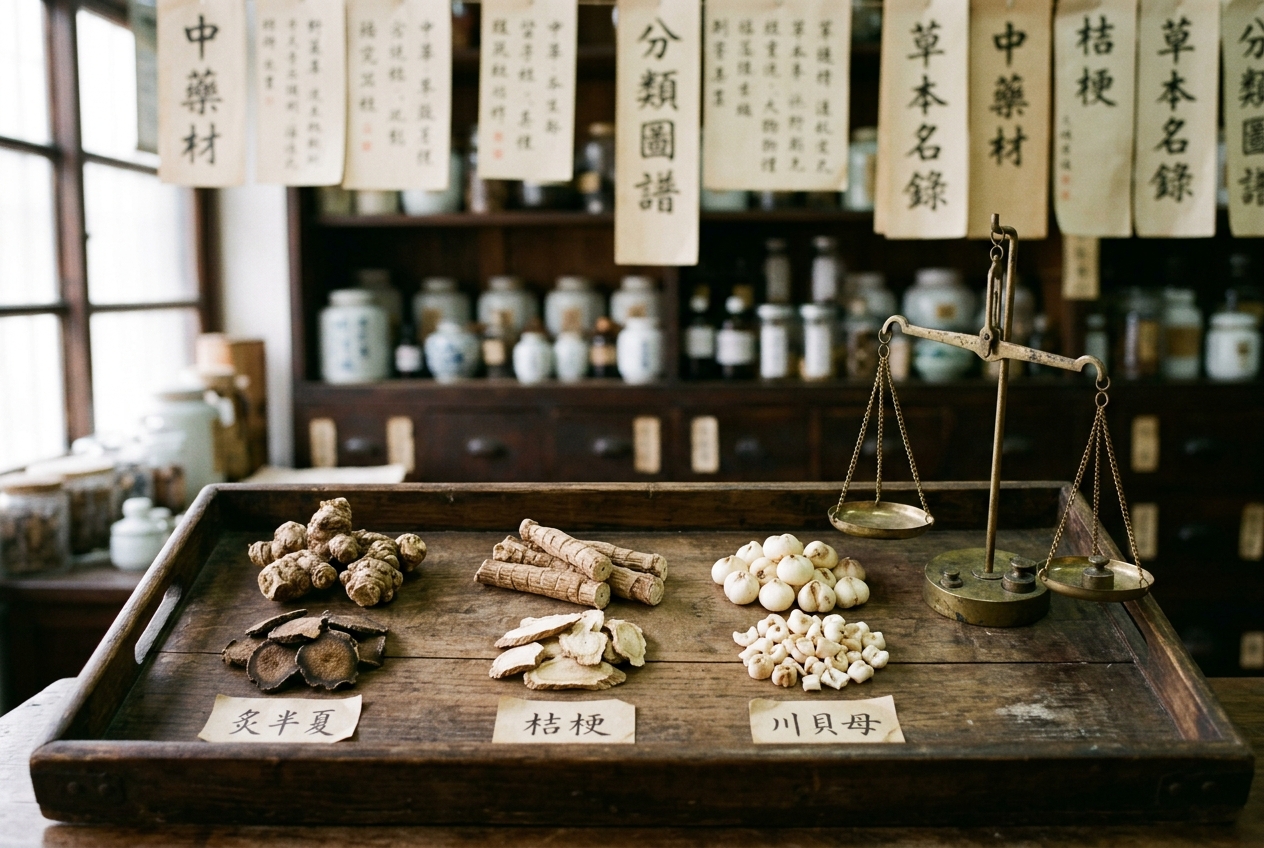
- Zhì Bàn Xià (Rhizoma Pinelliae Preparatum):
- Botanical Source: Pinellia ternata (Thunb.) Breit. (Araceae).
- Thermal & Channel Tropism: Warm, acrid, toxic (raw); enters the Spleen, Stomach, and Lung channels.
- Therapeutic Actions: Dries dampness, transforms cold phlegm, subdues rebellious Stomach Qi to stop vomiting, and dissipates focal glomus/nodules (Xiāo Pǐ Sàn Jié).
- Biomedical Pharmacology: Modern research documented on NCBI PubMed demonstrates that Pinellia ternata contains ephedrine alkaloids, beta-sitosterol, and polysaccharides that modulate central cough centers, stimulate gastric emptying, and suppress excessive goblet cell mucus secretion in airway epithelia.
- Tiān Nán Xīng (Rhizoma Arisaematis):
- Botanical Source: Arisaema erubescens (Wall.) Schott (Araceae).
- Thermal & Channel Tropism: Warm, acrid, bitter, toxic; enters the Liver, Lung, and Spleen channels.
- Therapeutic Actions: Aggressively dispels cold-phlegm, unblocks channel obstruction, dispels pathogenic wind, and relieves spasms/convulsions.
- Biomedical Pharmacology: Contains triterpenoid saponins and arisaemin that exhibit potent anticonvulsant, central sedative, and expectorant properties, particularly effective when phlegm obstructs the neuromuscular pathways.
- Bái Jiè Zǐ (Semen Sinapis Albae):
- Botanical Source: Sinapis alba L. (Brassicaceae).
- Thermal & Channel Tropism: Warm, acrid; enters the Lung channel.
- Therapeutic Actions: Penetrates the deep fascial planes and intercostal spaces to eliminate "phlegm lurking in the channels" (Tán Zài Pí Lǐ), disperses cold swellings, and relieves bronchial congestion.
- Biomedical Pharmacology: Rich in the glucosinolate sinigrin and the enzyme myrosinase. Upon hydrolysis, sinigrin yields allyl isothiocyanate, which irritates the gastric mucosa to reflexively stimulate bronchial secretomotor pathways, significantly thinning bronchial mucus.
Category 2: Herbs that Clear Heat-Phlegm (Qīng Huà Rè Tán Yào)
These agents possess sweet, bitter, and cold energetics. They liquefy thick, tenacious yellow mucus, clear inflammatory heat from the pulmonary parenchyma, and soothe bronchial irritation.
- Chuān Bèi Mǔ (Bulbus Fritillariae Cirrhosae):
- Botanical Source: Fritillaria cirrhosa D. Don (Liliaceae).
- Thermal & Channel Tropism: Slightly cold, sweet, bitter; enters the Lung and Heart channels.
- Therapeutic Actions: Clears heat, lubricates dry lungs, transforms stubborn phlegm, and dissipates scrofulous nodules. Specially indicated for chronic, dry, consumptive coughs with scanty, blood-streaked, or tenacious sputum.
- Biomedical Pharmacology: Pharmacological evaluations indexed in PubMed Central reveal that its principal steroidal alkaloids—peimine, peiminine, and verticine—act as potent non-narcotic antitussives. They exhibit selective antagonistic activity at muscarinic acetylcholine receptors (M3 subtype) and modulate voltage-gated calcium channels, mediating profound bronchial smooth muscle relaxation.
- Zhé Bèi Mǔ (Bulbus Fritillariae Thunbergii):
- Botanical Source: Fritillaria thunbergii Miq. (Liliaceae).
- Thermal & Channel Tropism: Cold, bitter; enters the Lung and Heart channels.
- Therapeutic Actions: Significantly more bitter and cold than Chuan Bei Mu; aggressively drains fire-heat, disperses toxic phlegm nodules, acute thyroid swellings, and breast abscesses.
- Biomedical Pharmacology: Possesses higher concentrations of verticinone and thunbergine, exerting broad-spectrum anti-inflammatory and anti-proliferative actions on lymphadenoid tissue.
- Guā Lóu (Fructus Trichosanthis):
- Botanical Source: Trichosanthes kirilowii Maxim. (Cucurbitaceae).
- Thermal & Channel Tropism: Cold, sweet, slightly bitter; enters the Lung, Stomach, and Large Intestine channels.
- Therapeutic Actions: Expands the chest to relieve painful constriction (Kuān Xiōng Sàn Jié), clears thick lung-heat phlegm, and lubricates the intestines to facilitate downward evacuation of toxins.
- Biomedical Pharmacology: Contains trichosanthin (a ribosome-inactivating protein), cucurbitacins, and unsaturated fatty acids that reduce microvascular permeability in the lungs, inhibit platelet aggregation, and stimulate intestinal peristalsis.
- Zhú Rú (Caulis Bambusae in Taeniam):
- Botanical Source: Bambusa tuldoides Munro (Poaceae).
- Thermal & Channel Tropism: Slightly cold, sweet; enters the Lung, Stomach, and Gallbladder channels.
- Therapeutic Actions: Clears heat-phlegm from the pulmonary and gastric systems, calms irritability, and halts acid reflux and vomiting secondary to Stomach Heat.
- Biomedical Pharmacology: Abundant in flavonoids, phenolic acids, and triterpenes that exert antioxidant protection on mucosal surfaces and demonstrate significant anti-emetic actions via central 5-HT3 receptor modulation.
Category 3: Cough-Relieving & Wheezing-Calming Herbs (Zhǐ Ké Píng Chuǎn Yào)
This subcategory focuses directly on redirecting rebellious Lung Qi downward, arresting bronchial spasms, and stopping cough regardless of underlying thermal etiology.
- Kǔ Xìng Rén (Semen Armeniacae Amarum):
- Botanical Source: Prunus armeniaca L. (Rosaceae).
- Thermal & Channel Tropism: Slightly warm, bitter, mildly toxic; enters the Lung and Large Intestine channels.
- Therapeutic Actions: Directs rebellious Lung Qi downward, arrests cough and dyspnea, and moistens the large bowel to relieve constipation.
- Biomedical Pharmacology: Contains the cyanogenic glycoside amygdalin (approximately 3–5%). As detailed in studies available via ScienceDirect, enzymatic cleavage of amygdalin by emulsin yields benzaldehyde and trace amounts of hydrocyanic acid (HCN). At therapeutic micro-doses, this trace HCN gently sedates the medullary respiratory center, decreasing reflex responsiveness and terminating cough paroxysms without depressing baseline minute ventilation.
- Zǐ Wǎn (Radix et Rhizoma Asteris):
- Botanical Source: Aster tataricus L. f. (Asteraceae).
- Thermal & Channel Tropism: Slightly warm, bitter, sweet; enters the Lung channel.
- Therapeutic Actions: Moistens the Lungs, descends Qi, and eliminates phlegm. Its neutral thermal balance makes it an indispensable agent for chronic, unremitting coughs across both cold and warm presentations.
- Biomedical Pharmacology: Rich in aster saponins, shionone, and epifriedelanol, which significantly accelerate tracheobronchial mucus transit velocity and stimulate the release of endogenous pulmonary surfactant.
- Kuǎn Dōng Huā (Flos Farfarae):
- Botanical Source: Tussilago farfara L. (Asteraceae).
- Thermal & Channel Tropism: Warm, acrid, sweet; enters the Lung channel.
- Therapeutic Actions: Directs rebellious Qi downward, moistens lung dryness, and stops cough. Frequently paired synergistically with Zi Wan for intractable wheezing.
- Biomedical Pharmacology: Contains tussilagone, farfadiol, and sesquiterpenoids that exert potent bronchodilatory and anti-spasmodic effects via direct calcium antagonism in airway smooth muscle cells.
- Sāng Bái Pí (Cortex Mori):
- Botanical Source: Morus alba L. (Moraceae).
- Thermal & Channel Tropism: Cold, sweet; enters the Lung and Spleen channels.
- Therapeutic Actions: Drains lung heat, subdues wheezing, and promotes diuresis to alleviate facial edema and hydrothorax (Xiè Fèi Píng Chuǎn, Lì Shuǐ Xiāo Zhǒng).
- Biomedical Pharmacology: Rich in prenylated flavonoids (morisin, kuwanon C/G) and moracenin D, demonstrating marked antihypertensive, diuretic, and elastase-inhibitory activities that protect alveolar walls against inflammatory degradation.
Classical Formulas: The Synergy of Formulation
Individual botanicals are rarely prescribed in isolation; they are deployed within elegant classical architectures designed to address root metabolic dysfunction alongside acute symptoms.
1. Èr Chén Tāng (Two-Cured Decoction)
Formulated by Chen Shi-liang in the Imperial Grace Formulary of the Tai-Ping Era (Taiping Huimin Heji Jufang, 1151 AD).
- Clinical Analysis: Er Chen Tang is the foundational prescription for resolving cold-damp phlegm arising from Spleen deficiency. The term "Two-Cured" refers to Ban Xia and Chen Pi, both of which improve in therapeutic quality and lose harsh acridity when aged (Chen) properly. By coordinating the drying of existing phlegm with the systemic drainage of dampness through the urinary bladder, it shuts down the source of fluid accumulation.
2. Bèi Mǔ Guā Lóu Sǎn (Fritillaria and Trichosanthes Powder)
Authored by Cheng Guo-peng in Medical Insights (Yi Xue Xin Wu, 1732 AD). * Composition: Chuan Bei Mu (Chief), Gua Lou (Deputy), Tian Hua Fen (Assistant), Fu Ling (Assistant), Ju Hong (Assistant), Jie Geng (Envoy). * Clinical Analysis: Designed specifically for lung-heat dry-phlegm patterns where thick, tenacious sputum resists expectoration, inducing paroxysms of exhausting, hacking cough. Chuan Bei Mu and Gua Lou clear heat and liquefy phlegm; Tian Hua Fen generates fluids to lubricate desiccated alveolar membranes; Jie Geng (Radix Platycodi) acts as the "soaring envoy," opening the upper chest and guiding the therapeutic action directly to the throat.
Toxicology & Processing Protocols: The Science of Pào Zhì
A central hazard in raw Araceae botanicals (Pinellia ternata, Arisaema erubescens) is their severe mucosal toxicity. Ingestion of raw Ban Xia or Tian Nan Xing produces immediate, agonizing oropharyngeal burning, glossal edema, aphonia, salivation, and potentially lethal laryngeal obstruction.
+----------------------------------------------------------------------------------------------------+
|                       PAO ZHI (PROCESSING) DETOXIFICATION MECHANISM                                |
+----------------------------------------------------------------------------------------------------+
| Raw Material Hazard       | Needle-shaped Calcium Oxalate Raphides + Inflammatory Lectins          |
| Morphological Form        | Sharp, spear-like crystalline bundles arranged in specialized idioblasts|
| Pathological Mechanism    | Mechanical puncture of oral/mucosal cells followed by injection        |
|                           | of irritant inflammatory lectin proteins and bradykinin-inducers   |
+---------------------------+------------------------------------------------------------------------+
| Pao Zhi Protocol          | Multi-day decoction/maceration with Shēng Jiāng (Fresh Ginger juice)   |
|                           | and Bái Fán (Potassium Alum - KAl(SO4)2·12H2O)                         |
+---------------------------+------------------------------------------------------------------------+
| Physico-Chemical Result   | 1. Alum ions degrade and round off the sharp tips of oxalate raphides. |
|                           | 2. Thermal processing denatures the toxic lectin proteins.             |
|                           | 3. Gingerols functionally counteract bradykinin-mediated inflammation. |
+----------------------------------------------------------------------------------------------------+
Through empirical refinement, Chinese pharmacognosy developed specialized processing (Pào Zhì) protocols. Raw Ban Xia is repeatedly soaked, boiled, and treated with Shēng Jiāng (fresh ginger rhizome juice) and Bái Fán (potassium alum).
Modern electron microscopy reveals that raw Pinellia contains sharp, needle-like calcium oxalate raphide crystals packed into specialized idioblast cells. These raphides act as microscopic hypodermic needles, puncturing mucosal membranes to inject toxic, pro-inflammatory lectin proteins that provoke massive local histamine and bradykinin cascades.
The Pao Zhi procedure chemically degrades and erodes the needle-sharp tips of the raphides into blunt, harmless micro-particles, while thermal decoction denatures the associated lectins. This transforms a dangerous mucosal irritant into Zhì Bàn Xià—a safe, indispensable clinical expectorant.
Accessible Dietary and Lifestyle Practices
To support the pharmacological clearance of phlegm using everyday ingredients: * Foods to Emphasize: * For Dry/Heat-Phlegm: Poached Asian pears (Pyrus pyrifolia) simmered with a pinch of organic lemon zest and a teaspoon of honey; steamed white fungus (Tremella fuciformis); daikon radish soup. * For Cold-Damp Phlegm: Simmered broth with fresh sliced ginger (Zingiber officinale), aged dried tangerine peel (Citrus reticulata), scallion whites, and lightly toasted barley or Job's tears (Coix lacryma-jobi). * Foods to Reduce: Eliminate ultra-processed dairy foods, iced cold drinks, deep-fried lipids, and refined corn-syrups. In TCM pathophysiology, these items overload the Spleen's transformative capacity, accelerating the transformation of unrefined food moisture into turbid pulmonary mucus.
7. Today's Takeaway
If you do only one thing today to optimize your respiratory fluid metabolism, spend three minutes practicing rhythmic, warm hydration accompanied by acupressure.
Brew a simple mug of hot water steeped with two thin slices of fresh ginger and a strip of organic orange or tangerine peel. As you sip the warm infusion, locate ST-40 (Fēng Lóng) on your lower leg—midway between your ankle and knee, two finger-widths lateral to the shinbone—and apply deep, circular pressure with your thumb for 90 seconds per side.
This simple daily intervention coordinates thermal digestive stimulation with neuro-reflexive phlegm clearing, opening your airways and restoring mental clarity from the inside out.