Pangguangshu Cavity Bladder Shu: Sacral Fascial Decompression, Lower Burner Fluid Transformation, and Posterior Kinetic Chain Rooting in Classical Neigong
At this specific anatomical coordinate, the tissue architecture exhibits remarkable structural complexity. Deep to the cutaneous surface lies the thick aponeurotic confluence of the thoracolumbar fascia, the tendinous origins of the erector spinae (specifically the longissimus and iliocostalis lumborum), and the deep, stabilizing multifidus fibers. Immediately anterior and inferior to this muscular bed lies the dense, fibrous webbing of the posterior sacroiliac ligaments and the superior anchorage of the sacrotuberous ligament.
Beneath this connective scaffolding lies a crucial neural hub: the lateral branches of the posterior rami of the second sacral spinal nerves (S2), adjacent to the second posterior sacral foramen. Through this foramen emerge the neurological conduits of the sacral parasympathetic outflow (S2–S4), which give rise to the pelvic splanchnic nerves. These pathways provide primary autonomic innervation to the pelvic viscera, governing urinary bladder contractility, lower bowel motility, and pelvic hemodynamic regulation.
In classical meridian theory, as cataloged by the World Health Organization Traditional Medicine benchmarks, BL28 belongs to the Foot Taiyang (Bladder) meridian—the longest and most superficial energetic channel of the human body. Fascial researchers like Thomas Myers have demonstrated that this energetic trajectory corresponds precisely to the "Superficial Back Line" (SBL), a continuous myofascial super-highway running from the plantar fascia and calcaneus, up the gastrocnemius, hamstrings, and sacrotuberous ligament, across the sacrolumbar fascia, along the erector spinae, and over the epicranial aponeurosis to the brow. Within this vast tensegrity web, BL28 operates as a dynamic force-transfer hinge, modulating mechanical loads between the vertical spine and the grounded legs.
Classical Physiology: The Mechanism of Qi Hua and Fluid Transformation
In the foundational medical treatise Huangdi Neijing Suwen (Yellow Emperor's Inner Classic, Chapter 8), the Urinary Bladder organ system is described not merely as a mechanical reservoir, but as a sophisticated metabolic engine:
"The Bladder is the official in charge of regional reservoirs; it stores the fluids (Jinye), and when transformed by Qi (Qi Hua), they can be discharged."
In traditional Chinese medicine (TCM), the transformation of fluids—termed Qi Hua (氣化)—is an active thermodynamic process. The physical bladder relies on the metabolic heat and movement supplied by the Lower Dantian and the Mingmen (Gate of Vitality) to vaporize clear fluids, sending refined mist upward to nourish the brain, lungs, and skin, while directing turbid water downward for excretion.
When the parasacral tissues at BL28 become rigid, dehydrated, or compressed due to chronic sitting or postural collapse, the physical and energetic conduit of Pangguangshu becomes obstructed. This local stagnation (Qi Zhi) inhibits the micro-circulation of interstitial fluid, stalls the sacral pump mechanism, and compromises the pelvic parasympathetic tone. The clinical consequences described in classical acupuncture texts—such as those indexed across National Center for Biotechnology Information biomedical literature on autonomic modulation—range from lower back stiffness, sciatica, and sacral coldness to urinary retention, pelvic floor hypertonicity, and chronic fatigue.
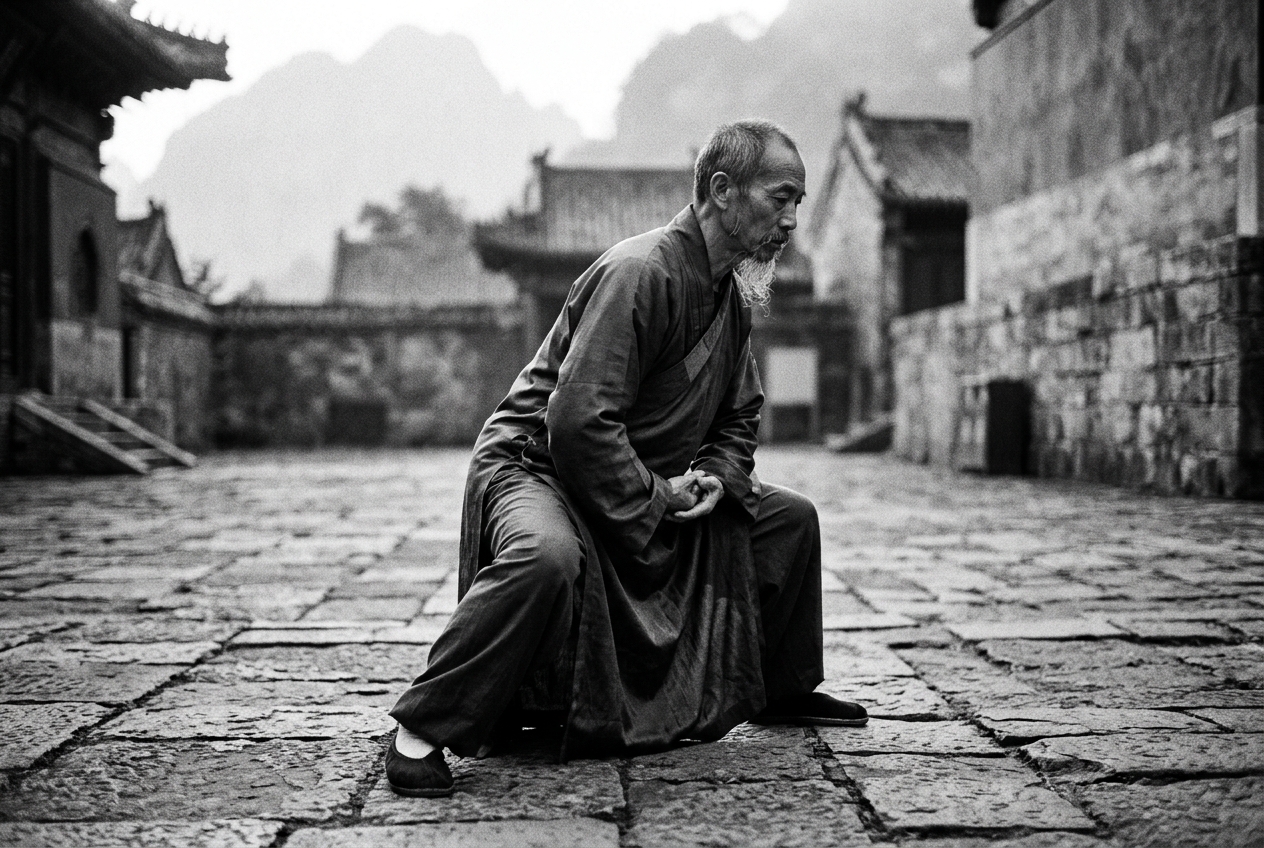
In internal martial arts (Neijiaquan), decompressing this area through the practice of Song Yao (鬆腰, releasing the waist) and Chen Kua (沉胯, sinking the hips) is considered essential for establishing structural alignment. An open, decompressed Pangguangshu region allows the descending kinetic vector of gravity to pass unobstructed through the sacrum, along the hamstrings and calves, and into the calcaneus (the heel), rooting the practitioner deeply into the earth while maintaining an upward, buoyant rebound through the central spine.
Step-by-Step Practical Cultivation Guide
To awaken and decompress the Pangguangshu cavity, practice the following four sequential exercises. These methods integrate somatic alignment, rhythmic breathwork, and focused mental intent (Yi).
Practice 1: Seated Daoyin Parasacral Pelvic Tilts (Zuo Shi Daoyin)
This foundational drill removes superficial muscular bracing around the S2 foramen and re-establishes conscious proprioceptive awareness of the sacral hinges.
- Setup: Sit forward on the edge of a firm, flat wooden chair or meditation bench. Place your feet flat on the floor, shoulder-width apart, with your knees bent at 90-degree angles. Place the palms of your hands over your sacrum, with your fingertips resting directly upon BL28 on both sides.
- Inhalation (Expansion): Inhale slowly through your nose into the lower abdomen (Lower Dantian). Allow your pelvis to gently roll forward on your sitz bones (ischial tuberosities), creating a subtle, natural anterior curve in your lumbar spine without pinching your lower back.
- Exhalation (Decompression): Exhale smoothly through your nose. Roll your pelvis backward slightly, allowing your tailbone to tuck underneath and your lower back to flatten and gently dome outward.
- Internal Focus: As you exhale and tuck the pelvis, direct your mental focus (Yi) into your fingertips at BL28. Intentionally relax the multifidus and gluteal attachments away from the sacral border. Feel the skin and fascia beneath your fingers widen horizontally.
- Cadence: Perform 18 to 36 continuous, rhythmic cycles. Move with slow, hydraulic fluidness rather than muscular effort.
Practice 2: The Sacral Wall Squat (Dun Qiang Gong 蹲牆功)
Originating from traditional Daoist longevity practices and popularized in modern qigong systems documented by the National Qigong Association, the wall squat is an effective posture for decompressing the thoracolumbar junction and opening the posterior sacral foramina.
- Setup: Stand facing a smooth, vertical wall. Place your feet parallel and touching (or shoulder-width apart for beginners), with your toes positioned two to four inches from the baseboard. Keep your arms hanging naturally at your sides or resting on your hips.
- Descent Phase: Inhale deeply into your lower back. On your exhalation, slowly bend your knees and descend into a squat. Keep your forehead and nose hovering within an inch of the wall without touching it.
- Sacral Cueing: As you sink, avoid collapsing your chest. Instead, focus entirely on dropping your coccyx straight down toward the floor. Visualize the sacral gutter at Pangguangshu peeling open like a fan, creating broad vertical and horizontal space across S2–S4.
- Ascent Phase: Pause at your lowest comfortable depth for two seconds. Inhale as you push through the center of your heels, drawing the earth force up through the back of your legs and unwinding the spine upward to return to standing.
- Common Mistakes & Corrections: - Error: Knees flaring outward or knocking inward, which twists the sacroiliac joint. - Correction: Keep your kneecaps tracking directly over the line of your second toes throughout the movement. - Error: Forcing the lower back flat through excessive abdominal tension. - Correction: Allow the descent to be driven by gravity and relaxation (Song) of the hip creases (Kua), letting the sacral space expand naturally.
Practice 3: Zhan Zhuang Standing Meditation with Parasacral Micro-Undulations
Standing meditation builds internal structural support by integrating the relaxed sacral gateway with the entire myofascial network.
- Setup: Stand in the classic Hunyuan (Embracing the Tree) posture. Feet are parallel and shoulder-width apart, knees slightly softened, pelvis neutrally suspended, and arms curved in front of your chest as if holding a large sphere. The crown of your head (Baihui, GV20) reaches upward as if suspended from a silk thread.
- Settling the Root: Release tension from your shoulders, chest, and diaphragm. Let this released weight slide down the spine and settle directly into the hip creases (Kua) and the sacral basin.
- The Micro-Undulation: - With every slow inhalation, imagine breathing directly into the Pangguangshu points. Feel a gentle, hydraulic fullness fill the sacral gutters, pushing your fingertips or clothing outward by a millimeter. - With every long exhalation, gently release the coccyx a millimeter deeper toward the floor. Feel the parasacral fascia soften and widen, while a responsive, spring-like rebound travels downward through the back of your thighs into the centers of your heels (Yongquan to Calcaneus).
- Duration: Maintain this quiet, micro-undulating standing posture for 10 to 20 minutes daily.
Practice 4: Yi-Directed Breathwork and Parasacral Vectoring (Xiang Yi Gui Gen)
This internal breathwork exercise connects mental intent with the neurological pathways of the sacrum.
- Posture: Lie flat on your back on a firm yoga mat or wooden floor, with your knees bent and your feet resting flat on the floor, hip-width apart.
- Hand Placement: Slide both hands palms-up under your sacrum so that the knuckles of your index and middle fingers rest comfortably against the muscular margins of BL28.
- The Water Breath Vector: - Inhale for a count of four into your Lower Dantian. - Hold your breath comfortably for a count of two, bringing your attention (Yi) to the physical pressure points where your sacrum rests against your fingers. - Exhale for a count of six through your nose, visualizing a stream of warm water flowing from the base of your brain, cascading down your spinal column, washing through the Pangguangshu gateways, and flowing out through the soles of your feet.
- Somatic Release: With each exhalation, feel the heavy sacral bone sinking into your hands as the surrounding myofascial tissues release their protective tone.
Contrasting Somatic Sensations: Compression vs. Parasacral Expansion
Recognizing internal somatic feedback is essential for navigating the progression of internal cultivation:
| Somatic Domain | Sacral Compression & Stagnation (Qi Zhi) | Parasacral Expansion & Tensegrity (Song Kai) |
|---|---|---|
| Lumbar Mechanics | Stiff, jammed lower back; exaggerated or flattened lumbar lordosis; sensation of mechanical compression at L5–S1. | Buoyant lumbar spine (Xu Ling); effortless upright carriage; sensation of spinal vertebrae resting upon hydraulic cushions. |
| Pelvic Floor Tone | Hypertonic, guarded, or collapsed pelvic diaphragm; chronic holding patterns in the perineum (Huiyin). | Supple, responsive pelvic diaphragm that rhythmically ascends and descends in harmony with the respiratory diaphragm. |
| Lower Limb Rooting | Disconnected leg kinetic chain; weight sits forward in the metatarsals; unstable, easily disrupted balance. | Deep calcaneal anchorage; force transfers effortlessly down the posterior line into the heels; grounded, tree-like stability. |
| Fluid & Thermal State | Coldness across the sacrum and gluteal region; sluggish lower-extremity circulation; swollen ankles or heaviness. | Radiant, warm sensation across the lower back and sacrum; smooth, buoyant circulation; light, springy lower limbs. |
| Autonomic Nervous State | Persistent low-grade sympathetic activation; shallow thoracic breathing; heightened vigilance. | Deep parasympathetic tone; slow, rhythmic diaphragmatic breathing; profound internal calm and mental clarity. |
Classical Lineage, Historical Context, and Epistemology
The systematic cultivation and mobilization of the sacral gateways is a central pillar of ancient Daoist Yang Sheng (Nourishing Life) traditions and classical Chinese medicine. Detailed in early acupuncture classics such as the Zhenjiu Jiayi Jing (Systematic Classic of Acupuncture and Moxibustion, circa 282 CE by Huangfu Mi), the points of the sacral region—specifically the Ba Liao (Eight Sacral Foramina) and the adjacent Shu points of the Bladder Meridian on Wikipedia: Bladder meridian—were recognized as critical command centers for regulating the "sea of marrow" and circulating defensive (Wei) and nutritive (Ying) Qi throughout the body.
In the internal martial traditions—including Yang and Chen style Taijiquan, Baguazhang, and Xingyiquan—the lower back and sacrum are collectively regarded as the "ruler of the entire body." The famous Taijiquan Classics, attributed to the legendary Daoist master Zhang Sanfeng and preserved by the Wu and Yang lineages, state unequivocally:
"The source of the postures lies in the waist (Yao). If you cannot find progress, seek it in the waist and legs."
In classical Neidan (Internal Alchemy), the sacral region is intimately associated with the Weilu Guan (尾閭關, the "Tailbone Gate" or "Coccyx Pass")—the first of the three formidable energetic checkpoints (San Guan) along the governing vessel (Du Mai) that must be opened for the subtle fire of the Lower Dantian to circulate upward through the Microcosmic Orbit (Xiao Zhou Tian). The precise mobilization of Pangguangshu acts as the mechanical key that unlocks this lower gateway, removing the dense fascial knots that prevent the ascending movement of refined vitality.
Western Neurophysiology and Fascial Dynamics
Modern scientific investigation offers compelling biological correlates for the phenomena described by classical masters:
- Parasympathetic Neuromodulation: As documented in clinical studies indexed across PubMed, mechanical stimulation and myofascial release of the parasacral tissues at the S2–S4 level directly modulate the parasympathetic nervous system. Decompressing the sacral gutter reduces aberrant mechanical afferent signals from hypertonic deep rotators and the piriformis, restoring normal autonomic regulation to the pelvic splanchnic plexus, improving bowel and bladder function, and supporting systemic heart rate variability (HRV).
- The Thoracolumbar Hydraulic Amplifier: The thoracolumbar fascia is not merely passive wrapping; it is a dynamic, highly innervated sensory organ embedded with mechanoreceptors (Ruffini endings, Pacinian corpuscles, and interstitial receptors). Deep diaphragmatic breathing, combined with the somatic pelvic adjustments of Song Yao, dynamically strains and relaxes this fascial lattice. This mechanism acts as a hydraulic pump, assisting venous return from the pelvic cavity and circulating interstitial fluids through the deep paraspinal tissues.
- Restoration of the Sacroiliac Joint Micro-Motion: While the sacrum is commonly viewed as an immobile keystone, it possesses vital physiological micro-motions: nutation (anterior nodding of the sacral base) and counternutation (posterior tilting). Chronic sedentary compression locks the sacrum in rigid, dysfunctional positions. The Daoyin movements detailed above restore healthy nutation mechanics, enabling the pelvic ring to absorb kinetic shock and distribute force through the posterior chain.
Daily Cultivation Schedule
To translate these principles into practical results, adopt the following structured routine:
Tomorrow morning, before having your first coffee or checking your digital devices, sit on the edge of a chair and perform five minutes of the Seated Daoyin Pelvic Tilts. Place your full awareness into the Pangguangshu points beneath your fingers. Notice the immediate change in your pelvic warmth, the ease of your upright posture, and the calm clarity of your mind as the lower gate of your spine opens to start your day.