Pan Long Ru Dong: Navigating Helical Peristaltic Mechanics, Deep Stagnation Dissolution, and Precision Acupressure Protocols
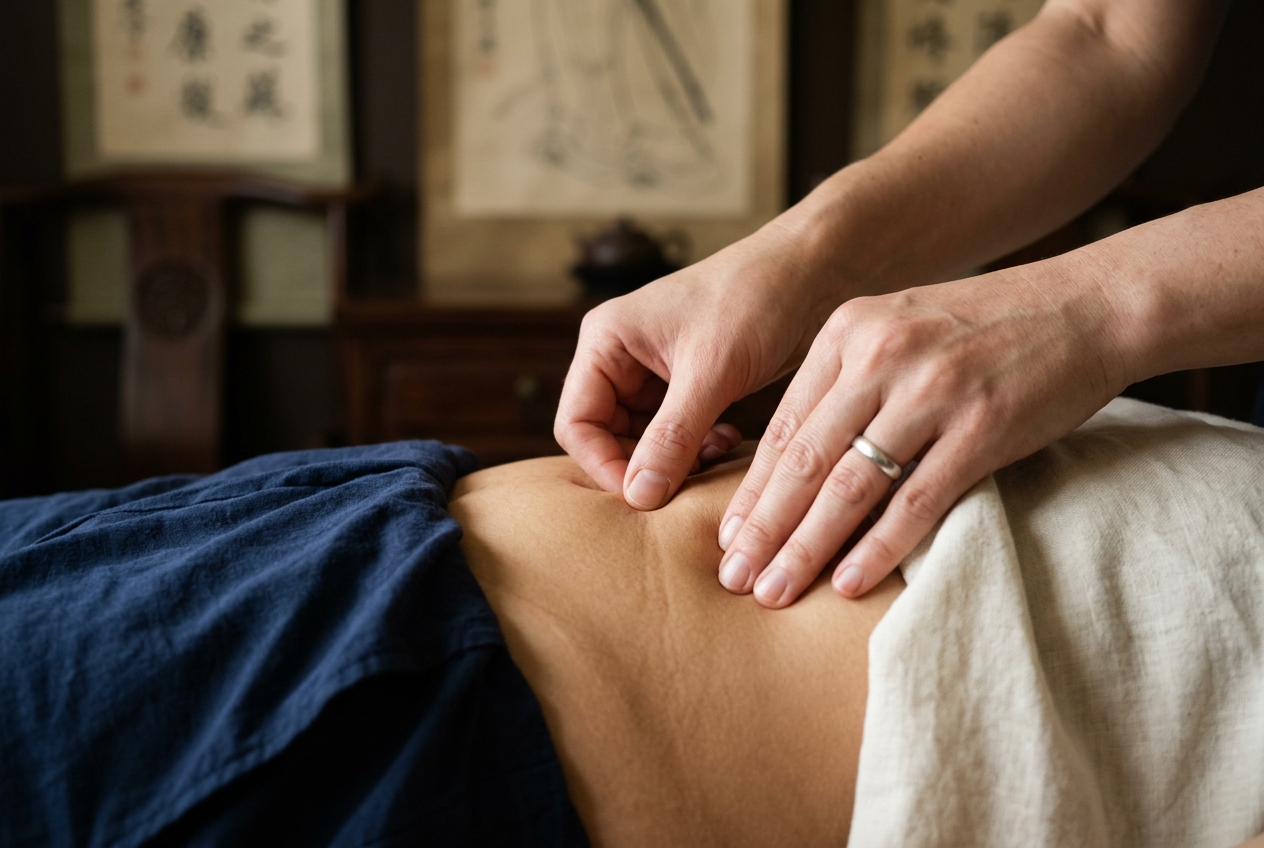
1. Opening — A Problem This Solves Today
If you regularly experience a dense, immovable fullness below your ribs after eating, find yourself plagued by sluggish mid-morning mental fatigue, or carry a chronic, low-grade knot of visceral apprehension in the pit of your stomach, you are intimately acquainted with the territory of functional gastrointestinal stagnation. Modern gastroenterology frequently categorizes these persistent, non-structural complaints under functional dyspepsia, irritable bowel syndrome, or autonomic dysregulation of the enteric nervous system. Standard pharmaceutical interventions—ranging from proton-pump inhibitors to prokinetic agents—frequently offer only palliative attenuation, failing to address the underlying physical densification and neuromuscular uncoupling of the abdominal wall and mesenteric fascia.
+-------------------------------------------------------------------------------+
| CLINICAL PHENOMENOLOGY: THE VISCERAL MANIFESTATION OF STAGNATION               |
+-------------------------------------------------------------------------------+
| Classical Syndrome      | Modern Neuro-Fascial Correlate                     |
+-------------------------+-----------------------------------------------------+
| Epigastric Glomus (Pi)  | Hyper-tonicity of the transversus abdominis &       |
|                         | solar plexus sympathetic hyper-reactivity           |
| Food Accumulation (Ji)  | Delayed gastric emptying & interstitial dysmotility |
| Qi-Blood Congealment    | Microvascular hypoperfusion & fascial cross-linking |
+-------------------------+-----------------------------------------------------+
Traditional Chinese Medicine (TCM) recognizes this state as a disturbance of the digestive meridian axis—primarily involving the Conception Vessel (Ren Mai), the Stomach Meridian of Foot-Yangming, and the Spleen Meridian of Foot-Taiyin. When emotional distress, postural collapse, or metabolic overburden halts the smooth descent of Stomach-Qi and the nutritive transformation of Spleen-Qi, the physiological consequence is Ji Ju (癥瘕积聚: visceral accumulations, gatherings, and recalcitrant glomus formations).
To resolve these deep, stubborn stagnations, classical masters did not rely on superficial stimulation. Instead, they devised subtle, dynamic biomechanical methods to physically unwind connective tissue and clear deep vascular resistance. Foremost among these advanced methods is Pan Long Ru Dong (盘龙蠕动法—The Coiling Dragon Undulation Method), a classical manual needling manipulation codified in the seminal Ming Dynasty text Jin Zhen Fu (金针赋 - Ode to the Gold Needle). By understanding the translation of these needle dynamics into refined, non-invasive spiral acupressure, we unlock a powerful clinical methodology for restoring visceral mobility, remodeling the extracellular matrix, and harmonizing the enteric nervous system.
2. The Meridian Path — A Journey Through the Body
To understand how the Coiling Dragon technique exerts its systemic effects, one must trace the living highways of connective tissue and neural pathways that link the extremities directly to the abdominal viscera. Rather than isolated energetic lines, Chinese medical meridians represent functional pathways running within continuous fascial planes, neurovascular bundles, and muscular chains.
The Foot-Yangming (Stomach) Meridian
The Stomach meridian begins beside the base of the nose, ascends to the inner corner of the eye, and cascades down the jawline into the throat. Traversing the collarbone, it plunges downward in a line running through the muscular belly of the pectorals, descends along the sheath of the rectus abdominis muscle, and passes over the front of the hip joint.
From the pelvic crest, it travels down the powerful muscle on the front-outer quadrant of your thigh, crosses the outer hollow of the knee, and moves down the front-outer surface of your shinbone—the exact muscular ridge (tibialis anterior) that tightens and aches after miles of brisk walking. It terminates at the lateral tip of the second toe. This meridian governs the somatic and visceral propulsion of food, kinetic mobilization, and the systemic descent of physiological fluids.
The Foot-Taiyin (Spleen) Meridian
Complementing this descent, the Spleen meridian commences at the medial corner of the great toe nail, sweeps along the inner border of the foot, and rounds the prominent inner ankle bone. It ascends directly along the posterior edge of the shinbone—running within the deep intermuscular septum between the calf muscles and the bone—crosses the inner knee, traverses the inner thigh, and enters the lower abdomen.
There, it integrates deeply with the digestive organs, pancreas, and spleen before terminating on the lateral ribcage below the armpit. The Spleen pathway manages tissue hydration, muscular tone, and the ascending extraction of refined metabolic energy.
The Conception Vessel (Ren Mai)
The Conception Vessel runs directly along the anterior midline of the human torso. Commencing at the perineum, it ascends through the pubic symphysis, crosses the center of the navel, bisects the epigastrium (solar plexus), travels over the sternum, and concludes in the groove beneath the lower lip. As the "Sea of the Yin Channels," the Ren Mai is the central neuro-fascial axis governing the visceral contents of the pelvic, abdominal, and thoracic cavities.
+-------------------------------------------------------------------------------+
| HISTORICAL LINEAGE & TEXTUAL FOUNDATION: JIN ZHEN FU                          |
+-------------------------------------------------------------------------------+
| Attributed to the Ming Dynasty scholar-physician Quan Zhenheng and later      |
| compiled in Yang Jizhou's landmark 1601 compendium Zhen Jiu Da Cheng          |
| (针灸大成 - The Great Compendium of Acupuncture and Moxibustion), the         |
| Jin Zhen Fu is a cornerstone of advanced Chinese needling therapeutics.       |
|                                                                               |
| The text delineates complex, multi-stage needle manipulations engineered      |
| to generate specific thermal, mechanical, and bioelectrical responses:        |
|                                                                               |
|  "盘龙蠕动,去积聚之坚凝;如龙盘卧,徐徐蠕动,破沉寒之痼冷。"                 |
|  ("The Coiling Dragon Undulates to dissolve the stubborn congealment of       |
|   accumulations; like a dragon coiled in stillness slowly undulating its     |
|   coils, it fractures deep-seated cold and unyielding stagnation.")          |
|                                                                               |
| Classical masters recognized that dense, chronic visceral stagnation          |
| could not be resolved through direct, forceful perpendicular puncture. Such   |
| crude approaches provoke protective muscular spasm. The method requires a    |
| composite helical torque coupled with a progressive wave oscillation, mimic-  |
| king the natural motility of healthy viscera to unwind deep tissue adhesions. |
+-------------------------------------------------------------------------------+
3. Mechanobiology of Pan Long Ru Dong: Helical Torque and Fascial Remodeling
To decipher why the Pan Long Ru Dong manipulation produces profound clinical outcomes in recalcitrant abdominal disorders, we must integrate classical theory with contemporary cellular biology and biophysics. Modern research into connective tissue kinematics demonstrates that classical acupuncture manipulations induce sweeping architectural shifts within the subcutaneous and deep fascial matrix.
Connective Tissue Winding and Shear Strain
Pioneering research led by Dr. Helene Langevin at Harvard Medical School and documented across NCBI PubMed studies on acupuncture mechanobiology demonstrates that rotating a needle—or applying rotational shear pressure via manual therapy—causes interstitial loose connective tissue to mechanically wind around the instrument or contact vector.
As the tissue winds, subcutaneous collagen bundles deform, transmitting physical shear strain to resident fibroblasts. This mechanical deformation initiates a rapid cellular response: within minutes, fibroblasts undergo extensive cytoskeletal remodeling, flattening and spreading along the stress vectors. This active cellular relaxation downregulates resting myofascial tension and reduces chronic tissue stiffness.
Extracellular Matrix (ECM) Piezoelectricity and Streaming Potentials
Collagen type I and III fibers, which form the structural scaffold of the abdominal aponeurosis and visceral fascia, are inherently piezoelectric biomaterials. When subjected to asymmetrical mechanical deformation—specifically the non-linear, multi-planar helical torque characteristic of the Coiling Dragon method—these crystalline protein matrices generate minute electrical potentials.
Simultaneously, the slow rhythmic displacement of interstitial fluid across charged proteoglycan molecules produces streaming potentials. These endogenous electrical gradients guide tissue repair, downregulate inflammatory gene expression, and modulate local tissue hydration. This provides an evidence-based biophysical explanation for how classical manual therapies "dissolve the hardened congealment" of stubborn visceral stagnation.
Somatovisceral Autonomic Reflexes
Beyond local fascial mechanics, applying targeted, oscillatory pressure to specific dermatomes and myotomes engages the central autonomic nervous system. As documented in neurophysiological research on somatovisceral reflex pathways, mechanical stimulation of somatic A-delta and unmyelinated C-fibers in the abdominal wall and lower limbs projects through the dorsal horn of the spinal cord to the nucleus tractus solitarii (NTS) in the brainstem.
This sensory input recruits preganglionic parasympathetic neurons, producing an immediate surge in efferent vagal nerve activity. Vagal efferent firing releases acetylcholine at the enteric motor plexuses, stimulating synchronized gastrointestinal smooth muscle peristalsis, increasing local mesenteric microcirculation, and suppressing pro-inflammatory cytokine release via the systemic cholinergic anti-inflammatory pathway.
4. Key Acupressure Points: Manual Topography and Translation
Translating the needle dynamics of Pan Long Ru Dong into manual clinical practice requires specific somatic landmarks, an understanding of target tissue stratification, and precise tactile execution. Practitioners utilize these locations as cataloged in the World Health Organization Standard Acupuncture Point Locations.
+-----------------------------------------------------------------------------------------+
| MASTER ACUPOINTS FOR VISCERAL UNWINDING                                                 |
+------------------------------------+----------------------------------------------------+
| Point Designation & Chinese Name   | Primary Structural & Neurological Substrate        |
+------------------------------------+----------------------------------------------------+
| CV12 (Zhongwan - 中脘)             | Linea alba, epigastric aponeurosis, celiac plexus   |
| ST36 (Zusanli - 足三里)             | Tibialis anterior muscle, deep peroneal nerve       |
| SP6 (Sanyinjiao - 三阴交)           | Tibial nerve, deep flexor compartment, saphenous n. |
+------------------------------------+----------------------------------------------------+
Point 1: CV12 (Zhongwan - Central Venter / 中脘)
- Physical Location: Positioned on the anterior midline of the upper abdomen. Place your palm flat on your belly: locate the bottom of your breastbone (the bony xiphoid notch where your ribs meet) and your navel. CV12 lies exactly halfway between these two landmarks along the midline.
- Tissue Depth & Stratification: Cutaneous layer $\rightarrow$ subcutaneous adipose $\rightarrow$ linea alba $\rightarrow$ transversalis fascia $\rightarrow$ subperitoneal connective tissue overlying the celiac (solar) nerve plexus and the lesser curvature of the stomach.
- The Somatic De Qi Sensation: When engaged with appropriate helical depth, you will experience a profound, dull, spreading ache accompanied by a warm, distending sensation radiating deep into the stomach cavity. This is often followed by audible gastrointestinal borborygmi (stomach gurgling) and an involuntary deepening of the breath.
- Manual Manipulation Mechanics: 1. Position the reinforced pads of the index and middle fingers vertically over the point. 2. Inhale deeply; on the exhalation, sink gently downward through the superficial adipose into the firm fibrous resistance of the linea alba. 3. Initiate a slow, clockwise spiral compression vector—describing micro-helices approximately the diameter of a small coin (10–15 mm). 4. Maintain this continuous three-dimensional rotational torque while introducing a gentle, rhythmic vertical oscillation (0.5 to 1 Hz) for 2 to 3 minutes.
- Clinical Indications: Acute and chronic epigastric distension, acid reflux, postprandial nausea, emotional anxiety manifesting as a "knot" in the solar plexus, functional dyspepsia, and chronic stomach pain.
Point 2: ST36 (Zusanli - Leg Three Miles / 足三里)
- Physical Location: Located on the front-outer aspect of the lower leg. Sit with your knee bent at a 90-degree angle. Place the four fingers of your opposite hand horizontally across the shinbone, with the index finger resting immediately against the lower edge of the kneecap. ST36 is located four finger-widths down from the kneecap, exactly one thumb-width outward (lateral) from the sharp, hard front edge of the shinbone, nestled within the thick belly of the tibialis anterior muscle.
- Tissue Depth & Stratification: Skin $\rightarrow$ crural fascia $\rightarrow$ muscular belly of the tibialis anterior $\rightarrow$ deep intermuscular septum adjacent to the anterior tibial artery/vein and the deep peroneal (fibular) nerve.
- The Somatic De Qi Sensation: A heavy, spreading soreness, often producing a pleasant, dull electrical ache that radiates downward along the lateral crest of the shinbone directly into the arch of the foot and the second toe.
- Manual Manipulation Mechanics: 1. Anchor the thumb pad firmly into the muscular groove of the tibialis anterior, angled slightly upward and inward toward the tibia. 2. Apply firm, sustained perpendicular pressure until the characteristic deep soreness emerges. 3. Execute the Coiling Dragon dynamic by maintaining constant deep pressure while rotating the thumb pad in small, continuous, elliptic spirals. 4. Oscillate between gentle compression and dynamic spiral friction at a rate of 1 cycle per second for 2 to 3 minutes per leg.
- Clinical Indications: Profound systemic fatigue, sluggish gastrointestinal transit, lower abdominal bloating, chronic diarrhea or constipation, post-illness depletion, and immune deficiency. For broader historical context on point applications, refer to the Wikipedia overview of classical acupuncture points.
Point 3: SP6 (Sanyinjiao - Three Yin Intersection / 三阴交)
- Physical Location: Found on the inner surface of the lower leg. Place the pinky edge of your four joined fingers on the highest point of your inner ankle bone (medial malleolus). SP6 lies four finger-widths up the leg, positioned directly in the shallow groove immediately behind the posterior border of the shinbone.
- Tissue Depth & Stratification: Skin $\rightarrow$ subcutaneous tissue $\rightarrow$ deep crural fascia $\rightarrow$ anterior border of the soleus and flexor digitorum longus muscles $\rightarrow$ adjacent to the posterior tibial neurovascular bundle and tibial nerve.
- The Somatic De Qi Sensation: Distinctly tender and sensitive upon palpation. Elicits a warm, spreading, mild tingling sensation that tracks proximally up the medial calf and medial thigh into the lower pelvic bowl.
- Manual Manipulation Mechanics: 1. Wrap the fingers around the lateral calf to provide a stable counter-anchor, placing the dominant thumb pad into the soft groove behind the shinbone. 2. Apply oblique-anterior pressure, pressing toward the posterior face of the bone. 3. Introduce slow, undulating, helical kneading vectors—softening the tight fascial interface between the deep flexor muscles and the bone. 4. Maintain continuous, non-abrupt oscillatory pressure for 2 minutes on each extremity.
- Clinical Indications: Abdominal cramping, lower abdominal fluid distension, dysmenorrhea, pelvic congestion, insomnia, restless leg syndrome, and autonomic nervous system agitation.
5. A Step-by-Step Point Combination for Refractory Bloating and Epigastric Stagnation
When severe postprandial bloating, abdominal distension, and visceral anxiety manifest after meals or at the end of a high-stress workday, applying these three points in a precise physiological sequence harnesses the full mechanotransductive cascade of the Pan Long Ru Dong method.
The Clinical "Do This Tonight" Protocol
1. Optimal Posture and Somatic Preparation
- Recline comfortably on a supportive, flat surface or firm mattress in a semi-supine posture (constructive rest position).
- Place a firm pillow or bolster beneath your knees. Bending your knees at a 45-degree angle slacks the rectus abdominis, lowers intra-abdominal pressure, and allows your abdominal aponeurosis to soften.
- Rest your hands over your lower belly for 60 seconds, engaging in slow diaphragmatic breathing (inhaling 4 seconds, exhaling 6 seconds) to calm sympathetic outflow.
2. Phase 1: CV12 (Zhongwan) — Epigastric Decompression (3 Minutes)
- Position the stacked pads of your index and middle fingers over CV12, halfway between the sternum notch and the navel.
- Kinematic Vector: Inhale softly. As you exhale, allow your fingers to sink 1.5 to 2.5 cm into the tissue until you meet elastic resistance.
- The Undulation: Without lifting your fingers from the skin, begin slow, rhythmic clockwise spiral circles (10–12 rotations per minute). As you complete each circular sweep, apply slightly firmer pressure on the descending arc (the 12 o'clock to 6 o'clock vector) and softer pressure on the ascending arc.
- Continue for 3 continuous minutes. You will likely feel a distinctive softening of the epigastric wall and hear quiet fluid movements in the gut.
3. Phase 2: ST36 (Zusanli) — Bilateral Prokinetic Activation (2 Minutes per Leg)
- Shift your attention to your lower legs. Locate ST36 on the right leg, four finger-widths below the kneecap and one thumb-width lateral to the shinbone.
- Kinematic Vector: Apply deep thumb pressure angled obliquely toward the bone until a clear, spreading ache radiates down the shin.
- The Undulation: Execute the Coiling Dragon micro-oscillation—compressing into the tissue, rotating 180 degrees clockwise, undulating vertically, and rotating back. Maintain a steady cadence of roughly 1 oscillation cycle per second.
- Perform for 2 minutes on the right leg, then repeat for 2 minutes on the left leg. This triggers somatovisceral reflexes that promote coordinated stomach and intestinal motility.
4. Phase 3: SP6 (Sanyinjiao) — Enteric Calming and Fluid Regulation (2 Minutes per Leg)
- Locate SP6 on the inner left calf, four finger-widths above the inner ankle bone, immediately behind the tibia.
- Kinematic Vector: Sink your thumb pad diagonally against the posterior border of the shinbone.
- The Undulation: Apply slow, undulating spiral pressure, gently mobilizing the fascial sheath away from the bone. The pressure should be firm, steady, and meditative, matching your exhalations.
- Perform for 2 minutes on the left leg, then repeat for 2 minutes on the right leg. This step balances pelvic blood flow, quiets leftover autonomic agitation, and settles enteric hyper-reactivity.
6. Safety, Sense, and Boundary Conditions
While the manual application of classical needling dynamics is exceptionally safe, effective clinical practice demands strict adherence to physiological boundaries and contraindications.
+-------------------------------------------------------------------------------+
| CLINICAL CONTRAINDICATIONS AND PRACTITIONER BOUNDARY MATRIX                   |
+-------------------------------------------------------------------------------+
| CONTRAINDICATION (ABSOLUTE)  | RATIONALE & MECHANISM                          |
+------------------------------+------------------------------------------------+
| Pregnancy (All Trimesters)   | SP6 exerts strong down-bearing contractile     |
|                              | effects on the myometrium; deep abdominal      |
|                              | pressure over CV12 is strictly contraindicated.|
+------------------------------+------------------------------------------------+
| Acute Abdomen                | Sharp, rigid, rebound pain indicates surgical  |
| (Appendicitis / Peritonitis) | emergencies (perforation, acute inflammation). |
+------------------------------+------------------------------------------------+
| Vascular Pathology           | Deep pressure over major vessels (abdominal    |
| (Abdominal Aortic Aneurysm)  | aorta) risks structural rupture.               |
+------------------------------+------------------------------------------------+
Navigating Pressure and Tissue Sensation
Acupressure must never replicate the sharp, traumatic sensation of physical bruising or acute distress. Classical texts strictly distinguish between authentic De Qi (得气—the arrival of physiological connection) and Tong (痛—tissue trauma or protective guarding).
- Authentic De Qi: Feels heavy, dull, warm, mildly electric, distending, and somatically satisfying. The surrounding musculature reflexively relaxes around the contact point.
- Excessive Pressure / Trauma: Manifests as sharp, pinching, lancinating, or abrasive pain, causing the patient to involuntarily hold their breath or tense their abdominal wall. If local defensive guarding occurs, immediately reduce depth by 50% and broaden your contact area.
When to Seek Professional Medical Care
Manual acupressure protocols serve as powerful therapeutic tools for functional, chronic, and lifestyle-related conditions. However, you must immediately suspend self-treatment and consult a licensed physician or gastroenterologist if you experience red-flag symptoms: * Unexplained, rapid weight loss accompanying digestive issues * Gastrointestinal bleeding (black, tarry stools or visible blood) * Persistent, unremitting vomiting or inability to retain fluids * Severe, localized abdominal pain with high fever and board-like abdominal rigidity * Palpable, hard, non-mobile abdominal masses that do not change shape or dissipate with respiration
7. Today's Takeaway: The Two-Minute Epigastric Reset
You do not need an hour of leisure or specialized tools to access the neuro-fascial benefits of classical manipulation. Before closing this article, take two minutes to apply the Coiling Dragon spiral directly to your epigastrium to release accumulated tension and re-anchor your autonomic tone.
+-------------------------------------------------------------------------------+
| THE TWO-MINUTE COILING DRAGON EPIGASTRIC RESET                                |
+-------------------------------------------------------------------------------+
|  1. LOCATE     | Place fingertips halfway between the sternum base & navel    |
|  2. ENGAGE     | Exhale fully, sinking 1 to 2 cm into the abdominal midline   |
|  3. SPIRAL     | Initiate slow, coin-sized clockwise helical rotations        |
|  4. OSCILLATE  | Layer a gentle, wave-like pulse (1 cycle per second)         |
|  5. RESOLVE    | Pause, inhale deeply into the abdomen, and release slowly    |
+-------------------------------------------------------------------------------+
- Locate: Sit upright or recline. Place the pads of your middle and index fingers at CV12 (Zhongwan)—halfway between the lower tip of your breastbone and your navel.
- Sink: Take a full breath in through your nose. As you exhale slowly through your mouth, allow your fingers to gently sink into the soft tissue of your upper abdomen until you encounter your first layer of firm resistance.
- Spiral: Without sliding across the skin, guide the underlying fascia in slow, smooth, clockwise micro-spirals (imagining the face of a clock resting on your abdomen; rotate 12 $\rightarrow$ 3 $\rightarrow$ 6 $\rightarrow$ 9).
- Undulate: Add a soft, rhythmic wave-like pulse—slightly deepening your pressure for three seconds, then easing off for two seconds without losing surface contact.
- Integrate: Maintain this gentle undulation for 120 seconds. As you finish, take a slow, deep diaphragmatic breath into the newly opened space beneath your ribs, let your shoulders drop, and notice the immediate shift toward ease and systemic calm across your entire digestive core.