Ling Shu Nine Needles: Navigating Classical Instrumental Morphologies, Tissue-Depth Mechanotransduction, and Precision Acupressure Protocols
1. Opening — A Problem This Solves Today
If you regularly finish a working day with a dull, compressive ache across your temples, a hollow exhaustion behind your eyes, and a stubborn tightening in the pit of your stomach that resists deep breathing, you are experiencing the somatic toll of the modern sensory economy. Prolonged physical stillness coupled with high-cognitive vigilance locks the axial musculature and autonomic nervous system into a state of continuous low-grade alarm. The soft tissue along the nape of the neck hardens; the diaphragmatic excursion becomes shallow; the microvasculature of the gut and periphery constricts.
Standard contemporary remedies often bifurcate between pharmaceutical suppression and passive rest. Yet traditional East Asian medicine offers an intensely practical, biomechanically sophisticated map for intervening in precisely this pattern of neurovisceral strain. Over two millennia ago, the authors of the foundational Han-dynasty canon, the Huangdi Neijing (The Yellow Emperor’s Inner Classic), recognized that somatic pain and systemic organ dysfunction are not isolated chemical failures. Rather, they are disturbances in the continuous biophysical continuum of the living body.
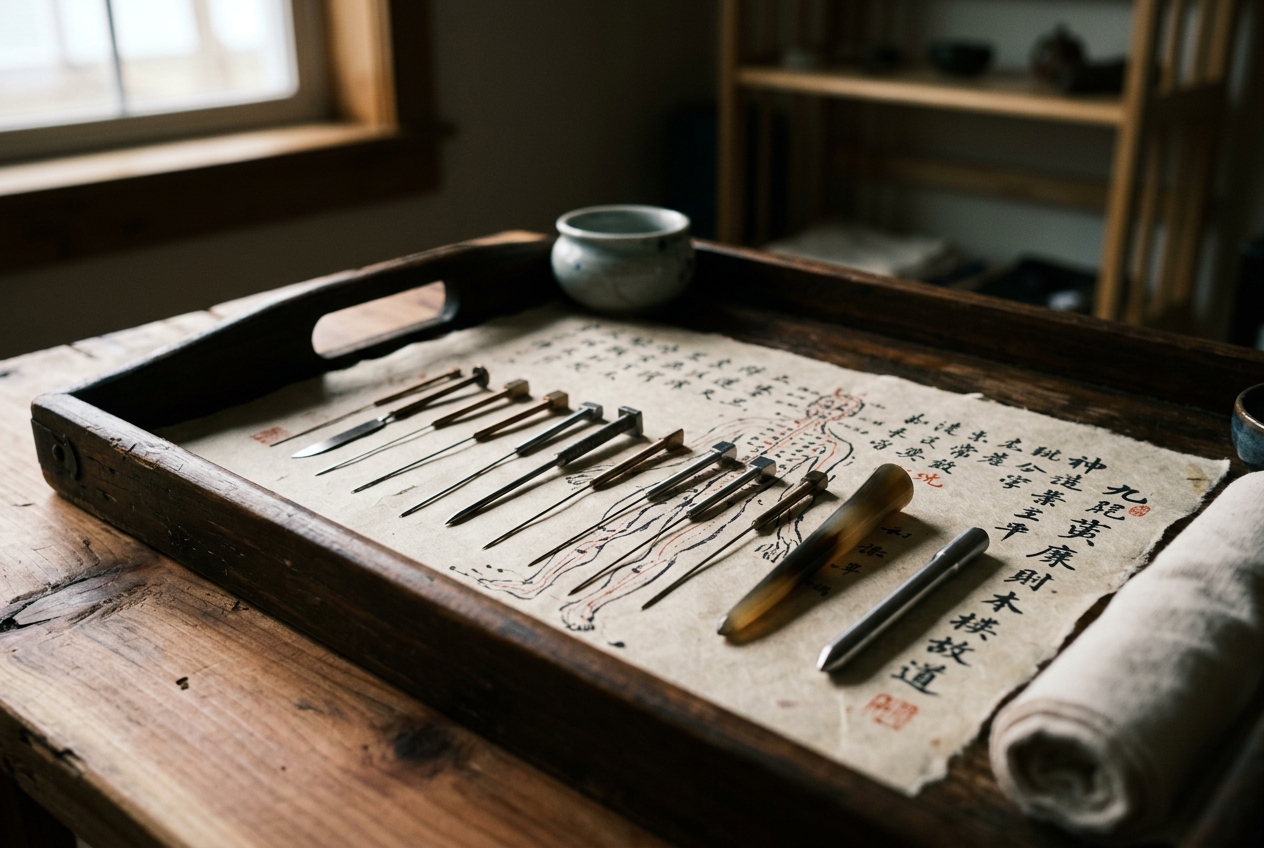
By understanding how external mechanical stimuli applied to specific bodily topographies alter internal vascular, neural, and connective tissue states, classical physicians developed a comprehensive taxonomy of therapeutic touch and needling known as the Nine Needles (Jiu Zhen, 九針). While modern medicine often views acupuncture solely through the lens of hair-thin invasive needles, the classical tradition established a diverse suite of instruments—several of which were entirely non-invasive, blunt, and designed exclusively for surface friction, fascial mobilization, and deep periosteal resonance. Today, modern cell biology and mechanotransduction research are confirming what these ancient clinicians codified: that the deliberate manual deformation of living tissue can reset autonomic tone, trigger local regenerative cascades, and dissolve entrenched patterns of stress.
2. Classical Foundations & Morphological Taxonomy
The primary textual architecture of the Nine Needles is preserved within Chapters 1 ("The Nine Needles and Twelve Yuan Sources", 九針十二原) and 7 ("Official Needles", 官針) of the Ling Shu (靈樞, The Miraculous Pivot). Far from being primitive iterations of a single tool, the nine instruments represented a calculated morphological taxonomy, engineered to address distinct tissue depths, pathological vectors, and physiological objectives.
Classical Chinese medical cosmology mapped these instruments to the Nine Palaces (Jiu Gong, 九宮), the Nine Regions (Jiu Ye, 九野), and the nine specific structural depths of the human form, moving systematically from the stratum corneum down to the periosteum:
- Chan Zhen (鑱針 — The Shear Needle): Measuring 1.6 cun with a broad, flat body and an arrowhead-like taper, this tool was designed not to puncture, but to graze the epidermis. It targeted superficial cutaneous heat, pathogen-induced exanthems, and stratum corneum micro-disturbances without injuring the underlying flesh.
- Yuan Zhen (圓針 — The Round Needle): Also 1.6 cun in length, this instrument featured a cylindrical shaft terminating in an egg-shaped, spherical tip. It was crafted specifically to glide over and massage the fenrou (divisions of the flesh and epimysial planes), resolving muscular spasms and dispersing fluid congestion without piercing the dermal layer.
- Di Zhen (鍉針 — The Spoon/Blunt Needle): Extending to 3.5 cun, the Di Zhen culminated in a rounded, millet-grain blunt terminus. It served as the primary non-invasive channel probe, designed to exert sustained focal pressure along the meridian conduits (Jingmai) to direct Qi and blood flow while maintaining dermal integrity. It is the direct historical progenitor of modern acupressure tools and the Japanese teishin.
- Feng Zhen (鋒針 — The Three-Edged Lance): A 1.6 cun instrument with a three-sided, razor-sharp pyramidal apex, engineered for precise collateral micro-bloodletting (Luo Mai drainage), venting acute heat, and dispersing severe toxic stasis.
- Pi Zhen (鈹針 — The Sword/Lance Needle): Measuring 4 cun long and 4.5 fen wide, with a dual-edged blade resembling a dagger, used surgically for the incision and evacuation of purulent abscesses and encapsulated fascial fluid.
- Yuan-Li Zhen (圓利針 — The Round-Sharp Needle): A 1.6 cun needle with a swollen, reinforced body and an acutely sharp tip, engineered to penetrate rapidly into deep myofascial trigger junctions to resolve sudden, severe painful obstruction syndromes (Bi pain) and acute visceral colic.
- Hao Zhen (毫針 — The Filiform Needle): The quintessential fine needle (1.5 to 3.6 cun), fine as a horsehair, designed for deep channel harmonization, gentle tonification (Bu), and subtle sedation (Xie) across the primary acupoint landscape.
- Chang Zhen (長針 — The Long Needle): Slender and resilient at 7 cun, this instrument was engineered to access deep pelvic, gluteal, and lumbar fascial envelopes—specifically targeting deep-seated sciatic neuralgia and chronic hip stagnation.
- Da Zhen (大針 — The Big Needle): A stout, 4 cun instrument with a thick, round-tapered tip, utilized to compress and mobilize chronic joint effusions, water retention, and severe arthritic pathology in the deep intra-articular spaces.
This classical instrumentarium proves that ancient acupuncture was inherently multi-dimensional, combining cutting, deep anchoring, superficial friction, and non-penetrative focal compression across distinct fascial strata.
3. Biomechanics & Modern Mechanotransduction Science
When manual pressure or a blunt probe is applied to the surface of the body, the resulting physiological transformation is driven by mechanotransduction—the cellular process by which physical forces are converted into biochemical and neurophysiological signals.
The Collagen Matrix and Piezoelectricity
The extracellular matrix (ECM) is an integrated tensegrity network composed predominantly of type I and type III collagen fibrils embedded in a viscoelastic proteoglycan ground substance. Applying blunt mechanical vectors (such as thumb compression or a round-tipped Di Zhen) generates local compressive and tensile strain fields.
Because collagen fibrils exhibit intrinsic non-centrosymmetric crystalline structures, mechanical shear induces a transient piezoelectric potential. This microcurrent alters local cell membrane polarities and aligns neighboring interstitial macromolecules, enhancing hydraulic permeability and facilitating metabolic waste clearance within previously stagnant fascial planes.
Mechanosensitive Ion Channels: PIEZO1, PIEZO2, and TRPV4
At the cellular membrane, physical deformation directly recruits mechanosensitive ion channels, most notably PIEZO1 and PIEZO2 as well as the TRPV4 cation channel. Under perpendicular compression and rotational shear: - The lipid bilayer undergoes physical tension, causing the propeller-shaped arms of PIEZO channels to open. - This creates an immediate influx of extracellular calcium ($Ca^{2+}$) and sodium ($Na^+$) ions into local fibroblasts, endothelial cells, and peripheral nerve terminals. - In fibroblasts, this calcium flux stimulates cytoskeletal remodeling, dynamic actin polymerization, and the synthesis of anti-inflammatory cytokines.
The Purinergic Cascade and Nitric Oxide Perfusion
Sustained mechanical deformation of interstitial connective tissue promotes cellular ATP exocytosis. In the extracellular space, this ATP is rapidly hydrolyzed by ectonucleotidases into adenosine. Research published in Nature Medicine and documented in NCBI biomedical studies on purinergic acupuncture analgesia demonstrates that extracellular adenosine acts directly upon local A1 adenosine receptors located on primary afferent nerve fibers. The binding of adenosine to A1 receptors induces long-lasting antinociceptive (pain-inhibiting) and sympatholytic effects, effectively dampening local nociceptive transmissions to the dorsal horn of the spinal cord.
Simultaneously, the shear stress exerted on the vascular endothelium activates endothelial Nitric Oxide Synthase (eNOS), yielding a localized burst of nitric oxide (NO). Nitric oxide induces the relaxation of vascular smooth muscle, generating visible cutaneous erythema (the classic hyperemic flush) and dramatically increasing local microvascular perfusion and oxygen delivery to ischemic tissues.
Neurobiology of the De Qi (得氣) Sensation
In classical texts, therapeutic efficacy depends on obtaining De Qi—the arrival of physiological resonance, traditionally described by patients as a compound sensation of soreness, numbness, heaviness, and distension (Suan, Ma, Zhang, Zhong).
From a neurophysiological perspective, De Qi corresponds to the balanced, concurrent recruitment of: - Myelinated A-beta ($\text{A}\beta$) fibers: High-threshold tactile responders signaling pressure and touch. - Thinly myelinated A-delta ($\text{A}\delta$) fibers: Mediating the initial deep, dull aching sensation and triggering spinal enkephalin release. - Unmyelinated C-fibers: Slow-conducting somatosensory afferents that project through the spinothalamic tract into the periaqueductal gray (PAG) and rostral ventromedial medulla (RVM), activating descending diffuse noxious inhibitory controls (DNIC) and up-regulating parasympathetic vagal outflow.
4. The Meridian Path — A Journey Through the Body
To practice these principles non-invasively, we must understand the geographic pathways through which mechanical force propagates. Far from esoteric constructs, the classical meridians (Jingmai) correspond with high fidelity to anatomical fascial cleavage planes, intermuscular septa, and neurovascular bundles mapped by contemporary functional anatomy.
The Stomach Meridian (Foot Yangming): The Anterior Structural Pillar
The Stomach meridian traverses the entire anterior surface of the human form, acting as the primary biophysical line for grounding, metabolic processing, and downward motility (Jiang). On the lower extremity, the channel emerges below the knee joint, traveling along the muscular valley just lateral to the prominent ridge of your shinbone (the anterior border of the tibia). It descends through the fleshy belly of the tibialis anterior muscle—the exact structure that hardens when you walk briskly or stand for hours on concrete—crosses the anterior bend of the ankle joint, and terminates at the lateral edge of the second toe nail bed. Mechanically stimulating this line directly modulates gastrointestinal peristalsis and visceral fascial tension in the mesentery.
The Liver Meridian (Foot Jueyin): The Medial Hydraulic Regulator
Representing the structural interior and the dynamic storage of blood and autonomic equilibrium, the Liver meridian originates at the medial corner of the great toe nail bed. It courses directly up the dorsal valley between your first and second metatarsal bones—the sensitive inter-osseous gorge on top of your foot—crosses anterior to the medial ankle bone, and ascends the innermost aspect of the calf along the posterior border of the tibia. Continuing past the medial hinge of the knee and up the adductor canal of the inner thigh, it enters the lower abdominal cavity and fans out across the subcostal margin of the ribcage. It is the master pathway for relieving somatic constriction, visceral tension, and vascular stasis caused by prolonged emotional vigilance.
The Pericardium Meridian (Hand Jueyin): The Vascular & Autonomic Core
Originating internally within the pericardial sac and the deep chest, the somatic pathway of the Pericardium meridian exits the pectoralis major and descends down the exact midline of the inner arm. It traverses the antecubital crease of the elbow and courses straight down the central highway of the anterior forearm, precisely nestled between two prominent, cord-like tendons: the flexor carpi radialis and the palmaris longus. Passing through the center of the wrist crease, it traverses the palm and terminates at the tip of the middle finger. This pathway is the primary neurological gateway for vagal modulation, cardiovascular deceleration, and the calming of visceral nausea and psychic agitation.
5. Non-Invasive Translation & Foundational Acupoint Topography
The profound genius of the Ling Shu taxonomy is that instruments like the blunt Di Zhen and spherical Yuan Zhen translate directly into non-invasive clinical practice. Today, manual acupressure—whether utilizing the thumb, the flexed interphalangeal joint of the index finger, or modern metallic tools such as the Japanese Teishin—applies the same biomechanical vectors without breaking the skin barrier.
To achieve reproducible clinical efficacy, every manual intervention should follow the classical Three-Phase Depth Staging (San Jie, 三階): - Phase 1: Tian (Heaven / Cutaneous Friction): Light surface contact and oscillatory friction across the epidermal-dermal boundary. Mobilizes cutaneous lymphatics and stimulates superficial A-beta fibers. - Phase 2: Ren (Human / Fascial Oscillation): The vector sinks deeper into the subcutaneous fascial envelope and muscular epimysium. Gentle 1–2 Hz circular oscillation recruits mechanosensitive PIEZO channels and mobilizes adenosine cascades. - Phase 3: Di (Earth / Periosteal Anchor): The vector settles firmly onto the deep fascial retinaculum or periosteal margin adjacent to bone. This deep, static compression engages slow unmyelinated C-fibers, generating the definitive De Qi phenomenon.
The Five Master Acupoints
The following protocol operationalizes these principles across five foundational acupoints recognized by the World Health Organization (WHO) Standard Acupuncture Point Locations:
===================================================================================
                       FOUNDATIONAL ACUPOINT MATRIX
===================================================================================
Point Code  Classical Name   Tissue Depth         Primary Mechanobiological Target
-----------------------------------------------------------------------------------
ST36        Zusanli          Epimysium / Tibia    Somatic Vagal Activation, Peristalsis
LV3         Taichong         Interosseous Fascia  Sympathetic Down-regulation, Tension
LI4         Hegu             Adductor Pollicis    Descending Analgesic Gating (DNIC)
SP6         Sanyinjiao       Deep Crural Fascia   Pelvic-Microvascular Optimization
PC6         Neiguan          Median Nerve Sheath  Cardiovascular Calming, Anti-Emesis
===================================================================================
1. Zusanli (ST36 — Leg Three Miles)
- Precise Anatomical Location: Sit with your knee bent at a 90-degree angle. Place the palm of your hand over your kneecap; your four fingers will rest naturally along the outer side of your shinbone. ST36 lies approximately four finger-widths below the lower border of your kneecap, in the soft muscular depression one finger-breadth lateral to the sharp crest of the tibia (within the tibialis anterior muscle belly).
- Subjective Tissue Resonance: A deep, spreading, heavy ache that frequently radiates down the outer shin into the dorsum of the foot, often accompanied by audible gastrointestinal gurgling (borborygmi).
- Manual Vector & Mechanics: Place your supported thumb or a blunt teishin perpendicularly against the muscle. Apply the Ren depth phase with a clockwise rotational frequency of 1.5 Hz for 90 to 120 seconds.
- Clinical Indications: Severe physical and mental fatigue, postprandial abdominal distension, sluggish digestion, and systemic metabolic depletion.
2. Taichong (LV3 — Great Rushing)
- Precise Anatomical Location: Located on the top of the foot. Slide your index finger backward along the fleshy groove between the big toe and the second toe. As your finger moves toward the ankle, it will naturally drop into the distinct triangular depression immediately before the junction where the two metatarsal bones converge.
- Subjective Tissue Resonance: Highly sensitive to pressure; manifests as an acute, distinct, slightly sharp yet releasing sensation that disperses tension upward through the inner leg.
- Manual Vector & Mechanics: Angle your thumb slightly backward toward the ankle joint (a 75-degree proximal vector). Sink steadily from Ren to Di depth, maintaining firm, continuous pressure without rapid rubbing for 90 seconds per side.
- Clinical Indications: Acute stress-induced headaches, jaw clenching (temporomandibular tension), emotional irritability, menstrual cramps, and visual eye strain.
3. Hegu (LI4 — Joining Valley)
- Precise Anatomical Location: Located on the back of the hand. Bring your thumb and index finger close together; a muscular mound will rise between them. LI4 is located at the highest point of that muscular bulge, situated anatomically in the adductor pollicis muscle, just along the midpoint of the second metacarpal bone on its radial (thumb-facing) edge.
- Subjective Tissue Resonance: A powerful, radiating soreness that can travel up the forearm, through the shoulder, and into the face and jawline.
- Manual Vector & Mechanics: Direct your thumb tip underneath the second metacarpal bone, pressing from the lateral edge inward toward the center of the palm. Apply firm, steady, rhythmic pumping compression (1 Hz) for 60 to 90 seconds per hand.
- Clinical Indications: Tension headaches, frontal sinus pressure, dental and facial pain, cervical spine stiffness, and systemic pain modulation.
4. Sanyinjiao (SP6 — Three Yin Intersection)
- Precise Anatomical Location: On the inner side of your lower leg. Locate the highest tip of your medial ankle bone (the medial malleolus). Measure four finger-widths straight up the leg. SP6 lies in the tender depression immediately behind the posterior border of the shinbone (tibia).
- Subjective Tissue Resonance: A distinct, dull, bruised sensation that softens visibly over 60 seconds of steady contact.
- Manual Vector & Mechanics: Hook your thumb directly behind the tibial bone edge, pressing toward the back of the calf rather than straight against the bone. Hold at Di depth with minimal oscillation for 2 minutes per side.
- Clinical Indications: Insomnia, pelvic congestion, menstrual discomfort, autonomic dysregulation, and lower abdominal bloating.
5. Neiguan (PC6 — Inner Gate)
- Precise Anatomical Location: On the inner side of the forearm. Turn your palm upward. Measure three finger-widths down from the primary wrist crease. PC6 lies precisely between the two prominent, cord-like flexor tendons running down the center of your forearm.
- Subjective Tissue Resonance: An electric, spreading tingling sensation that travels downward into the palm and upward toward the antecubital crease of the elbow.
- Manual Vector & Mechanics: Press the tip of your thumb straight down into the inter-tendinous channel, engaging the deep fascial sheath overlying the median nerve. Maintain steady, unyielding pressure while taking slow, diaphragmatic breaths for 90 seconds per arm.
- Clinical Indications: Motion sickness, postprandial nausea, acute situational anxiety, heart palpitations associated with stress, and tightness in the diaphragm.
6. A Point Combination for One Common Issue
The "Nocturnal Reset" Protocol for Hyper-Sympathetic Arousal & Digestive Stagnation
For the individual who transitions from a demanding workday into the evening with a racing mind, a tight neck, and an uncomfortable, bloated epigastrium, this continuous 8-minute protocol systematically down-regulates sympathetic tone and activates mesenteric microcirculation:
- Environmental & Postural Setup (Minute 0): Sit comfortably on the floor or in a firm chair with your spine upright and feet flat. Loosen any constrictive clothing around your waist and neck. Take three long, nasal inhalations followed by extended, unhurried exhalations.
- Step 1: Open the Thoracic Diaphragm via Neiguan (PC6) (Minutes 1–2.5): Apply firm, perpendicular thumb pressure to PC6 on the left arm for 90 seconds, matching your pressure to slow 4-second-in, 6-second-out diaphragmatic breaths. Switch and repeat on the right arm. Objective: Induces vagal slowing of heart rate and relieves epigastric tightness.
- Step 2: Clear Axial & Jaw Tension via Hegu (LI4) (Minutes 2.5–4.5): Transition to LI4. Grasp the right hand's web space with the left thumb and index finger. Compress firmly into the bone edge, oscillating at 1 Hz for 90 seconds. Switch hands and repeat. Objective: Triggers descending enkephalinergic pain gating, relaxing the masseters and suboccipital muscles.
- Step 3: Harmonize Peristalsis via Zusanli (ST36) (Minutes 4.5–6.5): Place your thumbs on both ST36 points simultaneously on your lower legs. Press deeply into the tibialis anterior muscle bellies using slow, clockwise circular sweeps for 90 seconds. Objective: Promotes mesenteric vasodilation via nitric oxide release and resolves postprandial gas distension.
- Step 4: Anchor the Autonomic Axis via Taichong (LV3) (Minutes 6.5–8): Finish at the feet. Place your thumbs into the valley of LV3 on both feet simultaneously. Press firmly down and back toward the ankle joint. Hold this static Di depth for 90 seconds while allowing your eyes to close. Objective: Alleviates residual cortical hyper-arousal and prepares the brainstem for restorative sleep.
7. Safety, Contraindications & Somatosensory Limits
While manual acupressure and non-invasive teishin applications avoid the risks associated with skin-puncturing needles, clinical safety requires strict adherence to somatic thresholds and medical contraindications:
Critical Pregnancy Contraindications
According to the WHO Guidelines on Basic Training and Safety in Acupuncture, high-intensity manual stimulation of Hegu (LI4), Sanyinjiao (SP6), and Taichong (LV3) is strictly contraindicated during pregnancy, particularly throughout the first and third trimesters. These points possess strong oxytocic-like, descending properties that can stimulate uterine myometrial contractions and potentially induce premature labor.
Calibrating Pressure: Therapeutic Resonance vs. Mechanical Trauma
A common clinical error is confusing therapeutic De Qi with blunt, destructive force. Effective acupressure should produce a distinct, spreading ache (Suan-Zhang), a feeling of heavy warmth, or mild tingling. It must never feel sharply lancinating, electric-shock-like (indicative of direct direct nerve trunk compression), or violently painful. Excessive force risks capillary rupture, localized tissue hematoma, and paradoxical sympathetic hyper-reactivity.
Clinical Red Flags for Immediate Medical Evaluation
Self-administered acupressure is an adjunctive self-care modality, not a replacement for medical emergency care or formal diagnosis. Immediately discontinue self-treatment and consult a qualified medical professional if you experience: - Sudden, severe, unprecedented headache ("thunderclap" onset). - Unexplained chest pressure, pain radiating into the left arm or jaw, or acute shortness of breath. - Acute, localized, rebound abdominal pain accompanied by fever. - Suspected deep vein thrombosis (unilateral calf swelling, heat, and erythema). - Open dermatological wounds, acute localized infections, burns, or suspected bone fractures at the acupoint sites.
8. Today’s Takeaway: The Two-Minute Reset
===================================================================================
                       THE TWO-MINUTE OFFICE RESET: HEGU (LI4)
===================================================================================
Target Point   : Hegu (LI4 — Joining Valley), on the web space of your hand.
Total Time     : 2 Minutes (60 seconds per hand).
Action Vector  : Hook your thumb under the index-finger bone (2nd metacarpal).
Depth Stage    : Settle from Ren (fascial) into Di (periosteal anchor).
Breath Pattern : Inhale for 4 seconds, exhale for 6 seconds.
Expected Result: Spreading ache, immediate softening of the neck and jawline.
===================================================================================
Before moving to your next task, take two minutes right now to experience this biophysical mechanism directly on your own body:
- Rest your left hand comfortably on your desk or thigh.
- With your right hand, place your thumb onto the webbed muscle between your left thumb and index finger (Hegu, LI4).
- Push your thumb tip firmly against the underside of the long bone leading to your index finger (the second metacarpal).
- As you feel that deep, distinctive, slightly sweet ache develop, close your eyes.
- Apply steady, pulsing circular pressure at a rhythm of one circle per second.
- Take six slow, expansive breaths—inhaling through your nose for 4 seconds and letting the air sigh out for 6 seconds.
- Switch hands and repeat for 60 seconds on the right hand.
Notice the immediate physical shift: the sudden warming in your palms from nitric oxide-induced vasodilation, the subtle dropping of your shoulders, and the easing of tension across your forehead. This is the living legacy of the Ling Shu—not an abstract philosophy, but a precise, accessible physiological science resting right beneath your fingertips.