Acupuncture Needling Techniques (Zhen Ci Shou Fa) Meridian Dynamics: Governing Needle Insertion, Deqi Proprioception, Depth-Angle Modulation, and Somatosensory Biomechanical Coupling in Traditional Chinese Medicine
1. Opening Scene — A Moment You'll Recognise
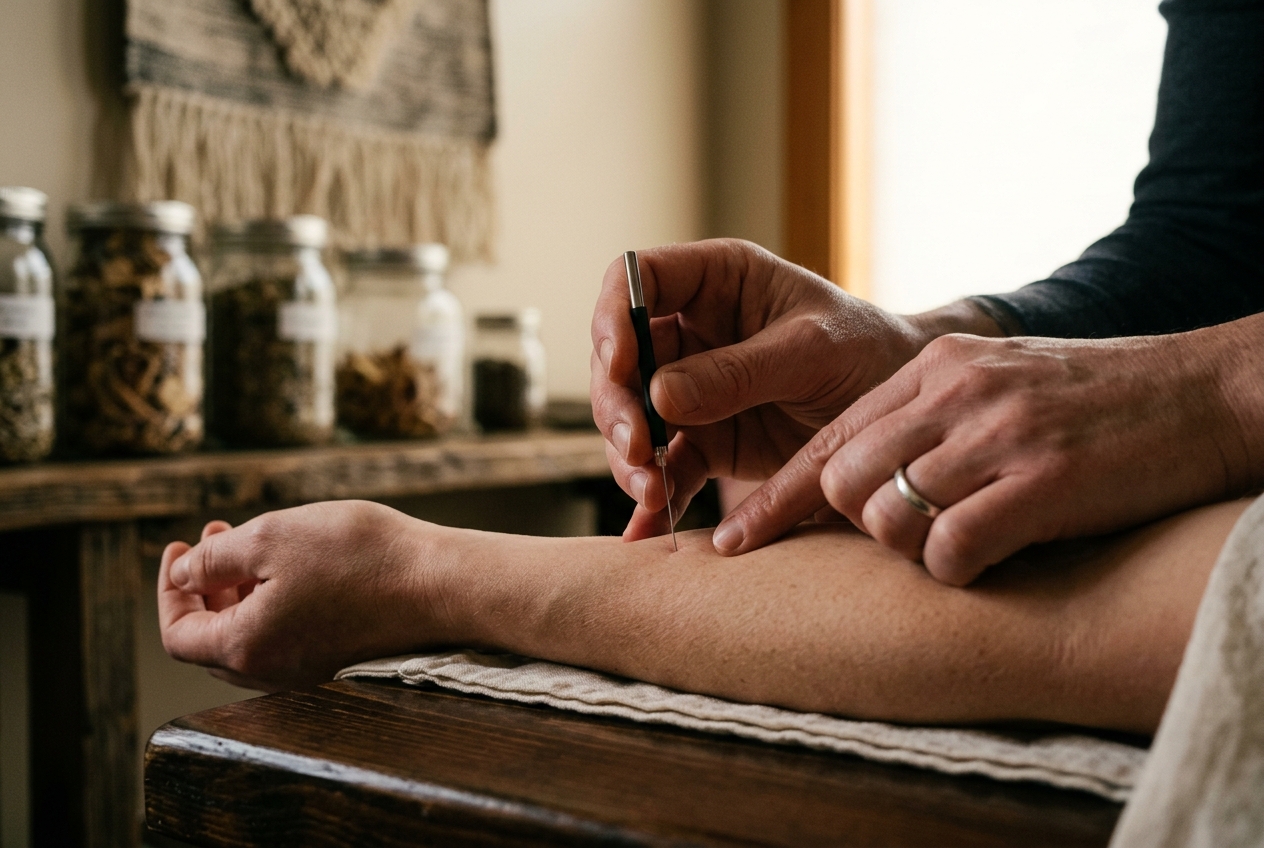
You are lying prone on a treatment table in a quiet room, the faint aroma of dried mugwort lingering in the air. A sterile, filiform needle—scarcely thicker than a strand of human hair—is swiftly guided through the cutaneous barrier of your lower leg at the acupoint Zusanli (ST36). At the moment of initial skin penetration, there is virtually no sensation: perhaps a microscopic tap, a momentary whisper against the epidermis. But moments later, as the practitioner gently twirls and depresses the shaft deeper into the underlying muscular compartment, a profound transformation occurs.
Suddenly, you feel it: not a sharp, stinging pain, but an unmistakable, radiating ache. It feels heavy, spreading like warm honey through the deep fascial planes of your tibialis anterior, sending subtle pulses of warmth and electric distension descending toward your ankle and ascending into your knee. In Traditional Chinese Medicine (TCM), this profound sensation is known as Deqi (得气)—the "arrival of vital energy."
Far from being an esoteric illusion, this palpable phenomenon represents a sophisticated biological interplay between ancient mechanical craft and modern cellular physiology. What feels to you like an energetic surge is, under the microscope, an intricate biomechanical cascade: connective tissue wrapping around a rotating stainless-steel shaft, pulling fibroblasts taut, initiating adenosine release, and firing specific neural pathways that communicate directly with the pain-modulating centers of your brainstem. To understand how a metal filament can orchestrate systemic balance, we must examine the classical foundations, structural anatomy, and manual dexterity of Zhen Ci Shou Fa (针刺手法)—the art and science of classical needle manipulation.
+-----------------------------------------------------------------------------------+
|                           THE SENSATION SPECTRUM OF DEQI                          |
|                                                                                   |
|  [Suan] Soreness / Aching       ---> Mediated by A-delta & C sensory fibers       |
|  [Ma] Numbness / Tingling       ---> A-beta cutaneous & deep mechanoreceptors     |
|  [Zhang] Distension / Fullness  ---> Interstitial hydrostatic pressure & fascia   |
|  [Zhong] Heaviness / Muscle Grip---> Collagen mechanical coupling / Myofibroblasts|
+-----------------------------------------------------------------------------------+
2. What This Organ System Does: The Jing-Luo Meridian Architecture & Classical Foundations
In classical Chinese medical physiology, the human organism is sustained and integrated through the Jing-Luo (经络) network—a comprehensive matrix of primary channels (Jing Mai), collateral vessels (Luo Mai), divergent channels (Jing Bie), and sinew pathways (Jing Jin). Rather than isolated anatomical tubes, classical meridians represent dynamic conduits of physiological communication, metabolic perfusion, and somatic coherence that link the superficial musculoskeletal structures directly to the deep internal Zang-Fu (visceral organ systems).
                 =================================================
                 CLASSICAL MERIDIAN (JING-LUO) STRUCTURAL HIERARCHY
                 =================================================
                                         |
         +-------------------------------+-------------------------------+
         |                                                               |
   [JING MAI: Primary Channels]                            [LUO MAI: Network Collaterals]
   12 Regular + 8 Extraordinary Channels                   Transverse & Longitudinal branches
         |                                                               |
   +-----+-----+                                                   +-----+-----+
   |           |                                                   |           |
[Jing Bie]  [Jing Jin]                                         [Sun Luo]   [Fu Luo]
Divergent   Sinew/Fascial                                      Minute      Superficial
Branches    Pathways                                           Capillaries Vessels
The seminal treatises of Chinese antiquity laid down the foundational laws governing how these pathways are influenced by manual needling:
- The Huangdi Neijing (Yellow Emperor's Inner Classic): In the Ling Shu (Spiritual Pivot), Chapter 1 (Jiu Zhen Shi Er Yuan / "Nine Needles and Twelve Yuan Sources") proclaims: "The key to acupuncture is the arrival of Qi; its efficacy lies in its swift arrival." The text details how needle manipulation must harmonize with the systemic movement of Ying (nutritive) and Wei (defensive) Qi. Chapter 9 (Shi Zhong) and Chapter 10 (Jing Mai) further formulate the directional, seasonal, and constitutional dynamics that dictate how deeply and forcefully a practitioner must intervene along the channel pathways. For historical context on these medical doctrines, consult the comprehensive overview of the Huangdi Neijing on Wikipedia.
- The Zhen Jiu Da Cheng (Compendium of Acupuncture and Moxibustion): Compiled in 1601 CE during the Ming Dynasty by the master physician Yang Jizhou, this monumental work formalized classical needle manipulation into sophisticated algorithmic sequences. Yang cataloged the intricate mechanics of complex multi-step techniques, such as Shao Shan Huo ("Setting the Mountain on Fire"—a warming, tonifying technique) and Tou Tian Liang ("Cooling the Sky"—a clearing, sedating technique), demonstrating how cyclic manipulation alters local tissue temperature, vascular perfusion, and systemic autonomic tone. Learn more about Yang Jizhou's compendium at Zhen Jiu Da Cheng on Wikipedia.
====================================================================================
           TISSUE STRATA PENETRATION & BIOMECHANICAL TRANSLATION
====================================================================================
 Depth (mm)      Anatomical Layer                    Biophysical Event
------------------------------------------------------------------------------------
  0.0 - 0.5 mm   Epidermis (Stratum Corneum/Basale)  Cutaneous puncture, Merkel cells
  0.5 - 2.0 mm   Dermis                              Dense irregular collagen engagement
  2.0 - 5.0 mm   Superficial Fascia (Tela Subcutanea)Hyaluronic acid flow, loose ECM
  5.0 - 25+ mm   Deep Fascia & Intermuscular Septa   Mechanical collagen winding,
                                                     A-delta & C fiber stimulation
====================================================================================
The Biomechanical & Fascial Matrix: Collagen Winding and Mechanotransduction
When an acupuncture needle penetrates the somatic tissue, it traverses four distinct histological strata: - Epidermis: A stratified squamous keratinized epithelium populated by keratinocytes, Langerhans cells, and Merkel nerve terminals. - Dermis: A dense connective tissue layer rich in Type I and Type III collagen bundles, elastin fibers, microvascular capillary loops, and Meissner and Ruffini corpuscles. - Superficial Fascia (Tela Subcutanea): A loose areolar and adipose matrix rich in interstitial fluid, proteoglycans, and unorganized fascial sheets. - Deep Fascia (Fascia Profunda) and Intermuscular Septa: Dense, highly organized collagenous aponeuroses that envelop skeletal muscle groups and house rich neurovascular bundles.
Groundbreaking research pioneered by Dr. Helene Langevin and colleagues has illuminated the exact biophysical mechanism of needle manipulation within this collagenous matrix. When a filiform needle is rotated (twirled) or translated (lifted and thrusted) within the connective tissue, interstitial collagen fibrils mechanically adhere to the microscopic surface irregularities of the metal shaft. As rotation proceeds unidirectionally or in alternating cycles, the loose connective tissue wraps tightly around the needle barrel—a phenomenon termed collagen winding.
This winding exerts sustained mechanical tension upon resident connective tissue cells: the fibroblasts. In response to this mechanical stretch, fibroblasts undergo rapid cytoskeletal remodeling, reorganizing their internal actin filaments and shifting from a rounded resting morphology to an extensively flattened, expanded state. This mechanical distortion triggers cellular mechanotransduction: the physical strain opens stretch-activated ion channels, stimulating intracellular calcium ($Ca^{2+}$) waves and driving the exocytotic release of adenosine triphosphate (ATP) into the extracellular milieu.
Extracellular ATP is rapidly broken down by ecto-nucleotidases into adenosine, a potent endogenous purine nucleoside. Adenosine binds to local $A_1$ adenosine receptors situated on neighboring primary sensory nerve terminals, exerting a profound, long-lasting antinociceptive and analgesic effect. Through this elegant molecular cascade, manual kinetic movement is translated directly into cellular and neural chemical signaling. Detailed empirical investigations of these connective tissue mechanics can be explored in the landmark NCBI PMC study on Acupuncture mechanotransduction and connective tissue winding.
3. How You Can Feel It: The Somatosensory Spectrum & Neurobiology of Deqi
Understanding the difference between genuine therapeutic needle engagement and erroneous tissue trauma is fundamental to meridian medicine. Clinically, this is the distinction between the multidimensional sensation of Deqi and sharp, superficial nociceptive pain (Tong).
+------------------------------------------------------------------------------------+
|                         DEQI VS. NOCICEPTIVE CUTANEOUS PAIN                        |
+------------------------------------------------------------------------------------+
| SENSATION ATTRIBUTE | CLASSICAL DEQI (得气)           | CUTICULAR NOCICEPTION (痛) |
+---------------------+---------------------------------+----------------------------+
| Perceptual Quality  | Aching (Suan), Numbness (Ma),   | Sharp, Pricking, Stinging,  |
|                     | Fullness (Zhang), Heaviness     | Burning, Electric shock    |
+---------------------+---------------------------------+----------------------------+
| Anatomical Origin   | Deep fascial planes, muscle     | Epidermal & superficial    |
|                     | septa, perivascular sheaths     | dermal nerve plexus        |
+---------------------+---------------------------------+----------------------------+
| Neural Substrate    | Group III (A-delta) & Group IV  | Group II (A-beta) &        |
|                     | (C) sensory afferents           | superficial A-delta fibers |
+---------------------+---------------------------------+----------------------------+
| Central Response    | DMN deactivation, Limbic        | Somatosensory cortex (S1/  |
|                     | modulation, Endorphin release   | S2) hyperactivation        |
+---------------------+---------------------------------+----------------------------+
The Classical Tetrad of Deqi Sensations
In classical texts, true Deqi is defined by four distinct somatic qualities experienced by the patient, mirrored by the practitioner's sensation of "a fish biting the hook" (Zhen Chen / needle grasp):
- Suan (酸 — Soreness / Aching): A deep, diffuse, dull ache originating from intramuscular connective tissue and periosteal zones. Neurobiologically, Suan is driven by the activation of small-myelinated Type III (A-$\delta$) fibers and unmyelinated Type IV (C) afferent fibers, signaling through mechanosensitive receptors in the interstitial fascial matrix.
- Ma (麻 — Numbness / Paresthesia): A tingling, vibratory sensation that often tracks distally or proximally along the channel trajectory. This quality is mediated by the low-threshold activation of cutaneous and subcutaneous A-$\beta$ mechanoreceptors alongside rhythmic pacing of sensory nerve branchlets.
- Zhang (胀 — Distension / Fullness): The distinct feeling of local swelling, hydrostatic expansion, or hydraulic pressure beneath the needle. This is generated by localized interstitial fluid shifts, altered microvascular hydraulic permeability, and the mechanical displacement of tight fascial sheets.
- Zhong (重 — Heaviness): A profound sensation of limb weight, muscular relaxation, or leaden anchoring. This corresponds to the biomechanical "needle grasp" where contracting myofibroblasts and collagen winding lock the needle in place, exciting muscle spindle afferents (Group Ia and II) and Golgi tendon organs (Group Ib).
Central Neural Processing and Descending Inhibition
When Deqi is evoked, action potentials propagate via the lateral spinothalamic tract into the central nervous system. Modern functional neuroimaging (fMRI) studies show that true Deqi induces a characteristic deactivation of the limbic-paralimbic-neocortical network (including the amygdala, hippocampus, and posterior cingulate cortex) while concurrently regulating the Default Mode Network (DMN).
Simultaneously, Deqi triggers the descending pain modulatory system: - Signals reaching the Periaqueductal Gray (PAG) in the midbrain stimulate the Rostral Ventromedial Medulla (RVM). - This excites descending serotonergic (5-HT) and noradrenergic (NE) projections back to the dorsal horn of the spinal cord. - Enkephalinergic interneurons in the substantia gelatinosa release endogenous opioids (beta-endorphins, enkephalins, and dynorphins), presynaptically inhibiting the release of Substance P and glutamate from incoming pain fibers.
To review the peer-reviewed neuroimaging evidence documenting these central neural correlates, explore this NCBI PubMed research on neurobiological mechanisms of Deqi sensation.
4. Qigong & Movement Practice: Manual Needle Dynamics, Biomechanical Vectoring & Somatic Channel Circulation
Just as the clinical acupuncturist governs the needle with rigorous biomechanical precision, the practitioner of Chinese movement arts (Qigong and Daoyin) cultivates the internal flow of Qi through intentional posture, fascial tensioning, and rhythmic respiration. Below, we systematically examine both the clinician's manual manipulation parameters (Zhen Ci Shou Fa) and an accessible, somatic movement sequence that reproduces channel-fascial mobilization at home.
       ================================================================
       PRIMARY NEEDLE INSERTION METHODS (JIN ZHEN FA)
       ================================================================

[A] SINGLE-HAND (Dan Shou)     [B] FINGER-PRESSING (Bian Zhi)
           Puncturing finger delivers      Supporting thumb/index stabilizes
           rapid downward thrust.          base while puncturing hand descends.
                   |                                       |
                   v                                       v
               |======|                                |=======|
               |      |                                |   |   |
               |  ||  |                                |(T)|(I)|
                  ||                                       ||
                 ==== (Skin)                              ==== (Skin)

[C] SKIN-PINCHING (Ti Nie)     [D] SKIN-STRETCHING (Shu Zhang)
           Pinches skin fold on shallow    Stretches skin taut on loose,
           areas (e.g. GV20, BL2, ST4).    flaccid zones (e.g. Abdomen).
                   |                                       |
                   v                                       v
                /\  /\                                <--- | --->
               /  \/  \                               ===========
                 ||                                        ||
                ==== (Fold)                               ==== (Taut)
The Engineering of Needle Insertion and Vectoring
To achieve maximal clinical efficacy with minimal cuticular discomfort, the master practitioner applies one of four primary classical insertion methods based on local anatomy:
- Single-Hand Insertion (Dan Shou Jin Zhen Fa): Executed exclusively with the thumb and index finger of the puncturing hand (Ci Shou). Relying on rapid, spring-loaded flexion of the interphalangeal joint, this method is ideal for long, flexible needles on broad muscular compartments (e.g., gluteal and femoral regions).
- Finger-Pressing Insertion (Bian Zhi Jin Zhen Fa): The nail of the assisting hand's thumb or forefinger (Ya Shou) presses firmly beside the target acupoint, creating localized lateral tissue compression. The needle is then guided swiftly along the nail border into the skin. This technique secures mobile subcutaneous vessels and blunts cutaneous pain reception via tactile gate-control inhibition.
- Skin-Pinching Insertion (Ti Nie Jin Zhen Fa): The practitioner pinches a fold of skin upward using the assisting hand's thumb and index finger, inserting the needle transversely into the elevated fold. This method is mandatory over shallow osseous zones where underlying soft tissue is minimal, such as Zanzhu (BL2) on the supraorbital ridge or Yintang at the glabella.
- Skin-Stretching Insertion (Shu Zhang Jin Zhen Fa): The assisting thumb and fingers spread the skin outward in opposing vectors, rendering the cutaneous surface taut and firm. This technique is utilized on regions with loose, folded, or flaccid abdominal skin (e.g., Tianshu ST25 or Guanyuan CV4), ensuring immediate, clean epidermal transit without drag.
====================================================================================
           INSERTION ANGLE VECTORS & ANATOMICAL CORRELATIONS
====================================================================================
 Angle Type             Degree Vector   Primary Indications & Tissue Targets
------------------------------------------------------------------------------------
 Perpendicular (Zhi Ci) 90°             Deep musculature of limbs, trunk, gluteals
 Oblique (Xie Ci)       45°             Overlying vital viscera, intercostal spaces
 Transverse (Ping Ci)   15° - 25°       Cranial aponeurosis, facial points, sternum
====================================================================================
Tissue Depth Calibration: Habitus and Seasonal Chronobiology
Insertion depth is never static; it is precisely calibrated according to patient morphology and classical seasonal dynamics: - Body Habitus: Robust, muscular, or sthenic individuals require deeper insertion into thick muscular sheaths to engage dense fascial planes; asthenic, emaciated, or pediatric patients necessitate shallow, light insertion into superficial fascial layers. - Seasonal Dynamics (Neijing Principle): In Spring and Summer, ambient Yang expands, drawing defensive Qi (Wei Qi) and vascular perfusion to the superficial somatic layers; needling must be light, rapid, and shallow. In Autumn and Winter, Yang retreats into the deep Zang-Fu core, and the exterior contracts; needling must be deeper, retained longer, and manipulated with measured warmth.
Fundamental Manipulation Parameters: Ti Cha and Nian Zhuan
Once the target depth is attained, dynamic manipulation activates the mechanotransductive cascade:
                  TI CHA (Lifting & Thrusting)        NIAN ZHUAN (Twirling)
                  ----------------------------        ---------------------
 Tonification     Heavy downward thrust,              Clockwise emphasis,
 (Bu Fa - Fill)   Gentle upward lift,                 Small angle (<180°),
                  Slow frequency (30-60 bpm)          Slow rotation

 Sedation         Gentle downward thrust,             Counter-clockwise emphasis,
 (Xie Fa - Drain) Forceful upward lift,               Large angle (>360°),
                  Rapid frequency (100-120 bpm)       Rapid, intense rotation
For rigorous mechanical measurements of these needle forces, see this NCBI PubMed study on acupuncture needle manipulation biomechanics.
Mind-Body Somatic Practice: "Opening the Six Fascial Channels" (Daoyin Exercise)
To experience the systemic fascial tensioning and meridian flow of acupuncture without needles, perform this classical Daoyin standing exercise daily:
[Phase 1: Neutral Alignment]      [Phase 2: Channel Tensioning]      [Phase 3: Resonant Release]
      Head suspended (GV20)               Arms spiraled out                  Qi sinks to Dan Tian
           o                                   \  o  /                             o
          /|\                                   \ | /                             /|\
          / \                                    / \                              / \
    (Feet hip-width)                      (Inhale, expand fascia)           (Exhale, sink warmth)
- Starting Position and Postural Alignment: - Stand with feet parallel, shoulder-width apart. Unlock your knees slightly, allowing the pelvis to settle into a neutral, un-tilted alignment. - Suspend the vertex of your head from above, gently tucking the chin to align the cervical spine with the point Baihui (GV20). - Rest your tongue gently against the upper palate behind your front teeth, connecting the Conception (Ren) and Governing (Du) vessels.
- Dynamic Movement and Breath Cadence: - Inhale (4 seconds, nasal diaphragmatic): Slowly rotate your palms outward and spiral your arms away from your midline, extending through the fingertips. Feel the fascial tension sweep from your chest through the lung and large intestine pathways to the tips of your thumbs and index fingers. - Hold & Expand (2 seconds): Gently extend the spine upward while rooting downward through the bubbling well point (Yongquan, KI1) on the soles of your feet. Feel the connective tissue sheet along your entire anterior torso pull taut. - Exhale (6 seconds, soft nasal release): Rotate the palms inward, drawing the hands back toward your lower abdomen (Xia Dan Tian). Let the shoulders melt downward, releasing all muscular gripping while preserving skeletal structure.
- Repetition and Timing: Perform 9 complete cycles (approximately 3 to 4 minutes).
- Sensation to Monitor: Look for an expanding sensation of tingling, fullness, and warmth across your palmar surfaces and fingers (Lao Gong, PC8), followed by a deep sense of abdominal anchoring. This indicates successful autonomic shift toward parasympathetic predominance and enhanced microvascular vasodilation.
5. Acupressure Points You Can Try Today: Precision Topography & Manipulation Vectors
You can engage the mechanotransductive pathways of your own nervous system using focused ischemic acupressure. Below are three of the most thoroughly researched classical acupoints.
====================================================================================
               SUMMARY OF HIGH-EFFICACY SOMATIC ACUPOINTS
====================================================================================
 Point Name     Channel Location           Primary Clinical Indications
------------------------------------------------------------------------------------
 Hegu (LI4)     1st/2nd metacarpal web     Headache, facial tension, systemic pain
 Zusanli (ST36) 4 fingers below patella    Fatigue, digestive stagnation, immunity
 Neiguan (PC6)  2 cun above wrist crease   Nausea, cardiac palpitations, anxiety
====================================================================================
1. Hegu (LI4 — "Joining Valley") — Large Intestine Channel
                       LI4 (HEGU) TOPOGRAPHY & APPLICATION
                       -----------------------------------
                                       /\ (Thumb)
                                      /  \
                       [LI4 Location]   * \  <--- Radial midpoint of 2nd
                                     \     \      metacarpal bone
                                      \  |  \
                                       \ | /
                                      (Wrist)
- Precise Anatomical Landmarking: Located on the dorsum of the hand, between the first and second metacarpal bones, approximately at the midpoint of the second metacarpal bone on its radial margin, in the belly of the first dorsal interosseous muscle.
- Biomechanical Technique: Place the tip of your opposing thumb onto the radial border of the second metacarpal bone. Press firmly inward and slightly angled underneath the bone edge. Apply steady, circular friction for 2 minutes. Maintain a firm pressure that elicits a clear Suan (aching/heavy) sensation without sharp, bruising cuticular pain.
- Clinical Applications: Recognized globally for its potent analgesic action on head, neck, and facial disorders, tension headaches, toothaches, rhinitis, and general stress mitigation. Contraindicated during pregnancy due to uterine contracting dynamics.
2. Zusanli (ST36 — "Leg Three Miles") — Stomach Channel
                     ST36 (ZUSANLI) TOPOGRAPHY & APPLICATION
                     ---------------------------------------
                                    ( Patella )
                                    /         \
                             [Tibia]           *  <--- ST36 (1 finger-width
                                |   \         /        lateral to crest,
                                |    \       /         3 cun below patella)
                                |     \_____/
                                |
- Precise Anatomical Landmarking: Located on the anterolateral aspect of the lower leg, four finger-widths (3 cun) inferior to the lateral infrapatellar depression (the lateral "eye of the knee"), one finger-breadth lateral to the anterior crest of the tibia, within the belly of the tibialis anterior muscle.
- Biomechanical Technique: Using the knuckle or tip of your thumb, press perpendicularly into the muscular groove of the tibialis anterior. Apply deep, rhythmic pressing and releases (3 seconds on, 1 second off) for 2 to 3 minutes per leg.
- Clinical Applications: The premier tonification point in classical medicine. It profoundly enhances digestive motility, alleviates abdominal bloating and chronic fatigue, and modulates systemic immune function through the vagus-adrenal axis.
3. Neiguan (PC6 — "Inner Gate") — Pericardium Channel
                      PC6 (NEIGUAN) TOPOGRAPHY & APPLICATION
                      --------------------------------------
                                     (Palm Base)
                                    ============= (Wrist Crease)
                                       |  *  |    <--- PC6 (2 cun proximal,
                                       |  |  |         between FCR & PL tendons)
                                       |  |  |
                                      (Forearm)
- Precise Anatomical Landmarking: Located on the anterior aspect of the forearm, two proportional thumb-widths (2 cun) proximal to the distal transverse crease of the wrist, nestled precisely between the tendons of palmaris longus and flexor carpi radialis.
- Biomechanical Technique: Apply direct, perpendicular thumb pressure deep into the inter-tendinous space. Maintain continuous, calm pressure while performing slow, deep diaphragmatic breathing for 90 seconds per wrist.
- Clinical Applications: Highly validated by clinical trials for alleviating nausea (motion sickness, post-operative, and morning sickness), autonomic dysregulation, cardiac palpitations, emotional anxiety, and chest constriction. Discover international benchmarks on complementary protocols via the World Health Organization Traditional Medicine Strategy.
6. Food & Lifestyle: Seasonal Calibration, Fascial Hydration & Clinical Safety Protocols
+-----------------------------------------------------------------------------------+
|                        SEASONAL MERIDIAN DYNAMICS & NUTRITION                     |
+-----------------------------------------------------------------------------------+
| SEASON     | MERIDIAN/ORGAN FOCUS | NUTRITIONAL EMPHASIS     | LIFESTYLE VECTORS  |
+------------+----------------------+--------------------------+--------------------+
| Spring     | Liver / Gallbladder  | Pungent, fresh greens,   | Stretching sinews, |
| (Expansion)| (Wood Phase)         | sprouts, lemon water     | early brisk walks  |
+------------+----------------------+--------------------------+--------------------+
| Summer     | Heart / Sm. Intestine| Bitter greens, cooling   | Moderate sweating, |
| (Peak Yang)| (Fire Phase)         | melon, cucumber, berries | midday rest/siesta |
+------------+----------------------+--------------------------+--------------------+
| Autumn     | Lung / Lg. Intestine | Moistening pears, root   | Deep breathwork,   |
| (Gathering)| (Metal Phase)        | vegetables, warm broths  | inward reflection  |
+------------+----------------------+--------------------------+--------------------+
| Winter     | Kidney / Bladder     | Warming stews, black     | Early sleep, warm  |
| (Storage)  | (Water Phase)        | beans, walnuts, bone broth| lumbar protection |
+------------+----------------------+--------------------------+--------------------+
The Biology of Fascial Hydration and Dietary Support
Because needle mechanotransduction depends entirely on the sliding and winding capacity of collagen fibrils within an extracellular matrix (ECM) rich in glycosaminoglycans and hyaluronic acid, physical tissue hydration is paramount: - Prioritize Extracellular Hydration: Drink warm, mineral-rich fluids (such as bone broths or warm water with a pinch of unrefined sea salt) rather than ice-cold beverages. Cold temperatures induce local vasoconstriction and stiffen the interstitial matrix, impeding cellular fluid flow and dampening mechanotransductive signaling. - Support Collagen Homeostasis: Consume foods abundant in dietary glycine, proline, and vitamin C (e.g., slow-simmered broths, dark leafy brassicas, and berries) to maintain the structural elasticity of the fascial sheaths and intermuscular septa. - Reduce Inflammatory Glycation: Minimize excessive refined sugars and hyper-processed foods. Advanced Glycation End-products (AGEs) crosslink collagen fibers, creating rigid, brittle fascial architecture that resists healthy mechanical deformation and exacerbates chronic pain.
Critical Clinical Safety Protocols & Anatomical Danger Zones
************************************************************************************
                          ANATOMICAL SAFETY & DANGER ZONES
************************************************************************************

[!] APEX OF LUNG (Pneumothorax Risk)
      Points: GB21 (Jianjing), LU1 (Zhongfu), BL11-BL15 (Upper Back Shu points).
      Protocol: NEVER needle perpendicularly. Use oblique/transverse insertion only.
      Depth limit: <= 0.5 - 0.8 cun.

[!] MEDULLA OBLONGATA & SPINAL CANAL
      Points: GV15 (Yamen), GV16 (Fengfu), BL10 (Tianzhu).
      Protocol: STRICTLY perpendicular or slightly downward angle. NEVER angle upward
      toward the foramen magnum.

[!] MAJOR VASCULAR TRUNKS
      Points: ST9 (Renying - Carotid), SP10/11 (Femoral), HT1 (Jiquan - Axillary).
      Protocol: Palpate artery, push vessel aside with assisting finger (Ya Shou),
      avoid penetrating the vascular wall.

[!] PREGNANCY FORBIDDEN POINTS
      Points: LI4, SP6, BL60, BL67, GB21, and ALL lower abdominal/sacral points.
      Protocol: STRICTLY CONTRAINDICATED during pregnancy due to danger of
      inducing uterine contractions.
************************************************************************************
Acupuncture is an exceptionally safe medical intervention when executed by rigorously trained clinicians with comprehensive anatomical mastery. Professional standards require strict adherence to clean needle technique (single-use, sterile filiform needles) and meticulous awareness of visceral margins: 1. Pneumothorax Prevention: Points situated over the thoracic cage (e.g., Jianjing GB21, Zhongfu LU1, and the medial Feishu BL13 line) must never be punctured deeply or perpendicularly. The pleural apex sits as shallow as 1.5 to 2 cm beneath the cutaneous surface in asthenic individuals. Needle insertion must be strictly oblique (angled along the rib margins) or transverse, limited to shallow safe depths. 2. Central Nervous System Protection: Points at the craniocervical junction (e.g., Yamen GV15, Fengfu GV16) sit adjacent to the cisterna magna and medulla oblongata. Classical and modern protocols strictly prohibit superior/upward angled insertions; needles must be inserted perpendicular to the cervical axis or angled slightly inferiorly to a depth strictly monitored against local vertebral anatomy. 3. Visceral Cavity Caution: Abdominal points (Zhongwan CV12, Tianshu ST25) require palpation to rule out hepatomegaly or splenomegaly, and patients must void their bladder prior to treatment to avoid puncture of the bladder wall when needling Zhongji (CV3) or Guanyuan (CV4). 4. Vascular Preservation: Over major arterial and venous pathways (e.g., Renying ST9 beside the carotid artery, or Jiquan HT1 in the axillary vault), the clinician must palpate the vessel with the assisting hand (Ya Shou), gently displacing the arterial wall before gently inserting the needle alongside, rather than through, the vascular sheath.
7. Today's Takeaway: A 5-Minute Channel-Fascial Reset
The single most effective practice you can perform today requires no needles, no specialized equipment, and just five minutes of quiet presence. Sit upright in a comfortable chair with your feet flat on the floor and your spine elongated. Locate the point Hegu (LI4) in the web of your left hand using the thumb of your right hand. Apply firm, steady, circular pressure angled toward your index finger bone until a deep, pleasant, heavy ache (Suan) emerges. Close your eyes, inhale deeply into your lower abdomen for four seconds, and exhale slowly for six seconds. Hold this pressure for two minutes, feeling the fascial tension drain from your jaw, neck, and temples. Switch to your right hand and repeat for two minutes. Conclude with one minute of gentle, rhythmic rubbing of both palms together until they glow with warmth, placing them gently over your closed eyes to absorb the soothing thermal energy. In five simple minutes, you have engaged the ancient mechanical, cellular, and neurological pathways of meridian medicine—restoring biological coherence to your mind and body.