Moxibustion Therapy: Navigating Artemisia Thermophysical Radiance, Localized Hyperthermic Perfusion, and Precision Acupressure Protocols
1. Foundational Energetics and Classical Theory
For millennia, the therapeutic corpus of East Asian medicine has been designated by the compound term Zhen Jiu (针灸)—an ontological pairing that fuses mechanical micro-trauma through acupuncture (Zhen) with controlled photothermal combustion through moxibustion (Jiu). Far from serving as an auxiliary adjunct to the needle, moxibustion occupies an indispensable, autonomous therapeutic domain.
This classical primacy is crystallized in the foundational canon of Chinese medicine, the Huangdi Neijing (Inner Canon of the Yellow Emperor). In the Ling Shu (Spiritual Pivot, Chapter 73), the text codifies an essential medical aphorism:
$$\text{针所不为,灸之所宜}$$
"Where the needle does not prevail, moxibustion is indicated."
The theoretical substrate of this modality resides in the therapeutic combustion of processed foliage from Artemisia argyi (Ai Ye, 艾叶), a perennial herb in the family Asteraceae. In classical phytopharmacology and channel theory, Ai Ye is categorized as acrid, bitter, and intrinsically warm, possessing an affinity for the Liver, Spleen, and Kidney conduits.
When aged, pulverized, and refined into moxa wool (Ai Rong), its ignition generates a radiant, penetrating thermal energy characterized in classical texts as "Pure Yang" (Chun Yang).
The functional dynamics of moxibustion operate across four classical physiological vectors:
- Warming the Meridians and Dispelling Pathogenic Cold (Wen Jing San Han): Pathogenic Cold (Han Xie) congeals biological fluids and constricts the vascular and channel networks, precipitating stasis and pain (Tong Ze Bu Tong). Moxa thermal stimulation dissolves congealed Cold-Damp matrices, restoring patent meridian transit.
- Quickening the Blood and Resolving Stagnation (Huo Xue Hua Yu): Thermal energy expands the dynamic movement of Qi, propelling systemic microcirculation and resolving chronic extravasated blood and recalcitrant tissue induration.
- Tonifying Primordial Yang and Supplementing Vacuity (Bu Xu Pei Yuan): In constitutional depletion, chronic debilitating disease, and senescence, the metabolic fires of the Mingmen (Gate of Vitality) and Spleen-Kidney axis wane. Controlled thermal administration supplements the visceral Yang reserves.
- Rescuing Collapsed Yang (Hui Yang Jiu Ni): In critical fulminant states characterized by sudden exhaustion of Yuan Qi, profuse cold perspiration, imperceptible pulse dynamics, and inversion of limb temperature, intensive partitioned moxibustion over umbilical and lower abdominal centers anchors the departing Yang.
2. Biophysical, Photothermal, and Neurovascular Mechanisms
Modern integrative biophysics has revealed that the physiological efficacy of moxibustion cannot be reduced to simple conductive heat. Instead, it involves a multi-dimensional biological cascade driven by specific infrared emission spectra, cellular thermoreceptor activation, heat shock protein expression, and systemic neuroendocrine-immune recalibration.
Photothermal and Infrared Combustion Spectrum
Spectrophotometric investigations confirm that burning Artemisia argyi exhibits a dual-band infrared radiation profile: * Near-Infrared (NIR, $\lambda \approx 0.75 - 1.5\ \mu\text{m}$): Delivers photons through the cutaneous barrier and subcutaneous adipose strata, penetrating into muscular fascia and vascular beds. * Far-Infrared (FIR, $\lambda \approx 1.5 - 7.5\ \mu\text{m}$, peaking between $3.0\ \mu\text{m}$ and $5.5\ \mu\text{m}$): Resonates directly with the vibrational and rotational frequencies of biological water clusters and peptide backbones within collagen fibers, yielding non-destructive, deep-tissue thermal energy transfer (NCBI NLM PubMed Central).
Thermal Receptor Transduction: The TRPV Axis
Thermal energy delivered to specific acupoint loci activates specialized Transient Receptor Potential (TRP) ion channels embedded in the membranes of unmyelinated C-fibers and thinly myelinated A$\delta$-sensory afferents: * TRPV1 Channels: Activated at temperatures exceeding $43^\circ\text{C}$, inducing calcium ion ($\text{Ca}^{2+}$) influx that initiates neurogenic signaling. * TRPV2 Channels: Recruited during higher-intensity thermal stimulation ($>52^\circ\text{C}$), expanding the receptive dynamic range of peripheral nociceptors and thermoreceptors (NCBI PubMed: Thermal Transduction).
Cellular Cytoprotection: Heat Shock Protein Kinetics
Non-destructive thermal stress prompts the rapid transcriptional activation of molecular chaperones, particularly Heat Shock Protein 70 (HSP70) and Heat Shock Protein 27 (HSP27).
These proteins preserve cellular proteostasis by refolding denatured polypeptides, preventing inappropriate protein aggregation, inhibiting pro-apoptotic caspase cascades, and preserving the integrity of local structural matrices.
Local Neurovascular and Microcirculatory Cascade
The thermal excitation of cutaneous and subcutaneous nerve terminals triggers an immediate local microvascular reflex: 1. Mast Cell Degranulation: Localized heat causes physical and chemical degranulation of perivascular mast cells, releasing histamine, leukotrienes, and heparin. 2. Vasodilator Neuropeptide Release: Antidromic axonal reflexes stimulate the release of Substance P (SP) and Calcitonin Gene-Related Peptide (CGRP). 3. Endothelial Nitric Oxide (NO) Synthesis: Upregulated inducible and endothelial nitric oxide synthases (iNOS/eNOS) generate nitric oxide, relaxing vascular smooth muscle, expanding capillary lumen diameter, and accelerating local perfusion and tissue oxygenation.
Neuroendocrine-Immune Systemic Homeostasis
Beyond localized responses, moxibustion exerts systemic effects through neural-immune-endocrine axes: * Cytokine Suppression: Downregulates systemic pro-inflammatory mediators, notably Tumor Necrosis Factor-alpha ($\text{TNF-}\alpha$), Interleukin-1 beta ($\text{IL-1}\beta$), and Interleukin-6 ($\text{IL-6}$). * Macrophage and Leukocyte Potentiation: Enhances the phagocytic index of polymorphonuclear leukocytes and resident macrophages. * HPA Axis Regulation: Modulates the hypothalamic-pituitary-adrenal axis to normalize circulating cortisol levels, reducing systemic inflammatory responses and mitigating stress-induced hyperalgesia.
3. Methodological Topography and Delivery Modalities
Clinical moxibustion encompasses a broad spectrum of administration techniques, categorized based on spatial contact, intervening media, and thermal intensity.
Direct Moxibustion (Zhi Jie Jiu, 直接灸)
In direct moxibustion, refined moxa wool is sculpted and placed directly onto the epidermal surface at target acupoint loci. * Grain-Sized / Thread Moxibustion (Mi Li Jiu / Xian Jiu): High-purity moxa is rolled into the dimensions of a sesame seed or grain of rice ($1–2\ \text{mm}$). A thin layer of petroleum jelly or herbal balm is applied to the cutaneous point to ensure adhesion and moderate thermal transfer. The moxa apex is ignited with an incense stick and extinguished with clinical tweezers or finger pressure when the patient experiences a distinct, localized heat sensation. * Cone Moxibustion (Ai Zhu Jiu): Moxa cones of varying sizes (small, medium, or large) are positioned directly on the skin. * Non-Scarring Moxibustion: The cone is removed when 60–70% combusted, before thermal transfer exceeds tissue injury thresholds ($45–48^\circ\text{C}$). * Scarring / Pustular Moxibustion (Hua Hen Jiu): Historical protocol where cones combust fully to create localized sterile blistering, producing protracted immune stimulation. This technique is largely superseded in modern practice by controlled non-scarring approaches.
Indirect Stick Moxibustion (Jian Jie Jiu, 间接灸)
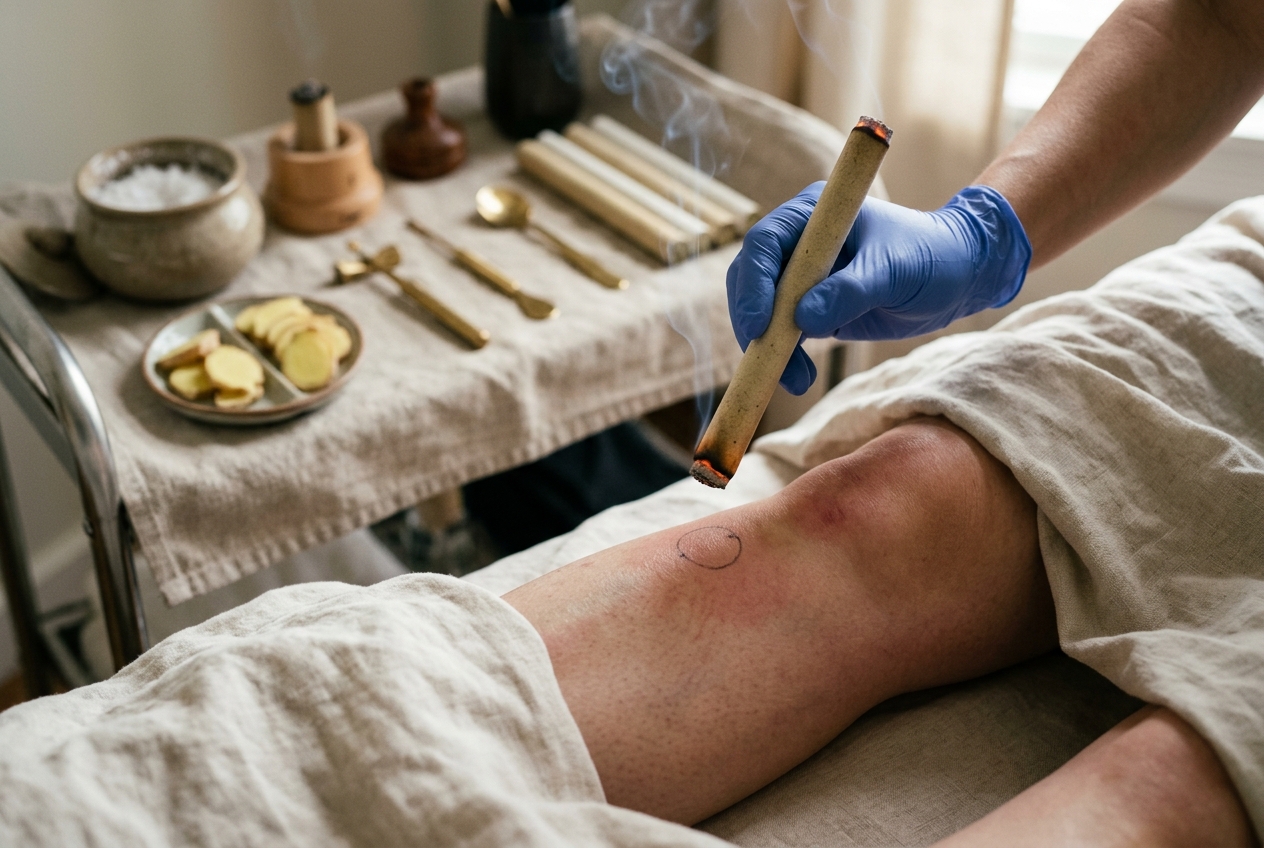
Moxa rolls, wrapped in mulberry paper, provide steady radiant heat without direct epidermal contact.
- Circular Warming (Wen He Jiu, 温和灸): The ignited stick is suspended $2–3\ \text{cm}$ above the acupoint, moving in subtle circular vectors to generate a comfortable, uniform thermal field for 10–15 minutes per locus until localized hyperemia appears.
- Sparrow-Pecking (Que Zhuo Jiu, 雀啄灸): The combustion tip moves in rhythmic vertical oscillations above the target locus, alternating between intense proximity ($1\ \text{cm}$) and retreat ($3\ \text{cm}$). This produces dynamic thermal spikes that stimulate deep mechanoreceptors and nociceptors without dermal overheating.
- Linear Sweeping (Xun He Jiu, 寻经灸): The moxa stick sweeps back and forth along the longitudinal axis of an entire meridian trajectory to resolve regional channel stagnation and treat extensive Bi syndrome patterns.
Partitioned Moxibustion Matrices (Ge Wu Jiu, 隔物灸)
Partitioned moxibustion places an intervening herbal medium between the moxa cone and the cutaneous boundary, combining thermal energy with pharmacological principles.
| Partition Modality | Intervening Medium & Preparation | Target Acupoint Loci | Classical Indications & Clinical Pharmacology |
|---|---|---|---|
| Ginger Partition (Ge Jiang Jiu, 隔姜灸) |
Fresh Zingiber officinale rhizome slice ($2–3\ \text{mm}$ thick), perforated with fine needle vents to allow volatile oil transmission. | ST36 (Zusanli), CV12 (Zhongwan), BL20 (Pishu), BL23 (Shenshu) | Spleen-Stomach Cold Vacuity, epigastric distension, acute/chronic vomiting, enteritis, cold arthralgia (Bi syndromes). Volatile gingerols synergize with moxa heat to enhance gastrointestinal perfusion. |
| Garlic Partition (Ge Suan Jiu, 隔蒜灸) |
Fresh Allium sativum bulb sliced into $2–3\ \text{mm}$ disks or crushed into a uniform paste. | GV14 (Dazhui), BL13 (Feishu), Local focal margins of indolent lesions. | Carbuncles, furuncles, deep toxic abscesses (Yin Ju), scrofula, pulmonary tuberculosis. Allicin provides antimicrobial and immunomodulating action via localized thermal permeation. |
| Salt Partition (Ge Yan Jiu, 隔盐灸) |
Pure, dry, fine-grain crystalline sodium chloride packed flush into the umbilical fossa, overlaid with a thin ginger wafer. | CV8 (Shenque / Umbilicus exclusively) | Acute collapse of Yuan Yang, cold-induced cholera-like diarrhea, flaccid stroke, extreme exhaustion. Salt acts as an isotropic thermal capacitor, delivering deep heat into the pelvic splanchnic plexus. |
| Aconite Cake Partition (Ge Fu Zi Jiu, 隔附子灸) |
Processed Radix Aconiti Lateralis Praeparata (Fu Zi) ground to powder, blended with yellow rice wine into a firm cake ($5\ \text{mm}$ thick), dried and perforated. | CV4 (Guanyuan), GV4 (Mingmen), KI1 (Yongquan), Refractory dermal ulcers. | Profound Kidney-Yang deficiency, decline of Mingmen fire, chronic non-healing ulcerations, intractable impotence, systemic hypothermia. Aconitine alkaloids deliver strong Yang-tonifying effects. |
Warm-Needling (Wen Zhen Jiu, 温针灸)
Warm-needling integrates filiform acupuncture with thermal moxibustion. After inserting an acupuncture needle to the therapeutic depth and obtaining the De Qi sensation, a $1.5–2.0\ \text{cm}$ segment of cylindrical moxa roll is impaled onto the needle handle and ignited at its base.
The metallic alloy of the needle body acts as a thermal conduit, transferring heat past the cutaneous barrier directly into myofascial structures, periosteum, and joint capsules. This technique is particularly effective for deep-seated cold-damp joint pathologies.
Enclosed Moxa Devices and Modern Delivery Systems
Modern clinical practice uses enclosed wood, bamboo, or ceramic moxa boxes (Ai Jiu He) containing internal mesh suspension frameworks. These devices maintain steady temperatures over broad anatomical zones (such as the lumbosacral plexus, lower abdomen, or upper thoracic spine) while capturing ash and reducing direct skin-contact burn risks.
4. Precision Point Integration and Acupressure Synergy
Clinical protocols achieve balanced therapeutic outcomes by pairing the thermal tonification of moxibustion with mechanical acupressure. Thermal stimulation warms the local tissue and primes peripheral neuroreceptors, while subsequent targeted pressure optimizes microvascular perfusion and modulates autonomic visceral tone.
========================================================================================
                          INTEGRATED CLINICAL PROTOCOL MATRIX
========================================================================================
AXIS 1: DIGESTIVE & SYSTEMIC TONIC AXIS
----------------------------------------------------------------------------------------
Primary Focus: Hypomotility, chronic fatigue, functional dyspepsia, postprandial distension.

1. ST36 (Zusanli - Leg Three Miles):
   • Topographical Location: Located on the anterior crural region, 3 B-cun inferior to
     ST35 (Dubi), one finger-breadth lateral to the anterior crest of the tibia, within
     the belly of the tibialis anterior muscle.
   • Moxa Delivery: Indirect stick moxibustion via Circular Warming (Wen He Jiu) for
     10 minutes per limb, or ginger-partitioned moxibustion (3 consecutive cones).
   • Acupressure Synergy: 90 seconds of firm, perpendicularly directed thumb compression
     with micro-rotational kneading until an irradiating dull ache propagates distally
     along the dorsum of the foot.

2. CV12 (Zhongwan - Middle Epigastrium):
   • Topographical Location: Located on the anterior median line of the upper abdomen,
     4 B-cun superior to the center of the umbilicus.
   • Moxa Delivery: Circular Warming stick moxibustion or moxa box application for
     12–15 minutes until a radiant, soothing warmth permeates the epigastric cavity.
   • Acupressure Synergy: Steady, moderate-depth palmar heel or joined-fingertip
     compression synchronized with deep diaphragmatic exhalation for 60–90 seconds.

----------------------------------------------------------------------------------------
AXIS 2: PRIMORDIAL YANG TONIFICATION AXIS
----------------------------------------------------------------------------------------
Primary Focus: Constitutional exhaustion, lumbar instability, chronic cold intolerance.

1. CV4 (Guanyuan - Gate of Origin) & CV8 (Shenque - Spirit Gate):
   • Topographical Location: CV4 is on the anterior median line of the lower abdomen,
     3 B-cun inferior to the umbilicus. CV8 is situated at the center of the umbilicus.
   • Moxa Delivery: Salt-partitioned moxibustion on CV8 (3–5 cones) combined with
     indirect stick or moxa box application across CV4 for 15–20 minutes.
   • Somatosensory Feedback: Patient reports a deep, flowing sensation of warmth spreading
     through the hypogastrium and descending into the lower extremities.

2. KI3 (Taixi - Supreme Stream):
   • Topographical Location: Located on the posteromedial aspect of the ankle, in the
     depression between the prominence of the medial malleolus and the calcaneal tendon.
   • Moxa Delivery: Mild circular stick warming for 5 minutes per limb.
   • Acupressure Synergy: Bilateral pincer-grip compression using the thumb on KI3 and
     the index finger resting on BL60 (Kunlun), maintaining firm ischemic pressure for
     90 seconds to reinforce the root of Kidney-Yin and Kidney-Yang.

----------------------------------------------------------------------------------------
AXIS 3: GYNECOLOGICAL & BLOOD REGULATING AXIS
----------------------------------------------------------------------------------------
Primary Focus: Primary dysmenorrhea, cold-coagulation pelvic stasis, irregular menses.

1. SP6 (Sanyinjiao - Three Yin Intersection) & CV6 (Qihai - Sea of Qi):
   • Topographical Location: SP6 is on the medial aspect of the lower leg, 3 B-cun
     superior to the prominence of the medial malleolus, posterior to the medial border
     of the tibia. CV6 lies on the anterior median line, 1.5 B-cun inferior to the umbilicus.
   • Moxa Delivery: Indirect warming stick moxibustion over CV6 for 10 minutes; gentle
     sparrow-pecking moxibustion over SP6 for 5–7 minutes per limb.
   • Acupressure Synergy: Firm, sustained ischemic thumb compression applied to SP6 at a
     $45^\circ$ angle toward the posterior tibial border for 90 seconds.

2. LV3 (Taichong - Great Surge):
   • Topographical Location: Located on the dorsum of the foot, in the depression distal
     to the junction of the bases of the first and second metatarsal bones.
   • Acupressure Synergy: Direct, deep distal-to-proximal stripping pressure with the thumb
     for 60 seconds per foot to release pelvic smooth muscle tension.

----------------------------------------------------------------------------------------
AXIS 4: RESPIRATORY & EXTERIOR DEFENSE AXIS
----------------------------------------------------------------------------------------
Primary Focus: Defensive Wei Qi deficiency, chronic allergic rhinitis, susceptibility to cold.

1. BL13 (Feishu - Lung Shu) & GV14 (Dazhui - Great Vertebra):
   • Topographical Location: BL13 is on the upper back, 1.5 B-cun lateral to the lower
     border of the spinous process of the third thoracic vertebra (T3). GV14 is located
     on the posterior median line, in the depression below the spinous process of the
     seventh cervical vertebra (C7).
   • Moxa Delivery: Garlic-partitioned moxibustion (2 cones) over BL13, or broad-spectrum
     moxa box application covering the GV14-BL13 thoracic triangle for 15 minutes.
   • Physiological Result: Expansion of tidal volume, relief of upper airway mucosal
     congestion, and induction of systemic diaphoresis.

2. LU7 (Lieque - Broken Sequence):
   • Topographical Location: Located on the radial aspect of the forearm, superior to the
     styloid process of the radius, 1.5 B-cun proximal to the palmar wrist crease.
   • Acupressure Synergy: Cross-handed hooking compression with the index fingernail edge
     against the radial styloid process for 60–90 seconds per side.
========================================================================================
5. Clinical Safety, Quality Standards, and Evidence-Based Research
Absolute and Relative Contraindications
Moxibustion delivers potent thermal stimulation and is therefore contraindicated in clinical presentations where additional exogenous heat or circulatory acceleration could exacerbate pathology:
Burn Prevention, Skin Monitoring, and Smoke Dynamics
- Thermal Boundary Monitoring: Practitioners must continuously assess cutaneous erythema. The clinical objective is mild, diffuse, non-blistered hyperemia (First-Degree Erythematous Response). The formation of bullae (Second-Degree Burn) indicates excessive local exposure and must be avoided.
- Ash Management: During warm-needling and stick moxibustion, non-combustible collection trays or protective collars should be placed beneath the ignition zone to protect the patient from falling embers.
- Ambient Air Quality and Smoke Extraction: Raw moxa combustion generates volatile organic compounds (VOCs), aromatic hydrocarbons, and particulate matter ($\text{PM}{2.5}$ and $\text{PM}{10}$). Clinical spaces require active negative-pressure exhaust systems or high-efficiency particulate air (HEPA) filtration units equipped with activated carbon scrubbers. For patients with reactive airway disease or asthma, indirect smokeless moxa carbon sticks (Ai Tiao Tan) or certified electronic moxibustion devices should be used.
Evidence-Based Research and Clinical Trial Syntheses
Over the past three decades, rigorous clinical trials, systematic reviews, and meta-analyses indexed in the World Health Organization (WHO) Traditional Medicine Databases and NCBI PubMed have evaluated the therapeutic efficacy of moxibustion across several key indications.
1. Cephalic Version of Breech Presentation (Acupoint BL67 Zhiyin)
The clinical application of moxibustion at BL67 (Zhiyin), located at the lateral aspect of the distal phalanx of the fifth toe, represents one of the most thoroughly investigated protocols in reproductive integrative medicine.
In a landmark randomized controlled trial published in JAMA by Cardini and Weixin (1998), 260 primigravidas at 33 weeks of gestation with ultrasound-confirmed breech presentations were randomized to receive either 7 days of moxibustion at BL67 or standard observational care. * Results: At 35 weeks of gestation, 75.4% of fetuses in the moxibustion group had rotated to cephalic version, compared to 47.7% in the control cohort ($P < .001$). * Mechanism: Thermal stimulation of BL67 stimulates the production of maternal adrenocortical hormones and placental prostaglandins ($PGF_{2\alpha}$), elevating basal uterine tone and fetal motor activity to encourage spontaneous cephalic turning.
2. Management of Knee Osteoarthritis (KOA)
Multicenter randomized sham-controlled trials evaluating indirect and warm-needle moxibustion in gonarthrosis demonstrate marked improvements in pain and joint function. Thermal delivery over local periarticular acupoints—including ST35 (Dubi), EX-LE4 (Neixiyan), SP9 (Yinlingquan), and ST36 (Zusanli)—leads to statistically significant reductions in Western Ontario and McMaster Universities Osteoarthritis Index (WOMAC) scores and Visual Analogue Scale (VAS) ratings.
Biochemical analyses show that these clinical improvements correlate with reduced synovial concentrations of pro-inflammatory cytokines ($\text{IL-1}\beta$, $\text{TNF-}\alpha$) and matrix metalloproteinases (MMP-1, MMP-13), attenuating chondrocyte apoptosis and cartilage degradation.
3. Chemotherapy-Induced Leukopenia and Myelosuppression
Chemotherapeutic protocols frequently cause myelosuppression, leaving patients vulnerable to systemic infection. Clinical trials evaluating partitioned and warm-needle moxibustion over systemic tonic points (ST36, CV4, BL20, and BL23) demonstrate significant protective effects on bone marrow hematopoiesis.
Moxibustion stimulates endogenous granulocyte-macrophage colony-stimulating factor (GM-CSF) synthesis, resulting in faster recovery of absolute neutrophil counts (ANC) and total white blood cell profiles compared to non-intervention controls. This helps prevent chemotherapy dose reductions and supports protocol completion in oncology cohorts.
6. Synthesis and Clinical Implementation
Moxibustion therapy represents a sophisticated synthesis of classical meridian energetics and modern biophysical medicine. The application of Artemisia argyi combustion delivers targeted near- and far-infrared radiation, activating deep thermoreceptive channels (TRPV1/TRPV2), inducing cytoprotective heat shock proteins, and eliciting local and systemic neurovascular responses.
When systematically combined with non-invasive acupressure across verified clinical axes, moxibustion provides practitioners with an evidence-based tool for warming cold-damaged channels, restoring tissue perfusion, alleviating chronic pain, and optimizing systemic physiological resilience.
+----------------------------------------------------------------------------------------------------+
|                                    PRIMARY REFERENCES & CITATIONS                                  |
+----------------------------------------------------------------------------------------------------+
| 1. World Health Organization (WHO). Traditional, Complementary and Integrative Medicine Strategy.  |
|    URL: https://www.who.int/health-topics/traditional-complementary-and-integrative-medicine       |
| 2. Cardini F, Weixin H. Moxibustion for cephalic version: a randomized controlled trial.           |
|    JAMA. 1998;280(18):1580-1584. PMID: 9820257.                                                   |
|    URL: https://pubmed.ncbi.nlm.nih.gov/9820257/                                                   |
| 3. World Health Organization (WHO). WHO Standard Acupuncture Point Locations in the Western        |
|    Pacific Region. Manila: WHO Regional Office for the Western Pacific; 2008.                      |
|    URL: https://iris.who.int/handle/10665/311400                                                   |
| 4. Huang HG, et al. Mechanisms of moxibustion: a review of biophysical and biochemical pathways.   |
|    Evidence-Based Complement Altern Med. 2013;2013:421379. PMID: 24363749.                         |
|    URL: https://pubmed.ncbi.nlm.nih.gov/24363749/                                                   |
| 5. National Center for Biotechnology Information (NCBI). Moxibustion and Thermal Stimulation       |
|    Research Compendium. PubMed Central Database.                                                   |
|    URL: https://www.ncbi.nlm.nih.gov/pmc/articles/PMC3789413/                                      |
+----------------------------------------------------------------------------------------------------+