Lie Jin Split Force: Opposing Bi-Directional Kinetic Vectoring, Helical Fascial Torsion, and Rotational Shear in Classical Neigong
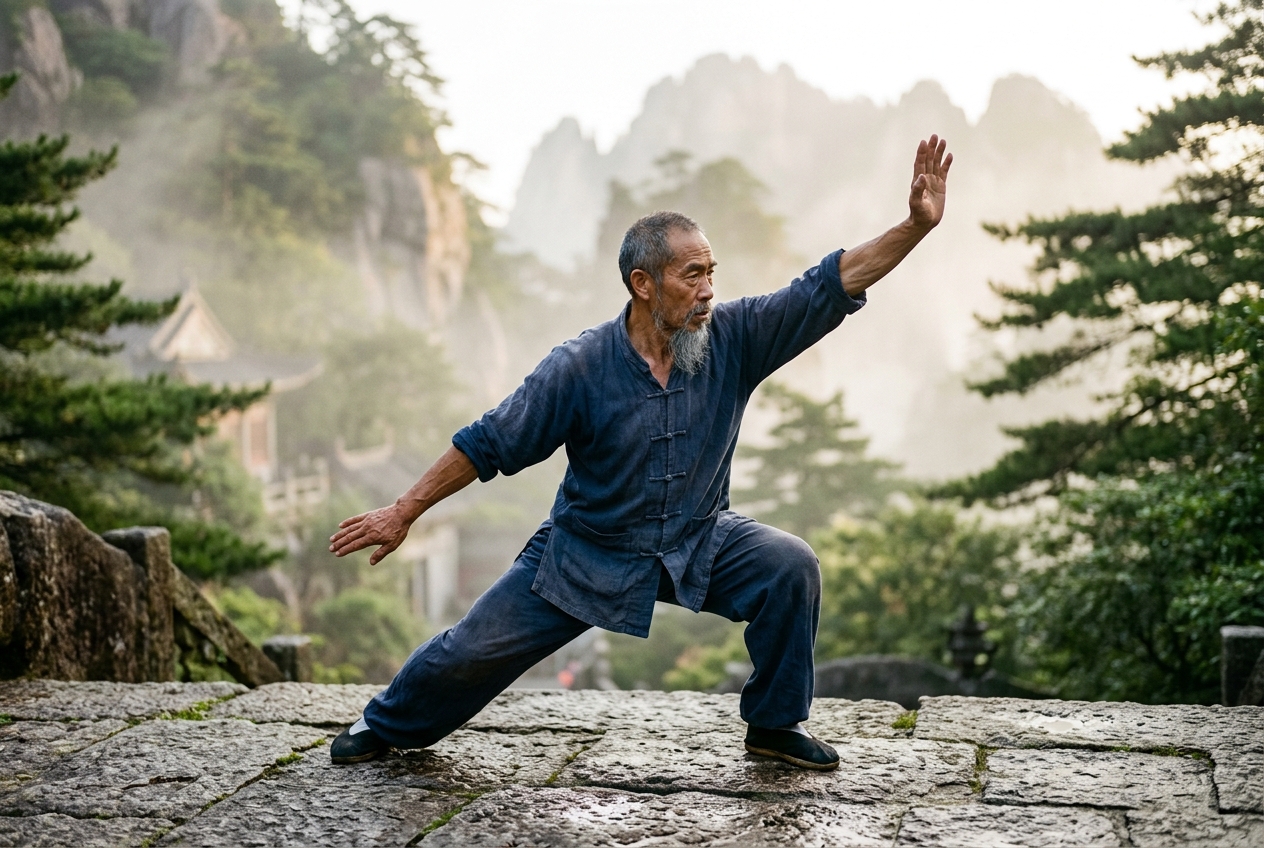
The Four Cardinal Energies establish structural equilibrium and primary translational vectors: 1. Peng (掤 - Ward-Off): An omnipresent, buoyant, spherical expansion directed outward in all directions, maintaining structural space. 2. Lu (捋 - Roll-Back): A yielding, curved, absorptive vector that leads incoming momentum into a circular void. 3. Ji (挤 - Press): A focused, forward-driving linear vector that combines dual contact points into a single penetrating force. 4. An (按 - Push/Settle): A downward-and-forward rooting vector that unbalances through grounding and arching leverage.
In contrast, the Four Corner Energies—comprising Cai (Pluck), Lie (Split), Zhou (Elbow), and Kao (Shoulder/Body Strike)—represent dynamic destabilization techniques used when primary geometric lines are breached or rotational leverage is required. Among these, Lie Jin is unique because it is not a singular directional vector; it is fundamentally a differential couple—two parallel forces of equal magnitude acting in opposite directions along distinct lines of action, thereby creating pure rotational shear without translational compliance. Where Peng expands, Lu absorbs, Ji thrusts, An suppresses, and Cai violently jerks downward, Lie bifurcates the opponent’s center of mass by applying simultaneous counter-vectors to two distinct anatomical landmarks.
Biomechanical Breakdown and Myofascial Tensegrity
The generation of an effective Lie Jin vector relies on an unbroken kinetic chain that bridges modern neuromuscular science and traditional Chinese sinew-channel theory (Jing Jin, 经筋). Rather than activating local muscle groups in isolation, the body operates as a continuous biotensegrity structure, a concept thoroughly explored in the somatic literature on the anatomy of fascia.
The mechanical sequence unfolds across four interconnected somatic stations:
1. Ground Reaction Force and Asymmetric Anchoring (Yongquan)
All internal kinetic energy begins at the earth interface. The practitioner establishes an asymmetric distribution of weight across the feet—typically a 70/30 or 60/40 ratio in postures such as the Bow Stance (Gong Bu) or Empty Stance (Xu Bu). Ground reaction force (GRF) is gathered through the Yongquan (涌泉, Kidney 1) point, situated in the depression created when the toes curl, just behind the ball of the foot. By suctioning the arch of the foot (Yongquan lifting) while gripping lightly with the toes and anchoring the calcaneus, the practitioner creates a stable base. The driving leg presses into the earth along a spiral vector, generating an equal and opposite upward ground reaction force that ascends through the tibia, fibula, and femoral helical rotation into the pelvis.
2. Pelvic Suspension and Waist Rotation (Song Yao and Dantian)
The pelvis acts as a mechanical differential gearbox. The perineum (Huiyin, CV 1) is gently suspended upward, preventing pelvic floor collapse, while the sacrum drops vertically, flattening the hyper-lordotic curve of the lumbar spine. This postural alignment opens the Mingmen (命门, Governing Vessel 4) gate, creating a dynamic biological fulcrum. When the waist rotates (Song Yao), it does not twist the vulnerable lumbar vertebrae in isolation; rather, the rotation is executed through the multi-axial ball-and-socket articulation of the hip joints (Kua), allowing the pelvic girdle to rotate smoothly while the spine remains an axis of vertical integrity (Zhong Ding).
3. Thoracolumbar Fascial Sling Transmission
The kinetic impulse generated by the hips is transmitted into the trunk via the thoracolumbar fascia (TLF)—a critical diamond-shaped retinacular lattice that anchors the latissimus dorsi, gluteus maximus, internal obliques, and transverse abdominis. As shown in peer-reviewed biomechanical studies cataloged on NCBI PubMed on myofascial force transmission, the cross-tensioning of the posterior oblique sling (connecting the left latissimus dorsi to the right gluteus maximus across the sacrolumbar junction) enables massive shear forces to be distributed across the posterior chain without placing localized mechanical strain on individual spinal disks. Lie Jin tensions this fascial diamond diagonally: as one side contracts eccentrically, the contralateral side contracts concentrically, turning the entire torso into a loaded torsional spring.
4. Kinetic Propagation Through the Sinew Channels (Jing Jin)
From the thoracolumbar diamond, the dual vectors travel outward into the upper extremities along the myofascial pathways described as the Spiral Line and Deep Front Arm Lines in modern somatics, and as the Hand Taiyin (Lung) and Hand Shaoyang (Triple Burner) Sinew Channels in classical acupuncture theory. One vector travels along the thumb-side radius of the forward arm, projecting an outward and upward shearing wedge; simultaneously, the counter-vector travels down the pinky-side ulna of the retracting arm or hip, creating a grounded, anchoring pull. The resulting output at the hands is not two separate arm movements, but the terminal manifestation of a single, unified, full-body torsional wave.
The Neuro-Fascial Physics of Neutralizing Torque
When an external linear force—such as a direct strike, grapple, or heavy push—contacts the body, standard structural resistance relies on orthogonal bracing, which inevitably pits muscle mass against muscle mass. Lie Jin neutralizes this incoming momentum through instantaneous rotational decomposition.
By establishing two distinct points of contact on the incoming limb or torso (for instance, one hand contacting the opponent’s wrist while the other forearm contacts the triceps tendon or neck), the internal practitioner establishes a moment arm. By initiating Song Yao and driving the feet in opposing ground vectors, the practitioner creates a torque ($\tau = r \times F$). The upper contact point accelerates the opponent's upper lever forward or upward, while the lower contact point shears their base backward or downward.
Because both vectors occur along the exact same millisecond timeline and originate from the practitioner's unified center of mass, the opponent’s nervous system is subjected to dual conflicting proprioceptive inputs. The Golgi tendon organs and muscle spindle networks in the opponent's stabilizing musculature cannot fire a coordinated compensatory reflex to two simultaneous opposing directions, resulting in an immediate collapse of their structural posture.
Step-by-Step Solo Daoyin Practice Guide
The following classical Daoyin drill, known historically as The Helix of Heaven and Earth Splitting Gate (Tian Di Xuan Zhuan Lie Shi), trains the nervous system, fascial sheets, and breath to synchronize into a single cohesive Lie Jin mechanism.
1. Foundational Stance and Alignment
- Stand in Wu Ji (neutral posture) with feet parallel, shoulder-width apart.
- Distribute your weight evenly over the three points of the foot: the base of the big toe, the base of the little toe, and the center of the heel.
- Tuck the chin slightly to lengthen the suboccipital musculature at the base of the skull (Baihui point reaching upward).
- Rest the tip of the tongue gently against the hard palate behind the upper front teeth to connect the Conception (Ren) and Governing (Du) vessels.
- Allow the shoulders to drop away from the ears (Chen Jian) and sink the elbows downward (Zhui Zhou), creating hollow, relaxed armpits.
2. Breath Coordination: Reverse Abdominal Breathing (Ni Fuhu Xi)
- Lie Jin relies on Reverse Abdominal Breathing (Ni Fuhu Xi, 逆腹式呼吸) to generate the intra-abdominal pressure necessary for explosive fascial recoil, a mechanism documented in clinical studies on NCBI PubMed regarding intra-abdominal pressure and spinal stability.
- On Inhalation (Coiling Phase): Draw the breath smoothly through the nose over a 4-second count. Gently draw the lower abdominal wall slightly inward toward the spine while simultaneously expanding the lower back (Mingmen), lateral ribs, and pelvic floor. Imagine pulling elastic potential energy upward from the earth through the soles of your feet into the lower dantian.
- On Exhalation (Splitting Phase): Exhale through relaxed lips over a 4-second count. Gently push the abdominal wall outward and downward into the pelvic bowl, solidifying the core cylinder without tensing the superficial rectus abdominis muscle. Simultaneously release the coiled fascial spiral through the limbs.
3. Movement Execution Sequence
-
The Inward Coil (Inhale): * Shift 70% of your body weight into your left leg, sinking deeply into the left hip crease (left Kua). * Rotate your torso 45 degrees to the left. * Bring both hands toward your left hip: the left hand floats near the left hip bone with the palm facing upward, while the right hand hovers over the left chest with the palm facing downward, forming an energetic "holding the sphere" posture. * Feel the spiral winding from the right heel, across the sacrum, into the left shoulder.
-
The Diagonal Split (Exhale): * Step forward-diagonally with your right foot at a 45-degree angle, landing heel-first, then rolling smoothly onto the full sole into a right Bow Stance (Gong Bu). * As you shift your weight forward (60% right leg, 40% left leg), drive off the rear left Yongquan and initiate a rapid, smooth rotation of the pelvis to the right. * Vector A (Upper Right Hand): Extend your right forearm diagonally upward and outward across your centerline, turning the palm inward toward your face at eye level, striking/shearing with the radial edge of the forearm. * Vector B (Lower Left Hand): Simultaneously slice your left palm diagonally downward and backward past your left hip, pressing the palm heel downward with fingers pointing laterally. * Arrive at the final structural position with both hands reaching their terminal expansion at the exact millisecond your breath finishes exhaling and your right foot anchors firmly into the floor.
-
The Reciprocal Return: * Inhale, relax the elastic tension, draw the right foot back, and repeat the identical sequence on the opposite side (coiling into the right Kua, then splitting diagonally forward with the left arm rising and the right arm pressing downward-backward). * Perform 12 repetitions per side daily.
4. Common Beginner Pitfalls and Precise Biomechanical Corrections
| Beginner Error | Anatomical Consequence | Precise Didactic Correction |
|---|---|---|
| Lumbar Hyper-Twisting | Excessive rotational shear on L4-L5/L5-S1 lumbar facets, leading to lower back strain. | Keep the lumbar spine stabilized. Fold and rotate strictly from the hip joints (Kua) while allowing thoracic rotation across the ribs. |
| Shoulder Elevation | Trapezius and levator scapulae contract, breaking the kinetic chain between the spine and arms. | Consciously "sink the shoulders and drop the elbows" (Chen Jian Zhui Zhou), engaging the serratus anterior to anchor the scapulae to the ribcage. |
| Decoupled Arm Movement | Arms move independently of torso rotation, producing weak, isolated muscular force. | Treat the arms as rigid-yet-elastic antennas welded to the chest and back; move them only as a consequence of pelvic turning (Yao). |
| Floating Rear Heel | Loss of ground connection, neutralizing the upward Ground Reaction Force (GRF). | Keep the entire perimeter of the rear foot rooted, pressing the rear heel firmly into the earth throughout the terminal split. |
5. Somatosensory Benchmarks: What You Should Feel
- Hydraulic Fullness (Peng Qi): A sensation of dense, fluid resistance within the limb joints, as though moving through warm water.
- Microvascular Tingling and Warmth: As the thoracic basket opens and peripheral blood vessels dilate due to parasympathetic tone, distinct tingling sensations (qi sensations) will manifest along the ulnar borders of the hands and fingertips.
- Elastic Fascial Rebound: At the peak of the movement, you should not feel muscular burn, but rather the taut snap of an expanded rubber band releasing its stored energy across the back.
Partner Silk-Reeling Application (Chansijin)
To bridge solo Daoyin practice into applied functional mechanics, practitioners utilize two-person Silk-Reeling drills (Chansijin, 缠丝劲).
- Setup: Two practitioners stand facing one another in a matched right Bow Stance. Partner A applies a controlled, linear two-handed push (Ji) directed toward Partner B’s chest.
- Contact and Adhesion: Partner B makes contact without resisting, placing their right palm on Partner A’s right wrist, while their left forearm adheres gently underneath Partner A’s right elbow joint.
- The Spiral Interception: Instead of pushing back against Partner A’s incoming vector, Partner B drops their center of mass by sinking into their right Kua, rotating their torso slightly clockwise to lead Partner A’s force into emptiness (Yin Jin Luo Kong).
- The Split Execution: Once Partner A’s balance begins to drift forward past their toes, Partner B reverses their waist rotation counter-clockwise with a sudden, coordinated reverse abdominal exhalation: * Partner B’s left forearm lifts upward and outward against Partner A’s upper arm. * Partner B’s right hand shears downward and inward across Partner A’s wrist.
- Outcome: The opposing forces fracture Partner A’s posture across their longitudinal axis, rotating their shoulders away from their hips and causing them to step off-balance instantly, without Partner B exerting localized muscular strain.
Diagnostic Self-Check Rubric
Use the following clinical diagnostic matrix to evaluate the integrity of your Lie Jin execution during solo practice:
Physiological Mechanisms and Somatosensory Science
Modern somatic science and clinical rehabilitation have increasingly validated the foundational principles underlying traditional internal practices, as recognized by the World Health Organization Traditional Medicine Strategy. The physiological benefits of Lie Jin extend across three primary biological systems:
1. Mechanoreceptive Enrichment and Proprioception
The human fascial matrix contains six to ten times more sensory nerve endings than muscle tissue, particularly Ruffini endings (which respond to sustained pressure and lateral shear) and Pacinian corpuscles (which detect rapid changes in velocity and acceleration). The multi-planar, counter-directional mechanics of Lie Jin stimulate these deep mechanoreceptors, providing high-resolution sensory feedback to the primary somatosensory cortex. This neuro-proprioceptive enrichment refines motor unit recruitment, enhances postural stability, and prevents musculoskeletal injury during complex daily tasks.
2. Fascial Remodeling and Intervertebral Decompression
Chronic seated posture causes the layers of the thoracolumbar fascia to dehydrate and adhere, restricting rotational freedom and creating compressive loads on the lumbar spine. The gentle, spiral cross-tensioning of Lie Jin promotes fluid shear within the hyaluronic acid layers between fascial sheets. This mechanical stimulation activates fibroblasts, prompting the synthesis of organized, healthy collagen fibrils and decompressing the intervertebral spaces between the L1 and S1 vertebrae, providing significant therapeutic relief for chronic mechanical lower back discomfort.
3. Autonomic Nervous System Regulation and Vagal Tone
The coordination of reverse abdominal breathing with rhythmic whole-body coiling and uncoiling exercises stimulates the vagus nerve as it traverses the esophageal hiatus of the respiratory diaphragm. Clinical trials on mind-body somatic exercises demonstrate that this structured slow-paced diaphragmatic respiration significantly increases Heart Rate Variability (HRV) and down-regulates sympathetic "fight-or-flight" nervous activity, shifting the practitioner into a sustained parasympathetic state characterized by lowered systemic cortisol levels and accelerated cellular tissue recovery.
Classical Lineage, Philosophical Roots, and Historical Evolution
The development of Lie Jin is inextricably bound to the philosophical and historical evolution of classical Chinese internal culture. While commonly associated with Taijiquan, its kinetic principles originated in early Daoist longevity gymnastics (Daoyin, 导引) practiced during the Han and Tang dynasties. These ancient routines sought to harmonize the human body with the dual forces of nature—Yin and Yang—by mirroring the dynamic spiraling patterns found throughout the natural world, such as vortexes of water and ascending thermal air currents.
During the late Ming and early Qing dynasties, master martial artist Chen Wangting (陈王廷, 1600–1680) systematically synthesized these energetic Daoyin principles with military spear techniques, traditional Chinese medical meridian theory, and the cosmological framework of the Yijing (Book of Changes). In the Yijing cosmology, Lie Jin is traditionally correlated with the Zhen (震, Thunder) and Xun (巽, Wind) trigrams. Zhen embodies the explosive, upward-arising shock of electrical energy from the earth, while Xun represents the subtle, penetrating, helical flexibility of wind. When united in physical movement, they produce a dynamic force that is at once structural and elusive.
The seminal 18th-century text Taijiquan Treatise (Taijiquan Lun, 太极拳论), historically attributed to scholar-master Wang Zongyue (王宗岳), provides the classical theoretical foundation for Split Force:
"If the opponent attacks with hardness, use softness to dissolve it; this is called Zou (yielding). If you follow the opponent's momentum and cause them to lose balance, this is called Nian (adhesion). When force is directed to the left, the left side empties; when force is directed to the right, the right side disperses. In splitting (Lie), the wheel rotates around a central hub; two forces separate like lightning across the sky, unbalancing the root without visible striving."
In the 19th century, as internal arts evolved into the Yang, Wu, Sun, and Baguazhang traditions, Lie Jin was preserved not merely as a combative tool, but as a premier diagnostic method for testing whether a student had truly eliminated localized muscular tension (Zhuo Li) and cultivated unified, whole-body fascial elasticity (Nei Jin).
Today’s Somatic Practice Commitment
To integrate the restorative and biomechanical benefits of Lie Jin into your daily routine, commit to the following structured 7-minute morning neural-fascial alignment micro-routine before beginning your daily activities:
- Minutes 0–2: Grounding and Breath Preparation * Stand in Wu Ji posture. Perform 10 deep cycles of Reverse Abdominal Breathing, focusing on expanding the Mingmen and lower back on inhalation and grounding your weight into the Yongquan points on exhalation.
- Minutes 2–5: The Dual-Vector Split Flow * Perform 12 slow, continuous repetitions of the Helix of Heaven and Earth Splitting Gate (6 per side). Focus entirely on feeling the simultaneous opposing stretch between your upper radial forearm and lower ulnar palm.
- Minutes 5–7: Stillness and Somatosensory Integration * Return to Wu Ji posture. Close your eyes, let your arms rest at your sides, and observe the sensations within your body for two full minutes. Notice the warmth in your palms, the structural openness across your chest and lower back, and the grounded stability beneath your feet.
By dedicating just seven minutes each morning to cultivating this unified cross-body tensegrity, you train your neuromuscular system to replace habitual, localized muscular tension with efficient, coordinated, and resilient whole-body movement.