Blood-Regulating Formulas (Li Xue Ji) Prescription Dynamics: Governing Microcirculatory Perfusion, Extravasation Arrest, Thrombosis Dissolution, and Hemorheological Homeostasis in Traditional Chinese Medicine
EXECUTIVE PEDAGOGICAL SUMMARY
- Taxonomic Division: Blood-Regulating Formulas (Lǐ Xuè Jì, 理血剂) bifurcate fundamentally into Blood-Invigorating and Stasis-Transforming Formulas (Huò Xuè Huà Yú Jì, 活血化瘀剂) and Hemostatic Formulas (Zhǐ Xuè Jì, 止血剂).
- Tripartite Organ Axis: The dynamic physiology of Blood (Xuè, 血) depends on the governing propulsion of the Heart (Xīn), the volumetric storage and smooth coursing of the Liver (Gān), and the extravasation-preventing containment governed by the Spleen (Pí).
- Classical Architectures: Mastery of this category requires analyzing seminal structural paradigms, including Xuè Fǔ Zhú Yú Tāng, Bǔ Yáng Huán Wǔ Tāng, Táo Hé Chéng Qì Tāng, Guì Zhī Fú Líng Wán, Shí Huī Sǎn, Huáng Tǔ Tāng, and Jiāo Ài Tāng.
- Translational Pharmacology: Classical herbs modulate the platelet aggregation cascade (TXA₂/PGI₂ ratio), upregulate endothelial nitric oxide synthase (eNOS), facilitate fibrinolysis via tissue plasminogen activator (tPA), and correct microvascular rheology.
- Safety & Critical Diagnostics: Precise discrimination between cold-stasis, heat-hyperactivity, and deficiency-extravasation prevents lethal iatrogenic errors, particularly when co-administered with pharmaceutical anticoagulants or during pregnancy.
1. Opening Scene — A Moment You'll Recognise
It begins as a dull, fixed ache deep within the left hypochondrium or beneath the shoulder blades—an unyielding, pinpoint discomfort that intensifies under the stillness of night. Perhaps you notice that a trivial bump against a desk leaves a stubborn, dark-purple hematoma that lingers for weeks, or that your lips and sublingual veins carry a dusky, cyanotic hue after a prolonged period of mental exhaustion and sedentary confinement. In the modern vernacular, we might dismiss these somatic complaints as muscular tension, poor posture, or the inevitable fatigue of a desk-bound existence.
Yet within the diagnostic ontology of Traditional Chinese Medicine (TCM), these subtle physical signatures reveal an underlying disruption in the systemic hydrodynamics of life: an impairment in the circulation, containment, and nourishment of Blood (Xuè, 血). The sensation of localized, stabbing pain (Cì Tòng, 刺痛) is not merely a neurological quirk; it represents the cellular cry of tissue suffering from ischemic microvascular compromise—a condition formally designated as Blood Stasis (Xuè Yú, 血瘀). When the dynamic flow of Blood falters, the entire somatic landscape shifts from vitality to stagnation, illustrating the classical axiom: "When there is free flow, there is no pain; when there is pain, there is no free flow" (Tōng zé bù tòng, tòng zé bù tōng, 通则不痛,痛则不通).
2. What This Organ System Does: The Physiology of Blood (Xuè) and Its Regulating Organs
In classical East Asian medical theory, Blood (Xuè) is not viewed merely as a passive liquid transport medium, but rather as a dense, nutrient-rich, material manifestation of vital energy that moves in an unbroken reciprocal dance with Qi (Qì, 气). To understand Blood-Regulating Formulas (Lǐ Xuè Jì), one must first comprehend the physiological tripartite axis formed by the Heart, Liver, and Spleen, as defined in the foundational canons of the Huangdi Neijing (黄帝内经).
The Tripartite Functional Architecture
- The Heart Governs the Blood and Vessels (Xīn Zhǔ Xuè Mài, 心主血脉): The Heart serves as the sovereign propulsive pump. Heart-Qi provides the hydrodynamic kinetic force that maintains continuous, forward, laminar flow through the vascular conduits (Mài). When Heart-Qi is robust, arterial and capillary perfusion remains unimpeded, the complexion radiates a lustrous luster, and cerebral faculties remain sharp.
- The Liver Stores the Blood and Regulates Dynamic Distribution (Gān Cáng Xuè, 肝藏血): The Liver acts as a dynamic biological reservoir. During periods of physical exertion, the Liver releases stored Blood into the peripheral musculature; during rest and recumbency, Blood returns to the Liver for filtration and conservation. Furthermore, the Liver's function of smooth coursing (Shū Xiè, 疏泄) ensures that emotional stressors do not induce mechanical constriction of the vascular bed.
- The Spleen Manages and Contains the Blood (Pí Tǒng Xuè, 脾统血): The Spleen is the central organ of metabolic transformation and transportation (Yùn Huà, 运化), extracting post-natal essence from food and fluid to synthesize Blood. Crucially, Spleen-Qi exercises an invisible containment force that maintains the structural integrity of the vascular walls, preventing extravasation, capillary fragility, and spontaneous hemorrhage.
The functional interdependence of Qi and Blood is encapsulated in the golden clinical maxims: * "Qi is the commander of Blood" (Qì wéi xuè zhī shuài, 气为血之帅): Qi generates, moves, and holds Blood in place. * "Blood is the mother of Qi" (Xuè wéi qì zhī mǔ, 血为气之母): Blood nourishes the organs that generate Qi and provides the physical anchor preventing Qi from dissipating into thin air.
3. How You Can Feel It — Signs of Balance and Imbalance
When the vascular equilibrium governed by this tripartite axis is intact, somatic vitality is effortless: the limbs are warm, the mind is tranquil, sleep is regenerative, and physical trauma heals with rapid tissue restitution. However, when endogenous pathogenic factors (such as Qi stagnation, pathogenic cold, toxic heat, or chronic Qi deficiency) disrupt this axis, the clinical manifestation of Blood disharmony emerges in two diametrically opposed yet paradoxically related patterns: Blood Stasis (Xuè Yú) and Hemorrhage/Extravasation (Chū Xuè).
Self-Assessment & Phenotypic Markers of Blood Imbalance
| Pattern Dimension | Pathophysiological Mechanism | Somatic Phenotype & Symptoms | Tongue & Pulse Diagnostics |
|---|---|---|---|
| Active Blood Stasis (Xuè Yú, 血瘀) | Physical microvascular occlusion; platelet hyper-reactivity; interstitial ischemic hypoxia. | Fixed, stabbing pain worse at night; dry, scaly skin (Jī Fū Jiǎ Cuò); dark-purple bruises; dark circles under eyes; cold, dusky fingertips. | Tongue: Dusky purple body, prominent petechiae, engorged/tortuous sublingual veins. Pulse: Choppy (Sè), Wiry (Xián), or Deep (Chén). |
| Blood Heat Extravasation (Xuè Rè Wàng Xíng, 血热妄行) | Febrile or inflammatory heat forcing blood out of hyperpermeable capillary beds. | Sudden, profuse, bright-red bleeding (epistaxis, hematemesis, menorrhagia); severe restlessness; insomnia; intense thirst with feverish sensation. | Tongue: Deep crimson/red body with prickles; yellow, dry coating. Pulse: Rapid (Shuò), Surging (Hóng), or Slippery (Huá). |
| Deficiency-Cold Extravasation (Pí Bù Tǒng Xuè / Xuè Hán) | Inability of deficient Spleen-Qi to contain blood, or deep Cold causing slow, passive oozing. | Chronic, pale or dark-purple, low-grade bleeding (melena, persistent spotting, bruising); cold extremities; pale complexion; chronic lethargy. | Tongue: Pale, swollen body with scalloped teeth marks; thin white coat. Pulse: Fine (Xì), Weak (Ruò), or Slow (Chí). |
4. Theoretical Framework & Classical Formula Architecture (Lǐ Xuè Jì)
In accordance with World Health Organization Traditional Medicine guidelines, the pharmacological formulation of Blood-Regulating Formulas requires systematic hierarchy. The classical canon constructs formulas based on the sovereign structural matrix: Sovereign (Jūn, 君), Minister (Chén, 臣), Assistant (Zuǒ, 佐), and Envoy (Shǐ, 使).
The grand category of Lǐ Xuè Jì is fundamentally bifurcated into two therapeutic branches: 1. Blood-Invigorating & Stasis-Transforming Formulas (Huò Xuè Huà Yú Jì, 活血化瘀剂) 2. Hemostatic Formulas (Zhǐ Xuè Jì, 止血剂)
Dual Taxonomic Division: Representative Formula Analyses
Subcategory I: Blood-Invigorating & Stasis-Transforming Formulas (Huò Xuè Huà Yú Jì)
1. Xuè Fǔ Zhú Yú Tāng (血府逐瘀汤 — Drive Out Stasis in the Mansion of Blood Decoction)
- Author & Source: Wang Qingren (王清任), Yī Lín Gǎi Cuò (Correcting the Errors in the Forest of Medicine, 1830).
- Primary Pathomechanism: Blood stasis obstructing the "Mansion of Blood" (the thoracic cavity and pericardial space), complicated by liver Qi constraint.
- Hierarchical Composition:
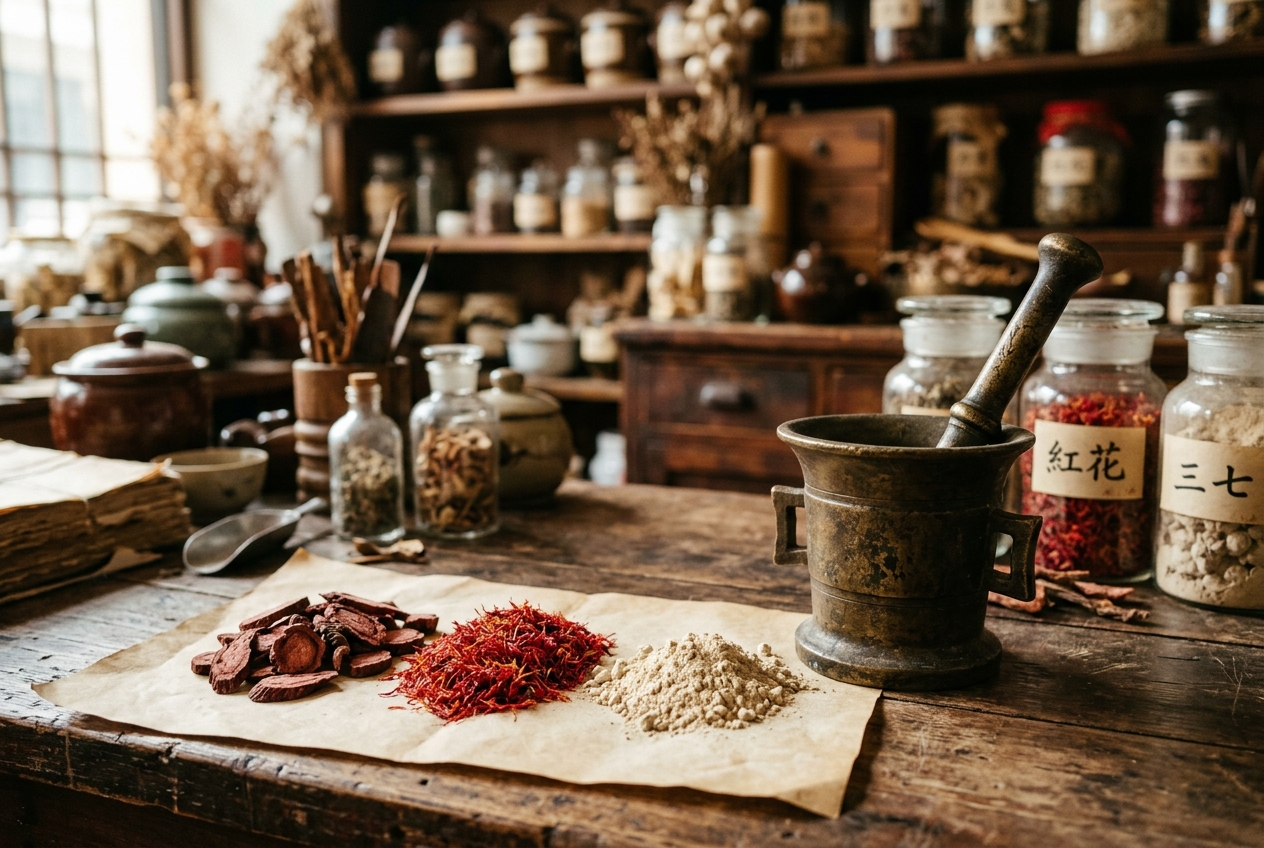
- Sovereign (Jūn): Táo Rén (Persicae Semen) and Hóng Huā (Carthami Flos) — Potent pair that directly shatters fixed microvascular thrombi and accelerates capillary flow.
- Minister (Chén): Chì Sháo (Paeoniae Radix Rubra), Chuān Xiōng (Chuanxiong Rhizoma), Dāng Guī (Angelicae Sinensis Radix) — Mobilize blood within the vessels; Shēng Dì Huáng (Rehmanniae Radix) — Clears heat, cools blood, and prevents the stasis-breaking herbs from consuming essential body fluids.
- Assistant (Zuǒ):
- Chái Hú (Bupleuri Radix) & Zhǐ Ké (Aurantii Fructus) — Smooth hepatic Qi and relieve subcostal fullness.
- Jié Gěng (Platycodonis Radix) — Guides formula upward to open chest Qi.
- Niú Xī (Achyranthis Bidentatae Radix) — Directs stagnant blood downward through the systemic vasculature.
- Envoy (Shǐ): Gān Cǎo (Glycyrrhizae Radix) — Harmonizes the intense dispersing actions of all eleven ingredients.
- Clinical Actions: Unblocks thoracic blood stasis, alleviates chronic stabbing chest pain, relieves intractable headaches, and dispels internal heat and palpitations resulting from chronic vascular impedance.
2. Bǔ Yáng Huán Wǔ Tāng (补阳还五汤 — Tonify Yang to Restore Five-Tenths Decoction)
- Author & Source: Wang Qingren, Yī Lín Gǎi Cuò.
- Primary Pathomechanism: Post-stroke sequelae characterized by profound Qi deficiency leading to secondary microvascular stasis and collateral malperfusion (ischemic stroke recovery).
- Hierarchical Composition:
- Sovereign (Jūn): High-dose Huáng Qí (Astragali Radix, traditionally 120g) — Massive tonification of primordial Yang-Qi to physically propel stagnant blood through empty collateral channels (Luo vessels).
- Minister (Chén): Dāng Guī Wěi (Angelicae Sinensis Radix Extremitas) — Specifically uses the root tips to invigorate and move blood without causing stagnation.
- Assistant (Zuǒ): Chì Sháo (Paeoniae Radix Rubra), Chuān Xiōng (Chuanxiong Rhizoma), Táo Rén (Persicae Semen), Hóng Huā (Carthami Flos) — Assist in dissolving capillary micro-thrombi; Dì Lóng (Pheretima / Earthworm) — Powerfully unblocks the collateral network via endogenous fibrinolytic modulation.
- Clinical Actions: Restores motor function following ischemic cerebrovascular accidents, treats hemiplegia, facial paralysis, slurred speech, urinary incontinence, and peripheral sensory loss.
3. Táo Hé Chéng Qì Tāng (桃核承气汤 — Peach Pit Decoction to Order the Qi)
- Author & Source: Zhang Zhongjing (张仲景), Shāng Hán Lùn (Treatise on Cold Damage Disorders, ca. 200 CE).
- Primary Pathomechanism: Accumulation of lower-jiao Blood Stasis clumping together with interior pathogenic Heat (Xuè Yú Fù Rè), frequently involving the bladder or uterus.
- Hierarchical Composition:
- Sovereign (Jūn): Táo Rén (Persicae Semen) — Breaks blood stasis; Dà Huáng (Rhei Radix et Rhizoma) — Purges accumulated interior heat and drains stasis via the bowels.
- Minister (Chén): Máng Xiāo (Natrii Sulfas) — Softens hard dry stool and assists Dà Huáng in draining systemic heat.
- Assistant (Zuǒ): Guì Zhī (Cinnamomi Ramulus) — Unblocks vascular Yang, warms channels, and prevents stagnant cold from coagulating during the cold purging process.
- Envoy (Shǐ): Zhì Gān Cǎo (Glycyrrhizae Radix Praeparata) — Protects the gastric mucosa from harsh purging.
- Clinical Actions: Alleviates acute lower abdominal pain, resolves postpartum lochioschesis, and halts manic delirium or acute psychiatric agitation triggered by lower-jiao blood-heat stasis.
4. Guì Zhī Fú Líng Wán (桂枝茯苓丸 — Cinnamon Twig and Poria Pill)
- Author & Source: Zhang Zhongjing, Jīn Guì Yào Lüè (Essential Prescriptions from the Golden Cabinet).
- Primary Pathomechanism: Mild, persistent, chronic blood stasis in the uterine cavity and pelvic floor colliding with fluid phlegm dampness.
- Hierarchical Composition:
- Sovereign (Jūn): Guì Zhī (Cinnamomi Ramulus) — Warms the channels, transforms stasis, and unblocks pelvic Yang; Fú Líng (Poria) — Leaches out dampness, strengthens the Spleen, and resolves fluid retention.
- Minister (Chén): Mǔ Dān Pí (Moutan Cortex) — Cools blood, dispels stasis, and clears stagnant heat; Táo Rén (Persicae Semen) — Mechanically dissolves static blood clumps.
- Assistant (Zuǒ) & Envoy (Shǐ): Chì Sháo (Paeoniae Radix Rubra) — Harmonizes the blood and relieves spasmodic pain; Bái Mì (Mel / Honey) — Binds the herbs, soothes the stomach, and ensures slow, gentle release over months.
- Clinical Actions: Safely reduces uterine leiomyomas (fibroids), resolves ovarian cysts, corrects chronic endometriosis, treats pelvic inflammatory disease, and normalizes dysmenorrhea with dark, clotted flow.
Subcategory II: Hemostatic Formulas (Zhǐ Xuè Jì)
5. Shí Huī Sǎn (十灰散 — Ten Pounded Ash Powder)
- Author & Source: Ge Keqian (葛可久), Shí Zhāi Yí Shū (Shi Zhai's Inherited Medical Writings, 1348).
- Primary Pathomechanism: Acute, fulminant upper-body hemorrhage resulting from pathogenic fire and hyperactive Blood Heat burning the microvasculature.
- Structural Dynamics: Consists of ten botanical elements that are traditionally calcined or charred into black ash (Dà Jì, Xiǎo Jì, Hé Yè, Cè Bǎi Yè, Bái Máo Gēn, Qiān Cǎo Gēn, Zōng Lǘ Pí, Dà Huáng, Mǔ Dān Pí, Zhī Zǐ).
- Mechanism: Charring (Chǎo Tàn, 炒炭) enhances the bio-availability of calcium salts and astringent carbon complexes, creating rapid local and systemic hemostasis while the cold intrinsic nature of the underlying herbs cools the fiery blood.
- Clinical Actions: Controls acute hematemesis, epistaxis, and hemoptysis occurring in hypertensive crises or acute pulmonary/gastric ulcer hemorrhages.
6. Huáng Tǔ Tāng (黄土汤 — Yellow Earth Decoction)
- Author & Source: Zhang Zhongjing, Jīn Guì Yào Lüè.
- Primary Pathomechanism: Chronic, passive lower gastrointestinal or uterine hemorrhage arising from severe Spleen-Yang deficiency and cold exhaustion (Pí Yáng Xū Hán).
- Hierarchical Composition:
- Sovereign (Jūn): Zào Xīn Tǔ / Fú Lóng Gān (Terra Flava Usta / Furnace Yellow Earth) — Acrid, warm, astringent substance that warms the middle burner, consolidates Qi, and arrests hemorrhage.
- Minister (Chén): Bái Zhú (Atractylodis Macrocephalae Rhizoma) and Pào Fù Zǐ (Aconiti Radix Lateralis Praeparata) — Powerfully revive Spleen-Yang and dispel internal yin cold.
- Assistant (Zuǒ):
- Shēng Dì Huáng (Rehmanniae Radix) and Ē Jiāo (Colla Corii Asini) — Nourish Yin and replenish depleted blood, preventing the heating herbs from damaging vascular fluids.
- Huáng Qín (Scutellariae Radix) — Clear paradoxical empty-heat caused by chronic blood loss.
- Envoy (Shǐ): Gān Cǎo (Glycyrrhizae Radix) — Coordinates Middle-Jiao tonic actions.
- Clinical Actions: Arrests chronic hematochezia (melena/bloody stools), bleeding hemorrhoids, and protracted uterine spotting accompanied by pale face, exhaustion, and cold limbs.
7. Jiāo Ài Tāng (胶艾汤 — Ass-Hide Gelatin and Mugwort Decoction)
- Author & Source: Zhang Zhongjing, Jīn Guì Yào Lüè.
- Primary Pathomechanism: Deficiency-cold of the Chong and Ren meridians (the Penetrating and Conception vessels), resulting in habitual miscarriage, threatened abortion, or unceasing uterine bleeding.
- Hierarchical Composition:
- Sovereign (Jūn): Ē Jiāo (Colla Corii Asini) — Nourishes blood and arrests bleeding; Ài Yè (Artemisiae Argyi Folium) — Warms the womb, disperses cold, and stabilizes the Chong and Ren channels.
- Minister (Chén): Dāng Guī (Angelicae Sinensis Radix) and Shēng Dì Huáng / Shú Dì Huáng — Deeply tonify essence and blood.
- Assistant (Zuǒ): Bái Sháo (Paeoniae Radix Alba) — Softens the Liver and astringes Yin; Chuān Xiōng (Chuanxiong Rhizoma) — Circulates blood within the tonic matrix to prevent heavy clumping.
- Envoy (Shǐ): Zhì Gān Cǎo (Glycyrrhizae Radix Praeparata) — Stabilizes the Middle Burner.
- Clinical Actions: Resolves persistent postpartum hemorrhage, prevents recurrent threatened miscarriage with abdominal cramping and spotting, and treats chronic metrorrhagia characterized by pale, watery discharge.
5. Hemorheological & Pharmacological Synergies: Biomedical Perspectives
Contemporary pharmacological investigations published via the National Center for Biotechnology Information (NCBI) PubMed have revealed that the empirical clinical efficacy of Lǐ Xuè Jì corresponds to precise molecular pathways governing vascular biology, hemorheology, and cellular signaling cascades.
1. Endothelial Nitric Oxide Synthase (eNOS) Upregulation & Vasodilation
- Active Bioactives: Ferulic acid (from Dāng Guī and Chuān Xiōng), Tetramethylpyrazine / Ligustrazine (from Chuān Xiōng), and Paeoniflorin (from Chì Sháo).
- Molecular Action: These lipophilic molecules stimulate the PI3K/Akt signaling pathway, leading to phosphorylation of Endothelial Nitric Oxide Synthase (eNOS) at Ser1177. The subsequent release of endogenous nitric oxide (NO) diffuses into vascular smooth muscle cells, stimulating soluble guanylyl cyclase (sGC) to synthesize cyclic guanosine monophosphate (cGMP). This cascades into profound muscular relaxation, systemic vasodilation, reduction of peripheral resistance, and suppression of Endothelin-1 (ET-1).
2. Platelet Aggregation Modulation & Antithrombotic Kinetics
- Active Bioactives: Amygdalin (from Táo Rén), Carthamin and Hydroxysafflor Yellow A (HSYA) (from Hóng Huā), and Paeonol (from Mǔ Dān Pí).
- Molecular Action: HSYA and amygdalin competitively antagonize adenosine diphosphate (ADP) receptors (P2Y12) on platelet membranes and suppress thromboxane A₂ (TXA₂) synthase activity while preserving prostacyclin (PGI₂) production in vascular endothelium. This rebalances the systemic TXA₂/PGI₂ ratio, attenuates intracellular Ca²⁺ mobilization, prevents the conformational activation of the Glycoprotein IIb/IIIa integrin complex, and interrupts blood stasis and thrombus propagation.
3. Fibrinolytic Cascades and Microvascular Rheology
- Active Bioactives: Lumbrokinase-type serine proteases (from Dì Lóng), Astragalosides I–IV (from Huáng Qí), and Tannic acids (from charred Zhǐ Xuè herbs).
- Molecular Action: In ischemic tissue, classical blood-invigorating formulas upregulate the synthesis of endogenous tissue plasminogen activator (tPA) while selectively inhibiting plasminogen activator inhibitor-1 (PAI-1). As documented in vascular pharmacology research on herbal formulas, this enhances endogenous fibrin degradation, reduces plasma fibrinogen concentration, and decreases whole-blood high-shear and low-shear viscosity. Furthermore, it restores red blood cell membrane deformability, enabling erythrocytes to squeeze through stenotic capillaries to relieve focal tissue hypoxia.
6. Qigong, Somatic Cultivation & Acupressure Points You Can Try Today
To complement pharmacological intervention, classical medical systems employ somatic cultivation and acupressure to clear the pericardial and hepatic channels, facilitating the unhindered movement of Blood.
Somatic Qigong Practice: "Separating Heaven and Earth to Unblock the Mansions of Blood" (Píng Héng Qì Xuè Gōng)
- Setup & Posture: Stand with feet parallel, shoulder-width apart, knees slightly flexed. Align your spine as if suspended from above by a silk thread. Rest your palms over the Lower Dan Tian (two inches below the navel).
- The Movement & Breath Timing: 1. Inhale (4 Seconds, Diaphragmatic): Slowly bring both hands up to the level of the chest (Middle Dan Tian). Turn the left palm upward toward the sky and the right palm downward toward the earth. Extend the left hand upward above the crown while pushing the right hand downward beside the hip. Feel a gentle, helical stretch across the ribcage, expanding the Liver and Spleen channels. 2. Hold (2 Seconds): Maintain the vertical extension without muscular strain, feeling the expansion in the intercostal microvasculature. 3. Exhale (6 Seconds, Nasal): Soften the shoulders and slowly return both palms to the center of the chest, then sink them back down to the Lower Dan Tian. 4. Alternate Sides: Repeat the motion, pressing the right palm upward and the left palm downward.
- Duration & Repetitions: Perform 8 complete cycles (4 on each side) daily, taking approximately 5 to 7 minutes.
- Somatic Sensations to Look For: Within 3 to 4 repetitions, expect a distinct prickling warmth or gentle magnetic tingling in the fingertips and palms, accompanied by an involuntary relaxation of the diaphragm and deeper spontaneous respiration. This sensation marks the peripheral vasodilation induced by parasympathetic activation and increased microvascular perfusion.
Targeted Acupressure Points for Daily Vascular Health
1. SP10 (Xuè Hǎi — Sea of Blood, 血海)
- Location: Sit with the knee flexed at a 90-degree angle. Place your right palm over your left kneecap with your fingers pointing upward; the point lies directly beneath the tip of your thumb, approximately two finger-widths (2 cun) above the superior-medial border of the patella, on the bulge of the vastus medialis muscle.
- Application Technique: Apply firm, perpendicular pressure using the fleshy pad of your thumb. Maintain static pressure or execute small, deep circular rotations for 2 to 3 minutes per leg until a dull, spreading soreness (Dé Qì, 得气) develops.
- Clinical Indications: Clears blood-heat, transforms pelvic stasis, resolves chronic urticaria, and relieves dysmenorrhea.
2. PC6 (Nèi Guān — Inner Gate, 内关)
- Location: On the anterior surface of the forearm, exactly three finger-widths (2 cun) proximal to the distal wrist crease, situated precisely between the two prominent tendons: the flexor carpi radialis and the palmaris longus.
- Application Technique: Press firmly with the thumb tip at a 90-degree angle, directing the pressure inward toward the interosseous membrane. Hold with sustained moderate-to-firm pressure for 1 to 2 minutes while taking slow, deep abdominal breaths.
- Clinical Indications: Relieves vascular constriction in the chest, eases cardiac palpitations, alleviates anxiety-induced hypertension, and counters nausea.
3. BL17 (Gé Shū — Diaphragm Shu / Hui-Meeting Point of Blood, 膈俞)
- Location: On the upper back, 1.5 finger-widths (1.5 cun) lateral to the lower border of the spinous process of the 7th thoracic vertebra (T7), roughly level with the inferior angle of the scapula.
- Application Technique: Because of its posterior location, lie supine on a firm surface with a smooth foam roller or a pair of tennis balls positioned on either side of the spine at the mid-back level. Allow body weight to compress the points gently for 2 minutes while breathing slowly into the back of the ribcage.
- Clinical Indications: The primary command point for all hematological disorders; tonifies deficient blood, disperses systemic stasis, and unblocks thoracic vascular constriction.
4. SP6 (Sān Yīn Jiāo — Three Yin Intersection, 三阴交)
- Location: On the medial aspect of the lower leg, exactly four finger-widths (3 cun) directly above the prominence of the medial malleolus (inner ankle bone), along the posterior border of the medial crest of the tibia.
- Application Technique: Use the thumb to apply steady, angled pressure against the posterior border of the tibial bone for 2 minutes on each leg.
- Clinical Indications: Harmonizes the tripartite axis of the Spleen, Liver, and Kidney; treats menorrhagia, amenorrhea, pelvic stagnation, and chronic insomnia. (Note: Strictly contraindicated during pregnancy).
7. Food, Lifestyle, Clinical Safety Protocols & Today's Takeaway
Dietary Adjustments for Vascular Fluidity
Dietary therapy acts as a daily, gentle regulator of vascular hemodynamics. The strategic integration of warm, dispersing culinary bioactives prevents subclinical capillary stasis: * Foods to Add: * Wood Ear / Black Fungus (Hēi Mù Ěr, 黑木耳): Contains unique acid polysaccharides that inhibit platelet aggregation and reduce blood viscosity. Consume steamed in broths twice weekly. * Hawthorn Berry (Shān Zhā, 山楂): Rich in oligomeric proanthocyanidins and flavonoids that dilate coronary arteries and dissolve lipidic blood stasis. Ideal as an unsweetened decoction. * Rose Flower Buds (Méi Guī Huā, 玫瑰花) & Saffron (Fān Hóng Huā, 番红花): Steeped as tea to gently move Liver-Qi and disperse minor blood stagnation in the chest and pelvis. * Pungent Warming Alliums (Scallions, Leeks, Garlic): Provide sulfurous compounds that support peripheral vascular dilation and dispel pathogenic Cold from the blood vessels. * Foods to Strictly Limit: * Refrigerated Drinks & Raw Salads: Extreme physical cold causes immediate vasoconstriction in the celiac vascular bed, slowing gastric microcirculation and triggering systemic Blood Cold Stasis (Xuè Hán). * Industrial Trans-Fats & Deep-Fried Foods: Generate toxic metabolic Phlegm-Heat (Tán Rè), increasing blood viscosity and accelerating atherosclerotic plaque formation.
Critical Clinical Differential Diagnostics & Safety Protocols
The administration of Blood-Regulating Formulas demands diagnostic precision. Indiscriminate use of blood-moving or hemostatic agents carries significant clinical risks:
- Absolute & Relative Contraindications During Pregnancy: * Formulas containing potent stasis-expelling, channel-draining herbs—such as Táo Rén, Hóng Huā, Dà Huáng, Niú Xī, É Zhú (Curcumae Rhizoma), and Shuǐ Zhì (Hirudo / Leech)—are strictly contraindicated during pregnancy. Their down-bearing and mechanical clot-dissolving dynamics directly stimulate uterine contractions, risking fetal extravasation or miscarriage.
- Herb-Drug Interactions with Modern Anticoagulants and Antiplatelets: * Concurrent administration of Huò Xuè Huà Yú formulas with pharmaceutical anticoagulants (e.g., Warfarin, Rivaroxaban, Apixaban) or antiplatelet drugs (e.g., Aspirin, Clopidogrel) produces powerful pharmacodynamic synergy. Bioactives like ferulic acid and salvianolic acid compete for binding sites and alter hepatic cytochrome P450 clearance, which can lead to unpredictable increases in the International Normalized Ratio (INR), prolonged bleeding time, and spontaneous cerebral or gastrointestinal hemorrhage. Co-management requires continuous clinical supervision and structured coagulation monitoring.
- The Risk of Misapplying Hemostatics in Pseudo-Hemorrhage: * When extravasation arises from severe Blood Stasis obstructing a vessel—causing blood to spill outside the vascular channel because the forward route is mechanically blocked—administering purely astringent hemostatics (Zhǐ Xuè Yào) will exacerbate the internal obstruction, worsening tissue ischemia and aggravating the hemorrhage. In such paradoxical presentations, one must apply the classical principle of "Transforming Stasis to Arrest Bleeding" (Huà Yú Zhǐ Xuè).
Today's Takeaway
If you do only one thing today to optimize your body's vascular equilibrium, perform the Five-Minute Warmth & Decompression Protocol: Sit upright with your feet planted flat on the floor, brew a warm cup of hot water infused with two slices of fresh ginger or a single pinch of dried rose petals, and apply two minutes of firm, rhythmic thumb pressure to PC6 (Nèi Guān) on each wrist while consciously breathing into your lower abdomen. This brief intervention reduces sympathetic vasoconstriction, prompts immediate endothelial nitric oxide release, and gently realigns the flow of Qi and Blood across the thoracic and hepatic vascular beds—restoring clear-headed vitality without requiring specialized equipment.