Koryo Hand Therapy: Navigating 14 Micro-Meridian Kiman Topography, Hand Somatotopic Reflexes, and Precision Acupressure Protocols
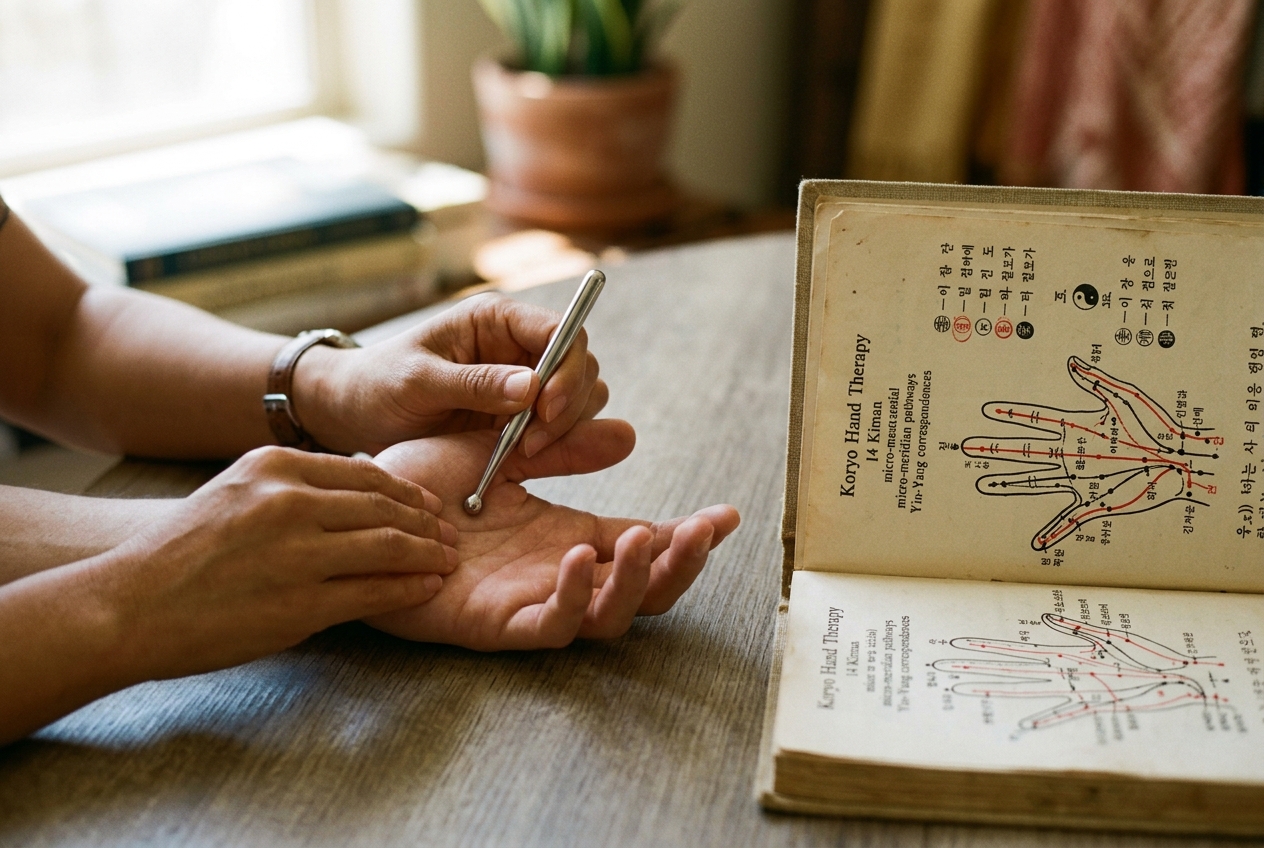
Traditional East Asian medicine, bolstered by contemporary neurobiology, suggests that we do not need to subject ourselves to complex interventions to initiate somatic balance. Instead, a complete, extraordinarily detailed topological map of the entire human organism exists within the human hand. This system, formalised as Koryo Hand Therapy (KHT; Korean: Koryo Sooji Chim, 고려수지요법), offers one of the world’s most sophisticated, non-invasive microsystem frameworks for clinical and self-administered somatic regulation.
                  ========================================
                  KORYO HAND THERAPY (KHT) SOMATOTOPIC MAP
                  ========================================

[ DIGIT 3 ]
                                 Middle Finger
                              (Head, Neck, Thorax)
                                   /        \
                    [ DIGIT 2 ]   /          \   [ DIGIT 4 ]
                    Index Finger /            \  Ring Finger
                    (Left Arm)  /              \ (Right Arm)
                               /                \
                              |   PALM / VENTRAL |
               [ DIGIT 1 ]    |   (A-Kiman / CV) |    [ DIGIT 5 ]
                  Thumb       |                  |    Little Finger
               (Left Leg)     |      [ A8 ]      |     (Right Leg)
                               \   (Umbilicus)  /
                                \              /
                                 ==============
                                   WRIST AXIS
                                (Pelvic Floor/A1)
1. The Meridian Path — A Journey Through the Hand’s Hologram
Conceived and systematically mapped in 1971 by the South Korean acupuncturist and scholar Dr. Tae-Woo Yoo, Koryo Hand Therapy is founded upon the principle of bio-holographic somatotopy. In biological cybernetics and fractal anatomy, a microsystem is defined as a discrete, localized anatomical substrate that mirrors the structural and physiological totality of the macro-organism. While traditional acupuncture treats points distributed across the 12 principal channels traversing the whole body, KHT posits that every macro-meridian, visceral organ (Zang-Fu), and musculoskeletal compartment possesses an isomorphic, miniature counterpart across the ventral (palmar) and dorsal aspects of the human hand.
To understand why the hand serves as an exceptionally sensitive therapeutic terminal, one must examine the cortical architecture of the human brain. Neuroanatomical mapping of the primary somatosensory cortex (postcentral gyrus) and primary motor cortex (precentral gyrus)—famously illustrated by Wilder Penfield’s cortical homunculus—demonstrates that the hands, thumbs, and fingers occupy a disproportionately massive volume of neural processing real estate relative to their actual physical dimensions. The glabrous (hairless) skin of the palm contains an ultra-dense distribution of low-threshold mechanoreceptors, including Meissner’s corpuscles, Merkel nerve endings, and Pacinian corpuscles. When tactile or blunt mechanical pressure is applied to precise coordinates on the hand, it triggers high-fidelity afferent signaling through the median, ulnar, and radial nerves into the dorsal horn of the spinal cord, ascending via the dorsal column–medial lemniscal pathway directly into thalamic and cortical integration centers.
      +----------------------------------------------------------------+
      |               NEUROVASCULAR REFLEX & TRANSDUCTION              |
      +----------------------------------------------------------------+
      |                                                                |
      |   [ Blunt Micro-Stimulation on Palmar KHT Coordinate ]         |
      |                               |                                |
      |                               v                                |
      |   [ Activation of Low-Threshold Glabrous Mechanoreceptors ]    |
      |             (Merkel Discs & Meissner Corpuscles)               |
      |                               |                                |
      |                               v                                |
      |   [ High-Velocity A-beta Afferent Neural Influx ]              |
      |      (Ascending Median / Ulnar / Radial Nerve Trunks)          |
      |                               |                                |
      |                               v                                |
      |   [ Dorsal Horn Gating & Thalamocortical Somatosensory Relay ] |
      |      (Segmental Gating at Substantia Gelatinosa)               |
      |                               |                                |
      |                               v                                |
      |   [ Autonomic Neuromodulation & Connective Tissue Relaxation ] |
      |     • Suppression of Efferent Sympathetic Hyperactivity       |
      |     • Vagal Parasympathetic Tone Upregulation                  |
      |     • Piezo-Electric Fascial Mechanotransduction              |
      |                                                                |
      +----------------------------------------------------------------+
Concurrently, modern research into fascial mechanotransduction demonstrates that localized mechanical deformation of subcutaneous collagenous matrices stimulates fibroblast signaling, opening stretch-activated ion channels and generating interstitial piezo-electric currents. Thus, KHT operates at the intersection of classical energetic topography and modern sensory neurophysiology.
The Somatotopic Structural Architecture
The macroscopic human frame translates onto the hand via an intuitive structural orientation:
- The Central Craniocervical-Trunk Axis (Digit 3 / Middle Finger & Palmar Midline):
- Distal Phalanx of Middle Finger: Corresponds strictly to the cranium, including the cerebrum, sensory sensory organs of the face (eyes, nose, mouth), and parietal vertex.
- Middle Phalanx of Middle Finger: Corresponds to the cervical spine, pharynx, larynx, and thyroid.
- Proximal Phalanx of Middle Finger: Corresponds to the thoracic inlet, upper sternum, trachea, and suprasternal notch.
- Volar Palm Body: The palmar basin directly mirrors the thoracic and abdominopelvic cavities. The proximal palmar crease beneath the middle finger marks the thoracic boundary, the exact geometric center of the palm represents the umbilicus, and the base of the palm at the transverse wrist crease represents the pubic bone and perineum.
- The Upper Extremities (Digits 2 & 4 / Index and Ring Fingers):
- The index finger (Digit 2) and ring finger (Digit 4) represent the bilateral arms. The proximal digit represents the shoulder girdle and humerus; the intermediate digit represents the elbow joint and forearm; the distal digit represents the wrist, metacarpus, and fingers.
- The Lower Extremities (Digits 1 & 5 / Thumb and Little Finger):
- The thumb (Digit 1) and little finger (Digit 5) represent the bilateral legs. The proximal phalanx / thenar or hypothenar junction represents the coxafemoral (hip) joint and upper thigh; the intermediate zone corresponds to the knee joint and patellar region; the distal phalanx corresponds to the ankle joint, tarsus, and foot.
- Yin vs. Yang Polarity:
- Volar (Palmar) Surface: Represents the Yin (anterior, ventral) aspect of the human body: face, throat, chest, epigastrium, lower abdomen, and the medial, flexor surfaces of the limbs.
- Dorsal (Back of Hand) Surface: Represents the Yang (posterior, dorsal) aspect of the human body: occiput, posterior cervical musculature, thoracic spine, lumbar spine, sacrum, and the extensor surfaces of the limbs.
       Table 1: Somatotopic Mapping in Koryo Hand Therapy
+-----------------------+-----------------------+-----------------------------+
| Anatomical Structure  | Hand Location (Volar) | Hand Location (Dorsal)      |
+-----------------------+-----------------------+-----------------------------+
| Head & Brain          | Digit 3 Distal Pad    | Digit 3 Distal Dorsum       |
| Cervical Spine & Neck | Digit 3 Middle Pad    | Digit 3 Middle Dorsum       |
| Chest & Thorax        | Digit 3 Proximal Pad  | Digit 3 Proximal Dorsum     |
| Epigastrium & Stomach | Upper Central Palm    | Upper Central Metacarpal    |
| Umbilicus / Abdomen   | Exact Center of Palm  | Mid-Dorsal Metacarpal Area  |
| Lower Pelvis & Urogen | Base of Palm / Wrist  | Base of Dorsal Wrist Crease |
| Upper Limbs (Arms)    | Digits 2 & 4 (Volar)  | Digits 2 & 4 (Dorsal)       |
| Lower Limbs (Legs)    | Digits 1 & 5 (Volar)  | Digits 1 & 5 (Dorsal)       |
+-----------------------+-----------------------+-----------------------------+
2. The 14 Micro-Meridians (Kiman: Pathways A through N)
Dr. Tae-Woo Yoo systematically mapped 14 micro-pathways across the hand, designating them as Kiman (기맥, 氣脈), labelled sequentially from A through N. Each Kiman corresponds to one of the twelve primary classical meridians recognized in traditional acupuncture nomenclature, alongside the two fundamental extraordinary vessels: the Conception Vessel (Ren Mai) and the Governing Vessel (Du Mai).
         ===========================================================
         THE 14 KHT MICRO-MERIDIANS (KIMAN) & SYSTEMIC CORRESPONDENCE
         ===========================================================

Kiman Code   Classical Meridian Equivalence    Channel Polarity
          ---------------------------------------------------------------
          A-Kiman      Conception Vessel (Ren Mai)       Yin / Mid-Ventral
          B-Kiman      Governing Vessel (Du Mai)         Yang / Mid-Dorsal
          C-Kiman      Lung Meridian (Fei)               Hand Taiyin
          D-Kiman      Large Intestine Meridian (Dachang)Hand Yangming
          E-Kiman      Stomach Meridian (Wei)            Foot Yangming
          F-Kiman      Spleen Meridian (Pi)              Foot Taiyin
          G-Kiman      Heart Meridian (Xin)              Hand Shaoyin
          H-Kiman      Small Intestine (Xiaochang)       Hand Taiyang
          I-Kiman      Urinary Bladder (Pangguang)       Foot Taiyang
          J-Kiman      Kidney Meridian (Shen)            Foot Shaoyin
          K-Kiman      Pericardium Meridian (Xinbao)     Hand Jueyin
          L-Kiman      Triple Energizer (Sanjiao)        Hand Shaoyang
          M-Kiman      Gallbladder Meridian (Dan)        Foot Shaoyang
          N-Kiman      Liver Meridian (Gan)              Foot Jueyin
         ===========================================================
The Central Axis: A-Kiman and B-Kiman
A-Kiman (The Conception Vessel / Ren Mai Micro-Meridian)
The A-Kiman is the primary functional axis for internal organ regulation in KHT. It courses straight up the longitudinal midline of the palmar surface. * Trajectory: Originates at the distal transverse wrist crease at point A1 (corresponding to the perineum / CV1), ascends along the palmar median line through the lower abdomen (A3 = bladder, A4 = uterus/prostate, A6 = lower intestine), reaches the geometric center of the palm at A8 (umbilicus / CV8), ascends through the epigastrium at A12 (stomach / CV12), crosses the sternal area at A16 (cardiac center / CV16) and A18 (mid-chest / CV17), traverses the proximal and middle phalanges of the third digit at A20 (throat / CV22) and A24 (mandible / CV24), and terminates at A33 at the distal apex of the third finger pad (corresponding to the sensory apex of the head/vertex).
B-Kiman (The Governing Vessel / Du Mai Micro-Meridian)
The B-Kiman is the primary structural and neurological channel of the dorsal hand. * Trajectory: Commences at the posterior transverse wrist crease at point B1 (corresponding to the coccyx / GV1), ascends the dorsal midline over the third metacarpal bone covering the sacral, lumbar, and thoracic spinal reflexes (B7 = mid-thoracic spine), crosses the dorsal aspect of the third metacarpophalangeal joint at B14 (cervicothoracic junction / C7–T1 / GV14), climbs the dorsal phalanges of the third digit across B19 (occiput / GV19) and B24 (crown vertex / GV20), terminating at the dorsal nail base of the middle finger.
       PALMAR SURFACE (Volar)               DORSAL SURFACE (Posterior)
          [Digit 3 Pad]                        [Digit 3 Nail]
             ( A33 )                              ( B24 )  <-- Vertex / Crown
                |                                    |
             ( A28 )  <-- Nose                    ( B19 )  <-- Occiput
                |                                    |
             ( A24 )  <-- Chin/Throat             ( B14 )  <-- C7 / T1 Junction
                |                                    |
       =========+=========                  =========+=========
       [MP Joint Crease]                    [Metacarpal Joint]
             ( A18 )  <-- Mid-Chest               ( B7 )   <-- Mid-Thoracic
                |                                    |
             ( A16 )  <-- Sternal Angle              |
                |                                    |
             ( A12 )  <-- Epigastrium/Stomach        |
                |                                    |
             ( A8  )  <-- Umbilicus / Center         |
                |                                    |
             ( A4  )  <-- Lower Abdomen              |
                |                                    |
             ( A1  )  <-- Perineum                ( B1  )  <-- Coccyx / Sacrum
       ===================                  ===================
       [Wrist Crease Base]                  [Dorsal Wrist Base]
The 12 Organ-Coupled Micro-Meridians (C through N)
- C-Kiman (Lung): Runs alongside the radial border of the palmar midline, regulating pulmonary dynamics, respiratory mechanics, and cutaneous immune barriers.
- D-Kiman (Large Intestine): Traverses the radial margin of the index finger and dorsal metacarpus; highly indicated for clearing systemic heat, acute orofacial tension, and distal colonic dysmotility.
- E-Kiman (Stomach): Runs parallel to the A-Kiman on the palmar surface, extending down into the limb reflex zones; essential for gastrointestinal motor coordination, appetite regulation, and frontal headache management.
- F-Kiman (Spleen): Mediates digestive metabolic transport, enzymatic output, and systemic muscular tone; situated on the medial palmar aspect adjacent to E-Kiman.
- G-Kiman (Heart): Traced on the palmar aspect toward the little finger; directly influences cardiovascular autonomic tone, psycho-emotional balance, and sleep stability.
- H-Kiman (Small Intestine): Courses along the ulnar border of the dorsal hand; applied clinically for scapular pain, neck stiffness, and nutrient assimilation pathology.
- I-Kiman (Urinary Bladder): Descends the dorsal aspect of the hand adjacent to B-Kiman down through the posterior limb digits; indicated for occipital headaches, spinal musculoskeletal tension, and fluid homeostasis.
- J-Kiman (Kidney): Situated along the deep palmar-ulnar axis; foundational for constitutional vigor, adrenal output, and lumbar structural integrity.
- K-Kiman (Pericardium) & L-Kiman (Triple Energizer / Sanjiao): Modulate systemic microvascular circulation, thoracic tension, and systemic neuroendocrine fluid-heat distribution across the ventral/dorsal planes.
- M-Kiman (Gallbladder) & N-Kiman (Liver): Located along the lateral margins of the hand and digits; indispensable for addressing myofascial tension syndromes, smooth muscle spasms, ocular strain, and stress-related neurovegetative dystonia.
3. Key Micro-Acupressure Points for Immediate Self-Regulation
To activate these micro-reflexes non-invasively, clinical practitioners and individuals utilize a specialized, blunt mechanical search probe (Sooji-Chim Probe). In the absence of a clinical probe, a household item possessing a smooth, rounded, non-piercing tip (such as the rounded end of a metal stylus, the tip of a spent ballpoint pen, or a firm fingernail edge) serves as an effective stimulus.
       ================================================================
       CRITICAL PALPATORY SEARCH PROTOCOL (The Tender Point Method)
       ================================================================
       1. Perpendicular Orientation: Hold the blunt probe at a strict
          90-degree angle to the cutaneous surface of the hand.
       2. Systematic Palpation: Apply light, uniform micro-pressure
          in a tight 1 mm grid across the projected target zone.
       3. The Sensitivity Reflex: When the correct micro-reflex point
          is engaged, the subject will experience a sharp, localized,
          disproportionate tenderness or dull ache ("Ashi" micro-reflex).
       4. Pressure Modulation: Maintain continuous, firm pressure with
          gentle clockwise micro-rotations for 60 to 180 seconds.
       ================================================================
Point 1: Point A12 (The Epigastric Node / Middle Energizer Harmonizer)
             DIGIT 3 (Middle Finger)
                      |
                 [Palmar Base]
                      |
                   ( A16 )   <-- Sternal Angle
                      |
                   [ A12 ]   <-- EXACT MIDPOINT BETWEEN A8 & A16
                      |          (Solar Plexus / Epigastrium)
                   ( A8  )   <-- Center of Palm (Umbilicus)
                      |
                 [Wrist Crease]
- Anatomical Location: Open the hand flat, palm facing upward. Locate the exact geometric center of your palm (Point A8, the umbilicus). Next, locate the natural horizontal crease at the base of the middle finger where it joins the palm. Point A16 lies just below this joint crease. Point A12 is situated on the longitudinal centerline of the palm, precisely halfway between point A8 and point A16.
- Sensation of Localization: As you compress the probe perpendicularly into the palmar aponeurosis at A12, you will detect a distinct, localized, pin-point sensitivity—noticeably more reactive than the tissue 2 millimeters to either side. You may perceive a warm radiating pulse or a gentle, dull sensation of release spreading through the center of your hand.
- Stimulation Parameters: Apply steady, firm, sustained pressure using the rounded tip of your probe or thumb. Integrate subtle clockwise micro-rotations. Maintain continuous engagement for 1.5 to 3 minutes, breathing deeply into the diaphragm.
- Clinical Applications: Point A12 is the primary systemic point for down-regulating upper gastrointestinal distress. It swiftly attenuates acute functional dyspepsia, nervous stomach cramping, acid reflux, postprandial lethargy, and stress-induced diaphragmatic constriction.
Point 2: Point A8 (The Umbilical Center / Autonomic Reset Gate)
                    DIGIT 3
                       |
               +---------------+
               |               |
               |     [A8]      |  <-- EXACT GEOMETRIC CENTER OF PALM
               |  (Umbilicus)  |      (Sympathetic Nervous System Reset)
               |               |
               +---------------+
                 [Wrist Crease]
- Anatomical Location: Located in the literal center of the palm. To find it without measuring, gently cup your hand; Point A8 sits in the deepest hollow of the palmar basin, directly in line with the longitudinal axis of the middle finger.
- Sensation of Localization: Mechanical compression here typically elicits a deep, grounded, spreading sensation of warmth and pressure. If the digestive or autonomic system is taxed, this site reveals a distinct, tender nodular micro-point within the underlying fascial layer.
- Stimulation Parameters: Apply perpendicular, moderate-to-firm pressure. Avoid aggressive jabbing; instead, apply sustained, rhythmic compression: hold for 5 seconds, release slightly for 1 second, and repeat across a 2-minute interval.
- Clinical Applications: As the holographic representation of the navel (Shenque / CV8), A8 governs the abdominal brain (the enteric nervous system). It is indicated for chronic bloating, lower abdominal cramping, systemic fatigue, and acute situational panic, inducing rapid parasympathetic activation.
Point 3: Point B14 / B19 (The Craniocervical & Occipital Reset)
       DORSAL SURFACE (Back of Hand) - DIGIT 3 (Middle Finger)

[Distal Joint]
                      |
                   [ B19 ]   <-- Base of Skull / Occipital Ridge
                      |          (Middle Phalanx Dorsum)
                [Middle Joint]
                      |
                   [ B14 ]   <-- Base of Neck / C7 Prominens
                      |          (Knuckle / MP Joint Dorsum)
              [Metacarpal Bone]
- Anatomical Location: Turn your hand over so the back of the hand faces you. Point B14 is located directly on the dorsal midline of the middle finger, immediately proximal to the large knuckle (the third metacarpophalangeal joint). Point B19 is located higher up on the dorsal midline of the middle finger, positioned just below the distal knuckle crease (representing the occipital ridge at the base of the skull).
- Sensation of Localization: When neck and shoulder tension is present, exploring B14 and B19 with a firm probe tip will immediately expose sharp, exquisite micro-tender points ("Ashi" micro-reflexes) that feel like miniature pinpricks or deep muscular bruises.
- Stimulation Parameters: Using a firm probe or the edge of your thumbnail, apply direct, targeted pressure onto the tender spot at B14 and B19 sequentially. Hold each point for 60 to 90 seconds while gently rolling your actual head and neck through slow, gentle cervical circles.
- Clinical Applications: Immediate mitigation of cervicogenic headaches, tension radiating along the upper trapezius and levator scapulae muscles, eye strain resulting from intensive computer use, and postural "text neck."
4. Clinical Point Combinations for Common Somatic Pathologies
+-----------------------------------------------------------------------------+
|               CLINICAL PROTOCOL 1: THE DIGITAL DESK STRAIN RESET            |
|       (Target: Postural Cervicogenic Cephalea & Scapulothoracic Pain)       |
+-----------------------------------------------------------------------------+
| Sequence & Points:                                                          |
|   1. Point B19 (Dorsal middle finger, below distal knuckle) - 90 seconds.   |
|   2. Point B14 (Dorsal middle finger, base knuckle junction) - 90 seconds.  |
|   3. Point D2 (Index finger pad, radial nail margin) - 60 seconds.          |
|                                                                             |
| Step-by-Step Procedure:                                                     |
|   • Sit erect with feet flat on the floor, uncrossing legs.                 |
|   • Locate the most exquisite tender coordinate around B19 using a probe.   |
|   • Apply sustained perpendicular pressure while inhaling for 4 seconds,    |
|     holding for 4, and exhaling for 6. Feel the occipital tension soften.   |
|   • Shift the probe to B14; press firmly while slowly turning your chin     |
|     over your left shoulder, then right shoulder.                           |
|   • Conclude on D2 (Large Intestine correspondence) to accelerate clear-    |
|     ance of descending cephalic tension.                                    |
|                                                                             |
| Total Execution Duration: ~4 to 5 Minutes Bilaterally                       |
+-----------------------------------------------------------------------------+
+-----------------------------------------------------------------------------+
|               CLINICAL PROTOCOL 2: POSTPRANDIAL DYSPEPSIA & BLOATING        |
|             (Target: Functional Gastric Stasis & Abdominal Distension)      |
+-----------------------------------------------------------------------------+
| Sequence & Points:                                                          |
|   1. Point A12 (Volar palm, exact midpoint between center and base crease)  |
|   2. Point A8  (Volar palm, exact geometric center)                         |
|   3. Point E45 / A4 (Lower abdominal / Stomach channel micro-points)        |
|                                                                             |
| Step-by-Step Procedure:                                                     |
|   • Rest in a comfortable seated or semi-reclined posture.                  |
|   • Compress A12 with moderate-to-firm circular probe rotations for 2 min.  |
|   • Move probe down to A8; apply rhythmic compressions for 2 minutes to     |
|     stimulate enteric peristalsis and down-regulate mesenteric spasming.    |
|   • Conclude by tracing the palmar midline downward with your thumb from    |
|     A16 through A12 and A8 down to A1 to physically guide gastrointestinal  |
|     qi downwards.                                                           |
|                                                                             |
| Total Execution Duration: ~5 Minutes                                        |
+-----------------------------------------------------------------------------+
+-----------------------------------------------------------------------------+
|               CLINICAL PROTOCOL 3: NOCTURNAL HYPER-AROUSAL & INSOMNIA       |
|            (Target: Sympathetic Overdrive & Inability to Sleep)             |
+-----------------------------------------------------------------------------+
| Sequence & Points:                                                          |
|   1. Point A16 (Volar palmar midline, just below digit 3 base crease)       |
|   2. Point G15 (Heart micro-channel, proximal phalanx of digit 5)           |
|   3. Point A8  (Center of the palm)                                         |
|                                                                             |
| Step-by-Step Procedure:                                                     |
|   • Perform in bed in a supine position in dim light.                       |
|   • Apply soft, slow, steady pressure on A16 (precordial center) for 2 min.|
|     Synchronize your breathing: 4-second nasal inhale, 7-second exhale.     |
|   • Stimulate Point G15 along the little finger for 60 seconds per hand to  |
|     calm the psycho-emotional *Shen* and decrease resting heart rate.       |
|   • Finish by resting your opposite thumb gently inside the hollow of A8,   |
|     maintaining passive thermal contact until sleep onset occurs.           |
|                                                                             |
| Total Execution Duration: ~5 to 6 Minutes                                   |
+-----------------------------------------------------------------------------+
5. Safety, Neuro-Sensory Precautions, and Clinical Boundaries
While Koryo Hand Therapy is one of the safest modalities in complementary integrative medicine due to its peripheral non-invasive nature, clinical discernment must govern its application.
+-----------------------------------------------------------------------------+
|                           SAFETY & CLINICAL BOUNDARIES                      |
+-----------------------------------------------------------------------------+
| 1. Excessive Mechanical Force:                                              |
|    • The micro-acupressure points on the hand should never be subjected     |
|      to bruising or skin-breaking force.                                    |
|    • "Therapeutic tenderness" (*De-Qi*) feels like a distinct, deep,        |
|      satisfying ache or sharp micro-focus. Bruising, sharp dermal pain, or  |
|      tissue tearing indicates excessive, counterproductive force.           |
|                                                                             |
| 2. Pregnancy Precautions:                                                   |
|    • Exercise caution with strong, dispersive stimulation on points         |
|      corresponding to the lower pelvis and reproductive organs—specifically  |
|      points A1, A2, A3, A4, and the distal reproductive margins of Digits   |
|      1 and 5—during all trimesters of pregnancy, as these reflexes can       |
|      stimulate uterine contraction.                                         |
|                                                                             |
| 3. Skin Integrity:                                                          |
|    • Avoid direct probe stimulation over open wounds, active eczema, local  |
|      infections, burns, or severe peripheral vascular lesions.              |
|                                                                             |
| 4. Red-Flag Symptoms (When to Seek Immediate Medical Evaluation):          |
|    • KHT is designed for functional, musculoskeletal, and stress-mediated   |
|      disturbances. It is NOT a substitute for emergency intervention.       |
|    • Never use KHT to treat crushing retrosternal chest pain radiating to   |
|      the jaw/arm (possible myocardial infarction), sudden acute neurological|
|      deficits or unilateral facial drooping (possible stroke), severe acute |
|      rigid abdominal pain (possible peritonitis or appendicitis), or severe |
|      unexplained pyrexia.                                                   |
+-----------------------------------------------------------------------------+
For systemic or chronic conditions that fail to respond to self-administered micro-acupressure, consultation with a board-certified licensed acupuncturist (LAc) or an integrative medical physician is recommended. Modern professional acupuncture research, documented across peer-reviewed databases such as NCBI PubMed, affirms that professional micro-acupuncture combined with constitutional body acupuncture yields optimal clinical outcomes.
6. Today's Takeaway: The Two-Minute Palmar Reset
You do not need an hour of leisure or specialized tools to access the neurological benefits of Koryo Hand Therapy. You can execute this immediate self-regulation sequence right now, seated at your desk:
+-----------------------------------------------------------------------------+
|                    THE 120-SECOND PALMAR PARASYMPATHETIC RESET              |
+-----------------------------------------------------------------------------+
| Goal: Rapid autonomic stabilization, reduction of mental fatigue, and       |
|       alleviation of postural epigastric/thoracic tension.                  |
|                                                                             |
| Step 1: Locate Point A12 (0:00 - 1:00)                                      |
|   • Position your dominant thumb in the upper central palm of your non-     |
|     dominant hand (halfway between the palm center and middle finger base). |
|   • Press firmly until you detect a subtle, tender, focused ache.           |
|   • Close your eyes, drop your shoulders away from your ears, and execute   |
|     four slow, full diaphragmatic breaths, inhaling deeply through the      |
|     nose and releasing slowly through pursed lips.                          |
|                                                                             |
| Step 2: Slide to Point A8 (1:00 - 2:00)                                     |
|   • Slide your thumb 1 centimeter straight down into the exact center of    |
|     your palm basin (Point A8).                                             |
|   • Apply continuous, warm, circular compression.                           |
|   • Feel the immediate grounding reflex travel up the arm, relaxing your    |
|     diaphragm, softening tension behind your eyes, and restoring systemic   |
|     equilibrium.                                                            |
+-----------------------------------------------------------------------------+
By understanding the hand as an interactive console for the central nervous system, you possess an accessible, physiologically grounded method for somatic restoration—anytime, anywhere.
Authoritative References & Academic Resources
- WHO Traditional Medicine Strategy & Standards
- National Center for Biotechnology Information (NCBI) / NLM PubMed
- Somatosensory Cortical Homunculus Neuroanatomy (StatPearls / NCBI Bookshelf)
- Mechanisms of Acupuncture and Connective Tissue Mechanotransduction (PMC3658605)
- National Certification Commission for Acupuncture and Oriental Medicine (NCCAOM)
- Academic Overview of Micro-Acupuncture and Somatotopic Systems (Wikipedia)