Kao Jin Shoulder Strike Force: Close-Range Trunk Kinetic Acceleration, Scapular-Torso Tensegrity, and Axial Ground Reaction Vectoring in Classical Neigong
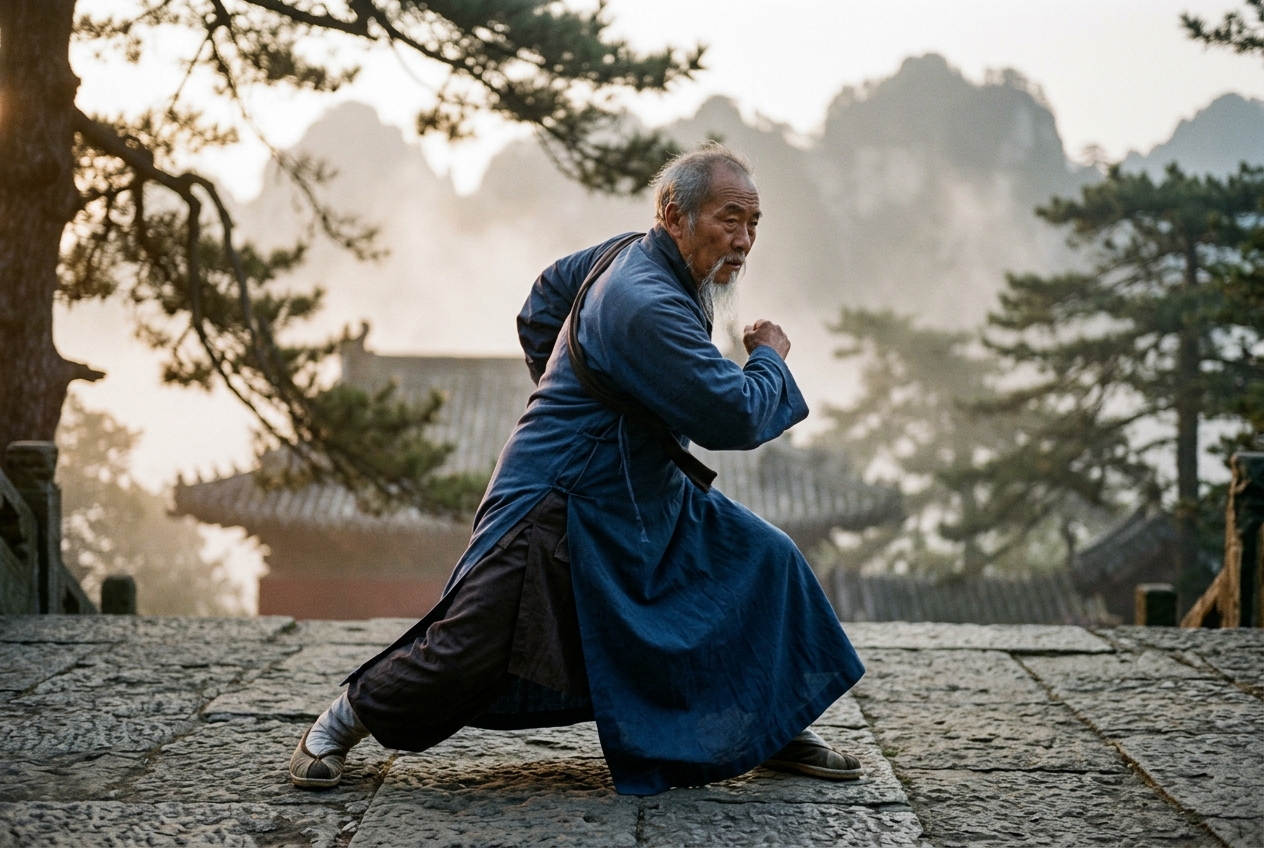
In classical Chinese somatic philosophy and internal martial arts treatises—specifically within the traditions of Taijiquan, Baguazhang, and Xingyiquan documented by historical masters and modern research archived at the National Qigong Association—Kao Jin is classified as the eighth and ultimate vector of the classical Ba Fa (Eight Methods or Eight Gates). The Eight Gates form a complete octagonal topology of kinetic discharge:
- Peng (掤): Outward spherical buoyancy and upward warding force.
- Lu (捋): Yielding, diagonal backward redirection and roll-back.
- Ji (挤): Symmetrical, two-point linear compression and press.
- An (按): Downward grounding sinking followed by forward cresting push.
- Cai (採): Sudden, sharp downward plucking and unbalancing.
- Lie (挒): Torsional, splitting force along opposing axes.
- Zhou (肘): Short-range rotational elbow strikes.
- Kao (靠): Whole-body close-quarters torso, shoulder, and pelvic impact energy.
Where long-range limbs are neutralized or trapped in close combat, Kao Jin activates the trunk itself as the primary weapon. Classical internal treatises describe authentic Kao as an expression of whole-body Hun Yuan Jin (unified primordial force): the strike is not executed with the shoulder, but through the shoulder from the earth.
Classical Neigong taxonomy subdivides Kao Jin into three distinct structural vectors: * Qian Kao (前靠 — Forward/Anterior Shoulder Force): Emitted through the anterior deltopectoral groove and clavicular head, backed by the opposing scapular stabilizer. * Bei Kao (背靠 — Dorsal/Spinal Force): Emitted backward or laterally through the interscapular spine, rhomboid-trapezius shield, and thoracolumbar junction, often termed the "Iron Shirt Back Strike." * Kua Kao / Tun Kao (胯靠 / 臀靠 — Inguinal/Pelvic Force): Emitted through the greater trochanter of the femur and lateral iliac crest, uprooting the opponent's center of gravity by collapsing their base of support from below.
BIOMECHANICAL & MYOFASCIAL KINETIC CHAINS
To understand how a strike with virtually zero wind-up can generate hundreds of pounds of instantaneous impact force, one must analyze the kinetic chain from the perspective of modern biomechanics and tensegrity systems.
The generation of Kao Jin conforms rigorously to the Newtonian principle of Ground reaction force (GRF) combined with short-distance impulse momentum ($J = \int F \, dt = \Delta p$). The kinetic chain does not begin in the torso, but at the plantar surface of the foot at the acupuncture point Yongquan (涌泉, Kidney-1, located in the depression formed when the toes curl).
1. The Lower Extremity Kinetic Engine
The practitioner establishes a stable tripod foot contact (calcaneus, first metatarsal head, and fifth metatarsal head), creating an active arch dome. When initiating Kao Jin, the rear ankle undergoes dorsiflexion while the knee maintains a stable $120^\circ$ to $135^\circ$ angle to prevent shearing of the patellar tendon. The pivotal engine of rotation is the Kua (胯)—the coxofemoral hip joint and deep acetabular socket. The practitioner "folds the Kua" (Luo Kua), retracting the femoral head deeply into the pelvic girdle. This folding prestretches the gluteal complex, piriformis, and obturator internus, loading elastic strain energy into the deep pelvic fascia like a compressed mechanical spring.
2. Pelvic Torque and Axial Force Vectoring
As the rear foot drives into the terra firma, GRF travels upward through the tibia and femur. The pelvis undergoes a sudden, compact rotational snap around a vertical axis passing through the lead hip joint. This converts linear ground thrust into high-velocity axial rotational torque. The sacroiliac joint acts as a dynamic force distributor, preventing destructive torque from concentrating on the L5-S1 lumbar vertebrae.
3. Thoracolumbar Fascial Recruitment
The force cannot be allowed to dissipate through a soft, yielding spine. The rotational energy from the pelvis is captured by the Fascia—specifically the extensive thoracolumbar fascia (TLF), a multilayered diamond of connective tissue that bridges the gluteus maximus on one side to the contralateral latissimus dorsi on the other. When the practitioner maintains Han Xiong Ba Bei (含胸拔背 — "Hollow the Chest, Pluck the Back"), the posterior layer of the TLF is pulled taut, creating a cross-body myofascial tension band that transmits kinetic energy directly across the torso with negligible elastic loss.
4. Scapulothoracic Packing and Tensegrity Locking
The most critical failure point in an amateur shoulder strike is the collapse of the glenohumeral joint or the separation of the scapula from the ribcage, which causes severe rotator cuff trauma. In authentic Kao Jin, the scapula is dynamically anchored via an anatomical sling formed by the co-activation of two antagonist muscles: * The Serratus Anterior: Pulls the medial border of the scapula firmly forward against the thoracic cage. * The Latissimus Dorsi & Lower Trapezius: Depresses the scapula downward toward the hip (Chen Jian Zhui Zhou — "Sink Shoulders, Drop Elbows").
This simultaneous protraction and depression compresses the shoulder blade securely against the posterior ribcage, converting the upper torso into an incompressible, solid bone-fascia shield. The impact surface is not the delicate acromioclavicular joint, but the dense, muscular wall supported directly by the skeletal rib cage and spine.
ENERGETIC & MERIDIAN DYNAMICS: THE HYDRAULIC CORE
While modern biomechanics explains the muscular and fascial transmission, classical Neigong (internal skill) and the meridian theory recognized by the World Health Organization explain how the internal energetic matrix preserves structural integrity during high-impact emission.
The Extraordinary Vessels in Torso Discharge
Kao Jin relies heavily on the coordinated activation of three primary Extraordinary Meridians (Qi Jing Ba Mai):
- Dai Mai (带脉 — The Girdling Vessel): The only horizontal meridian in the human body, encircling the waist like a broad belt. Prior to impact, the Dai Mai is cinched through the co-contraction of the transversus abdominis and internal obliques. This creates a rigid cylindrical constraint around the waist, preventing lateral energy leaks and unifying the upper and lower body.
- Chong Mai (冲脉 — The Penetrating Vessel): Running vertically through the core of the body from the perineum (Huiyin, CV-1) through the spine to the vertex (Baihui, GV-20). The Chong Mai acts as the primary hydraulic piston of internal power. As force is discharged, Qi surges upward through this central axis, driving the kinetic mass forward.
- Du Mai (督脉 — The Governing Vessel): Ascending along the posterior midline of the spine. By tucking the tailbone slightly (Chun Tun) and straightening the lumbar lordosis (opening Mingmen, GV-4 — the "Gate of Life"), the Du Mai is opened, allowing the spine to act as an uncompressed composite bow.
Intra-Abdominal Pressure (IAP) as an Internal Shock Absorber
A primary concern during high-velocity torso collisions is the potential for internal organ displacement, concussive trauma, or diaphragmatic rupture. Neigong resolves this through the cultivation of the Lower Dantian (下丹田) as a pressurized fluid-gas canister.
During the execution of Kao Jin, the practitioner employs Reverse Abdominal Breathing (Ni Fu Shi Hu Xi). Upon the instant of explosive issuance (Fajin): 1. The diaphragm contracts and descends firmly downward. 2. The pelvic floor (Huiyin) contracts and lifts upward. 3. The deep transversus abdominis pulls inward and compresses the visceral mass.
This creates profound intra-abdominal pressure (IAP), an incompressible hydraulic cushion that pushes outward against the lumbar spine and abdominal walls simultaneously. Clinical research cataloged in NCBI PubMed on core stability and intra-abdominal dynamics confirms that elevated IAP significantly stiffens the lumbar spine, decreases spinal compressive loads, and protects the internal viscera from external impact forces. The internal organs are safely buffered within a pressurized hydro-pneumatic envelope, while the whole torso transforms into a unified, high-density projectile.
PROGRESSIVE STEP-BY-STEP TRAINING PROTOCOL
Mastery of Kao Jin must be cultivated progressively across four distinct pedagogical phases to ensure structural safety, fascial adaptation, and explosive neuromuscular coordination.
Phase 1: Static Postural Alignment & Scapulothoracic Packing
- Objective: Establish the static structural tensegrity and eliminate isolated shoulder lifting.
- Execution: 1. Assume a standard Zhan Zhuang (Standing Pole) posture with feet parallel, knees softened, and pelvis neutral. 2. Implement Han Xiong Ba Bei: slightly relax the sternum inward (a gentle indentation of roughly half an inch) while actively widening the space between the medial borders of the scapulae. 3. Engage Chen Jian Zhui Zhou: contract the lower trapezius and latissimus dorsi to pull the shoulder girdle down away from the ears. 4. Bring the lead arm across the chest in a rounded shield shape (Peng posture). Place the opposite hand on the lead deltoid to monitor muscle tension. 5. Hold this isometric structure for 5 minutes per side, breathing deeply into the Lower Dantian, ensuring the shoulder muscles remain soft to the touch while the underlying skeletal-fascial frame feels solid and rooted.
Phase 2: Slow-Motion Stepping & Kinetic Vector Transfer
- Objective: Coordinate stepping, center-of-mass transference, and ground-force vectoring without breaking torso alignment.
- Execution: 1. Stand in an empty stance (Xu Bu) with 90% of weight on the rear leg. 2. Slowly step forward into a rooted bow stance (Gong Bu) or diagonal cross-stance at a $45^\circ$ angle. The lead heel touches down smoothly without thudding. 3. As the weight shifts forward into a 60/40 distribution, fold the lead Kua inward. Do not let the lead knee drift past the toes. 4. Synchronize the arrival of the lead foot with a subtle rotational settling of the hips ($15^\circ$ to $30^\circ$ twist). 5. The lead shoulder and upper torso move forward as a single monolithic unit with the pelvis. The movement is smooth, uninterrupted, and timed to a slow 4-second inhalation followed by a 4-second exhalation. Repeat 30 repetitions on each side.
Phase 3: Explosive Short-Range Fajin Release
- Objective: Introduce rapid acceleration, reverse abdominal breathing, and whole-body elastic rebound.
- Execution:
1. Set up in a compact diagonal stance, approximately 2 inches away from a heavy hanging striking bag.
2. Inhale gently using reverse abdominal breathing, drawing the lower abdomen inward while expanding the lateral ribs and Mingmen (lower back).
3. With zero preliminary backward wind-up, trigger the strike with a sudden, sharp exhalation (emitting the vocalized guttural sound "Heng" or "Ha").
4. Simultaneously:
- Drive the rear heel into the floor (Yongquan grounding).
- Snap the pelvis forward and rotate the lead hip into the fold.
- Tightly squeeze the pelvic floor and lower abdomen (IAP spike).
- Lock the scapula against the ribs via the serratus-latissimus sling. 5. Impact the bag with the anterior-lateral shoulder or upper dorsal back. Instantly relax the muscles back into structural neutrality within 0.1 seconds after impact to allow the shockwave to penetrate without rebounding into your own joints. Perform 3 sets of 10 explosive reps.
Phase 4: Partner Contact Drills & Recoil Dissipation
- Objective: Calibrate kinetic transmission against human resistance and master the redirection of reactionary forces.
- Execution: 1. Partner A holds a high-density curved striking shield against their chest, braced in a deep, rooted stance. 2. Partner B stands chest-to-pad with zero gap (static contact). 3. Partner B engages the ground-root dynamic, pulsing through the Kua and emitting Kao Jin. 4. Partner A provides steady resistance, allowing Partner B to feel whether the force punches through their balance or bounces backward harmlessly. 5. Recoil Dissipation: If the target is immovable, Partner B must instantly channel the equal-and-opposite reactionary force down through the lead hip, across the spine, and deep into the rear heel into the floor, neutralizing joint compression entirely.
COMMON DEVIATIONS, PATHOMECHANICS, AND CORRECTIONS
Even dedicated internal martial artists frequently fall into biomechanical errors that degrade kinetic transmission and risk musculoskeletal injury.
1. The Isolated Deltoid Push (Pectoral / Shoulder Ramming)
- The Pathomechanics: The practitioner lunges their shoulder forward independently of the pelvic axis, contracting the anterior deltoid and pectoralis major. This shears the glenohumeral joint, collapses the rotator cuff against the acromion process, and limits force output to the small muscle mass of the shoulder girdle.
- The Correction: Lock the shoulder blade down and back onto the ribcage (Ba Bei). Ensure that the distance between the lead shoulder tip and the sternum does not change during the strike. The arm and shoulder remain a rigid, connected strut; the propulsion comes entirely from the rear leg driving through the pelvis.
2. Cervical Hyperextension ("Leading with the Head")
- The Pathomechanics: In an instinctive effort to generate power, the practitioner thrusts their head forward or tilts their chin upward, compressing the cervical vertebrae (C3–C7) and breaking the alignment of the Governing Vessel (Du Mai). This destabilizes the vestibular system, compromises balance, and exposes the cervical spine to severe whiplash upon impact.
- The Correction: Maintain Xu Ling Ding Jin (虚领顶劲 — "Empty Neck, Energy to the Crown"). Gently tuck the chin, lift the occipital bone upward as if suspended by an ethereal thread from the heavens (Baihui), and lengthen the back of the neck. The cervical spine must remain continuous with the thoracic curve throughout impact.
3. Plantar Disconnection (Lifting the Rear Heel)
- The Pathomechanics: Leaning the torso past the base of support causes the rear heel to lift off the ground. The moment the heel loses contact with the earth, the ground reaction force is completely severed. The strike degenerates into a falling bodyweight shove with zero structural backing.
- The Correction: Maintain active rooting through the rear Yongquan point. Imagine your rear heel is screwed clockwise into the earth. The rear leg acts as a compression strut; if your heel leaves the floor, reduce your stance length until continuous three-point plantar contact is preserved.
4. Chest Protrusion and Rib Flaring (Failure of Han Xiong)
- The Pathomechanics: Flaring the ribcage outward and arching the lower back pinches the lumbar spine, locks the Kua, and breaks the abdominal cylinder, making the internal organs vulnerable to blunt concussive trauma.
- The Correction: Relax the sternal notch inward and downward. Allow the rib cage to settle over the pelvis like a heavy bell, wrapping the intercostal fascia around the sides of the body to seal the Dai Mai.
CLASSICAL LINEAGE & NEIGONG CONTEXT
The development of Kao Jin is inextricably linked with the historical evolution of Daoist internal cultivation (Daoyin Neigong) and the martial traditions of China's Ming and Qing Dynasties.
Originally cultivated within Daoist monastic hermitages in the Wudang and Henan mountains as a longevity method, the foundational postures of Kao Jin were designed to invigorate the bone marrow, massage the liver and spleen through pressurized diaphragmatic action, and mobilize spinal cerebrospinal fluid through rhythmic flexion of the Mingmen. Ancient somatic texts referred to these methods as "Spinal Dragon Awakening" (Ji Long Dong) and "Bear Shoulder Torso Rolling" (Xiong Kao).
During the 16th and 17th centuries, as internal alchemy merged with practical close-quarters combat systems—most notably through the Chen Family lineage in Chenjiagou and the subsequent codification of the Taijiquan Treatises (Taijiquan Pu) attributed to Wang Zongyue—the mechanics of torso impact were codified into the Ba Fa canon.
In classical battlefield conditions, where warriors fought wearing heavy iron lamellar armor and brandishing long polearms, combatants frequently found themselves locked chest-to-chest within grappling range (Qinna). With arms entangled and weapons pinned, the ability to emit an explosive, armor-penetrating shockwave directly from the torso was a decisive survival skill. Masters recognized that while limbs can be trapped, broken, or dislocated, the consolidated human trunk possesses unmatched mass and bone density.
Transmitted across generations from Chen Changxing to Yang Luchan and down to modern masters, Kao Jin evolved from a brutal battlefield maneuver into one of the most sophisticated expressions of somatic integration, fascial elasticity, and hydrodynamic internal pressure in the world of martial arts.
THE MODERN BODY SCIENCE: WHY IT WORKS
The extraordinary efficacy of Kao Jin finds profound validation in modern neurophysiology, fascia research, and exercise science.
1. Viscoelastic Recoil in the Extracellular Matrix
Traditional biomechanics previously viewed human movement purely through isolated skeletal levers and muscle origin-insertions. Modern fascia research demonstrates that the body is an interconnected Tensegrity network. The deep fascial sheets—particularly the thoracolumbar fascia and the serratus-abdominal aponeurosis—exhibit significant viscoelasticity. When the practitioner folds the Kua and hollows the chest, these collagenous matrices are elongated, storing potential strain energy. The sudden release of Kao Jin allows this stored elastic energy to recoil with minimal metabolic expense, discharging force faster than active muscular sliding filaments can contract alone.
2. High-Threshold Motor Unit Synchronization
Executing Fajin through the torso requires the central nervous system to instantaneously recruit high-threshold Type IIx motor units across the entire posterior kinetic chain within milliseconds. Rather than a sustained tetanic contraction, Kao Jin demands a microsecond pulse of total co-activation followed by immediate somatic relaxation. This rapid rate-coding and motor unit synchronization allows massive kinetic discharge without triggering reciprocal inhibition or muscular braking from antagonist muscle groups.
3. Autonomic Regulation and Heart Rate Variability (HRV)
The integration of deep diaphragmatic breathing and pelvic floor stabilization during internal training stimulates the vagus nerve, balancing the sympathetic and parasympathetic branches of the autonomic nervous system. Studies on contemplative somatic movement published on NCBI PubMed demonstrate that this controlled pressure breathing enhances heart rate variability (HRV), optimizes baroreceptor sensitivity, and prevents the hypertensive spikes commonly associated with high-intensity isometric straining.
TODAY'S PRACTICE COMMITMENT
To begin integrating the transformative biomechanics of Kao Jin into your daily somatic routine, commit to the following 10-minute foundational protocol tomorrow morning before breakfast:
- Minutes 0–3: Scapulothoracic Packing in Zhan Zhuang. Stand with soft knees and rounded back. Focus entirely on lowering the shoulders (Chen Jian) and expanding the back (Ba Bei), breathing into the lower abdomen to set your hydraulic core.
- Minutes 3–7: Slow-Motion Kua Stepping. Perform 15 slow-motion stepping repetitions on each side. Focus on transferring weight from the rear Yongquan into the folded lead Kua, ensuring the shoulder and hip arrive simultaneously.
- Minutes 7–10: Doorframe Isometric Pulses. Stand with your lead shoulder touching a sturdy doorframe. Without winding up, execute five gentle, 2-second ground-reaction pulses per side using reverse abdominal breathing. Focus on feeling the ground push back into your rear heel as force transmits cleanly through your torso without any local deltoid strain.
Notice how your body feels over the subsequent hour: observe the warmth radiating through your lower abdomen, the expanded lightness across your upper back, and the profound sense of grounded structural stability throughout your entire physical frame. Through patient daily cultivation, the ancient kinetic power of Kao Jin awakens not as an aggressive impulse of brute force, but as an effortless, unified expression of nature's fundamental biomechanics.