Juque Cavity Great Tower Gate: Subxiphoid Fascial Decompression, Cardiac Shen Anchoring, and Epigastric Kinetic Vectoring in Classical Neigong
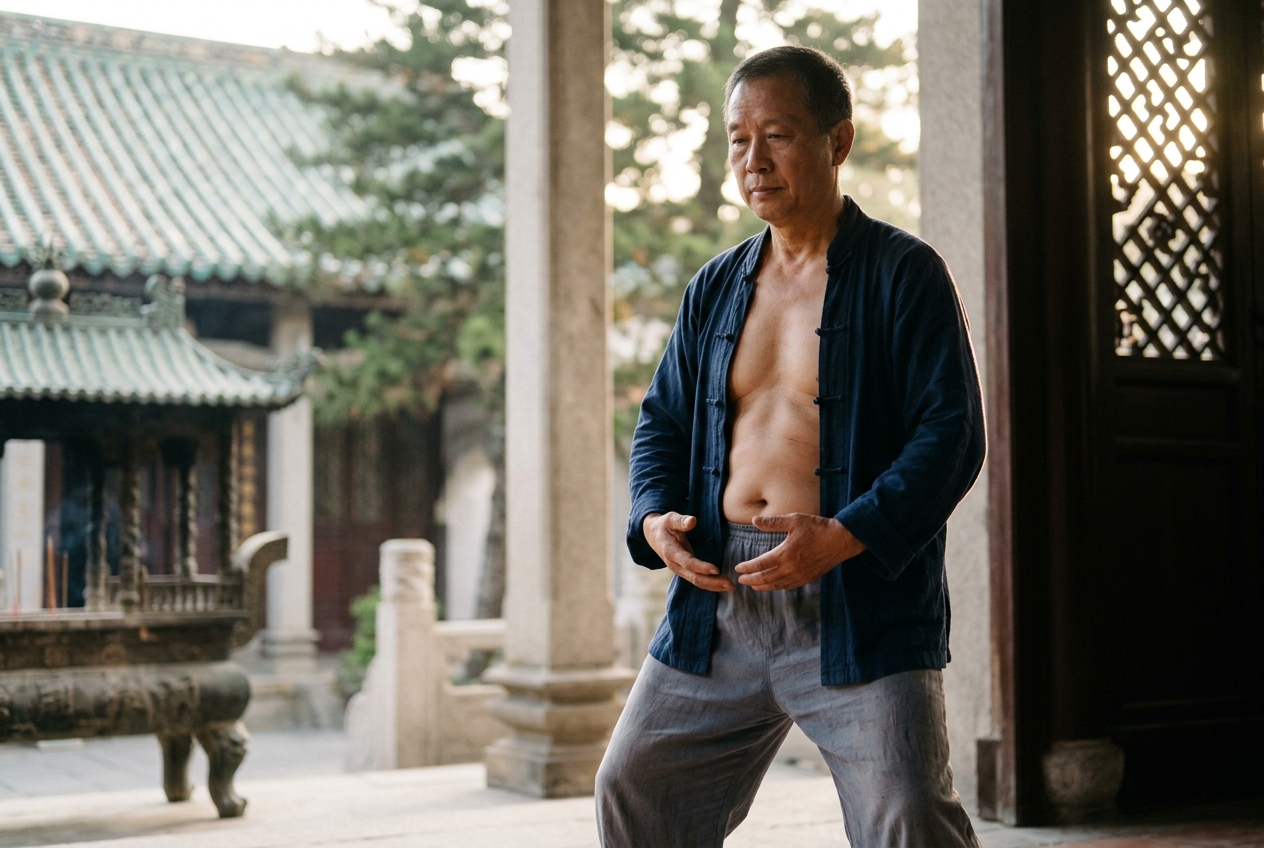
1. Foundational Postural Stance (Wuji Alignment)
Begin by standing with your feet parallel, precisely shoulder-width apart, with your toes pointing straight ahead. Unlock your knees slightly, allowing your pelvis to rest in a neutral, suspended basin alignment—neither aggressively tucked under nor anteriorly tilted. Feel your body weight settle evenly through the center of your feet, placing particular tactile awareness on the bubbling spring point (Yongquan, Kidney-1) located in the depression behind the ball of each foot.
Lengthen your cervical spine gently by imagining the crown of your head (Baihui, GV-20) suspended from above by a fine silk thread. Allow your chin to tuck inward by a fraction of a centimetre, which naturally flattens and decompresses the base of the skull. Rest the tip of your tongue against the hard palate of your upper mouth behind your front teeth, bridging the internal bio-circuit between the Governing Vessel (Du Mai) along the spine and the Conception Vessel (Ren Mai) along the front midline.
2. Sinking the Sternum: "Contain the Chest, Pluck the Back" (Han Xiong Ba Bei)
The single most crucial micro-adjustment for liberating Juque is the classical martial principle of Han Xiong Ba Bei. Rather than aggressively caving in your chest or rounding your shoulders forward, allow the manubrium and body of your sternum to yield softly inward and downward, as though the breastbone itself were gently settling into warm water.
As the sternocostal angle relaxes downward, allow the space between your shoulder blades (Tianzong and the thoracic spine) to widen subtly without muscular tension. This creates a dome-like structural resonance across the upper back while completely unloading the anterior fascia of the epigastrium. Maintain your full vertical height through the spine; do not shorten your torso.
3. Palpation and Neuro-Somatic Anchoring
Bring your dominant hand up and gently place the soft pads of your middle three fingers over Juque—located on the anterior midline, approximately six cun (the width of eight finger-breadths) superior to the center of your navel, roughly one cun inferior to the xiphoid notch. Place your other hand flat against your lower abdomen across the lower Dantian.
Do not poke, jab, or dig aggressively into the tissue. Instead, apply a steady, non-invasive contact pressure that matches the density of the underlying skin, inviting the local connective tissue to recognize external touch.
       ================ PROTOCOL SUMMARY TABLE ================
       +--------------------+---------------------------------------+
       | Phase              | Key Somatic & Biomechanical Focus     |
       +--------------------+---------------------------------------+
       | 1. Wuji Alignment  | Crown lifted (Baihui), weight rooted  |
       | 2. Han Xiong       | Sternal yielding, thoracic widening   |
       | 3. Respiration     | 4-second nasal inhale, 6-second exhale|
       | 4. Yi Dao Qi Dao   | Subxiphoid unwinding -> Lower Dantian |
       +--------------------+---------------------------------------+
4. The Rhythmic Respiration Cycle
Close your eyes or maintain a soft, unfocused gaze toward the floor three meters in front of you. Breathe exclusively through your nose.
- The Inhalation (4 Seconds): Inhale smoothly without pulling air into the upper ribs. Keep the shoulders, clavicles, and throat completely still. Direct the incoming air downward through the central axis of your torso, feeling the lateral and posterior aspects of your lower rib cage widen like the gills of a fish. Maintain gentle awareness at Juque, allowing the area to remain receptive and soft rather than expanding rigidly forward.
- The Exhalation (6 to 7 Seconds): Allow the exhalation to occur without forceful pushing. As the air exits through the nostrils, actively release all residual tone beneath your upper fingers at Juque. Imagine the Great Tower Gate unlatching and swinging open. Mentally trace a warm, heavy, descending fluid sensation cascading from beneath the xiphoid process straight down through the abdominal midline into the lower Dantian.
- The Micro-Pause (2 Seconds): At the bottom of the exhalation, allow the body to rest in natural stillness before the next inhalation effortlessly arises.
Repeat this cycle for 18 to 36 complete breaths.
Common Beginner Mistakes and Precise Corrections
- The Collapse Error (Thoracic Slump): Beginners often confuse "containing the chest" with slouching, collapsing the thoracic spine, and compressing the stomach. Correction: Keep the crown of the head actively lifting toward the ceiling. Your spine must remain long and buoyant; only the anterior breastbone melts downward.
- The Military Armor Error (Puffed Ribs): Inhaling by lifting the chest upward causes the subxiphoid muscles to clench defensively. Correction: Place one hand on your upper chest; if that hand rises during inhalation, pause and reset your breath downward into your lower ribs and flank.
- Epigastric Bracing: Actively pushing the abdominal wall outward with muscular force creates intra-abdominal shearing. Correction: Soften the belly completely. Let the expansion be an elastic consequence of diaphragmatic excursion, not muscular straining.
Somatic Indicators of Successful Epigastric Release
As the subxiphoid matrix decompresses, observe the following benchmark somatic markers: 1. The Vagal Sigh: A spontaneous, involuntary deep inhalation followed by a long, trembling exhalation or yawning, signaling an immediate downshift in the autonomic nervous system. 2. Epigastric Softening and Borborygmi: The hard, knuckle-like tension beneath your fingers transforms into a yielding, elastic texture, often accompanied by audible digestive gurgling as mesenteric blood vessels dilate. 3. Thermal Redistribution: An identifiable wave of warmth radiating downward into the lower belly, followed by tingling or warmth in the palms and soles of the feet. 4. Mental Deceleration: An abrupt cessation of internal mental chatter, replaced by a quiet, grounded interoceptive presence.
Biomechanical and Neuro-Fascial Dynamics
To comprehend why the decompression of Juque produces such profound somatic shifts, one must examine the intersection of classical energetic topography and contemporary human anatomy. Juque does not exist in isolation; it represents the primary anterior crossroad of structural tension and autonomic signaling in the human torso.
                  +-----------------------------------+
                  |   CHRONIC PSYCHOLOGICAL STRESS    |
                  +-----------------+-----------------+
                                    |
                                    v
                  +-----------------------------------+
                  |  Subxiphoid Epigastric Guarding   |
                  |     (Juque / Ren-14 Tension)      |
                  +--------+-----------------+--------+
                           |                 |
            +--------------+                 +---------------+
            v                                                v
+-----------------------+                        +-----------------------+
|  Diaphragmatic Crura  |                        | Celiac Plexus / Vagus |
|     Constriction      |                        |  Sympathetic Overdrive|
+-----------+-----------+                        +-----------+-----------+
            |                                                |
            +--------------+                 +---------------+
                           |                 |
                           v                 v
                  +-----------------------------------+
                  |    Han Xiong Ba Bei Decompression |
                  |    & Diaphragmatic Breathwork     |
                  +-----------------+-----------------+
                                    |
                                    v
                  +-----------------------------------+
                  | Vagal Tone Surge / HRV Elevation  |
                  | Lower Dantian Energetic Anchoring |
                  +-----------------------------------+
The Fascial Crossroads: Linea Alba and Deep Front Line
From a structural perspective, Juque sits directly over the superior segment of the linea alba, the dense fibrous raphe formed by the interlocking aponeuroses of the external oblique, internal oblique, and transversus abdominis muscles. Just deep to this structure lies the anterior insertion of the diaphragmatic crura—the muscular tendons that anchor the respiratory diaphragm to the upper lumbar vertebrae (L1–L3).
In the anatomical taxonomy of myofascial meridians, this region forms a crucial node within the Deep Front Line (DFL). As documented in modern research on myofascial force transmission and connective tissue mechanics, mechanical tension or chronic shortening in one segment of a continuous fascial plane alters load distribution across the entire kinetic chain.
When you slouch or brace your core against emotional threat, the falciform ligament, transversus abdominis aponeurosis, and central tendon of the diaphragm shorten simultaneously. This locks the rib cage in an expiratory or inspiratory restriction, arresting the natural piston movement of the core and preventing kinetic energy generated from the legs from transferring fluidly through the torso.
Autonomic Neuromodulation and the Solar Nexus
Directly posterior to the posterior abdominal wall behind Juque lies the celiac plexus (the solar plexus)—the largest autonomic nerve center in the abdominal cavity—alongside the bifurcating terminal fibers of the anterior vagus nerve (Cranial Nerve X).
                                 [ Brainstem ]
                                       |
                           ( Vagus Nerve / CN X )
                                       |
                                       v
                    +------------------------------------+
                    |        Subxiphoid Aperture         |
                    |     (Juque Mechanical Window)      |
                    +------------------+-----------------+
                                       |
                    +------------------+-----------------+
                    |                                    |
                    v                                    v
          [ Cardiac Deceleration ]             [ Splanchnic Vasodilation ]
          - Heart Rate Downregulation          - Enteric Motility Surge
          - Elevated HRV                       - Borborygmi & Visceral Ease
When an individual chronically contracts the epigastrium, the continuous mechanical compression maintains high sympathetic efferent firing, effectively keeping the nervous system trapped in a low-grade fight-or-flight loop.
When Juque is consciously decompressed through the structural adjustments of Han Xiong Ba Bei and slow diaphragmatic excursions, the mechanical traction on the phrenic and vagal nerve pathways changes. As validated by peer-reviewed studies available on the National Center for Biotechnology Information (NCBI) on diaphragmatic breathing and autonomic regulation, slow, low-frequency diaphragmatic breathing immediately enhances respiratory sinus arrhythmia (RSA) and elevates Heart Rate Variability (HRV). This mechanical release allows the vagus nerve to exert its physiological "brake" on the sinoatrial node of the heart, lowering cardiac output, reducing systemic vascular resistance, and translating the classical concept of "calming the Shen" into measurable neuro-cardiac deceleration.
Classical Lineage, Martial Transmission, and Alchemical Lore
The conceptualization of Juque as a primary energetic and martial gate is woven deeply throughout historical Chinese medical and martial treatises. The point first appears systematically documented in the foundational canon of East Asian medicine, the Huangdi Neijing (Yellow Emperor's Inner Classic, circa 2nd century BCE), where its status as the Front-Mu point of the Heart was established. In the subsequent Nan Jing (Classic of Difficult Issues, chapter 67), the Front-Mu points were defined as the gathering places on the ventral surface of the body where the visceral Qi of the internal organs concentrates and can be directly accessed, balanced, or cleared.
The name Juque (巨阙) carries significant historical and metaphorical resonance. In ancient Chinese history, Juque was the name of a legendary, impervious sword forged by the master metalworker Ou Yazi during the Spring and Autumn period—a blade renowned for its supreme sharpness and structural integrity, capable of piercing the thickest armor. By bestowing this name upon the 14th point of the Conception Vessel, ancient Daoist masters designated this anatomical locus as the supreme energetic sentinel guarding the thoracic palace of the imperial Heart.
       ================ ALCHEMICAL WATER-FIRE MATRIX ================

       ( Unanchored State )                      ( Cultivated Kan-Li State )

       [ Disturbed Heart / Shen ]                [ Quiescent Heart / Shen ]
           |  (Floating Fire / Agitation)            |  (Settled Shen)
           v                                         v
       [ Locked Juque (Ren-14) ]                 [ Decompressed Juque ]
           |  (Barrier / Blockade)                   |  (Open Conduit)
           x                                         v
       [ Depleted Lower Dantian ]                [ Nourished Lower Dantian ]
           |  (Cold / Disconnected)                  |  (Kindled Water & Fire)
In the internal martial arts lineages of Taijiquan, Xingyiquan, and Baguazhang, Juque is recognized as an indispensable mechanical valve. In the Taijiquan Lun (Treatise on Taijiquan) and the oral teachings codified by master Yang Chengfu in his Ten Essential Principles of Taijiquan, the very second instruction following the suspension of the head is Han Xiong Ba Bei (Contain the Chest and Pluck the Back). Yang Chengfu explicitly warned that if the chest is puffed out or rigid, the Qi will become stuck in the upper epigastrium at Juque, causing the practitioner's upper body to become top-heavy, their stance to become unstable, and their martial power (Fa Jin) to dissipate at the shoulder joints.
In the internal alchemy traditions fostered by organizations like the National Qigong Association, the unlocking of Juque is an absolute prerequisite for completing the Small Heavenly Circuit or Microcosmic Orbit (Xiao Zhou Tian). The descent of energy down the central Ren Mai conduit cannot occur if the subxiphoid gateway remains structurally locked. The Daoist text Taiyi Jinhua Zongzhi (The Secret of the Golden Flower) describes this release as allowing the light of the consciousness to turn backward and penetrate the deep lower abdominal furnace, uniting the conscious spiritual intent with the primordial life essence (Jing).
Biomechanical Contraindications and Safety Boundaries
While the mindful somatic decompression of Juque is universally beneficial, practitioners must observe clear clinical boundaries to prevent tissue trauma or adverse physiological reactions:
- No Direct Invasive Force: Juque should never be subjected to heavy, sharp, or percussive manual pressure. The xiphoid process directly superior to the point is cartilaginous and vulnerable to structural dislocation, and the left lobe of the liver and the stomach lie directly in the deep retroperitoneal plane.
- Acute Epigastric Conditions: Individuals with active hiatal hernias, unhealed surgical incisions, or acute peptic ulcer flare-ups should practice purely with mindful postural alignment and breathwork, entirely eschewing manual palpation.
- Postprandial Timing: Do not practice concentrated epigastric decompression immediately following a large meal. Allow at least 90 minutes for initial gastric emptying to avoid visceral reflux or digestive discomfort.
- Cardiovascular Instability: Those with diagnosed severe aortic aneurysms or advanced hemodynamic dysregulation should engage in slow breathwork under qualified medical supervision, ensuring they never perform breath holds (Kumbhaka) or forceful abdominal contractions.
Daily Cultivation Protocol: The 7-Day Subxiphoid Reset
To permanently transform the neuro-fascial tonus of the Great Tower Gate, intellectual understanding must be converted into somatic habituation. Commit to the following calibrated routine for the next seven consecutive days:
========================================================================
                 THE 7-MINUTE MORNING JUQUE RESET PROTOCOL
========================================================================
 Minute 0:00 - 1:30 | Wuji Alignment & Spinal Suspension
                     - Establish root at Yongquan (K-1)
                     - Suspend Baihui (GV-20); tuck chin fractionally
                     - Connect tongue to palate; unlock knee joints

Minute 1:30 - 3:00 | Sternal Melting (Han Xiong Ba Bei)
                     - Exhale and release the breastbone downward
                     - Widen interscapular fascia; feel ribs drop

Minute 3:00 - 6:00 | 18 Cycles of Conscious Gateway Respiration
                     - Inhale (4s) into lateral lower ribs
                     - Exhale (6-7s), softening Juque (Ren-14)
                     - Trace warmth descending to Lower Dantian (Ren-4/6)

Minute 6:00 - 7:00 | Stillness & Somatic Integration
                     - Rest both hands over lower abdomen
                     - Observe peripheral warmth, vagal sigh, mental clarity
========================================================================
Tomorrow morning, immediately upon waking and before consuming your first cup of coffee or checking a digital screen, step out of bed and dedicate precisely seven minutes to this practice. Notice the immediate drop in resting pulse, the release of tension across your neck and lower back, and the profound stillness that emerges when the sovereign Heart settles comfortably behind its open Great Tower Gate.