Jin Gou Diao Yu: Navigating Curved Hook Traction Mechanics, Deep Stagnation Decompression, and Precision Acupressure Protocols
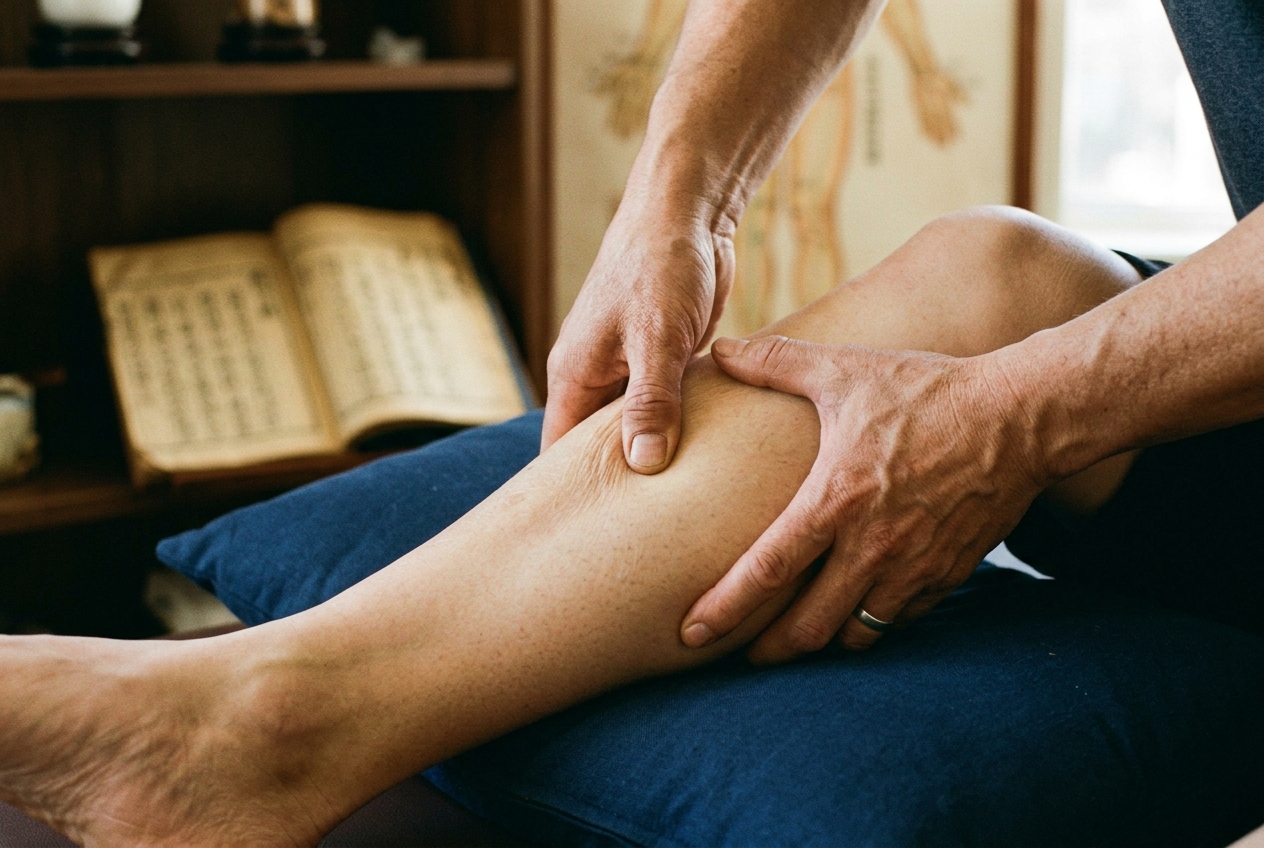
If you have ever carried a persistent, immovable knot between your shoulder blades, experienced an intractable heaviness in your epigastrium following chronic psychological stress, or felt an unyielding ache deep along your shinbones that defies routine stretching, you have encountered recalcitrant channel stagnation. In the taxonomy of modern biomechanics, these sensations represent dense myofascial densifications, altered collagen cross-linking, and trapped interstitial metabolic byproducts. In the diagnostic framework of Traditional Chinese Medicine (TCM), they are classified as deep-stratum Qi and Blood stasis (Xue Yu), phlegm-damp obstruction (Tan Shi), or obstinate cold-damp invasion lodged within the sinew channels (Jing Jin).
Standard, superficial therapeutic interventions—whether light effleurage, standard broad-surface acupressure, or rapid superficial acupuncture insertion—frequently provide only fleeting relief. When pathogenic factors penetrate beyond the superficial cutaneous regions and become anchored in the deep retinacular fascial planes, linear thrusting and broad compression glide harmlessly over the lesion. The tissue requires a specialized mechanical vector capable of descending beneath the pathology, mechanically engaging the densified matrix, and drawing it outward toward the superficial circulation.
This is the exact clinical problem solved by one of the most sophisticated needle manipulation and manual therapy techniques in classical Chinese medicine: Jin Gou Diao Yu (金钩钓鱼), or the Golden Hook Fishing Method. By marrying classical needle mechanics with modern connective tissue physiology, this method provides both the licensed acupuncturist and the manual therapist with a systematic protocol to uncouple deep-seated adhesions, reset interstitial mechanoreceptors, and re-establish homeostatic flow throughout the channel network.
2. Classical Foundations: Canonical Lineage and Philosophical Architecture
The method of Jin Gou Diao Yu represents the pinnacle of specialized compound needle manipulations developed during the golden age of classical acupuncture systematization. Its primary textual genesis is traced directly to the seminal Ming Dynasty canon, the Zhen Jiu Da Cheng (Great Compendium of Acupuncture and Moxibustion), compiled by Yang Jizhou in 1601, which preserved the crucial operational verses of Xu Feng’s 15th-century masterwork, the Jin Zhen Fu (Ode to the Golden Needle).
Within classical Chinese medical cosmology, therapeutic needle manipulation is governed by the three cosmological strata: 1. Heaven (Tian Bu / 天部): The superficial stratum corresponding to the skin, subcutaneous capillary networks, and the circulating Wei Qi (defensive energy). 2. Human (Ren Bu / 人部): The intermediate stratum corresponding to superficial fascia, superficial venous pathways, and the Ying Qi (nutritive energy). 3. Earth (Di Bu / 地部): The deep stratum corresponding to deep investing fascia, intermuscular septa, periosteal margins, deep sinew channels, and the Xue (Blood) and Zang-Fu root connections.
Classical theory dictates that when a pathogen has settled into the Earth stratum, simple perpendicular tonification (Bu) or dispersion (Xie) is insufficient. The Jin Zhen Fu conceptualizes the obstruction as an elusive, deep-dwelling entity—metaphorically described as a bottom-dwelling fish nestled among subterranean reeds.
To dislodge it, the practitioner must not spear downward directly onto the lesion, which would cause tissue defense and compact the stagnation further. Instead, the practitioner must execute the mechanics of Gou (钩 - angling and hooking) and Diao (钓 - patient, directional traction). The needle or manual vector penetrates vertically past the blockage into the Earth stratum, angles obliquely to create a cantilever hook beneath the lesion, twists subtly to engage the tissue lattice, and lifts with sustained axial tension. This mechanical drawing vector lures and extracts the anchored pathogen from the deep darkness of the structural core into the dynamic, circulating pathways of the human and heaven strata, where the body's natural immunological and metabolic mechanisms can disperse it.
3. Neurofascial Correlates: Shear Strain, Mechanotransduction, and Collagen Remodeling
Far from being merely a poetic historical metaphor, the mechanics of Jin Gou Diao Yu map with extraordinary precision onto contemporary discoveries in connective tissue biology, neurophysiology, and fascial mechanotransduction. Pioneer biomedical research led by Dr. Helene Langevin and colleagues on acupuncture biomechanics has demonstrated that acupuncture needle manipulation induces winding of subcutaneous loose connective tissue around the needle shaft, creating measurable mechanical coupling and pulling on surrounding interstitial matrices.
The Biomechanics of Fascial Shear Strain
Human fascia is organized in multi-layered sheets separated by thin layers of hyaluronan-rich fluid that permit gliding between adjacent muscular and neural structures. In chronic pathological states—caused by repetitive strain, physical trauma, or sustained sympathetic tone—this ground substance densifies from a lubricating sol-state into a rigid gel-state. This process fosters aberrant, non-physiological collagen cross-links between overlapping fascial laminas.
When the Golden Hook method is applied: 1. Perpendicular Penetration: Transverses the loose superficial areolar tissue with minimal shear. 2. Oblique Tilting (30°–45°): Re-orients the tip or focused manual pressure vector beneath the densified layer, creating an asymmetrical moment arm. 3. Rotational Hooking: Winds the collagen fibrils around the vector, creating an unyielding mechanical anchor. 4. Axial Traction (Lifting Tension): Generates localized interlaminar shear strain. This directional shear forces adjacent fascial planes to slide past one another, physically cleaving the micro-adhesions and non-enzymatic collagen cross-links that bind restricted tissue layers.
Mechanoreceptor Activation and Neurophysiological Gating
The deep fascial and periosteal zones targeted by the Golden Hook method are densely populated with specialized mechanoreceptors and free nerve endings: * Ruffini Endings (Type II Mechanoreceptors): These slow-adapting receptors respond specifically to sustained, low-velocity tissue stretch and lateral shear force. When stimulated by the sustained traction phase of Jin Gou Diao Yu, they initiate central autonomic resetting, triggering a localized reduction in sympathetic vasospasm and promoting deep myofascial relaxation. * Pacinian Corpuscles (Type III/IV Mechanoreceptors): Highly sensitive to subtle directional changes and rapid oscillatory micro-traction. Their recruitment dampens central pain perception at the spinal dorsal horn via the classic gate control mechanism, transforming chronic hyperalgesic signals into a soothing proprioceptive cascade. * Fibroblast Remodeling: Within minutes of sustained mechanical tension, fibroblasts undergo active cytoskeletal remodeling, releasing adenosine (a potent endogenous analgesic and anti-inflammatory agent) and secreting matrix metalloproteinases that reorganize the structural extracellular matrix.
4. The Three-Phase Execution Vector: Step-by-Step Biomechanical Breakdown
To master the Golden Hook Fishing Method, the practitioner must internalize its exact tripartite mechanical vector. Whether performed with a filiform acupuncture needle (typically 0.25–0.30 mm gauge, 40–75 mm length) or via precision manual acupressure, the execution follows an invariant geometric progression.
Phase 1: Deep Vertical Descent to the Earth Stratum (Di Bu / 地部)
- Kinematics: The implement or reinforced thumb enters perpendicular (90°) to the cutaneous plane. It traverses the Heaven stratum (skin and superficial subcutaneous fascia) and the Human stratum (superficial muscle/epimysium) smoothly and without lateral deviation.
- Target Depth: The descent halts precisely at the Earth stratum—the deep retinacular investing fascia, intermuscular septum, or periosteal margin.
- Tactile Feedback: The practitioner senses an immediate transition from loose, spongy compliance to a dense, resilient, fibroelastic resistance.
- Critical Rule: Do not compress or irritate the underlying periosteum directly; anchor immediately superficial to the dense fibrous baseline.
Phase 2: Oblique Lateral Hook Tilting (Xie Ci Gou Qi / 斜刺钩气)
- Kinematics: Maintaining the target depth in the Earth stratum, the practitioner shifts the external angle of the implement or thumb from 90° to an oblique angle of 30° to 45°, directed along the anatomical pathway of the channel (either upstream against channel flow for dispersion, or downstream with flow for tonification).
- Rotational Engagement: Once angled, a precise, unidirectional rotation of 90° to 180° is applied.
- Tactile Feedback: This rotation causes the deep collagen fibers to wrap mechanically around the tip or contact surface. The sensation is described in classical texts as Chen Jin Ru Yu Tun Gou (沉紧如鱼吞钩)—a distinct, heavy, suction-like pull, precisely resembling a fish striking and grasping a baited hook.
Phase 3: Sustained Directional Traction and Retrieval (Diao Yu Ti Ba / 钓鱼提拔)
- Kinematics: While preserving both the 30°–45° tilt and the rotational engagement, the practitioner initiates a slow, continuous, axial lifting and pulling traction upward toward the Human stratum.
- Force Dynamic: The movement is not a rapid yank, but a measured, continuous vector against the engaged tissue resistance. The traction is sustained for 3 to 10 seconds per cycle, followed by a slight relaxation of tension without losing the foundational anchor, repeated across 3 to 5 rhythmic retrieval waves.
- Cellular Outcome: The engaged myofascial adhesions and dense ground substance undergo immediate plastic deformation and directional uncoupling. The practitioner feels the heavy resistance gradually soften and yield—marking the release and mobilization of the trapped pathogen.
5. Precision Non-Invasive Acupressure Protocols Across Primary Key Points
While classically executed with sterile acupuncture needles, the profound therapeutic vectors of Jin Gou Diao Yu can be fully translated into advanced manual medicine and non-invasive acupressure. By substituting a reinforced thumb tip, interphalangeal joint, or ceramic acupressure tool for the needle shaft, manual practitioners can generate the identical shear strain vectors required to clear recalcitrant stagnation.
Below are the precision protocols for the five primary classical acupoints, standardized in accordance with World Health Organization (WHO) Acupuncture Guidelines and modern clinical kinesiology.
1. ST36 (Zusanli - Leg Three Miles) — Stomach Meridian
- Physical Landmark: Located on the front of your lower leg. Place your hand across the base of your kneecap; four finger-widths directly below the lower outer edge of the knee, in the soft muscular groove one finger-width to the outside of your prominent shinbone crest (Tibialis anterior).
- Tactile Indicator: A distinct, deep tenderness nestled in the muscular valley; upon firm contact, it produces a dull, radiating ache down the lateral shin toward the ankle.
- Manual Hooking Vector: 1. Descent: Apply the reinforced tip of your thumb perpendicularly into the muscular groove until you encounter the firm resistance of the intermuscular septum. 2. Angle: Tilt the thumb to a 45° angle, pointing the contact vector upward toward the knee (against the downward energetic flow of the Stomach channel). 3. Traction: Hook the thumb upward under the edge of the anterior tibialis muscle belly, anchoring the deep fascia, and apply steady upward and outward lifting traction for 60 to 90 seconds.
- Daily Indications: Severe post-meal lethargy, chronic abdominal distension, stubborn brain fog, and systemic physical fatigue.
2. LV3 (Taichong - Great Surge) — Liver Meridian
- Physical Landmark: On the top of your foot. Place your index finger in the webbing between your big toe and second toe, and slide your finger upward toward your ankle until it drops into the deep triangular depression just before the two long foot bones (metatarsals) join.
- Tactile Indicator: Intense, exquisitely tender, reactive soreness that feels disproportionately sharp compared to the light pressure applied—a definitive sign of constrained systemic tension.
- Manual Hooking Vector: 1. Descent: Sink the corner of your thumb or a firm knuckle vertically into the skeletal junction. 2. Angle: Incline your thumb to an oblique 35° angle directed backward toward the center of your heel. 3. Traction: Rotate your thumb slightly inward toward the first metatarsal bone, "hooking" the deep interosseous fascia, and sustain a drawing pull back toward your ankle joint for 60 seconds while taking slow, diaphragmatic breaths.
- Daily Indications: Unyielding tension headaches across the temples, jaw clenching (bruxism), acute emotional irritability, and premenstrual mood tension.
3. LI4 (Hegu - Joining Valley) — Large Intestine Meridian
- Physical Landmark: On the back of your hand, in the muscular webbing between your thumb and index finger. Bring your thumb against your index finger to create a small muscular mound; the point lies at the highest point of that mound, just along the bone of the index finger.
- Tactile Indicator: A deep, spreading ache that radiates outward into the palm and frequently travels up the forearm toward the elbow.
- Manual Hooking Vector: 1. Descent: Place your opposing thumb on the top of the web space and your index finger on the palm side for support. Press straight down into the radial edge of the second metacarpal bone. 2. Angle: Tilt your thumb tip at a 40° angle, angling directly beneath the shelf of the second metacarpal bone. 3. Traction: Hook the thumb tip beneath the bone edge, rolling the tissue slightly, and draw outward away from the wrist with steady, sustained compressive tension for 1 to 2 minutes.
- Daily Indications: Stubborn frontal and sinus headaches, chronic jaw tension, neck stiffness from computer screens, and acute facial or tooth discomfort.
4. SP6 (Sanyinjiao - Three Yin Intersection) — Spleen Meridian
- Physical Landmark: On the inner side of your lower leg. Locate the highest tip of your inner ankle bone. Place four finger-widths flat across your leg above that point; SP6 sits directly behind the inner edge of the shinbone (Tibia).
- Tactile Indicator: A sensitive, bruise-like soreness that softens upon rhythmic sustained engagement; signals venous and fluid stagnation in the lower pelvis and extremities.
- Manual Hooking Vector: 1. Descent: Rest your fingers along the outer shin for counter-leverage and sink your thumb vertically into the soft groove directly hugging the back edge of the shinbone. 2. Angle: Incline the thumb at a 45° angle, aiming slightly forward so the thumb tip slips directly under the posterior border of the bone. 3. Traction: Hook the deep fascial margin of the flexor digitorum longus muscle and draw upward toward the knee, holding firm, continuous traction for 90 seconds.
- Daily Indications: Menstrual cramps and pelvic heaviness, lower extremity fluid retention, insomnia linked to an overactive mind, and chronic digestive sluggishness.
5. PC6 (Neiguan - Inner Pass) — Pericardium Meridian
- Physical Landmark: On the palm-side of your inner forearm. Lay three finger-widths across your wrist, starting at the main wrist crease. PC6 lies centered in the arm, directly between the two prominent, rope-like tendons (Palmaris longus and Flexor carpi radialis) that stand out when you make a fist.
- Tactile Indicator: A deep, tingling, electric, or warm sensation that spreads through the center of the palm and travels up the inside of the arm toward the chest.
- Manual Hooking Vector: 1. Descent: Press the thumb tip straight down between the two tendons until you reach the deep interosseous membrane beneath the superficial flexor musculature. 2. Angle: Tilt your thumb 30° toward the elbow joint. 3. Traction: Hook the thumb tip downward into the deeper fascial bed and apply sustained, gentle lifting traction toward your palm, relieving diaphragmatic constriction. Hold for 60 to 90 seconds per arm.
- Daily Indications: Motion sickness, nausea, epigastric distress, tight constriction in the chest, and sleep-disrupting nighttime anxiety.
6. A Point Combination for One Common Issue: The Evening De-Stagnation Protocol
To experience the systemic power of the Golden Hook vector, apply this integrated protocol designed specifically for recalcitrant evening fatigue accompanied by mental overarousal and postprandial digestive fullness (the classic "wired but exhausted" presentation caused by concurrent Liver Qi constraint and Spleen-Stomach dampness).
Complete "Do This Tonight" Execution
- Position: Sit comfortably on a firm sofa, floor mat, or bed with your spine supported and knees bent, allowing easy, unstrained manual access to your feet and lower legs. Take three deep nasal breaths, lengthening each exhalation to twice the duration of your inhalation.
- Step 1: Release the Tension Valve at LV3 (Taichong)
- Execution: Locate LV3 on your left foot. Sink your left thumb into the metatarsal junction, angle 35° toward your heel, hook the deep interosseous tissue, and draw backward.
- Duration: 60 seconds per foot.
- Sensation: A deep, releasing ache that unlocks tension in your jaw and temples.
- Step 2: Mobilize the Earth Center at ST36 (Zusanli)
- Execution: Shift to your left ST36. Sink your thumb into the muscle bed below the knee, angle 45° upward, hook under the anterior tibialis muscle, and apply steady upward lifting traction.
- Duration: 90 seconds per leg.
- Sensation: A warm, spreading sensation across the abdomen accompanied by stomach gurgling (borborygmi), signaling the return of parasympathetic gastrointestinal peristalsis.
- Step 3: Unbind the Diaphragm at PC6 (Neiguan)
- Execution: Place your thumb between the two wrist tendons on your left arm. Sink deep to the interosseous membrane, angle 30° toward the elbow, hook, and traction distally toward your palm.
- Duration: 60 seconds per arm.
- Sensation: A profound easing of respiratory constriction, allowing full, uninhibited diaphragmatic expansion.
- Step 4: Anchor the Root at SP6 (Sanyinjiao)
- Execution: Move to your inner lower leg. Sink your thumb directly behind the shinbone, angle 45° forward under the bone shelf, hook the deep flexor sheath, and draw upward.
- Duration: 90 seconds per leg.
- Sensation: A heavy, grounding warmth flowing into the lower abdomen and feet, melting away mental chatter.
7. Clinical Indicators, De Qi Sensation Markers, Safety & Contraindications
The clinical efficacy of the Golden Hook method is intimately tied to the elicitation of De Qi (得气)—the arrival and engagement of vital channel energy, verified in neurophysiological literature as the simultaneous recruitment of A-delta and C sensory afferent fibers coupled with connective tissue winding.
Comparative Synergy with Other Classical Needle Methods
In the comprehensive repertoire of classical acupuncture, Jin Gou Diao Yu occupies a unique functional niche, frequently paired with other canonical compound manipulations: * Shao Shan Huo (烧山火 - Setting the Mountain on Fire): A multi-tiered, slow-in, rapid-out tonification technique designed to generate profound warming sensations for extreme Yang-deficiency cold syndromes. Jin Gou Diao Yu is cooler and more mechanically directional, prioritizing the extraction of physical stagnation over thermal supplementation. * Tou Tian Liang (透天凉 - Cooling the Sky): A rapid-in, slow-out dispersion technique utilized to purge acute, toxic febrile heat from the blood level. While Tou Tian Liang purges heat outward, Jin Gou Diao Yu gathers deep, stubborn phlegm-stasis agglomerations that are too dense for simple thermal clearance. * Cang Gui Tan Xue (青龟探穴 - Green Turtle Seeking the Cave): A multi-directional probing technique in which the needle explores four quadrants to locate channel pathways in areas of severe structural distortion. Cang Gui Tan Xue identifies the terrain; Jin Gou Diao Yu hooks and extracts the obstruction once found.
Safety Boundaries, Red Flags, and Contraindications
While non-invasive manual acupressure is intrinsically safe for general self-care, strict clinical boundaries must be maintained:
[!CAUTION] Vascular & Tissue Boundaries: Never apply the high-traction Golden Hook vector over compromised skin, open lesions, active phlebitis, deep vein thrombosis, varicose veins, or directly over prominent arterial pulses (e.g., the femoral triangle or carotid sinus).
- The Threshold of "Too Much Pressure": Authentic De Qi produces a satisfying, therapeutic ache (Suan-Zhang). It should never cause breath-holding, facial wincing, or sharp, agonizing pain. Sharp pain indicates superficial tissue tearing or periosteal bruising.
- When to Consult a Licensed Professional: Self-acupressure is an outstanding daily maintenance and self-regulation tool. However, if your symptoms include unexplained sharp unilateral pain, radiating numbness, progressive motor weakness, acute structural trauma, or constitutional symptoms (unexplained fever, unintended weight loss), seek comprehensive evaluation from a licensed acupuncturist (L.Ac.) or medical physician.
8. Today’s Takeaway: The Two-Minute Somatic Unhooking Practice
You do not need an hour of free time or a clinic appointment to experience the profound liberating mechanics of the Golden Hook method. Before closing this article, take exactly two minutes to unhook the accumulated cognitive and physical fatigue of your day using your own LI4 (Hegu).
================================================================================
                    THE 2-MINUTE DESK RESET (LI4 HOOK)
================================================================================
  [0:00 - 0:20]  Locate the muscular mound on your left hand between thumb
                 and index finger. Rest your right thumb against the index bone.
  [0:20 - 0:40]  Sink your thumb tip straight down to the bone edge (Phase 1).
  [0:40 - 1:00]  Tilt your thumb 40° underneath the bone shelf (Phase 2).
  [1:00 - 1:40]  Hook and apply sustained outward lifting traction (Phase 3).
                 Close your eyes; feel the deep, radiating ache spread into your
                 palm and neck. Take three long, relaxing breaths.
  [1:40 - 2:00]  Gently release the tension. Repeat briefly on the right hand.
================================================================================
Notice the immediate physical shift: your jaw unclenches, the tension across your forehead softens, and a subtle wave of mental clarity returns. You have just transformed a classical 600-year-old needle art into an immediate, neurofascial release—proving that the most sophisticated mechanics of classical healing are always available at your fingertips.