Japanese Meridian Therapy: Navigating Five-Phase Sho Vacuity Patterns, Tactile Pulse Diagnostics, and Precision Acupressure Protocols
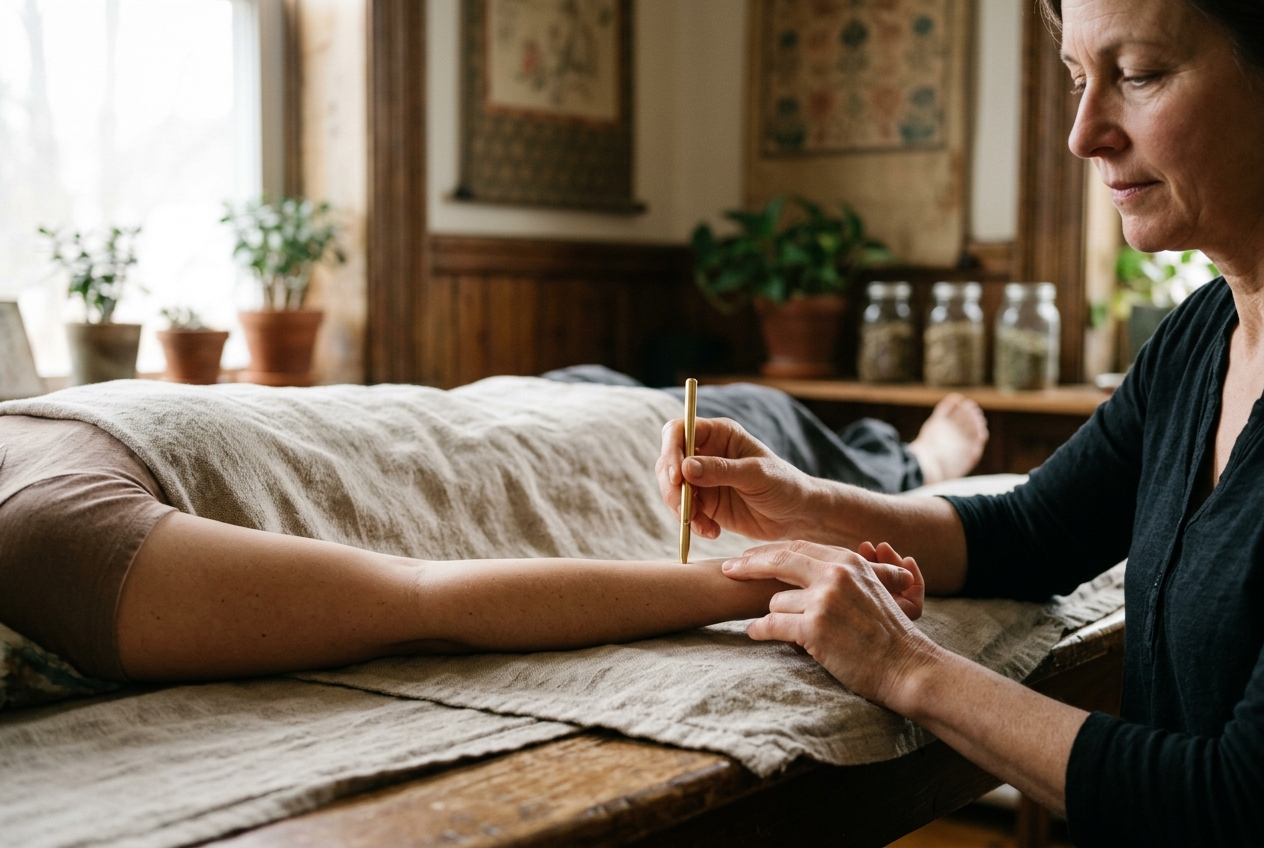
1. Opening — A Problem This Solves Today
Consider a physical state familiar to millions: by three in the afternoon, your shoulders are hunched toward your ears, a dull compressive tightness constricts the base of your skull, your digestion feels stagnant and distended following a hasty lunch, and your breathing remains trapped in the shallow upper third of your ribcage. You might reach for an analgesic, schedule a deep-tissue massage, or attempt a series of aggressive neck stretches. Yet, within hours or days, the identical constellation of symptoms resurfaces.
This frustrating recurrence illustrates a fundamental flaw in the modern symptom-chasing paradigm: treating the localized site of discomfort—the "branch" (Hyosai, 標治)—while entirely ignoring the systemic energetic imbalance that generated it—the "root" (Honsai, 本治).
When your body is subjected to persistent psychosocial stress, circadian disruption, and intellectual overexertion, the physiological consequences do not occur in isolated musculoskeletal vacuums. Instead, they manifest across interconnected bio-electric and fascial communication pathways known classically as meridians (Keiraku, 経絡). In East Asian medicine, chronic postural strain, epigastric bloating, and low-grade anxiety are not three distinct pathologies requiring three separate pharmacological interventions; they are the outward reverberations of a single primary deficiency within the body’s twelve primary channels.
For those navigating this chronic, low-grade autonomic dysregulation, Japanese Meridian Therapy (Keiraku Chiryo, 経絡治療) offers an extraordinarily refined and non-invasive map. Rather than demanding forceful manipulation or painful interventions, this classical tradition demonstrates that the gentlest, most precise tactile inputs at strategic peripheral points can restore systemic equilibrium, release chronic tension, and reset the autonomic nervous system.
2. The Meridian Path — A Journey Through the Body & The Classical Revival
To understand how a point on the inner foot can unravel tension in the upper cervical spine, one must understand the living geometry of the meridian system. Far from being mystical constructs, the meridians correspond to organized planes of interstitial connective tissue, neurovascular bundles, and bio-electric signaling conduits that traverse the body from core to periphery.
Consider the path of the Lung Meridian (Fei Jing): it begins deep within the solar plexus and middle abdomen, descends to communicate with the large intestine, loops back upward through the diaphragm, enters the lung tissue, ascends across the throat, and emerges onto the chest just beneath the collarbone. From this anatomical crossroads, it travels down the inner arm along the biceps, passes through the outer crease of the elbow, continues along the front edge of the forearm, crosses the wrist crease over the radial artery, and terminates at the outer corner of the thumbnail.
Parallel to this, the Spleen Meridian (Pi Jing) commences at the inner corner of the big toenail, travels along the boundary where the red and white skin meet on the arch of the foot, ascends directly in front of the inner ankle bone, tracks up the inner calf along the posterior border of the shinbone, crosses the inner knee and thigh, and ascends into the lower abdomen before fanning out into the digestive viscera and tongue.
The Twentieth-Century Japanese Revival: Back to the Nan Jing
During the Meiji Restoration (1868–1912) and the early decades of the twentieth century, traditional East Asian medicine in Japan faced severe existential threats. Western biomedical hegemony sought to reduce acupuncture to crude local neuro-muscular stimulation, discarding the holistic meridian architecture as primitive superstition. In response, a visionary cadre of blind and sighted master clinicians—most notably Yanagiya Sorei (1898–1959) and Inoue Keiri (1900–1967)—initiated a profound renaissance in the 1930s known as the Keiraku Chiryo movement.
Yanagiya and Inoue recognized that modern practitioners had devolved into "symptom-chasers," applying aggressive, painful needle insertions directly into local trigger points. They argued that genuine clinical efficacy required returning to the root diagnostic doctrines codified in the Han Dynasty classical text, the Nan Jing (Classic of Difficulties).
The cornerstone of the Keiraku Chiryo philosophy rests upon three revolutionary tenets: 1. Subtle, Non-Insertive Palpation (Teishin & Touch): Heavy, painful stimulation triggers sympathetic defensive reflexes (Taiki / protective Qi contraction), causing systemic vascular constriction. In contrast, ultra-fine contact or subtle, non-invasive acupressure engages low-threshold mechanoreceptors (C-tactile and $A\beta$ afferent fibers), evoking immediate parasympathetic dominance and peripheral vasodilation as documented in contemporary neurophysiological literature. 2. Prioritization of Root Treatment (Honsai) over Branch Treatment (Hyosai): Local pain is merely a symptomatic alarm. By identifying and correcting the primary meridian deficiency (Sho), the peripheral muscular rigidity melts away without requiring traumatic local intervention. 3. Continuous Radial Pulse Diagnostic Verification (Myakushin): Diagnostic precision is maintained throughout treatment via real-time monitoring of the radial arterial pulse at multiple depths.
The six-position radial pulse method, formalized in Chapters 18 through 21 of the Nan Jing, evaluates three distinct anatomical positions on each wrist: the distal position (Sun / 寸), the middle position (Kan / 関, opposite the radial styloid process), and the proximal position (Shaku / 尺). At each position, the clinician palpates two distinct depths: * Superficial Level (Fu / 浮): Palpated with feather-light pressure to assess the Yang, hollow viscera (Fu organs: Large Intestine, Stomach, Small Intestine, Gallbladder, Bladder, Triple Burner). * Deep Level (Chen / 沈): Palpated with deeper, structured pressure against the radial artery wall to assess the Yin, solid viscera (Zang organs: Lung, Spleen, Heart, Liver, Kidney, Pericardium).
By evaluating the relative strength, volume, elasticity, and morphology across these twelve diagnostic territories, the practitioner diagnoses which of the fundamental Five-Phase Root Vacuity Patterns is driving the patient's illness.
3. Key Points You Can Press: The Four Root Sho (証) Patterns
In Keiraku Chiryo, disease arises when a primary Yin meridian falls into vacuity (Kyo / 虚), allowing secondary meridians to drift into compensatory hyperactive repletion (Jitsu / 実). In accordance with Chapter 69 of the Nan Jing—which establishes the clinical axiom: "In deficiency, tonify the mother; in excess, sedate the child" (虚すれば其の母を補い、実すれば其の子を瀉す)—treatment involves stimulating specific Five-Phase "Mother" points (Gogyo Ketsu) to nourish the depleted channel via the Generating (Sheng) cycle, while regulating the Controlling (Ke) cycle.
Below are the four cardinal Root Vacuity Patterns (Sho / 証), their Five-Phase mechanics, their paired primary tonification points as standardized by the World Health Organization (WHO) Acupuncture Nomenclature, and instructions for non-invasive clinical application.
Pattern I: Lung Vacuity Pattern (Fei Xu Sho / 肺虚証)
- Mechanics: Metal (Lung) is primarily deficient. Under Five-Phase mechanics, Earth is the Mother of Metal. To tonify Metal, one must tonify Earth. Additionally, Fire over-controls Metal via an unrestrained Ke cycle.
- Clinical Presentation: Shallow respiration, chronic fatigue, spontaneous sweating, susceptibility to recurrent upper respiratory infections, grief/worry, dry skin, and tension across the upper trapezius.
1. Taiyuan (LU9, "Great Abyss")
- Location: On the palm-side crease of the wrist, in the soft depression directly between the radial artery and the tendon at the base of the thumb pad. When resting your fingers gently over the pulse, it sits in the hollow just lateral to the pulsing vessel.
- Palpatory Quality: A soft, subtle dip that feels slightly tender, sponge-like, or faintly resonant when contacted.
- Acupressure Vector & Touch: Apply gentle, steady, non-occlusive contact directed at a 45-degree angle proximally toward the elbow (along the natural flow of the channel to supplement Qi). Hold with sustained light-to-medium pressure for 90 to 120 seconds.
- Daily Indications: Relieves chest constriction, dispels mental grief, calms morning fatigue, and eases wrist stiffness.
2. Taibai (SP3, "Supreme White")
- Location: On the inner border of the foot, in the prominent hollow located just behind and beneath the large knuckle at the base of the big toe (the first metatarsophalangeal joint), along the boundary where the red dorsal skin meets the pale plantar skin.
- Palpatory Quality: Distinct tenderness with a gentle, spreading ache when lightly pressed.
- Acupressure Vector & Touch: Direct the vector upward toward the inner ankle at a 45-degree angle. Maintain soft, unbroken contact for 90 seconds per foot.
- Daily Indications: Calms digestive bloating, anchors wandering thoughts, and resolves lethargy following meals.
Pattern II: Spleen Vacuity Pattern (Pi Xu Sho / 脾虚証)
- Mechanics: Earth (Spleen) is primarily deficient. Fire is the Mother of Earth; hence, Fire points are stimulated to generate Earth, while Wood (Liver) is harmonized to prevent pathological over-control (Ke cycle constraint).
- Clinical Presentation: Postprandial lethargy, soft stools, muscular weakness, persistent rumination/overthinking, abdominal bloating, and heaviness in the limbs.
1. Taibai (SP3, "Supreme White")
(See anatomical details in Pattern I). In the Spleen Vacuity pattern, SP3 acts as the primary homeostatic anchor, strengthening the transformative capacity of digestive Qi (Gu Qi).
2. Shaofu (HT8, "Lesser Mansion")
- Location: On the palm of the hand, directly between the fourth and fifth palm bones (metacarpals). When you make a loose fist, it is the exact spot where the tip of your pinky finger rests against the palm crease.
- Palpatory Quality: A sensitive, sharp, or lightly electric sensation upon pinpoint palpation.
- Acupressure Vector & Touch: Apply perpendicular, calm contact using the rounded tip of your thumb. Use rhythmic, gentle compressions synchronized with slow exhalations for 60 to 90 seconds.
- Daily Indications: Clears mental brain fog, alleviates emotional agitation, and restores metabolic fire for sluggish digestion.
Pattern III: Liver Vacuity Pattern (Gan Xu Sho / 肝虚証)
- Mechanics: Wood (Liver) is deficient. Water is the Mother of Wood. To tonify Wood, one must nourish Water, while ensuring Metal does not over-restrain the Liver.
- Clinical Presentation: Muscular cramping, tendon stiffness, eye strain/dry eyes, brittle nails, nocturnal waking between 1:00 AM and 3:00 AM, irritability, and nervous system hyper-reactivity.
1. Ququan (LV8, "Spring at the Bend")
- Location: On the inner side of the knee. When the knee is bent at a 90-degree angle, locate the prominent crease on the inside of the joint. LV8 sits in the soft depression just above the inner end of this crease, directly in front of two distinct tendons (semimembranosus and semitendinosus).
- Palpatory Quality: Deep, dull tenderness that rapidly dissipates into a spreading sensation of warmth.
- Acupressure Vector & Touch: Angle pressure slightly upward toward the inner thigh. Apply continuous, soft pressure for 2 minutes.
- Daily Indications: Relieves tension headaches, eases inner-knee stiffness, soothes ocular fatigue, and softens irritability.
2. Yingu (KI10, "Yin Valley")
- Location: At the inner end of the transverse crease at the back of the knee joint, located precisely in the deep valley between the two major inner hamstring tendons when the knee is slightly flexed.
- Palpatory Quality: A distinct, tight furrow that yields softly under sustained touch.
- Acupressure Vector & Touch: Perpendicular, deep yet gentle pad-of-thumb pressure. Maintain contact for 90 seconds while taking slow, deep diaphragmatic breaths.
- Daily Indications: Alleviates lower back tension, balances fluid metabolism, and calms an overactive sympathetic nervous system.
Pattern IV: Kidney Vacuity Pattern (Shen Xu Sho / 腎虚証)
- Mechanics: Water (Kidney) is primarily deficient. Metal is the Mother of Water. To tonify Water, one must tonify Metal points to generate fluid reserves and anchor root vitality.
- Clinical Presentation: Chronic lower back soreness, knee instability, tinnitus, deep fatigue unresponsive to sleep, cold feet, night sweats or hot flashes, and existential anxiety or timidity.
1. Fuliu (KI7, "Recover Flow")
- Location: On the inner lower leg, approximately two finger-widths directly above the high point of the inner ankle bone (medial malleolus), situated along the front edge of the Achilles tendon.
- Palpatory Quality: A sensitive, tingling indentation that feels slightly tight or fibrous in chronically exhausted individuals.
- Acupressure Vector & Touch: Direct the pressure upward toward the knee at a 45-degree angle. Apply continuous, comforting pressure for 2 minutes per leg.
- Daily Indications: Recharges core adrenal vitality, warms cold lower extremities, relieves lumbar ache, and stabilizes nocturnal sweating.
2. Chize (LU5, "Cubit Marsh")
- Location: On the crease of the inner elbow. With your palm facing upward, locate the thick, cord-like biceps tendon in the center of the crease. LU5 lies in the soft hollow immediately to the outer (radial/thumb) side of this tendon.
- Palpatory Quality: A clear, noticeable notch that produces a relaxing ache when gently engaged.
- Acupressure Vector & Touch: Gentle perpendicular contact. Maintain soft contact for 90 seconds while focusing on deep, full exhalations.
- Daily Indications: Clears upper-body heat, relieves tension in the neck and shoulders, and settles emotional restlessness.
Objective Clinical Markers of Energetic Harmonization
How does one verify that a Keiraku Chiryo protocol has achieved systemic homeostatic balance? In classical Japanese practice, the clinician relies on three objective, immediate physiological transformations:
These observable shifts, documented extensively in clinical trials on somatosensory micro-stimulation and autonomic regulation, provide immediate biofeedback confirming that the root meridian vacuity has been resolved.
4. A Point Combination for One Common Issue: The Evening Decompression Protocol
For Autonomic Hyperarousal, Screen-Induced Neck Rigidity, and Agitated Insomnia
After ten to twelve hours of continuous sensory and cognitive demand, the nervous system frequently becomes locked in sympathetic overdrive. The Liver channel becomes constrained, the Kidney reserves depleted, and the Spleen/Lung Qi ascends pathologically into the cranium. Attempting to force the neck muscles to relax via painful massage often backfires, as the traumatized muscle spindles contract defensively.
Perform the following Five-Phase Root-and-Branch Decompression Protocol tonight in bed or on a comfortable floor mat.
The Protocol (Total Time: 8–10 Minutes)
-
Positioning & Preparation: * Lie supine (on your back) with a small pillow beneath your head and a bolster or rolled blanket under your knees to fully relax the abdominal wall (Hara). * Place both palms over your lower abdomen below the navel. Close your eyes and observe your natural breathing for one minute without attempting to control it. Note the resting baseline tension in your neck, jaw, and solar plexus.
-
Step 1: Root Tonification via Fuliu (KI7) & Chize (LU5) * KI7 (Inner Ankle): With your legs resting comfortably, reach down and locate KI7 two finger-widths above your inner ankle bone on both legs. Apply gentle, steady, warm thumb pressure directed upward toward your knee. Hold for 2 minutes per side. Feel the grounding warmth entering the lower pelvis. * LU5 (Inner Elbow): Rest your arms beside you, palms up. Locate LU5 on the outer side of the central biceps tendon on your left arm. Press gently with your right thumb for 90 seconds, breathing slowly. Switch arms and repeat on the right for 90 seconds. As you hold LU5, observe the immediate drop in shoulder elevation and the opening of the ribcage.
-
Step 2: Descending Branch Regulation via Taibai (SP3) & Yintang (Ex-HN3) * SP3 (Inner Foot Arch): Lightly hold the hollow behind the big toe joint on each foot for 60 seconds. This drains mental rumination downward into the earth element. * Yintang (Hall of Impression / Ex-HN3): Place the soft pad of your middle finger directly between your eyebrows. Do not push aggressively into the frontal bone; instead, apply a feather-light resting contact. Maintain this contact for 2 minutes while allowing your jaw to fall slightly slack and the tongue to rest on the floor of the mouth.
-
Step 3: Verification & Integration: * Remove your hands and place them back over your lower abdomen. Notice the tangible shifts: your breath naturally settles deep into the pelvis, the solar plexus feels pliant and warm, the pulse feels slower and fuller at the wrists, and the compressive rigidity across the base of the skull has noticeably unraveled.
5. Safety & Sense: Clinical Boundaries and Best Practices
While non-invasive Japanese acupressure is one of the safest self-regulatory modalities in integrative medicine, its power lies in precision rather than brute force. Adhere to the following clinical guidelines:
- The Principle of Minimal Stimulus: The nervous system responds to information, not force. Heavy, bruising pressure stimulates $A\delta$ and C pain fibers, activating sympathetic vasoconstriction and increasing muscle tension. If you feel yourself straining to push deeper, pause and lighten your touch by half.
- Pregnancy Precautions: While the subtle root tonification points described in this guide (LU9, SP3, LV8, KI7) are gentle, individuals who are pregnant should avoid points that induce strong downward uterine contraction—specifically Hegu (LI4), Sanyinjiao (SP6), Jianjing (GB21), and Kunlun (BL60)—unless under the direct supervision of a licensed acupuncturist or obstetrician.
- Skin & Vascular Integrity: Never apply direct acupressure over open wounds, acute inflammatory lesions, localized bone fractures, active phlebitis, or deep vein thrombosis.
- When to Seek Professional Consultation: Self-administered acupressure is designed for daily maintenance and functional regulation. If your symptoms represent a sudden, acute shift—such as chest pressure, unexplained weight loss, severe progressive neurological weakness, or relentless localized pain—consult a board-certified physician immediately. For chronic, deep-seated internal conditions, seek out a licensed practitioner trained in traditional Japanese Meridian Therapy.
6. Today's Takeaway: A 2-Minute Reset You Can Do Right Now
If you have two minutes before closing this article, you can immediately experience the calming influence of Keiraku Chiryo through its premier Metal-tonifying Earth point: Taiyuan (LU9).
By engaging this single "Mother" point on the Lung channel, you nourish the root of your respiratory and defensive reserves, quiet the mental chatter of the cerebral cortex, and experience firsthand the profound elegance of Japanese Meridian Therapy: that true healing is not a matter of forceful intervention, but of gentle, precise, and profound alignment with the body's natural energetic pathways.