Intradermal Needle Therapy: Navigating Subcutaneous Retained Micro-Needling, Sustained Fascial Neuromodulation, and Precision Acupressure Protocols
1. Opening: The Problem This Solves Today
If you navigate modern life carrying a persistent, low-grade physical rebellion—an intractable tightness at the base of your skull that resists massage, a stubborn late-afternoon digestive stagnation, or an elusive undercurrent of nervous hyperarousal that prevents restorative sleep—you are experiencing a state of dysregulated somatic feedback. For millions of individuals, chronic symptoms exist in a therapeutic twilight zone: they are not severe enough to warrant invasive surgical interventions, yet they prove stubbornly refractory to short-acting pharmaceuticals or transient manual therapies whose benefits vanish within hours of leaving the clinic.
The fundamental dilemma of conventional mechanical therapy is its transience. A standard therapeutic intervention provides a temporary afferent burst to the central nervous system; once the stimulus ceases, pathological neuromuscular and sympathetic reflex loops often reassert themselves.
                                  CHRONIC AFFERENT STIMULATION ARCHITECTURE

   +----------------------------------------------------------------------------------------------------+
   |                                                                                                    |
   |   [ Intradermal Needle Retention ]                                                                 |
   |   Continuous mechanical micro-shear (24–72 hrs)                                                    |
   |                                                                                                    |
   |              |                                                                                     |
   |              v                                                                                     |
   |   [ Dermal Mechanoreceptor Activation ]                                                            |
   |   A-beta (Meissner, Merkel, Ruffini) + Low-threshold C-tactile afferents                           |
   |                                                                                                    |
   |              |                                                                                     |
   |              v                                                                                     |
   |   [ Spinal Substantia Gelatinosa Gating ]  ----->  [ Descending PAG-RVM Pain Inhibition ]          |
   |   Inhibition of A-delta & C nociceptive inputs     Serotonergic & noradrenergic suppression        |
   |                                                                                                    |
   |              |                                                                                     |
   |              v                                                                                     |
   |   [ Autonomic Tone Re-equilibration ]                                                              |
   |   Nucleus Tractus Solitarii (NTS) -> Vagal efferent activation & sympathetic down-regulation       |
   |                                                                                                    |
   +----------------------------------------------------------------------------------------------------+
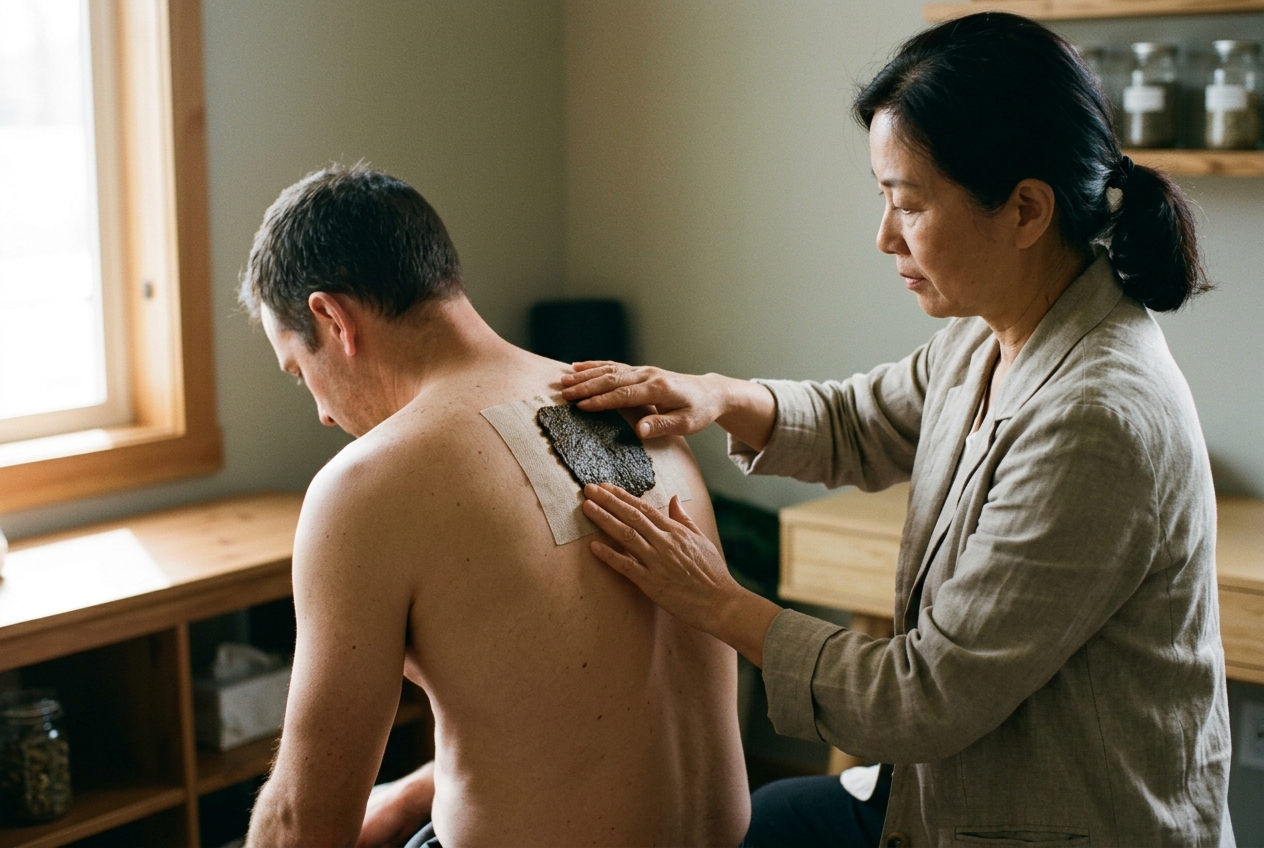
Intradermal needle therapy (Pi Nei Zhen 皮内针, known in Japanese clinical traditions as Hinaishin) offers an elegant solution to this limitation. By implanting miniature, sterile metallic instruments into the dermis and superficial fascial layers for extended intervals spanning 24 to 72 hours, this modality delivers continuous, low-threshold mechanoreceptive signaling to the spinal cord. Rather than attempting to force tissue relaxation through deep muscular trauma, intradermal therapy leverages the body’s own cutaneous meridian territories (Pi Bu 皮部) to recalibrate spinal gating mechanisms, reset autonomic balance, and dissolve chronic myofascial holding patterns from the surface inward.
2. Historical Lineage: From Classical Superficial Puncturing to Modern Micro-Instrumentation
The theoretical foundation of intradermal therapy traces directly back over two millennia to the foundational text of East Asian medicine, the Huangdi Neijing (The Yellow Emperor's Inner Classic). In the Ling Shu (Spiritual Pivot), Chapter 7 (Guan Zhen / "On the Official Needles"), classical physicians articulated specialized needling depths tailored to distinct anatomical strata:
- Mao Ci (毛刺 / Hair Needling): The practice of puncturing shallowly into the cutaneous layer to treat superficial dermatological disturbances and peripheral sensory disharmonies without penetrating the muscular flesh (Fen Rou).
- Fu Ci (浮刺 / Floating Needling): A dedicated oblique or horizontal shallow puncturing technique designed to treat cold-induced muscular contractions and superficial pain syndromes by mobilizing defensive Wei Qi in the superficial fascial matrix.
- Ban Ci (半刺 / Half Needling): Rapid, shallow insertion and withdrawal targeting the skin and lung system, engaging cutaneous sensory interfaces without disturbing deep tissue beds.
========================================================================================================
                          EVOLUTION OF SUPERFICIAL NEEDLING METHODOLOGIES
========================================================================================================

Classical Dynasty: Han (c. 100 BCE)        Mid-20th Century Japan (c. 1950s)       Modern Contemporary Era
------------------------------------       ---------------------------------       -----------------------
• Huangdi Neijing (Ling Shu)               • Dr. Akabane Kobei (赤羽幸兵卫)        • Advanced Micro-Needles
• Mao Ci (毛刺): Hair Needling             • Development of "Hinaishin"            • Thumbtack Press (揿钉型)
• Fu Ci (浮刺): Floating Needling          • Inter-dermal micro-retention          • Linear Grain (颗粒型)
• Superficial Fascial Engagement           • Diagnosis via thermal asymmetry       • Medical-grade acrylics & PVD
========================================================================================================
In the mid-20th century, the Japanese physician Dr. Akabane Kobei (赤羽幸兵卫) revolutionized these classical insights by developing systematic diagnostic methods using thermal sensitivity tests across meridian terminals, coupled with the long-term retention of tiny intradermal needles. Akabane demonstrated that prolonged micro-stimulation of the superficial dermis could produce systemic therapeutic effects that rivaled or exceeded standard deep filiform needle insertion.
Contemporary clinical practice utilizes two primary structural variants of intradermal instrumentation:
- Thumbtack-Type Press Needles (揿钉型 / Pyonex Type): Characterized by a vertical shaft (0.2 mm to 1.5 mm in length; diameter 0.12 mm to 0.20 mm) mounted perpendicularly upon a circular metallic or plastic base and pre-fixed to breathable, hypoallergenic surgical tape. These instruments penetrate vertically into the dermo-epidermal junction and stratum papillare.
- Transverse Linear Intradermal Needles (颗粒型 / 麦粒型 / Grain-Type): Composed of a straight, horizontal filiform needle (3.0 mm to 6.0 mm in length) terminating in a ring or flat handle. These needles are introduced horizontally at an angle of 5° to 15° relative to the skin surface, navigating strictly within the stratum reticulare of the dermis and the uppermost laminae of the superficial fascia (tela subcutanea).
3. Biomechanical Anchoring and Neurophysiological Dynamics
Understanding how a minuscule intradermal needle alters systemic physiology requires examining the dense biomechanical and neurosensory architecture of human skin and its underlying connective tissue.
                           DERMAL AND SUBCUTANEOUS FASCIAL CROSS-SECTION

    Stratum Corneum     [====================================================]
    Epidermis           [~~~~~~~~~~~~~~~~~~~~~~~~~~~~~~~~~~~~~~~~~~~~~~~~~~~~]
                         |                                                  |
    Papillary Dermis     |  [o] Meissner Corpuscle    [T] Merkel Complex     |  <-- Thumbtack (0.2–1.5mm)
                         |                                                  |
    Reticular Dermis     |  (===) Ruffini Ending      (~) C-Tactile Fiber    |  <-- Linear Transverse
                         |                                                  |      (Horizontal 3–6mm)
    Superficial Fascia   |  ~~~~~~~~~~~~~~~~ Collagen Fibres ~~~~~~~~~~~~~~ |  <-- Mechanotransductive
    (Subcutis)           |  (O) Pacinian Corpuscle    [x] Interstitial Wave |      Coupling Zone
                         +--------------------------------------------------+
Mechanoreceptor Transduction in the Dermal Matrix
The human dermis is one of the body's most densely innervated sensory structures. When an intradermal needle is placed, it resides in continuous contact with specialized low-threshold mechanoreceptors:
- Meissner’s Corpuscles & Merkel Cell-Neurite Complexes: Rapidly and slowly adapting Type I mechanoreceptors located in the dermal papillae and basal epidermis that register precise mechanical deformation, lateral shear, and sustained micro-pressure.
- Ruffini Endings: Slowly adapting Type II mechanoreceptors distributed within the reticular dermis that respond specifically to tissue stretch, collagen fiber realignment, and directional dermal tension.
- Low-Threshold C-Tactile (CT) Afferents: Unmyelinated nerve fibers present in hairy skin that respond selectively to gentle, continuous mechanical shear. As documented in neurological research on Cutaneous C-tactile Afferents, these pathways bypass standard discriminative sensory routes to project directly to the insular cortex, dampening stress reactivity and promoting autonomic down-regulation.
The Gate Control Mechanism and Descending Inhibitory Control
The primary analgesic mechanism of intradermal needle therapy operates via the classic Gate Control Theory, first articulated by Ronald Melzack and Patrick Wall and expanded in contemporary pain neuroscience literature indexed on NCBI PubMed.
                                SPINAL DORSAL HORN GATING CIRCUIT

   A-beta Fiber (Low-threshold)      (+) -------------------------------> [ Substantia Gelatinosa ]
   (From Intradermal Needle)                                                      (Lamina II)
                                                                                       |
                                                                                  (-)  | (GABA / Glycine)
                                                                                       v
   C / A-delta Fiber (Nociceptive)   (+) -------------------------------> [ Wide Dynamic Range (WDR) ]
   (From Injured/Inflamed Tissue)                                                 (Laminae I & V)
                                                                                       |
                                                                                       | Blocked Ascending
                                                                                       x Pain Signal
                                                                                       |
                                                                                       v
                                                                             [ Spinothalamic Tract ]
When an intradermal needle remains anchored within the dermis, normal physiological micro-movements—such as respiration, arterial pulsations, and postural shifts—generate ongoing, non-noxious mechanical stimulation. This sustained micro-deformation selectively excites large-diameter, myelinated A-beta ($\text{A}\beta$) fibers.
Upon entering the dorsal horn of the spinal cord, these $\text{A}\beta$ collaterals project into the Substantia Gelatinosa (Lamina II), where they excite inhibitory GABAergic and glycinergic interneurons. These interneurons exert potent pre-synaptic and post-synaptic inhibition on Wide Dynamic Range (WDR) neurons and marginal zone projection neurons (Laminae I and V), effectively closing the spinal gate against ascending nociceptive signals carried by slow, unmyelinated C fibers and thinly myelinated A-delta ($\text{A}\delta$) fibers.
Concurrently, this continuous ascending stream of non-painful tactile input engages the Periaqueductal Gray–Rostral Ventromedial Medulla (PAG-RVM) axis, triggering the descending release of endogenous opioids (enkephalins, $\beta$-endorphins) and monoamines (serotonin and noradrenaline) to systematically attenuate central sensitization, as detailed in reviews on the Neurobiological Mechanisms of Acupuncture.
Fascial Winding and Interstitial Mechanotransduction
Beyond neural activation, the sustained retention of linear intradermal needles leverages the physical dynamics of connective tissue. Research by Dr. Helene Langevin and colleagues on Fascial Mechanoreceptors and Interstitial Signaling indicates that even minor needle rotation or horizontal fascial translation causes mechanical coupling between the needle surface and extracellular matrix components (specifically collagen types I and III and laminin).
+------------------------------------------------------------------------------------------------------+
|                         BIOMECHANICAL FASCIAL SIGNALING SEQUENCE                                     |
|                                                                                                      |
| 1. Needle Insertion  --> Winding of interstitial collagen fibrils around needle shaft                |
| 2. Cellular Tension  --> Cytoskeletal deformation of resident fascial fibroblasts                   |
| 3. Biochemical Wave  --> Paracrine release of Adenosine via Pannexin-1 channels (A1 Receptor binding)|
| 4. Hemodynamic Shift --> Local microvascular vasodilation and tissue fluid pressure normalization    |
+------------------------------------------------------------------------------------------------------+
This mechanical displacement deforms the cytoskeleton of resident fibroblasts, activating intracellular signaling cascades that release adenosine—a potent local analgesic and anti-inflammatory nucleoside that binds to inhibitory purinergic $\text{A}_1$ receptors on peripheral nerve terminals.
4. The Superficial Meridian Map: A Journey Through Living Landmarks
In Traditional Chinese Medicine, the twelve regular channels express themselves externally through the twelve Cutaneous Regions (Shi Er Pi Bu 十二皮部). Rather than conceiving of meridians as abstract, isolated lines suspended in space, we can map them along visible anatomical landmarks, muscular contours, and neurovascular pathways, as codified in the World Health Organization Standard Acupuncture Point Locations.
========================================================================================================
                                 PRIMARY CUTANEOUS HUBS & NERVE ROOTS
========================================================================================================
Acupoint    Everyday Anatomical Landmark                     Underlying Innervation     Primary Clinical Domain
--------------------------------------------------------------------------------------------------------
ST36        Four fingers below kneecap, lateral shin         Deep & Cutaneous Peroneal  Gastrointestinal / Vagal
LV3         Web space groove between 1st & 2nd metatarsals   Medial Deep Peroneal       Hepato-Vascular / Stress
LI4         Dorsal web space between thumb & index finger    Superficial Radial Branch  Craniofacial / Analgesic
SP6         Four fingers above medial ankle behind tibia     Saphenous & Tibial Nerves  Pelvic / Autonomic Tone
PC6         Three fingers above wrist between flexor tendons Cutaneous Median Nerve     Cardiogastric / Anxiety
========================================================================================================
                                 DISTAL MERIDIAN HIGHWAYS

          [ LI4 - Hegu ]                              [ PC6 - Neiguan ]
       Dorsal Thumb-Index Web                     Volar Distal Forearm Groove
                  \                                            /
                   \                                          /
                    +----------------------------------------+
                    |        SYSTEMIC INTEGRATION AXIS       |
                    +----------------------------------------+
                   /              |                          \
                  /               |                           \
        [ ST36 - Zusanli ]  [ SP6 - Sanyinjiao ]         [ LV3 - Taichong ]
       Anterior Tibial Ridge   Medial Supra-Malleolar   Dorsal Metatarsal Valley
1. The Anterior Leg Highway (Stomach Meridian / Foot Yangming)
- The Pathway: Begins beneath the orbital socket, cascades across the jaw, descends the sternocleidomastoid muscle into the chest and abdomen along the mammillary line, courses down the anterior thigh along the rectus femoris, passes the lateral border of the patella, tracks down the muscular anterior compartment of the shin, and terminates at the lateral edge of the second toe nail bed.
- Key Point: ST36 (Zusanli / "Leg Three Miles")
- Living Landmark: Place your four fingers horizontally across your shin, directly beneath the bottom edge of your kneecap. One finger-width outward from the prominent, sharp vertical crest of the shinbone, you will feel a distinct muscular dip in the tibialis anterior muscle.
- Sensation Profile: A dull, radiating, grounded ache that may travel down the lateral aspect of the ankle toward the foot.
- Clinical Applications: Functional dyspepsia, postprandial lethargy, systemic fatigue, and chronic low-grade anxiety.
2. The Medial Foot Valley (Liver Meridian / Foot Jueyin)
- The Pathway: Arises at the medial angle of the great toenail, travels across the dorsum of the foot, ascends along the medial aspect of the lower leg anterior to the Achilles tendon, ascends the inner thigh through the adductor canal, wraps around the external genitalia, enters the lower abdomen, and arborizes into the costal margins and hypochondriac region.
- Key Point: LV3 (Taichong / "Great Surge")
- Living Landmark: Slide your index finger backward along the dorsal groove between your big toe and second toe. As the bones begin to converge into a "V" shape, your finger will drop into a pronounced, tender valley just before the joint union.
- Sensation Profile: A sharp, electric, or spreading pressure sensation that instantly highlights underlying systemic tension.
- Clinical Applications: Tension headaches, jaw clenching (temporomandibular tightness), emotional irritability, and vascular spasm.
3. The Dorsal Hand Valley (Large Intestine Meridian / Hand Yangming)
- The Pathway: Originates at the radial tip of the index fingernail, courses along the radial border of the second metacarpal bone, traverses the anatomical snuffbox of the wrist, climbs the lateral edge of the forearm to the lateral elbow crease, traverses the deltoid insertion, ascends over the shoulder and neck, and crosses the philtrum to terminate beside the opposite nostril.
- Key Point: LI4 (Hegu / "Joining Valleys")
- Living Landmark: On the back of your hand, bring your thumb and index finger flush together; a small mound of muscle will rise. Relax the hand, and locate the highest point of that muscular mound, pressing angled slightly underneath the second metacarpal bone.
- Sensation Profile: A deep, heavy, spreading ache that resonates through the palm and up the radial side of the forearm.
- Clinical Applications: Frontal headaches, sinus congestion, cervical tightness, facial pain, and systemic discomfort.
4. The Inner Ankle Channel (Spleen Meridian / Foot Taiyin)
- The Pathway: Commences at the medial border of the great toe, tracks along the medial border of the foot, passes in front of the inner ankle bone, ascends directly along the posterior edge of the tibia, crosses the medial knee and inner thigh, and ascends the anterolateral abdominal wall to terminate in the intercostal spaces of the lateral ribcage.
- Key Point: SP6 (Sanyinjiao / "Three Yin Intersection")
- Living Landmark: Place the flat of your four fingers across your inner lower leg, resting your pinky finger against the high center point of your inner ankle bone (medial malleolus). The point sits just level with your index finger, tucked closely behind the posterior edge of the shinbone.
- Sensation Profile: A tender, fluid, bruise-like ache reflecting visceral and pelvic vascular pooling.
- Clinical Applications: Menstrual cramps, lower abdominal distension, insomnia, and pelvic floor tension.
5. The Volar Forearm Gateway (Pericardium Meridian / Hand Jueyin)
- The Pathway: Originates lateral to the nipple in the fourth intercostal space, curves over the axilla, descends down the midline of the anterior arm between the biceps heads, traverses the center of the cubital crease, travels between the two prominent tendons of the forearm, and terminates at the tip of the middle finger.
- Key Point: PC6 (Neiguan / "Inner Gate")
- Living Landmark: Lay three fingers across your inner wrist, with the edge of the third finger resting directly on the distal wrist crease. The point lies centered between the two prominent, rope-like cords (flexor carpi radialis and palmaris longus tendons) that become visible when you make a tight fist and flex your wrist inward.
- Sensation Profile: A tingling, light electric sensation that can travel up the inner arm toward the chest.
- Clinical Applications: Psychogenic nausea, motion sickness, epigastric oppression, palpitations, and sleep-onset anxiety.
5. Clinical Integration Protocols: Pairing Retained Needles with Targeted Stimulation
The highest clinical efficacy occurs when semi-permanent intradermal micro-needles are paired with regular, non-invasive acupressure over key distal targets. The intradermal needle maintains a low-level baseline of mechanoreceptive gating, while manual acupressure provides rhythmic afferent surges that break through established pain pathways.
+------------------------------------------------------------------------------------------------------+
|                           CLINICAL INTEGRATION & HYGIENE PROTOCOL                                    |
|                                                                                                      |
| [ PRE-PLACEMENT ]   Clean site with 70% Isopropyl Alcohol or 2% Chlorhexidine; let air dry completely |
|                                                                                                      |
| [ IMPLANTATION ]    Tense skin between two fingers; introduce needle at 10°–15° (linear) or          |
|                     press vertically (thumbtack); ensure zero pinch during active movement           |
|                                                                                                      |
| [ RETENTION ]       Retain for 24 to 72 hours; perform home acupressure cycles twice daily           |
|                                                                                                      |
| [ REMOVAL ]         Peel adhesive parallel to skin; inspect epidermis; dispose in sharps container   |
+------------------------------------------------------------------------------------------------------+
========================================================================================================
                          TARGETED PROTOCOLS FOR COMMON CLINICAL SCENARIOS
========================================================================================================
Clinical Scenario          Intradermal Needle Placement   Paired Manual Acupressure    Execution Method
--------------------------------------------------------------------------------------------------------
A. Cervicogenic Tension    Retain Thumbtack on GB20       Press LI4 (bilateral)        Circular friction,
   & Frontal Headache      or Upper Trapezius tender site followed by LV3 for 2 min    firm pressure (2-3 min)

B. Dyspeptic Stagnation    Retain Linear Grain on         Apply sustained compression  3-second press cycles,
   & Epigastric Distress   CV12 (Zhongwan) or ST25        on ST36, then PC6            paired with deep exhale

C. Psychophysiological     Retain Thumbtack on            Rhythmic rotational glide    Gentle, slow pressure;
   Insomnia & Rumination   Anmian (behind earlobe)        on SP6 and PC6 before bed    maintain 120 sec/point
========================================================================================================
Scenario A: Cervicogenic Tension and Frontal Headache
- Clinical Presentation: A tight band of pain spanning from the suboccipital ridge over the scalp to the forehead, aggravated by prolonged screen exposure.
- Intradermal Anchoring: Affix a 0.6 mm thumbtack-type press needle over the most reactive tender locus (Ashi point) in the upper trapezius or beneath the occiput (GB20 region).
- Active Acupressure Pairing:
- Sit upright in an ergonomically supportive chair with feet flat on the floor.
- Engage LI4 (Hegu) on the right hand using the left thumb angled under the metacarpal bone. Apply firm, steady, circular friction for 2 minutes while slowly rolling the neck from side to side.
- Shift to LV3 (Taichong) on the foot. Apply sustained downward pressure for 90 seconds while taking long, slow diaphragmatic breaths.
- Repeat on the opposite side.
Scenario B: Dyspeptic Stagnation and Postprandial Bloating
- Clinical Presentation: Abdominal fullness, sluggish digestion, and epigastric tightness following meals or periods of emotional stress.
- Intradermal Anchoring: Apply a horizontal linear intradermal needle (3.0 mm) over the cutaneous zone of the upper abdomen, 4 cun above the umbilicus (CV12 territory).
- Active Acupressure Pairing:
- Recline comfortably with knees bent at a 45-degree angle to relax the abdominal wall.
- Locate ST36 (Zusanli). Using the knuckle of your index finger or your thumb tip, press deeply into the muscle belly of the tibialis anterior. Maintain firm pressure for 3 seconds, release slightly for 1 second, and repeat for 2 minutes per leg.
- Transition to PC6 (Neiguan) on the wrist. Use your thumb to apply rhythmic, moderate pressure directed toward the elbow for 90 seconds per arm.
Scenario C: Psychophysiological Insomnia and Nocturnal Rumination
- Clinical Presentation: Difficulty falling asleep due to an overactive mind, accompanied by restless legs and a racing evening pulse.
- Intradermal Anchoring: Place a 0.2 mm micro-press needle at the extra point Anmian ("Peaceful Sleep"), located in the depression between the mastoid process and the cervical spine.
- Active Acupressure Pairing:
- Lie flat in bed on your back with the lights dimmed.
- Reach down to SP6 (Sanyinjiao). With the pad of your thumb, apply slow, gentle, circular strokes without causing sharp pain for 2 minutes per limb.
- Place your thumb on PC6 (Neiguan) of the opposite arm. Synchronize your pressure with your breathing: apply gentle pressure during a 4-second inhalation, hold for 4 seconds, and release pressure gradually across a 6-second exhalation. Continue for 2 to 3 minutes per side.
6. Safety Parameters, Biomechanical Movement, and Clinical Vigilance
While intradermal needling and acupressure have exceptional safety profiles, their direct interaction with the cutaneous barrier demands strict adherence to aseptic protocols and biomechanical principles.
+------------------------------------------------------------------------------------------------------+
|                                   CLINICAL CAUTION & SAFETY MATRIX                                   |
|                                                                                                      |
| [!] PREGNANCY CONTRAINDICATION: Absolute prohibition of heavy stimulation or needle retention at     |
|     LI4, SP6, BL60, and GB21 due to uterine contractile stimulation.                                 |
|                                                                                                      |
| [!] BIOMECHANICAL RESTRICTION: Never place intradermal needles over mobile joint creases (e.g.,      |
|     antecubital fossa, popliteal crease, palmar flexion lines) to avoid mechanical shear and pain.   |
|                                                                                                      |
| [!] HYGIENE PROTOCOL: If an intradermal site exhibits localized erythema, pruritus, or throbbing,    |
|     remove the needle immediately, disinfect the site, and do not re-needle that location.          |
+------------------------------------------------------------------------------------------------------+
1. Aseptic Technique and Retention Parameters
- Skin Disinfection: The target cutaneous site must be cleansed thoroughly with 70% isopropyl alcohol or chlorhexidine swabs and allowed to air dry completely before needle placement.
- Retention Duration: Needles should remain in place for no longer than 24 to 48 hours in warm, humid weather (or on sweat-prone skin) and up to 72 hours in temperate, dry conditions. Exceeding 72 hours increases the risk of local epidermal irritation, adhesive-induced contact dermatitis, or micro-bacterial colonization.
- Moisture Management: Patients may shower normally, but should avoid aggressive scrubbing or submerging in baths, saunas, or swimming pools. Pat the tape dry with a clean towel immediately after water exposure.
2. Anatomical and Biomechanical Movement Considerations
- Avoid Dynamic Joint Creases: Never place intradermal needles directly across flexion creases (such as the wrist crease, elbow pit, or back of the knee). Dynamic skin movement at these locations causes the needle shaft to pinch underlying tissue, generating discomfort and triggering reactive inflammation.
- Sensory Calibration (The "Pinch Test"): A correctly placed intradermal needle should be imperceptible during standard movement. Following placement, have the patient perform active movement (bending the limb, turning the neck). If they report a sharp, stabbing, or pinching sensation, the needle has either been inserted at an incorrect angle or impinging on a cutaneous nerve branch. It should be removed immediately and replaced.
3. Absolute and Relative Contraindications
- Pregnancy: Strong manual stimulation or prolonged needle retention at points known to stimulate uterine contractions—notably LI4 (Hegu), SP6 (Sanyinjiao), BL60 (Kunlun), and GB21 (Jianjing)—is strictly contraindicated during pregnancy.
- Dermatological Compromise: Do not apply needles over areas of active eczema, psoriasis, open wounds, localized cellulitis, sunburn, or varicosis.
- Systemic Conditions: Patients with severe thrombocytopenia, active systemic bacteremia, or advanced peripheral neuropathy should receive non-invasive acupressure rather than cutaneous micro-needles.
7. Today's Takeaway: The 2-Minute Vagal Reset
You can experience the benefits of cutaneous sensory modulation right now without any specialized equipment. This simple two-minute practice uses cutaneous mechanoreception on the Pericardium pathway to settle an overactive nervous system:
+------------------------------------------------------------------------------------------------------+
|                                 THE 2-MINUTE CUTANEOUS VAGAL RESET                                   |
|                                                                                                      |
|  Step 1: REST      Sit comfortably with both feet flat on the floor; rest your left forearm          |
|                    palm-upward on your lap.                                                          |
|                                                                                                      |
|  Step 2: LOCATE    Place your right index, middle, and ring fingers across your left inner wrist,    |
|                    resting against the crease. The point (PC6) sits directly between the two         |
|                    prominent tendons at the edge of your index finger.                               |
|                                                                                                      |
|  Step 3: ENGAGE    Place your right thumb tip into this groove. Apply steady, moderate pressure—     |
|                    firm enough to evoke a dull, grounded ache, but gentle enough to avoid pain.      |
|                                                                                                      |
|  Step 4: BREATHE   Maintain steady pressure while inhaling deeply for 4 seconds, pausing for         |
|                    2 seconds, and exhaling slowly for 6 seconds. Continue for 60 seconds, then       |
|                    switch wrists and repeat on the right side.                                       |
+------------------------------------------------------------------------------------------------------+
By delivering steady, non-noxious mechanical stimulation to the cutaneous median nerve pathway while prolonging your exhalations, you send a clear stream of sensory information through your spinal cord to the brainstem. The result is an immediate down-regulation of sympathetic tone, a reduction in peripheral vascular tension, and a return to physiological balance—illustrating the core principle that has sustained cutaneous acupuncture across millennia.
Authoritative References & Further Reading
- World Health Organization: WHO Standard Acupuncture Point Locations in the Western Pacific Region
- National Center for Biotechnology Information (NCBI): Neurobiological Mechanisms of Acupuncture and Sensory Modulation
- Melzack R, Wall PD: Gate Control Theory: Pain Mechanisms and Dorsal Horn Modulation
- Langevin HM, et al.: Subcutaneous Fascial Shear Strain and Mechanotransductive Interstitial Signaling
- National Institutes of Health / PMC: Cutaneous C-tactile Afferents and the Neurobiology of Gentle Touch
- Encyclopedic Reference: Acupoint Anatomy and Channel Theory