Blood-Invigorating and Stasis-Resolving Herbs (Huo Xue Hua Yu Yao) Pharmacodynamics: Governing Hemorheological Flow, Microcirculatory Perfusion, Thrombosis Dissolution, and Vascular Recanalization in Traditional Chinese Medicine
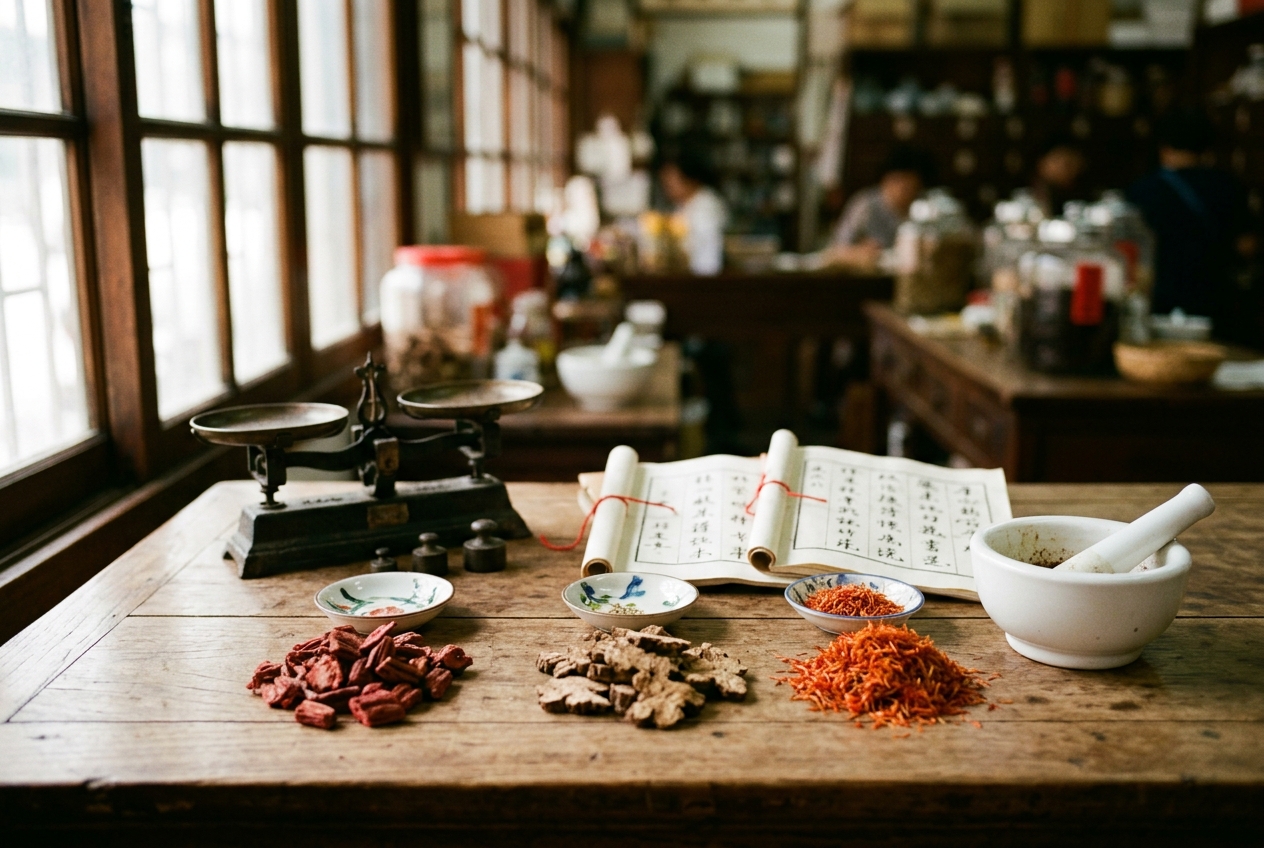
You wake in the early morning hours aware of a persistent, localized ache beneath your left shoulder blade or a dull, drilling sensation in your lower abdomen. Unlike the diffuse, migrating soreness that follows a strenuous workout, this discomfort is fixed, sharp, and stubbornly resistant to shifting postures or light massage. When you look in the bathroom mirror, the signs are subtle but unmistakable: dark rings shadow the skin beneath your eyes, the nail beds possess a faint violaceous hue, and your extremities remain cold to the touch long after your morning tea.
In the conceptual architecture of Traditional Chinese Medicine (TCM), these physical markers point to a fundamental physiological disruption: Xue Yu (血瘀), or Blood Stasis. Where Western clinical medicine observes microvascular endothelial dysfunction, erythrocyte hyperaggregation, and localized tissue ischemia, TCM perceives an internal river whose current has slowed to a turbid, coagulative crawl. The classical clinical canon states with axiomatic simplicity: Tong Ze Bu Tong, Bu Tong Ze Tong (通则不痛,痛则不痛)—"Where there is free flow, there is no pain; where there is pain, there is no free flow." When the vital circulation of Blood and Qi is impeded, the body sounds an unmistakable alarm through sharp, fixed physical discomfort and characteristic tissue changes.
2. What This Organ System and Circulatory Network Does
In Chinese medical physiology, circulation is not merely a mechanical pump-and-conduit system; it is an intricate functional collective governed by the Heart (Xin), modulated by the Liver (Gan), and contained by the Spleen (Pi).
The Heart commands the blood vessels (Mai), serving as the sovereign force propelling fluid through the vasculature. The Liver acts as an internal reservoir and dynamic regulator, storing blood during periods of rest and releasing it during exertion while maintaining the uninhibited, smooth movement of Qi—the metabolic impetus that keeps fluids from stagnating. The Spleen manufactures the foundational essences of blood from dietary intake and exerts a holding function (Pi Tong Xue), preventing blood from extravasating beyond vascular walls.
When these relational networks falter, Xue Yu (Blood Stasis) develops. Pathogenetically, stasis can arise from several distinct functional etiologies: 1. Qi Stagnation (Qi Zhi Xue Yu): Emotional tension or Liver constraint arrests the movement of Qi; because "Qi is the commander of Blood," its cessation causes the blood to stall. 2. Qi Deficiency (Qi Xu Xue Yu): Chronic exhaustion or metabolic depletion leaves the body without adequate energetic force to propel the bloodstream through extensive peripheral capillary beds. 3. Cold Congealing (Han Ning Xue Yu): Cold constricts the vascular channels (Mai), causing fluids to thicken and solidify like oil chilled in winter. 4. Heat Scorching (Re Jie Xue Yu): Pathogenic heat or chronic inflammation evaporates the fluid portion of blood, leaving a viscous, concentrated sludge. 5. Traumatic Extravasation (Die Da Sun Shang): Physical trauma ruptures micro-vessels, pooling blood outside normal anatomical pathways where it clots and obstructs surrounding interstitial transit.
Modern Hemorheological and Pathophysiological Correlates
Contemporary biomedical research validates this classical taxonomy. Modern clinical pathology identifies Blood Stasis as a state of microcirculatory failure characterized by three interconnected abnormalities: * Hemorheological Alterations: Elevated whole-blood viscosity, high plasma fibrinogen (FIB), heightened erythrocyte aggregation, and decreased red blood cell deformability. * Platelet Hyperreactivity: Upregulation of surface P-selectin (CD62P) and elevated thromboxane A2 (TXA2) synthesis, precipitating microthrombus formation within capillaries. * Endothelial Dysfunction: Downregulation of endothelial nitric oxide synthase (eNOS), diminished basal nitric oxide (NO) bioavailability, and excessive release of endothelin-1 (ET-1), accompanied by increased expression of vascular cell adhesion molecules (ICAM-1, VCAM-1) that promote leukostasis and vascular wall inflammation.
Pharmacodynamics of Blood-Invigorating and Stasis-Resolving Herbs (Huo Xue Hua Yu Yao)
To restore microcirculatory perfusion, TCM pharmacology deploys Huo Xue Hua Yu Yao (Blood-Invigorating and Stasis-Resolving medicinal substances), systematically classified into four functional tiers based on their pharmacodynamic potency:
1. Mild Blood-Harmonizing and Regulating Herbs (He Xue Diao Jing Yao)
These agents gently circulate and nourish blood without exhausting physiological vital energy (Qi), making them suitable for chronic cardiovascular and metabolic conditions: * Radix Salviae Miltiorrhizae (Dan Shen): Highly researched in cardiovascular pharmacology through the NCBI PubMed Database. Contains lipophilic diterpenoid tanshinones (Tanshinone I, Tanshinone IIA, Cryptotanshinone) and hydrophilic phenolic compounds (Salvianolic acid B, Danshensu). Tanshinone IIA upregulates eNOS gene expression, directly attenuates myocardial ischemia-reperfusion injury, suppresses intracellular reactive oxygen species (ROS), and inhibits vascular smooth muscle cell proliferation by arresting cell-cycle progression. Salvianolic acid B inhibits intercellular adhesion molecule-1 (ICAM-1) and blocks nuclear factor kappa B (NF-κB) transcription, safeguarding endothelial integrity. * Radix Paeoniae Rubra (Chi Shao): Contains monoterpene glycosides, primarily paeoniflorin and oxypaeoniflorin. It cools pathogenic heat in the blood while clearing intravascular stasis, balancing the TXA2/prostacyclin ($PGI_2$) ratio and suppressing adenosine diphosphate (ADP)-induced platelet aggregation. * Caulis Spatholobi (Ji Xue Teng): Rich in flavonoids such as formononetin and isoliquiritigenin. Uniquely bridges two clinical functions: tonifying deficient blood (Bu Xue) while invigorating its movement (Huo Xue), promoting hematopoiesis in bone marrow progenitor cells and enhancing microcirculatory flow velocity.
2. Moderate Blood-Invigorating and Pain-Relieving Herbs (Huo Xue Zhi Tong Yao)
These substances specialize in resolving severe, sharp, or spasmodic somatic and visceral pain: * Rhizoma Chuanxiong (Chuan Xiong): Historically praised as the "Qi within the Blood." Its primary active alkaloid, tetramethylpyrazine (ligustrazine), alongside ferulic acid, crosses the blood-brain barrier. Ligustrazine blocks voltage-gated calcium channels, suppresses intracellular calcium influx in vascular smooth muscle, enhances erythrocyte deformability, and promotes cerebral and coronary arterial dilation. * Rhizoma Corydalis (Yan Hu Suo): The premier natural analgesic in the TCM pharmacopeia. Contains the isoquinoline alkaloid l-tetrahydropalmatine ($l$-THP) and corydaline. $l$-THP functions as a potent antagonist at central dopamine $D_2$ receptor sites with downstream modulation of opioid receptor systems, yielding central and peripheral analgesia without inducing the rapid tolerance or gastrointestinal hypomotility common to classical opiates. * Radix Curcumae (Yu Jin): Contains curcumin, curdione, and curcumol. It resolves Liver constraint, promotes biliary excretion, lowers blood serum lipids, and clears pericardial heat by scavenging lipid peroxides. * Olibanum (Ru Xiang / Frankincense) & Myrrha (Mo Yao / Myrrh): Classic resinous pair. Rich in boswellic acids (including acetyl-11-keto-$\beta$-boswellic acid, or AKBA) and guggulsterones. They potently inhibit 5-lipoxygenase (5-LOX) and cyclooxygenase-2 (COX-2), arresting leukotriene biosynthesis, resolving inflammatory exudates, and stimulating the resorption of chronic fibrous swellings.
3. Stasis-Dispelling and Channel-Unblocking Herbs (Huo Xue Tong Jing Yao)
These agents penetrate deep into the visceral collateral channels (Luo Mai), resolving obstinate gynecological, traumatic, and lower-body vascular stasis: * Semen Persicae (Tao Ren): Packed with cyanogenic glycosides (principally amygdalin) alongside oleic and linoleic fatty acids. Amygdalin inhibits thrombin activity, prevents fibrin polymerization, and enzymatically downregulates transforming growth factor-beta 1 (TGF-$\beta 1$), mitigating renal and hepatic interstitial fibrosis while clearing pelvic venous congestion. * Flos Carthami (Hong Hua): Yields the water-soluble chalcone C-glycoside Hydroxysafflor Yellow A (HSYA) and carthamin. HSYA competitively antagonizes platelet-activating factor (PAF) receptor binding, protects vascular endothelial cells from hypoxia-induced apoptosis, and dilates peripheral capillary beds. * Radix Achyranthis Bidentatae (Huai Niu Xi) & Radix Cyathulae (Chuan Niu Xi): Rich in phytoecdysterones and triterpenoid saponins. In herbal formulations, they act as "guiding herbs" (Yin Dao Yao), directing the systemic movement of blood downward into the lower abdomen, pelvic basin, and lower extremities to relieve pelvic stasis and lumbar stagnation.
4. Potent Stasis-Breaking and Mass-Eliminating Herbs (Po Xue Xiao Zheng Yao)
The most pharmacodynamically forceful tier, utilized to break intractable, organized physical masses (Zheng Jia), heavy arterial plaques, and deep venous thromboses: * Hirudo (Shui Zhi / Dried Leech): Contains hirudin, a 65-amino-acid polypeptide. Detailed mechanisms can be explored via the Hirudin Mechanism and Anticoagulation entry. Hirudin is the most potent natural, direct, and specific non-covalent bivalent inhibitor of free and clot-bound $\alpha$-thrombin. Unlike heparin, hirudin does not require antithrombin III as a cofactor, effectively arresting fibrin formation and dissolving established microvascular thrombi without consuming endogenous plasma cofactors. * Rhizoma Curcumae Phaeocaulis (E Zhu) & Rhizoma Sparganii (San Leng): This dynamic pair contains sesquiterpenoids including curcumol, $\beta$-elemene, and sparganol. Research on PubMed Central indicates that $\beta$-elemene and curcumol downregulate vascular endothelial growth factor (VEGF), suppress matrix metalloproteinases (MMP-2, MMP-9), break down excessive collagen deposition, and induce targeted apoptosis in pathological fibrotic tissue—making them effective in treating uterine leiomyomas, ovarian endometriomas, and hepatosplenomegaly.
Classic Formula Architectures and Synergies
Traditional formulas combine these individual herbs into balanced thermodynamic architectures:
- Xue Fu Zhu Yu Tang (Drive Out Stasis in the Mansion of Blood Decoction): Formulated by Qing dynasty physician Wang Qingren. It unites Tao Hong Si Wu Tang (Peach Kernel and Safflower Four Substances Decoction) with Qi-regulating guides. It pairs ascending herbs (Jie Geng, Chai Hu) to open thoracic circulation with descending herbs (Zhi Ke, Niu Xi) to unblock the lower abdomen. This creates an open dynamic loop that mobilizes stasis in the chest, pericardium, and upper vasculature.
- Tao Hong Si Wu Tang (Four Substances Decoction with Safflower and Peach Kernel): The foundational baseline formula for gynecological blood stasis combined with mild blood deficiency, preventing the stagnation of newly generated blood.
- Ge Xia Zhu Yu Tang (Drive Out Stasis Below the Diaphragm Decoction): Concentrates the stasis-resolving actions of Wu Ling Zhi, Chuan Xiong, and Dan Shen directly upon the middle and lower gastrointestinal and pelvic viscera to treat deep abdominal masses.
Chronopharmacology, Herb-Drug Synergies, and Safety
- Chronopharmacological Timing: Peak cardiovascular and thrombotic vulnerability occurs during the early morning hours (06:00–09:00), corresponding to the circadian spike in platelet aggregability and morning blood pressure surge. In clinical practice, administering blood-invigorating formulas in the early morning or divided between early morning and evening (before sleep) provides optimal hemorheological coverage during this vulnerable transition.
- Herb-Drug Interactions: Combining Huo Xue Hua Yu Yao with pharmaceutical anticoagulants (e.g., Warfarin, Dabigatran) or antiplatelet therapies (Aspirin, Clopidogrel) produces potent synergistic antihemostatic effects. Concomitant administration can extend the International Normalized Ratio (INR) and bleeding time, necessitating strict clinical oversight.
- Strict Contraindications:
- Pregnancy (Ren Shen Ji Yong): Potent blood-invigorating and stasis-breaking agents (e.g., Tao Ren, Hong Hua, and especially Shui Zhi, E Zhu) stimulate uterine smooth muscle contractions and disrupt implantation beds, posing clear abortifacient and teratogenic risks.
- Active Bleeding Pathologies: Absolute contraindication in active peptic ulceration, hemorrhagic cerebrovascular events, thrombocytopenia, or excessive menorrhagia without underlying stasis etiology.
3. How You Can Feel It — Signs of Balance and Imbalance
Blood Stasis is not an abstract laboratory measurement; it registers throughout the physical body, altering tissue color, temperature, sleep quality, and pain perception.
Self-Assessment: Evaluating Your Microcirculation Right Now
Take a moment to conduct a systematic self-examination in natural light:
- The Mirror Sublingual Check: Lift your tongue to the roof of your mouth behind the upper incisors. Examine the two prominent sublingual veins running along the underside. In a state of balanced circulation, they are light pinkish-purple, straight, and under 2 millimeters in diameter. If they appear swollen, dark blue or purple, knotted, or tortuous, this is a clear diagnostic indicator of systemic venous and microvascular stasis.
- The Nocturnal Pain Signature: Note the timing and character of your chronic physical aches. Does your back, hip, or abdominal discomfort intensify between 11:00 PM and 4:00 AM, or feel noticeably aggravated by cold, resting immobility? Pain that demands movement to get the "gears turning" is classic Xue Yu.
- Nail Bed Capillary Refill: Press firmly on the center of your thumbnail for five seconds until the bed turns white, then release. Count the seconds it takes for the pink coloration to return. Rapid refill occurs in under 2 seconds. A sluggish return (>3 seconds), especially when paired with a constant purplish tint, indicates peripheral capillary resistance.
4. Qigong & Movement Practice: The Microcirculation Wave
This simple, highly effective medical Qigong sequence—drawn from the classical Baduanjin (Eight Brocades) and vascular opening traditions—uses rhythmic muscle pumping and diaphragmatic respiration to stimulate microvascular flow and promote nitric oxide release.
Step-by-Step Instructions
- Starting Position: Stand with feet shoulder-width apart, knees slightly softened (not locked), arms resting naturally at your sides. Drop the tailbone slightly toward the earth, relax the shoulders, and touch the tip of the tongue gently to the hard palate behind your front teeth.
- Phase 1 (Inhale & Ascending Spiral): Inhale slowly through your nose for a count of four. Simultaneously, sweep both arms outward and upward in a broad arc until your hands meet overhead, palms facing skyward. As your arms reach their apex, slowly rise onto the balls of your feet, lifting your heels 1–2 inches off the floor.
- Phase 2 (The Calibrating Pause): Hold your breath gently for two seconds at the top of the posture. Feel the contraction of the calf muscles (the body's secondary venous pump) compressing the deep posterior tibial and soleus veins, propelling pooled blood back toward the heart while expanding the ribcage.
- Phase 3 (Exhale & Vascular Flush): Exhale smoothly through your mouth for a count of six. Slowly lower your heels back to the floor, feeling the gentle impact reverberate through your skeletal frame. As your heels settle, bring your hands down the midline of your body with palms facing inward, pressing the breath down into the lower abdomen (Dan Tian).
- Duration and Repetitions: Perform this sequence for 12 complete, unhurried repetitions (approximately 3–5 minutes), ideally once in the morning upon waking and once in late afternoon.
- What to Look For: Within 6 to 8 repetitions, you should notice a warm, prickling or tingling sensation spreading across your palms, fingertips, and the soles of your feet. This is the physiological sensation of peripheral vasodilation—the opening of microvascular beds and capillary refill.
5. Acupressure Points You Can Try Today
Targeted manual acupressure stimulates local somatic nerve plexuses, triggers localized neurogenic vasodilation, and clears stagnation along associated meridians.
1. Xuehai (SP10 — "Sea of Blood")
- Location: Sit with your knee bent at a 90-degree angle. Place your right palm over your left patella (kneecap), with your fingers pointing upward and your thumb resting along the inner side of your thigh. The point lies directly beneath the tip of your thumb, in a tender depression on the bulge of the vastus medialis muscle, approximately two thumb-widths above the inner upper border of the patella.
- Application Technique: Use the tip of your thumb to apply firm, steady pressure angled slightly toward the femur bone. Maintain a moderate, circular kneading motion for 2 minutes on each leg. The sensation should be a clear, dull ache (De Qi), not a sharp, surface pain.
- Daily Use: The classical master point for resolving blood stasis and clearing blood heat. Use for easing menstrual cramps, clearing chronic inflammatory skin flare-ups, and relieving deep thigh or knee stiffness.
2. Geshu (BL17 — "Diaphragm Shu / Hui-Meeting Point of Blood")
- Location: Located on the upper-to-mid back, 1.5 cun (approximately two finger-widths) lateral to the lower border of the spinous process of the 7th thoracic vertebra (T7), roughly level with the lower angle of the scapula.
- Application Technique: Because reaching the mid-back can be challenging, lie on your back on a yoga mat with two tennis balls placed on either side of your spine between the shoulder blades. Cross your arms over your chest to open the shoulder blades, and breathe deeply for 2 to 3 minutes, letting your body weight compress the points.
- Daily Use: Renowned as the systemic convergence point for blood. It invigorates systemic blood flow, eases chronic thoracic tension from long desk hours, and supports deep respiratory oxygenation.
3. Sanyinjiao (SP6 — "Three Yin Intersection")
- Location: On the inner aspect of the lower leg, exactly four finger-widths (3 cun) above the prominent tip of the medial malleolus (the inner ankle bone), resting directly along the posterior border of the tibia.
- Application Technique: Grip your lower calf and press your thumb into the groove just behind the shinbone. Apply deep, continuous pressure for 90 seconds per side while rotating your ankle in slow, wide circles to engage the local muscular pump.
- Daily Use: The junction where the Spleen, Liver, and Kidney meridians meet. Highly effective for resolving lower abdominal congestion, cold feet, water retention, and evening fatigue. (Caution: Strictly avoid during pregnancy due to its downward, labor-promoting action).
6. Food & Lifestyle — Small Changes for Today
Dietary therapy for blood stagnation focuses on incorporating warming, pungent, and aromatic functional foods that promote circulation, while avoiding substances that introduce cold, viscous stagnation into the digestive tract.
Accessible Therapeutic Foods to Add
- Hawthorn Berry (Shan Zha): Widely available as dried berries in health food stores and Asian markets. Rich in bioflavonoids, proanthocyanidins, and organic acids, Shan Zha gently dissolves arterial lipid deposits, accelerates microvascular flow, and eases post-meal abdominal fullness. Simmer 10 grams of dried hawthorn slices in hot water for 10 minutes as a daily post-lunch tea.
- Turmeric Root (Jiang Huang) & Black Pepper: The curcuminoids in fresh or ground turmeric provide potent anti-inflammatory and microvascular endothelial benefits. Pair half a teaspoon of ground turmeric with a pinch of black pepper (piperine enhances curcumin bioavailability significantly) and a healthy fat (olive oil or coconut milk) in cooking.
- Warming Alliums and Spices: Garlic (Da Suan), scallions (Cong Bai), shallots, and fresh ginger (Sheng Jiang) contain volatile sulfur compounds and gingerols that prevent platelet hyperaggregation and dissipate cold congealing.
- Anthocyanin-Dense Plants: Incorporate deeply pigmented fruits and vegetables like wild blueberries, blackberries, pomegranates, and beetroot. Their potent flavonoids support capillary basement membrane integrity and stimulate endogenously produced nitric oxide.
What to Reduce
- Iced Drinks and Excessive Raw Foods: Ingesting iced liquids causes acute thermal vasoconstriction in the stomach and spleen vascular networks. Over time, this "freezes" the internal channels, slowing visceral blood transit. Opt for warm, lightly cooked, or steamed meals accompanied by room-temperature or hot beverages.
- Atherogenic Fats and Refined Sugars: Saturated trans-fats and high-fructose syrups increase plasma viscosity, elevate fibrinogen, and trigger advanced glycation end-products (AGEs) that damage endothelial walls.
Simple Lifestyle Upgrades
- The 45-Minute Posture Reset: Prolonged sitting compresses the femoral and popliteal vessels, pooling venous blood in the lower limbs. Set a timer to stand, stretch, and perform 10 calf raises every 45 minutes to keep venous return active.
- Contrast Foot Baths: Before bed, alternate soaking your feet in warm water (3 minutes) and cool water (30 seconds) for three cycles. This induces rhythmic vascular constriction and dilation, flushing stagnant blood out of the lower extremities and encouraging deeper sleep.
7. Today's Takeaway
To start improving your circulation today, spend just five minutes on this simple routine: take a brief mirror look at your sublingual veins to establish your personal baseline, then brew a warm cup of crushed ginger and hawthorn tea. While it steeps, stand up and perform twelve slow, rhythmic repetitions of the Qigong Microcirculation Wave—rising onto your toes as you inhale, expanding your ribcage, and lowering your heels as you exhale. This short practice activates your calf muscle pumps, stimulates endothelial nitric oxide production, and helps restore a smooth, free-flowing state throughout your circulatory network.
Authoritative References and Scientific Reading
- Overview of global integrative frameworks via the World Health Organization.
- Pharmacological database and bioassay access through the National Center for Biotechnology Information.
- Clinical trials on blood-invigorating formulas within the NCBI PubMed Database.
- Biochemical pathways of thrombin inhibition detailed in the Hirudin Mechanism and Anticoagulation compendium.
- Pathophysiology of vascular dysfunction documented in Endothelial Dysfunction in Cardiovascular Disease.