Huantiao Cavity Jumping Round: Coxofemoral Fascial Decompression, Sciatic Pathway Release, and Lateral Kinetic Rooting in Classical Neigong
+-------------------------------------------------------------------------+
|                  SOMATIC SENSORY CHECKLIST FOR GB30                     |
+-------------------------------------------------------------------------+
| [ ] Decompression: Sensation of space widening within the hip socket    |
| [ ] Microvascular Inundation: Warm, spreading flush down the lateral leg|
| [ ] Fascial Elasticity: Spring-loaded pelvic floor without rigidity     |
| [ ] Rooting (Chen): Weight settling decisively through Yongquan (KI1)   |
+-------------------------------------------------------------------------+
Phase 1: Static Calibration in Zhan Zhuang (Embracing the Tree)
- Foundational Architecture: Stand with your feet parallel, spaced precisely hip-width to shoulder-width apart. Ensure your weight is distributed evenly across the tripod of each foot: the base of the first metatarsal, the base of the fifth metatarsal, and the center of the calcaneus. Soften your ankles and knees without letting the arches of your feet collapse inward.
- Locating the Cavity: Locate the bony apex of your greater trochanter on the lateral side of your hip. Trace an imaginary line from this point upward and medially to the sacral hiatus at the base of the sacrum. The Huantiao cavity (GB30) rests at the junction of the lateral third and medial two-thirds of this line, situated within the deep muscular notch behind the greater trochanter.
- The Sinking and Widening Cue (Song Kua): Instead of actively tucking your pelvis under—a ubiquitous beginner error that flattens the lumbar spine and clenches the gluteus maximus—imagine your ischial tuberosities (sit bones) melting downward toward your heels. Allow the deep tissue at GB30 to soften, creating an internal sensation of a widening pocket within the posterior hip joint.
- Breath Synchronization: Inhale smoothly through the nose into the lower abdominal basin (Xia Dantian), allowing the pelvic diaphragm to descend elastically. As you exhale, do not contract your gluteals; instead, feel an expansive, warming release radiating from Huantiao down the lateral aspect of the thighs, stabilizing your connection into the National Qigong Association standard of rooted balance. Maintain this static posture for five to ten minutes, sustaining constant interoceptive monitoring of deep pelvic relaxation.
Phase 2: Dynamic Helical Transmission in Chan Si Gong (Silk Reeling)
- Initiating the Transverse Shift: From a neutral standing posture, transfer 70 percent of your body mass onto the right leg while keeping the torso vertical and relaxed. As the weight settles, consciously soften the right Huantiao point, allowing the right femoral head to seat deeply and cleanly into the acetabular socket.
- Spiraling the Kinetic Line: Rotate the pelvis three to five degrees to the right around the vertical axis of the right hip joint. The movement must originate from the deep internal rotator release at GB30 rather than from twisting the knee or shearing the lumbar spine.
- Plantar-to-Pelvic Rebound: Press subtly through the right foot's bubbling spring point (Yongquan / KI1), allowing ground reaction forces to travel upward through the relaxed lateral leg, passing unobstructed through the uncompressed Huantiao cavity to rotate the lower abdomen back toward the center.
- Bilateral Transition: Repeat the sequence on the left side, smoothly gliding across the pelvic floor in a continuous figure-eight pattern. The transition must feel like liquid silk, characterized by zero friction or popping sensations in the coxofemoral joints.
Phase 3: Low Stance Integration (Gong Bu and Pu Bu)
- Bow Stance (Gong Bu): Step into a forward lunge stance where the front knee remains aligned directly over the ankle without surpassing the toes. The rear leg extends backward with the foot angled at 45 degrees. The primary technical requirement is the total relaxation of the rear leg's Huantiao cavity: if GB30 remains contracted, the rear hip will hike upward, distorting the sacroiliac joint and severing pelvic-spinal continuity.
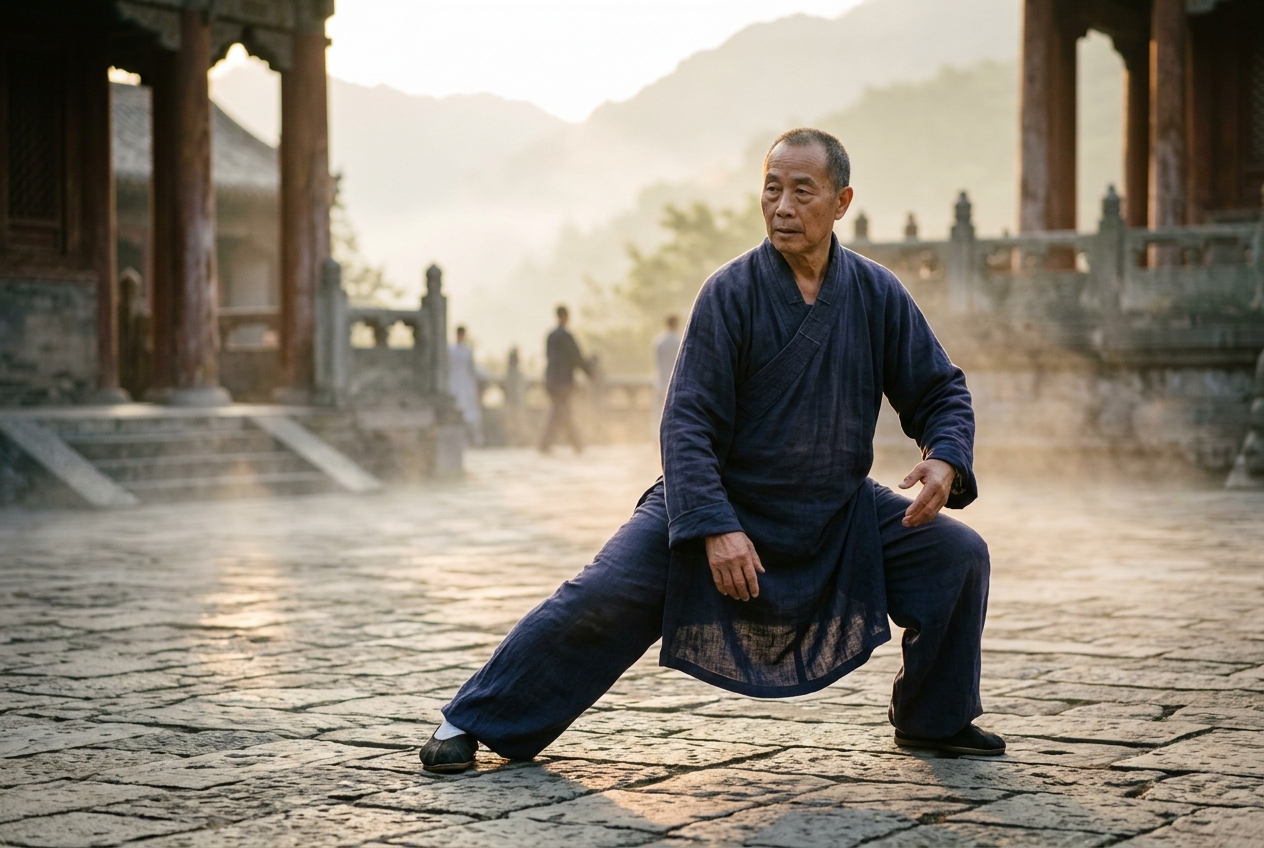
- Crouching Stance (Pu Bu): Lower your center of gravity by squatting deeply on one leg while fully extending the opposite leg laterally. To prevent destructive torsional forces at the medial meniscus, the folded leg must completely release the Huantiao cavity, allowing the pelvis to sink below the knee line while the spine maintains upright axial suspension (Xu Ling Ding Jin).
Postural Faults, Somatic Markers, and Remediation
| Postural / Somatic Fault | Biomechanical Consequence | Sensory Marker | Corrective Intervention |
|---|---|---|---|
| Coxofemoral Clamping | Hypertonicity of piriformis and gluteus medius; mechanical impingement of sciatic nerve. | Sharp, pinching ache in the outer buttocks; cold feet; elevated heart rate. | Widen the stance slightly; mentally "inflate" the space between the sacrum and greater trochanter during exhalation. |
| Anterior Pelvic Tilt | Hyperlordosis of the lumbar spine; anterior shear of L5-S1; hyperextension of hip capsules. | Lumbar compression; tight hip flexors; superficial belly distension. | Soften the lower ribs; release the coccyx downward without clenching the abdominal wall. |
| Genu Valgum Collapse | Medial collapse of the knee joint; over-pronation of the subtalar joint; torsional shear. | Medial knee strain; excessive pressure on the inner arch of the foot. | Engage the external hip abductors elastically by gently spreading the floor with the soles of your feet. |
The Body Science: Biomechanical Tensegrity and Neuro-Fascial Dynamics
The clinical efficacy and structural transformation induced by releasing Huantiao are readily explained through contemporary kinesiology, fascial biotensegrity, and neurophysiology. Anatomically, GB30 is situated precisely over the infrapiriform foramen, through which the massive sciatic nerve (nervus ischiadicus), posterior femoral cutaneous nerve, inferior gluteal nerve, and internal pudendal vessels exit the pelvis into the posterior compartment of the thigh.
+-------------------------------------------------------------------------+
|                  NEURO-FASCIO-VASCULAR ARCHITECTURE                     |
+-------------------------------------------------------------------------+
| Superficial Layer : Gluteus Maximus & Tensor Fasciae Latae (IT Band)   |
| Intermediate Layer: Piriformis Muscle & Infrapiriform Foramen           |
| Deep Neurovascular: Sciatic Nerve Bundle & Inferior Gluteal Artery      |
| Articular Matrix  : Acetabulofemoral Capsule & Sacrotuberous Ligament   |
+-------------------------------------------------------------------------+
When an individual chronically contracts the gluteal complex—a standard compensatory pattern resulting from prolonged sitting, postural anxiety, or improper athletic mechanics—the piriformis muscle undergoes adaptive shortening and hypertonicity. This hypertonus induces mechanical compression of the sciatic nerve, a condition comprehensively documented in biomedical literature indexed on NCBI PubMed as piriformis syndrome or deep gluteal syndrome. Research into Piriformis Syndrome and Sciatic Nerve Entrapment confirms that sustained mechanical pressure at this exact anatomical locus restricts neural axoplasmic transport and causes local microvascular ischemia, generating the radiating paresthesia, lumbar rigidity, and lower limb motor dysfunction that classical Chinese medicine historically classified as Bi (painful obstruction) syndrome and Wei (flaccidity/paralysis) syndromes.
From the perspective of fascial biotensegrity—the structural model demonstrating that biological organisms are stabilized through continuous tension and discontinuous compression—the pelvis acts as the primary mechanical vault distributing loads between the axial skeleton and the lower extremities. As detailed in clinical reviews on Fascia as a Sensory and Tensegrity Organ, the thoracolumbar fascia, the gluteal aponeurosis, the iliotibial tract, and the sacrotuberous ligament form a unified, continuous tensile network.
When the Huantiao cavity is released via conscious somatic relaxation (Song), the compressive stress on the coxofemoral joint is unloaded. The femoral head centers smoothly within the acetabulum, eliminating the parasitic torque that typically dissipates kinetic energy across the knees and lower back. Consequently, Ground Reaction Forces (GRF) absorbed by the plantar fascia during dynamic movement are transmitted linearly and elastically through the lateral myofascial kinetic chain without shear stress.
       KINETIC TRANSMISSION PATHWAY (GROUND TO CROWN)

[ Baihui (GV20) - Cranial Suspension ]
                   ^
                   |  (Spinal Elongation / Dural Tension Release)
 [ Mingmen (L2-L3) - Lumbar Expansion ]
                   ^
                   |  (Pelvic Diaphragm & Sacral Unwinding)
 [ Huantiao (GB30) - Coxofemoral Decompression ]
                   ^
                   |  (Shaoyang Lateral Fascial Line)
 [ Yanglingquan (GB34) - Tendon Confluence ]
                   ^
                   |  (Plantar Elastic Loading)
 [ Yongquan (KI1) - Earth Rooting ]
Furthermore, the release of deep peritrochanteric tension exerts a profound regulatory influence upon the autonomic nervous system. The pelvic floor and the deep hip rotators share rich somato-visceral neurological reflex loops with the sacral parasympathetic outflow (segments S2–S4). Unwinding the deep myofascial matrix around GB30 alleviates tonic compression upon the pudendal neurovascular bundle and stimulates high concentrations of low-threshold mechanoreceptors (Ruffini endings and Pacinian corpuscles) densely embedded within the coxofemoral joint capsule and gluteal retinacula.
This mechanoreceptive afferent bombardment down-regulates central sympathetic tone, diminishes systemic cortisol secretion, enhances microvascular perfusion via local nitric oxide release, and elevates high-frequency Heart Rate Variability (HRV), moving the practitioner into a sustained state of parasympathetic rest, repair, and optimal neuromuscular responsiveness.
Classical Lineage, Meridian Energetics, and Daoist Neigong Context
The systematic cultivation of the Huantiao cavity represents one of the crowning achievements of classical Chinese somatic science, tracing its origins to early Daoyin manuscripts excavated from the Han Dynasty Mawangdui tombs (Daoyin Tu, circa 168 BCE) and the medical canons of the Huangdi Neijing (Yellow Emperor's Inner Classic). Within the systemic taxonomy preserved across centuries and recognized by the World Health Organization Traditional Medicine Strategy, Huantiao serves as the 30th point on the Foot Shaoyang Gallbladder Meridian (Zú Shǎoyáng Dǎnjīng), while concurrently operating as a pivotal intersection point (Jiao Hui Xue) where the Gallbladder meridian conjoins with the Foot Taiyang Bladder Meridian.
+-------------------------------------------------------------------------+
|                  CLASSICAL MERIDIAN ATTRIBUTES OF GB30                  |
+-------------------------------------------------------------------------+
| Meridian Pathway    : Foot Shaoyang Gallbladder Meridian                |
| Confluence Status   : Intersection Point with Foot Taiyang Bladder Ch. |
| Energetic Function  : Eliminates Wind-Damp, Clears Shaoyang Stagnation  |
| Vertical Polarity   : Counterpart to Jianjing (GB21) in Upper Torso    |
+-------------------------------------------------------------------------+
In classical Daoist Neidan (Internal Alchemy) and martial Daoyin traditions—such as the Dragon Gate lineage (Longmen Pai) and traditional Chen and Yang style Taijiquan—the Foot Shaoyang system is revered as the cosmological and physiological "Pivot" (Shu). While the Taiyang meridians govern the exterior opening of the organism and the Yangming meridians govern the interior processing, the Shaoyang functions as the dynamic hinge mediating between internal storage and external functional expression.
The name Huantiao itself carries profound metaphorical and technical meaning: Huan (环) signifies a closed ring, circle, or the act of encircling, referring both to the spherical geometry of the femoral head revolving within the acetabulum and to the uninterrupted circular circulation of primordial Qi through the pelvic girdle. Tiao (跳) translates directly as jumping or leaping, denoting the restoration of agile, spring-loaded kinetic vitality to lower limbs previously crippled by energetic stagnation or muscular paralysis.
Classical acupuncture treatises, including Huangfu Mi's 3rd-century Zhenjiu Jiayi Jing (Systematic Classic of Acupuncture and Moxibustion) and Yang Jizhou's Ming Dynasty masterpiece Zhenjiu Dacheng (Great Compendium of Acupuncture and Moxibustion), designate GB30 as the preeminent clinical cavity for treating hemiplegia, cold wind-damp paresthesia, lumbar pain radiating to the lateral malleolus, and inability to flex or extend the hip. Energetically, Huantiao acts as the master pelvic sluice gate regulating the descent of clear Yang Qi from the upper dantian and thoracic cavity into the lower limbs, while simultaneously facilitating the ascending filtration of Yin Qi drawn from the earth through the bubbling spring point (Yongquan, KI1).
          THE VERTICAL EQUILIBRIUM POLARITY

             [ Jianjing / GB21 ]  <-- Sinking Upper Yang
                     |
                     |  (Axial Plumb Line)
                     |
             [ Huantiao / GB30 ]  <-- Dynamic Pelvic Hinge
                     |
                     |  (Lateral Kinetic Root)
                     |
             [ Yongquan / KI1 ]   <-- Ascending Earth Yin
Crucially, Daoist internal cultivation models establish a direct vertical energetic polarity between Jianjing (GB21 / Shoulder Well) in the superior trapezius ridge and Huantiao (GB30) in the posterior-lateral pelvis. In the internal arts, tension in the upper body and tension in the lower body are viewed as reciprocal manifestations of a severed central equilibrium axis.
If Jianjing is elevated or hypertonic—a common manifestation of psychological stress and shallow chest breathing—Yang Qi becomes trapped in the upper thoracic cavity and cranium, causing hypertension, dizziness, and somatic anxiety. To resolve this, the internal martial master consciously sinks Jianjing downward into the torso, which immediately requires a reciprocal opening and widening of Huantiao below.
When GB21 sinks and GB30 opens, the structural axis between the occiput (Baihui, GV20), the lower lumbar gate (Mingmen, GV4), the pelvic floor (Huiyin, CV1), and the plantar center (Yongquan, KI1) snaps into seamless elastic alignment. The entire somatic frame transforms from an assemblage of rigid, isolated levers into a pressurized, fluid-filled tensegrity structure capable of neutralizing external forces effortlessly while generating immense explosive power (Fa Jin) without structural breakdown.
Today's Practice Commitment: Progressive Five-Minute Pelvic Decompression Protocol
To integrate this knowledge into direct somatic reality, execute the following calibrated five-minute neuro-fascial unwinding routine tomorrow morning prior to consuming caffeine or engaging in digital work:
+-------------------------------------------------------------------------+
|              FIVE-MINUTE DAILY GB30 UNWINDING PROTOCOL                  |
+-------------------------------------------------------------------------+
| Minute 01: Palpation, Stance Calibration, and Diaphragmatic Priming    |
| Minute 02: Standing Zhan Zhuang - Sinking the Ischial Tuberosities     |
| Minute 03: Micro-Helical Unwinding (Right Coxofemoral Release)         |
| Minute 04: Micro-Helical Unwinding (Left Coxofemoral Release)          |
| Minute 05: Vertical Alignment Check - Jianjing (GB21) to Yongquan (KI1)|
+-------------------------------------------------------------------------+
- Minute 1 — Palpation and Stance Calibration: Stand barefoot on a firm surface. Place your thumbs directly into the soft indentation of the Huantiao cavity behind your greater trochanters. Take five deep, diaphragmatic breaths, exhaling fully while applying gentle, sustained inward pressure to prime interoceptive mechanoreceptors.
- Minute 2 — Static Zhan Zhuang Release: Lower your arms to embrace an imaginary spherical tree trunk at chest height. Soften the knees, drop the tailbone, and release all muscular gripping in the gluteal muscles beneath your awareness. Feel the deep pelvic tissues widen laterally.
- Minutes 3 & 4 — Micro-Helical Unwinding: Shift your mass smoothly into the right heel, releasing the right GB30 point so deeply that the hip joint feels hollow and unobstructed. Breathe into the right hip for 60 seconds, visualizing warm liquid filling the joint space. Transition smoothly to the left side and repeat for 60 seconds.
- Minute 5 — Vertical Polarity Integration: Return to bilateral symmetry. Consciously drop your shoulders (Jianjing / GB21), open your hip sockets (Huantiao / GB30), and sense the grounded stability anchoring through the soles of your feet (Yongquan / KI1). Step out of the posture and notice the profound lightness, lumbar decompression, and rooted mental clarity that accompany an open pelvic gate.