Hemostatic Herbs (Zhi Xue Yao) Pharmacodynamics: Governing Blood Coagulation, Extravasation Arrest, Stasis Resolution, and Microvascular Integrity in Traditional Chinese Medicine
You look down at your forearm and notice a sudden, inexplicable purplish bruise—a minor subcutaneous extravasation that appeared without any memorable trauma or collision. Or perhaps you brush your teeth in the morning, only to find the delicate pink margin of your gums weeping thin, pale blood that takes minutes to resolve. Later in the day, after a modest meal, an overwhelming postprandial lethargy sets in: your limbs feel heavy as lead, your cognitive clarity dissolves into brain fog, and your abdomen distends with a dull, hollow discomfort.
In the conceptual architecture of Traditional Chinese Medicine (TCM), these seemingly disparate phenomena—spontaneous capillary fragility, prolonged micro-bleeding, digestive incompetence, and chronic systemic exhaustion—are intimately intertwined manifestations of a single underlying dynamic: a failure of the Spleen (Pǐ, 脾) to govern and consolidate the blood within its vascular conduits. Rather than viewing the vascular tree as an inert plumbing system governed solely by hydrostatic pressure, classical medical theory understands the containment of blood as an active, energy-demanding metabolic process. When the body's central assimilative engine falters, the vital force (Qì, 气) loses its cohesive holding power, allowing blood (Xuè, 血) to escape its physiological pathways. Bridging these traditional insights with modern molecular pathophysiology reveals a profound dialogue between ancient empirical formulas and contemporary vascular biology, opening new horizons for understanding hemostatic control.
2. What This Organ System Does: Blood Containment, Vascular Integrity, and Classical Pathophysiology
In classical Chinese physiological discourse, the Spleen (Pǐ) occupies the sovereign position of the "Root of Post-Heaven Existence" (Hòu Tiān Zhī Běn), orchestrating the conversion of ingested nutrients into vital substances. Yet, its physiological mandate extends far beyond digestion. The Spleen is tasked with two overarching systemic imperatives: transporting and transforming nutritive essences (Pǐ Zhǔ Yùn Huà), and governing the containment of blood within the vascular network (Pǐ Zhǔ Tǒng Xuè).
To fully grasp the Spleen’s role in hemostasis, one must examine the triadic functional relationship uniting the Spleen (Pǐ), the Liver (Gān, 肝), and the Vessels (Mài, 脉). While the Heart governs circulation and the Liver acts as the dynamic reservoir that stores and regulates blood volume (Gān Cáng Xuè), the Spleen generates the bio-energetic tension—the holding Qi (Tǒng Shè Zhī Qì)—that maintains the structural integrity of the vessels (Xuè Mài). In biomedical terms, this holding power corresponds to the preservation of microvascular endothelial integrity, the continuous synthesis of basal lamina collagen, and the regulation of tight junctional complexes (such as VE-cadherin and claudins) that prevent plasma and erythrocyte diapedesis into interstitial tissues.
Pathological hemorrhage (Chū Xuè) arises whenever this homeostatic equilibrium is disrupted. Classical differential diagnosis categorizes hemorrhage into four primary etiologies, each commanding a distinct therapeutic strategy and herbal pharmacodynamic class:
1. Blood Heat Inducing Extravasation (Xuè Rè Wàng Xíng, 血热妄行)
When internal or external pathogenic Heat penetrates the nutrient (Yíng) and blood (Xuè) levels, it accelerates circulatory velocity and destabilizes endothelial boundaries. Blood becomes hyper-dynamic, turbulent, and literally "boils over" the vessel walls, manifesting as acute, profuse, bright-red or crimson hemorrhage. This mirrors biomedical acute hyper-inflammatory states where pro-inflammatory cytokines (such as TNF-α and IL-6) trigger severe endothelial barrier breakdown, capillary hyperpermeability, and hyperdynamic microvascular flow.
2. Spleen Qi Deficiency Failing to Control Blood (Pǐ Bù Tǒng Xuè, 脾不统血)
Chronic metabolic exhaustion, prolonged illness, or nutritional insufficiency depletes Spleen Qi. Lacking the cohesive, ascending bio-energetic force required to maintain vascular competence, the blood passively oozes through weakened capillary walls. The bleeding is typically insidious, prolonged, and pale or watery. Biochemically, this aligns with impaired endothelial protein synthesis, chronic thrombocytopenia, capillary basement membrane thinning, and subnormal platelet aggregation velocity.
3. Meridian Cold Stagnation (Hán Níng Xuè Yù, 寒凝血瘀)
Invasion of pathogenic Cold or constitutional Yang deficiency causes microvascular vasoconstriction, sluggish perfusion, and local tissue hypoxia. Cold congeals the blood, leading to localized ischemia and subsequent microvascular rupture. Bleeding under this pattern is characteristically dark, accompanied by cold sensations and alleviation through warmth, reflecting cold-induced vasospasm and compromised microcirculatory rheology.
4. Trauma and Blood Stasis Obstructing the Collaterals (Yù Xuè Zǔ Luò, 瘀血阻络)
Physical trauma or long-standing circulatory stagnation creates mechanical and rheological obstructions within the microvasculature. When extravasated or clotted blood blocks the lumen of the collaterals, upstream hydrostatic pressure surges, forcing newly arrived blood out of the vessel channel. This dynamic embodies the classical dictum: "Where there is stasis, blood cannot return to its channel" (Yù Xuè Bù Chéng Zhèng Guǐ).
3. How You Can Feel It: Signs of Balance, Imbalance, and Classical Hemorrhagic Etiologies
The balance of the Spleen-Blood containment system registers continuously across energy levels, tissue tone, dermatological resilience, and mental endurance.
+---------------------------------------------------------------------------------------------------+
|                                 CLINICAL PATTERN COMPARISON MATRIX                                |
+-----------------------+-----------------------+-------------------------+-------------------------+
| Diagnostic Parameter  | Blood Heat (Xuè Rè)   | Spleen Def. (Pǐ Xū)     | Blood Stasis (Yù Xuè)   |
+-----------------------+-----------------------+-------------------------+-------------------------+
| Bleeding Morphology   | Profuse, bright-red,  | Chronic, slow oozing,   | Dark, clotted, purplish,|
|                       | acute onset, crimson  | pale or thin discharge  | intermittent, recalcitrant|
+-----------------------+-----------------------+-------------------------+-------------------------+
| Sensation / Pain      | Burning, restlessness,| Dull fatigue, prolapse, | Sharp, fixed, stabbing, |
|                       | feverish discomfort   | postprandial heaviness  | worse with pressure     |
+-----------------------+-----------------------+-------------------------+-------------------------+
| Dermatological Signs  | Maculopapular rash,   | Easy bruising, pallor,  | Petechiae, dry scaling, |
|                       | flushed complexion    | sallow skin, ecchymosis | subungual splintering   |
+-----------------------+-----------------------+-------------------------+-------------------------+
| Tongue & Pulse Signs  | Scarlet tongue body;  | Pale, flabby tongue with| Purple/dusky tongue body;|
|                       | rapid, forceful pulse | teeth marks; weak pulse | choppy, wiry pulse      |
+-----------------------+-----------------------+-------------------------+-------------------------+
Self-Assessment Matrix
To evaluate the functional integrity of your blood-containment dynamic, consider the following self-diagnostic parameters: - Tissue Fragility: Do minor accidental impacts result in disproportionately large or persistent ecchymoses (bruises)? - Mucosal Integrity: Do your gums bleed spontaneously during gentle brushing, or do you experience recurrent spontaneous epistaxis (nosebleeds)? - Digestive Vitality: Following meals, do you experience acute somnolence, abdominal fullness, and chronic loose stools containing undigested food particles? - Cognitive and Muscular Stamina: Is your physical endurance undermined by heavy, aching limbs and an inability to sustain focused mental attention? - Vascular Inspection: Look at your tongue in a mirror. Is it pale and swollen with scalloped indentations along the lateral margins (indicative of Spleen Qi deficiency failing to hold shape and fluid), or is it deep crimson with purplish petechiae (indicative of Heat or Stasis obstructing the microcirculatory collaterals)?
4. Comprehensive Pharmacodynamics of Hemostatic Herbs (Zhǐ Xuè Yào)
The therapeutic category of Zhǐ Xuè Yào (止血药, Hemostatic Herbs) constitutes one of the most pharmacologically sophisticated divisions of the traditional pharmacopoeia. Rather than indiscriminately halting coagulation, classical pharmacology classifies these agents into four functional subcategories based on thermal property (Qì), flavor (Wèi), and functional directionality.
1. Blood-Cooling Hemostatics (Liàng Xuè Zhǐ Xuè Yào, 凉血止血药)
These herbs are typically bitter (Kǔ) and cold (Hán). They act by clearing vascular Heat, dampening inflammatory cascades, and stabilizing endothelial cellular junctions to prevent the extravasation of hyperdynamic blood.
- Dì Yú (地榆, Radix Sanguisorbae / Sanguisorba officinalis): Renowned for arresting bleeding in the lower burner (e.g., bleeding hemorrhoids, hematochezia, and dysfunctional uterine bleeding). It is rich in hydrolyzable tannins, sanguisorbins, and ziyuglycosides. Pharmacologically, its high tannin content induces localized protein precipitation on mucosal surfaces, while ziyuglycosides downregulate inducible nitric oxide synthase (iNOS), attenuating excessive vasodilation.
- Xiǎo Jì (小蓟, Herba Cirsii) & Dà Jì (大蓟, Herba Cirsii Japonici): Potent agents for epistaxis, hemoptysis, and hematuria driven by Blood Heat. Containing flavones, acacetin, and cirsimaritin, these herbs exhibit pronounced anti-inflammatory, antioxidant, and vasoconstrictive activities, directly curbing capillary permeability during acute inflammation.
- Bái Máo Gēn (白茅根, Rhizoma Imperatae / Imperata cylindrica): Sweet and cold, it cools the blood while promoting diuresis without injuring fluids. Its active constituent, imperanene, exerts potent platelet-regulatory and anti-inflammatory properties, making it ideal for hematuria and febrile epistaxis.
- Cè Bǎi Yè (侧柏叶, Cacumen Platycladi): Bitter, astringent, and slightly cold, it enters the Lung, Liver, and Large Intestine channels. Rich in flavonoids (such as quercetin and myricetin) and volatile oils, it stabilizes capillary fragility, arrests pulmonary and gastrointestinal bleeding, and promotes tissue regeneration.
Classical Prescription Bridge: Shí Huī Sàn (十灰散, Ten Ash Powder), recorded in the Shí Yào Shén Shū (Formulas from the Immortal's Book), utilizes Blood-Cooling and carbonized herbs to rapidly extinguish rampant Blood Heat, arrest severe upper-body hemorrhage (hemoptysis and hematemesis), and restore vascular serenity.
2. Astringent Hemostatics (Shōu Liǎn Zhǐ Xuè Yào, 收敛止血药)
Astringent hemostatics possess sour (Suān) and astringent (Sè) properties. They do not rely primarily on thermal clearance; instead, they mechanically and biochemically bind and seal damaged vascular structures.
- Xiān Hè Cǎo (仙鹤草, Herba Agrimoniae / Agrimonia pilosa): A versatile, neutral herb applicable to bleeding anywhere in the body, regardless of whether etiology stems from Heat, Cold, Deficiency, or Excess. Its primary active compounds—agrimophol, ellagitannins, and luteolin—stimulate platelet aggregation, shorten bleeding and clotting times, and provide robust tonic effects that reinforce Spleen metabolic function.
- Bái Jí (白芨, Rhizoma Bletillae / Bletilla striata): A gelatinous, highly viscous botanical indicated for gastrointestinal ulceration and pulmonary cavitation (hemoptysis). Bletilla glucomannan polysaccharides form bio-adhesive hydrogels upon hydration. These hydrogels physically seal vascular ruptures, recruit platelets, activate coagulation Factor XII, and stimulate vascular endothelial growth factor (VEGF) for rapid mucosal re-epithelialization.
- Zōng Lǚ Tān (棕榈炭, Petiolus Trachycarpi Carbonisatus): Prepared via carbonization, this charred palm petiole exhibits exceptional astringency, absorbing fluid and binding proteins to rapidly halt chronic, refractory uterine and intestinal hemorrhage.
3. Stasis-Transforming Hemostatics (Huà Yù Zhǐ Xuè Yào, 化瘀止血药)
The stasis-transforming hemostatics represent the crowning jewel of classical Chinese pharmacodynamics, perfectly capturing the core clinical principle: "Stop bleeding without retaining stasis" (Zhǐ Xuè Bù Liú Yù, 止血不留瘀). Standard hemostatic agents run the severe risk of inducing secondary thrombosis, microvascular sludging, and ischemic necrosis. Stasis-transforming botanicals selectively promote clot formation at the site of trauma while actively preventing paradoxical disseminated thrombosis in adjacent micro-vessels.
- Sān Qī (三七, Radix Notoginseng / Panax notoginseng): The foremost herb in this category. Its unique pharmacodynamic profile is governed by two primary chemical classes: 1. Dencichine ($\beta$-$N$-oxalyl-L-$\alpha$,$\beta$-diaminopropionic acid): A non-protein amino acid that increases platelet counts, enhances platelet adhesion and aggregation, and accelerates the release of coagulation factors, thereby rapidly arresting external and internal hemorrhage. 2. Notoginsenosides (Rg1, Rb1, R1): Dammarane-type triterpenoid saponins that promote microcirculatory vasodilation, inhibit pathological thrombosis, attenuate intracellular calcium overload, and protect endothelial cells from hypoxic death.
- Qiàn Cǎo (茜草, Radix Rubiae): Bitter and cold, it enters the Liver meridian, clearing heat while invigorating the blood and breaking up stasis. Its active anthraquinone derivatives, mollugin and purpurin, exhibit a dual regulatory action: arresting hyperdynamic menstrual and gastrointestinal bleeding while inhibiting pathological platelet aggregation in high-shear vessels.
- Pú Huáng (蒲黄, Pollen Typhae): Sweet and neutral, raw Pú Huáng strongly invigorates blood and breaks stasis to resolve post-partum pain, whereas charred Pú Huáng Tān shifts heavily toward astringent hemostasis. Rich in isorhamnetin and quercetin flavonoids, it accelerates thrombin time locally while improving systemic micro-rheology.
4. Channel-Warming Hemostatics (Wēn Jīng Zhǐ Xuè Yào, 温经止血药)
These herbs are acrid (Xīn), bitter (Kǔ), and warm (Wēn). They target hemorrhage arising from deficiency-cold (Xū Hán) of the middle burner or the penetrating and conception vessels (Chōng Rèn).
- Ài Yè (艾叶, Folium Artemisiae Argyi): Enters the Liver, Spleen, and Kidney channels. Its rich volatile essential oils (including 1,8-cineole, camphor, and borneol) warm the womb, alleviate pelvic cold-cramping, reverse ischemic vasoconstriction, and stabilize capillary fragility in cold-deficiency menorrhagia and threatened miscarriage.
- Pào Jiāng (炮姜, Rhizoma Zingiberis Preparatum): Prepared by roasting dried ginger until it becomes dark brown and puffed. The thermal nature turns warm and astringent, transforming pungent gingerols into shogaols and zingerone. It warms the Spleen-Yang, stops abdominal diarrhea, and arrests chronic intestinal bleeding caused by Spleen-Yang failure.
Classical Prescription Bridge: Jiāo Ài Tāng (胶艾汤, Ass-Hide Gelatin and Mugwort Decoction), from the Jīn Guì Yào Lüè (Essential Prescriptions from the Golden Cabinet), combines Ài Yè, È Jiāo, and nourishing blood herbs to simultaneously nourish, warm, and secure the uterine vascular bed, resolving cold-deficiency gynecological bleeding.
+----------------------------------------------------------------------------------------------------+
|                             PHYTOCHEMICAL & PHARMACODYNAMIC SUMMARY                               |
+-------------------+--------------------+------------------------+----------------------------------+
| Herb Name         | Functional Class   | Key Phytochemicals     | Primary Biomedical Mechanisms    |
+-------------------+--------------------+------------------------+----------------------------------+
| Dì Yú (地榆)      | Blood-Cooling      | Sanguisorbins, Tannins | Protein precipitation; down-     |
|                   |                    | Ziyuglycosides         | regulates iNOS & inflammatory NO |
+-------------------+--------------------+------------------------+----------------------------------+
| Xiān Hè Cǎo (仙鹤草)| Astringent        | Agrimophol, Luteolin,  | Accelerates platelet aggregation;|
|                   |                    | Ellagitannins          | shortens prothrombin time        |
+-------------------+--------------------+------------------------+----------------------------------+
| Bái Jí (白芨)     | Astringent         | Bletilla Glucomannan   | Hydrogel mechanical sealing;     |
|                   |                    | Polysaccharides        | activates FXII; induces VEGF     |
+-------------------+--------------------+------------------------+----------------------------------+
| Sān Qī (三七)     | Stasis-Transforming| Dencichine,            | Local platelet activation via    |
|                   |                    | Notoginsenosides R1/Rg1| dencichine; systemic anti-stasis |
+-------------------+--------------------+------------------------+----------------------------------+
| Ài Yè (艾叶)      | Channel-Warming    | 1,8-Cineole, Camphor,  | Reverses microvascular cold-     |
|                   |                    | Flavonoids             | spasm; stabilizes uterine micro-bed|
+-------------------+--------------------+------------------------+----------------------------------+
Herbal Processing Dynamics: The Science of Carbonization (Tān Zhì, 炭制)
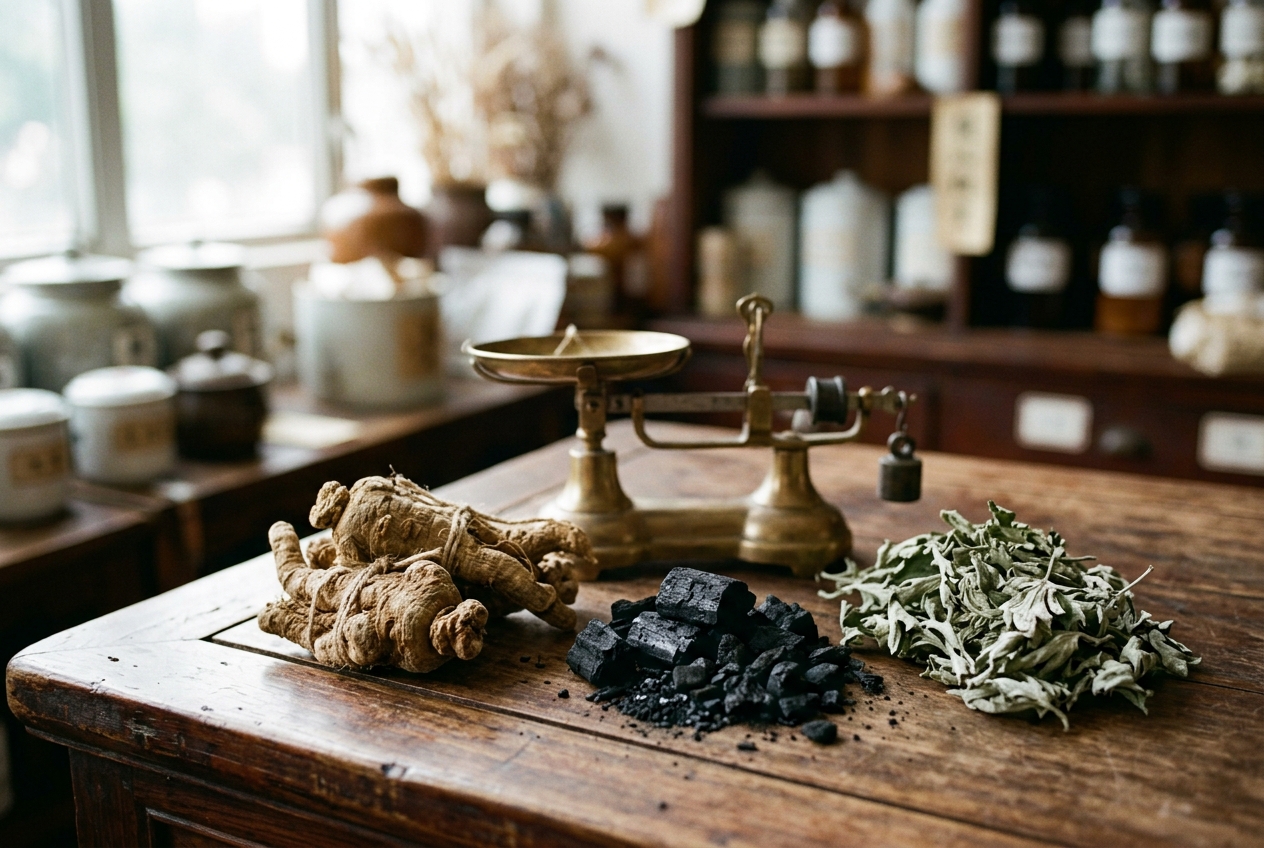
A foundational tenet of Chinese pharmacy dictates: "When blood is charred, it stops bleeding" (Xuè Jiàn Tān Zé Zhǐ, 血见炭则止). Processing botanicals into charcoal through controlled pyrolysis (Tān Zhì) alters their chemical and physical architecture: 1. Pyrolytic Structural Rearrangement: Carbonization destroys volatile and irritating monoterpenes while concentrating condensed tannins and creating porous, high-surface-area carbon lattices. 2. Adsorptive & Mechanical Action: The resulting activated carbon structure exerts strong physical adsorption over wound exudates and blood fluids, concentrating endogenous clotting factors at the vascular breach. 3. Shift in Functional Direction: Pungent, dispersing botanicals (such as raw Pú Huáng or Jīng Jiè) lose their outward-scattering vector and gain a downward, consolidating, and astringent pharmacological vector.
Biomedical Bridges to the Clotting Cascades & Clinical Safety
Modern molecular pharmacology confirms that Zhǐ Xuè Yào interface dynamically with both the intrinsic and extrinsic coagulation cascades: * Extrinsic Cascade & Tissue Factor: Botanical polysaccharides and charred lattices facilitate Tissue Factor (Factor III) exposure, accelerating Factor VII activation to form the extrinsic tenase complex. * Platelet Adhesion & Microvascular Sealing: Compounds like dencichine upregulate platelet surface glycoprotein receptors (GP IIb/IIIa), enhancing fibrinogen cross-linking and platelet plug formation. * Endothelial Cytoprotection: Flavonoid components preserve endothelial nitric oxide synthase (eNOS) transcription, maintaining basal vascular relaxation and protecting against inflammatory endothelial detachment.
Critical Clinical Contraindications & Safety Warnings: * Active Thrombosis vs. Hemorrhagic Shock: While Hua Yu Zhi Xue Yao (e.g., Sān Qī) is safe due to its bidirectional regulation, pure astringents (Shōu Liǎn Zhǐ Xuè Yào) are strictly contraindicated in active deep vein thrombosis, pulmonary embolism, or disseminated intravascular coagulation (DIC). Indiscriminately locking the door with astringents retains pathogenic factors (Bì Mén Liú Kòu) and induces catastrophic organ infarction. * Acute Hemorrhagic Shock: Severe, arterial, or hemodynamic shock requires immediate emergency surgical and transfusion interventions. Herbal decoctions serve as therapeutic and restorative modalities, not substitutes for life-saving trauma surgery.
5. Qigong & Movement Practice: Cultivating Upright Qi to Harmonize the Blood Matrix
To invigorate Spleen metabolic function, reinforce vascular resilience, and cultivate the upward-lifting energetic vector (Qì Zhào) that contains the blood, practice the classical Baduanjin movement: "Raising Single Arm to Harmonize Spleen and Stomach" (Diáo Lǐ Pǐ Wèi Xū Dān Jǔ).
Setup and Posture
- Stand with your feet parallel, precisely shoulder-width apart. Unlock your knees, allowing your tailbone to sink gently as though resting against a high stool.
- Rest the tip of your tongue against the upper palate just behind your front teeth. Relax your shoulders and let your arms hang naturally at your sides with palms facing your thighs.
- Bring your hands in front of your solar plexus (Zhōng Wǎn, RN12), palms facing upward, fingers loosely pointing toward one another as if cradling a sphere of warm light.
Movement and Breath Synchronization
- Inhalation (Ascent & Counter-Tension): * Slowly inhale through the nose for a count of 4. * As you inhale, turn your left palm upward and raise it smoothly along your midline, pressing it up toward the sky directly above your head with the wrist flexed so your fingers point rightward. * Simultaneously, turn your right palm downward and press it down beside your right hip, fingers pointing forward, rooting your energy into the earth. * At the top of the inhalation, feel a gentle, bidirectional vertical stretch elongating the left hypochondriac region and solar plexus, gently tensioning the fascial plane supporting the stomach, spleen, and hepatic vascular tree.
- Breath Retention: Hold the position effortlessly for 2 seconds, feeling the expansive bio-energetic alignment through the core.
- Exhalation (Return to Center): * Slowly exhale through the nose for a count of 6. * Relax the wrists and guide both hands back to the starting position at the solar plexus, palms facing upward.
- Opposite Side: Inhale again, this time pressing the right palm up to the sky and the left palm down to the earth.
Duration and Prescribed Repetitions
Perform 8 complete cycles (8 ascents per side, 16 total movements) once or twice daily, ideally in the morning or two hours after a meal to stimulate gastric motility and core perfusion.
Perceptual Shifts & Physiological Meaning
During this exercise, look for a distinct sensation of radiating warmth across the epigastrium and a subtle, tingling pulsation along the medial aspect of the legs and forearms. This sensation signals the activation of Spleen Qi and the microvascular redistribution of blood away from stagnant visceral pools into functional, dynamic circulation.
6. Acupressure Points You Can Try Today: Key Acupoints for Hemostatic Control and Vascular Regulation
Acupressure provides a non-invasive, direct neurological and bio-energetic input to reinforce the Spleen’s blood-holding capacity and clear pathological heat. Apply firm, steady pressure using your thumb or middle knuckle, maintaining contact for 2 to 3 minutes per point while breathing deeply.
1. Yǐnbái (隐白, Spleen 1 — "Hidden White")
- Anatomical Location: Situated on the medial aspect of the great toe, approximately 0.1 cùn (about 1 to 2 millimeters) posterior to the corner of the nail bed.
- Biomedical & Classical Action: SP1 is the Jǐng-Well (Wood) point of the Spleen Channel. In classical acupuncture, Jǐng-Well points govern acute shifts in channel dynamics; SP1 specifically commands the blood-containment threshold. Moxibustion or firm acupressure here is the premier classical intervention for arresting uterine hemorrhage, functional menorrhagia, and acute epistaxis.
- Technique: Use the edge of your thumbnail or a blunt stylus to apply firm, perpendicular pressure directed toward the bone. Maintain for 90 to 120 seconds.
2. Sānyīnjiāo (三阴交, Spleen 6 — "Three Yin Intersection")
- Anatomical Location: On the medial side of the lower leg, exactly 3 cùn (the combined width of your four fingers placed horizontally) superior to the prominence of the medial malleolus (inner ankle bone), immediately posterior to the medial border of the tibia.
- Biomedical & Classical Action: The convergence nexus of the three leg Yin meridians (Spleen, Liver, and Kidney). It harmonizes Spleen function, consolidates the Liver's blood-storing capacity, and tonifies Kidney essence. Clinically indicated for chronic fatigue, easy bruising, irregular uterine bleeding, abdominal distension, and autonomic vascular dysregulation.
- Technique: Apply deep, circular kneading with your thumb pad. The point will feel mildly sore or distended. Continue for 2 to 3 minutes on both legs.
3. Xuèhǎi (血海, Spleen 10 — "Sea of Blood")
- Anatomical Location: With your knee bent at a 90-degree angle, locate the point 2 cùn (two thumb-widths) superior to the medial-superior border of the patella, in the tender depression on the bulge of the vastus medialis muscle.
- Biomedical & Classical Action: The premier point for regulating the blood. It possesses a bidirectional therapeutic profile: it cools the blood in hyperdynamic heat patterns, clears blood stasis, and invigorates microcirculation without inducing extravasation. Ideal for inflammatory dermatological conditions (eczema, hives), purpura, and menstrual disorders.
- Technique: Use your thumb to apply firm, steady pressure directed slightly inward and upward toward the femur. Hold for 2 minutes while practicing slow diaphragmatic breathing.
4. Zúsānlǐ (足三里, Stomach 36 — "Leg Three Miles")
- Anatomical Location: On the anterior-lateral aspect of the lower leg, four finger-widths inferior to the inferior border of the patella, and one finger-breadth (middle finger width) lateral to the anterior crest of the tibia.
- Biomedical & Classical Action: The Hé-Sea (Earth) point of the Stomach Channel. It tonifies central Qi, stimulates postprandial nutrient absorption, and boosts the synthesis of platelets and plasma proteins.
- Technique: Apply vigorous, downward-kneading pressure with your thumb or knuckle for 2 to 3 minutes until a warm, spreading ache is felt along the channel.
7. Food & Lifestyle: Small Changes for Today to Consolidate the Spleen and Secure the Vessels
Nutritional therapy for Spleen-Blood containment does not demand obscure, exotic ingredients; rather, it hinges upon understanding the thermal and mechanical dynamics of everyday foods. According to World Health Organization traditional medicine principles, integrating food energetics with circadian rhythms optimizes systemic physiology.
Foods to Add to Your Regimen
- Fresh and Cooked Lotus Root (Lián Ǒu, 莲藕): Lotus root exhibits a remarkable dual pharmacodynamic nature. Eaten raw or freshly juiced, it is cool and sweet, clearing blood heat and arresting epistaxis or hemoptysis. When steamed, stewed, or simmered in broths, its thermal nature turns warm and tonifying, strengthening the Spleen, nourishing the blood, and reinforcing vascular containment.
- Warm Congees and Slow-Cooked Root Vegetables: Congee (rice porridge simmered with a 1:8 or 1:10 grain-to-water ratio for several hours) provides easily assimilable fuel for Spleen transformation. Pair short-grain rice with kabocha squash, carrots, and sweet potatoes, which resonate with the sweet flavor (Gān Wèi) and yellow hue associated with the Earth element.
- Astragalus & Jujube Infusion (Huáng Qí & Dà Zǎo): Simmer 10g of Astragalus root (Huáng Qí) and 3 to 4 sliced Chinese red dates (Dà Zǎo) in 500ml of water for 20 minutes. Astragalus elevates Upright Qi to prevent vessel leakage, while dates tonify nutritive blood and soothe the central digestive hearth.
Foods to Dramatically Reduce
- Ice-Cold Beverages and Raw Foods: Ingesting iced liquids or excessive raw salads forces the stomach to expend metabolic heat to warm the bolus to 37°C, extinguishing Spleen digestive enzymes and creating internal cold-damp stagnation that weakens capillary integrity.
- Pro-Inflammatory Vascular Agitators: Eliminate excess refined sugars, deep-fried trans-fats, and high-proof alcohol. These substances generate toxic Damp-Heat in the Liver and Stomach channels, irritating the vascular endothelium and precipitating blood extravasation.
8. Today's Takeaway
The single most transformative step you can take today to protect your microvascular integrity and tonify your Spleen requires no equipment and takes less than five minutes: sit quietly in an upright chair, uncross your legs, and apply firm, rhythmic, circular pressure with your thumbs to Sānyīnjiāo (SP6), three finger-widths above your inner ankle bone, for two minutes per leg, while matching each press to a deep four-second nasal inhalation and six-second diaphragmatic exhalation. Concurrently replace your next iced drink with a cup of warm, spiced water or roasted barley tea; this simple thermal pivot immediately relieves the metabolic burden on your Spleen, allowing its holding Qi to restore order to your vascular matrix.
Authoritative References & Further Reading
- World Health Organization (WHO) Traditional Medicine Strategy
- National Center for Biotechnology Information (NCBI) Bookshelf: Coagulation Cascade and Hemostasis
- NCBI PMC: Molecular Pharmacology of Agrimonia pilosa and its Hemostatic Constituents
- NCBI PubMed: Pharmacological Review of Panax notoginseng and Dencichine Modulation
- Wikipedia: Sanguisorba officinalis (Dì Yú) Botanical and Chemical Overview
- Wikipedia: Bletilla striata (Bái Jí) Polysaccharides and Wound Healing