Gua Sha Therapy: Navigating Petechial Subcutaneous Micro-Extravasation, Cutaneous Collateral Decongestion, and Precision Acupressure Protocols
1. Opening — The Somatosensory Crisis of the Modern Axial Skeleton
If you spend your waking hours anchored before illuminated displays, you are intimately familiar with the pervasive, leaden constriction that settles across the trapezius ridge, creeps upward into the suboccipital hollows, and locks the interscapular thoracic spine into a rigid posture of defensive flexion. This daily presentation—characterized by myofascial trigger point irritability, localized tissue ischemia, and low-grade neurogenic inflammation—is frequently accepted as an inevitable tax of sedentary cognitive labor. Conventional approaches routinely oscillate between temporary pharmacological analgesia and non-specific passive stretching, neither of which systematically engages the intricate matrix of subcutaneous microvasculature, dense irregular connective tissue, and cutaneous nerve arborizations that govern chronic somatic distress.
Within East Asian medicine, this presentation is understood as a primary collapse of kinetic patency across the superficial channel networks, where environmental influences and postural exhaustion induce localized stasis of Qi and Blood (Xue). The therapeutic discipline of Gua Sha (scraping therapy) offers a sophisticated, mechanically rigorous, instrument-assisted modality designed to decompress these congested zones. By combining unidirectional, shear-stress stroking with targeted focal acupressure, Gua Sha bridges centuries-old channel energetics with state-of-the-art vascular and immunological science, transforming static tissue beds into dynamic conduits of microcirculatory perfusion, enzymatic cytoprotection, and somatic relief.
2. Classical & Theoretical Foundations: Cutaneous Regions (Pi Bu) and Superficial Collaterals (Fu Luo)
The lineage of instrument-assisted dermabrasive therapies extends deep into Chinese medical antiquity. While folkloric iterations employed simple porcelain spoons, coins, or smoothed river stones to express acute epidemic pathogens (Sha Qi) during seasonal febrile crises, classical external medicine (Wai Ke) codified these tactile interventions into formal channel mechanics. Central to classical thought—crystallized within the foundational canons of the Huangdi Neijing (Yellow Emperor's Inner Classic)—is the hierarchical stratification of the body's functional layers.
In classical channel topography, the exterior surface is partitioned into the Twelve Cutaneous Regions (Pi Bu), which serve as the outermost defensive barrier and energetic projection zones of the internal primary meridians (Jing Mai). Directly beneath this dermal boundary resides the arborized network of the Superficial Luo-Collaterals (Fu Luo) and Minute Collaterals (Sun Luo). Under optimal physiological conditions, Qi and Blood circulate unimpeded through these micro-vessels, providing thermal regulation, tissue nourishment, and immunological defense.
When an individual experiences protracted postural strain, emotional constriction, or pathogenic invasions of External Wind, Cold, or Dampness, this superficial microcirculation suffers immediate rheological compromise. Blood velocity slows, metabolic byproducts accumulate, and the interstitial ground substance densifies. The patient manifests this internally as a subjective sensation of heavy, bound, or unyielding stiffness, often accompanied by palpable tender nodules (Ashi points).
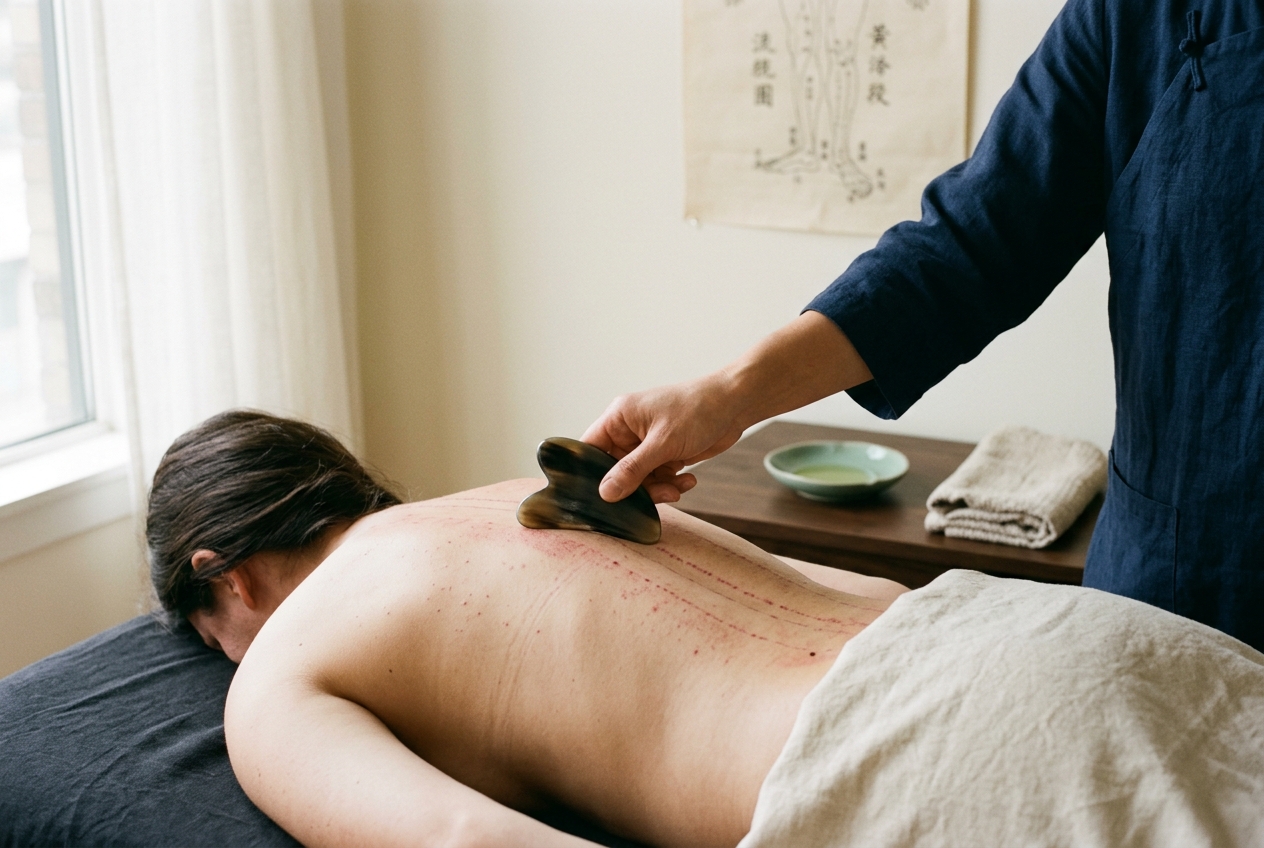
In classical nomenclature, the visible sign of this pathology is terminally designated as "Sha" (痧)—a multifaceted construct describing both the acute, sand-like pathogenic grit lodged within the micro-collaterals and the transient petechial eruption evoked when the skin is methodically scraped with a smooth, contoured edge. Unidirectional scraping (Tui Gua) applies controlled mechanical shear force across the Pi Bu, stretching the dermis, dislodging stagnant, micro-thrombotic blood from the congested Fu Luo, and guiding metabolic waste upward toward the superficial capillary bed where it can be rapidly cleared and metabolically recycled.
3. Modern Biophysical and Physiological Mechanisms: The Vascular and Immunological Cascade
Modern biomedical research has extensively validated the physiological events initiated during and following Gua Sha intervention. Far from being an unguided form of tissue damage, therapeutic scraping initiates an intricate, highly regulated neurovascular, immunological, and fascial cascade.
Transitory Petechial Micro-Extravasation
The hallmark of Gua Sha is the deliberate induction of ecchymosis-like petechiae—an event scientifically classified as transitory subcutaneous micro-extravasation. Unlike traumatic contusions, where severe blunt impact tears deep muscular tissue, ruptures larger arteriolar walls, and produces disordered intramuscular hematomas, Gua Sha utilizes controlled surface shearing that gently separates capillary endothelial junctions. Red blood cells extravasate harmlessly into the superficial interstitial fluid without compromising deep muscular architecture or tearing the epidermis.
Heme Oxygenase-1 (HO-1) Induction and Anti-Inflammatory Cytokines
The metabolic degradation of these extravasated erythrocytes serves as the trigger for Gua Sha's profound anti-inflammatory efficacy. The presence of free hemoglobin in the extracellular space stimulates the immediate genetic transcription and systemic upregulation of Heme Oxygenase-1 (HO-1), a critical, rate-limiting stress-response enzyme investigated extensively across NCBI PubMed biomedical literature.
HO-1 rapidly catalyzes the cleavage of the pro-oxidant heme molecule into three biologically potent byproducts: 1. Biliverdin (which is rapidly converted by biliverdin reductase into bilirubin, an exceptionally potent endogenous lipophilic antioxidant); 2. Free Ferrous Iron (which induces the synthesis of ferritin, safely sequestering toxic iron ions); 3. Carbon Monoxide (CO) (a vital gaseous signaling molecule exhibiting profound vasodilatory, anti-apoptotic, and anti-inflammatory properties).
This HO-1 enzymatic cascade directly dampens the nuclear factor kappa B (NF-$\kappa$B) pathway, culminating in the significant systemic and localized downregulation of key pro-inflammatory cytokines, specifically Tumor Necrosis Factor-alpha ($\text{TNF-}\alpha$), Interleukin-1 beta ($\text{IL-1}\beta$), and Interleukin-6 ($\text{IL-6}$), alongside a sustained upregulation of the anti-inflammatory cytokine Interleukin-10 ($\text{IL-10}$).
Microcirculatory Perfusion Surge
Quantitative evaluations using laser Doppler perfusion imaging demonstrate that Gua Sha generates an immediate, dramatic surge in localized cutaneous and subcutaneous microcirculation—frequently exceeding a 400% elevation in blood perfusion units at the treated site. Crucially, this hyperemic response is not confined to the immediate duration of instrument contact; sustained microcirculatory elevation persists for up to 96 hours post-treatment, ensuring continuous delivery of oxygen, amino acids, and cellular repair factors to previously ischemic myofascial tissues.
Fascial Gliding Mechanics and Hyaluronan De-densification
On a structural level, modern investigations into fascial morphology reveal that chronic muscular tension promotes the densification and polymerization of hyaluronic acid within the loose connective tissue interface between deep fascial planes. This architectural glue impedes natural fascial gliding, locking adjacent muscle slips into unyielding, painful immobility. The tangential mechanical vectors delivered during Gua Sha impart shear strain across these collagenous matrices, breaking down pathologic collagen cross-linking, restoring normative thixotropic fluid dynamics, and re-establishing seamless fascial sliding planes.
Somatosensory Gate-Control Analgesia
Simultaneously, the continuous, broad-spectrum mechanical stimulation of low-threshold, myelinated A-beta ($\text{A}\beta$) mechanoreceptive afferents overwhelms the dorsal horn of the spinal cord. In accordance with the classical Melzack-Wall Gate Control Theory of pain, this dense mechanoreceptive barrage activates inhibitory interneurons within the substantia gelatinosa, effectively gating and suppressing the transmission of nociceptive signals carried by unmyelinated C-fibers and poorly myelinated A-delta ($\text{A}\delta$) fibers.
4. Meridian Topography & Instrument Ergonomics
Executing clinically effective Gua Sha demands an intimate understanding of tool material characteristics, spatial channel pathways, and precise mechanical stroke vectors.
+------------------------------------------------------------------------------------+
|                       MATERIAL DYNAMICS OF GUA SHA INSTRUMENTS                     |
+------------------------------------------------------------------------------------+
|  MATERIAL           THERMAL CAPACITY     EDGE GEOMETRY      PRIMARY INDICATION     |
+------------------------------------------------------------------------------------+
|  Water Buffalo Horn  Neutral/Insulative   Semi-yielding      Classical sedating,   |
|  (Shuiniujiao)       Low thermal drag     Soft rounded edge  Heat clearing         |
+------------------------------------------------------------------------------------+
|  Nephrite Jade       Cool / High Mass     Dense, hard        Facial Gua Sha,       |
|  (Yu)                Rapid heat sink      Micro-polished     Delicate tonification |
+------------------------------------------------------------------------------------+
|  Stainless Steel     Thermally conductive Ultra-precise      Deep myofascial IASTM,|
|  (316L Medical)      Non-porous           Rigid crisp bevel  Stubborn fibrotic scar|
+------------------------------------------------------------------------------------+
Instrument Selection and Material Dynamics
- Water Buffalo Horn (Shuiniujiao): The historical material of classical Chinese practitioners. Naturally keratinized, horn possesses a subtle microscopic elasticity that conforms organically to bony contours. In traditional pharmacology, horn is regarded as intrinsically cooling, capable of clearing heat and resolving toxins from the Blood level.
- Nephrite Jade (Yu): Exceptionally smooth, dense, and naturally cold to the touch. Jade maintains thermal stability, providing a soothing, sedative tactile input ideal for sensitive craniocervical regions, aesthetic facial treatments, or individuals presenting with hyper-reactive autonomic nervous systems.
- Medical-Grade 316L Stainless Steel: The premier instrument of modern Instrument-Assisted Soft Tissue Mobilization (IASTM). Stainless steel delivers unmatched acoustic resonance back to the clinician’s hands, amplifying tactile feedback over fibrotic scar tissue, calcified adhesions, and myogeloses, while allowing hospital-grade sterilization.
Lubrication Mediums
Gua Sha must never be performed on dry skin. A viscous, biocompatible medium is mandatory to eliminate surface friction while preserving the transmission of shear forces into the deeper layers: * Cold-Pressed Organic Camellia or Jojoba Seed Oil: Highly stable lipids that do not clog pores or oxidize rapidly during rigorous friction. * Medicated Herbal Liniments (Die Da Jiu or St. John's Wort / Arnica-infused carriers): Formulated with warming and blood-invigorating botanicals (e.g., Carthamus tinctorius, Angelica sinensis) to potentiate microcirculatory recruitment and accelerate the clearance of extravasated blood.
Principal Anatomical Meridian Axes
Gua Sha stroke trajectories are strictly dictated by the linear topography of the primary meridian pathways:
- The Du Mai (Governing Vessel — Posterior Midline): Originates in the pelvic cavity, emerges at the perineum, ascends along the interior of the spinal column, traverses over the vertex of the cranium, and terminates at the upper labial frenulum. On the posterior neck and back, it runs directly down the spinous processes from cervical spine C1 to the sacrum. Biomechanical stroke vector: Deliberate, light-to-moderate longitudinal strokes descending directly over the midline interspinous ligaments to regulate the central nervous system and clear systemic heat.
- The Foot Taiyang Bladder Meridian (Pangguang Jing — Paraspinal Lines): The longest meridian system in the human body, descending in two bilateral columns parallel to the vertebral column: - The Inner Paraspinal Line: Located 1.5 cun lateral to the midline, tracking down the furrow of the erector spinae group (traversing the vital Back-Shu transport points). - The Outer Paraspinal Line: Located 3.0 cun lateral to the midline, traversing the medial border of the scapula and deep iliocostalis musculature. Biomechanical stroke vector: Long, unidirectional, cranial-to-caudal strokes that decompress the autonomic sympathetic paravertebral chain and mobilize paraspinal fascial sheaths.
- The Foot Shaoyang Gallbladder Meridian (Dan Jing — Anterolateral Cervicocranial Pathway): Originates at the outer canthus of the eye, weaves in intricate arcs across the temporal cranium, dips through the suboccipital triangle, and crests broadly over the superior ridge of the trapezius muscle. Biomechanical stroke vector: Oblique, descending strokes sweeping from the suboccipital insertion points (Fengchi, GB20) downward and outward along the trapezius toward the acromioclavicular articulation.
5. Precision Acupressure Integration: Confluence and Relief Loci
To elevate Gua Sha from an undifferentiated scraping routine into a high-precision therapeutic intervention, superficial strokes must be seamlessly integrated with targeted focal acupressure at key anatomical intersections.
+------------------------------------------------------------------------------------+
|               FIVE KEY INTEGRATIVE ACUPRESSURE & GUA SHA TARGETS                   |
+------------------------------------------------------------------------------------+
| POINT NAME    LOCATION                       INDICATION            STROKE DYNAMICS |
+------------------------------------------------------------------------------------+
| Dazhui (GV14) C7–T1 Interspinous Hollow      Systemic Heat, Fever, Circular anchor |
|                                              Cervicodorsal Hump    30° Angle       |
+------------------------------------------------------------------------------------+
| Fengchi (GB20)Suboccipital base between      Tension Cephalea,     Cephalad 45°    |
|               Trapezius & SCM insertions     Ocular Strain, Stress Sustained hold  |
+------------------------------------------------------------------------------------+
| Jianjing (GB21)Trapezius ridge midpoint      Trapezius Spasm,      Inferior Vector |
|               between C7 and Acromion        Shoulder Impingement  Deep ischemic   |
+------------------------------------------------------------------------------------+
| Feishu (BL13) 1.5 cun lateral to T3 spinous  Respiratory Tension,  Caudal glide    |
|               process interspace             Bronchial Congestion  Moderate shear  |
+------------------------------------------------------------------------------------+
| Hegu (LI4)    Dorsal hand, midpoint of 2nd   Orofacial Pain, Head  Distal anchor   |
|               metacarpal radial border       Congestion, Systemic  Perpendicular   |
+------------------------------------------------------------------------------------+
1. Dazhui (GV14 — "Great Vertebra")
- Anatomical Topography: Located on the posterior midline, in the pronounced depression immediately inferior to the spinous process of the seventh cervical vertebra (C7), directly superior to the first thoracic vertebra (T1).
- Somatosensory Cue: Ask the patient to gently flex the neck forward; C7 remains the most prominent, stable bony landmark, while C6 glides anteriorly away from the palpating digit. The point yields a broad, dull, warm ache under perpendicular compression.
- Technique & Mechanics: Apply the rounded corner of the Gua Sha tool directly into the interspinous hollow. Administer 60–90 seconds of moderate, slow circular pressure, followed by short, unidirectional downward strokes (30° angle) passing over the cervicothoracic junction.
- Clinical Efficacy: The grand confluence point of the Governing Vessel with all six Yang meridians of the body. Clears systemic pathogenic heat, resolves acute febrile conditions, downregulates sympathetic hyperarousal, and mobilizes the stagnated fat-fascial pads associated with chronic postural cervicodorsal kyphosis.
2. Fengchi (GB20 — "Wind Pool")
- Anatomical Topography: Located at the posterior base of the skull, within the pronounced hollow between the superior origins of the sternocleidomastoid and the lateral border of the trapezius muscle, lying directly over the splenius capitis and suboccipital triangle.
- Somatosensory Cue: Slide two thumbs upward along the vertical muscular columns of the neck until they fall into the bilateral cranial undercut beneath the occipital bone. Compression yields an unmistakable, radiating ache that frequently projects forward behind the homolateral orbit.
- Technique & Mechanics: Anchor the curved concave edge of a jade or horn tool into the suboccipital notch. Direct the mechanical vector slightly upward and inward toward the opposite eye socket for 90 seconds of sustained, static pressure. Follow with gentle outward scraping sweeping downward toward the clavicle.
- Clinical Efficacy: Relieves tension-type cephalalgia, suboccipital myofascial spasms, ocular fatigue, cervical vertigo, and acute wind-cold stiff neck presentations.
3. Jianjing (GB21 — "Shoulder Well")
- Anatomical Topography: Located on the superior crest of the shoulder, precisely at the midpoint of the line connecting the spinous process of C7 (Dazhui, GV14) and the lateral tip of the acromion process.
- Somatosensory Cue: Grasp the thick muscle belly of the upper trapezius between thumb and index finger; find the firmest, most tender nodule within the central fibrous band. Pressure induces an intense, local "de-qi" sensation of heavy sinking relaxation.
- Technique & Mechanics: Use the flat, convex edge of the instrument held at a 45° angle. Execute firm, unidirectional downward and forward strokes across the trapezius crest. After 15–20 rhythmic scraping passes, apply deep, static, vertical compression with the tool's apex for 60 seconds.
- Clinical Efficacy: Releases chronic trapezius contracture, addresses upper crossed postural syndrome, relieves cervical radicular tension, and descends counterflow Qi to alleviate stress-induced tension headaches. (Caution: Strictly contraindicated during all trimesters of pregnancy).
4. Feishu (BL13 — "Lung Transport Point")
- Anatomical Topography: Located on the posterior thorax, 1.5 cun lateral to the lower border of the spinous process of the third thoracic vertebra (T3), situated over the rhomboid major and erector spinae musculature.
- Somatosensory Cue: Locate the level of the spine of the scapula, which horizontally aligns with the spinous process of T3. Measure approximately two finger-widths lateral to the spinous process furrow. Palpation reveals a distinct myofascial resistance that aches pleasantly upon firm, perpendicular pressure.
- Technique & Mechanics: Apply smooth, rhythmic longitudinal strokes moving strictly from superior to inferior (T1 toward T5) along the inner Bladder line. Follow with slow, sustained circular ischemic compression directly over BL13.
- Clinical Efficacy: Modulates pulmonary function, dispels acute bronchial congestion, alleviates asthma and cough paroxysms, and releases deep interscapular muscular rigidity resulting from prolonged thoracic flexion.
5. Hegu (LI4 — "Joining Valleys")
- Anatomical Topography: Located on the dorsum of the hand, between the first and second metacarpal bones, approximately at the midpoint of the radial border of the second metacarpal bone.
- Somatosensory Cue: Adduct the thumb flush against the index finger; locate the highest mound of the first dorsal interosseous muscle. Abduct the thumb and press deeply inward toward the radial shaft of the second metacarpal bone. The sensation is sharply tender, spreading through the palm.
- Technique & Mechanics: While Gua Sha is rarely scraped extensively over the delicate dorsal hand, LI4 serves as an indispensable distal anchor. Apply intense, circular friction using the smooth rounded edge of a horn or steel tool for 1–2 minutes per side.
- Clinical Efficacy: The supreme distal command point for the entire head, face, neck, and sensory orifices. Regulates orofacial pain, frontal headaches, temporomandibular joint (TMJ) dysfunction, and potentiates the systemic pain-relieving effects of axial scraping. (Caution: Strictly contraindicated during pregnancy).
6. A Replicable Point & Scraping Combination for Craniocervical & Scapular Distress
For the educated individual or clinician seeking an immediate, structured, and clinically validated evening protocol to dismantle severe upper-body postural strain, the following multi-stage intervention combines meridian scraping with point-specific acupressure.
+------------------------------------------------------------------------------------+
|          EVENING PROTOCOL FOR CHRONIC CRANIOCERVICAL & SCAPULAR TENSION             |
+------------------------------------------------------------------------------------+
|  STEP  PHASE                      TARGET REGION             DURATION   TOOL / POINT|
+------------------------------------------------------------------------------------+
|  1.    Pre-Treatment Lubrication  Occiput to Mid-Scapula    1 min      Jojoba Oil  |
|  2.    Cervicothoracic Midline    Du Mai / C1 to T6         2 mins     GV14 Anchor |
|  3.    Suboccipital Decompression Occipital Ridge to C7     3 mins     GB20 Focal  |
|  4.    Trapezius Crest Release    C7 to Acromion Process    3 mins     GB21 Focal  |
|  5.    Distal Orofacial Cleansing Radial Dorsal Hand        2 mins     LI4 Anchor  |
|  6.    Thermal & Fluid Recovery   Total Body Insulation     Rest       Warm Water  |
+------------------------------------------------------------------------------------+
Stage 1: Preparation and Tissue Priming (1 Minute)
- Positioning: The recipient sits upright in a supportive, high-backed chair with their forehead resting comfortably on a padded cushion, maintaining the cervical spine in slight, relaxed flexion.
- Lubrication: Warm 5–8 drops of pure jojoba or camellia oil between the palms and apply using broad, sweeping effleurage strokes from the suboccipital hairline down over the trapezius ridges and across the medial borders of the scapulae.
Stage 2: Decompressing the Axial Midline (2 Minutes)
- Action: Utilizing the flat, gently curved edge of a water buffalo horn or polished jade tool, position the instrument at a 30-degree angle relative to the skin surface over the upper cervical spinous processes.
- Trajectory: Execute slow, unidirectional downward strokes along the Du Mai (midline), extending from C2 down through C7 (Dazhui) to the level of T6. Maintain continuous, even contact pressure. Perform 25–30 strokes until a visible, light pink-to-crimson petechial flush emerges.
- Focal Hold: Anchor the apex of the tool into the depression below C7 (Dazhui, GV14) for 45 seconds of steady, grounding pressure.
Stage 3: Suboccipital and Paraspinal Mobilization (3 Minutes)
- Action: Transition the tool to the suboccipital hollows (Fengchi, GB20). Direct the strokes downward and outward along the bilateral splenius cervicis and the inner paraspinal Bladder line (Feishu, BL13).
- Kinematics: Stroke length should span approximately 4–6 inches. Maintain a consistent velocity of 2–3 inches per second. Avoid bouncing over bony prominences.
- Focal Hold: Apply dual-thumb or instrument-assisted compression into both GB20 points simultaneously for 60 seconds to release tension headache patterns.
Stage 4: Trapezius Ridge Stripping & De-densification (3 Minutes)
- Action: Place the concave border of the Gua Sha tool on the lateral neck musculature, sweeping firmly across the crest of the upper trapezius toward the shoulder tip.
- Kinematics: Increase stroke pressure moderately to engage the deeper myofascial interfaces. 30–40 deliberate, sweeping strokes per shoulder.
- Focal Hold: Locate the trigger band at Jianjing (GB21) and exert deep, ischemic perpendicular pressure for 60 seconds, instructing the subject to breathe deeply through the diaphragm.
Stage 5: Distal Autonomic Balance (2 Minutes)
- Action: Discontinue axial scraping. Cleanse residual oil from the hands.
- Focal Compression: Seat your thumb deeply into the Hegu (LI4) point on the dorsal web space of each hand in turn. Apply pulsing, circular pressure (1 Hz frequency) for 60 seconds per side to distribute the mobilized Qi, alleviate latent craniofacial tension, and ground the central nervous system.
7. Clinical Applications, Diagnostic Petechial Differentiation, and Safety Standards
Differentiating Therapeutic Petechiae from Traumatic Contusions
A central didactic imperative in the modern understanding of Gua Sha is the clear differentiation between controlled therapeutic petechial micro-extravasation and unguided soft-tissue trauma (bruising).
+------------------------------------------------------------------------------------+
|        THERAPEUTIC PETECHIAE (SHA) vs. UNGUIDED SOFT-TISSUE CONTUSIONS             |
+------------------------------------------------------------------------------------+
| PARAMETER           THERAPEUTIC GUA SHA (SHA)      TRAUMATIC BLUNT CONTUSION       |
+------------------------------------------------------------------------------------+
| Vascular Source     Capillary endothelial cleft    Rupture of arterioles/venules   |
|                     micro-extravasation            with active pool hematoma       |
+------------------------------------------------------------------------------------+
| Structural IntegrityEpidermis & deep muscular      Deep muscular fiber tearing &   |
|                     fibers remain fully intact     interstitial tissue disruption  |
+------------------------------------------------------------------------------------+
| Resolution Window   Resolves completely in         Requires 10–21 days; passes     |
|                     2 to 5 days                    through dark yellow-green stages|
+------------------------------------------------------------------------------------+
| Sensation           Light skin warmth; immediate   Throbbing, sharp pain, severe   |
|                     musculoskeletal relief         inflammatory hyperalgesia       |
+------------------------------------------------------------------------------------+
| Diagnostic Color    Bright red, crimson, to deep   Disorganized purple-black       |
| Interpretation      violaceous speckling           amorphous blood pooling         |
+------------------------------------------------------------------------------------+
Diagnostic Palette of "Sha"
The specific chromatic presentation of the petechial eruption provides immediate diagnostic intelligence regarding the chronicity and nature of the underlying tissue pathology: * Bright Red (Xian Hong): Indicates acute, superficial Heat or early-stage external Wind-Heat invasion. Resolves rapidly (within 48 hours). * Dark Purple/Crimson (Zi Hong): Denotes long-standing, chronic Blood Stasis (Xue Yu), tissue ischemia, and entrenched myofascial trigger point development. * Deep Blue/Violaceous-Black (Qing Hei): Reflects severe, deep Cold coagulation and long-term microcirculatory impairment within the sinew channels. * Pale or Fleeting Pink: Signifies a pattern of Qi and Blood Deficiency, wherein the body lacks the vitality to mount a robust micro-extravasative or hyperemic response.
+------------------------------------------------------------------------------------+
|                EVIDENCE-BASED CLINICAL INDICATIONS (WHO & PUBMED)                  |
+------------------------------------------------------------------------------------+
|  • Cervical Spondylosis, Upper Crossed Syndrome & Trapezius Myogeloses             |
|  • Tension-Type Headaches & Chronic Suboccipital Neuralgia                         |
|  • Acute Upper Respiratory Tract Prodromes (Wind-Cold / Rhinovirus Invasions)      |
|  • Scapulocostal Syndrome & Rhomboid / Levator Scapulae Trigger Points             |
|  • Lumbar Paraspinal Ischemia & Chronic Low Back Muscular Fatigue                 |
|  • Thoracic Outlet & Postural Repetitive Strain Injuries (RSI)                     |
+------------------------------------------------------------------------------------+
Absolute and Relative Contraindications
Practitioners must adhere to uncompromising safety standards established across international acupuncture and complementary medicine frameworks, including the World Health Organization Guidelines on Basic Training and Safety in Acupuncture and global integrative medicine benchmarks.
===================================================================================
                              CONTRAINDICATION MATRIX
===================================================================================

[ ABSOLUTE CONTRAINDICATIONS ]
 ----------------------------------------------------------------------------------
   ❌ Severe Thrombocytopenia, Hemophilia, or Von Willebrand Disease
   ❌ Active Therapeutic Anticoagulant Therapy (Warfarin, NOACs, High-Dose Heparin)
   ❌ Open Wounds, Abrasions, Active Herpes Zoster, Psoriatic Plaques, or Dermatitis
   ❌ Cutaneous Malignancies, Melanomas, or Unexplained Dermal Masses
   ❌ Direct Application Over Deep Vein Thrombosis (DVT) or Vascular Aneurysms
   ❌ Acute Osteomyelitis or Unstable Vertebral Fractures

[ RELATIVE CONTRAINDICATIONS & CLINICAL PRECAUTIONS ]
 ----------------------------------------------------------------------------------
   ⚠️ Pregnancy: Absolute avoidance of strong descending points (GB21, LI4, SP6)
      and absolute avoidance of the lumbosacral and lower abdominal regions.
   ⚠️ Frail Geriatric or Cachectic Patients: Extremely light tonifying strokes only.
   ⚠️ Sunburned or Radiated Skin: Avoid mechanical scraping over irradiated fields.
Post-Treatment Thermal Preservation and Metabolic Guidelines
The mechanical opening of the cutaneous pores (Xuan Fu) and the temporary hyperemic surge leave the treated dermal terrain temporarily vulnerable to environmental penetration. Clinicians must prescribe strict post-treatment protocols: 1. Thermal Preservation: The treated surface must be shielded from drafts, air conditioning, and ambient cold for at least 24 hours. The patient must not take cold showers or swim immediately post-treatment. 2. Hydration: The patient should consume 500–750 mL of warm water or ginger-infused herbal tea to assist renal clearance of cellular and metabolic byproducts mobilized into systemic circulation. 3. Avoidance of Immediate Strenuous Strain: Heavy resistance training or eccentric loading of the scraped muscle groups should be deferred for 24–48 hours to permit fascial realignments and enzymatic recovery.
8. Today's Takeaway: The Two-Minute Craniocervical Reset
If you are currently experiencing the familiar, mounting tension of prolonged screen work, you do not need to wait for a full clinical appointment to begin restoring patency to your cervical microvasculature. You can perform this highly effective, two-minute intervention right now at your desk.
By understanding and engaging the classical architecture of the Pi Bu and Fu Luo through the lens of modern vascular biology, Heme Oxygenase-1 upregulation, and precision acupressure, Gua Sha ceases to be an enigmatic folk practice. It stands revealed as a sophisticated, biophysically coherent discipline that offers rapid, reproducible, and non-pharmacological liberation from modern axial distress.
Authoritative Medical References & Scholarly Resources
- World Health Organization Traditional Medicine Strategy & Global Standards
- NCBI PubMed: Nielsen et al. — The Effect of Gua Sha Treatment on the Microcirculation of Surface Tissue
- NCBI PubMed: Kwong et al. — Bioluminescence Imaging of Heme Oxygenase-1 Upregulation by Gua Sha
- Wikipedia Compendium: Gua Sha Historical and Clinical Overview
- Wikipedia Enzymological Profile: Heme Oxygenase-1 (HO-1 / HMOX1)
- NCBI PubMed: Systematic Review of Instrument-Assisted Soft Tissue Mobilization (IASTM)