Gua Fa: Navigating Thumbnail Scraping Mechanics, High-Frequency Micro-Vibrational Conduction, and Precision Acupressure Protocols
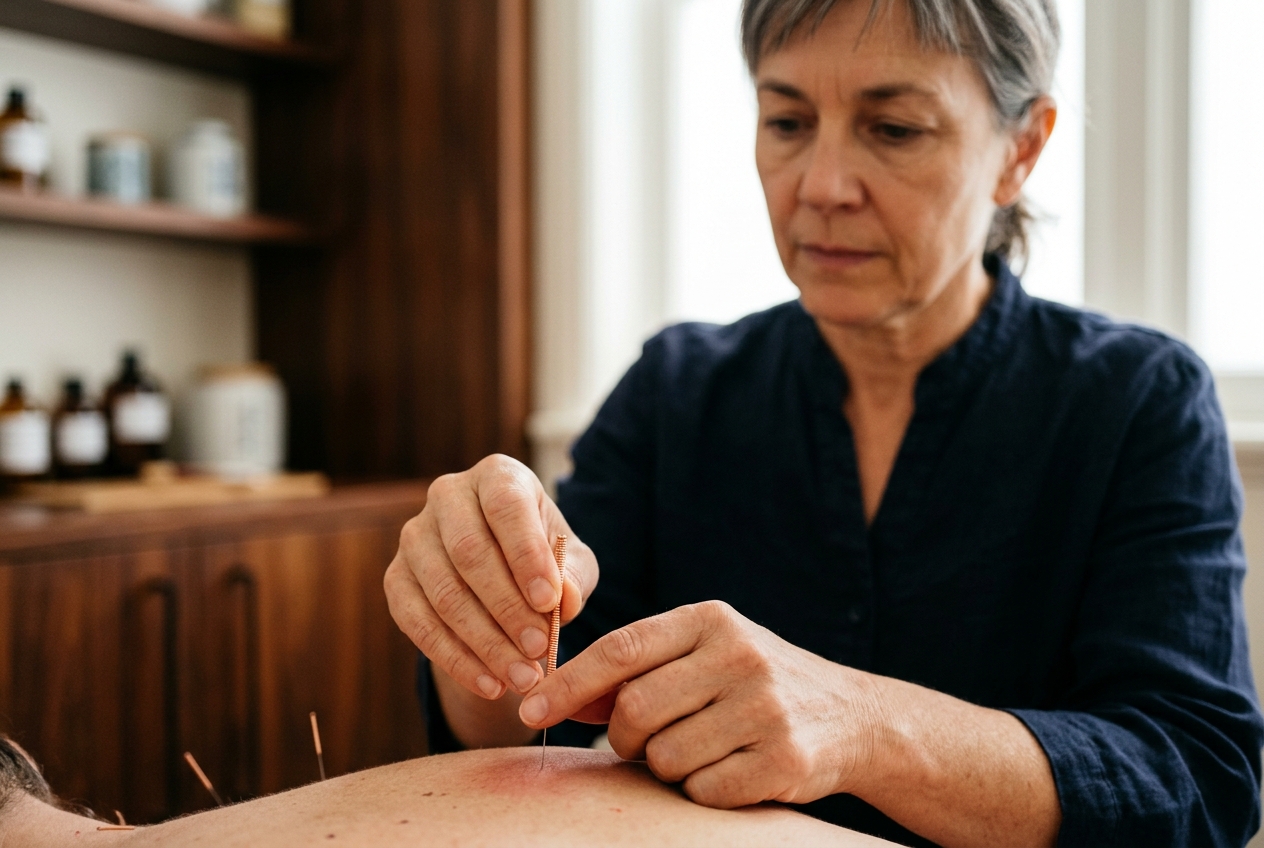
If you have ever experienced an intractable ache deep within your shoulder blades after hours at a desk, or a stubborn, heavy sluggishness across your lower limbs that ordinary massage fails to budge, you have encountered what Traditional Chinese Medicine (TCM) defines as recalcitrant channel stagnation (Jing Luo Yu Zhi). In modern neuromuscular terms, this manifests as a chronic densification of the deep fascial planes—a state where localized micro-adhesions, ischemic trigger points, and extracellular fluid stasis create a sensory barrier. Standard manual pressure often simply bounces off the surface of these tissues, failing to reach the deeper sensory receptors embedded within the connective tissue matrix.
When conventional rubbing or static pressing yields only fleeting relief, classical acupuncture offers a sophisticated mechanical solution: Gua Fa (刮法), or the filiform needle handle scraping technique. First codified during the height of Chinese medical scholarship, this technique utilizes rapid, microscopic acoustic vibrations to propagate mechanical shear waves deep into stubborn fascial beds.
By understanding the biophysical principles behind this classical method, we can demystify how subtle acoustic shearing dissolves physiological stagnation. Furthermore, we can translate these insights into a refined, non-invasive home practice using fingernail strumming and targeted acupressure across primary therapeutic loci.
+-------------------------------------------------------------------------+
| CLASSICAL INSIGHT : THE MECHANICS OF "GUA FA"                           |
| "Scraping the needle handle generates resonant micro-acoustics that     |
| awaken sluggish De Qi, dislodging stubborn stagnation without causing   |
| structural micro-trauma to delicate fascial networks."                  |
+-------------------------------------------------------------------------+
2. Historical & Classical Foundations: The Whispering Needle in the Canon
The therapeutic lineage of Gua Fa emerges from the golden age of classical acupuncture systematization. It is most famously illuminated in the masterwork of Ming Dynasty scholar-physician Yang Jizhou, the 1601 compendium Zhen Jiu Da Cheng (The Great Compendium of Acupuncture and Moxibustion). Within its lyrical passages, particularly in the foundational Jin Zhen Fu (金针赋, The Ode to the Gold Needle), Yang and his predecessors addressed a recurring clinical dilemma: what to do when a needle has been precisely inserted into an acupoint, yet the vital therapeutic sensation—De Qi (得气)—remains completely dormant.
In classical theory, De Qi signifies the arrival and active mobilization of bodily resources at the treated locus. Without De Qi, the therapeutic effect is negligible. However, classical masters recognized that aggressively thrusting, twisting, or forcing a needle deeper into resistant tissue risked tearing micro-vasculature and causing unnecessary pain.
                                  GUA FA DYNAMICS

    Fingernail Scraping ---> Filiform Handle ---> Needle Shaft Micro-Vibration
             |                                              |
             v                                              v
      Acoustic Wave Generation <----------------- Extracellular Matrix
             |                                              |
             +--------------> Mechanoreceptor <-------------+
                              Activation (De Qi)
The elegant solution was Gua Fa: resting the left thumb gently on the skin at the base of the point to stabilize the tissue, while the right thumbnail rhythmically scraped upward or downward along the filiform needle’s spiraled handle.
The Jin Zhen Fu pithily summarizes its dual therapeutic action: "Scraping the handle generates and disperses Qi" (刮柄以引气散气). Rapid, controlled friction generates a continuous micro-vibrational hum that travels directly down the shaft into the tissue. Rather than relying on brute force, Gua Fa uses acoustic resonance to awaken recalcitrant channels, gently unlocking stagnant energetic pathways without physical disruption.
3. Biophysical & Neurofascial Mechanisms: Acoustic Waves, Adenosine, and the Matrix
Modern biomechanics and neurophysiology have revealed the remarkable sophistication of this ancient technique. When a thumbnail scrapes the grooved handle of a filiform needle, it produces high-frequency mechanical vibrations (typically between 100 and 300 Hz). The metallic shaft acts as an acoustic waveguide, directly transmitting these high-frequency shear waves into the viscoelastic extracellular matrix (ECM).
+---------------------------------------------------------------------------+
| BIOPHYSICAL CASCADE OF GUA FA                                             |
| 1. High-Frequency Micro-Vibration (100–300 Hz)                            |
| 2. Mechanical Shearing across Collagen & Interstitial Fluid               |
| 3. High-Threshold Mechanoreceptor Excitation (Pacinian & Meissner)        |
| 4. Cellular Adenosine Triphosphate (ATP) Cleavage -> Interstitial Adenosine|
| 5. A1-Receptor Mediated Antinociception & Local Vasodilation             |
| 6. Propagated Sensation Along the Meridian (PSM) Neurovascular Wave       |
+---------------------------------------------------------------------------+
Mechanoreceptor Activation & Purinergic Signaling
As pioneered by neurobiological investigations into acupuncture mechanisms, mechanical manipulation of connective tissue triggers a profound cellular cascade. Groundbreaking research published via PubMed on Adenosine A1 Receptor Mechanisms demonstrates that mechanical rotation and vibration of needles induce local cells to release adenosine triphosphate (ATP), which is rapidly degraded into adenosine. Adenosine binds to local $A_1$ adenosine receptors, delivering a potent, long-lasting antinociceptive (pain-relieving) effect and increasing microcirculatory blood flow.
Furthermore, these micro-acoustic vibrations specifically stimulate rapidly adapting Pacinian corpuscles and Meissner corpuscles embedded in the subcutaneous and fascial layers. These mechanoreceptors respond optimally to transient, high-frequency vibratory stimuli, firing afferent signals through large-myelinated $A\beta$ and moderately myelinated $A\delta$ nerve fibers to close the spinal pain gate.
Fascial Mechanotransduction and Propagated Sensation
As established in landmark studies on Connective Tissue Mechanotransduction, subcutaneous collagen fibers physically wind around an oscillating needle tip. The rhythmic shearing generated by Gua Fa creates micro-acoustic wave propagation across continuous intermuscular septa.
This mechanical continuity explains the clinical phenomenon known as Propagated Sensation Along the Meridian (PSM)—a perceptible, radiating wave of warmth, heaviness, or electrical buzzing that travels along recognized anatomical pathways. Far from being an esoteric concept, this phenomenon reflects the physical transmission of shear stress and purinergic signaling along hydrated connective tissue highways.
4. The Meridian Path — A Journey Through Bodily Landscapes
To understand where and how to apply these techniques, we must trace the pathways where physical stagnation most commonly gathers. The human body is interlaced with continuous fascial conduits that link peripheral limbs directly to central physiological functions.
- The Front-Body Highway (Stomach Meridian - Foot Yangming): Beginning just below the eye socket, this channel sweeps down the jaw, courses down the neck, chest, and belly, passes through the crease of the hip, travels down the fleshy anterior compartment of the thigh, descends along the outer edge of the shinbone, and terminates at the tip of the second toe. It governs nourishment, tissue regeneration, and postural grounding.
- The Inner Arch & Emotional Valve (Liver Meridian - Foot Jueyin): Starting on the inner corner of the big toenail, this pathway climbs across the top of the foot, ascends past the inner ankle, traces the inner border of the calf, traverses the inner thigh, and terminates in the ribcage beneath the breast. It is the body's primary conduit for regulating muscular tone and systemic tension.
- The Forearm Release Pathway (Large Intestine Meridian - Hand Yangming): Originating at the tip of the index finger, this channel travels through the webbed muscular mound between the thumb and forefinger, runs up the top outer edge of the forearm to the elbow crease, ascends the shoulder to the neck, and finishes at the opposite side of the nose. It serves as the primary clearing route for cranial congestion, jaw tension, and neck strain.
- The Deep Calming Corridor (Pericardium Meridian - Hand Jueyin): Emerging from the chest, it travels down the inner arm, running precisely between the two prominent tendons of the inner forearm, through the center of the palm, to the tip of the middle finger. It regulates cardiac rhythm, diaphragmatic ease, and autonomic equilibrium.
5. Non-Invasive Acupressure Translation: The Fingernail Scraping & Strumming Method
While classical Gua Fa requires filiform needles and licensed clinical training, its underlying biophysical mechanics—high-frequency friction, micro-vibrational resonance, and transverse fascial shearing—can be adapted into an effective manual therapy technique: Fingernail Strumming & Scraping Acupressure (Zhua Gua Fa).
Rather than applying broad, static thumb pressure, this method uses the clean, rounded edge of the fingernail (or the edge of an adjacent knuckle) to apply rapid, perpendicular strumming strokes across the dense fascial bands surrounding classical acupoints. This rhythmic friction induces mechanoreceptor firing and stimulates local adenosine release, effectively replicating the acoustic signature of classical needle scraping without piercing the skin.
All point locations correspond to the standardized clinical criteria established by the World Health Organization Standard Acupuncture Point Locations.
+-------------------------------------------------------------------------------+
| CLINICAL PROTOCOL: NON-INVASIVE "FINGERNAIL STRUMMING"                        |
|                                                                               |
| 1. Anchoring: Stabilize the surrounding tissue with your non-dominant thumb.  |
| 2. Angle: Place your dominant fingernail at a 45-degree angle to the skin.    |
| 3. Vector: Strum transversely across the underlying tendon or fascial groove. |
| 4. Frequency: Maintain a rapid, rhythmic pace (2–3 strokes per second).       |
| 5. Duration: Apply continuously for 60–90 seconds per therapeutic locus.     |
+-------------------------------------------------------------------------------+
           NON-INVASIVE FINGERNAIL STRUMMING TECHNIQUE

     Non-Dominant Hand                   Dominant Hand
    [Anchoring Thumb]               [Curved Fingernail @ 45°]
           |                                   |
           v                                   v
    +--------------+                    \~~~~~~~~~~~~~/ (Rapid 2-3 Hz
    | Skin Surface |                     \  Strumming /  Oscillation)
  ==+==============+======================\==========/=============
           |                                   |
           v                                   v
    [Stabilized Base]               [Transverse Fascial Shearing]
                                               |
                                               v
                                    Deep Mechanoreceptor Firing
The Five Cardinal Points and Their Application
+-------------------------------------------------------------------------------+
| POINT REFERENCE MATRIX                                                        |
+---------+--------------------+-------------------------+----------------------+
| Point   | Classical Name     | Anatomical Landmark     | Primary Function     |
+---------+--------------------+-------------------------+----------------------+
| ST36    | Zusanli (足三里)   | Outer shin, below knee  | Vitality & Digestion |
| LV3     | Taichong (太冲)    | Foot web, 1st/2nd metat.| Stress & Qi Flow     |
| LI4     | Hegu (合谷)        | Hand web, 1st/2nd metac.| Head & Neck Clearing |
| SP6     | Sanyinjiao (三阴交)| Inner calf, above ankle | Hormonal & Fluid Bal.|
| PC6     | Neiguan (内关)     | Inner forearm, 2 tendons| Nausea & Vagal Tone  |
+---------+--------------------+-------------------------+----------------------+
1. ST36 (Zusanli - "Leg Three Miles")
- Everyday Landmark: Sit with your knees bent at 90 degrees. Place four fingers across the front of your leg, directly below your kneecap. Locate the outer edge of your vertical shinbone; slide one finger-width outward into the fleshy muscle valley (the tibialis anterior).
- Sensory Feedback: A distinct, dull ache accompanied by a warm sensation that radiates down the outer shin toward the ankle.
- Strumming Dynamics: Anchor your outer leg with your fingers. Using the edge of your thumb or index fingernail, strum perpendicularly across the muscle fibers (moving side-to-side across the channel) at a brisk frequency of 2 to 3 beats per second for 2 minutes.
- Daily Applications: Chronic fatigue, post-prandial bloating, and deep lower-limb heaviness.
2. LV3 (Taichong - "Great Surge")
- Everyday Landmark: Look at the top of your foot. Place your finger in the soft webbing between your big toe and second toe. Slide your finger upward along the groove between the two long foot bones (the metatarsals) until your finger settles into the narrow, sensitive junction where the bones meet.
- Sensory Feedback: A sharp, tender, electric sensation that often surprises with its sensitivity.
- Strumming Dynamics: Rest your heel on the floor. Use your index fingernail to execute a firm, downward scraping motion along the bony groove toward the web of the toes. Apply moderate pressure for 90 seconds.
- Daily Applications: Tension headaches, irritability, eye strain, and physical stress stored in the jaw.
3. LI4 (Hegu - "Joining Valleys")
- Everyday Landmark: Bring your thumb and index finger flat together. A prominent mound of muscle will rise between them on the back of your hand. Place your opposite thumb on the peak of this mound, then relax your hand. Angle your thumb slightly inward toward the bone of your index finger.
- Sensory Feedback: A pronounced, deeply resonant ache that can radiate toward your wrist or index finger.
- Strumming Dynamics: Support your palm with your fingers. Use your opposite thumbnail to apply short, rhythmic transverse scraping strokes against the border of the second metacarpal bone for 60 to 90 seconds.
- Daily Applications: Tension in the neck and shoulders, frontal headaches, sinus congestion, and mental fatigue.
4. SP6 (Sanyinjiao - "Three Yin Intersection")
- Everyday Landmark: Locate the highest, most prominent point of your inner ankle bone. Place four fingers horizontally above this landmark along your calf. Feel for the soft depression located immediately behind the inner edge of your shinbone.
- Sensory Feedback: A tender, heavy, bruised sensation that indicates the intersection of the Spleen, Liver, and Kidney conduits.
- Strumming Dynamics: Anchor your foot. Using the flat curve of your fingernail, scrape gently upward along the posterior border of the tibia in slow, rhythmic pulses for 90 seconds.
- Daily Applications: Restless legs, lower abdominal distension, pelvic floor congestion, and disrupted sleep.
5. PC6 (Neiguan - "Inner Pass")
- Everyday Landmark: Turn your hand palm-up. Measure three finger-widths down your forearm from the primary wrist crease. Clench your fist slightly until two thick, cord-like tendons stand out in the center of your wrist. The point lies precisely in the deep valley between these two tendons.
- Sensory Feedback: A spreading, tingling warmth that travels through the palm into the middle finger, accompanied by an immediate reflexive deepening of the breath.
- Strumming Dynamics: Support the back of your wrist with your fingers. Press your thumbnail between the two tendons and perform a rapid, lateral strumming motion (flicking across the tendons like guitar strings) for 60 seconds.
- Daily Applications: Motion sickness, stress-induced palpitations, tightness in the chest, and acute anxiety.
6. Clinical Indications & Vector Dynamics: Tonification (Bu) versus Sedation (Xie)
In classical acupuncture, the efficacy of Gua Fa depends on the direction and speed of manipulation. These principles translate directly into manual strumming and scraping:
+-------------------------------------------------------------------------------+
| DIRECTIONAL BIOMECHANICS: VECTOR DYNAMICS                                     |
+-------------------+--------------------------------+--------------------------+
| Parameter         | Tonification (Bu Fa - 补法)    | Sedation (Xie Fa - 泻法) |
+-------------------+--------------------------------+--------------------------+
| Vector Direction  | Follows channel flow (Centrip.)| Opposes flow (Centrif.)  |
| Stroke Frequency  | Gentle, rhythmic (1 Hz)        | Rapid, vigorous (3–4 Hz) |
| Tissue Objective  | Warms, nourishes, activates    | Clears heat, drains stasis|
| Primary Contexts  | Chronic fatigue, cold limbs    | Acute pain, hypertension |
+-------------------+--------------------------------+--------------------------+
                   VECTOR DYNAMICS OF GUA FA

   TONIFICATION (Bu Fa)                  SEDATION (Xie Fa)
   Follows Meridian Flow                 Opposes Flow / Dispersive

       [ Upward/Centripetal ]                [ Downward/Centrifugal ]
             ^                                     |
             |  Smooth, Rhythmic                   |  Rapid, Vigorous
             |  (1 Hz)                             |  (3-4 Hz)
             |                                     v
   +-----------------------+             +-----------------------+
   | Deep Nourishment      |             | Clears Acute Tension  |
   | Enhances Vitality     |             | Resolves Stagnation   |
   | Restores Tissue Tone  |             | Drains Inflammation   |
   +-----------------------+             +-----------------------+
The Dynamics of Tonification (Bu Fa)
To tonify deficient, depleted tissues (such as in chronic lower back ache, constitutional fatigue, or cold extremities), scraping vectors must follow the natural trajectory of the meridian. Strumming should be smooth, rhythmic, and moderate in speed (roughly 1 Hz), warming the connective tissue beds and encouraging systemic circulation without triggering defensive muscular guarding.
The Dynamics of Sedation (Xie Fa)
To sedate acute, excess stagnation (such as in acute muscle spasms, migraine episodes, or inflammatory flare-ups), the scraping vector runs opposite the channel's pathway or disperses outwardly from the core toward the extremities. Strokes are applied with higher frequency (3–4 Hz), generating micro-acoustic shear waves that interrupt nociceptive pain signaling and promote lymphatic drainage.
7. Point Combinations for Common Conditions
To resolve complex patterns of tension, individual points should be combined into synergistic protocols. Below are targeted clinical combinations designed for specific modern ailments.
                     EVENING DECOMPRESSION PROTOCOL

    Step 1: LI4 (Hand Web)        Step 2: LV3 (Foot Valley)     Step 3: PC6 (Inner Wrist)
   [Lateral Strumming, 90s]  ---> [Downward Scrape, 90s]   ---> [Transverse Strum, 60s]
              |                              |                             |
              v                              v                             v
       Releases Neck &                Opens Peripheral              Calms Diaphragm &
       Cranial Tension                Blood Vessels                 Deepens Respiration
Protocol A: The Desk-Bound Headache & Neck Clearing Sequence
- Context: At the end of a long workday, when screen glare and prolonged sitting cause tension to pool in your upper trapezius muscles, temples, and suboccipital ridges.
- Step 1: Sit comfortably with your spine supported. Begin on your left hand at LI4 (Hegu). Apply lateral thumbnail strumming across the muscle edge for 90 seconds, consciously relaxing your jaw and forehead as you exhale. Repeat on the right hand.
- Step 2: Move to your feet and locate LV3 (Taichong). Perform downward scraping strokes from the bone junction toward the web of the toes for 90 seconds per foot. This combination—classically known as the "Four Gates" (Si Guan)—promotes systemic vasodilation and releases muscular tension.
- Step 3: Conclude at PC6 (Neiguan) on both wrists, strumming across the twin tendons for 60 seconds each to ease respiration and settle the nervous system.
Protocol B: Recalcitrant Digestive Stasis & Post-Meal Bloating
- Context: When poor digestion leaves you feeling heavy, distended, and lethargic after eating.
   Step 1: ST36 (Outer Shin)               Step 2: SP6 (Inner Calf)
  [Downward Strumming, 2 Min]  -------->  [Upward Scraping, 90s]
              |                                      |
              v                                      v
   Stimulates Gastric Motility            Harmonizes Fluid Balance
   & Parasympathetic Tone                 & Eases Abdominal Fullness
- Step 1: Locate ST36 (Zusanli) on your outer shin. Use your thumb or knuckle to apply downward strumming strokes for 2 minutes on each leg. This activates the vagal-gastric reflex arc and stimulates healthy gastrointestinal motility.
- Step 2: Move directly to SP6 (Sanyinjiao) on the inner lower leg. Using moderate upward strokes, scrape along the rear edge of the shinbone for 90 seconds on each side to support fluid metabolism and relieve lower abdominal pressure.
8. Safety, Contraindications, and Clinical Sense
While non-invasive scraping and strumming acupressure is safe and versatile, sound clinical judgment is essential.
+-------------------------------------------------------------------------------+
| CRITICAL CLINICAL CAVEATS & CONTRAINDICATIONS                                 |
|                                                                               |
| PREGNANCY RESTRICTION:                                                        |
| Strictly avoid LI4 (Hegu) and SP6 (Sanyinjiao) during pregnancy. Both loci    |
| stimulate uterine tone and promote downward pelvic descent.                   |
|                                                                               |
| TISSUE INTEGRITY:                                                             |
| Never apply scraping or fingernail strumming to broken skin, active burns,    |
| varicose veins, open wounds, or areas of localized infection.                 |
|                                                                               |
| PRESSURE REGULATION:                                                          |
| Therapy should produce a therapeutic ache, not sharp pain. Discontinue       |
| immediately if bruising, persistent erythema, or sharp nerve pain occurs.     |
+-------------------------------------------------------------------------------+
- Absolute Pregnancy Contraindications: Points LI4 (Hegu) and SP6 (Sanyinjiao) are potent descending loci historically used to induce labor and promote uterine contraction. They must be avoided entirely throughout pregnancy.
- Tissue Sensitivity & Force Calibration: The goal of fingernail scraping is acoustic vibration and mechanoreceptor excitation, not blunt-force friction. The skin should show at most a mild, transient redness (hyperemia); it should never be scratched, broken, or bruised. If you experience sharp, superficial pain rather than a spreading, deep ache, decrease your pressure immediately.
- When to Seek Professional Medical Care: Self-applied acupressure is a supportive wellness practice, not a substitute for medical diagnosis. Consult a qualified physician or licensed acupuncturist if you experience:
- Sudden, severe headaches ("thunderclap" onset)
- Unexplained, persistent neurological numbness or progressive weakness
- Chronic, unremitting gastrointestinal pain accompanied by unintentional weight loss
- Suspected deep vein thrombosis (swelling, warmth, and localized tenderness in the calf)
9. Today’s Takeaway: The Two-Minute Reset
You do not need an entire afternoon or specialized equipment to experience the restorative benefits of classical vibrational medicine. You can begin right now, sitting at your desk:
+-------------------------------------------------------------------------------+
| THE TWO-MINUTE RESET ROUTINE                                                  |
| 1. Elevate your right leg and place your left index finger at ST36 (Zusanli). |
| 2. Locate the fleshy depression one finger-width outside your shinbone.       |
| 3. Set a timer for 60 seconds.                                               |
| 4. Strum across the muscle fibers at a brisk pace (2–3 beats per second).     |
| 5. Take three deep diaphragmatic breaths, feeling the spreading ache.         |
| 6. Switch legs and repeat on the opposite side for 60 seconds.                |
+-------------------------------------------------------------------------------+
As the micro-vibrational shear waves activate mechanoreceptors within your deep fascia, notice the subtle shift: the gradual warming of your lower limbs, the deepening of your breath, and the release of accumulated tension. In just two minutes, you have engaged the same physiological pathways cultivated for centuries by classical masters—reawakening stagnant tissue through the refined, resonant science of Gua Fa.