Gong Bu Bow Stance Qigong: Sagittal Pelvic Tensegrity, Iliopsoas Elongation, and Asymmetric Ground Reaction Force Vectoring in Classical Daoyin
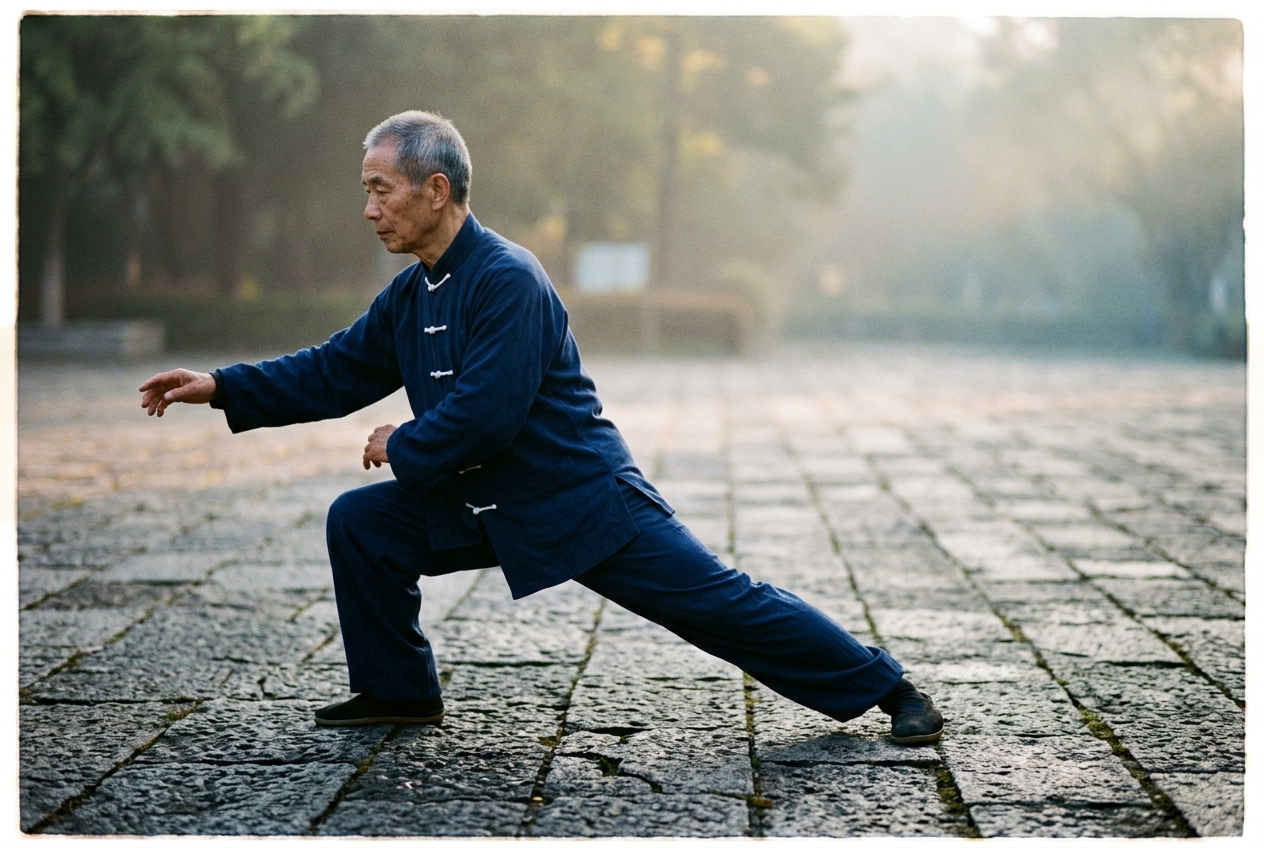
Rather than relying on brute muscular force, Gong Bu reorganizes how your body interacts with gravity. In classical Chinese medicine and movement philosophy, the posture is engineered to quiet mental chatter by directing attention and circulation to the lower body. The foundational concept of Dantian (丹田)—which Western anatomy understands as the body's primary center of mass located roughly two inches below the navel—acts as a hydraulic reservoir. By relaxing the waist through an action known as Song Yao (松腰) and opening the deep inguinal folds of the hips, known as the Kua (胯), the practitioner creates a structural funnel. Ground reaction force is drawn upward from the Yongquan (湧泉, "Bubbling Spring") acupoint on the soles of the feet directly into this abdominal center, stabilizing the physical and energetic core.
STEP-BY-STEP SOMATIC PRACTICE PROTOCOL
To experience the full therapeutic and biomechanical value of Gong Bu, the posture must be constructed from the ground up with architectural precision. Follow this granular somatic sequence.
       Phase 1               Phase 2               Phase 3               Phase 4
  [Dual-Track Stance]  ->  [Sagittal Descent]  ->  [Pelvic Neutrality]  ->  [Dantian Breath]
  (Shoulder-width sep)     (70/30 weight split)    (Song Yao & Coccyx)     (Fascial expansion)
1. The Dual-Track Foundation
Begin in a neutral standing posture, Wuji (无极), with feet parallel and shoulder-width apart. Rather than stepping forward on a single tightrope-like line, maintain this shoulder-width lateral separation as you slide your left foot forward roughly two and a half to three shoulder-widths. Your lead left foot must point directly forward (true north), while your rear right foot pivots outward to precisely forty-five degrees.
2. Sagittal Descent and Weight Distribution
Inhale deeply, and as you exhale, lower your pelvis vertically toward the floor. Shift your weight until precisely 70 percent of your body mass rests upon the lead left leg, leaving the remaining 30 percent supported by the rear right leg. Flex the lead left knee until it forms a supportive right angle (a 90-degree angle) with the tibia perpendicular to the floor. Under no circumstances should the lead knee drift forward past the tips of the toes, as this introduces destructive patellar shear. Simultaneously, press the rear right heel down, driving the calcaneus into the floor to lock the posterior structural pillar.
3. Pelvic Alignment and Song Yao
Place your hands on your anterior superior iliac spines (the bony crests of your hips). In an untrained lunge, the pelvis twists open toward the rear leg, causing the lower back to arch. In classical Gong Bu, gently draw the lead hip crease back while wrapping the rear hip forward until the pelvis is square to the front. Now execute Song Yao: consciously release muscular tension across the lumbar spine, allowing the coccyx (tailbone) to drop naturally toward the earth as if weighted with a lead plumb bob. This subtle posterior tilt decompresses the L4–S1 vertebrae and instantly engages your lower abdominal wall.
4. Diaphragmatic Breath Integration
Rest your palms gently over your lower abdomen, two inches below the navel (Lower Dantian). Inhale smoothly through the nose over a count of four, feeling a three-dimensional, 360-degree pneumatic expansion across your lower abdomen, flanks, and lower back. As you inhale, allow the pelvic floor to soften downward. As you exhale through the nose over a count of six, gently engage the pelvic floor (Huiyin, 會陰) with a subtle upward drawing sensation, driving structural intra-abdominal pressure that reinforces the spine while the legs remain firmly rooted.
5. Smooth Somatic Transition and Exit
After holding the stance for three to five complete breath cycles (approximately 30 to 60 seconds), do not collapse out of the posture. Inhale, push firmly through the lead heel to extend the forward knee, shift the weight back into the rear leg, and step the forward foot back into the parallel shoulder-width Wuji position. Stand quietly for three breaths to observe the post-isometric rebound before repeating the entire sequence on the opposite side (right leg lead, left leg rear).
DIAGNOSTIC FAULTS & REAL-TIME CORRECTIONS
| Observable Fault | Biomechanical Mechanism | Somatic Diagnostic Cue | Real-Time Corrective Action |
|---|---|---|---|
| Medial Knee Collapse (Dynamic Valgus) | Weakness in the ipsilateral gluteus medius; adductor hypertonicity. | Lead knee falls inward of the big toe; medial joint line compression. | Manually externally rotate the lead femur; align the patella directly over the second toe; press through the lateral edge of the front foot. |
| Rear Heel Elevation (Calf Shortening) | Inelasticity of the gastrocnemius-soleus complex; loss of posterior grounding. | Daylight visible under the rear heel; weight dumping exclusively forward. | Abduct the rear foot to exactly 45 degrees; actively drive the calcaneus downward into the earth as if sinking into wet sand. |
| Lumbar Hyperlordosis (Pelvic Dump) | Tight psoas major pulling the lumbar spine forward into excessive lordosis. | Pinching sensation in the lower back; protruding belly; disengaged core. | Apply Song Yao; gently tuck the tailbone under; draw the lower abdomen toward the spine to lengthen the lumbar vertebrae. |
SOMATIC SENSATIONS: WHAT YOUR NERVOUS SYSTEM IS EXPERIENCING
As you sustain the isometric architecture of Gong Bu, you will encounter distinct somatic markers. Learning to interpret these signals separates mechanical exercise from authentic mind-body cultivation:
- Penetrating Warmth (Re, 熱): A profound thermogenic flush radiating through the front quadriceps, groin, and lower belly. Physiologically, this reflects massive capillary recruitment, localized vasodilation, and the metabolic cost of high-threshold motor unit recruitment during sustained isometric loading.
- Micro-Pulsing Tingling (Zhen, 針): A subtle, effervescent tingling sensation traveling down the posterior chain and into the plantar surface of the feet. This marks peripheral neurovascular stimulation, enhanced cutaneous mechanoreceptor signaling, and the activation of unmyelinated C-tactile afferents in the deep fascia.
- Structural Heaviness (Zhong, 重): A sensation of sinking density, as though your lower limbs have been cast in bronze or rooted like ancient timber into the subsoil. This is the subjective feeling of myofascial down-regulation, kinetic grounding, and the stabilization of your physical center of mass.
- Fascial Release (Song, 鬆): A sudden, melting alleviation of chronic muscular bracing around the hip joints, sacrum, and respiratory diaphragm. This represents the down-regulation of sympathetic motor tone, allowing tense tissues to transition from rigid holding to elastic tensegrity.
THE BODY SCIENCE: BIOMECHANICS, FASCIA, AND NEUROPHYSIOLOGY
To understand why a simple lunge posture can produce such profound systemic health outcomes, we must look to contemporary musculoskeletal science, fascia research, and autonomic neurobiology.
1. Biomechanical Vectors and Asymmetric Load Distribution
Gong Bu places the human body in an engineered state of asymmetrical kinetic loading. By allocating 70 percent of body weight to the anterior limb and 30 percent to the posterior limb, the posture forces the neuromuscular system to resolve complex tri-planar ground reaction forces (GRFs).
The lead limb functions as a primary shock absorber and load-bearing column. The 90-degree flexion limit at the knee is a critical structural boundary documented in musculoskeletal research published in the Journal of Bodywork and Movement Therapies. Restricting the patella from traveling past the anterior margin of the toes transfers the kinetic load away from the patellofemoral joint cartilage and patellar tendon directly into the muscular bellies of the quadriceps femoris (vastus medialis, vastus lateralis, vastus intermedius) and the gluteus maximus. Concurrently, the ipsilateral gluteus medius and minimus fire isometrically to abduct and externally rotate the femoral head within the acetabulum, preventing medial valgus collapse.
On the trailing limb, the mechanical dynamic is inverted: it operates under high-tension eccentric lengthening. The calcaneus, anchored firmly to the ground at a 45-degree angle, anchors the entire lower leg. This creates a powerful tensile load across the Achilles tendon, gastrocnemius, and soleus, while the extended hip forces the contralateral iliopsoas complex (psoas major and iliacus) into prolonged, restorative elongation. This specific mechanical vector counters the chronic adaptive shortening of the hip flexors caused by modern sedentary lifestyle patterns.
2. Myofascial Tensegrity: The Deep Front and Superficial Back Lines
In the paradigm of structural integration established by Thomas Myers in Anatomy Trains, human movement is governed not by isolated muscles, but by continuous, whole-body sheets of connective tissue known as myofascial meridians. Gong Bu offers a pristine laboratory demonstration of myofascial tensegrity (tensional integrity).
The posture creates a dynamic interplay between two primary fascial highways: * The Deep Front Line (DFL): Beginning in the deep plantar tissues of the foot, running upward through the tibialis posterior, popliteus, adductor group, psoas major, iliacus, and pelvic floor, and continuing along the anterior longitudinal ligament of the spine to the diaphragm and cranial base. In Gong Bu, the lead leg provides an isometric anchor while diaphragmatic breathing drives structural lift through this deep core fascial sheath. * The Superficial Back Line (SBL): Extending continuously from the plantar fascia of the sole, around the calcaneus, up the Achilles tendon, gastrocnemius, hamstrings, sacrotuberous ligament, erector spinae, and epicranial aponeurosis to the frontal ridge of the skull. The grounded rear leg in Gong Bu acts as a tensile spring across this entire posterior continuum. By stabilizing the rear calcaneus and dropping the sacrum through Song Yao, the superficial back line is placed under sustained, elastic tension, releasing chronic myofascial adhesions along the thoracolumbar fascia and relieving chronic tension in the lumbar spine.
Scientific evaluations compiled by the National Center for Biotechnology Information (NCBI PubMed) consistently demonstrate that sustained isometric posturing within functional fascial trains stimulates fibroblast activity, enhances hyaluronic acid lubrication between fascial planes, and improves elastic recoil capacity across the lower kinetic chain.
3. Autonomic Regulation and the Diaphragmatic-Pelvic Piston
From a neurophysiological perspective, holding Gong Bu while executing slow, rhythmic abdominal breathing triggers a potent shift in autonomic nervous system balance. The sustained isometric contraction of large lower-limb muscle groups stimulates mechanoreceptors and intramuscular baroreceptors, sending afferent signals via the spinal cord to the brainstem.
Simultaneously, the coordinated motion of the thoracic respiratory diaphragm and the pelvic floor diaphragm creates a biological hydraulic piston. On inhalation, the descending thoracic diaphragm compresses the abdominal viscera against the muscular floor of the pelvis, generating therapeutic intra-abdominal pressure (IAP) that mechanically stabilizes the lumbar spine from the inside out. On exhalation, the upward recoil of the pelvic floor and deep transversus abdominis stimulates the vagus nerve (CN X) as it passes through the esophageal hiatus. This increases cardiac vagal tone, enhances Heart Rate Variability (HRV), and down-regulates the sympathetic fight-or-flight response, fostering a calm, grounded state of alert relaxation.
TRADITIONAL CHINESE MEDICINE: MERIDIAN DYNAMICS & INNER VECTORS
In the classical medical framework recognized globally by bodies such as the World Health Organization Traditional Medicine Programme, physical postures are dynamic tools designed to clear stagnation and guide the flow of Qi (vital bioelectric energy) and blood (Xue) through the body's primary meridian networks.
1. Yangming and Taiyang Meridian Activation
Gong Bu targets two major Yang meridian pairs along the lower extremities: * The Yangming (Stomach / Large Intestine) Channels: Running down the anterior-lateral aspect of the thigh, knee, and crural region into the dorsum of the foot. The intense isometric loading of the forward leg activates key acupoints, including Zusanli (ST36, "Leg Three Miles") and Liangqiu (ST34), known for tonifying digestive energy, building metabolic stamina, and boosting systemic vitality. * The Taiyang (Urinary Bladder) Channels: Flowing down the entire posterior chain of the body, through the sacral foramina, hamstrings, calf, and lateral foot to the fifth toe. The elongated, grounded trailing leg in Gong Bu stretches and clears this extensive water-element channel. Anchoring the rear heel stimulates points such as Chengshan (BL57) and Kunlun (BL60), dispelling pathogenic cold, draining physical dampness, and clearing stagnation along the spine.
2. Channeling Yuan Qi through the Kua
At the base of the trailing foot lies Yongquan (KD1, "Bubbling Spring"), the root acupoint of the Kidney meridian and the primary energetic portal connecting the body to terrestrial ground energy. In Gong Bu, grounding the rear calcaneus opens this portal.
As the practitioner sinks the hips and relaxes the Kua (the inguinal creases), a dynamic energetic pump is formed. Rather than meeting muscular resistance at the hip joint, terrestrial ground energy is vectored upward through the open Kua, ascending the medial Yin channels (Kidney, Liver, Spleen) directly into the Lower Dantian. Here, it nourishes Yuan Qi (Original Qi)—the congenital constitutional energy responsible for longevity and cellular vitality.
3. Transverse Stabilization of the Dai Mai
The Dai Mai (帶脈), or "Girdling Vessel," is the only horizontal, transverse meridian in the entire human energetic anatomy, encircling the waist like an energetic belt to bind all twelve vertical primary channels together. When a practitioner allows the pelvis to twist unevenly or tips the hips into an exaggerated anterior tilt, the Dai Mai becomes slack, leading to what classical texts describe as energetic leakage between the upper and lower halves of the body. By applying Song Yao, dropping the coccyx, and squaring the pelvic girdle to the front in Gong Bu, the Dai Mai is tightened and balanced. This stabilizes the core cylinder, secures the lumbar vertebrae, and unifies vertical energy flow throughout the entire body.
CLASSICAL LINEAGE: FROM SILK SCROLLS TO MARTIAL ARTS
Gong Bu is not a modern fitness invention; it is an ancestral somatic technology refined across more than two millennia of continuous experiential practice.
The earliest visual evidence of structured lunging postures appears in the famous Mawangdui Daoyin Tu (马王堆导引图)—a silk funerary scroll excavated from Tomb No. 3 at Changsha, Hunan province, dated to the Western Han Dynasty (168 BCE). Among its forty-four painted human figures engaged in therapeutic exercises, several are depicted in unmistakable precursor variations of the bow stance. These early Daoist practitioners utilized asymmetric lower-body loading combined with breath-guided somatic movements to treat digestive disorders, alleviate joint stagnation, and expel seasonal pathogenic influences from the internal organs.
Centuries later, during the Song and Ming dynasties, this asymmetric foundation was codified into one of the most widely practiced medical Qigong routines in human history: the Baduanjin (八段錦), or Baduanjin Eight Pieces of Brocade.
Specifically, in Movement Two, titled "Left and Right Drawing the Bow to Shoot the Eagle/Hawk" (左右开弓似射雕), Gong Bu provides the indispensable lower-body platform. As the practitioner transitions into a deep bow stance, the upper body opens dynamically across the chest to mime drawing an archer’s heavy compound bow. This coordinated movement expands the ribcage, flushes the Lung and Large Intestine meridians with oxygenated blood, and cultivates exceptional kinetic power from the ground up.
As internal martial arts (Neijiaquan, 內家拳) matured through the Ming and Qing dynasties into the styles we recognize today—Taijiquan, Xingyiquan, and Baguazhang—Gong Bu became the cornerstone of ground-force transmission. Master practitioners discovered that human power does not originate in the arms or shoulders; it is generated in the feet, channeled through the legs, directed by the waist (Yao), and expressed through the fingers. Gong Bu became the primary structural vehicle for accumulating and releasing this elastic, whole-body kinetic force.
Today, authoritative professional bodies such as the National Qigong Association (NQA) continue to preserve and teach these classical lineage protocols as essential modalities for contemporary postural rehabilitation, falls prevention, and nervous system regulation.
TODAY'S PRACTICE COMMITMENT: THE FIVE-MINUTE GROUNDING RESET
Theory without somatic practice remains purely academic. To anchor these biomechanical and energetic benefits into your own nervous system, adopt this simple, five-minute grounding routine tomorrow morning before your first cup of coffee or tea.
- Left Gong Bu Root (2 Minutes): Step your left foot forward into a clean, measured bow stance. Maintain the 70/30 weight distribution, ensure your lead knee does not pass your toes, drive your rear right heel into the floor at a 45-degree angle, and drop your tailbone through Song Yao. Rest your palms over your lower belly and breathe slowly into your Lower Dantian for ten deep, unhurried breath cycles.
- Neutral Wuji Integration (1 Minute): Step back to parallel, shoulder-width standing. Close your eyes, let your arms hang loosely, and observe the asymmetrical sensations between your left and right legs. Feel the rush of blood, warmth, and neurovascular activity leveling out across your hips and spine.
- Right Gong Bu Root (2 Minutes): Step your right foot forward and repeat the exact architectural setup for the opposite side. Focus on smoothing the breath, decompressing the lower back, and relaxing the neck and jaw.
Pay attention to how you feel over the subsequent hour: notice the warmth in your extremities, the grounded stability in your step, the natural decompression in your lumbar spine, and the calm, centered clarity of your mind. You have not simply completed an exercise; you have aligned yourself with an ancient, living science of human structural movement.