Geshu Cavity Diaphragm Shu: Infrascapular Fascial Decompression, Diaphragmatic Kinetic Mobility, and Hematological Qi Regulation in Classical Neigong
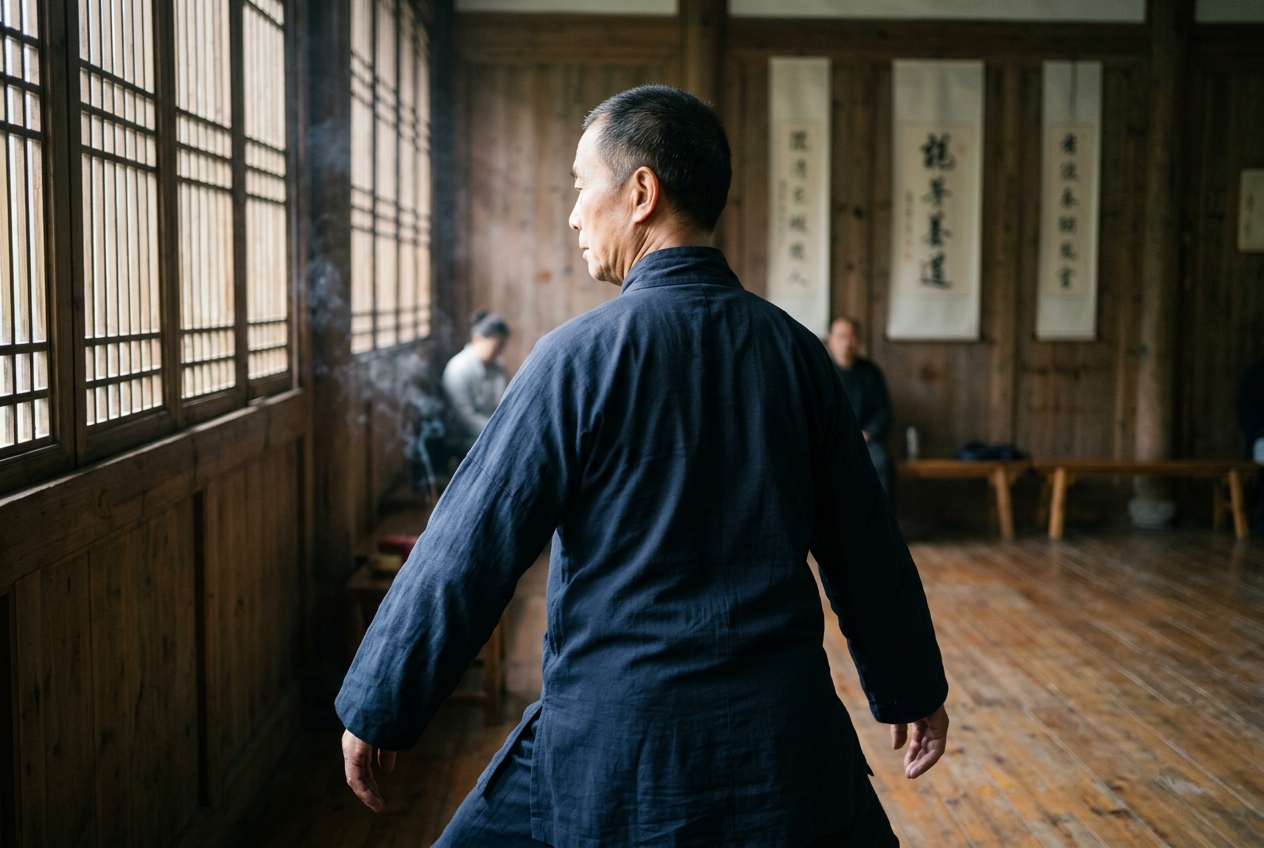
In everyday terms, instead of breathing shallowly into your upper chest, you learn to breathe into your lower belly—an area roughly two inches below your navel termed the Xia Dantian (lower elixir field)—while simultaneously opening the space across your mid-thoracic spine. By expanding the lower abdomen and the mid-back in a synchronized three-dimensional rhythm, you decompress the deep fascial webbing that connects your shoulder blades, spine, and diaphragm. The result is an immediate down-regulation of the nervous system, a surge in systemic microcirculation, and a restoration of natural, fluid movement throughout the entire torso.
       [ Classical Posterior Topography of Geshu (BL17) ]

Spinous Process T7
                          (C7 -> T1...T7)
                           |
             [BL17] <--- 1.5 cun ---> [BL17]
          (Geshu Left)     |       (Geshu Right)
                           |
                  Du Mai Midline (GV)
                           |
               Inferior Angle of Scapula
                           |
             Thoracolumbar Fascial Network
                           |
               Deep Diaphragmatic Crura
Step-by-Step Practice Guide
To unlock the Geshu cavity without strain, follow this progressive sequence combining static postural alignment (Zhan Zhuang, or "standing like a post") with undulating articulation (Daoyin spinal waves). You do not need any specialized equipment—only a quiet space with flat ground.
1. Establishing the Grounded Postural Architecture (Wuji to Zhan Zhuang)
Begin by establishing a stable, suspended base of support: 1. Foot Placement & Weight Distribution: Place your feet strictly parallel, outer edges aligned with the width of your shoulders. Distribute your body weight evenly across the "nine points" of the soles, centering your gravity over the bubbling spring point (Yongquan, K1) located in the depression behind the ball of the foot. 2. Knee Buoyancy & Pelvic Neutrality: Unlock your knees, maintaining a micro-flexion without letting them collapse inward. Allow your sacrum to hang vertically, as though weighted by a small plumb line. This gently flattens excessive lumbar curve without mechanically tucking the pelvis into a posterior clench. 3. Suspension of the Crown (Baihui): Imagine a fine silk cord suspended from the crown of your head, drawing the cervical spine into subtle vertical elongation while the chin rests lightly retracted. 4. Hollowing the Chest and Broadening the Back (Han Xiong Ba Bei): Relax the sternum downward. Without slumping forward, imagine widening the physical space between the medial borders of your scapulae. Let the arms drape naturally, curving as if holding a large, buoyant sphere in front of your lower abdomen, fingers relaxed and pointed toward one another.
2. Dantian-Geshu Synchronized Respiration
Once your static stance is stable, initiate rhythmic thoracoabdominal breathing: 1. The Inhalation Phase (360-Degree Expansion): Inhale slowly through your nasal passages over four to five seconds. Direct the descent of the breath not upward into the clavicles, but downward into the pelvic basin. As your lower belly gently pushes outward, simultaneously direct your interoceptive focus to the T7 region of your mid-back. Feel a reciprocal backward and lateral expansion of the posterior ribs beneath the shoulder blades. The Geshu point should feel as though it is opening like a gentle blossom or expanding outward into an elastic band wrapped around your mid-torso. 2. The Suspension Phase: Pause for one effortless second at the summit of inhalation without closing the glottis or holding pressure in the throat. Keep the infrascapular zone wide and spacious. 3. The Exhalation Phase (Elastic Recoil & Micro-Release): Exhale smoothly through the nose over six to seven seconds. Allow the abdominal wall to draw softly back toward the spine via natural elastic recoil. As the breath empties, consciously release deep-seated muscular tension around the T7 vertebrae, allowing the shoulders to sink further away from the ears while maintaining the buoyant upward suspension of the crown. 4. Repetition: Maintain this rhythmic breathing cycle continuously for 12 to 24 breath cycles.
3. The Dynamic Spinal Wave (Daoyin Infrascapular Articulation)
Transition from static stillness into dynamic spinal wave mobilization to clear fascial adhesions around the mid-dorsal hinge: 1. Initiation from the Feet: Press gently into your heels, sending a soft kinetic ripple upward through the knees and pelvis. 2. Lumbar to Thoracic Undulation: Allow your pelvis to tilt subtly forward, rippling an extension wave up through the lumbar spine. As the wave reaches the mid-back (T7), gently draw the shoulder blades down and back, opening the anterior chest without flaring the ribcage. 3. Thoracic Flexion & Geshu Opening: Reverse the wave: push gently through the balls of the feet, soften the sternum inward, and let the mid-back expand backward into a smooth, gentle convex dome. Feel the rhomboids and middle trapezius glide cleanly over the underlying ribcage, creating traction directly through BL17. 4. Coordinate Breath with Motion: Inhale during the subtle upward opening; exhale during the backward posterior expansion of the Geshu cavity. Perform 8 to 12 slow, continuous repetitions.
       [ Dynamic Breath-Motion Sequence for BL17 ]

[Inhale: 4-5s]  --> Diaphragm descends, abdomen expands 360°
                           |
  [Pause: 1s]     --> Gentle lateral width across infrascapular fascia
                           |
  [Exhale: 6-7s]  --> Elastic recoil of Dantian, deep T7 decompression
                           |
  [Spinal Wave]   --> Micro-undulation from heels to crown through BL17
Common Beginner Mistakes and Precise Corrections
- Fault 1: Thoracic Hyperextension (Rib Flaring)
- The Mistake: Forcing the chest forward and arching the mid-back in an attempt to stand "straight," which severely compresses the T7 vertebrae and pinches the diaphragmatic crura.
- The Correction: Soften the xiphoid process and lower anterior ribs downward toward the pelvis. Imagine your mid-back resting against a warm, supportive wall.
- Fault 2: Scapular Winging and Upper Shoulder Elevation
- The Mistake: Pulling the shoulder blades together or shrugging them toward the ears, activating the upper trapezius and locking the infrascapular fascia.
- The Correction: Engage the serratus anterior subtly by imagining you are gently wrapping the bottom tips of your shoulder blades around the sides of your ribcage, sinking the elbows downward.
- Fault 3: Abdominal Bracing (Reverse Breath-Locking)
- The Mistake: Tensing the rectus abdominis tightly, preventing the central tendon of the diaphragm from descending.
- The Correction: Fully soften the wall of the lower belly. Allow the pelvic floor to relax naturally on inhalation so intra-abdominal pressure distributes evenly rather than jamming against the spine.
Somatosensory Milestones: What to Feel and What It Means
As you progress through these drills, specific somatic sensations will arise: * Localized Thermal Sensation (Re): A distinct feeling of spreading warmth between the shoulder blades indicates capillary vasodilation and the activation of deep microvascular perfusion across the mid-dorsal tissues. * Subtle Tingling or Vibrational Buzzing (Ma): Tingling radiating along the thoracic ribs or down the spine reflects the release of chronic peripheral nerve compression and the awakening of cutaneomuscular mechanoreceptors. * Profound Rooted Heaviness (Chen): A sensation of the upper body becoming light and buoyant while the lower torso and legs feel deeply weighted signals the descent of your center of mass and successful parasympathetic nervous system shifting. * Myofascial Spontaneous Unwinding (Song): Sudden, involuntary micro-releases, soft clicks along the rib heads, or an immediate urge to take a spontaneous, unrestricted sigh confirm the mechanical decompression of the diaphragmatic crura.
Why It Works — The Body Science
The profound therapeutic and energetic transformations experienced when opening the Geshu cavity are deeply anchored in contemporary functional biomechanics, neuroanatomy, and microvascular physiology.
+-------------------------------------------------------------------------+
|                  BIOMECHANICAL & PHYSIOLOGICAL CASCADE                  |
+-------------------------------------------------------------------------+
|  1. Postural Neutrality (T7 Decompression)                              |
|     --> Eliminates mechanical impingement on diaphragmatic crura (L1-L3)|
|                                                                         |
|  2. True Diaphragmatic Excursion                                        |
|     --> Lowers intrathoracic pressure / elevates intra-abdominal pressure|
|                                                                         |
|  3. Hydrostatic Piston Effect                                           |
|     --> Maximizes venous return through Inferior Vena Cava & Aorta      |
|                                                                         |
|  4. Neuro-Autonomic Recalibration                                       |
|     --> Stimulates vagal afferents, enhances Heart Rate Variability (HRV)|
|                                                                         |
|  5. Systemic Microvascular Perfusion                                    |
|     --> Capillary recruitment & optimal hematocrit transport (Xue Hui)  |
+-------------------------------------------------------------------------+
Precise Anatomical Topography
In classical topography, Geshu (BL17) is located on the posterior aspect of the thorax, precisely 1.5 cun (approximately two finger-widths) lateral to the inferior border of the spinous process of the seventh thoracic vertebra (T7). This location aligns horizontally with the inferior angle of the scapula when the arms are resting neutrally at the sides.
Deep to the skin and subcutaneous tissues at this coordinate lie the lower fibers of the trapezius, the rhomboid major, the latissimus dorsi aponeurosis, the serratus posterior inferior, and the longissimus and iliocostalis divisions of the erector spinae. More critically, T7 marks the exact transitional hinge where the thoracic kyphotic curvature interfaces with the lower posterior ribs, directly overlying the posterior costodiaphragmatic recess.
The Classical "Meeting Point of Blood" (Xue Hui) in Modern Physiology
Classical texts identify BL17 as the Hui-Meeting Point of Blood (Xue Hui), designating it as the primary somatic node for treating all pathologies related to blood stasis, blood deficiency, and hemorrhage. When examined through contemporary hematological and circulatory frameworks, this classical attribution reveals remarkable anatomical logic:
- Vascular Proximity to Major Circulatory Conduits: Directly anterior to the T7 vertebral body lies the descending thoracic aorta, the azygos and hemiazygos venous systems, and the main trunk of the thoracic duct—the human body's primary lymphatic channel.
- The Diaphragmatic Hydrostatic Piston: The mechanical action of the diaphragm serves as a vital secondary heart. During unconstrained diaphragmatic respiration, the downward piston motion of the central tendon creates a negative pressure gradient in the thoracic cavity while generating rhythmic positive pressure within the abdominal cavity. This pressure differential dramatically accelerates venous return through the inferior vena cava (which traverses the central tendon at T8) and propels lymphatic fluid through the thoracic duct.
- Enhancing Systemic Microvascular Perfusion: When the mid-dorsal spine is compressed by poor posture or emotional armoring, this hydrostatic pump is severely compromised. Restoring the mobility of the T7-T12 motor units eliminates mechanical impedance on the aorta and vena cava, instantly boosting systemic capillary exchange and microvascular hematocrit distribution throughout peripheral tissues. Clinical overviews documented by the World Health Organization Traditional Medicine continue to explore these integrative physiological intersections between acupoint stimulation and circulatory dynamics.
Biomechanical and Fascial Architecture
The structural continuity connecting the superficial mid-back to the deep viscera relies on the intricate fascial web documented extensively in modern biomechanics research, such as articles indexed in the National Center for Biotechnology Information and detailed in anatomical treatises on the thoracolumbar fascia.
   [Infrascapular Fascia / Middle & Lower Trapezius / Rhomboids]
                                |
                                v
               [Thoracolumbar Fascia (TLF)]
                                |
                                v
      [Vertebral Motor Units T7-T12 & Posterior Rib Heads]
                                |
                                v
        [Deep Diaphragmatic Crura (Anchoring at L1-L3)]
                                |
                                v
       [Thoracoabdominal Hydrostatic Pressure Gradients]
The middle and lower trapezius and rhomboid major muscles do not terminate at isolated bony insertions; their epimysial sheets merge into the middle and posterior layers of the thoracolumbar fascia. This fascial sheet links directly to the deep muscular pillars of the thoracic diaphragm—the right and left diaphragmatic crura—which anchor firmly to the anterior surfaces of the upper lumbar and lower thoracic vertebral bodies (L1–L3 and T12).
When a practitioner exhibits thoracic hyperextension or scapular winging, the infrascapular myofascia shortens chronically. This creates a mechanical tug-of-war across the thoracolumbar lattice, locking the diaphragmatic crura in a state of sustained isometric spasm. By consciously decompressing the Geshu cavity through the Han Xiong Ba Bei vector, the practitioner releases tensile strain across the crural tendons, permitting the diaphragm to complete its full anatomical excursion.
Autonomic and Vagal Recalibration
The mechanical decompression of BL17 and the underlying costovertebral joints directly modulates the sympathetic paravertebral chain ganglia situated along the heads of the ribs. Relieving chronic compressive loads in the T5–T9 segment dampens aberrant sympathetic outflow to the upper abdominal viscera (stomach, liver, spleen).
Simultaneously, the deep, rhythmic movement of the diaphragm stimulates vagal nerve afferents passing through the esophageal hiatus, shifting systemic neurovegetative balance toward high-vagal parasympathetic dominance. As evidenced by clinical research across National Institutes of Health databases, this autonomic shift markedly improves Heart Rate Variability (HRV), optimizes digestive function, and accelerates tissue regeneration.
Classical Lineage & Context
The systematic study of the Geshu cavity and its role in internal somatic cultivation is not a modern innovation; it is the culmination of more than two millennia of continuous empirical observation within Chinese medicine and Daoist internal cultivation (Neidan).
+-------------------------------------------------------------------------+
|                  HISTORICAL LINEAGE OF GESHU CULTIVATION                |
+-------------------------------------------------------------------------+
|  Huangdi Neijing (ca. 2nd Century BCE)                                 |
|  --> First systematic mapping of the 12 primary meridians & BL17       |
|                                                                         |
|  Nan Jing: Classic of Difficult Issues (Chapter 45, Han Dynasty)        |
|  --> Codification of the Eight Hui-Meeting Points: "Xue Hui Geshu"     |
|                                                                         |
|  Daoist Neidan & Daoyin Traditions (Tang to Song Dynasties)             |
|  --> Identification of the Jiaji Pass (Narrow Spine Pass) at T7         |
|                                                                         |
|  Internal Martial Lineages (Ming to Qing Dynasties: Taiji, Yiquan)      |
|  --> Operational principle: Han Xiong Ba Bei (Hollow Chest, Pluck Back) |
+-------------------------------------------------------------------------+
The foundational codification of Geshu appears in the seminal medical canon Huangdi Neijing (The Yellow Emperor’s Inner Classic, ca. 2nd century BCE), where the Bladder Meridian—the longest and most complex channel in the body, detailed in resources such as the Wikipedia entry on the Bladder meridian—was methodically mapped along the paraspinal musculature.
However, it was in the Han Dynasty alchemical and medical classic, the Nan Jing (The Classic of Difficult Issues), that the theoretical status of Geshu was immortalized. In Chapter 45, the author outlines the Ba Hui Xue (The Eight Hui-Meeting Points)—the eight master somatic junctions that concentrate the energetic resonance of specific anatomical substrates (Sinews, Bones, Marrow, Qi, Vessels, Organs, Viscera, and Blood). The text delivers the enduring aphorism:
“Blood gathers at Geshu; when blood is disharmonized, seek the mid-dorsal hinge.”
Within the esoteric lineage of Daoist internal alchemy (Neidan), the anatomical region surrounding Geshu was known by a different, highly descriptive title: the Jiaji Pass (the "Narrow Spine" or "Central Squeeze" Pass). Daoist alchemists categorized the human spine into three formidable energetic fortresses, known as the San Guan (Three Gates or Three Mountain Passes), which internal energy (Qi) had to ascend along the Governor Vessel (Du Mai): 1. The lower Weilü Pass at the coccyx. 2. The central Jiaji Pass at the T7/Geshu level. 3. The upper Yuzhen (Jade Pillow) Pass at the occiput.
Masters of classical Daoyin recognized that the central Jiaji Pass was the most difficult of the three gates to open because it serves as the somatic reservoir for repressed emotional stress, grief, and physical defensive posturing. When an individual experiences prolonged distress, the body instinctively forms a muscular carapace across the rhomboids and mid-trapezius—a phenomenon modern somatic psychology terms "character armor."
In the eyes of classical Daoist adepts, a frozen Jiaji Pass transformed the dynamic flow of blood and Qi into a stagnant reservoir, obstructing communication between the upper fire chamber of the heart and the lower water reservoir of the kidneys.
During the Ming and Qing dynasties, these alchemical insights were integrated directly into the core movement principles of internal martial arts (Neijiaquan), such as Taijiquan, Baguazhang, and the seminal stationary standing postures of Zhan Zhuang preserved within the National Qigong Association archives. Lineage masters recognized that without the conscious opening of Han Xiong Ba Bei to liberate the Geshu cavity, internal martial power (Jin) could not transmit smoothly from the lower legs and sacrum through the spine into the hands, and longevity cultivation remained fundamentally incomplete.
Today's Practice Commitment
To transform these anatomical principles from theoretical concepts into permanent somatic literacy, dedicate yourself to this concise, five-minute morning protocol before engaging with your digital devices or drinking your first morning coffee:
- Minute 1: Grounding & Structural Calibration: Stand in the parallel Wuji stance. Spend sixty seconds releasing tension down the leg channels into the soles of your feet, letting your sacrum hang, and elevating the crown point.
- Minutes 2–4: Dantian-Geshu Synchronized Breathing: Perform three uninterrupted minutes (approximately 18 to 20 breath cycles) of slow, 360-degree Dantian-to-mid-back breathing. Focus entirely on the sensation of lateral and posterior expansion beneath your shoulder blades during inhalation, followed by effortless, warm relaxation on exhalation.
- Minute 5: Spinal Wave Integration: Conclude with one minute of gentle, undulating spinal waves to integrate your fascial continuity from heels to crown.
Notice how your postural balance, mental clarity, and baseline respiratory freedom shift over the following hour. By systematically opening this ancient mid-dorsal crossroad each day, you restore the natural biological rhythm between your spine, your breath, and the living vascular network that sustains you.