Ganshu Cavity Liver Shu: Mid-Thoracic Fascial Decompression, Hepatic Qi Regulation, and Sinew Kinetic Elasticity in Classical Neigong
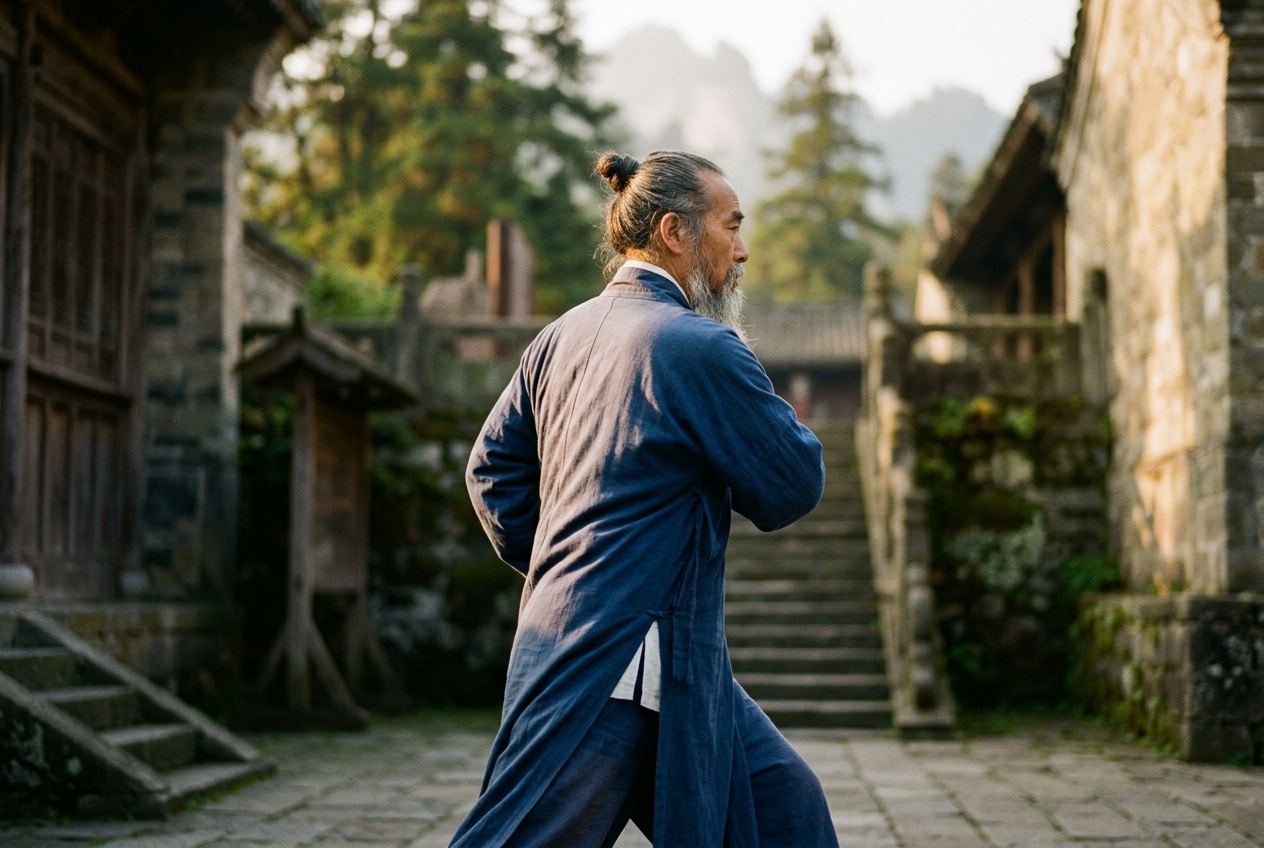
In the taxonomy codified by the World Health Organization Traditional Medicine guidelines and classical acupuncture manuals, the Ganshu point is categorized as a Bei-Shu (Back-Transporting) point. These dorsal loci act as direct conduits through which atmospheric and metabolic energies are transported directly into their corresponding visceral organs. When approached through contemporary biomechanics, decompressing this specific region relieves mechanical impingement on the posterior rami of the spinal nerves and modulates the sympathetic outflow traveling through the greater splanchnic nerve, thereby exerting a direct regulatory influence on hepatic microcirculation and visceral metabolic function.
Step-by-Step Somatic Practice Guide
To safely mobilize and open the Ganshu cavity without inducing compensatory strain in the lumbar or cervical spine, follow this precise didactic sequence:
1. Establishing the Structural Matrix (Wuji Stance)
- Foot Positioning: Place your feet parallel, precisely hip-to-shoulder-width apart, with your toes pointing straight forward. Soften the arches of your feet, sensing the Yongquan (Kidney 1) bubbling spring point behind the ball of the foot establishing an active suction-grip with the earth.
- Pelvic and Cranial Alignment: Tuck the sacrum slightly downward without clenching the gluteal muscles, allowing the lumbar lordosis to flatten naturally. Simultaneously, gently tuck the chin and draw the crown of the head (Baihui, GV20) upward as if suspended from above. This dual vector establishes vertical axial traction through the entire spinal column.
- The "Hollow Chest, Plucked Back" Configuration: Relax the sternum inward by two to three millimeters—a subtle somatic instruction known in internal martial arts as Han Xiong Ba Bei (含胸拔背). Allow the medial borders of both scapulae to glide gently outward, widening the interscapular region and creating a broad, convex myofascial dome across the mid-back.
2. The Micro-Rotational Undulation Sequence
- Phase I: Axial Inhalation: Inhale slowly through your nose using reverse abdominal breathing (Ni Fu Shi Hu Xi). As the breath enters, gently draw the lower abdomen slightly inward toward the spine, directing the internal hydraulic pressure upward and backward into the dorsal rib cage. Feel the posterior ribs at the level of the ninth thoracic vertebra expand laterally and posteriorly.
- Phase II: The Segmental Spiral: As you reach the peak of your inhalation, initiate a subtle, three-degree horizontal rotation of your rib cage to the left, keeping your hips, pelvis, and knees completely stationary. The movement must not originate from your shoulders or neck; instead, imagine an internal axis spinning exclusively within the T8–T10 vertebral cylinder.
- Phase III: Dorsal Opening on Exhalation: Exhale smoothly through your nose, releasing the abdominal contraction and allowing the breath to settle into the lower belly. As the air leaves your lungs, gently emphasize the outward expansion of the right Ganshu point, feeling the muscle fibers between the right border of the T9 spinous process and the medial border of the scapula lengthen and release.
- Phase IV: Bilateral Integration: Inhale back to the neutral midline, feeling both Ganshu cavities expand simultaneously. Repeat the spiral to the right side on the subsequent breath cycle. Perform twelve continuous, uninterrupted breath cycles per side.
       =========================================================
                 DIAGNOSTIC MATRIX: BIOMECHANICAL CORRECTIONS
       =========================================================
       DISTORTION PATTERN     PATHOMECHANICS           SOMATIC CORRECTION
       ---------------------------------------------------------
       Mid-Thoracic Kyphotic  Collapse of T7-T11       Lengthen the crown
       Collapse (Slumping)    intervertebral space;    upward (Baihui); draw
                              ischemic compression     sternum slightly in
                              of dorsal rami.          while elevating spine.
       ---------------------------------------------------------
       Hyperlordotic Rib-     Anterior flare of lower  Sink the lower ribs;
       Flaring (Pinching)     ribs; hyper-extension    tuck sacrum to flatten
                              pinching Ganshu cavity   thoracolumbar hinge
                              and blocking splanchnic  into a neutral vertical
                              nerve transmission.      plumb line.
       =========================================================
3. Common Biomechanical Errors and Corrections
- The Kyphotic Slump: Beginners frequently confuse "rounding the back" with collapsing into a slouched, hyper-kyphotic posture. This collapse compresses the anterior vertebral bodies and pinches the dorsal tissues. Correction: Never round forward from the collarbones. Maintain vertical elongation through the crown of the head while allowing the back muscles to expand outward horizontally.
- The Thoracolumbar Hinge Pinch: Practitioners often arch the lower back and flare the lower ribs forward in an effort to stand straight, creating a severe hyperlordotic hinge at T11–L1 that jams the Ganshu aperture shut. Correction: Drop your front lower ribs down toward your anterior superior iliac spines, ensuring that the back of your rib cage remains anchored to your pelvic bowl.
- Scapular Retraction: Clamping the shoulder blades together creates acute ischemic compression across the trapezius and rhomboids, suffocating the Ganshu point. Correction: Let the arms rotate slightly inward so the palms face backward and downward, allowing the scapulae to drift naturally apart.
4. Proprioceptive Sensations and Interpretations
- Deep Thermal Sensation: A radiating warmth emerging in the mid-back indicates microvascular vasodilation and the release of chronic baseline hypertonicity within the deep intrinsic spinal rotators.
- Fascial "Crepitus" or Unwinding Vibrations: Fine tingling sensations spreading down the lateral flanks toward the hypochondrium signify the mechanical release of the thoracolumbar fascia and the restoration of normal gliding mechanics between the latissimus dorsi and longissimus sheaths.
- Descending Somatic Heaviness: A palpable sense of weight sinking through the legs into the soles of the feet reflects the grounding of rebellious Liver Yang and the stabilization of autonomic tone.
Why It Works: Neurobiology, Fascial Mechanics, and Hepatic Hemodynamics
To comprehend the profound efficacy of this Neigong protocol, we must analyze the interface where classical energetic topography intersects with modern biomechanical and neurophysiological science. Detailed anatomical texts mapped on Wikipedia's overview of acupuncture points and meridians record Ganshu as residing precisely 1.5 cun (approximately two finger-widths) lateral to the inferior border of the spinous process of the ninth thoracic vertebra (T9), situated along the medial line of the dorsal Foot-Taiyang Bladder meridian.
       =========================================================
            CROSS-SECTIONAL MYOFASCIAL STRATIGRAPHY AT T9
       =========================================================
       [Skin & Superficial Adipose Layer]
                     |
       [Layer 1]: Trapezius Muscle (Inferior Ascending Fibers)
                     |
       [Layer 2]: Latissimus Dorsi Aponeurotic Sheet
                     |
       [Layer 3]: Erector Spinae Mass (Longissimus Thoracis / Iliocostalis)
                     |
       [Layer 4]: Transversospinalis Group (Multifidi & Rotatores Thoracis)
                     |
       [Layer 5]: Costovertebral Articulation & T9 Posterior Nerve Ramus
       =========================================================
1. Myofascial Stratigraphy and Decompression
As detailed in the stratigraphy schematic above, descending through the Ganshu locus reveals a complex laminography of overlapping muscular tissues: the superficial inferior fibers of the trapezius, the aponeurotic origin of the latissimus dorsi, the intermediate bundle of the longissimus thoracis, and the deepest intrinsic layer composed of the multifidus and rotatores thoracis. Chronic emotional stress, prolonged seated posture, or shallow thoracic respiration causes these dense muscular layers to adhere, generating myofascial trigger points and ischemic fibrotic bands. Micro-rotational spinal undulations create an interlaminar shearing force that rehydrates the interstitial ground substance, reduces fascial cross-linking, and restores longitudinal elasticity to the posterior kinetic chain.
2. The Splanchnic-Hepatic Autonomic Axis
The ninth thoracic spinal segment serves as a critical neurological relay station. Emerging from the intervertebral foramina at this level are the dorsal and ventral rami of the T9 spinal nerve. Deep to the transverse processes, preganglionic sympathetic fibers pass from the spinal cord into the sympathetic chain to form the greater splanchnic nerve, documented extensively in neurological literature accessible via the PubMed database.
These splanchnic fibers descend to synapse in the celiac ganglion, which directly governs the vasoconstriction and vasodilation of the hepatic artery and portal venous system. By relieving biomechanical compression at the T9 intervertebral junction, Neigong practices reduce aberrant sympathetic irritation. This autonomic modulation prompts vasodilation within the hepatic sinusoidal capillary beds, maximizing liver perfusion, optimizing bile synthesis, and facilitating the enzymatic clearance of metabolic byproducts—a modern physiological validation of the classical maxim that opening Ganshu "regulates the storage and smooth dispersal of Liver Blood (Gan Xue)." For deeper insights into spinal-autonomic pathways, explore Wikipedia's reference on the thoracic nerves and autonomic plexus.
       +-------------------------------------------------------+
       |             PHYSIOLOGICAL ACTION PATHWAY              |
       +-------------------------------------------------------+
       |  1. Axial Elongation & Micro-Rotation at T9           |
       |                         ↓                             |
       |  2. Decompression of T9 Dorsal Rami & Fascial Sheaths |
       |                         ↓                             |
       |  3. Modulation of Greater Splanchnic Nerve Tone       |
       |                         ↓                             |
       |  4. Celiac Plexus Relaxation & Hepatic Vasodilation   |
       |                         ↓                             |
       |  5. Enhanced Sinusoidal Perfusion & Venous Drainage   |
       |                         ↓                             |
       |  6. Systemic Fascial Elasticity & Tendon Nourishment  |
       +-------------------------------------------------------+
3. Tendinomuscular Integration (Jing Jin) and Mechanotransduction
In traditional East Asian medicine, the Liver dominates the sinews (Gan Zhu Jin). Cellular biology research indexed on the National Center for Biotechnology Information demonstrates that fibroblasts and tenocytes embedded within connective tissues respond directly to mechanical tension through mechanotransduction. When the Ganshu gateway is mobilized, tensile mechanical signals propagate across the uninterrupted thoracolumbar fascial sheet, stimulating collagen matrix remodeling and hyaluronic acid secretion throughout the body's entire connective tissue web. Consequently, releasing the mid-thoracic spine produces systemic enhancements in joint mobility, fascial recoil capacity, and overall muscular resilience.
Classical Lineage and Textual Foundations
The systematic opening of the mid-thoracic apertures is rooted in the early Daoist traditions of internal cultivation (Neidan) and therapeutic gymnastics (Daoyin). The classical foundational text of Chinese medicine, the Huangdi Neijing (The Yellow Emperor’s Inner Classic, compiled circa 1st century BCE), identifies the Liver as the "General of the Armed Forces, from whom strategy and planning emanate" (Suwen, Chapter 8). The text underscores that the Back-Shu points are the primary energetic ports where environmental pathogenic factors can invade the viscera, and conversely, where internal stagnations can be therapeutically vented to the exterior.
                   HISTORICAL LINEAGE OF THE PRACTICE
                   ==================================
           Huangdi Neijing (Suwen & Lingshu) [c. 1st C. BCE]
                     Codification of Back-Shu Cavities
                                     |
                                     v
           Shangqing Daoist Daoyin Protocols [c. 4th-6th C. CE]
                  Spinal Micro-Coiling & Breath Guidance
                                     |
                                     v
           Song Dynasty Neidan Transmissions [c. 960-1279 CE]
               Integration of Microcosmic Orbit (Xiao Zhou Tian)
                                     |
                                     v
           Classical Martial Neigong (Taijiquan / Baguazhang)
             "Contain Chest, Pluck Up the Back" (Han Xiong Ba Bei)
During the Tang and Song dynasties, internal alchemical lineages associated with Mount Wudang and the Quanzhen (Complete Reality) school integrated these clinical insights into martial and meditative praxis. Master practitioners recognized that an individual could not circulate internal energy through the Microcosmic Orbit (Xiao Zhou Tian) if the mid-back remained structurally congested. The Ganshu point was identified as the critical gateway guarding the boundary between the middle and lower energetic burners (Zhong Jiao and Xia Jiao). In the internal martial traditions of Taijiquan and Baguazhang, mastering the phrase Han Xiong Ba Bei became mandatory: without the lateral expansion of the dorsal Ganshu region, issuing internal kinetic power (Fa Jin) through the arms while maintaining dynamic root was considered an anatomical impossibility. Contemporary pedagogical bodies such as the National Qigong Association continue to preserve and teach these exact lineage mechanics for health preservation and structural longevity.
Today’s Practice Commitment
To transmute theoretical understanding into embodied structural transformation, commit to the following five-minute regimen tomorrow morning immediately upon waking, before consuming food or caffeine:
       +-------------------------------------------------------+
       |               DAILY FIVE-MINUTE PROTOCOL              |
       +-------------------------------------------------------+
       |  0:00 - 1:00 | Establish Wuji posture; calibrate      |
       |              | axial elongation from Baihui to       |
       |              | Yongquan.                              |
       |  1:00 - 3:30 | Perform 12 slow, coordinated micro-   |
       |              | rotational spirals across T9 with      |
       |              | diaphragmatic breath integration.      |
       |  3:30 - 5:00 | Stand in quiescent stillness; observe  |
       |              | thermal changes, lateral fascial       |
       |              | release, and ocular clarity.           |
       +-------------------------------------------------------+
Over the subsequent two hours, pay acute attention to your physiological baseline. Notice whether your visual field appears brighter and sharper (reflecting the classical pathway wherein the Liver meridian opens directly into the eyes), observe whether the habitual tightness in your hamstrings and plantar fascia has diminished, and track the degree of calm, centered clarity present in your emotional and mental landscape. Through this simple, highly targeted somatic decompression, you restore the natural energetic and physiological function of one of the human body's most foundational kinetic intersections.