Fukushin Abdominal Diagnostics: Navigating Epigastric-Hypochondriac Reflex Zones, Oketsu Palpatory Resistance, and Precision Acupressure Protocols
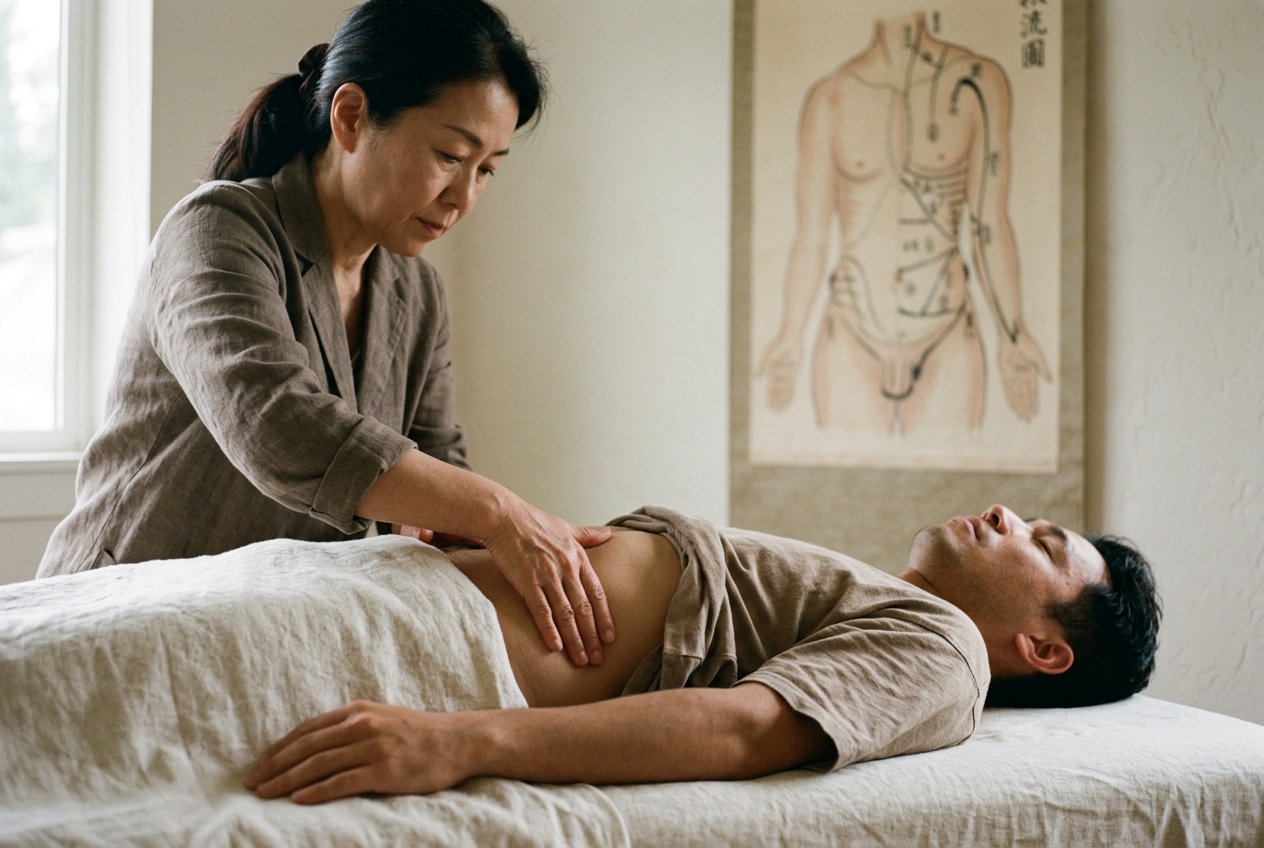
If you have ever experienced an unyielding knot beneath your breastbone during periods of chronic work stress, felt an inexplicable fullness beneath your ribcage that resists a full diaphragmatic breath, or noticed a rhythmic, anxious fluttering deep within your navel that medical blood panels dismiss as benign, you have already encountered the living terrain of abdominal diagnostic mapping. In modern Western domestic life, the abdomen is frequently treated as a passive container—an anatomical trunk housing digestive organs that occasionally misbehave, or an aesthetic surface to be toned at the gym. Yet, beneath the skin lies our most densely innervated sensory interface, home to the enteric nervous system and a primary convergence zone where systemic autonomic tone, microvascular stasis, and visceral stress physically crystallize.
Classical East Asian medicine, particularly the refined Japanese tradition of Fukushin (腹診, abdominal palpation), offers an extraordinarily sophisticated, tactile cartography for understanding these somatic phenomena. Developed across centuries from classical Han dynasty medical canons to Edo-period master clinicians, Fukushin demonstrates that the anterior wall of the torso is an immediate, dynamic mirror of internal organ-meridian homeostasis. When visceral strain or channel stagnation occurs, specific abdominal reflex zones exhibit measurable changes in tissue resistance, temperature, and nociceptive hypersensitivity. By decoding these topographical markers and applying targeted, non-invasive acupressure to distal regulatory hubs on the extremities, we can engage somatovisceral reflex arcs, release chronic myofascial restriction, and restore autonomic equilibrium across the core.
1. The Lineage of the Living Canvas: From Nan Jing to Edo Clinical Realism
The diagnostic centrality of the abdomen possesses an ancient pedigree within East Asian medical philosophy. While foundational Chinese texts such as the Huangdi Neijing (Inner Canon of the Yellow Emperor) laid down the initial cosmological and physiological frameworks of qi, blood (xue), and organ networks (zang-fu), it was the Nan Jing (Classic of Difficult Issues), compiled around the first and second centuries CE, that explicitly codified the abdomen as a multi-layered diagnostic instrument.
In Chapter 16 of the Nan Jing, the author outlines a five-phase topography across the abdominal surface, attributing distinct somatic territories to the primary organ networks: * The Epigastrium (Shinshika): Pertaining to the Fire element and the Heart network. * The Subumbilical Region: Pertaining to the Water element and the Kidney network. * The Periumbilical Center: Pertaining to Earth and the Spleen/Stomach network. * The Right Hypochondrium: Pertaining to Metal and the Lung network. * The Left Hypochondrium: Pertaining to Wood and the Liver network.
While continental Chinese medicine over subsequent dynasties shifted its primary diagnostic focus toward radial arterial pulse reading (Mo Zhen), Japanese practitioners during the Edo period (1603–1867) orchestrated a radical clinical renaissance. Rejecting purely abstract scholasticism in favor of direct, empirical sensory verification, Japanese physicians recognized the abdomen as the most reliable, anatomically stable diagnostic field of the human body.
Foremost among these innovators was Yoshimasu Todo (1702–1773), a pioneering physician of the Koho-ha (Ancient Formula School). Todo famously declared: “Fuku wa sei no hon nari; hyakubyo wa koko ni genzu” (“The abdomen is the root of life; all hundreds of diseases manifest here”). Todo stripped away centuries of speculative metaphysics, insisting that the visceral reality of pathology must be felt directly beneath the clinician's fingertips.
Following Todo, master clinician Inaba Bunrei published his monumental clinical atlas, Fukushō Kiran (腹証奇覧, Illustrated Mirror of Abdominal Diagnoses) in 1800, later expanded by his successor Wakabayashi Tora. Illustrated with detailed woodblock prints, Fukushō Kiran standardized the palpation techniques, tactile resistance grading, and precise herbal-acupoint correlations that form the bedrock of contemporary Japanese Meridian Therapy (Keiraku Chiryo). In this living tradition, the abdominal wall is not a static anatomical wall, but an active, neurofascial biofeedback terminal.
2. The Systematic Topographical Atlas: Key Diagnostic Reflex Zones
Conducting a systematic Fukushin examination requires a relaxed, supine patient, with knees gently bent to eliminate tension in the rectus abdominis and psoas musculature. The practitioner applies light, moderate, and deep pressure using the soft palmar pads of the middle three fingers, moving across five primary functional zones.
A. Shinshika (心下痞 / Epigastric Distress and Heart/Stomach Tension)
- Topography: Situated along the midline in the epigastric region, spanning from the base of the xiphoid process down toward the midpoint between the xiphoid and the navel (corresponding to classical points Juque [CV14] and Zhongwan [CV12]).
- Palpatory Quality: Upon moderate palpation, the tissue presents a taut, unyielding resistance, often accompanied by subjective discomfort, a sense of "stuffiness," or sharp tenderness.
- Clinical Significance: Shinshika reflects dysregulation within the Stomach and Heart networks, typically manifesting in individuals experiencing acute or prolonged psycho-emotional stress, functional dyspepsia, gastroesophageal reflux, or generalized autonomic hyperarousal. It signals a failure of somatic descent—the inability of the body to clear thoracic tension downward into the digestive basin.
B. Kyokyo Kuman (胸脇苦満 / Hypochondriac Fullness and Liver Channel Stagnation)
- Topography: Located bilaterally along the inferior subcostal margins of the ribcage, extending from the tip of the eleventh free rib up toward the costal cartilage arch (encompassing Qimen [LV14] and Zhangmen [LV13]).
- Palpatory Quality: When the practitioner gently curls fingers upward and inward beneath the lower ribs during exhalation, the patient experiences a distinct, defensive discomfort, fullness, or unyielding muscular resistance that prevents deep penetration.
- Clinical Significance: The cardinal signature of Shao Yang and Liver-Gallbladder channel pathology, Kyokyo Kuman denotes severe neurovascular stagnation, diaphragmatic splinting, chronic frustration, intercostal neuralgia, and an inability of the sympathetic nervous system to downregulate following chronic cognitive or physical strain.
C. Kamin or Doki (臍下動悸 / Periumbilical Aortic Pulsation and Chong Mai Hyperarousal)
- Topography: The immediate circumferential perimeter surrounding the navel (Shenque [CV8]), extending slightly superiorly toward Shuifen [CV9] and inferiorly toward Yinjiao [CV7].
- Palpatory Quality: A sharp, bounding, rhythmic arterial thumping palpable directly beneath the fingertips, distinct from normal, diffuse aortic motion. It feels tense, superficial, and irritable.
- Clinical Significance: In Fukushin diagnostics, this bounding periumbilical pulsation signifies a state of Kidney Jing (constitutional essence) vacuity accompanied by secondary upsurges of deficient heat through the Chong Mai (Penetrating Vessel). Clinically, it correlates with adrenal exhaustion, systemic sleep fragmentation, hyper-reactivity, and dysregulated baroreceptor feedback.
D. Shofuku Koki and Shofuku Fuman (Lower Abdominal Tone Divergence)
- Topography: The lower hypogastric zone between the navel and the superior border of the pubic bone (incorporating Guanyuan [CV4] and Zhongji [CV3]).
- Palpatory Duality:
- Shofuku Koki (少腹急結 / Lower Abdominal Hypertonicity): Palpated as rigid, ropy, hyper-contracted muscular bands or sharp, defensive spasms in the lower abdomen, indicating acute lower-burner stasis, urinary irritability, or cold accumulation.
- Shofuku Fuman (少腹不仁 / Lower Abdominal Flaccid Vacuity): The tissue feels hollow, spongy, and devoid of elastic rebound—resembling a deflated balloon or wet cotton. Pressing inward meets zero structural resistance. This cardinal sign indicates severe Kidney-Bladder Yang deficiency, chronic fatigue, pelvic organ prolapse tendencies, and constitutional exhaustion.
E. Oketsu (瘀血 / Localized Left Lower Quadrant Blood Stasis)
- Topography: Focused predominantly in the left iliac fossa, between the anterior superior iliac spine (ASIS) and the lower midline (corresponding anatomically to Daju [ST27] and Fushe [SP13]).
- Palpatory Quality: Deep palmar palpation reveals localized, pebble-like indurations, ropy fascial cords, and a sharp, localized wincing tenderness that is markedly more pronounced on the left side than the right.
- Clinical Significance: Oketsu denotes microcirculatory blood stasis and venous congestion within the mesenteric, iliac, and pelvic vascular beds. It is the hallmark diagnostic finding for chronic gynecological dysfunction (such as endometriosis or dysmenorrhea), systemic inflammatory sequelae, venous insufficiency, and pelvic myofascial pain syndromes.
3. The Neurofascial and Autonomic Substrate
Far from being a mystical artifact of pre-modern intuition, Fukushin diagnostics aligns directly with contemporary neuroscience and fascia research. The abdominal wall serves as the primary intersection for three major physiological control systems:
Viscerosomatic Reflex Arcs and Segmental Convergence
Every visceral organ sends sensory afferent fibers back to the spinal cord via sympathetic pathways (splanchnic nerves derived from thoracic levels T5 through lumbar L2). When an internal organ experiences ischemia, distension, or metabolic inflammation, its unmyelinated C-fiber afferents bombard the dorsal horn interneurons at specific spinal segments.
Because somatic sensory nerves from the abdominal skin, fascia, and musculature converge upon the exact same dorsal horn interneuron pools, the central nervous system misinterprets continuous visceral distress as coming from the somatic body wall. This induces localized muscle guarding, cutaneous allodynia, and fascial densification within the corresponding dermatome and myotome. For example, subcostal Kyokyo Kuman represents a viscerosomatic spasm mediated through the greater splanchnic nerve and intercostal motor nerves (T7–T9), reflecting functional stress in the hepatobiliary and subdiaphragmatic structures.
The Ventral Kinetic Fascial Chain
The human abdominal wall is not a series of isolated muscle plates; it is an integrated, continuous tension network embedded within the deep investing fascia, rectus sheath, transversalis fascia, and the retroperitoneal/mesenteric continuum. Fascial structures are densely embedded with Mechanoreceptors (Ruffini endings, Pacinian corpuscles) and unmyelinated interstitial free nerve endings that regulate local vascular permeability and myofascial tone.
Pathological strain along the deep ventral kinetic chain—extending from the pelvic floor up through the transversalis fascia, diaphragm, and pericardial membranes—creates distinct vectors of mechanical strain. A focal restriction at the left iliac fossa (Oketsu) alters tension vectors across the entire pelvic bowl, transmitting rotational torque upward through the linea alba into the epigastrium (Shinshika).
Autonomic Mesenteric Tone and the Enteric Axis
The mesenteric sheets supporting the small and large intestines are richly endowed with smooth muscle cells, microvessels, and intrinsic neural networks operating under the dual guidance of the sympathetic chain and the vagus nerve.
Sympathetic dominance triggers vasoconstriction within the splanchnic bed, reducing mucosal perfusion, stiffening the mesentery, and producing palpable rigidity across the abdominal quadrants. Conversely, therapeutic stimulation of distal somatic acupoints activates somatovisceral reflex loops, depressing sympathetic outflow, promoting mesenteric vasodilation, and instantaneously releasing parietal abdominal guarding.
4. Precision Distal Acupressure Intervention Protocol
In Japanese Meridian Therapy, the abdomen is primarily a diagnostic sanctuary rather than an aggressive local treatment site. Palpating a tender, hypertonic reflex zone provides the clinician with immediate baseline diagnostic data. The practitioner then selects specific distal regulating acupoints located on the extremities to clear the abdominal tension.
The following master regulatory points are precisely located using natural anatomical body landmarks and standard clinical guidelines as outlined in the WHO Acupuncture Benchmarks and anatomical literature.
Key Distal Points and Their Abdominal Reflex Targets
1. Taichong (LV3 / Liver Channel) — The Master Subcostal Decongestant
- Anatomical Location: Situated on the dorsum of the foot, in the hollow depression distal to the junction of the first and second metatarsal bones. Trace your finger backward along the web-space between your big toe and second toe until your finger slips into a distinct, triangular valley just before the bones meet.
- Somatic Sensation (Deqi): Produces a radiating, dull ache, occasional tingling along the top of the foot, or a subtle clearing sensation ascending the medial lower limb.
- Acupressure Execution: Apply sustained, angled pressure toward the second metatarsal bone using the tip of the thumb. Maintain firm, unyielding, but non-sharp pressure for 90 to 120 seconds while instructing the patient to take long, unhurried abdominal breaths.
- Target Abdominal Release: Directly softens Kyokyo Kuman along the subcostal arch, unlocks diaphragmatic restriction, and restores free lateral costal expansion during inhalation.
2. Zusanli (ST36 / Stomach Channel) — The Epigastric and Mesenteric Modulator
- Anatomical Location: Located on the anterior aspect of the lower leg, four finger-widths inferior to the bottom edge of the kneecap (patella), and one finger-breadth lateral to the sharp anterior crest of the shinbone (tibia), sitting directly in the belly of the tibialis anterior muscle.
- Somatic Sensation (Deqi): A deep, heavy, spreading ache that frequently radiates downward into the dorsum of the foot or upward toward the knee joint.
- Acupressure Execution: Utilize reinforced thumbs (one thumb placed atop the other) to exert perpendicular, deep, rhythmic circular kneading into the muscle belly for 2 minutes per limb.
- Target Abdominal Release: Immediately relieves epigastric hardness in Shinshika, downregulates gastric hyperacidity reflexes, and stimulates rhythmic peristaltic relaxation across the mid-abdomen.
3. Sanyinjiao (SP6 / Spleen Channel) — The Pelvic Microvascular Resolver
- Anatomical Location: On the inner aspect of the lower leg, four horizontal finger-widths above the prominent tip of the medial malleolus (inner ankle bone), nestled directly along the posterior border of the tibia.
- Somatic Sensation (Deqi): Highly sensitive upon palpation; produces a distinct, resonant, sweet ache that can travel up the inner calf toward the medial knee.
- Acupressure Execution: Place the pad of the thumb along the posterior edge of the bone and press slightly forward and under the tibia. Maintain steady, gentle-to-moderate pressure for 90 seconds. Avoid aggressive poking; allow the tissue to yield to sustained pressure.
- Target Abdominal Release: The primary intervention point to dissipate left iliac fossa tenderness (Oketsu), reduce pelvic fascial congestion, and harmonize the lower uterine/ovarian reflex arcs.
4. Neiguan (PC6 / Pericardium Channel) — The Diaphragmatic and Cardiac Stabilizer
- Anatomical Location: On the palmar aspect of the forearm, three finger-widths proximal to the distal wrist crease, lying precisely between the two prominent tendons: the flexor carpi radialis and the palmaris longus (most visible when making a fist and flexing the wrist).
- Somatic Sensation (Deqi): An electrical, expanding tingling sensation that radiates along the median nerve path into the palm, middle fingers, or up the forearm.
- Acupressure Execution: Press deeply into the inter-tendinous groove using the pad of the thumb, aiming pressure perpendicularly between the radius and ulna. Hold for 60 to 90 seconds per wrist while maintaining slow, resonant breathing.
- Target Abdominal Release: Releases subxiphoid epigastric tension (Shinshika), stimulates vagal parasympathetic afferents, relieves cardiac-associated thoracic tightness, and halts nervous nausea.
5. Taixi (KI3 / Kidney Channel) — The Periumbilical Anchor
- Anatomical Location: On the medial aspect of the ankle, positioned in the deep anatomical depression directly between the tip of the medial malleolus and the medial border of the Achilles tendon.
- Somatic Sensation (Deqi): A calm, profound, grounding ache that often generates a sensation of warmth spreading through the heel and ascending the posterior leg.
- Acupressure Execution: Grasp the ankle with your hand, placing your thumb into the KI3 cleft and your index finger on the outer ankle (BL60). Gently pinch and compress these opposing hollows with steady, calming pressure for 2 full minutes.
- Target Abdominal Release: Anchors and attenuates hyperactive periumbilical aortic throbbing (Kamin / Doki), strengthens constitutional tissue turgor in lower abdominal vacuity (Shofuku Fuman), and stabilizes autonomic volatility.
5. Post-Treatment Re-Palpation Protocol & Immediate Verification Criteria
A defining hallmark of Japanese Fukushin diagnostics is its self-verifying, closed-loop feedback design. The clinician never assumes an intervention was successful based solely on theory; rather, every distal acupoint stimulation must be immediately corroborated through re-palpation of the original abdominal reflex zones.
Upon completing distal acupressure, the practitioner gently re-palpates the previously tender or rigid abdominal zones using the exact same finger placement and depth of pressure as during the initial assessment.
Objective Verification Criteria:
- Tissue Elasticity and Tone Normalization: Areas of taut, spastic muscular guarding (such as the subcostal tightness of Kyokyo Kuman or the epigastric hardness of Shinshika) demonstrate immediate myofascial softening, yielding effortlessly to palmar pressure without defensive reflex contraction.
- Attenuation of Nociceptive Response: Points that initially elicited sharp wincing or localized pain upon light-to-moderate pressure (notably the left lower quadrant Oketsu zone) convert into sensations of neutral, comfortable pressure.
- Vascular Rhythm Stabilization: A rapid, superficial, bounding periumbilical aortic pulse (Kamin/Doki) softens into a deep, slow, harmonious vascular rhythm that retreats deep into the retroperitoneal bed.
- Systemic Parasympathetic Emergence: The patient exhibits clear systemic markers of parasympathetic recovery: an involuntary, deep diaphragmatic sigh, audible borborygmi (intestinal gurgling denoting renewed digestive motility), peripheral warming of the hands and feet, and visible relaxation of the facial and suboccipital musculature.
6. The "Evening Visceral Reset" Point Combination Protocol
To translate these clinical principles into an accessible evening self-care routine, the following sequence provides an effective remedy for modern postprandial distress, cognitive overload, epigastric tightness, and nervous sleep disruption.
Step-by-Step Execution Protocol
- Prerequisite Position: Lie comfortably on your back in a quiet, warm space. Place a small pillow under your head and a bolster or rolled pillow beneath your knees to allow the hip flexors and rectus abdominis to completely relax.
- Phase I — Epigastric Release via PC6 (Neiguan): Begin by locating PC6 on your left forearm (three finger-widths above the wrist crease between the tendons). Using your right thumb, apply firm, steady pressure for 90 seconds while focusing your awareness on softening the knot beneath your breastbone. Repeat on the right forearm.
- Phase II — Mesenteric Motility via ST36 (Zusanli): Move down to the lower legs. Locate ST36 (four finger-widths below the kneecap, one finger-width outside the shinbone). Press deeply into the muscle with both thumbs simultaneously, performing slow, circular kneading for 2 minutes. Feel the descent of digestive tension.
- Phase III — Subcostal Decompression via LV3 (Taichong): Move to the feet. Locate the hollow between your big toe and second toe metatarsals. Press firmly into this valley on both feet for 90 seconds. As you maintain pressure, take long, smooth exhalations, consciously letting your lower ribcage widen and descend.
- Phase IV — Quieting the Core via KI3 (Taixi): Grasp the inner ankle hollow behind the ankle bone. Hold sustained, calming pressure on both ankles for 2 minutes, visualizing internal heat and over-thinking descending downward into the soles of the feet.
- Completion: Place both palms gently over your navel. Take five slow, deep diaphragmatic breaths, noticing the renewed softness, warmth, and quietude throughout the abdominal wall.
7. Safety, Clinical Boundaries, and Contraindications
While non-invasive acupressure and diagnostic palpation are exceptionally safe modalities, precise clinical boundaries must be respected:
- Pregnancy Considerations: Strong stimulation of point SP6 (Sanyinjiao) is strictly contraindicated during pregnancy due to its potent influence on the pelvic parasympathetic plexus and potential induction of uterine contractions. Furthermore, deep palmar palpation over the lower abdomen (Shofuku Koki / Shofuku Fuman zones) must be avoided during all trimesters.
- The "Acute Abdomen" Triage: Non-invasive Fukushin is designed for chronic functional, constitutional, and musculoskeletal evaluation. It must never be applied to acute, undiagnosed abdominal crises. If an individual presents with high fever, a rigid "board-like" abdominal wall, involuntary muscular guarding that cannot relax, or rebound tenderness (where sudden release of pressure causes sharp, excruciating pain—a hallmark of peritonitis or appendicitis), all acupressure must cease immediately and emergency medical services must be contacted.
- Aneurysmal Vigilance: While light palpation of a bounding periumbilical aortic pulse (Kamin/Doki) is a standard diagnostic step, clinicians and self-care practitioners must never apply forceful, deep, shearing perpendicular force directly into a severely pulsating midline mass in older adults with atherosclerotic risk factors, ruling out an undetected Abdominal Aortic Aneurysm (AAA).
- Calibrating Sensation: Therapeutic pressure should elicit a sensation that practitioners characterize as Deqi—a deep, resonant, satisfying ache or warmth. It should never cause wincing, breath-holding, or sharp localized pain. Aggressive pressure induces a sympathetic fight-or-flight recoil, reinforcing the very fascial tension patterns the treatment seeks to dissolve.
8. Today's Takeaway: A 2-Minute Diagnostic & Self-Release Exercise
You do not need to wait for a full clinical session to experience the immediate feedback loop of abdominal somatic diagnostics.
- The 15-Second Self-Check: Right now, sitting in your chair or resting in bed, place the pads of your middle fingers just beneath your lower ribs on both the right and left sides. Take a breath in, and as you exhale, gently press your fingertips upward and inward. Note any tightness, fullness, or tenderness (Kyokyo Kuman).
- The 90-Second Intervention: Reach down to your foot. Slide your finger into the web-space between your big toe and second toe, sliding backward until your finger drops into the valley just before the bones connect. This is LV3 (Taichong). Apply firm, deep, stationary pressure with your thumb for 90 seconds. Breathe naturally, allowing your jaw and shoulders to drop.
- The 15-Second Verification: Return your hands to the margins beneath your ribs and press inward once more with the same pressure. You will notice that the underlying tissue has softened, the tenderness has decreased, and your next inhalation enters the lower lungs with noticeably greater ease.
By learning to read the abdominal map, we bridge the gap between ancient tactile wisdom and modern neurofascial physiology—transforming our relationship with our internal organs from one of silent distress into one of conscious, somatic self-regulation.
Authoritative References & Scientific Resources
- WHO Benchmarks for the Training of Acupuncture — World Health Organization standards for point locations and clinical competencies.
- National Center for Biotechnology Information (NCBI PubMed) — Clinical trials, somatovisceral reflex pathways, and neuroimaging studies on meridian stimulation.
- Traditional Japanese Medicine (Kampo & Fukushin) — Comprehensive historical and clinical overview of Japanese medical diagnostic lineages.
- The Anatomy and Mechanics of the Enteric Nervous System — Physiological mechanisms of the brain-gut axis and autonomic innervation.
- Fascial Research and Mechanoreception — Contemporary anatomical findings on the continuity of deep investing fascia and visceral dynamics.