Fengchi Cavity Wind Pool: Sub-Occipital Fascial Decompression, Vertebrobasilar Hemodynamics, and Clear Yang Elevation in Classical Neigong
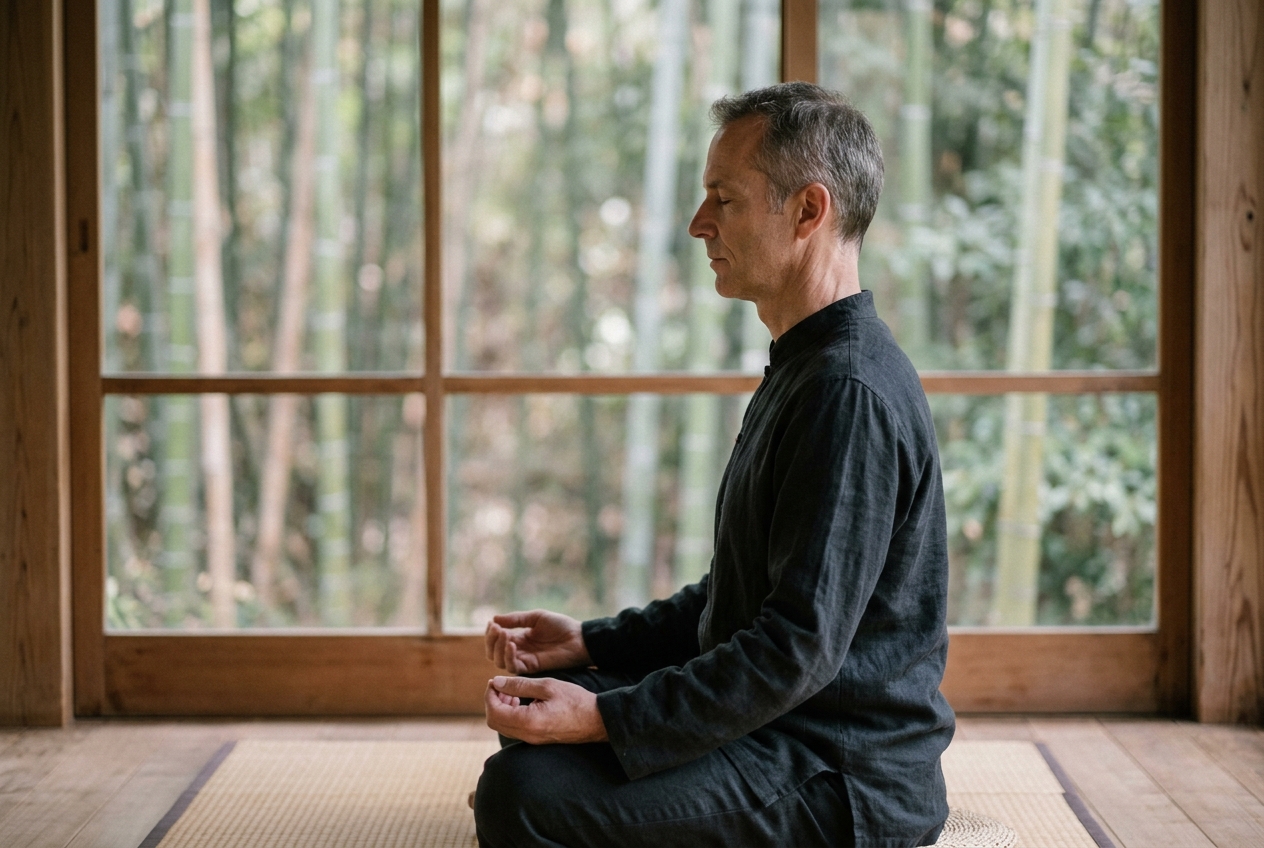
When you spend hours staring at screens, your head drifts forward, causing the muscles at the upper nape of the neck to lock into a state of chronic spasm. Traditional Chinese Medicine (TCM) categorises the resulting stagnation as an accumulation of "Internal Wind"—a poetic yet physiologically descriptive term for neurovascular constriction, spasming connective tissue, tension headaches, and sensory fog. By cultivating what classical masters termed Xu Ling Ding Jin—the effortless, agile suspension of the crown of the head—you create micro-space between the base of your skull and your top cervical vertebra. This structural release allows what classical texts call Qing Yang ("Clear Yang," the refined bio-electrical and oxygenated metabolic energy of the body) to ascend freely into the brain and sensory organs, revitalising mental clarity and ocular acuity.
Step-by-Step Practice Guide: Decompressing the Wind Pool
The following protocol combines structural alignment from Zhan Zhuang (standing pole meditation) with internal fascial unwinding (Daoyin). It requires no equipment and can be performed seated in an ergonomic chair or standing in a classical posture.
1. Foundation and Postural Setup
Begin by establishing a stable, neutral base. If standing, separate your feet shoulder-width apart, parallel to one another, with the knees unlocked and softening over the bubbling springs of the soles (Yongquan, K1). If seated, perch on the forward third of a firm chair so your sitz bones (ischial tuberosities) are grounded and your pelvis is level, not tilted backward.
Rest your hands over your lower abdomen—what classical internal arts designate as the Lower Dantian—approximately two inches beneath your navel. Allow your shoulders to widen horizontally, letting the shoulder blades melt down the rib cage as if weighted with warm water.
2. The Internal Vector of Crown Suspension (Xu Ling Ding Jin)
Bring your attention to the highest point of your skull, the vertex (Baihui, GV20). Imagine an invisible, resilient silken thread attached to this point, gently drawing the crown toward the ceiling.
Do not tilt your head back to achieve height. Instead, gently draw your chin slightly inward and backward—a subtle movement often described as "tucking the chin," though it must be performed without throat constriction. Imagine your cervical vertebrae gently stacking on top of one another like smoothly rounded river stones, creating vertical space at the sub-occipital hinge where the skull rests upon the atlas (C1 vertebra).
3. Sub-Occipital Respiration Pacing
Inhale slowly through your nose for a count of four, directing the somatic sensation of the breath down into the pelvic floor and lower abdomen. As the lower belly gently expands, maintain the upward suspension of the crown.
As you exhale smoothly for a count of six through the nose, bring your active mental focus (Yi) directly into the two bilateral hollows of Fengchi at the cranial base. Do not push or strain. Imagine the tissue in these hollows softening, widening laterally, and releasing like melting ice into water. With each prolonged exhalation, feel the base of your skull floating upward while your shoulders and spine sink downward.
4. Micro-Cervical Daoyin Release
With your crown suspended and breath rhythm established, introduce microscopic somatic movements: - The Micro-Nod: Nod your head downward by no more than two to three millimeters, pivoting purely from the atlanto-occipital joint (the junction directly between your ears), rather than bending your mid-neck. Feel the sub-occipital fascia at Fengchi stretch and widen. - The Micro-Glide: On your next exhalation, rotate your head a fraction of an inch to the left, initiating the rotation purely from the cranial base while keeping the throat open. Pause for one full breath cycle, feeling the contralateral Fengchi cavity bloom open. Return to center on the inhale, and repeat on the right side.
5. Common Beginner Mistakes and Precise Corrections
- The Military Neck Fallacy: Beginners frequently confuse cervical elongation with pulling the chin backward with muscular force. This mistake creates intense tension in the anterior scalenes and hyoid musculature, compressing the throat and restricting the jugular vein.
- Correction: Keep the anterior throat soft and hollow. The movement is an upward lengthening of the back of the neck (occipital lift), not a rigid flattening of the cervical spine.
- Shoulder Elevation: As practitioners attempt to "lift" the crown, they unconsciously shrug the trapezius muscles upward, directly crushing the Fengchi cavity.
- Correction: Drop the elbows and imagine heavy weights hanging from the inferior angles of your scapulae.
- Hyperventilation or Forced Breath: Forcing deep breathing can trigger sympathetic nervous arousal.
- Correction: Breathe naturally, smoothly, and silently. The respiration should be like silk drawn through a ring.
6. Interoceptive Sensations: What to Expect
As the myofascial tension surrounding Fengchi begins to unravel, you may register several distinct somatic markers: * Thermal Shifts (Warmth): A sudden, radiating sensation of heat across the base of the skull, spreading upward over the parietal ridge toward the forehead, indicating restored local micro-circulation. * Paresthesia (Tingling): A fine, champagne-bubble effervescence traveling over the scalp, often described in classical texts as the "opening of the Jade Pillow Pass" (Yuzhen Guan). * Ocular Decompression: A sensation of pressure releasing from behind the globes of the eyes, accompanied by an involuntary sigh or spontaneous swallowing reflex (Jade Liquid secretion). * Cranial Buoyancy (Lightness): The subjective experience of the head losing its dense, heavy weight, feeling effortlessly balanced atop the spine.
Why It Works — The Body Science
The efficacy of opening the Fengchi point is rooted firmly in contemporary functional anatomy, vascular hemodynamics, and neurophysiology. When evaluated through the lens of modern medicine, this classical Daoist practice addresses one of the most mechanically vulnerable bottlenecks in human physiology: the suboccipital region.
Topographically, Fengchi sits over the suboccipital muscles—a specialized quartet consisting of the rectus capitis posterior major, rectus capitis posterior minor, obliquus capitis superior, and obliquus capitis inferior. These tiny, highly dense postural muscles possess one of the highest concentrations of muscle spindles (proprioceptive sensory receptors) anywhere in the human musculoskeletal system—up to 36 spindles per gram of tissue, compared to just 7 in the gluteus maximus. They act as the spatial navigation sensors of the head, constantly adjusting tone to balance the heavy cranial sphere over the cervical column.
When poor posture, visual fatigue, or psychological distress forces these muscles into continuous isometric contraction, two critical neurovascular structures become mechanically impinged:
- The Vertebrobasilar Arterial System: The left and right vertebral arteries ascend through the transverse foramina of the cervical vertebrae before making a sharp tortuous curve along the posterior arch of the atlas (C1) within the suboccipital triangle, entering the skull via the foramen magnum. Hypertonic spasm of the suboccipital muscles directly restricts vertebrobasilar arterial perfusion, compromising transient microvascular blood flow to the brainstem, cerebellum, and visual cortex. By actively decompressing this area through Xu Ling Ding Jin, practitioners relieve mechanical compression on these vessels, enhancing basilar hemodynamics and alleviating the cerebral hypoxia that underlies tension headaches and brain fog.
- The Greater Occipital Nerve: Emerging from the dorsal ramus of C2, the greater occipital nerve pierces through the inferior oblique muscle and upper trapezius near Fengchi. Chronic myofascial constriction here irritates this nerve, producing referred pain that sweeps over the scalp to the retro-orbital region (cervicogenic cephalalgia). Releasing the suboccipital fascial sheath liberates the nerve from entrapment.
Furthermore, anatomical research cataloged by the National Center for Biotechnology Information has validated the existence of the "myodural bridge"—a direct connective tissue continuity linking the rectus capitis posterior minor muscle to the posterior atlanto-occipital membrane and the delicate spinal dura mater (the outermost protective sheath of the central nervous system). Clinical studies on myodural bridges and suboccipital anatomy confirm that hypertonicity at the Fengchi site exerts direct mechanical traction on the cranial and spinal meninges, impacting cerebrospinal fluid (CSF) dynamics and triggering autonomic distress.
Somatic decompression of Fengchi interrupts this cycle. By pairing axial elongation with prolonged exhalations, the practitioner stimulates the baroreceptors and the nearby vagus nerve pathway, shifting the autonomic nervous system out of sympathetic fight-or-flight dominance and into parasympathetic repair. This neurological reset lowers systemic muscular tone, enhances heart rate variability (HRV), and establishes the relaxed, alert state central to deep meditative absorption.
Classical Lineage & Historical Context
The systematic opening of Fengchi is not a modern ergonomic invention; it is an essential pillar of ancient internal cultivation preserved across millennia of medical and martial lineages.
The foundational theoretical framework for Fengchi appears in humanity's oldest preserved medical canon, the Huangdi Neijing (The Yellow Emperor's Inner Classic), dating to the Han Dynasty (circa 2nd century BCE). In the Lingshu (Spiritual Pivot) section, the cranial base is identified as the strategic crossroad where environmental pathogens (External Wind) invade the body and where emotional and metabolic disturbances (Internal Wind) stagnate. The World Health Organization Traditional Medicine classification confirms that GB20 remains one of the most widely indicated acupuncture points in classical literature for dispelling Wind, clearing the sensory orifices, and regulating intracranial pressure.
Within the esoteric Daoist lineages of the Shangqing (Supreme Clarity) tradition and the seminal fourth-century alchemical writings of Ge Hong (Baopuzi), the physical area surrounding Fengchi was recognized as a crucial gatekeeper of the "Three Passes" (San Guan). In Daoist Neidan (Internal Alchemy), the practitioner seeks to refine coarse generative essence (Jing) into vital energy (Qi), and refine Qi into luminous spiritual awareness (Shen). For this refined energy to ascend the spine (Du Mai) and enter the Upper Dantian (Shang Dantian, situated in the cranial cavity), it must penetrate the narrow anatomical gate of the "Jade Pillow Pass" (Yuzhen Guan), flanked symmetrically by the Fengchi cavities. If Fengchi is locked in tension, the spiritual light cannot illuminate the brain, and the practitioner experiences energetic stagnation, irritability, and head fullness.
Later, during the Ming and Qing Dynasties, this medical and alchemical wisdom was woven directly into the internal martial arts (Neijiaquan)—most notably Taijiquan, Baguazhang, and Xingyiquan. The classic treatise attributed to master Wang Zongyue opens with the cardinal rule of internal movement: "Xu Ling Ding Jin, Qi Chen Dantian"—"Suspending the head agilely from the crown, allowing Qi to sink to the lower abdomen." Master practitioners recognized that without this subtle decompression at the cranial base, whole-body tensegrity (Zheng Ti) collapses, structural power dissipates, and the martial artist becomes ungrounded and vulnerable. The somatic techniques practiced today by organizations like the National Qigong Association represent an unbroken continuum of this refined kinetic heritage.
Today's Practice Commitment
To transform this theoretical understanding into lived neurovascular health, integrate this brief, non-straining somatic reset into your daily routine.
Set a recurring timer for mid-morning and mid-afternoon—the peak hours of digital screen fatigue. Step away from your workspace, sit upright or stand in neutral alignment, and execute the seven-minute protocol: two minutes establishing the suspended crown, three minutes pacing sub-occipital respiration, and two minutes observing the micro-unwinding of the cranial base.
As you return to your activities, take thirty seconds to record your subjective markers in a notebook: Did your peripheral vision widen? Has the tension behind your eyes dissipated? Is your breathing naturally deeper? By consistently releasing the Wind Pool, you restore the innate physiological channel through which clarity, vitality, and ease flow upward to illuminate the mind.