Feishu Cavity Pulmonary Shu: Scapulothoracic Fascial Decompression, Dorsal Pulmonary Qi Expansion, and Upper-Limb Kinetic Integration in Classical Neigong
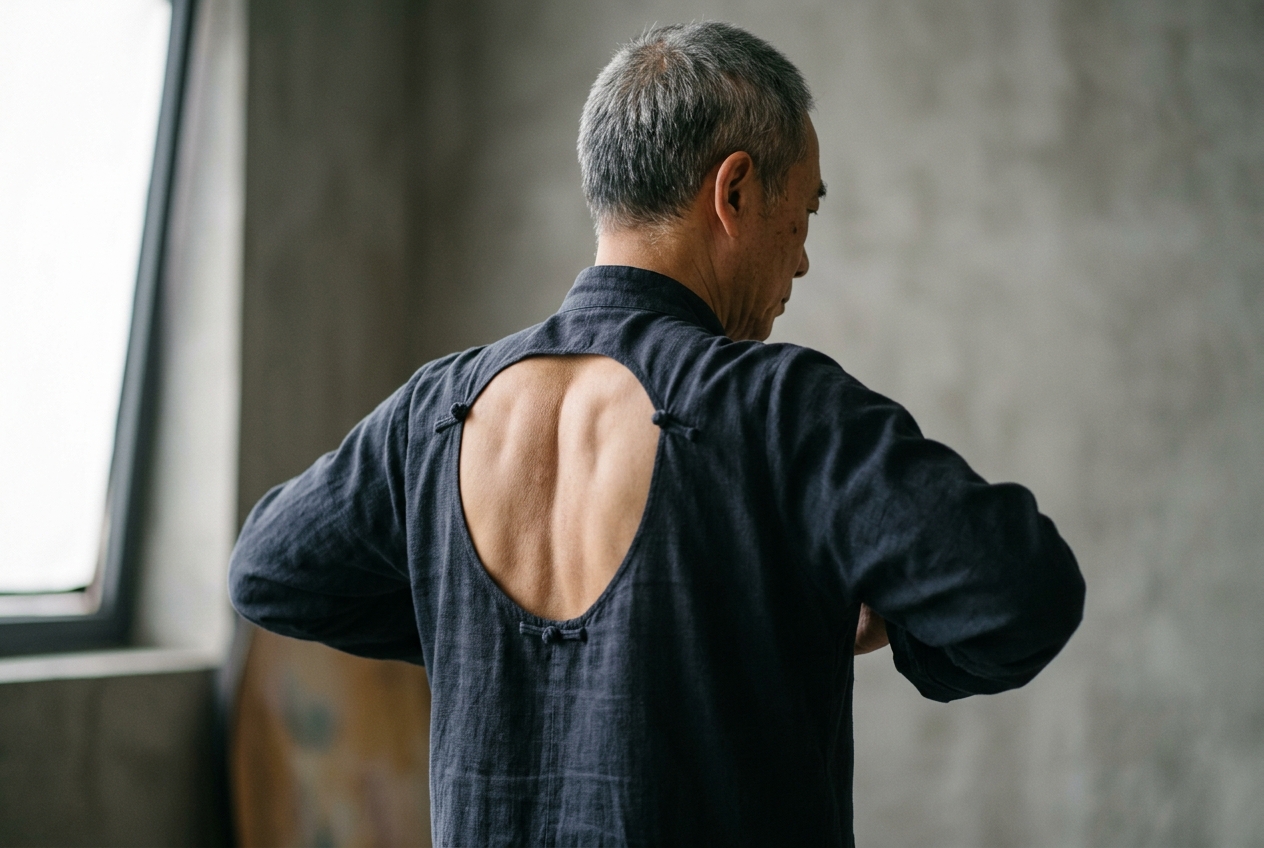
When we experience mental fatigue, emotional grief, or prolonged physical stress, the musculature surrounding the upper thoracic spine locks into a defensive isometric contraction. The shoulder blades pinch inward toward the vertebral column, trapping the breath in the superficial apical chambers of the lungs and compressing the delicate nerves that exit the spinal cord. The practice of "opening the Feishu cavity" involves a sequence of structural adjustments and directed breathing methods designed to widen the interscapular space, decompress the fascial sheaths around the third thoracic vertebra, and restore the natural mechanical pump of the posterior rib cage.
By learning to soften the anterior chest while gently expanding the upper dorsal spine—a posture traditionally described as Han Xiong Ba Bei (含胸拔背, "containing the chest and plucking up the back")—the practitioner transforms the upper rib cage from a rigid cage into an elastic, responsive bellows.
Step-by-Step Practice Guide
This protocol isolates and mobilizes the Feishu apertures through structural alignment, diaphragmatic coordination, and internal somatosensory focus. It requires no specialized apparatus and can be executed within a compact domestic space.
1. Establishing the Grounded Postural Baseline (Wuji Alignment)
- Stand with your feet parallel, precisely shoulder-width apart, distributing your body weight across the tripod of each foot: the ball of the big toe, the base of the little toe, and the calcaneus (heel).
- Micro-flex the knees, allowing the coccyx to sink as though lightly resting against a high barstool. This releases the lumbar lordosis and anchors the pelvic basin.
- Suspend the crown of the head (Baihui, GV20) toward the ceiling, gently tucking the chin to elongate the suboccipital region and straighten the cervical spine.
- Allow the arms to curve softly at your sides, creating an open, airy space in the armpits (Huxin), as if holding a ripe plum under each axilla.
2. Mobilizing the Scapulothoracic Plane (Han Xiong Ba Bei)
- Inhale smoothly through the nose over a four-second count. As you inhale, float both hands upward to chest height, curving the elbows outward to form a wide, rounded circle as if lightly embracing the trunk of an ancient pine (Cheng Bao Zhan Zhuang).
- Do not pull the shoulders toward the ears. Keep the upper fibers of the trapezius soft and descending.
- Without collapsing your sternum inward or hunching the spine, allow the medial (inner) borders of your shoulder blades to glide laterally, spreading outward away from the spine.
- Imagine a horizontal thread connecting the left and right Feishu points (located approximately 1.5 inches lateral to the spine at the level of the upper third of the shoulder blade). Feel that thread gently tauten and widen across the dorsal back.
3. Engaging the Posterior-Inferior Respiratory Vector
- As you exhale through the nose over a six-second count, sink your physical awareness downward toward the lower abdomen (Dantian).
- On the subsequent inhalation, consciously prevent the upper chest and clavicles from rising. Direct the volume of the incoming breath downward into the lower posterior ribs, feeling the breath push backward into the T3 vertebral zone.
- Feel the dorsal rib joints (articulationes costovertebrales) subtly pivot and separate, creating an expansive, buoyant sensation directly across the Feishu field.
- On each exhalation, maintain the widened structural circumference of the upper back while allowing all muscular gripping around the rhomboids and mid-trapezius to melt away.
4. Applying Internal Intention (Yi Dao Qi Dao)
- In classical Chinese somatic theory, Yi Dao Qi Dao (意到气到) dictates that "where the mind's intention arrives, the vital energy follows."
- Maintain your awareness inside the warm, expanding interscapular corridor. Visualize the Feishu cavities breathing in tandem with the physical lungs: expanding outward on inhalation, and releasing warm, heavy tension down through the spine and legs on exhalation.
- Perform this continuous cycle for twelve to twenty-four deliberate, unbroken breaths.
Common Beginner Faults and Corrective Solutions
| Fault Pattern | Biomechanical Error | Somatic Correction |
|---|---|---|
| Interscapular Pinching | Hyper-retracting the scapulae ("military posture"), which crushes BL13. | Broaden the elbows laterally; imagine inflating an inner cushion between the spine and shoulder blades. |
| Kyphotic Slumping | Collapsing the sternum downward, curving the thoracic spine into a hunched posture. | Lift the vertex of the head (Baihui); keep the spine tall while only the muscular sheath of the chest relaxes. |
| Apical Clavicular Breathing | Elevating the shoulders and ribs during inhalation via scalene over-activation. | Place one hand on the upper chest; ensure it remains still while the dorsal and lateral ribs expand. |
| Posterior Cervical Jamming | Tilting the chin upward, compressing the suboccipital hinge and tensing upper traps. | Drop the chin slightly toward the sternal notch to open the cervicothoracic junction (C7–T1). |
Sensory Milestones and Somatic Feedback
- Localized Thermal Radiance (Re, 热): A distinct spreading warmth across the interscapular region, indicating microvascular dilation and the release of chronic muscular ischemia.
- Micro-Vibratory Tingling (Ma, 麻): Fine, effervescent sensations radiating down the ulnar pathway of the arms to the ring and little fingers, caused by the decompression of thoracic spinal roots and myofascial tracks.
- Profound Sinking Heaviness (Chen, 沉): A sensation that the center of gravity has dropped decisively into the pelvis and feet, accompanied by the release of visceral tension in the epigastrium.
- Spontaneous Autonomic Downshift: Automatic deep sighs, increased salivary flow, and a rapid deceleration of racing thoughts, signaling the inhibition of sympathetic outflow.
Why It Works: The Body Science
The clinical efficacy of mobilizing the Feishu cavity rests upon well-documented mechanisms within functional neuroanatomy, respiratory mechanics, and fascial biotensegrity.
Topographical and Myofascial Stratigraphy
Anatomically, Feishu is situated 1.5 cun (approximately two finger-widths) lateral to the lower border of the spinous process of the third thoracic vertebra (T3). Accessing this locus requires working through several distinct myofascial layers:
- Superficial Layer: The descending and transverse fibers of the trapezius muscle, enveloped within the superficial investing layer of deep cervical and thoracic fascia.
- Intermediate Layer: The rhomboid major muscle, which anchors the medial border of the scapula to the spinous processes of T2 through T5.
- Deep Layer: The serratus posterior superior muscle, an accessory muscle of respiration that inserts onto the second through fifth ribs, directly overlying the erector spinae mass (musculus longissimus thoracis and iliocostalis thoracis).
- Articular Foundation: The costovertebral and costotransverse joints, bound by the radiata and costotransverse ligaments, immediately adjacent to the internal intercostal neurovascular bundles.
When an individual adopts a rigid, shoulder-retracted stance or suffers from chronic emotional strain, these fascial strata adhere to one another, forming densified cross-links within the extracellular matrix. Decompressing the scapulothoracic interface restores sliding and gliding mobility along these myofascial planes, particularly within the deep dorsal arm line and spiral lines detailed in modern connective-tissue research published via the National Center for Biotechnology Information (NCBI).
Autonomic and Neuro-Reflex Pathways
The T3 vertebral level corresponds precisely to the emergence of somatic and autonomic nerve roots governing cardiopulmonary function. The dorsal rami of the thoracic spinal nerves innervate the intrinsic spinal musculature and overlying skin of the Feishu locus, while the corresponding ventral rami communicate with the thoracic sympathetic chain ganglia via the white and gray rami communicantes.
Sympathetic postganglionic fibers arising from the T1–T5 segments form the pulmonary and cardiac plexuses, which modulate bronchodilation, pulmonary vascular resistance, and alveolar secretory activity.
Mechanical compression or hypomobility at the T3 costovertebral segment generates sustained nociceptive and sympathetic afferent firing, maintaining the body in a state of sub-acute adrenergic arousal. By mobilizing this dorsal spinal zone through slow, rhythmic breathing and scapular protraction, the practitioner stimulates mechanoreceptors within the costovertebral joint capsules and deep paraspinal tendons. This inputs an inhibitory reflex into the sympathetic chain, balancing autonomic outflow and enhancing vagal tone, as documented in scientific frameworks established by the World Health Organization Traditional Medicine Strategy.
Dorsal Ventilation Dynamics and Gas Exchange Mechanics
Human pulmonary architecture is not symmetrical along the anteroposterior axis; the posterior and basal segments of the lower pulmonary lobes contain significantly larger alveolar surface areas and a higher density of capillary beds than the apical anterior regions.
When breathing is restricted to the anterior chest, the ventral rib cage lifts while the posterior lower lobes remain poorly ventilated, creating a ventilation-perfusion ($V/Q$) mismatch.
Expanding the Feishu zone actively recruits the dorsal-costal musculature, lifting the posterior ribs outward and downward. This creates a negative intrathoracic pressure gradient that pulls inspired air deeply into the rich vascular beds of the posterior lung fields. As detailed in the anatomical compendiums of Wikipedia's Overview of Fascia, this expansion restores the elastic compliance of the endothoracic fascia without requiring energy-expensive shoulder elevation.
+-------------------------------------------------------------------------+
|                  SUMMARY OF NEURO-SOMATIC MECHANISMS                    |
+-------------------------------------------------------------------------+
|  1. Interscapular Fascial Glide: Restores shearing movement between the |
|     trapezius, rhomboid major, and serratus posterior superior strata.  |
|  2. Sympatholytic Reflex: Decompresses T3 dorsal rami to temper chronic |
|     cardiopulmonary adrenergic outflow and support heart-rate variance. |
|  3. Optimized V/Q Ratio: Directs pulmonary volume to the dense capillary|
|     networks in the posterior and basal pulmonary lung lobes.           |
|  4. Reciprocal Axis: Harmonizes the anterior Front-Mu (LU1) aperture    |
|     with the posterior Back-Shu (BL13) regulatory engine.               |
+-------------------------------------------------------------------------+
The Energetic Interplay: Front-Mu (Zhongfu) and Back-Shu (Feishu)
In traditional acupuncture energetics and internal alchemy, single acupoints are rarely cultivated in isolation. Point networks operate in complementary pairs, most notably through the functional polarity of Front-Mu (Alarm/Gathering) points and Back-Shu (Transporting) points.
Feishu (BL13) on the dorsal Taiyang bladder line forms an indissoluble operational axis with Zhongfu (LU1, 中府 - "Central Treasury"), the Front-Mu point of the Lung located on the anterolateral upper chest, just below the acromial end of the clavicle.
According to the classical paradigm: * Zhongfu (LU1) sits on the Yin plane. It is the gathering pool where primordial Qi from the spleen and stomach ascends to combine with atmospheric oxygen (Qing Qi), forming the True Respiratory Qi (Zhen Qi). * Feishu (BL13) sits on the Yang plane along the spinal conduit. It is the distribution hub that commands the dual functional actions of the Lung: Xuan Fa (宣发), the upward and outward dispersal of protective Defensive Qi (Wei Qi) to the skin and fascia, and Su Jiang (肃降), the downward clearing and purifying filtration of fluids and stale energy into the kidneys and bladder.
When the practitioner cultivates Han Xiong Ba Bei, the anterior Zhongfu cavity is deliberately softened and slightly hollowed, allowing the gathering of internal Qi without front-body defensive bracing. Simultaneously, the posterior Feishu cavity is widened and elevated, creating an open conduit through which the dispersed Qi can travel down the spinal channels and out through the limbs. Without this balance, breathing exercises can cause internal stagnation, leading to sensations of fullness in the throat, emotional agitation, or thoracic tightness.
Further clinical details regarding the point pathways can be explored via the Wikipedia Reference on Acupuncture Meridians and international repositories maintained by the National Qigong Association.
Classical Lineage and Context
The systematic cultivation of the upper thoracic apertures traces back over two millennia to the foundational canons of Chinese medicine and Daoist internal cultivation.
Ancient Foundations: The Medical Canons
The earliest clinical treatise detailing the Feishu locus is the Huangdi Neijing (黄帝内经, The Yellow Emperor's Inner Classic, compiled circa 2nd century BCE). In the Lingshu (Spiritual Pivot, Chapter 51), the text delineates the Back-Shu points as the principal locations where the Qi of the internal Zang-Fu organs is transported directly to the exterior Yang surface of the body. The text notes:
"The Lung has its transport point on the back, situated on both sides of the third thoracic vertebra... To treat cold, heat, fullness, and rebellious cough, one must harmonize this gate."
Excavations at the Zhangjiashan Han Dynasty tomb site yielded the Yinshu (引书, The Pulling Book, c. 186 BCE), which provides direct evidence of early therapeutic exercises (Daoyin) explicitly designed to stretch the interscapular region. Movements such as "Expanding the Crane's Wings" and "Looking Back at the Moon" were prescribed to release the precise muscular band corresponding to the modern T3 transverse axis, treating what early physicians termed "thoracic reversal Qi."
Daoist Internal Alchemy and Martial Traditions
During the Tang and Song Dynasties, Daoist alchemical adepts within the Shangqing (Supreme Purity) and Quanzhen (Complete Reality) lineages integrated these anatomical insights into seated meditation (Jingzuo) and standing stillness (Zhan Zhuang).
Masters recognized that if the Feishu area remained locked, the "Lesser Heavenly Circuit" (Xiao Zhoutian, the circulation of energy up the Du Mai spine vessel and down the Ren Mai midline vessel) could not breach the "Upper Narrow Defile" (Jiaji Guan), a traditional bottleneck situated precisely across the upper thoracic vertebrae.
In the 19th century, internal martial arts lineages—principally Taijiquan, Xingyiquan, and Baguazhang—codified this requirement within their core training aphorisms. The classic Taijiquan Treatises attributed to the legendary master Wang Zongyue and later expounded by Yang Chengfu placed Han Xiong Ba Bei at the very top of their essential requirements:
"If you can pluck up the back, then Qi sticks to the spine. Pulling in the chest naturally broadens the back; the power can then be emitted from the spine like an arrow leaving a drawn bow."
Through centuries of empirical observation, these internal traditions established that functional power, emotional calm, and respiratory vitality depend entirely upon keeping the interscapular gateway broad, supple, and dynamically alive.
Today's Practice Commitment
To translate these principles into tangible physiological changes, commit to a five-minute protocol tomorrow morning before eating breakfast or looking at your digital devices:
+-------------------------------------------------------------------------+
|                  FIVE-MINUTE MORNING FEISHU PROTOCOL                    |
+-------------------------------------------------------------------------+
|  0:00 - 1:00  Establish Wuji stance; settle the breath into the soles.  |
|  1:00 - 3:00  Raise arms into the wide Tree-Embracing posture; loosen   |
|               the chest and expand the space between the T3 scapulae.   |
|  3:00 - 4:30  Breathe 12 cycles directly into the posterior rib cage;   |
|               widen the dorsal plane on inhalation, sink down on exhale.|
|  4:30 - 5:00  Slowly lower arms to the sides; rest awareness at Dantian;|
|               note sensations of warmth, spinal ease, and clear focus.  |
+-------------------------------------------------------------------------+
Over the course of the subsequent hour, pay close attention to your posture, breathing rhythm, and mental clarity. By consciously unlocking this single anatomical junction, you dismantle the structural bracing of modern stress and engage a respiratory engine refined over thousands of years of somatic exploration.