Fei Fa: Navigating Rapid Twirling-Release Mechanics, High-Frequency Resonance Conduction, and Precision Acupressure Protocols
1. Opening — Somatosensory Bottlenecks in the Modern Body
If you spend your working hours tethered to a digital workstation, you likely recognize a specific, intractable matrix of discomfort: a persistent occipital headache that tightens like a vise by mid-afternoon, a burning heaviness across the trapezius ridge, a sluggish epigastric fullness following meals, and a baseline hum of sympathetic nervous hyperarousal. In contemporary clinical neurology, this symptom cluster is categorized under tension-type cephalalgia, upper crossed syndrome, and functional gastrointestinal dysmotility. Yet, in traditional Chinese medicine (TCM), these manifestations are understood as phenotypic expressions of Qi stagnation—a state where physiological kinetic energy and microvascular perfusion become physically obstructed within the connective-tissue matrix.
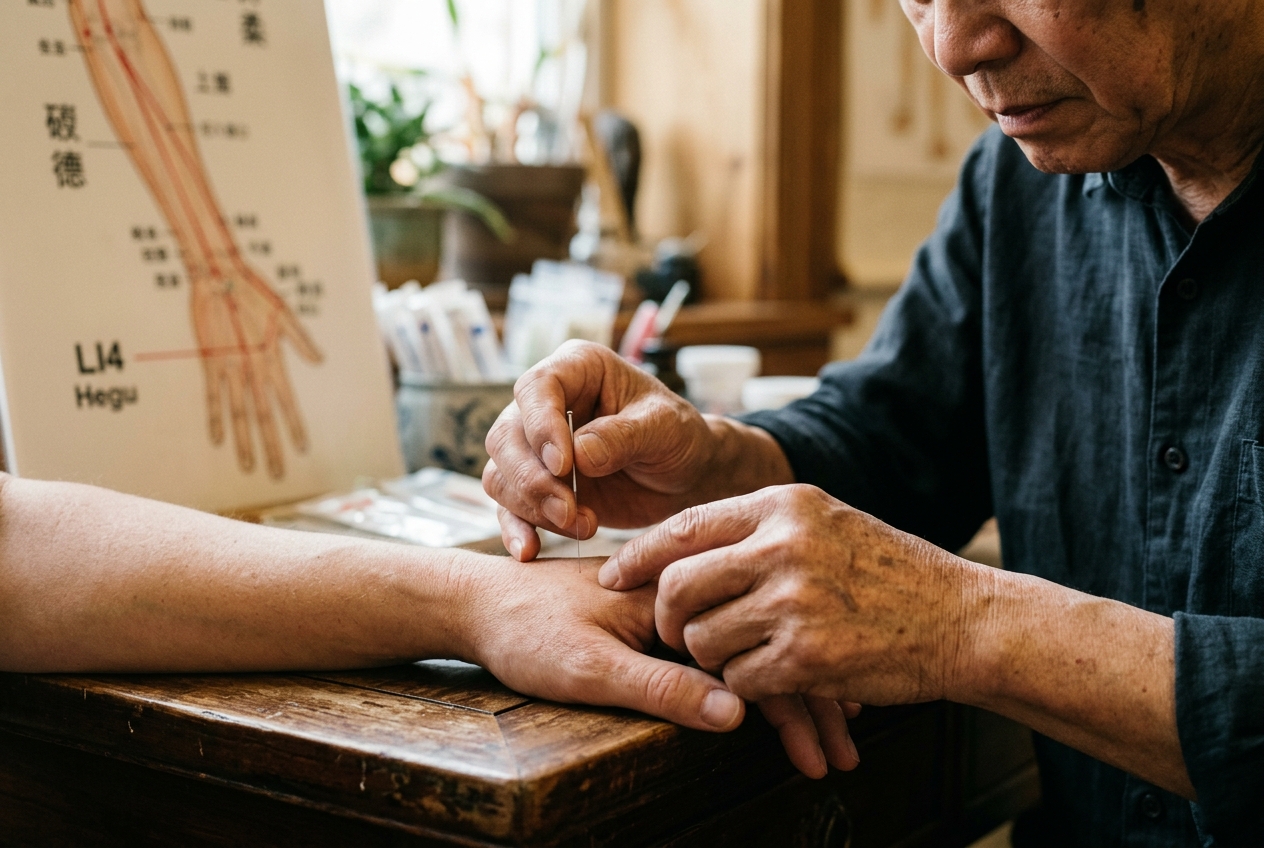
When standard static pressure or gentle circular massage fails to resolve these deep-seated holding patterns, classical acupuncture literature offers a sophisticated, dynamic mechanical intervention: Fei Fa (飞法, the "Flying Method"). Originating in the high-water mark of Ming Dynasty acupuncture scholarship, Fei Fa does not merely apply pressure; it creates a dynamic, high-frequency mechanosensory wave designed to penetrate deeply adhered interstitial tissues. By translating this historical technique into both modern fascial science and accessible acupressure protocols, we uncover an extraordinary bridge between ancient experiential mastery and contemporary neurobiology.
2. Historical Lineage and the Biomechanics of Classical Fei Fa
To understand the mechanics of the Flying Method, one must trace its primary textual documentation. Fei Fa was first codified with poetic precision in the Jin Zhen Fu (金针赋, Ode of the Gold Needle), an authoritative clinical treatise attributed to the Ming Dynasty master Xu Feng. It was subsequently anthologized and expanded by Yang Jizhou in his seminal 1601 compendium, the Zhen Jiu Da Cheng (针灸大成, The Great Compendium of Acupuncture and Moxibustion).
The classical definition dictates:
"For the Flying Method: twirl the needle with the thumb and index finger three times in rapid succession, then suddenly let go of the grip, mimicking the sudden, buoyant flutter of a bird spreading its wings to take flight." (以大指次指捻针,捻三下,如飞鸟展翅之状).
While early translations dismissed this imagery as purely decorative metaphor, contemporary orthopedic and biophysical research provides a rigorous mechanistic rationale. Pioneer investigations into connective tissue mechanics by Dr. Helene Langevin and colleagues at Harvard Medical School demonstrate that when an acupuncture needle is rotated within the subcutaneous fascia, unmineralized interstitial collagen fibrils wind tightly around the shaft. This creates a quantifiable mechanical coupling—a physical "tissue grasp"—that generates lateral shear strain and translocates force through the extracellular matrix (ECM).
When the practitioner performs the three rapid rotational twirls characteristic of Fei Fa, they induce high-amplitude torsional deformation within the local collagen and elastin network. Crucially, the subsequent instantaneous release ("the bird taking flight") produces an immediate elastic recoil. The stretched interstitial matrix snaps back to baseline equilibrium, discharging a localized mechanical and piezo-electric impulse through the fascial plane.
Neurophysiologically, this rapid-onset mechanical transient preferentially excites Rapidly Adapting (RA) mechanoreceptors, notably Pacinian corpuscles, alongside Slowly Adapting Type II (SA-II) Ruffini corpuscles situated within the deep dermis and intermuscular septa. The synchrony of this afferent burst propagates along the unmyelinated C-fibers and finely myelinated A-delta fibers, mediating what classical texts term De Qi (得气) and generating the clinical phenomenon of Propagated Sensation Along Channels (PSAC). This ascending volley modulates dorsal horn nociceptive gating mechanisms and triggers descending inhibitory pain pathways via the periaqueductal gray (PAG) matter.
3. The Meridian Path — A Journey Through the Body
To effectively apply this manipulation, one must understand the anatomical pathways through which these mechanosensory signals travel. Rather than viewing meridians as abstract metaphysical lines, modern integrative medicine recognizes them as functional fascial tracts and neurovascular corridors that trace predictable surface landmarks.
The Front Highway: The Yangming (Large Intestine and Stomach) Axis
The Yangming meridian system forms the principal anterior highway of the body, governing digestive efficiency, frontal head tension, and muscular power. * The Upper Branch (Large Intestine): Begins at the tip of the index finger, travels along the prominent muscular ridge on the outer edge of your forearm (the brachioradialis muscle), passes over the point of the shoulder where your arm muscle meets your collarbone, ascends the side of the neck, and crosses under the nose to terminate beside the opposite nostril. * The Lower Branch (Stomach): Begins just beneath the eye socket, descends through the jaw muscles, travels down through the throat, passes vertically through the center of the chest and abdomen, plunges down the front of the thigh, runs along the fleshy muscle just outside your shinbone (the tibialis anterior—the muscle that tires after hiking downhill), passes across the ankle crease, and terminates at the tip of the second toe.
The Deep Dynamic Axis: The Jueyin (Liver and Pericardium) Network
The Jueyin system serves as the body’s interior regulator of vascular tone, visceral smooth-muscle tension, and emotional equilibrium. * The Lower Branch (Liver): Commences at the inside corner of the big toenail, travels across the soft webbing on the top of the foot, ascends along the inside groove of the shinbone behind the inner ankle, courses along the inner seam of the thigh, and terminates in the soft space just below your ribcage. * The Upper Branch (Pericardium): Originates deep within the chest, emerges on the inner aspect of the arm, courses straight down the middle of the inner forearm directly between the two prominent flexor tendons (which become visible when you make a fist and flex your wrist), passes through the center of the palm, and exits the tip of the middle finger.
4. Key Points and Their Non-Invasive Fei Fa Acupressure Adaptations
While classical Fei Fa relies on stainless steel filiform needles, its biomechanical principles—rapid torsional loading, deep tissue coupling, and sudden elastic release—translate directly into non-invasive clinical acupressure. By using the thumb pad or a smooth, rounded acupressure tool, the practitioner can generate comparable mechanotransductive recoil within the superficial and deep fascia.
========================================================================================================
                                 FEI FA ACUPRESSURE PROTOCOL MATRIX
========================================================================================================
Point Name       Anatomical Landmark           Vector & Depth          Fei Fa Cadence      Clinical Focus
--------------------------------------------------------------------------------------------------------
Hegu (LI4)       Webbing between 1st & 2nd     Perpendicular-radial;   3 micro-rotations   Frontal headache,
                 metacarpal bones              firm into 2nd bone      + snap release      orofacial tension

Taichong (LV3)   Depression proximal to 1st &  Distal-to-proximal      3 deep twists       Stress hyperarousal,
                 2nd toe junction              45° angle; moderate     + abrupt unweight   ocular strain

Zusanli (ST36)   One fingerbreadth lateral to  Perpendicular-deep;     3 heavy rotations   Fatigue, epigastric
                 anterior tibial tuberosity    firm into muscle belly  + instant release   stasis, brain fog

Neiguan (PC6)    2 inches proximal to wrist    Perpendicular-vertical; 3 rhythmic pulses   Nausea, palpitations,
                 crease, between flexor cords  moderate sustained      + rapid recoil      autonomic distress
========================================================================================================
1. Hegu (LI4, 合谷) — Valley of Convergence
- Surface Landmark: Rest your thumb in the soft webbing between the index finger and thumb of the opposite hand. Squeeze your thumb against your index finger; find the highest peak of the muscle that bulges outward (the first dorsal interosseous muscle). Slide your thumb pad just toward the bone of the index finger.
- Somatic Sensation (De Qi): A profound, spreading dull ache that often radiates toward the wrist or ascends along the outer forearm toward the jawline.
- Non-Invasive Fei Fa Technique: Anchor your thumb pad against the radial border of the second metacarpal bone. Apply sustained, firm inward pressure. Perform three rapid, small-diameter rotational clockwise twists (cadence: approximately 3 twists over 1.5 seconds) to engage the perivascular connective tissue, then instantaneously withdraw 80% of your pressure within a fraction of a second, leaving the thumb lightly resting on the surface. Repeat this cycle 10 to 12 times over a 2-minute duration.
- Primary Clinical Indications: Frontal and temporal headaches, temporomandibular joint (TMJ) dysfunction, sinus congestion, and systemic pain modulation via the World Health Organization's recognized acupuncture benchmarks.
2. Taichong (LV3, 太冲) — Great Surge
- Surface Landmark: Place your finger in the groove between your big toe and second toe. Slide your finger upward along the top of your foot toward the ankle until your finger falls into a natural, tender depression just before the two long foot bones (metatarsals) converge.
- Somatic Sensation (De Qi): Sharp, highly localized tenderness that immediately transitions into a diffuse, descending warmth across the sole of the foot.
- Non-Invasive Fei Fa Technique: Angle your thumb at a 45-degree angle pointing slightly upward toward the ankle. Press firmly into the osseous junction. Execute three rapid, high-frequency rotational compressions, followed by an immediate, buoyant release of vertical pressure. Maintain this rhythmic pulse-and-release pattern for 90 seconds per foot.
- Primary Clinical Indications: Emotional irritability, stress-induced hypertension, ocular fatigue from prolonged screen exposure, and tension in the subcostal/flank region.
3. Zusanli (ST36, 足三里) — Leg Three Miles
- Surface Landmark: Sit with your knee bent at a right angle. Place the palm of your hand over your kneecap. Your fingers will naturally drape down your shin. Locate the bottom edge of your four fingers: find the bony ridge running down the center of your shin, and move one thumb’s-width outward into the muscular valley (the tibialis anterior muscle).
- Somatic Sensation (De Qi): A heavy, grounding sensation characterized by a dull distension that radiates down the lateral shin to the dorsum of the foot.
- Non-Invasive Fei Fa Technique: Use a reinforced thumb or the knuckle of the index finger to drive perpendicular pressure deep into the muscle belly. Perform three deep, firm rotational grinds, twisting the skin and deep fascia over the muscle, followed by an instantaneous, bird-like release of pressure. Repeat the sequence for 2 to 3 minutes.
- Primary Clinical Indications: Postprandial bloating, chronic lethargy, immune optimization, and functional gastrointestinal dysmotility documented extensively in contemporary gastrointestinal neuromodulation studies.
4. Neiguan (PC6, 内关) — Inner Pass
- Surface Landmark: Turn your palm upward. Measure the width of your three middle fingers combined from the distal wrist crease up the forearm. Place your thumb in the exact center of your arm, precisely between the two prominent, cord-like tendons (flexor carpi radialis and palmaris longus).
- Somatic Sensation (De Qi): A mild, electrical, tingling sensations that travels up the medial arm toward the chest or into the middle finger.
- Non-Invasive Fei Fa Technique: Apply vertical, perpendicular pressure into the inter-tendinous space. Without sliding across the skin, execute three rapid, micro-rotational pulses that deform the deep antibrachial fascia, followed by an abrupt release of pressure. Continue this cadence for 1 to 2 minutes.
- Primary Clinical Indications: Anxiety-induced palpitations, motion sickness, insomnia, and functional epigastric distress.
5. A Point Combination for One Common Issue: The Four Gates Protocol
For the pervasive modern dilemma of chronic stress-induced autonomic dysregulation, tension headaches, and neck stiffness after a long screen-bound workday, the clinical literature points to the classic pairing known as the Si Guan (四关, the "Four Gates"): bilateral Hegu (LI4) combined with bilateral Taichong (LV3).
In Chinese medicine theory, Hegu (governing the upper Yangming system) descends stagnant Yang energy from the head and chest, while Taichong (governing the lower Jueyin system) moves dormant Qi upward and outward from the viscera. Together, they act as an internal hydraulic reset for systemic blood flow and neurological equilibrium. Neuroimaging demonstrates that this specific combination induces significant down-regulation of the limbic system, particularly within the amygdala and anterior cingulate cortex, as validated by functional MRI studies on acupuncture point specificity and De Qi.
The 8-Minute Evening Reset Protocol
==========================================================================
                     EVENING FOUR GATES STEP-BY-STEP
==========================================================================
Phase 1: Preparation
  • Sit comfortably with an upright spine and uncrossed legs.
  • Take 3 diaphragmatic breaths (4-second inhale, 7-second exhale).

Phase 2: Opening the Upper Gates (LI4)
  • Left Hegu (LI4): 90 seconds of Fei Fa cadence (3 twirls + snap release).
  • Right Hegu (LI4): 90 seconds of Fei Fa cadence (3 twirls + snap release).
  • Focus somatic awareness on the relaxation of the jaw, brow, and shoulders.

Phase 3: Opening the Lower Gates (LV3)
  • Left Taichong (LV3): 90 seconds of angled Fei Fa micro-compressions.
  • Right Taichong (LV3): 90 seconds of angled Fei Fa micro-compressions.
  • Coordinate each "snap release" directly with a full abdominal exhalation.

Phase 4: Autonomic Integration
  • Rest both hands on your thighs with palms facing upward for 2 minutes.
  • Observe the systemic sensation of warmth and descending muscular release.
==========================================================================
6. Safety, Precision, and Contraindications
Acupressure and Fei Fa manipulations, while non-invasive, exert profound physiological influences on systemic neurovascular tone and smooth muscle contraction. Strict adherence to safety boundaries is mandatory.
- Vagal Precautions: Individuals prone to vasovagal syncope should always perform these techniques while seated or supine, never while standing.
- Tissue Health: Never apply Fei Fa or any high-cadence compression over areas of active phlebitis, deep vein thrombosis, open dermatological lesions, localized cellulitis, or acute bone fractures.
7. Today's Takeaway: The Two-Minute Micro-Reset
You do not need an entire clinic hour to benefit from the mechanical resonance of Fei Fa. Before navigating away from this page, execute this rapid 120-second intervention:
By understanding the physiological dialogue between ancient clinical intuition and modern mechanosensory neurology, Fei Fa transforms from an obscure 16th-century poetic needle maneuver into an accessible, scientifically validated somatic tool for the modern world.