Dryness-Clearing Formulas (Zhi Zao Ji) Prescription Dynamics: Governing External Dryness Dispersal, Internal Yin Moistening, Pulmonary Mucociliary Hydration, and Fluid Homeostasis in Traditional Chinese Medicine
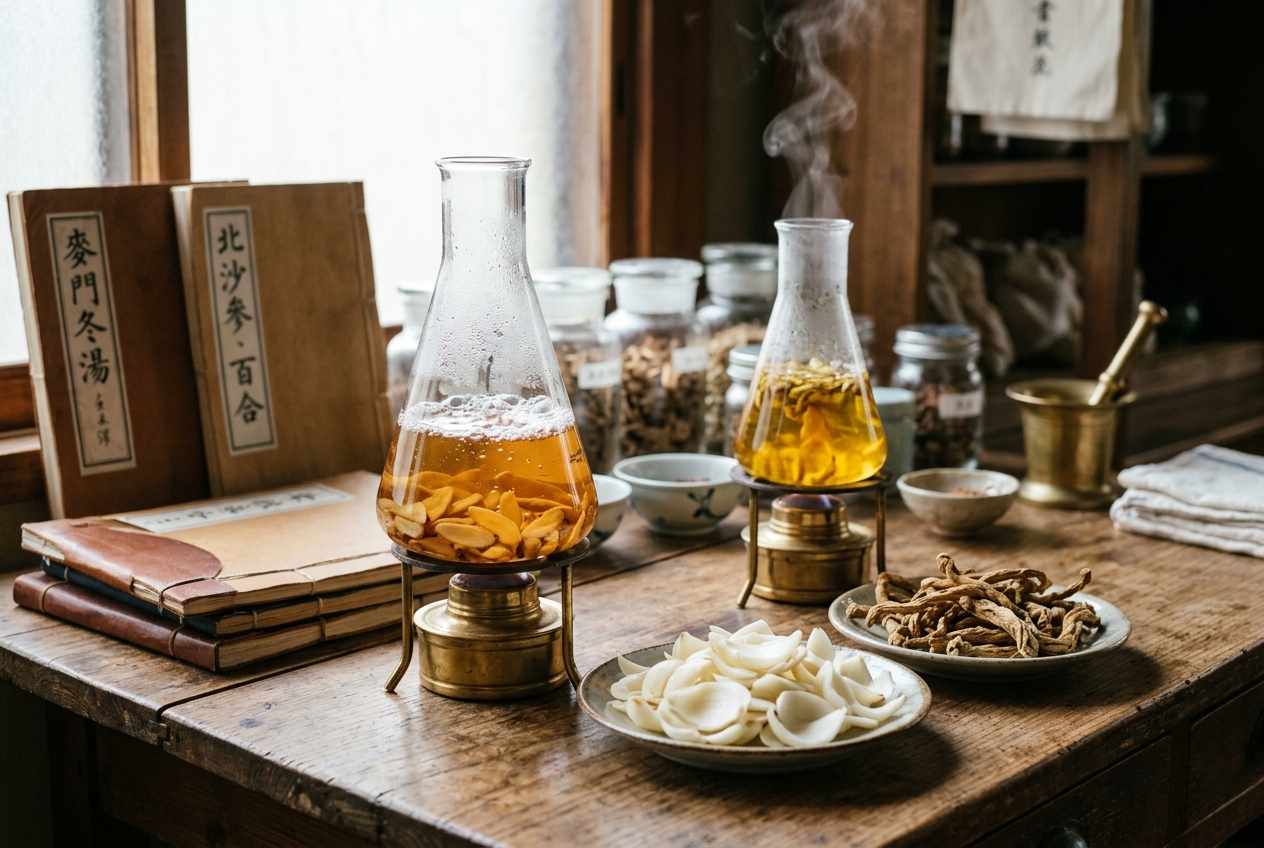
1. Opening Scene — A Moment You'll Recognise
You awaken in the early hours of an autumn morning to an unmistakable, grating discomfort in the back of your throat. Every swallow feels like fine sandpaper brushing against parched parchment. Your nasal passages are tight, your lips cracked at the vermilion border, and a persistent, rasping tickle in your upper airway provokes a shallow, hacking cough that yields not a single drop of phlegm. Even after drinking a tall glass of cold water, the moisture vanishes almost instantaneously, leaving your mouth as desiccated as before.
In Traditional Chinese Medicine (TCM), this state is not regarded merely as simple dehydration to be cured by guzzling water. Rather, it represents the invasion or internal manifestation of Zào Xié (燥邪)—Pathogenic Dryness. As the autumn winds strip the moisture from the atmosphere, the human body mirrors its macrocosm. The primary victim of this seasonal desiccation is the Lung (Fèi, 肺), celebrated across millennia of classical medical texts as the "Delicate Organ" (Jiāo Zàng, 娇脏). Because the Lung connects directly to the external world through the respiratory tract, it possesses neither the tolerance for cold nor the resilience against heat, functioning instead as a finely calibrated canopy over the body's internal fluid network (Jīn Yè, 津液). When environmental desiccation or metabolic exhaustion depletes these vital fluids, the ancient medical canon turns to a sophisticated pharmacological category: Zhi Zao Ji (治燥剂), or Dryness-Clearing Formulas.
+-----------------------------------------------------------------------------------+
| CLINICAL TAXONOMY: THE SPECTRUM OF DRYNESS PATHOLOGY                             |
+------------------------------------+----------------------------------------------+
| EXTERNAL DRYNESS (Wài Zào, 外燥)   | INTERNAL DRYNESS (Nèi Zào, 内燥)             |
+------------------------------------+----------------------------------------------+
| • Cool Dryness (Liáng Zào, 凉燥)   | • Yin-Fluid Depletion (Yīn Xū Zào, 阴虚燥)   |
|   Astringing cold-dry autumn wind  |   Constitutional exhaustion of deep fluids   |
| • Warm Dryness (Wēn Zào, 温燥)     | • Post-Febrile Desiccation (Rè Shāng Yīn)    |
|   Lingering summer heat + dryness  |   Residual heat scorching mucosal secretions |
+------------------------------------+----------------------------------------------+
2. What This Organ System Does: Fluid Metrology and Classical Pharmacology
In the physiological architecture of Chinese medicine, the Lung acts as the "Prime Minister" (Xiāng Fù Zhī Guān, 相傅之官), governing Qi and orchestrating the entire systemic fluid distribution pathway (Tong Tiao Shui Dao, 通调水道). Working in close metabolic synergy with the Stomach (Wèi, the origin of fluids) and the Kidneys (Shèn, the sovereign root of water), the Lung regulates two fundamental fluid movements:
- Diffusion (Xuān Fā, 宣发): Propelling lighter fluids and protective Qi upward and outward to moisten the skin, subcutaneous tissues, and mucosal surfaces.
- Descending (Sù Jiàng, 肃降): Channeling heavier fluids and metabolic byproducts downward to nourish the lower viscera and supply the Kidneys and Bladder.
When pathogenic dryness strikes, this delicate dynamic collapses. Classical diagnostics categorise dryness into two distinct presentations: Exogenous Dryness (Wài Zào, 外燥), caused by climatic invasion, and Endogenous Dryness (Nèi Zào, 内燥), arising from constitutional Yin deficiency, febrile fluid loss, or visceral burnout.
To manage these conditions, classical physicians engineered the Zhi Zao Ji formulas, dividing them into two therapeutic classes:
A. Gently Dispersing External Dryness (Qīng Xuān Wài Zào)
External dryness attacks the superficial canopy of the Lung. Because the delicate Lung tissue cannot tolerate harsh, cloying tonics while an external pathogen resides in the exterior, these formulas deploy light, acrid, diffusing botanicals paired with gentle moistening agents.
- Xing Su San (杏苏散 — Apricot Kernel and Perilla Leaf Powder): Formulated by Wu Jutong in the Wen Bing Tiao Bian (Systematic Differentiation of Warm Diseases), this prescription treats Cool Dryness (Liáng Zào, 凉燥). When late-autumn cold astringes the exterior, Lung Qi becomes constrained, manifesting as a dry, non-productive cough, mild chills, absence of sweating, and a thin white tongue coating. The formula utilizes Folium Perillae (Zǐ Sū Yè) and Semen Armeniacae Amarum (Kǔ Xìng Rén) to warm and diffuse the upper burner without overheating, whilst Radix Platycodi (Jié Gěng) and Radix Peucedani (Qián Hú) vent the bronchial Qi.
- Sang Xing Tang (桑杏汤 — Mulberry Leaf and Apricot Kernel Decoction): Designed for Warm Dryness (Wēn Zào, 温燥), where lingering summer heat couples with autumn aridity to scorch Lung fluids. Patients present with fever, a hacking dry cough, dry red throat, and a thin yellow tongue coat. The sovereign pairing of Folium Mori (Sāng Yè) and Semen Armeniacae Amarum (Kǔ Xìng Rén) clears warm-dry pathogens from the exterior, while Fructus Gardeniae (Zhī Zǐ) and Bulbus Fritillariae Thunbergii (Zhè Bèi Mǔ) clear pulmonary heat and dissolve desiccated secretions.
- Qing Zao Jiu Fei Tang (清燥救肺汤 — Eliminate Dryness and Rescue the Lungs Decoction): Masterminded by Yu Jiayan in the Yi Men Fa Lu, this formula targets severe, high-grade warm dryness attacking both the Qi level and the deep Yin fluids of the Lung. Patients exhibit severe dyspnoea, chest pain, wheezing, panting, parched mouth, dry cracked tongue, and an empty, rapid pulse. It combines high doses of Folium Mori (Sāng Yè) with Gypsum Fibrosum (Shí Gāo) to clear blazing heat, alongside Radix Ophiopogonis (Mài Mén Dōng), Colla Corii Asini (Ē Jiāo), and Semen Sesami Nigrum (Hēi Zhī Ma) to rebuild lost fluids and restore alveolar compliance.
B. Deeply Nourishing Yin & Moistening Dryness (Zī Yīn Rùn Zào)
When fluid exhaustion moves inward, the therapeutic strategy transitions from light outward dispersion to deep inward nourishment.
- Bai He Gu Jin Tang (百合固金汤 — Lily Bulb Decoction to Solidify Metal): Originating from the Shen Zhai Yi Shu, this is the quintessential prescription for concurrent Lung and Kidney Yin deficiency. When the Kidney water fails to nourish the Lung metal, internal deficiency fire flares upward, scorching the pulmonary microvasculature and causing a chronic dry cough with blood-streaked sputum (hemoptysis), tidal fever, night sweats, and a crimson tongue with peeling coat. The sovereign agents Bulbus Lilii (Bǎi Hé) and Radix Rehmanniae Glutinosae (Shēng Dì Huáng / Shú Dì Huáng) restore systemic Yin, while Radix Scrophulariae (Xuán Shēn) descends deficiency fire.
- Mai Men Dong Tang (麦门冬汤 — Ophiopogon Decoction): Recorded in Zhang Zhongjing's Han Dynasty classic Jin Gui Yao Lue, this formula addresses a specialized dynamic: Lung and Stomach fluid collapse accompanied by rebellious upward counterflow of Qi. The patient suffers from debilitating bouts of dry, retching cough, spitting of clear foamy saliva, parched pharynx, and an empty, deficient pulse. Rather than focusing solely on the chest, this formula rebuilds the "Earth Mother" (Stomach Yin) to feed the "Metal Child" (Lung Qi) by utilising a massive sovereign dose of Radix Ophiopogonis (Mài Mén Dōng) balanced by an indispensable minister, Rhizoma Pinelliae Praeparatum (Fǎ Bàn Xià).
- Yang Yin Qing Fei Tang (养阴清肺汤 — Nourish Yin and Clear the Lungs Decoction): Created by Zheng Meijian in the Chong Lou Yu Duo, this formula treats severe toxic heat scorching the throat and upper airway (traditionally utilized for diphtheritic croup and severe pharyngeal ulceration). It employs Radix Scrophulariae (Xuán Shēn) and Radix Rehmanniae (Shēng Dì Huáng) to clear toxic mucosal heat and enrich exhausted fluids, protecting the airway against structural tissue necrosis.
- Zeng Ye Tang (增液汤 — Increase Fluids Decoction): A foundational three-herb masterpiece by Wu Jutong comprising Radix Scrophulariae (Xuán Shēn), Radix Rehmanniae (Shēng Dì Huáng), and Radix Ophiopogonis (Mài Mén Dōng). This formula embodies the celebrated therapeutic mechanism "Increase Water to Float the Boat" (Zēng Shuǐ Xíng Zhōu, 增水行舟). When acute febrile illness or chronic Yin exhaustion drains the large intestine of moisture, fecal impaction occurs. Instead of using harsh, drying purgatives (which would further exhaust fluids), Zeng Ye Tang floods the bowel with deep Yin fluids, allowing the stagnant stool to float out naturally.
+---------------------------------------------------------------------------------------------------------------------+
| FORMULA ARCHITECTURE & JUN-CHEN-ZUO-SHI BOTANICAL MATRICES                                                          |
+----------------------+--------------------+----------------------------------------+--------------------------------+
| PRESCRIPTION         | SOVEREIGN (Jūn)    | MINISTERIAL / ASSISTANT (Chén / Zuǒ)   | THERAPEUTIC MECHANISM          |
+----------------------+--------------------+----------------------------------------+--------------------------------+
| Xing Su San          | Su Ye, Xing Ren    | Qian Hu, Jie Geng, Zhi Ke, Ban Xia     | Acrid-warm exterior dispersal  |
| Sang Xing Tang       | Sang Ye, Xing Ren  | Bei Mu, Dan Dou Chi, Sha Shen, Zhi Zi  | Acrid-cool exterior moistening |
| Qing Zao Jiu Fei     | Sang Ye, Shi Gao   | Mai Dong, E Jiao, Hei Zhi Ma, Xing Ren | Rescue Qi & Yin, Alveolar rest.|
| Bai He Gu Jin Tang   | Sheng Di, Shu Di   | Bai He, Mai Dong, Xuan Shen, Jie Geng  | Lung-Kidney Yin, Stop Bleeding |
| Mai Men Dong Tang    | Mai Men Dong (64g) | Ban Xia, Dang Shen, Geng Mi, Da Zao    | Enrich Earth to generate Metal |
| Yang Yin Qing Fei    | Xuan Shen          | Sheng Di, Mai Dong, Bai Shao, Mu Dan Pi| Cool Pharyngeal Toxic Heat     |
| Zeng Ye Tang         | Xuan Shen (30g)    | Sheng Di (24g), Mai Dong (24g)         | "Increase Water to Float Boat" |
+----------------------+--------------------+----------------------------------------+--------------------------------+
C. Botanical Pairings: Achieving Hydration Without Dampness
A primary technical challenge in botanical medicine is that sweet, cold, fluid-enriching herbs can easily impair Spleen function, generating pathological dampness (Shī, 湿) and phlegm (Tán, 痰). Classical pharmacology solves this through calculated botanical dyads:
- Sang Ye with Xing Ren (Mulberry Leaf & Bitter Apricot Seed): Sang Ye clears heat and diffuses upper lung-heat, while Xing Ren directs descending lung qi and lubricates the respiratory lining. Together, they clear surface dryness without arresting natural fluid movement.
- Mai Men Dong with Ban Xia (Ophiopogon Root & Prepared Pinellia Rhizome): In a traditional 7:1 ratio (as found in Mai Men Dong Tang), the heavily moistening, cold Mai Dong enriches fluid reserves, while the acrid, warm, drying Ban Xia prevents fluid stasis, breaks phlegm accumulation, and redirects rebellious upward qi downward.
- Sheng Di Huang with Xuan Shen (Fresh Rehmannia Root & Scrophularia Root): This pairing penetrates the deep nutritive (Yíng) and blood (Xuè) levels to clear heat and replenish systemic fluids without creating metabolic sludge.
D. Biomedical Correlates: Cellular Hydration and Mucosal Defense
Modern pharmacological investigations referenced by the WHO Traditional Medicine Programme and catalogued on NCBI PubMed demonstrate clear cellular correlates for these classical principles:
- Aquaporin (AQP) Water Channel Regulation: Phytochemical saponins (such as ophiopogonin D from Radix Ophiopogonis) upregulate the expression of transmembrane water channels, specifically Aquaporin-5 (AQP5) in type I alveolar cells and submucosal glands, and AQP1 in pulmonary microvascular endothelium, accelerating transepithelial fluid transport.
- Mucociliary Clearance Kinetics: Compounds such as amygdalin from Semen Armeniacae Amarum optimize goblet cell secretion, restoring the balanced production of MUC5AC and MUC5B mucin glycoproteins to rehydrate thickened, sticky secretions.
- Surfactant Synthesis and Alveolar Surface Tension: Formulations such as Qing Zao Jiu Fei Tang promote the synthesis of dipalmitoylphosphatidylcholine (DPPC), the primary phospholipid component of endogenous pulmonary surfactant, preventing micro-atelectasis and reducing mechanical work during breathing.
- Epithelial Barrier Integrity: Iridoid glycosides and polysaccharides in Radix Rehmanniae upregulate zonula occludens-1 (ZO-1) and occludin tight-junction proteins, accelerating repair of damaged mucosal barriers.
3. How You Can Feel It — Signs of Balance and Imbalance
=====================================================================================
                      DIAGNOSTIC SELF-ASSESSMENT: IDENTIFYING YOUR PROFILE
=====================================================================================

[ SYMPTOM CLUSTER 1: COOL DRYNESS (Liáng Zào) ]
  [ ] Scratchy throat accompanied by mild chills or draft-sensitivity
  [ ] Non-productive, tight, hacking cough triggered by cool air
  [ ] Dry, tight skin with lack of perspiration
  [ ] Tongue: Pale or normal body, thin white coating
  [ ] Pulse: Floating, tight, or moderate

[ SYMPTOM CLUSTER 2: WARM DRYNESS (Wēn Zào) ]
  [ ] Burning, raw throat with dry, painful cough
  [ ] Sticky, scanty yellow secretions that are difficult to expectorate
  [ ] Intense thirst for cool drinks; dry, red nasal passages
  [ ] Tongue: Red tip and edges, thin, dry yellow coating
  [ ] Pulse: Floating, rapid, and thin

[ SYMPTOM CLUSTER 3: YIN-FLUID EXHAUSTION (Yīn Xū Zào) ]
  [ ] Chronic dry tickle in throat, hoarseness, evening throat discomfort
  [ ] Dry eyes, parched cracked lips, constipation with dry, pebble-like stool
  [ ] Low-grade subjective heat sensations in the palms, soles, and chest (5-Palm Heat)
  [ ] Tongue: Deep red, little-to-no coating, longitudinal cracks
  [ ] Pulse: Thin, rapid, and wiry or floating-empty
=====================================================================================
Differential Diagnostics and Contraindications
- Damp-Phlegm Accumulation (Shí Tán, 湿痰): If a cough produces copious, loose, white, easily expectorated mucus accompanied by chest fullness, epigastric distension, and a thick, greasy tongue coat, Zhi Zao Ji formulas are strictly contraindicated. Administering heavy, moistening tonics like Sheng Di Huang or Mai Dong in this setting will trap pathogenic dampness and worsen airway congestion.
- Spleen Deficiency Diarrhea (Pí Xū Biàn Táng, 脾虚便溏): Patients presenting with loose stools, chronic fatigue, poor appetite, and abdominal bloating must not be given unbuffered Yin-enriching formulas like Zeng Ye Tang or Bai He Gu Jin Tang. The cold, cloying nature of these herbs will overwhelm the digestive fire (Pí Yáng).
- The Hazard of Cloying Tonics (Nì Zhì, 腻滞): Chronic dryness cannot be resolved simply by consuming high-dose tonifying herbs. Formulas must always incorporate Qi-regulating and dispersing vectors (such as Chen Pi, Zhi Ke, or Ban Xia) to ensure that fluids circulate freely rather than stagnating into pathological dampness.
4. Qigong & Movement Practice: The Metal-Flute Moistening Sequence
This daily, classical home practice combines upper-thoracic postural alignment with specific breath mechanics and internal hydration cultivation to gently diffuse Lung Qi and support fluid circulation across the respiratory epithelium.
Phase 1: Postural Alignment and Opening the Lung Canopy
- Setup: Stand with feet shoulder-width apart, knees soft, spine gently lengthened. Rest the tip of your tongue against the upper palate, just behind the front teeth. Relax the shoulders down and back, opening the chest without arching the lower back.
- Movement: On a slow, 4-second inhalation through the nose, rotate your palms outward and float your arms laterally upward until they reach shoulder height, expanding the upper chest (drawing attention to the Yunmen / Cloud Gate region below the collarbones).
- Breath Timing: Pause for 2 seconds at the peak of the inhalation, allowing the chest to gently expand.
Phase 2: Generating the "Jade Fluid" (Yù Yè Huán Dān, 玉液还丹)
- Technique: While maintaining a relaxed stance, gently circle the tip of the tongue along the outside of the upper and lower teeth—9 times clockwise, then 9 times counter-clockwise. This classical Daoist technique stimulates the submandibular and parotid salivary glands.
- Swallowing: Allow the generated saliva to pool on the floor of the mouth. Divide the saliva into three equal portions and swallow them sequentially in three deliberate gulps, mentally guiding the moisture down through the throat, chest, and into the lower abdomen (Dān Tián).
Phase 3: The Metal Sound Resonant Exhalation (Sī Zì Jué, 呬字诀)
- Movement: Slowly lower your hands back to your sides, palms facing downward.
- Vocalisation: On a 6-second exhalation, gently part the lips and make the soft, sibilant sound: "Sssssss" (the sound of the Metal element). The sound should be smooth and quiet, creating a gentle vibration in the throat and lungs.
- Repetitions: Complete 8 continuous rounds, morning and evening.
- Sensory Shift: Look for a soothing, cool sensation spreading through the pharynx, followed by spontaneous salivation and an easeful sensation in the chest.
5. Acupressure Points You Can Try Today
+---------------------------------------------------------------------------------------------------------------------+
| CLINICAL ACUPRESSURE PROTOCOL FOR DESICCATION                                                                       |
+---------------------+---------------------------------------------------+--------------------+----------------------+
| POINT               | PRECISE ANATOMICAL LOCATION                       | STIMULATION VECTOR | PRIMARY INDICATION   |
+---------------------+---------------------------------------------------+--------------------+----------------------+
| LU7 (Liè Qūe)       | 1.5 cun proximal to the radial styloid process;   | Firm, circular;    | Dry, tickling cough; |
| Broken Sequence     | interlock thumbs, point sits under index finger.  | 2 mins bilateral   | clears external wind |
+---------------------+---------------------------------------------------+--------------------+----------------------+
| KI6 (Zhào Hǎi)      | In the depression 1 cun directly below the        | Upward angled;     | Parched, dry throat; |
| Shining Sea         | lower border of the medial malleolus (inner ankle)| 2 mins bilateral   | nourishes Yin fluids |
+---------------------+---------------------------------------------------+--------------------+----------------------+
| LU9 (Tài Yuān)      | At the wrist crease, in the radial depression     | Gentle, steady;    | Chronic lung dryness;|
| Great Abyss         | lateral to the radial artery.                     | 90s bilateral      | tonifies source Qi   |
+---------------------+---------------------------------------------------+--------------------+----------------------+
Point 1: Lieque (LU7 — Broken Sequence)
- Location: Interlock the index fingers and thumbs of both hands. With the index finger of one hand resting along the radial edge of the opposite forearm, the point lies in the distinct groove between the two tendons, just over the styloid process of the radius (approximately 1.5 finger-widths above the primary wrist crease).
- How to Press: Apply firm, direct pressure with your thumb tip, making small circular oscillations angled slightly toward the elbow. Maintain for 1 to 2 minutes on each arm.
- Daily Application: As the Command Point of the head and neck and master point of the Conception Vessel (Ren Mai), LU7 disperses constrained wind-dryness, opens the Lung canopy, and soothes dry, irritable upper airways.
Point 2: Zhaohai (KI6 — Shining Sea)
- Location: On the inside of the foot, locate the prominent tip of the inner ankle bone (medial malleolus). Slide your thumb directly downwards into the depression roughly one thumb-width below the lower edge of the bone.
- How to Press: Apply steady, sustained pressure with your thumb pad, directing the force slightly upward into the bone notch. Maintain firm pressure for 2 minutes while breathing deeply through the nose.
- Daily Application: KI6 is the master point of the Yin Motility Vessel (Yin Qiao Mai). It is one of the premier points on the body for soothing a dry, scratchy throat, improving hoarseness, and drawing Kidney fluid upward to moisten the respiratory tract.
Point 3: Taiyuan (LU9 — Great Abyss)
- Location: Turn your palm facing upward. Locate the major transverse crease of the wrist. Feel along the radial edge (thumb side) in the soft depression between the tendon of the flexor carpi radialis and the pulsating radial artery.
- How to Press: Use gentle, steady thumb pressure without compressing the radial artery too firmly. Hold for 90 seconds per wrist.
- Daily Application: As the Yuan-Source and Earth point of the Lung channel, LU9 nourishes both Lung Qi and Lung Yin, supporting mucosal hydration in those with chronic dry cough or vocal fatigue.
6. Food & Lifestyle — Small Changes for Today
Dietary therapy (Yǐn Shí Liáo Fǎ, 饮食疗法) plays an essential role in resolving dryness. In accordance with the Five Phase (Wǔ Xíng) system, the Metal phase (Lung) responds to foods that are naturally white, sweet, neutral-to-cool, and rich in natural, easily assimilated moisture.
+---------------------------------------------------------------------------------------------------------------------+
| DIETARY TROPHOLOGY FOR METABOLIC HYDRATION                                                                          |
+------------------------------+------------------------------------+-------------------------------------------------+
| FOOD INGREDIENT              | TCM PROPERTIES & TASTE             | CLINICAL EFFECT & PREPARATION                   |
+------------------------------+------------------------------------+-------------------------------------------------+
| Asian Pear (Shēng Lí)        | Cool, Sweet, Slightly Acidic       | Clears lung-heat, generates fluids.             |
|                              |                                    | Steam with a pinch of Sichuan fritillary/honey. |
+------------------------------+------------------------------------+-------------------------------------------------+
| Silver Ear Mushroom          | Neutral, Sweet, Bland              | Deeply enriches lung and stomach Yin.           |
| (Yín Ěr / Bái Mù Ěr)         |                                    | Simmer slowly into a gelatinous broth.          |
+------------------------------+------------------------------------+-------------------------------------------------+
| White Lotus Root (Bái Ǒu)    | Cool (Raw) / Warm (Cooked), Sweet  | Clears heat and arrests mucosal bleeding.       |
|                              |                                    | Puree into a warm soup or light congee.         |
+------------------------------+------------------------------------+-------------------------------------------------+
| Sweet Apricot Seeds (Nán Xìng)| Neutral, Sweet                     | Lubricates the large intestine and lungs.       |
|                              |                                    | Grind and simmer into warm almond/apricot milk. |
+------------------------------+------------------------------------+-------------------------------------------------+
Culinary Recommendations
- Steamed Pear with Raw Honey: Core an Asian pear (Pyrus pyrifolia), place a teaspoon of raw honey (and optionally 2-3g of crushed sweet apricot kernels) inside the core, and steam for 20 minutes until translucent. Consume the fruit and its accumulated juices warm. This provides gentle, direct hydration to the pharyngeal and bronchial epithelium.
- Silver Ear Mushroom Elixir: Soak dried Tremella fuciformis (Silver Ear / Snow Fungus) until soft, then simmer on low heat for 90 minutes until the polysaccharides break down into a smooth, gelatinous soup. This directly enriches Stomach and Lung Yin reserves without straining digestion.
- Hydration Dynamics: Avoid gulping large volumes of iced water, which chills the Spleen and can cause fluids to stagnate into dampness rather than diffusing to the mucosa. Instead, sip warm water, mild herbal infusions, or congee water regularly throughout the day.
Environmental and Lifestyle Modifications
- Maintain Ambient Humidity: Keep living and working spaces between 45% and 55% relative humidity to reduce trans-epithelial moisture loss across the respiratory tree.
- Minimize Thermal Aggressors: Reduce intake of dry, heating foods such as roasted nuts, spicy curries, coffee, and spirits, all of which accelerate fluid desiccation.
7. Today's Takeaway
The single most effective action you can take right now takes less than three minutes: brew a cup of warm water, sit quietly, interlock your thumbs to apply firm pressure to LU7 (Lieque) for 60 seconds, and follow this by pressing KI6 (Zhaohai) beneath your inner ankle for another 60 seconds. Then, perform 9 gentle circles of the tongue across your teeth to collect the generated saliva, and swallow this natural moisture deliberately in three quiet gulps. This simple sequence coordinates classical acupressure with the body's natural salivary reflex, opening the Lung canopy and providing instant, easeful hydration to dry, irritable tissues.
Authoritative References & Further Reading
- WHO Global Traditional Medicine Centre: Evidence and Clinical Guidelines
- National Center for Biotechnology Information (NCBI PubMed): Pharmacological Mechanisms of Zhi Zao Formulas & Aquaporin Regulation
- Wikipedia: Traditional Chinese Medicine & Pathology of Pathogenic Factors
- Wikipedia: Aquaporin-5 and Transepithelial Fluid Dynamics
- Wikipedia: Mucociliary Clearance Physiology