Ding Bu T-Step Qigong: Unilateral Weight Transference, Ankle Stabilizer Recruitment, and Pelvic Tensegrity in Classical Daoyin
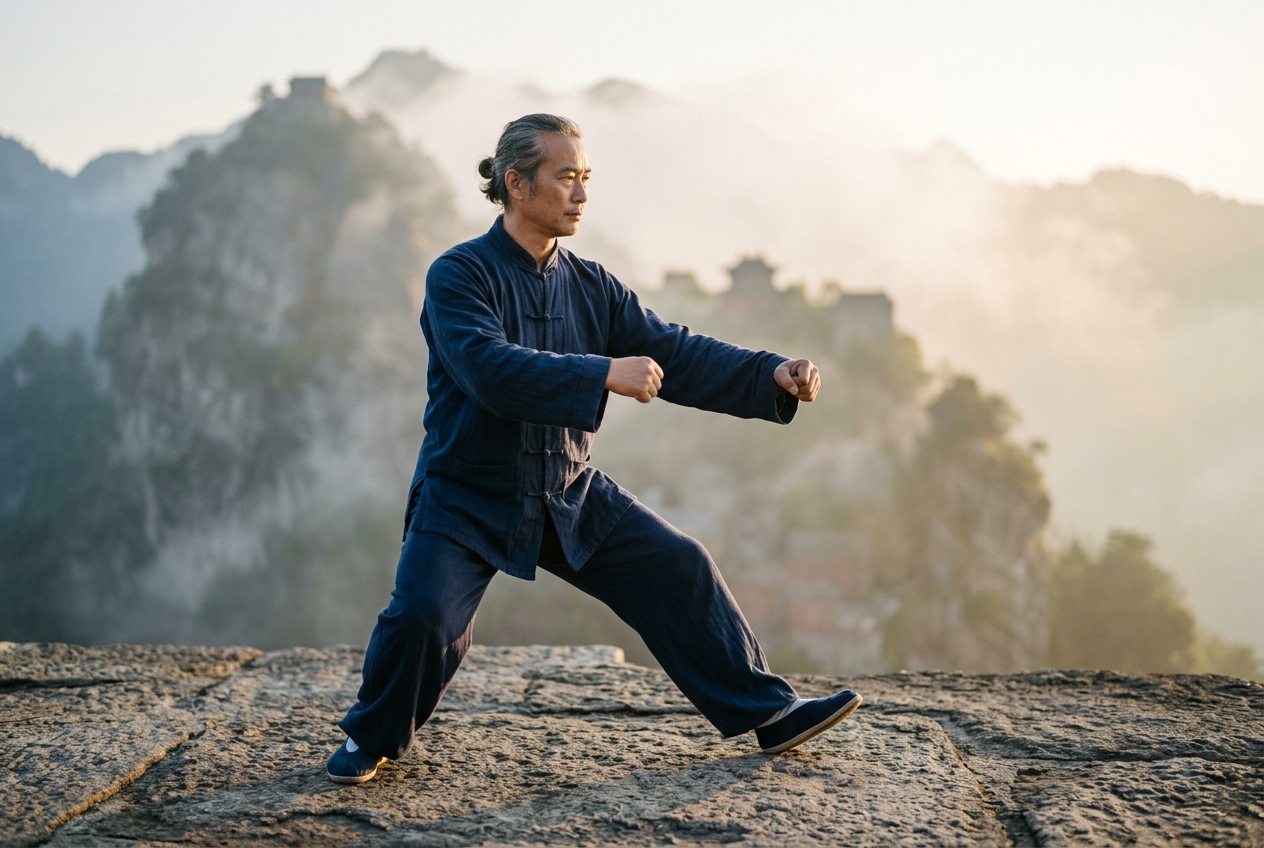
For the modern practitioner, Ding Bu can be understood as the ultimate somatic laboratory for unilateral stability and dynamic equilibrium. Instead of distributing your mass symmetrically across both legs as in standard standing meditation (Zhan Zhuang), the T-step deliberately isolates ninety to one hundred percent of your weight onto a single leg. The non-weight-bearing foot acts not as a crutch, but as a sensory antenna and mechanical counterweight.
Traditional Chinese Medicine (TCM) and Daoist somatic science describe this as the physical manifestation of Yin and Yang differentiation: one leg is rendered fully substantial (Shi), solid and rooted like an ancient cedar, while the other is made entirely insubstantial (Xu), light, responsive, and ready to pivot in any direction at a fraction of a second’s notice.
   DING BU (T-STEP) GEOMETRIC ALIGNMENT

          [ Supporting Foot ] (90-100% Load)
             /===========\
            |   Yongquan  |  <-- KD-1 Plantar Root
            |    (KD-1)   |
             \===========/
                   \
                    \  45° Angle of Rooting
                     \
                      \
                       *  <-- Empty Metatarsal Light Touch (0-10% Load)
                      / \
                     |   | [ Empty Stepping Foot ]
                      \_/
Within classical texts, this posture serves as the vital gateway between static standing and dynamic movement. It trains the practitioner to gather their physical center of gravity and energetic awareness into the Xia Dantian (the lower abdominal center located roughly two inches below the navel and three inches inward), to anchor the breath downward into the pelvic floor through Huiyin (the perineal center, CV-1), and to establish an unshakeable connection to the earth via Yongquan (the "Bubbling Spring" point, Kidney-1, located in the depression of the anterior sole). When mastered, Ding Bu transforms everyday stepping from an unconscious series of controlled falls into an integrated, glide-like expression of structural tensegrity.
Step-by-Step Practice Guide
The following progressive protocol is designed to guide you through the precise neuromuscular setup, breathing integration, and diagnostic refinement of Ding Bu. Practice barefoot on a flat, firm surface.
+--------------------------------------------------------------------------------+
|                        PRACTICE SUMMARY & KEY BENCHMARKS                       |
+--------------------------------------------------------------------------------+
| Primary Focus: Unilateral rooting, pelvic leveling, deep core activation       |
| Weight Split:  90/10 transitioning to 100/0 (True Empty Stance)               |
| Breath Model:  Diaphragmatic Dantian breathing (4-second in, 6-second out)     |
| Daily Target:  5 to 10 minutes total (alternating 60-90 second holds per side) |
| Key Sensation: Deep arch suction, gluteal burn without lumbar pinching         |
+--------------------------------------------------------------------------------+
1. The Architectural Setup
- Establish the Neutral Foundation: Stand with feet parallel, hip-width apart. Inhale deeply into your lower abdomen, softening the knees, releasing the gluteal clench, and allowing the sacrum to sink naturally toward the floor like a heavy plumb line.
- Orient the Root Foot: Pivot your right foot outward at a clean 45-degree angle. Press the tripod of the right foot firmly into the ground: the base of the big toe (first metatarsal head), the base of the pinky toe (fifth metatarsal head), and the center of the calcaneus (heel). Sense the center of your foot arch dome upward, activating Yongquan (Kidney-1).
- Fold into the Inguinal Crease (Kua): Without tilting your pelvis sideways or leaning your shoulders, fold inward at your right hip crease. Imagine your right hip socket receiving the head of the femur like a ball dropping smoothly into a well-oiled cup. Your right knee must bend slightly, tracking directly over your second and third toes, never collapsing inward.
- Position the Empty Foot: Slowly draw your left foot toward your right foot. Rest the metatarsal head (the ball) of the left big toe lightly against the floor, positioned approximately two to four inches away from the medial instep of your right foot. The left heel remains elevated one to two inches off the floor.
- Calibrate the Weight Distribution: Gradually shift 90% to 95% of your body mass onto the right leg. The left foot should retain no more than 5% to 10% of your weight—just enough to maintain contact with the ground without supporting your skeletal structure. If a sheet of paper were placed beneath your left toes, someone should be able to slide it away without resistance.
- Upper Body Suspension: Rest your hands lightly on your lower belly over the Xia Dantian, or curve your arms in front of your chest in a relaxed circle (Hun Yuan Bao Qiu). Keep the chin slightly tucked to elongate the cervical spine, elevating the crown of the head (Baihui, GV-20) toward the sky.
2. Breath and Energy Synchronization
- The Inhalation (Grounded Expansion): Inhale slowly through your nose for a count of four seconds. Direct the air deep into your pelvic bowl. Feel the lower abdomen, the lateral flanks, and the lower back (Mingmen, GV-4) expand outward three-dimensionally. As the breath fills the abdomen, visualize pulling vitality upward from the earth through the right Yongquan point, drawing it through the inner calf and thigh into the Dantian.
- The Exhalation (Rooting and Sinking): Exhale gently through your nose for a count of six seconds. As the air leaves your lungs, do not collapse your posture; instead, maintain the expansive structural volume of your torso while allowing your muscular tension to melt downward. Feel your weight settle deeper into the right heel and midfoot, cementing your root into the floor. Subtly engage the perineal floor (Huiyin), lifting it microscopically upward to prevent downward energetic leakage.
3. Common Biomechanical Faults and Corrections
| Fault Observed | Biomechanical Cause | Somatic Correction Cue |
|---|---|---|
| Knee Valgus Collapse | Weakness in hip abductors/rotators; collapsed foot arch. | "Spiral the right knee outward over the second toe; suction the center of the foot upward." |
| Pelvic Drop (Trendelenburg) | Inactive gluteus medius on the stance leg; hip sagging. | "Press the ground away through the supporting heel; level both anterior hip bones horizontally." |
| Posterior Weight Leakage | Leaning the torso backward to balance; lumbar hyperextension. | "Soften the sternum, fold deeper at the hip crease (kua), and allow the tailbone to hang heavy." |
| Heavy Empty Foot | Inability to stabilize unilaterally; fear of falling. | "Lift the front toes off the floor for two seconds to prove zero weight is held in the stepping foot." |
4. Sensations to Anticipate and Their Meaning
- Thermal Activation (Deep Heat in Lower Extremities): Within 45 to 60 seconds of holding Ding Bu, you will likely experience an intense warmth developing within the deep soleus of the calf, the gluteus medius, and the lower abdomen. This indicates vasodilation and the activation of slow-twitch postural muscle fibers.
- Micro-Tremors and Shaking: Involuntary fine trembling in the supporting ankle or hip is a standard neuromuscular phenomenon. It signals that your deep proprioceptors and stabilizing muscle motor units are adapting to novel recruitment thresholds. Breathe through the tremor without tensing your shoulders.
- Pulsing or Suction at the Plantar Arch: A sensation of tingling, fullness, or magnetic suction at the Yongquan depression reflects the opening of microvascular beds and myofascial tension release along the plantar aponeurosis and deep posterior compartment.
Why It Works — The Body Science
To understand the profound health benefits of Ding Bu, one must examine the intersection of modern neuromuscular science, biotensegrity, and autonomic physiology. Far from being an esoteric posture, the T-step is an exacting application of human kinetic mechanics.
       DEEP FASCIAL & NEUROMUSCULAR RECRUITMENT IN DING BU

              [ Cranial Suspension: Baihui / Cervical Fascia ]
                                      |
                      [ Diaphragmatic Core: Transverse Abdominis ]
                                      |
                       [ Pelvic Floor: Huiyin / Levator Ani ]
                                      |
       +------------------------------+------------------------------+
       |                                                             |
   [ STANCE LEG (90-100%) ]                              [ EMPTY LEG (0-10%) ]
   - Hip: Gluteus Medius, Piriformis,                    - Hip: Iliopsoas (Light Flexion)
     Obturator Internus (Horizontal Pelvic Level)        - Ankle: Tibialis Anterior (Dorsiflexion)
   - Knee: Vastus Medialis Stabilization                 - Foot: Metatarsal Sensory Tactile Touch
   - Ankle: Soleus & Peroneus Longus (Arch Balance)        (Proprioceptive Calibration)
   - Foot: KD-1 Yongquan Suction / Plantar Tensegrity
Neuromuscular Stabilization and Pelvic Tensegrity
Human bipedal gait requires continuous unilateral stabilization. Whenever we take a step, our body weight is momentarily supported entirely by a single limb. In individuals with sedentary habits or chronic postural misalignments, this single-leg transition triggers compensatory dysfunction: the unweighted side of the pelvis drops downward (a clinical Trendelenburg sign), or the lumbar spine hyperextends and hinges to keep the torso upright.
Ding Bu directly eliminates these compensations by demanding continuous, isometric co-contraction of the deep hip stabilizers: * The Lateral Stabilizers: The gluteus medius and gluteus minimus contract on the weight-bearing side to anchor the ilium against the femoral head, holding the pelvic rim strictly horizontal. * The Deep External Rotators: The piriformis, obturator internus, obturator externus, gemelli, and quadratus femoris act as a dynamic muscular cuff around the hip joint. They counteract inward femoral rotation (valgus collapse) and seat the femoral head firmly into the acetabulum. * The Lower Leg Kinetic Chain: The peroneus longus and peroneus brevis (on the lateral calf) work in synergistic opposition with the tibialis posterior (deep medial calf). This muscular sling wraps beneath the plantar vault, actively maintaining the transverse and longitudinal arches of the foot while stabilizing the subtalar joint over the soleus and gastrocnemius.
Through this concerted activation, Ding Bu achieves horizontal pelvic tensegrity—a state where tension is distributed omnidirectionally across the connective tissue matrix rather than concentrated as shearing stress on the lumbar vertebrae or knee cartilage. Research compiled on single-leg stance mechanics in NCBI PubMed consistently demonstrates that targeted unilateral training dramatically enhances balance, reduces fall risk, and restores functional hip abduction strength across adult populations.
Myofascial Integration: The Deep Front Line and Lateral Line
In the anatomical paradigm established by Thomas Myers' Anatomy Trains, human movement is orchestrated by continuous meridians of fascia. Ding Bu specifically engages two critical fascial tracks:
- The Deep Front Line (DFL): Beginning at the deep plantar surface of the toes and the Yongquan point, the DFL ascends along the posterior compartment of the lower leg (tibialis posterior, flexor digitorum longus), passes behind the medial epicondyle of the knee, traverses the adductor group, and weaves directly into the pelvic floor (Huiyin / levator ani). From the pelvic floor, the DFL ascends anteriorly through the psoas major, the iliacus, and the respiratory diaphragm, eventually terminating in the deep cervical fascia and the cranial base. By aligning the foot arch with the pelvis and crown, Ding Bu tensions the entire DFL like a tuned bowstring, creating a direct physical conduit between the ground and the core breathing apparatus.
- The Lateral Line (LL): Running from the lateral edge of the foot, through the peroneal muscles, up the iliotibial band (ITB), across the tensor fasciae latae, gluteal complex, and lateral abdominal obliques, the Lateral Line acts as an elastic stabilizing brace that prevents lateral buckling during asymmetric loading.
When you practice the T-step, the dialogue between the Deep Front Line and the Lateral Line balances the internal hydrostatic pressure of the abdominal cavity with the external stabilizing sheath of the hip, perfectly echoing classical descriptions of circulating Qi through the Chong Mai (Penetrating Vessel) and Dai Mai (Girdling Vessel).
Autonomic and Neurovascular Mechanisms
Beyond skeletal biomechanics, Ding Bu exerts a profound influence on autonomic nervous system balance. The sustained, slow-cadence diaphragmatic breathing mandated by the posture stimulates the pulmonary stretch receptors and activates the vagus nerve. This vagal upregulation enhances parasympathetic tone, decreases resting sympathetic outflow, and produces measurable increases in heart rate variability (HRV), as recognized by contemporary clinical studies indexed on NCBI PMC.
Furthermore, the static isometric contraction of the triceps surae (calf muscles) combined with regulated intra-abdominal pressure acts as an auxiliary physiological pump. It promotes venous return through the inferior vena cava toward the right atrium while simultaneously stimulating the dense concentration of mechanoreceptors (Pacinian and Ruffini corpuscles) in the plantar fascia. This flood of afferent signals trains the cerebellum and vestibular system, refining proprioception and spatial orientation.
Classical Lineage & Context
The historical lineage of Ding Bu is woven deep into the tapestry of China's classical longevity arts and martial traditions. The earliest visual record of unilateral stepping and Daoyin posturing appears on the famous Daoyin Tu (导引图, Gymnastics Chart), a set of forty-four silk paintings excavated from the 2nd-century BCE Han Dynasty tombs at Mawangdui in Changsha, Hunan Province. Several figures on the silk roll are depicted in asymmetrical, semi-squatted stances with one heel raised and the torso elongated, practicing therapeutic animal-frolic movements designed to clear stagnant bodily humors and open the meridian pathways.
                         CHRONOLOGICAL LINEAGE OF DING BU

   2nd Century BCE        Han Dynasty Mawangdui Daoyin Tu (Earliest Asymmetrical Roots)
          |
   6th Century CE         Shaolin Monastery Yijinjing (Tendon-Changing Stances)
          |
   14th–17th Century      Wudang Daoist Cultivation & Sanfeng Neijia Origins
          |
   17th–19th Century      Integration into Internal Martial Arts:
                          - Xingyiquan (San Ti Shi & Dragon Stepping)
                          - Baguazhang (Ding Zi Bu Mud-Gliding Transitions)
                          - Taijiquan (Chen, Yang, Wu Styles: Xu Bu Transitional Pivot)
          |
   Modern Era             Global Health Protocols validated by the WHO & NQA
During the Tang and Song dynasties, Daoist internal alchemical (Neidan) sects formalized these physical postures into systematic somatic rituals. Stances like Ding Bu were not viewed merely as exercises, but as physical crucibles for transmuting raw physiological essence (Jing) into refined bio-energy (Qi) and luminous consciousness (Shen). Within Daoist cosmology, human standing represents the bridge between Heaven (Yang, celestial atmosphere) and Earth (Yin, terrestrial ground). By standing with one foot firmly rooted into the dirt and the other poised weightlessly above it, the practitioner mirrored the ceaseless, dialectical interplay of the Taiji diagram—solid yet fluid, rooted yet completely free to transform.
By the late Ming and early Qing dynasties, the T-step had become a cornerstone of China's high internal martial arts (Neijiaquan): * In Xingyiquan (Form-Intention Boxing): The fundamental stance, San Ti Shi (Trinity Stance), relies on an exacting 70/30 or 90/10 weight split that derives directly from Ding Bu principles. Xingyi masters referred to the empty foot as the "prow of the warship," capable of exploding forward in crushing linear attacks (Beng Quan) without telegraphing movement through a preliminary weight shift. * In Baguazhang (Eight Trigram Palm): The circle-walking practice relies entirely on Ding Zi Bu (T-character stepping) and Kou Bu (pigeon-toe hooking) to allow the martial artist to pivot smoothly around an opponent's flank without losing rotational torque or rooting stability. * In Taijiquan (Supreme Ultimate Boxing): Foundational sequences across Chen, Yang, Wu, and Sun lineages utilize Ding Bu as the silent, transitional hinge between major forms—such as moving from "White Crane Spreads Its Wings" to "Brush Knee and Twist Step."
Today, institutions such as the National Qigong Association and initiatives recognized under the World Health Organization Traditional Medicine Strategy continue to study and promote classical Qigong forms like Ding Bu as vital non-pharmacological interventions for balance restoration, joint health, and stress regulation.
Progressive Daoyin Movement Protocols
To bridge the gap between static isometric holding and dynamic functional movement, practice the following two-part Daoyin sequence. It integrates Dantian respiration with fluid Ding Bu stepping transitions.
+--------------------------------------------------------------------------------+
|                   PROGRESSIVE DAOYIN MOVEMENT FLOW (THE CYCLE)                 |
+--------------------------------------------------------------------------------+
|  [ Neutral Zhan Zhuang ] ---> Inhale / Gather to Dantian                      |
|            |                                                                   |
|            v                                                                   |
|  [ Sink into Right Kua ] ---> Exhale / Right 45° Plantar Rooting               |
|            |                                                                   |
|            v                                                                   |
|  [ Left Metatarsal Draw ] --> Inhale / Settle into Ding Bu (95/5 Weight Split) |
|            |                                                                   |
|            v                                                                   |
|  [ Cloud Hands Extension ] -> Exhale / Push Hands Forward, Root Deepens        |
|            |                                                                   |
|            v                                                                   |
|  [ Transverse Transition ] -> Inhale / Step Left Foot to Parallel, Level Out   |
|            |                                                                   |
|            v                                                                   |
|  [ Repeat on Left Side ] ---> Mirror Cycle on Opposite Root Leg                |
+--------------------------------------------------------------------------------+
Protocol 1: Sinking the Pearl to the Sea Bed (Chen Zhu Ru Hai)
- Starting Position: Begin in a standard shoulder-width parallel stance (Wuji). Inhale, raising both hands to chest height with palms facing down.
- Initiating the Shift: Exhale, turning the right foot outward 45 degrees. Shift 95% of your weight into the right hip, bending the right knee and folding the right kua.
- Drawing the T-Step: Concurrently draw the left foot inward, touching the left big toe ball opposite the right instep. As your lower body settles into Ding Bu, lower both hands smoothly down to the sides of your hips, palms pressing gently toward the earth as if depressing two floating balls under water.
- Breath Hold and Expansion: Pause the physical movement for two seconds at the bottom of the exhalation. Keep the crown suspended, lengthen the spine, and feel the suction at the right Yongquan point.
- Re-expansion: Inhale, stepping the left foot smoothly back out to shoulder-width parallel, rising slightly, and elevating the palms back to chest height.
- Repetitions: Perform 8 repetitions on the right leg, then switch and perform 8 repetitions on the left leg.
Protocol 2: The Dragon Inspects Its Claws (You Long Tan Zhao)
- Forming the Posture: Step into a right-leg Ding Bu. Form a loose, hollow fist with your right hand and place it at your right hip. Extend your left hand forward at heart height, palm facing outward with fingers curved like a dragon's claw.
- Coordinated Rotation: Inhale deeply into your Xia Dantian. As you exhale, rotate your torso 30 degrees to the left while keeping your right knee and right foot rigidly stabilized and rooted. Push the left palm two inches further forward while pulling the right elbow slightly backward, creating an internal rotational twist through the abdominal obliques and the thoracic spine.
- Maintaining the Root: Ensure that the right knee does not collapse inward during the torso rotation. The left foot must remain completely feather-light; resist any temptation to push off the floor with the left toe.
- Return and Dissolve: Inhale, returning the torso to the forward-facing position, softening the hands.
- Cadence: Hold the rotated stretch for 3 complete breath cycles (18 seconds), then dissolve and mirror on the opposing side. Repeat 4 times per side.
Today’s Practice Commitment
Theoretical knowledge of somatic mechanics is meaningless without direct physical embodiment. To integrate the profound grounding and stabilizing benefits of Ding Bu into your daily life, commit to the following 7-minute micro-session tomorrow morning before checking your phone, opening your computer, or drinking your first cup of coffee:
+--------------------------------------------------------------------------------+
|                          TOMORROW MORNING'S 7-MINUTE DRILL                     |
+--------------------------------------------------------------------------------+
|  Minute 0:00 - 1:00  | Joint Lubrication: Gentle ankle rolls and hip circles   |
|  Minute 1:00 - 3:00  | Right Leg Ding Bu: 2-minute sustained root hold         |
|  Minute 3:00 - 3:30  | Neutral Wuji Standing: Equalize bilateral circulation   |
|  Minute 3:30 - 5:30  | Left Leg Ding Bu: 2-minute sustained root hold          |
|  Minute 5:30 - 7:00  | Dynamic Daoyin Integration: 8 slow alternating cycles   |
+--------------------------------------------------------------------------------+
- Minute 0:00 to 1:00 (Joint Mobilization): Stand barefoot. Perform 10 slow, smooth ankle rotations on each foot, followed by 10 gentle hip circles in each direction to lubricate the joint capsules and warm the synovial fluid.
- Minute 1:00 to 3:00 (Right-Side Rooting): Set up an exact right-leg Ding Bu. Place your hands over your lower belly. Maintain a 95/5 weight distribution, sink your hip crease, and execute twelve deep, conscious 10-second breath cycles (4 seconds in, 6 seconds out). Maintain horizontal pelvic alignment and keep the left foot feather-light.
- Minute 3:00 to 3:30 (Neutral Transition): Step both feet parallel. Stand quietly in neutral balance. Notice the distinct difference in temperature, cellular pulsation, and grounded density between your right and left legs.
- Minute 3:30 to 5:30 (Left-Side Rooting): Mirror the stance on your left leg. Sink into the left kua, rotate the left foot 45 degrees, touch the right metatarsal lightly to the floor, and breathe deeply for twelve cycles.
- Minute 5:30 to 7:00 (Dynamic Integration): Perform Protocol 1 (Sinking the Pearl to the Sea Bed), alternating smoothly between left and right sides on every breath cycle.
As you step away from this brief morning practice and proceed into your everyday routine, pay close attention to how you carry your weight across the floor. Notice how your foot strikes the earth, how your pelvis balances over your hips, and how an underlying sense of calm, rooted equilibrium anchors you through the mental and physical demands of the day ahead.