Dazhu Cavity Great Shuttle: Upper Thoracic Fascial Decompression, Bone Hui Dynamics, and Axial Skeletal Kinetic Transmission in Classical Neigong
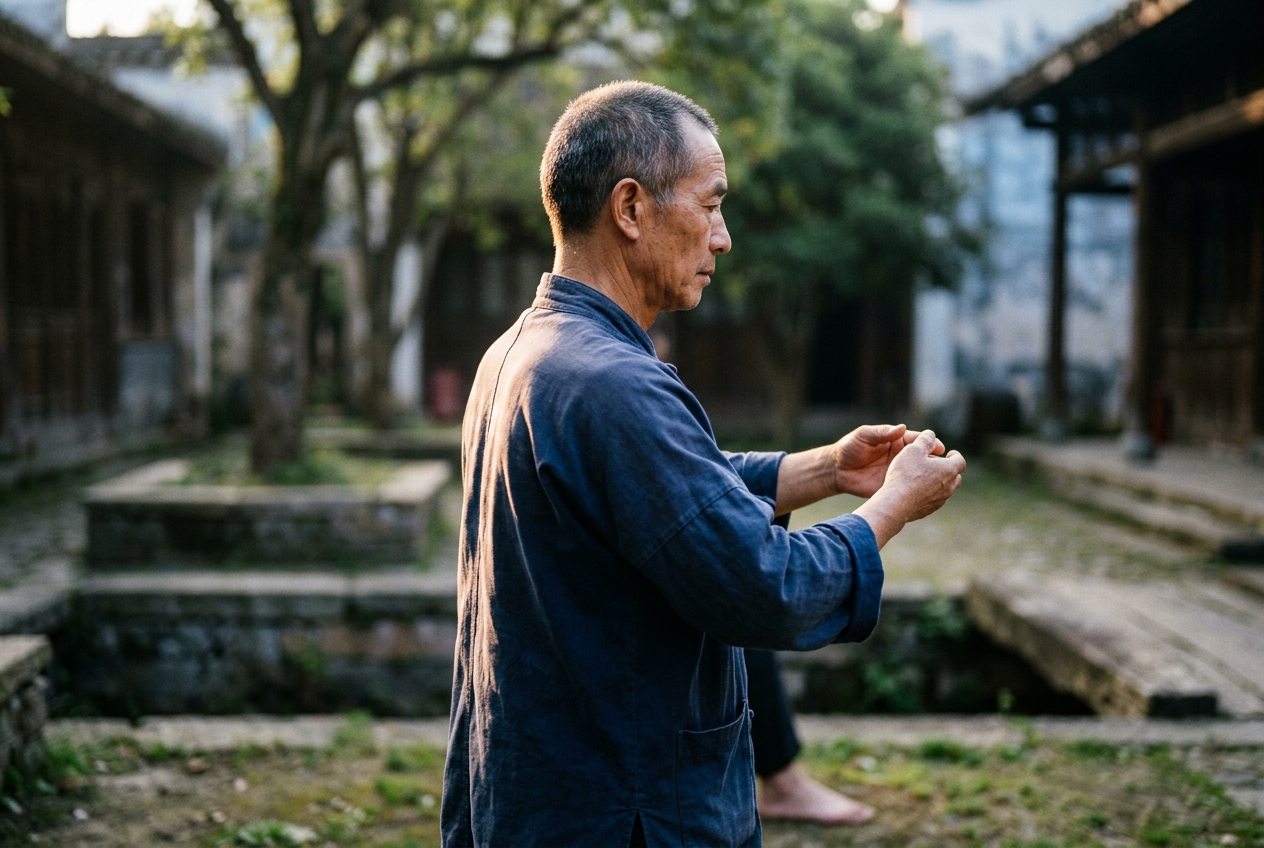
In the taxonomy of traditional Chinese medicine, Dazhu is classified as the Gu Hui (骨会), or the Systemic Influential Meeting Point of the Bones. The metaphor of the weaver’s shuttle is deeply intentional: just as a shuttle moves rhythmically back and forth across the loom to guide the warp and weft of a tapestry, the Dazhu cavity serves as the primary mechanical and energetic pivot that distributes structural tension across the vertical axis of the spine and the horizontal span of the shoulder girdle. Situated 1.5 cun (roughly two finger-widths) lateral to the lower border of the spinous process of the first thoracic vertebra (T1), Dazhu is the master key for regulating skeletal integrity, releasing upper-body constriction, and establishing what internal martial artists call whole-body tensegrity.
                  [ Baihui (DU20) - Upward Suspension ]
                                   |
                                   v
                       ( Cervical Spine: C1-C7 )
                                   |
======== [ Dazhu (BL11) ] <--- C7-T1 Nexus ---> [ Dazhu (BL11) ] ========
   \          |                    |                    |          /
    \   [Rhomboid Minor]    [Spinal Axis]    [Serratus Post. Sup] /
     \        |                    |                    |        /
      ==> Transverse Fascial Expansion <-> Longitudinal Force Vector
                                   |
                       ( Thoracic Spine: T1-T12 )
                                   |
                                   v
                  [ Yongquan (K1) - Ground Reaction ]
Step-by-Step Practice Guide: Calibrating the Cervicothoracic Pivot
To cultivate the Dazhu cavity within the framework of Zhan Zhuang standing meditation and classical Daoyin, follow this sequential alignment protocol. Practice this routine in a quiet space where you can stand undisturbed for ten to fifteen minutes.
1. Foundational Postural Setup (The Wuji Matrix)
- Base Placement: Stand with your feet parallel, precisely shoulder-width apart, with your toes pointing directly forward. Distribute your body weight evenly across the tripod of each foot: the base of the big toe, the base of the little toe, and the center of the calcaneus (heel).
- Joint Unlocking: Soften your knees without bending them deeply; allow the patellae to release their upward tension so your femur heads sink naturally into the acetabulum of the pelvis.
- Pelvic Neutrality: Gently release the coccyx downward as if it were weighted by a plumb line, allowing the lumbar curve (Mingmen) to flatten naturally without actively thrusting the hips forward.
- Arm Suspension: Allow your arms to hang loosely at your sides, creating a subtle hollow beneath the axillae (armpits) as if cradling a fragile quail egg under each arm.
2. The Dazhu Decompression Sequence
- The Suspended Crown (Baihui): Imagine a delicate silk cord attached to the crown of your head (Baihui, DU20), drawing the vertex vertically toward the sky. Let the chin make a micro-retraction—not pulling backward aggressively, but softly gliding inward so the occipital ridge rises and the back of the neck lengthens.
- Locating the T1 Hinge: Bring your internal focus (Yi) to the space 1.5 cun lateral to the T1 spinous process. Visualize this point not as a solid anatomical barrier, but as an expansive cavern or breathing pore.
- Hollowing the Chest and Rounding the Upper Back (Han Xiong Ba Bei): Without slouching, allow the sternum to sink inward by a fraction of a millimeter. Simultaneously, feel the medial borders of the scapulae gently separate and wrap forward around the ribcage. This opens the interscapular furrow and directly tensions the fascial envelope surrounding Dazhu.
- The Vector of Downward Release: As you inhale through the nose, guide the breath down to the lower abdomen (Dantian). As you exhale, imagine the tension around the C7–T1 junction melting outward along the clavicles and downward through the erector spinae, pouring the weight of the skull and upper torso directly into the skeletal columns of the legs.
       +-------------------------------------------------------------+
       |             NEIGONG SOMATIC CALIBRATION AUDIT               |
       +-------------------------------------------------------------+
       | 1. Cranial Vector: Baihui suspended; occiput elevated.      |
       | 2. Cervical Alignment: Chin retracted 2mm; throat soft.     |
       | 3. Thoracic Pivot: T1 spine decompressed; Dazhu widened.    |
       | 4. Scapular Wrap: Rhomboids lengthened; axillae hollowed.   |
       | 5. Kinetic Conduit: Ground force grounded in Yongquan (K1). |
       +-------------------------------------------------------------+
3. Breath Synchronization and Bone Breathing (Gu Sui Xi)
- Phase 1 (Inhalation): Draw air smoothly through the nostrils into the lower abdomen while feeling an expansive, hydraulic suction along the spinal canal. Envision the breath drawing environmental energy through the Dazhu cavities on both sides, penetrating directly into the spongy trabecular marrow of the first thoracic vertebra.
- Phase 2 (Retention/Transition): Hold the breath naturally for one to two seconds without closing the glottis. Feel the internal pressure equilibrate across the upper ribcage.
- Phase 3 (Exhalation): Exhale slowly through the nose with a soft, unvoiced "whoosh" sensation at the back of the palate. Direct an internal wave of downward settling through the marrow of the entire vertebral column, passing through the sacrum, down the femurs and tibias, and anchoring into the Yongquan (K1, Bubbling Spring) points on the soles of your feet.
4. Common Beginner Errors and Corrections
- The "Military Posture" Error: Thrusting the chest forward and pinching the shoulder blades together.
Correction: Soften the center of the breastbone; allow the clavicles to rest like a gently curved coat hanger rather than a rigid bar. - Cervical Hyperextension: Tilting the chin upward, which collapses the suboccipital space and compresses C7–T1.
Correction: Look straight ahead toward the horizon, slightly lowering the eyeline by five degrees while lifting the base of the skull. - Fascial Clamping: Actively tightening the trapezius muscles to hold the shoulders down.
Correction: Do not pull the shoulders down muscularly; instead, let gravity act on the elbow joints, allowing their weight to passively stretch the trapezius and levator scapulae.
5. Somatic Milestones and Interpretations
- Tingling or Piezoresonant Humming: A micro-vibratory sensation across the upper thoracic spine and down the ulnar nerve pathway into the ring and little fingers indicates the unpinning of the lower brachial plexus and local fascial release.
- Deep Thermal Waves: A feeling of radiant warmth spreading from T1 outward indicates vasodilation of the posterior intercostal arterial branches and activation of parasympathetic tone.
- Sensory Heaviness (Chen): A sensation that the skeleton has suddenly doubled in weight, anchoring firmly into the earth, confirms that muscular holding patterns have handed over structural support to the deep ligamentous and biotensegrity network.
The Western Somatic Science: Biomechanics and Neurophysiology
The functional mechanics cultivated at Dazhu correspond with remarkable precision to the clinical kinesiology and neuroanatomy of the cervicothoracic junction. Structurally, the C7–T1 transition represents one of the most mechanically vulnerable junctures in the human body. It is the primary transitional zone between the lordotic, highly mobile cervical spine and the kyphotic, relatively rigid thoracic cage.
   Cervical Lordosis (C1-C7)  -->  High Mobility / Low Structural Load
                                         |
                               [ C7-T1 TRANSITION ZONE ]
                                 (Dazhu / Great Shuttle)
                                         |
   Thoracic Kyphosis (T1-T12) -->  Low Mobility / High Load & Rib Support
When forward head posture or chronic stress causes the head to drift anteriorly, the gravitational load exerted on this junction multiplies exponentially. A forward displacement of merely two inches increases the effective weight of the cranium on the cervicothoracic hinge from approximately 10–12 pounds to over 30 pounds. This chronic mechanical overload forces the levator scapulae, rhomboid minor, and the serratus posterior superior to remain in a state of sustained isometric hypertonicity.
                                CRANIAL MASS VECTORS

   Neutral Cervical Alignment:                  Anterior Head Carriage:
          [ Head: ~10 lbs ]                            [ Head: ~32 lbs ]
                 |                                             \
                 v                                              \ (Shear Vector)
           [ C7-T1 Axis ]                                        v
                 |                                      ===> [ C7-T1 Shearing ] <===
                 v                                       (Rhomboid & Serratus Spasm)
         (Axial Transmission)
The serratus posterior superior originates on the nuchal ligament and the spinous processes of C7 through T3, inserting directly into the superior borders of the second through fifth ribs. When Dazhu is chronically compressed, this muscle locks in spasm, restricting the bucket-handle excursion of the upper ribs and forcing the body into shallow, clavicular breathing patterns. By consciously widening and releasing the Dazhu cavity, the practitioner lengthens the rhomboid minor and serratus posterior superior, permitting the first and second ribs to mobilize. This dynamic release is documented in modern biomechanical literature exploring fascial tensegrity networks, which explain how continuous collagenous matrices distribute strain throughout the musculoskeletal frame.
+---------------------------------------------------------------------------------------------------+
|                           BIOMECHANICAL & NEUROLOGICAL CORRELATIONS                               |
+------------------------------------+--------------------------------------------------------------+
| Classical Neigong Phenomenon       | Contemporary Neurophysiological Mechanism                    |
+------------------------------------+--------------------------------------------------------------+
| Decompression of Dazhu (BL11)      | Lengthening of serratus posterior superior & rhomboid minor  |
| "Opening the Bone Hui"             | Axial mechanotransduction; osteoblast activation via stress  |
| Downward sinking of internal Qi    | Reset of sympathetic chain / Stellate ganglion down-regulation|
| Upper torso stabilization          | Optimization of Ground Reaction Force (GRF) transmission     |
| Release of chest constriction      | First rib mobilization; improved phrenic nerve excursion     |
+------------------------------------+--------------------------------------------------------------+
Furthermore, this release directly relieves pressure on the underlying neurovascular structures. Immediately anterior to the transverse process of the first thoracic vertebra lies the stellate ganglion (cervicothoracic ganglion), a critical crossroad of the sympathetic nervous system. Chronic muscular contraction and postural shearing at C7–T1 can provoke mechanical irritation of this sympathetic hub, driving persistent autonomic arousal, elevating systemic cortisol, and depressing heart rate variability (HRV).
Decompressing the Dazhu cavity mechanically unburdens the stellate ganglion, triggering a rapid shift toward parasympathetic dominance. Concurrently, it eliminates impingement on the dorsal rami of the upper thoracic spinal nerves and promotes unobstructed venous drainage from the cranial vault via the vertebral venous plexuses.
From the perspective of skeletal mechanobiology, opening Dazhu restores the spine's capacity for optimal axial load bearing. In an aligned posture, ground reaction forces (GRF) generated during movement or static standing are transmitted without shearing forces straight through the vertebral bodies and intervertebral discs. When the spine maintains this vertical tensegrity, micro-compressive forces generate minute electrical potentials within the bone matrix—a phenomenon known as the piezoelectric effect. These electrical signals stimulate osteoblastic activity and bone remodeling in accordance with Wolff’s Law, providing a clear biological foundation for the classical designation of Dazhu as the master point governing the health and density of the skeletal system (Gu Hui).
Classical Lineage, Energetic Confluence, and Historical Context
The theoretical importance of Dazhu is deeply rooted in the foundational texts of Chinese medical and internal martial traditions. The earliest systemic analysis of the point appears in the Huangdi Neijing (黄帝内经, The Yellow Emperor’s Inner Classic, circa 2nd century BCE). In the Lingshu (Spiritual Pivot, Chapter 33, "On the Seas"), Dazhu is designated as an indispensable upper portal for the "Sea of Blood" (Xue Hai):
"The Sea of Blood has its upper point at Dazhu, and its lower points at Shangjuxu (ST37) and Xiajuxu (ST39)... When the Sea of Blood is replete, the individual experiences a subjective sense of bodily enlargement, uncentered vitality, and an inability to define their physical boundary; when it is deficient, they experience physical reduction, narrowness of spirit, and an incapacity for clear physical manifestation."
This attribution connects Dazhu to systemic cardiovascular hemodynamics and the nourishment of deep connective tissues. In the Nanjing (难经, The Classic of Difficult Issues, Chapter 45), the point's functional taxonomy was formalized under the doctrine of the Ba Hui Xue (八会穴, Eight Influential Meeting Points), explicitly codifying Dazhu as the Gu Hui (Bone Meeting Point). Classical physicians posited that whenever pathology penetrated the marrow, whenever joints grew brittle, or whenever structural deformities compromised somatic equilibrium, Dazhu was the non-negotiable gateway for therapeutic intervention.
                     ENERGETIC CONFLUENCE MATRIX OF DAZHU (BL11)

                     +----------------------------------------+
                     |         Foot Taiyang (Bladder)         |
                     +-------------------+--------------------+
                                         |
               +-------------------------+-------------------------+
               |                         |                         |
               v                         v                         v
     +-------------------+     +-------------------+     +-------------------+
     |   Hand Taiyang    |     |  Governing Vessel |     |   Sea of Blood    |
     | (Small Intestine) |     |  (Du Mai Nexus)   |     | (Lingshu Cap. 33) |
     +-------------------+     +-------------------+     +-------------------+
               |                         |                         |
               +-------------------------+-------------------------+
                                         |
                                         v
                     +----------------------------------------+
                     |         MASTER SKELETAL MATRIX         |
                     |         (Gu Hui - Bone Meeting)        |
                     +----------------------------------------+
Energetically, Dazhu is situated on the Urinary Bladder Meridian (Foot Taiyang), the longest and most exterior-facing energetic conduit in the body, which governs somatic defense, postural tonus, and the entire dorsal fascial chain. However, Dazhu is not merely a single-channel point; it serves as a major intersection (Jiao Hui Xue) where the channels of the Foot Taiyang Bladder and Hand Taiyang Small Intestine meet, with secondary energetic branches connecting directly to the Du Mai (Governing Vessel) at Dazhui (DU14) and descending into the deep spinal marrow network.
Because the Small Intestine channel governs the dynamic articulation of the scapulae and posterior shoulder capsule, and the Bladder channel governs the longitudinal integrity of the spine down to the heels, Dazhu functions as the energetic bridge uniting arm movements with spinal kinetics.
In Daoist internal alchemical lineages (Neidan) and the martial traditions of the Ming and Qing Dynasties—including Yiquan, Taijiquan, and the Shaolin Yijin Jing (Tendon-Changing Classic)—Dazhu was preserved as an essential secret of the "Three Back Passes" (San Guan). The upper pass, Yuzhen (the Jade Pillow at the occiput), cannot be opened if the kinetic energy stalls at the cervicothoracic junction.
Lineage masters observed that tension at Dazhu acted like a closed sluice gate along the spine, trapping pathogenic internal heat in the head, causing hypertension and emotional volatility, while starving the lower limbs of energetic circulation. Mastering the opening of Dazhu was therefore regarded as an indispensable prerequisite for the true circulation of the Microcosmic Orbit (Xiao Zhou Tian).
Practical Neigong Calibration and Diagnostic Indicators
Because the cervicothoracic junction is prone to sensory motor amnesia, practitioners should use regular diagnostic self-checks to evaluate the functional open state of the Dazhu cavity.
             DIAGNOSTIC TRIAD OF CERVICOTHORACIC CONSTRICTION

          [ 1. Suboccipital & Palpable Hypertonicity at T1 ]
                                 / \
                                /   \
                               /     \
  [ 2. Asymmetric Scapular ] <---------> [ 3. Paradoxical Upper Chest ]
  [      Retraction        ]             [     Respiratory Lift       ]
Diagnostic Indicators of Constriction
- Palpable Induration: Tenderness or dense, fibrous tissue knots 1.5 cun lateral to the T1 spinous process indicate chronic myofascial contracture and stasis in the regional microcirculation.
- Paradoxical Clavicular Breathing: If the upper chest and clavicles rise noticeably during normal resting inhalation, the Dazhu cavity is locked, signaling that the accessory respiratory muscles are overworking to compensate for restricted ribcage mechanics.
- Loss of Kinetic Transmission: When applying forward pressure with the palms against a resistance wall, any collapse or pinching sensation at the base of the neck indicates a failure of the skeletal framework to route ground reaction forces through the cervicothoracic junction.
The Dazhu Dynamic Micro-Calibration Drill
- The Postural Arc: Stand in a neutral stance with hands resting on the hips. Lower your chin gently toward your sternum until you feel a light stretch along the back of your neck.
- Isolating T1: Slowly rotate your head just five degrees to the left. Take a slow breath into the right Dazhu point, imagining you are directing the air right into the taut fascial band between T1 and the superior medial border of the right scapula.
- The Micro-Circle: Trace a tiny circle with the crown of your head—no larger than the diameter of a coin—keeping your focus centered entirely on the gentle mobilization of the first thoracic vertebra relative to the first rib.
- Integration: Return to the vertical center, suspend the crown point (Baihui), and feel an immediate rush of warmth and circulation flow down your spine into the lumbar region.
Daily Practice Commitment: The Five-Minute Morning Protocol
To integrate the bioenergetic cultivation of Dazhu into your daily routine, commit to this focused five-minute recalibration every morning before consuming your first cup of tea or coffee:
- Minute 0:00–1:00 (Wuji Grounding): Stand with feet shoulder-width apart. Let your eyes soften and take three deep diaphragmatic breaths. Release all intentional muscular effort in your face, jaw, and shoulders.
- Minute 1:00–3:00 (Opening the Great Shuttle): Bring your awareness to the base of your neck. Lightly tuck the chin, suspend the crown of your head, and let your shoulder blades gently spread and wrap forward around the ribcage (Han Xiong Ba Bei). Breathe slowly in and out of the Dazhu cavities at T1, visualizing the space widening with every exhalation.
- Minute 3:00–4:30 (Bone Marrow Pulsing): Inhale while drawing structural awareness up through the soles of your feet into Dazhu; exhale while streaming that structural energy down the central axis of your skeleton back into the earth, confirming your rooted, whole-body connection.
- Minute 4:30–5:00 (Settling the Qi): Place both palms over your lower abdomen (Dantian). Take three slow, integrative breaths, feeling how your upper back rests open, wide, and light, while your physical center feels anchored and grounded.
Track your somatic responses throughout the day. Notice whether your neck feels freer, your shoulder tension eases at your desk, and your mental focus remains steady. Over time, consistently decompressing this structural nexus transforms your posture from a precarious, muscle-held effort into an effortless, suspended state of skeletal balance.