Dao Qi Fa: Navigating Directed Channel Conduction Dynamics, Propagated Qi Induction Vectors, and Precision Acupressure Protocols
If you have ever sat at your desk late on a Tuesday afternoon, paralyzed by an unyielding band of tension across your temples, an epigastric hollow of indigestion churning beneath your ribs, and a diffuse cognitive fog that no double espresso can pierce, you are experiencing the modern collapse of autonomic regulation. In clinical terms, this syndrome manifests as sustained sympathetic hyper-arousal coupled with functional microvascular constriction and visceral hypomotility. We inhabit a culture that treats these somatic complaints with pharmacological suppression—swallowing non-steroidal anti-inflammatories for the cranium and proton-pump inhibitors for the gut—yet the underlying physiological grid remains rigidly bound in chronic strain.
Traditional Chinese Medicine (TCM) conceives of this distress not as isolated organ failures, but as a dynamic interruption within the longitudinal conduits of bodily communication: the Jingluo (meridian system). When stress locks the diaphragmatic and fascial planes, the circulation of Qi—the functional bioelectric and metabolic coherence of the organism—stagnates. Fortunately, classical East Asian medicine developed an extraordinarily sophisticated, non-invasive therapeutic framework known as Dao Qi Fa (导气法, or the "Qi Guiding Method").
Rather than viewing the body as a passive vessel to be randomly poked or rubbed, Dao Qi Fa represents a systematic discipline of manual vectoring, depth modulation, and respiratory synchronization designed to steer propagated somatic sensations directly to diseased target tissues. By understanding the biomechanical and neurofascial underpinnings of this classical methodology, any educated reader can transform simple manual pressure into an exacting, reproducible instrument of self-directed neuro-visceral restoration.
The Meridian Path — A Journey Through the Body
To understand how pressing a point below your knee or on the web of your hand can relieve a migraine or settle a turbulent stomach, one must demystify the meridian pathway. Stripped of mystical obfuscation, meridians correspond with remarkable fidelity to the body’s fascial planes, intermuscular cleavage lines, and neurovascular tracts. When classical texts describe energy flowing through channels, modern physiology identifies interstitial hydraulic continuity, low electrical impedance pathways, and perivascular nerve plexuses running continuously from the extremities to the viscera.
+---------------------------------------------------------------------------------------+
|                              THE DUAL CONTINUUM OF DAO QI                             |
|                                                                                       |
|   Classical Vector Mechanics (Ling Shu)     <--->     Biophysical Substrate           |
|   - Guan Neng (官能): Qi Zhi Bing Suo        <--->     - Interstitial Shear Stress     |
|   - Zhen Jiu Da Cheng: Vector Angulation    <--->     - Piezo1/2 Mechanotransduction  |
|   - Respiration-Coupled Guidance            <--->     - A-Delta / C-Fiber Recruitment |
|   - De Qi (得气) Conduction Matrix          <--->     - Perivascular Autonomic Tone   |
+---------------------------------------------------------------------------------------+
Consider the great anterior pathway of the Stomach Meridian of Foot-Yangming: it does not merely exist on paper; you can trace it upon your own flesh. It begins beneath the orbit of the eye, descends through the jaw and throat, courses down the chest over the rectus abdominis, passes through the groin, and travels along the thick muscular ridge on the outside of your shinbone—the exact tissue that aches after a day of unaccustomed hiking—before terminating at the second toe.
Similarly, the Pericardium Meridian of Hand-Jueyin charts a direct path down the inner arm. It emerges from the chest, courses between the biceps tendons, slips between the two prominent cord-like flexor tendons of the inner forearm—the tendons that stand out like taut cables when you clench your fist—and exits through the center of the palm to the tip of the middle finger.
These paths are anatomical highways. Modern research published through the National Center for Biotechnology Information (NCBI) demonstrates that acupoints located along these meridians exhibit significantly higher densities of unmyelinated free nerve endings, encapsulated mechanoreceptors, mast cells, and microvascular beds compared to non-channel control points. Applying pressure here is not an act of faith; it is an act of targeted neurofascial stimulation.
The Classical Lineage and Biophysical Mechanisms of Dao Qi Fa
The foundational theory of Dao Qi Fa traces its lineage to the foundational canon of East Asian medicine, the Huangdi Neijing Ling Shu (黄帝内经·灵枢, c. 1st century BCE). In Chapter 73, titled Guan Neng (官能, "Official Capabilities"), the text establishes a clear clinical demarcation: while standard tonification (Bu) reinforces generalized functional depletion and sedation (Xie) disperses acute pathological excess, Dao Qi Fa is specifically designed for recalcitrant, localized conditions where sensation must be deliberately propelled across anatomic barriers. The governing maxim of this approach is Qi Zhi Bing Suo (气至病所)—"driving the therapeutic sensation directly to the site of disease."
Centuries later, during the Ming Dynasty, Yang Jizhou codified these principles within the encyclopedic Zhen Jiu Da Cheng (针灸大成, The Great Compendium of Acupuncture and Moxibustion, 1601). Yang emphasized that Qi does not migrate autonomously; its trajectory is dictated by the vector of mechanical insertion, the cyclical depth of pressure, and the synchrony of the patient's respiratory rhythm.
Biophysical Correlates: Shear Stress and Mechanotransduction
When a practitioner applies directional acupressure according to Dao Qi Fa, the mechanical load deforms the extracellular matrix (ECM) of the subcutaneous loose connective tissue. According to fascial research indexed on PubMed Central (PMC), this mechanical deformation induces interstitial fluid shear stress. The surrounding fibroblasts and endothelial cells respond to this fluid displacement via membrane-bound, mechanically activated ion channels—specifically Piezo1 and Piezo2.
The activation of Piezo channels triggers an immediate intracellular calcium influx, facilitating the localized exocytosis of adenosine triphosphate (ATP), nitric oxide (NO), and substance P. Nitric oxide induces immediate smooth-muscle relaxation in adjacent microvessels, leading to local hyperaemia and the warming sensation characteristic of somatic activation.
Neurological Recruitment and Propagated Sensation Along Channels (PSC)
Concurrently, Dao Qi Fa recruits specific neural pathways. The manual compression engages: 1. Low-threshold A-beta mechanoreceptors (providing tactile grounding), 2. Thinly myelinated A-delta fibers (transmitting the characteristic heavy, aching sensation), and 3. Unmyelinated C-fibers (responsible for slow, radiating warmth and autonomic modulation).
This distinct neurosensory phenomenon is recognized in biomedical literature as De Qi (得气, "the arrival of Qi"), an essential prerequisite for therapeutic efficacy documented by the World Health Organization (WHO) and modern studies on Deqi mechanisms.
When pressure is maintained with a directional vector rather than perpendicular force, it creates an asymmetric wave of strain along the fascial cleavage plane. This initiates Propagated Sensation along Channels (PSC)—a phenomenon extensively documented in clinical studies on Propagated Sensation along Channels. PSC is perceived by the patient as a linear, creeping sensation of warmth, distension, or electrical tingling traveling along the classic meridian path toward the pathological focus.
5 Core Acupressure Points and Dao Qi Fa Protocols
To practice Dao Qi Fa effectively through non-invasive acupressure, one must master five primary therapeutic hubs. Each point requires an exact anatomic identification based on somatic landmarks, a directional vector, progressive depth staging, and respiratory synchronization.
=========================================================================================
                               CORE ACUPOINT PROFILE MATRIX
=========================================================================================
Point    Anatomical Landmark             Vector Angulation      Depth Modulation
-----------------------------------------------------------------------------------------
ST36     Four finger-widths below knee,  45° Superior-Medial   Three-Stage "Heaven-
(Zusanli) lateral to shinbone crest      toward the patella     Earth-Man" (15-25mm)

LV3      Webbing groove between 1st &    30° Proximal-Deep      Continuous Oscillation
(Taichong) 2nd metatarsal bones         toward the ankle joint (8-15mm)

LI4      Peak of musculature between     45° Proximal-Medial    Intermittent Sustained
(Hegu)   thumb and index metacarpals     toward 2nd metacarpal  (12-20mm)

SP6      Four finger-widths above inner  45° Superior-Posterior Stepped Increment
(Sanyinjiao) ankle, behind tibia edge    along tibial border    (10-18mm)

PC6      Three finger-widths above wrist 90° Perpendicular with Rhythmic Piezoresistive
(Neiguan) crease, between flexor tendons proximal tilt          (8-12mm)
=========================================================================================
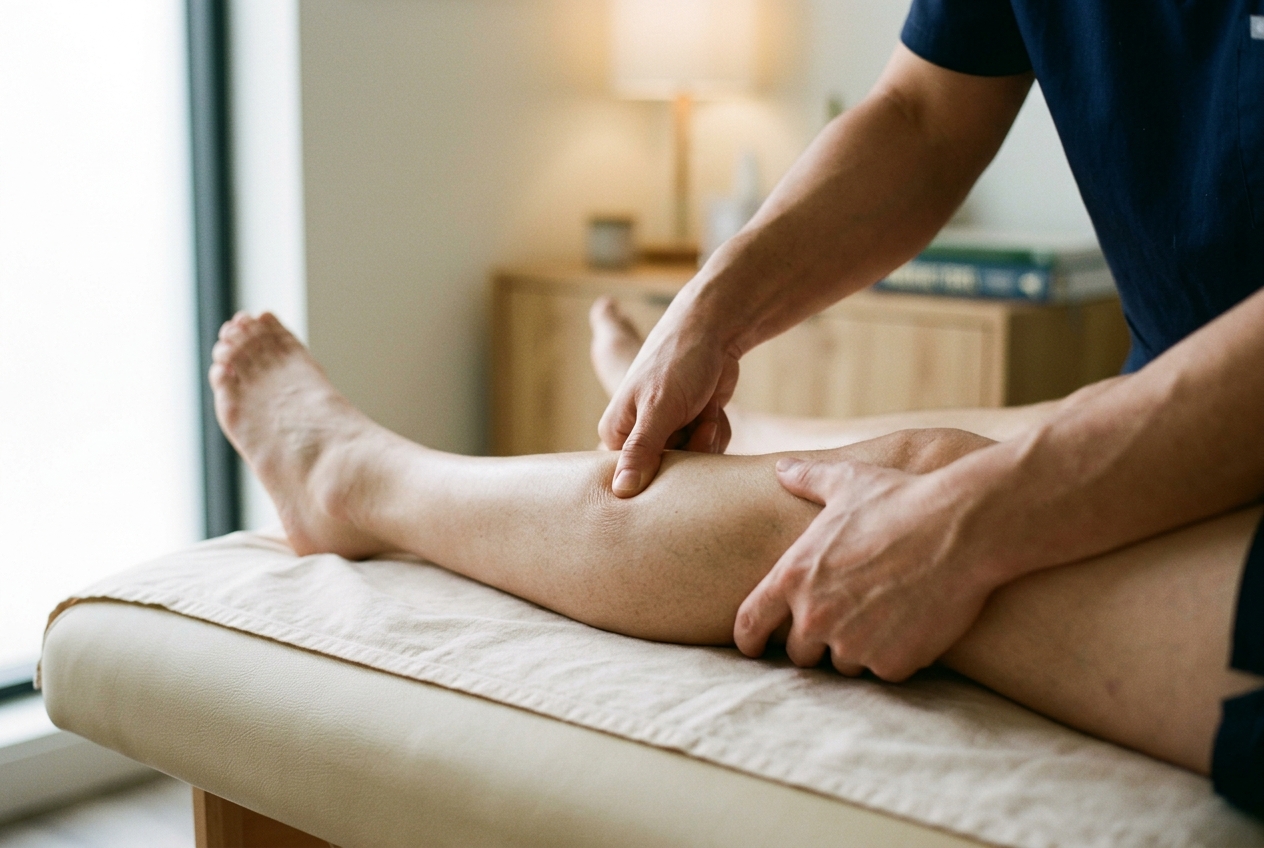
1. ST36 (Zusanli, 足三里) — "Leg Three Miles"
- Somatic Landmark: Place the palm of your hand directly over your kneecap on the same side. Let your fingers rest naturally on your shin. ST36 lies approximately four finger-widths below the bottom edge of the kneecap, in the soft muscular groove one finger-breadth lateral (outward) from the sharp, bony ridge of your shinbone (the anterior crest of the tibia).
- The De Qi Signature: When properly located, deep pressure produces a profound, heavy, dull ache that frequently radiates downward into the dorsum of the foot or upward toward the knee joint.
- Dao Qi Fa Vector & Execution:
- Directional Angulation: Angle your thumb at a 45-degree angle pointing superior-medially (upward and slightly inward toward the center of the knee). This directs the mechanical strain along the deep peroneal nerve and anterior tibial fascial sheath.
- Progressive Depth Modulation: Employ the classical San Bu (Three Steps) method. Press through the superficial fascia (Heaven layer, 5 seconds), sink to the muscular belly (Man layer, 10 seconds), and finally anchor against the deep interosseous membrane (Earth layer, 15 seconds).
- Respiratory Pacing: Advance pressure during the patient's prolonged exhalation; hold stationary during inhalation.
- Duration: 2 to 3 minutes per limb.
- Primary Clinical Applications: Chronic fatigue syndrome, post-prandial epigastric distension, generalized immune depletion, and functional constipation.
2. LV3 (Taichong, 太冲) — "Great Rushing"
- Somatic Landmark: On the top of your bare foot, locate the webbing between your great toe and second toe. Slide your finger backward (proximally) along the groove between the two long bones (the first and second metatarsals) until your finger falls into a natural, tender depression immediately before the junction where the bones meet.
- The De Qi Signature: Highly sensitive; manifests as an immediate, sharp distension that softens into a wide, spreading warmth over the instep of the foot.
- Dao Qi Fa Vector & Execution:
- Directional Angulation: Direct your pressure proximally at a 30-degree angle toward the ankle joint, rather than pushing straight down into the floor. This aligns with the course of the deep peroneal nerve trunk.
- Progressive Depth Modulation: Apply sustained, circular micro-oscillations at a constant depth of 8–15mm, avoiding sudden jerky movements.
- Respiratory Pacing: Coordinate with slow, 6-second abdominal exhalations to facilitate systemic parasympathetic conversion.
- Duration: 2 minutes per foot.
- Primary Clinical Applications: Stress-induced hypertension, vertex tension headaches, affective irritability, and ocular strain from digital display exposure.
3. LI4 (Hegu, 合谷) — "Joining Valleys"
- Somatic Landmark: Spread your thumb and index finger apart. On the back of the hand, look at the fleshy mound of muscle (the first dorsal interosseous) between the first and second metacarpal bones. Bring the thumb and index finger close together; a muscular peak will rise. LI4 is located at the absolute apex of this mound, slightly closer to the bone of the index finger.
- The De Qi Signature: An intensely radiating, numb ache that frequently travels up the radial aspect of the forearm toward the elbow and face.
- Dao Qi Fa Vector & Execution:
- Directional Angulation: Anchor your thumb against the point and press obliquely at a 45-degree angle underneath the second metacarpal bone (pointing toward the wrist). Never press straight down against the surface skin.
- Progressive Depth Modulation: Apply sustained, firm ischemic compression, increasing depth progressively every 10 seconds over a 60-second block.
- Respiratory Pacing: Inhale for 4 seconds, exhale for 6 seconds; on every third exhalation, apply an additional 10% pressure increment.
- Duration: 2 to 3 minutes per hand.
- Primary Clinical Applications: Frontal and temporal headaches, temporomandibular joint (TMJ) dysfunction, sinus congestion, and systemic pain mitigation.
              [ LI4 / HEGU PRESSURE VECTOR ]

              Index Metacarpal Bone
                  /
                 /   <- Direct pressure UNDER the bone at 45°
   Thumb Metacarpal  \  (Oblique vector toward wrist)
          \           \
           \           [LI4 Apex]
            \
4. SP6 (Sanyinjiao, 三阴交) — "Three Yin Intersection"
- Somatic Landmark: Locate the highest prominence of your medial malleolus (the bony knob on the inside of your ankle). Lay your four fingers flat across your inner calf, starting with your pinky resting on the top of the ankle bone. SP6 is located directly four finger-widths above the ankle knob, immediately posterior to the inner edge of the shinbone.
- The De Qi Signature: A deep, visceral, spreading ache that can be felt ascending the inner aspect of the calf and thigh toward the lower abdomen.
- Dao Qi Fa Vector & Execution:
- Directional Angulation: Slide your thumb slightly behind the posterior border of the tibia and press forward and upward at a 45-degree angle, wedging between the bone and the soleus/flexor digitorum longus muscles.
- Progressive Depth Modulation: Utilize a stepped rhythm—press for 5 seconds, relax 10% of pressure for 2 seconds, and then sink deeper for 10 seconds.
- Respiratory Pacing: Synchronize with diaphragmatic breathing, encouraging the subject to visualize warmth accumulating in the pelvic floor during each exhale.
- Duration: 2 minutes per leg.
- Primary Clinical Applications: Dysmenorrhea, pelvic floor stagnation, lower abdominal distension, insomnia, and nocturnal micturition.
5. PC6 (Neiguan, 内关) — "Inner Pass"
- Somatic Landmark: Turn your hand palm-up. Lay three fingers of your opposite hand across the inside of your wrist, starting at the distal wrist crease. PC6 is located directly three finger-widths above the wrist crease, precisely nestled between the two prominent cords running down your forearm (the tendons of the palmaris longus and flexor carpi radialis muscles).
- The De Qi Signature: An unmistakable, electric, tingling sensation that tracks along the median nerve distribution into the middle finger and radiates up through the cubital fossa toward the chest.
- Dao Qi Fa Vector & Execution:
- Directional Angulation: Apply perpendicular pressure with a subtle proximal tilt (10 degrees toward the elbow), capturing the deep fascial compartment enveloping the median nerve.
- Progressive Depth Modulation: Employ gentle, piezoresistive micro-rotations (clockwise for 15 rotations, counter-clockwise for 15 rotations) without allowing the skin-to-thumb contact to slip.
- Respiratory Pacing: Deep, slow thoracic-diaphragmatic breaths (4 seconds in, 7 seconds out) to augment vagal tone.
- Duration: 1.5 to 2 minutes per arm.
- Primary Clinical Applications: Motion sickness, post-operative or morning nausea, cardiac palpitations related to anxiety, and gastroesophageal reflux.
A Clinical Protocol for One Common Issue: The Digital Desk Reset
Modern sedentary professionals routinely suffer from a tripartite symptom complex: occipital tension headaches, epigastric hypomotility (bloating), and sympathetic cognitive overdrive. This state arises from forward-head posture compressing the suboccipital nerves, prolonged mental stress inhibiting vagal outflow, and lack of diaphragmatic excursion stalling gut motility.
The following sequential protocol employs Dao Qi Fa channel conduction vectors to systematically reset the autonomic balance and clear somatic stagnation.
+---------------------------------------------------------------------------------------+
|                    THE 10-MINUTE DIGITAL DESK RESTORATION PROTOCOL                     |
|                                                                                       |
|  Phase 1: Clear the Cephalic Axis (Minutes 0:00 - 3:00)                               |
|  - Point: LI4 (Hegu) Bilaterally                                                      |
|  - Posture: Seated upright, elbows supported on desk                                  |
|  - Vector: 45° Oblique-Proximal toward index metacarpal                               |
|  - Breath: 4-second inhalation, 6-second exhalation                                   |
|                                                                                       |
|  Phase 2: Engage the Vagal-Cardiopulmonary Axis (Minutes 3:00 - 6:00)                 |
|  - Point: PC6 (Neiguan) Bilaterally                                                   |
|  - Posture: Palms facing skyward, forearms relaxed on lap                             |
|  - Vector: 90° Perpendicular with proximal tilt                                       |
|  - Breath: 4-second inhalation, 7-second exhalation                                   |
|                                                                                       |
|  Phase 3: Descend the Gastrointestinal Stagnation (Minutes 6:00 - 10:00)              |
|  - Points: ST36 (Zusanli) coupled with LV3 (Taichong)                                 |
|  - Posture: Seated with ankles crossed or feet flat on floor                          |
|  - Vector: ST36 (45° Superior-Medial); LV3 (30° Proximal)                             |
|  - Breath: Deep abdominal resonant breathing (5s in, 5s out)                          |
+---------------------------------------------------------------------------------------+
Step-by-Step Execution Guide
Phase 1: Clear the Cephalic Axis (0:00 to 3:00)
- Sit comfortably with your spine upright and shoulders dropped away from the ears. Rest your forearms on the desk.
- Locate LI4 (Hegu) on your left hand using the somatic landmark described above.
- Sink your right thumb into the tissue, establishing an oblique vector directed underneath the second metacarpal bone toward the wrist.
- Inhale deeply for 4 seconds; as you exhale slowly for 6 seconds, increase the pressure to the Man (intermediate) depth until a distinct, heavy ache is achieved. Maintain for 90 seconds.
- Switch to the right hand and repeat for 90 seconds. Expected Result: Release of tension in the jaw and frontal brow; opening of the nasal passages.
Phase 2: Engage the Vagal-Cardiopulmonary Axis (3:00 to 6:00)
- Turn both palms upward and place your forearms on your lap.
- Identify PC6 (Neiguan) on the left arm, precisely between the flexor tendons.
- Apply perpendicular pressure with your right thumb, tilting the vector slightly toward the elbow.
- Implement rhythmic piezoresistive oscillations: compress firmly during the 7-second exhale, easing off by roughly 20% during the 4-second inhale. Continue for 90 seconds.
- Repeat on the right arm for 90 seconds. Expected Result: Measurable slowing of the heart rate, alleviation of chest tightness, and cessation of epigastric fluttering.
Phase 3: Descend Gastrointestinal Stagnation (6:00 to 10:00)
- Sit with feet firmly planted flat on the floor, uncrossing the legs to ensure uninhibited venous and lymphatic return.
- Locate ST36 (Zusanli) on both legs simultaneously using both thumbs.
- Press upward and inward at a 45-degree angle toward the knee joint, anchoring your fingers around the posterior calves for leverage.
- Hold for 2 continuous minutes, pacing your breath into the lower abdomen (belly expands on inhale, contracts on exhale).
- Slide down to both feet and locate LV3 (Taichong) in the metatarsal groove. Press proximally toward the ankles for 2 minutes with slow, circular micro-compressions. Expected Result: Audible borborygmus (stomach gurgling) indicating the reactivation of peristalsis; downward clearing of cranial pressure.
Safety, Sensations, and Clinical Boundaries
While Dao Qi Fa acupressure is a non-invasive modality, its clinical potency requires a clear understanding of physiological thresholds, contraindications, and biomedical red flags.
+---------------------------------------------------------------------------------------+
|                             CLINICAL SAFETY GUIDELINES                                |
|                                                                                       |
|   CONTRAINDICATED IN PREGNANCY:       PRESSURE THRESHOLD:                             |
|   - LI4 (Hegu)                        - Therapeutic: Dull, heavy, spreading ache      |
|   - SP6 (Sanyinjiao)                  - Damaging: Sharp, lancinating, pinching pain   |
|   (Risk of inducing uterine tonus)    (Cease immediately if sharp pain occurs)        |
|                                                                                       |
|   LOCAL CONTRAINDICATIONS:            BIOMEDICAL RED FLAGS:                           |
|   - Acute phlebitis / DVT             - Thunderclap headache                          |
|   - Active dermal infections          - Unexplained chest pain radiating to jaw       |
|   - Fractures or open wounds          - Sudden focal neurological deficits            |
+---------------------------------------------------------------------------------------+
Critical Contraindications During Pregnancy
Certain acupoints exert profound descending and oxytocic actions that stimulate uterine contractility. LI4 (Hegu) and SP6 (Sanyinjiao) are strictly contraindicated throughout all trimesters of pregnancy, except when deliberately administered by a licensed professional during active labor to facilitate delivery. Strong manual stimulation of these points can induce premature uterine contractions through autonomic neural reflex arcs.
Deciphering Somatosensory Feedback: De Qi vs. Nociceptive Damage
A critical distinction must be drawn between the therapeutic sensation of De Qi and acute tissue trauma: * Therapeutic De Qi: Characterized by a dull, spreading, heavy, distending, or warm ache. It feels "productive"—as though tight, bound tissue is finally releasing stored strain. The sensation may radiate along the limb but is fundamentally tolerable and calms down as pressure is sustained. * Tissue Distress / Nociceptive Damage: Characterized by sharp, stinging, pinching, or lancinating pain. If the sensation feels like a knife or an electric shock shooting across a superficial nerve trunk, your pressure is misaligned or excessively forceful. Bruising, capillary rupture, or prolonged soreness after a session indicates excessive mechanical force. Acupressure must be firm and assertive, never violent.
When to Seek Professional Medical Care
Self-administered acupressure is a restorative, homeostatic maintenance tool, not a substitute for emergency biomedical intervention. You must immediately seek licensed medical attention if you experience: * Sudden, severe "thunderclap" headaches unlike any previously experienced. * Chest pain, crushing substernal pressure, or pain radiating into the left jaw or arm. * Sudden unilateral weakness, facial drooping, dysphasia, or ataxia. * Acute, rigid, or rebound abdominal pain accompanied by high fever. * Unexplained unilateral lower limb swelling and heat (indicative of deep vein thrombosis).
For chronic structural, metabolic, or psychological conditions, consult a licensed acupuncturist certified by national regulatory bodies such as the NCCAOM or an integrative medical physician.
Today's Takeaway: The Two-Minute Cephalic-Vagal Reset
Before you close this window or return to the demands of your schedule, take exactly two minutes to put the biophysics of Dao Qi Fa into practice right now.
+---------------------------------------------------------------------------------------+
|                     YOUR TWO-MINUTE CEPHALIC-VAGAL RESET                              |
|                                                                                       |
|  1. TARGET: LI4 (Hegu) on your non-dominant hand.                                     |
|  2. ANCHOR: Wedge your thumb under the second metacarpal bone, angled at 45°.         |
|  3. CADENCE: Inhale for 4 seconds; exhale for 6 seconds.                              |
|  4. DEPTH: Sink 10% deeper on each exhalation for 6 consecutive breath cycles.        |
|  5. OBSERVE: Feel the heavy, dull ache spread across your hand, downshifting your     |
|     nervous system and relaxing the muscles of your neck, jaw, and brow.              |
+---------------------------------------------------------------------------------------+
- Locate: Bring your non-dominant hand up. Find the fleshy muscle mound between your thumb and index finger—LI4 (Hegu).
- Set the Vector: Do not press straight down. Rest the tip of your dominant thumb on the muscle mound and angle your force at a 45-degree angle beneath the index finger bone, directed backward toward your wrist.
- Engage the Breath: Close your eyes. Inhale through your nose for 4 counts; exhale slowly through pursed lips for 6 counts.
- Modulate the Depth: As you exhale, press firmly into the tissue until you feel that distinctive, heavy, spreading ache (De Qi). Hold this precise depth through the inhalation, and sink 10% deeper on the next exhalation.
- Complete the Cycle: Maintain this focused compression for six complete breath cycles (approximately 60 seconds), then switch hands and repeat on the opposite side.
As you release the point, notice the subtle surge of microvascular warmth flowing through your palms, the dropped tension in your masseter (jaw) muscles, and the renewed clarity across your forehead. You have not simply massaged a muscle—you have harnessed the classical mechanics of Dao Qi Fa to consciously direct your own neurophysiology.