Dampness-Dispelling Formulas (Qu Shi Ji) Prescription Dynamics: Governing Turbid Moisture Transformation, Lin Syndrome Clearance, Arthralgia Resolution, and Interstitial Fluid Homeostasis in Traditional Chinese Medicine
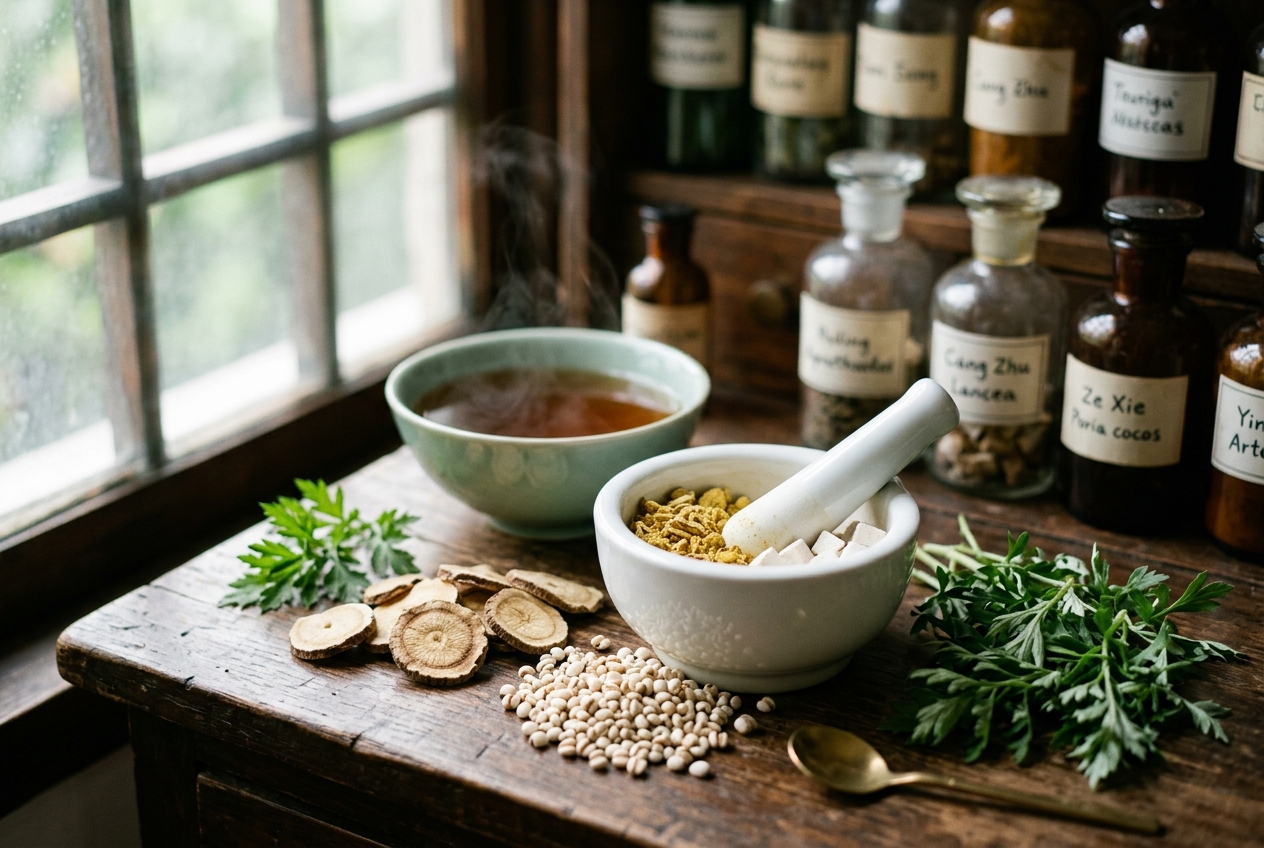
Much like a saturated sponge that loses its structural resilience and fluid-conducting capacity, the human metabolic framework, when burdened by environmental humidity or digestive insufficiency, ceases to circulate physiological fluids (Jīn Yè, 津液). Instead, these clear, nourishing humors congeal into a turbid, viscous, and obstructive pathological substrate.
To resolve this pervasive dysregulation, classical Chinese medicine developed one of its most sophisticated architectural pharmacopeias: the Dampness-Dispelling Formulas (Qū Shī Jì, 祛湿剂). Rather than functioning merely as crude botanical diuretics, these multi-target herbal matrices modulate systemic microvascular permeability, alter gastrointestinal motility, optimize biliary secretion, and restore cellular fluid homeostasis.
                                  +---------------------------------------+
                                  |     SYSTEMIC FLUID HOMEOSTASIS        |
                                  |        (Jin Ye & Water Metabolism)    |
                                  +---------------------------------------+
                                                     |
                                   +-----------------+-----------------+
                                   |                                   |
                                   v                                   v
                    +-----------------------------+     +-----------------------------+
                    |      PATHOGENESIS (Shi Xie) |     |  THERAPEUTIC ENGINE (Qu Shi)|
                    | - Spleen Yun Hua Deficit    |     | - Spleen Transformation     |
                    | - San Jiao Obstruction      |     | - Triple Burner Unblocking  |
                    | - Lower Burner Turbidity    |     | - Aquaporin Channel Reset   |
                    | - Peripheral Bi Stagnation  |     | - Bidirectional Homeostasis |
                    +-----------------------------+     +-----------------------------+
1. Foundational Theory & Pathophysiological Vectors of Fluid Stagnation
In traditional physiology, fluid metabolism is governed by an integrated tripartite circuit composed of the Lung (the upper source of water), the Spleen (the central transformer and distributor), and the Kidney (the foundational energetic gatekeeper), coordinated across the interstitial pathways of the Triple Burner (Sān Jiāo, 三焦). Pathogenic Dampness occupies a unique diagnostic classification because it exhibits dual properties: it is intrinsically Yin—characterised by heaviness, turbidity, viscosity, and downward adhesion—yet it frequently combines with Wind, Cold, Heat, or Summer-Heat to create complex, multi-system disorders.
                           +----------------------------------------+
                           |           UPPER BURNER (LUNG)          |
                           |  Governs Mist & Upper Water Exhalation |
                           +----------------------------------------+
                                              |
                                              v
                           +----------------------------------------+
                           |          MIDDLE BURNER (SPLEEN)        |
                           |  Central Pivot: Yun Hua Fluid Dynamics |
                           +----------------------------------------+
                                              |
                                              v
                           +----------------------------------------+
                           |          LOWER BURNER (KIDNEY)         |
                           |  Yang Qi Spark & Bladder Vaporisation  |
                           +----------------------------------------+
The Spleen as the Central Metabolic Pivot (Yùn Huà)
The Spleen (Pí, 脾) is the principal organ responsible for the transportation and transformation (Yùn Huà, 运化) of nutrients and water. When dietary irregularities—such as the overconsumption of chilled, raw, or highly saturated foods—or chronic mental fatigue weaken Spleen Qi, the organ loses its capacity to separate the clear essence (Qīng) from turbid waste (Zhuó). Instead of being ascended to the Lungs and distributed to the peripheral tissues, fluids pool within the middle burner, engendering internal dampness.
Triple Burner Pathway Obstruction
The Triple Burner functions as the systemic irrigation channel through which Primordial Qi (Yuán Qì) and physiological humors circulate. When dampness accumulates, it coats the fascial and interstitial pathways, mechanical clearance decelerates, and the entire metabolic engine experiences hydro-dynamic stagnation.
Lower-Burner and Peripheral Extravasation
Because dampness is heavy and downward-draining (Shī Xìng Chén Zhòng), unmitigated middle-burner turbidity descends into the lower burner, encumbering the bladder and reproductive pathways to manifest as urinary strangury (Lín Zhèng, 淋证), turbid leukorrhea, or inflammatory pelvic congestion. Conversely, when external atmospheric dampness invades the body during periods of defensive Qi (Wèi Qì) deficiency, it lodges within the peripheral musculature, sinews, and articulatory capsules, giving rise to painful obstruction syndrome (Bì Zhèng, 痹证).
From the perspective of modern cellular physiology, documented extensively in the National Center for Biotechnology Information (NCBI) Bookshelf on Fluid Homeostasis, these traditional dynamics correspond directly to perturbations in interstitial oncotic pressure, altered expression of renal aquaporin channels, microvascular endothelial hyperpermeability, and aberrant intestinal barrier permeability with associated systemic endotoxemia.
2. What This Fluid Network Does: The Classical Organ Dynamics
To understand how Dampness-Dispelling Formulas operate, we must examine the physiology of the primary organs governing fluid dynamics in plain, direct language:
+----------------------------------------------------------------------------------------------------+
|                                    ORGAN SYSTEM PHYSIOLOGY MATRIX                                  |
+-------------------+------------------------------------+-------------------------------------------+
| Organ System      | TCM Energetic Designation          | Physiological & Clinical Function         |
+-------------------+------------------------------------+-------------------------------------------+
| Spleen (Pí)       | Central Soil & Fluid Distributor   | Extracts nutrient essences; powers        |
|                   |                                    | lymphatic return and interstitial flow    |
+-------------------+------------------------------------+-------------------------------------------+
| Triple Burner     | Systemic Irrigation Network        | Connects interstitial fascia and serous   |
| (Sān Jiāo)        |                                    | cavities for continuous fluid drainage    |
+-------------------+------------------------------------+-------------------------------------------+
| Bladder & Kidneys | Gate of Fluid Vaporisation         | Regulates nephron filtration, electrolyte |
| (Pángguāng/Shèn)  |                                    | excretion, and bladder Qi transformation  |
+-------------------+------------------------------------+-------------------------------------------+
- The Spleen (Pí): Governs the digestion of food and the dynamic distribution of fluid. Think of the Spleen as the body’s central water pump and refinery. When functioning optimally, it prevents fluids from settling into stagnant, swampy reserves, routing them upward to nourish the brain, muscles, and skin.
- The Triple Burner (Sān Jiāo): Regarded as the body’s metabolic plumbing network. It is not an isolated physical organ, but rather the collective functional space encompassing the chest, epigastrium, and lower pelvis, facilitating unimpeded communication between systemic blood vessels, lymphatic conduits, and interstitial spaces.
- The Bladder and Kidneys (Pángguāng and Shèn): Provide the underlying thermal energy (Yang Qi) required to warm, vaporise, and filter fluids. The Kidney provides the metabolic heat that allows the Bladder to separate recyclable hydration from toxic waste, driving clean urine excretion.
3. Five Structural Subcategories & Prescription Hierarchies
Classical Chinese pharmacopoeia stratifies Qū Shī Jì into five precise subcategories, each targeting a distinct thermodynamic and anatomical presentation of fluid stagnation.
                                  +---------------------------------------+
                                  |     DAMPNESS-DISPELLING FORMULAS      |
                                  |              (Qu Shi Ji)              |
                                  +---------------------------------------+
                                                     |
         +-------------------+-----------------------+-------------------+-------------------+
         |                   |                       |                   |                   |
         v                   v                       v                   v                   v
+-----------------+ +-----------------+     +-----------------+ +-----------------+ +-----------------+
| Aromatic Turbid | | Clear Damp-Heat |     | Leach Edema     | | Warm Cold-Damp  | | Dispelling Wind |
| Transforming    | | & Diuresis      |     | (Li Shui)       | | (Wen Hua)       | | Arthralgia (Bi) |
| (Fang Xiang)    | | (Qing Re Qu Shi)|     | (Shen Shi)      | | (Han Shi)       | | (Qu Feng Sheng) |
+-----------------+ +-----------------+     +-----------------+ +-----------------+ +-----------------+
| - Ping Wei San  | | - Yin Chen Hao  |     | - Wu Ling San   | | - Zhen Wu Tang  | | - Du Huo Ji     |
| - Huo Xiang     | | - Ba Zheng San  |     | - Zhu Ling Tang | | - Ling Gui Zhu  | |   Sheng Tang    |
|   Zheng Qi San  | |                 |     |                 |   Gan Tang        | | - Juan Bi Tang  |
+-----------------+ +-----------------+     +-----------------+ +-----------------+ +-----------------+
A. Transforming Turbid Aromatic Dampness (Fāng Xiāng Huà Shī Jì)
When dampness stagnates in the middle burner, it produces epigastric fullness, loss of appetite, a thick turbid tongue coating, and gastrointestinal sluggishness. Aromatic herbs possess volatile terpenes that pierce through turbidity, awaken the Spleen, and stimulate digestive secretions.
                           +-----------------------------------------------+
                           |          PING WEI SAN ARCHITECTURE            |
                           +-----------------------------------------------+
                           | Sovereign (Jun): Cang Zhu (Dries Dampness)    |
                           | Minister (Chen): Hou Po (Descends Stagnant Qi)|
                           | Assistant (Zuo): Chen Pi (Transforms Phlegm)  |
                           | Courier (Shi): Zhi Gan Cao (Harmonises)       |
                           +-----------------------------------------------+
- Canonical Archetype: Píng Wèi Sǎn (平胃散 - Calms the Stomach Powder)
- Sovereign Dynamics: Cāng Zhú (苍术, Atractylodis Rhizoma) acts as the primary sovereign agent. Rich in atractylodin and hinesol, it displays potent aromatic dryness that directly strips away middle-burner dampness while upregulating gastric ghrelin receptors.
- Ministerial Synergy: Hòu Pò (厚朴, Magnoliae Officinalis Cortex), containing magnolol and honokiol, acts as the minister to disperse distension, accelerate gastric emptying, and relax intestinal smooth muscle spasms.
- Adjuvant & Courier: Chén Pí (陈皮, Citri Reticulatae Pericarpium) regulates Qi flow, while Zhì Gān Cǎo (炙甘草, Glycyrrhizae Radix Praeparata) harmonises the middle burner, preventing mucosal irritation.
- Canonical Archetype: Huò Xiāng Zhèng Qì Sǎn (藿香正气散 - Agastache Powder to Rectify Qi)
- Designed for acute summer-cold-damp invasions manifesting as sudden nausea, watery diarrhea, and systemic malaise. Sovereign Huò Xiāng (藿香, Pogostemonis Herba) releases the exterior while simultaneously resolving internal turbidity, supported by Zǐ Sū Yè (Perillae Folium) and Bái Zhǐ (Angelicae Dahuricae Radix) to eliminate external pathogens.
B. Clearing Heat and Promoting Diuresis (Qīng Rè Qù Shī Jì)
When dampness lingers, it easily undergoes thermal transformation, turning into pathogenic Damp-Heat (Shī Rè), characterised by jaundice, bitter taste in the mouth, dysuria, burning diarrhea, or suppurative skin lesions.
- Canonical Archetype: Yīn Chén Hāo Tāng (茵陈蒿汤 - Capillaris Decoction)
- Target: Damp-Heat Jaundice (Yáng Huáng), manifesting as bright orange-yellow skin and sclera, clear yellow oliguria, and constipation.
- Pharmacodynamics: Sovereign Yīn Chén (茵陈, Artemisiae Scopariae Herba) stimulates bile acid secretion via upregulation of hepatic canalicular transporters (such as BSEP and MRP2), facilitating rapid bilirubin clearance. Minister Zhī Zǐ (栀子, Gardeniae Fructus) clears heat and drains dampness downward through the urine via its geniposide active fraction. Assistant Dà Huáng (大黄, Rhei Radix et Rhizoma) activates intestinal motility via anthraquinones, draining heat and stagnant bile through the bowel.
- Canonical Archetype: Bā Zhèng Sǎn (八正散 - Eight-Herb Powder for Rectification)
- Target: Lower-burner Damp-Heat dysuria (Lín Zhèng / Acute Cystitis or Urolithiasis).
- Mechanisms: Utilises Chē Qián Zǐ (Plantaginis Semen), Huá Shí (Talcum), Mù Tōng (Akebiae Caulis), and Qú Mài (Dianthi Herba) to flush uropathogenic Escherichia coli from the urinary urothelium, decrease bladder mucosa inflammatory cytokines, and alkalinise the urine.
+------------------------------------------------------------------------------------------------------+
|                                    HEPATOBILIARY DAMP-HEAT CASCADE                                   |
+------------------------------------------------------------------------------------------------------+
|  Pathogenic Trigger: Spleen Stagnation + Heat Conflagration -> Impaired Bile Secretion (Yang Huang)  |
|                                                  |                                                   |
|  Botanical Resolution (Yin Chen Hao Tang):                                                           |
|  - Artemisiae Scopariae Herba (Yin Chen)    ===> Upregulates BSEP/MRP2 -> Bilirubin Excretion        |
|  - Gardeniae Fructus (Zhi Zi)               ===> Drains Heat downward through Renal Pathways         |
|  - Rhei Radix et Rhizoma (Da Huang)         ===> Clears Intestinal Stasis & Bilirubin Reabsorption   |
+------------------------------------------------------------------------------------------------------+
C. Leaching Dampness and Resolving Edema (Lǐ Shuǐ Shèn Shī Jì)
This structural class addresses fluid extravasation into subcutaneous tissues, interstitial spaces, and serous cavities, presenting as peripheral pitting edema, abdominal ascites, or oliguria with headache.
- Canonical Archetype: Wǔ Líng Sǎn (五苓散 - Five-Ingredient Powder with Poria)
- Target: Impaired Bladder Qi transformation with interior fluid accumulation and exterior cold (Taiyang Fu syndrome).
- Architectural Synergy: Combines Zé Xiè (泽泻, Alismatis Rhizoma - Sovereign) to vigorously leach fluid, assisted by Fú Líng (茯苓, Poria) and Zhū Líng (猪苓, Polyporus). Crucially, it incorporates Bái Zhú (白术, Atractylodis Macrocephalae Rhizoma) to anchor Spleen transportation and Guì Zhī (桂枝, Cinnamomi Ramulus) to warm the bladder Yang and induce peripheral vasodilation. Modern research shows this formula downregulates hyperactive renal aquaporin-2 (AQP2) water channels, restoring osmotic balance without inducing electrolyte wasting.
- Canonical Archetype: Zhū Líng Tāng (猪苓汤 - Polyporus Decoction)
- Target: Water accumulation with Yin injury and heat, presenting as dysuria, low-grade fever, thirst, and insomnia. It balances the diuretic force of Zhū Líng, Fú Líng, and Zé Xiè with Ē Jiāo (阿胶, Colla Corii Asini) to nourish Yin and Huá Shí to soothe inflamed mucosal membranes.
                              +-------------------------------------------+
                              |      AQUAPORIN & OSMOTIC HOMEOSTASIS      |
                              +-------------------------------------------+
                                                   |
                              +--------------------+--------------------+
                              |                                         |
                              v                                         v
               +-----------------------------+           +-----------------------------+
               |     CONVENTIONAL DIURETICS  |           |     WU LING SAN FORMULA     |
               | - Forced solute excretion   |           | - Dual AQP2 channel reset   |
               | - Risk of hypokalemia       |           | - Preserves electrolyte pool|
               | - Rebound RAAS activation   |           | - Sustains renal perfusion  |
               +-----------------------------+           +-----------------------------+
D. Warming and Transforming Cold-Damp (Wēn Huà Hán Shī Jì)
Cold-dampness arises when Spleen and Kidney Yang are deeply deficient, rendering the internal fire incapable of vaporising water. Fluids pool as frigid, stagnant, clear effusions, manifesting as generalized edema, deep limb coldness, wheezing, vertigo, or congestive cardiac strain.
- Canonical Archetype: Zhēn Wǔ Tāng (真武汤 - True Warrior Decoction)
- Target: Spleen and Kidney Yang deficiency with systemic water overflow (corresponding clinically to chronic congestive heart failure and nephrotic syndrome).
- Dynamics: Sovereign Pào Fù Zǐ (炮附子, Aconiti Radix Lateralis Praeparata) provides intense Yang heat to the Kidneys, igniting the metabolic furnace. Minister Bái Zhú solidifies the Spleen to prevent damp percolation, Fú Líng drains stagnant fluids, Shēng Jiāng (生姜) disperses peripheral cold, and Bái Sháo (白芍, Paeoniae Radix Alba) softens the liver, preserves Yin, relieves abdominal pain, and protects against the drying nature of aconite.
- Canonical Archetype: Líng Guì Zhú Gān Tāng (苓桂术甘汤 - Poria, Cinnamon Twig, Atractylodes, and Licorice Decoction)
- Target: Phlegm-fluid retention in the epigastrium (Tán Yǐn), causing dizziness, palpitations, chest fullness, and coughing of thin, watery sputum. It warms the middle burner to transform phlegm without excessive heat.
E. Dispelling Wind-Dampness for Arthralgia (Qù Fēng Shèng Shī Jì)
When environmental wind, cold, and dampness penetrate the peripheral meridians, they form inflammatory exudates, synovial effusion, cartilage degradation, and microvascular micro-thromboses in the joints.
                           +-----------------------------------------------+
                           |        DU HUO JI SHENG TANG TOPOLOGY          |
                           +-----------------------------------------------+
                           | Sovereign: Du Huo (Pierces Deep Lower Collaterals) |
                           | Ministers: Qin Jiao, Fang Feng, Sang Ji Sheng |
                           | Nourishing Core: Dang Gui, Shu Di Huang, Bai Shao |
                           | Tonifying Matrix: Ren Shen, Fu Ling, Du Zhong |
                           +-----------------------------------------------+
- Canonical Archetype: Dú Huó Jì Shēng Tāng (独活寄生汤 - Angelica Pubescens and Sangjisheng Decoction)
- Target: Chronic, intractable Bi syndrome with liver and kidney deficiency, presenting as lower back weakness, knee stiffness, joint deformity, and cold intolerance.
- Sovereign Vector: Dú Huó (独活, Angelicae Pubescentis Radix) pierces deep into the lower back and lower-extremity meridians to eradicate entrenched wind-cold-dampness.
- Holistic Architecture: It incorporates Sāng Jì Shēng (桑寄生, Taxilli Herba), Dù Zhòng (Eucommiae Cortex), and Niú Xī (Achyranthis Bidentatae Radix) to regenerate bone matrix and strengthen sinews, combined with Sì Wù Tāng (Four Substances) to nourish the blood, and Sì Jūn Zǐ Tāng ingredients to sustain Qi.
4. Jūn-Chén-Zuǒ-Shǐ Synergy & Modern Pharmacodynamics
The lasting clinical efficacy of Dampness-Dispelling Formulas lies in their adherence to the four-tier architectural hierarchy: Sovereign (Jūn), Minister (Chén), Assistant (Zuǒ), and Courier (Shǐ).
                      +---------------------------------------------------+
                      |      JUN-CHEN-ZUO-SHI PHARMACODYNAMIC MATRIX      |
                      +---------------------------------------------------+
                      |                                                   |
                      |  [JUN] Sovereign: Identifies and eradicates the  |
                      |        primary pathological entity.               |
                      |                                                   |
                      |  [CHEN] Minister: Amplifies sovereign action &    |
                      |         addresses concurrent sub-patterns.        |
                      |                                                   |
                      |  [ZUO] Assistant: Counters toxicity, moderates    |
                      |        drying, checks aggressive purging.         |
                      |                                                   |
                      |  [SHI] Courier: Guides formula to target channel  |
                      |        and harmonises the systemic matrix.        |
                      +---------------------------------------------------+
The Spleen-Tonification and Diuresis Coupling
A core principle across all Qū Shī Jì is: "To treat dampness, one must simultaneously tonify the Spleen and regulate Qi; when Qi circulates freely, fluids transform smoothly."
If a practitioner relies solely on aggressive diuretic agents (such as Zé Xiè or Zhū Líng), the physical removal of fluid will deplete healthy interstitial humors (Yīn Yè) without addressing the underlying enzymatic and energetic deficiency of the Spleen. Thus, classical architects systematically pair leaching agents with tonifying astringents:
- The Fú Líng + Bái Zhú Axis: Fú Líng drains dampness downward through the urinary tract, while Bái Zhú ascends clear Qi and tones the mesenteric capillary network. Together, they establish a bidirectional fluid gradient that enhances lymphatic return while clearing interstitial edema.
- The Chén Pí + Hòu Pò Axis: These aromatic Qi-regulators break the stagnation that inevitably accompanies viscous damp accumulation. By enhancing gastrointestinal transit and restoring normal peristaltic patterns, they prevent fluid pooling in the splanchnic circulation.
5. Contraindications, Clinical Pitfalls, and Precision Differentiation
Precision differentiation is essential when prescribing Dampness-Dispelling Formulas. Misidentifying the thermodynamic nature of dampness or over-administering drying agents can cause severe iatrogenic injury.
+----------------------------------------------------------------------------------------------------+
|                                PRECISION DIFFERENTIAL MATRIX                                       |
+----------------------+------------------------------------+----------------------------------------+
| Diagnostic Feature   | Cold-Damp Pathomorphology (Hán Shī)| Damp-Heat Pathomorphology (Shī Rè)     |
+----------------------+------------------------------------+----------------------------------------+
| Tongue Presentation  | Pale, swollen, scalloped, white wet| Red body, yellow greasy coating, dry   |
|                      | slippery coating                   | root                                   |
+----------------------+------------------------------------+----------------------------------------+
| Thermal Sensation    | Intolerance to cold; relieved by   | Intolerance to heat; low-grade fever   |
|                      | warmth                             | unyielding after sweating              |
+----------------------+------------------------------------+----------------------------------------+
| Excretory Signs      | Clear, profuse urine; loose, watery| Scanty, dark-amber urine; foul,        |
|                      | odor-free stool                    | burning, explosive stool               |
+----------------------+------------------------------------+----------------------------------------+
| Primary Formula Archetype | Zhen Wu Tang / Ping Wei San  | Yin Chen Hao Tang / Ba Zheng San       |
+----------------------+------------------------------------+----------------------------------------+
Critical Clinical Pitfalls
- Depletion of Yin Humors (Yīn Xū): Aromatic drying agents (Cāng Zhú, Hòu Pò) and acrid warming agents (Fù Zǐ) are strictly contraindicated in patients presenting with fluid exhaustion, dry mucous membranes, cracked tongue bodies without coating, or post-febrile Yin deficiency.
- Overuse of Bitter-Cold Purging: Prolonged administration of bitter-cold formulas (such as Bā Zhèng Sǎn or Yīn Chén Hāo Tāng) damages Spleen Yang, turning a manageable acute damp-heat condition into a chronic, intractable cold-damp state.
- Electrolyte and Microvascular Monitoring: Modern integrative practice necessitates that when administering these formulas alongside conventional pharmacology, practitioners observe systemic blood pressure, serum potassium, and renal perfusion markers to prevent drug-herb interactions.
6. How You Can Feel It: Signs of Balance and Imbalance
You do not need an advanced diagnostic laboratory to determine whether your internal fluid pathways are flowing smoothly or becoming waterlogged. The human body produces unmistakable signs of both balance and damp accumulation.
                                  +---------------------------------------+
                                  |      SYSTEMIC VISCERAL MONITOR        |
                                  +---------------------------------------+
                                                     |
                                   +-----------------+-----------------+
                                   |                                   |
                                   v                                   v
                    +-----------------------------+     +-----------------------------+
                    |    SIGNS OF DAMP IMBALANCE  |     |   SIGNS OF FLUID HARMONY    |
                    | - Heavy, foggy head         |     | - Clear, alert cognition    |
                    | - Scalloped, coated tongue  |     | - Fresh pink tongue         |
                    | - Sticky, sluggish stool    |     | - Clean, effortless stool   |
                    | - Puffy eyelids & ankles    |     | - Unencumbered joints       |
                    +-----------------------------+     +-----------------------------+
Signs of Fluid Stagnation (Damp Imbalance)
- Cognitive and Physical Heaviness: Waking up feeling unrefreshed, experiencing heavy limbs that feel as though they are dragging weights, and sustained brain fog that peaks after meals.
- Lingual Morphology: A tongue body that is enlarged and indented along the lateral borders by the teeth (scalloping), covered by a thick, greasy white or yellow coating that cannot be scraped away.
- Gastrointestinal Stasis: Sticky, unformed bowel movements that leave residue, accompanied by persistent abdominal bloating that worsens in humid weather.
- Interstitial Swelling: Puffy lower eyelids upon waking, socks leaving deep indents around the ankles by evening, and stiff, aching joints during barometric drops.
Signs of Optimal Fluid Balance
- Clear Cognition and Light Limbs: Immediate physical vitality upon waking, steady metabolic energy without postprandial slumps, and a feeling of lightness in the joints.
- Clean Digestion: Regular, effortless bowel movements that leave no residue, a flat and comfortable epigastrium, and normal thirst for room-temperature water.
- Clean Lingual Surface: A supple, pink tongue with a thin, transparent, clear-white coating.
7. Qigong & Movement Practice: Triple Burner Elongation (Bā Duàn Jǐn)
To mechanically support the dispersion of dampness, the classical Ba Duan Jin (Eight Brocades) Qigong system incorporates a specific movement: "Two Hands Hold Up the Heavens to Harmonise the Triple Burner" (Liǎng Shǒu Tuō Tiān Lǐ Sān Jiāo). This movement creates axial fascial tension, stretches the peritoneal spaces, enhances thoracic duct lymphatic pumping, and assists the Spleen in fluid transformation.
                     +-----------------------------------------------------+
                     |     TWO HANDS HOLD UP THE HEAVENS KINEMATIC CYCLE   |
                     +-----------------------------------------------------+
                     |                                                     |
                     |  1. Rooted Stance -> Pelvic floor softly engaged    |
                     |                                                     |
                     |  2. Inhale (4s)   -> Interlace fingers, draw Qi to  |
                     |                      chest, pivot palms upward      |
                     |                                                     |
                     |  3. Apex Hold (2s)-> Full axial extension, gaze at  |
                     |                      back of hands                  |
                     |                                                     |
                     |  4. Exhale (6s)   -> Trace wide lateral arcs, sink  |
                     |                      Qi to Dantian                  |
                     +-----------------------------------------------------+
Step-by-Step Biomechanical Execution
- Starting Position: Stand with your feet parallel, hip-width apart. Unlock your knees slightly, tuck your tailbone gently to flatten the lumbar curve, and let your arms hang loosely at your sides. Rest the tip of your tongue against the roof of your mouth behind your upper incisors.
- Interlacing and Ascent: On a slow, 4-second inhalation through the nose, bring both hands to the lower abdomen (Dāntián), interlace the fingers with palms facing upward, and draw them smoothly up the midline of the chest.
- Rotation and Extension: As the hands reach the sternum, pivot the palms outward and press them firmly toward the sky. Fully extend your elbows without shrugging your shoulders, gently tilt your head back to gaze at your thumbs, and expand your rib cage. Hold this apex stretch for 2 seconds.
- Descent and Dispersion: On a sustained 6-second exhalation through the nose, release your fingers and trace two wide, sweeping arcs with your arms down to your sides. Feel your ribs settle and your diaphragm descend, drawing your center of mass down into your heels.
- Cadence and Repetitions: Perform this sequence for 8 continuous cycles, approximately 3 to 5 minutes total.
- Somatic Feedback: As you complete the cycles, you will likely feel a warming sensation radiating across your epigastrium, an increase in clear saliva production (a sign of Spleen Qi activation), and a noticeable reduction in chest and abdominal pressure.
8. Acupressure Points You Can Try Today
Targeted acupressure manually stimulates local peripheral nerve fibers and activates meridian pathways, providing immediate relief from fluid stagnation.
                         +-------------------------------------------------+
                         |      ACUPRESSURE TARGET NODES FOR FLUID METABOLISM
                         +-------------------------------------------------+
                         |                                                 |
                         |  [SP9] Yinlingquan  ===> Leaches Dampness from  |
                         |                          Lower Burner & Knees   |
                         |                                                 |
                         |  [ST36] Zusanli     ===> Ignites Spleen Qi &   |
                         |                          Accelerates Gastric    |
                         |                          Motility               |
                         |                                                 |
                         |  [ST40] Fenglong    ===> Systemic Phlegm and    |
                         |                          Turbidity Dissolver    |
                         +-------------------------------------------------+
1. Yīnlíngquán (SP9, 阴陵泉) — Yin Mound Spring
- Location: On the inside of the lower leg, in the depression directly below the inner condyle of the tibia (slide your finger up along the inside of your shinbone until it falls into an angle just below the knee joint).
- Technique: Apply firm, deep pressure using your thumb tip at a 90-degree angle toward the bone. Maintain this pressure while making tiny circular oscillations for 2 minutes on each leg. The point will feel distinctly tender or achy.
- Clinical Use: The primary water-regulating point on the Spleen meridian; rapidly relieves abdominal bloating, heavy legs, and ankle swelling.
2. Zúsānlǐ (ST36, 足三里) — Leg Three Miles
- Location: Four finger-widths below the bottom edge of the kneecap, and one finger-width toward the outside of the shinbone (located within the tibialis anterior muscle).
- Technique: Apply firm pressure using your thumb or knuckle until a strong, radiating sensation spreads down your leg. Maintain steady, rhythmic pressure for 1 to 2 minutes on each leg.
- Clinical Use: Strengthens Spleen and Stomach Qi, stimulates gastric motility, boosts systemic metabolic output, and clears postprandial fatigue.
3. Fēnglóng (ST40, 丰隆) — Abundant Bulge
- Location: Midway between the lateral knee crease and the tip of the outer ankle bone, approximately two finger-widths lateral to the anterior crest of the tibia.
- Technique: Press with the edge of your thumb or a rounded massage tool using firm, steady pressure for 2 minutes per side.
- Clinical Use: The preeminent point on the body for dissolving internal dampness, clearing mucosal congestion, and lifting cognitive brain fog.
9. Food & Lifestyle: Practical Changes for Fluid Balance
To maintain clear fluid circulation, daily lifestyle practices must support the digestive capacity of the Spleen while preventing exogenous environmental dampness from entering the system.
+----------------------------------------------------------------------------------------------------+
|                                DIETARY THERAPEUTICS & REGIMEN MATRIX                               |
+------------------------------------+---------------------------------------------------------------+
| Category                           | Practical Recommendations & Botanical Dynamics                |
+------------------------------------+---------------------------------------------------------------+
| Therapeutic Additions              | - Roasted Job's Tears (Coix Seed / Yì Yǐ Rén): Leaches damp   |
| (Promote Transformation)           | - Adzuki Beans (Chì Xiǎo Dòu): Drains lower-burner swelling   |
|                                    | - Warming Aromatics: Cardamom, ginger, fennel, orange peel    |
+------------------------------------+---------------------------------------------------------------+
| Proscribed Dietary Items           | - Iced drinks, raw cold salads, refined white sugars          |
| (Produce Viscous Turbidity)        | - Deep-fried grease, excessive dairy products, alcohol        |
+------------------------------------+---------------------------------------------------------------+
| Environmental & Behavioral Hygiene | - Avoid sitting on damp ground or wearing wet clothes         |
|                                    | - Avoid large meals after 7:30 PM; incorporate light walking   |
+------------------------------------+---------------------------------------------------------------+
                              +-------------------------------------------+
                              |         DIETARY DYNAMICS BALANCING        |
                              +-------------------------------------------+
                                                   |
                              +--------------------+--------------------+
                              |                                         |
                              v                                         v
               +-----------------------------+           +-----------------------------+
               |     DAMP-PROMOTING FOODS    |           |     FLUID-DRAINING FOODS    |
               | - Iced water & cold salads  |           | - Roasted barley & Coix seed|
               | - Excess pasteurized dairy  |           | - Fresh ginger & cardamom   |
               | - Refined fats & sugars     |           | - Steamed, warming broths   |
               +-----------------------------+           +-----------------------------+
Foods to Prioritise
- Job’s Tears / Coix Seed (Yì Yǐ Rén) & Adzuki Beans (Chì Xiǎo Dòu): These easily sourced grains act as gentle, everyday Lǐ Shuǐ Shèn Shī agents. Simmer them into broths or porridge to promote kidney drainage without irritating the stomach lining.
- Aromatic Warming Spices: Incorporate freshly sliced ginger (Shēng Jiāng), crushed cardamom pods, toasted fennel seeds, and aged tangerine peel into meals. These spices invigorate digestion and disperse stagnant fluids.
- Warm, Lightly Cooked Meals: Emphasise steamed vegetables, warming bone broths, and lightly stewed grains that require minimal digestive energy to break down.
Foods to Minimise
- Iced Drinks and Chilled Food: Ingesting items below core body temperature causes local vasoconstriction in the stomach, stalling Spleen Qi and freezing fluids into stubborn dampness.
- Excess Dairy, Refined Sugars, and Saturated Greases: These dense substances directly burden the pancreas and liver, producing sticky, turbid metabolic waste.
- Late-Night Overeating: Consuming heavy meals late in the evening overwhelms the digestive system, causing food stasis that turns into dampness overnight.
Daily Lifestyle Adjustments
- Maintain Environmental Dryness: Avoid prolonged stays in damp basements, never sit on cold concrete, and change out of sweat-soaked workout clothes immediately.
- Postprandial Walking: Engage in 10 to 15 minutes of slow, relaxed walking (Bǎi Bù Zǒu) after meals to assist the diaphragm in pumping fluids through the abdomen.
10. Summary of Clinical Insights
The physiological insights established by the World Health Organization Traditional Medicine Strategy and ongoing pharmacological investigations on PubMed Central confirm what classical practitioners observed centuries ago: fluid balance is maintained through dynamic metabolic transformation. By combining classical herbal formulas like Ping Wei San, Wu Ling San, and Zhen Wu Tang with targeted movement and mindful lifestyle habits, we can systematically clear fluid stagnation, resolve internal dampness, and restore long-term metabolic health.
11. Today's Takeaway
To immediately restore sluggish fluid circulation without specialist equipment, brew a simple warming digestive infusion: simmer three thin slices of fresh ginger and a crushed cardamom pod in warm water for five minutes. As you sip this tea, sit comfortably and apply firm, circular thumb pressure to Yinlingquan (SP9) on the inner calf for two minutes on each side. This quick daily ritual stimulates Spleen transportation, clears post-meal lethargy, and keeps your internal fluid pathways flowing smoothly.