Dabao Cavity Great Embracement: Mid-Axillary Intercostal Fascial Decompression, Great Luo-Connecting Vessel Integration, and Lateral Torso Kinetic Tensegrity in Classical Neigong
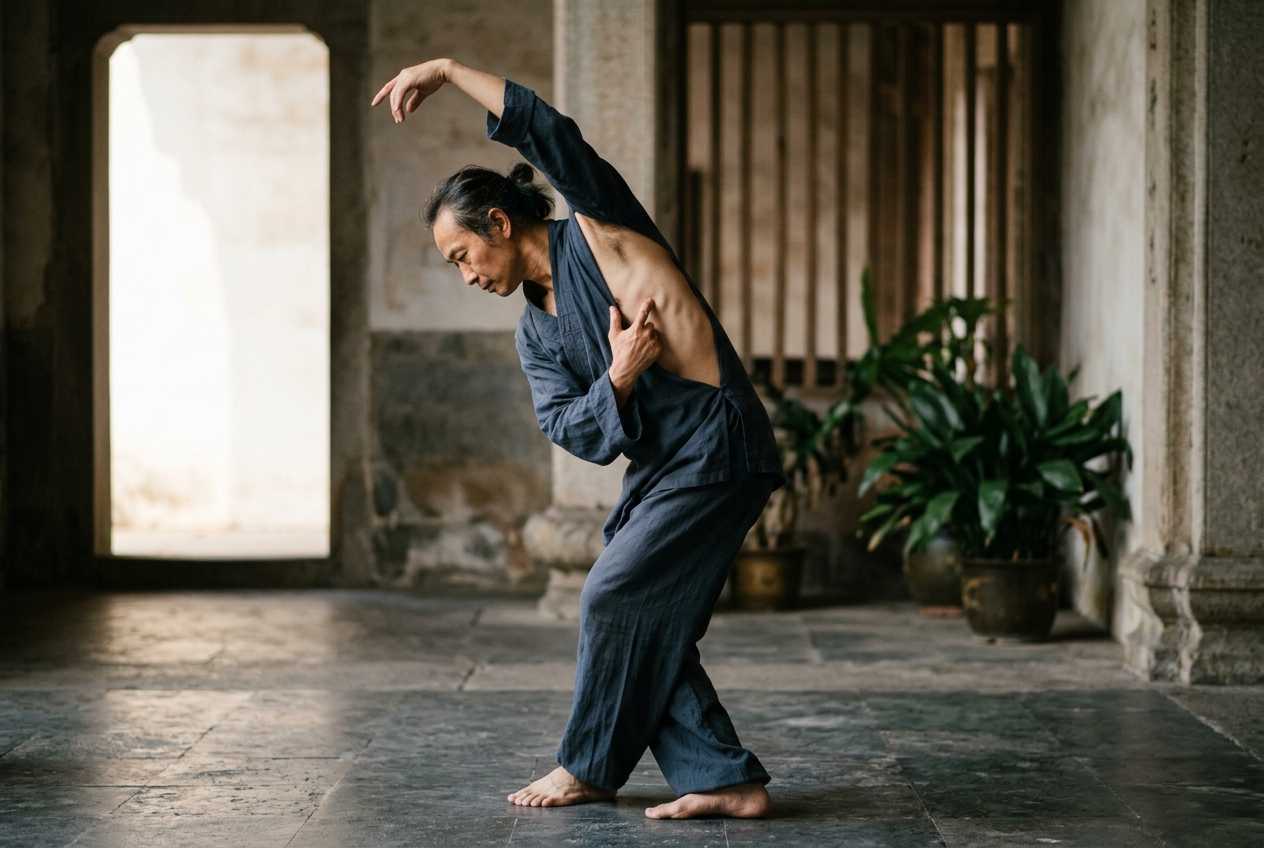
When this area becomes chronically restricted due to sedentary posture, emotional stress, or shallow apical breathing, the entire kinetic chain stiffens. Daoist Neigong (internal skill cultivation) and modern biotensegrity biomechanics both recognize that when you awaken this lateral hinge, you do not simply stretch a muscle; you structurally integrate the upper and lower halves of the skeleton, decompress the diaphragm, and restore systemic micro-circulation.
Anatomical Topography and Neuro-Fascial Architecture
To locate Dabao with clinical precision, palpate the sixth intercostal space directly along the mid-axillary line (linea medioaxillaris), midway between the axillary fossa and the free end of the eleventh rib. In individuals of standard anatomical proportion, this sits roughly one hand-width below the crest of the axilla, directly on the lateral thoracic wall.
       Mid-Axillary Line (Lateral Thoracic Wall)
                     |
  [ Rib 5 ] =========|======================
                     |  <-- 5th Intercostal Space
  [ Rib 6 ] =========|======================
                     |  <-- 6th Intercostal Space: DABAO (SP21)
  [ Rib 7 ] =========|======================   (Serratus Anterior &
                     |                          Neurovascular Bundle)
  [ Rib 8 ] =========|======================
                     |
The structural morphology of Dabao constitutes a dense, multi-layered myofascial junction:
- Muscular Interface: Dabao is situated directly over the fleshy digitations of the serratus anterior muscle, where its muscular slips interlock seamlessly with the interdigitating origins of the external abdominal oblique (musculus obliquus externus abdominis). Deep to the serratus anterior lie the external and internal intercostal muscles (musculi intercostales externi et interni), while its posterior margin borders the sweeping anterior edge of the latissimus dorsi.
- Neurovascular Distribution: The cavity is innervated by the lateral cutaneous branches of the sixth intercostal nerve (nervus intercostalis VI) and the long thoracic nerve (nervus thoracicus longus). Vascular supply is governed by the lateral thoracic artery and vein, as well as the lateral branches of the posterior intercostal vessels.
- Fascial Webbing and Kinetic Slings: Under contemporary fascial meridian mapping, Dabao represents a primary anchor node along the Lateral Line and the Spiral Line. It directly interfaces with the deep investing fascia of the thorax, mediating force transmission between the pectoral girdle, the thoracic cage, and the contralateral pelvic basin.
When the serratus anterior is hypertonic or locked in short, it glues the scapula to the posterior ribcage, severely restricting the bucket-handle elevation of the lower ribs during respiration and blocking functional torque transmission through the torso.
Classical Energetics and Great Luo Vessel Integration
The foundational theoretical framework for Dabao appears in the seminal Han Dynasty medical canon, the Huangdi Neijing Ling Shu (Spiritual Pivot, Chapter 10: Jingmai). Classical Chinese medicine delineates fifteen primary Luo-Connecting Vessels (Luo Mai, 絡脈) that branch from the primary meridians to couple Yin-Yang organ pairs. Dabao, however, is unique: it is designated as the sixteenth, the Great Luo of the Spleen (Pi zhi Da Luo, 脾之大絡).
==========================================================================
              THE CLASSICAL PATHOLOGY OF DABAO (SP21)
           From the Huangdi Neijing Ling Shu (Chapter 10)
==========================================================================
• SHI (Excess / Fullness / 實):
  "When it is full, there is pain across the entire body (身盡痛)."
  --> Fascial rigidity, widespread muscular hypertonicity, microvascular
      stasis, structural compensation, and somatic guarding.

• XU (Deficiency / Emptiness / 虛):
  "When it is empty, all the hundred joints are loose and lax (百節皆縱)."
  --> Loss of biotensegrity, joint instability, ligamentous weakness,
      chronic fatigue, and failure of systemic kinetic binding.
==========================================================================
The Ling Shu notes that the Great Luo of the Spleen emerges at Dabao, spreads across the chest and lateral hypochondrium, and weaves a pervasive web through all superficial collaterals (fu luo, 浮絡) and minute capillary vessels (sun luo, 孫絡). Because the Spleen (in Chinese medical physiology) governs the flesh, connective tissues, and transport of nutrient fluids (Gu Qi), Dabao acts as the grand distributor. It governs the entire interstitial fluid matrix and capillary beds across the trunk.
When Dabao is stagnant or contracted (Fullness), interstitial fluid and venous circulation pool, producing diffuse somatic aches, costal neuralgia, and myofascial tightness across the torso. Conversely, when Dabao is depleted or collapsed (Deficiency), the connective tissues lose their tensile integrity, resulting in hypermobility, ligamentous laxity, joint fragility, and profound physical exhaustion. Opening Dabao therefore recalibrates systemic Yin-Yang distribution, revitalizes interstitial hydration, and restores the fascial tension necessary to bind the joints.
Biotensegrity and Kinetic Chain Transmission
To comprehend why classical masters of Daoist Neigong and internal martial arts placed exceptional value on Dabao, one must examine the biomechanics of biotensegrity. In a biotensegrity system—pioneered by orthopedic surgeon Stephen Levin based on Buckminster Fuller's architectural principles—the musculoskeletal framework does not function as a stack of bones bearing continuous compressive weight. Instead, rigid compressive struts (bones) float within a continuous, self-equilibrating sea of tensile cables (the myofascial matrix).
   [Tensegrity Expansion]                 [Compressive Collapse]
      <--- (SP21) --->                         ---> | <---
     /                \                       /            \
  +======================+                 +==================+
  |  Scapulothoracic     |                 | Locked Scapulae  |
  |  Gliding & Elastic   |                 | Apical Chest     |
  |  Bucket-Handle Ribs  |                 | Breathing & Rib  |
  |  3D Diaphragm Drop   |                 | Fixation         |
  +======================+                 +==================+
Dabao serves as the primary lateral spring hinge of this tensegrity dome. Its mobilization radically enhances three fundamental physiological mechanisms:
1. Three-Dimensional Diaphragmatic Excursion
Human breathing relies on two distinct thoracic rib motions: the sagittal pump-handle motion of the upper ribs and the frontal bucket-handle motion of the lower lateral ribs (ribs 6–10). Chronically tight serratus anterior and intercostal tissues pin the mid-axillary ribs in adduction, forcing the nervous system into shallow, apical chest breathing that overworks the scalenes and sternocleidomastoid. Decompressing Dabao restores the outward and upward swing of the lateral ribs, allowing the dome of the diaphragm to descend fully without compressive resistance.
2. Helical Elasticity in Silk Reeling (Chan Si Gong)
In Chen-style Taijiquan and internal martial arts, all functional power (Fa Jin) is generated through helical, twisting kinetic chains known as Chan Si Gong (Silk Reeling). Power originates in the feet, is directed by the waist (Dantian), and manifests through the fingertips. Dabao is the structural fulcrum where rotational torsion of the torso transitions into the shoulder girdle and arms. If Dabao is collapsed, spiral torque leaks through the lateral flank; if it is open and supple, the lateral fascia acts like a coiled steel spring, storing and discharging elastic kinetic energy effortlessly.
3. Torsional Stability in Bagua Zhang Walking
During the circle walking of Bagua Zhang, the practitioner's torso is held in continuous, extreme isometric twist toward the center of the circle while the lower body walks forward (the "Dragon Body"). Dabao acts as the myofascial anchor that stabilizes the thoracic spine against excessive rotational shear, distributing torsional stress evenly across the ribcage and thoracolumbar fascia rather than allowing it to concentrate destructively in the lumbar discs.
Step-by-Step Somatic Practice Guide
The following progressive protocols synthesize classical Wudang Daoyin, Zhineng Qigong methods, and modern somatic fascial release to decompress, activate, and integrate Dabao.
==========================================================================
           THREE-STAGE PROGRESSIVE PROTOCOL FOR DABAO (SP21)
==========================================================================
STAGE 1: Bilateral Ischemic Compression & Lateral Respiration
         --> Static release of trigger points in the 6th intercostal space.
STAGE 2: Wudang Daoyin "The Dragon Expands Its Flanks"
         --> Dynamic unilateral fascial elongation and ribcage mobilization.
STAGE 3: Silk-Reeling Kinetic Integration (Chan Si Gong)
         --> Dynamic whole-body helical coiling across the lateral plane.
==========================================================================
Protocol 1: Bilateral Acupoint Contact and Lateral Respiration
Objective: Mechanically release deep intercostal adhesions and stimulate local mechanoreceptors.
- Foundational Stance: Stand with feet hip-width apart, knees unlocked, pelvis in a neutral tilt, and the crown of your head suspended as if drawn upward by a silk thread (Baihui, GV20).
- Acupoint Engagement: Form loose fists and place the flat pads of your thumbs directly onto the bilateral Dabao points (sixth intercostal space on the mid-axillary line). Press inward and slightly upward with moderate, sustained pressure (a sensation of dull ache, warmth, or mild distention is expected and desirable).
- Directed Intercostal Breathing: Inhale slowly through your nose for 4 counts. Deliberately expand your lateral ribs outward into the physical resistance of your thumbs. Do not permit your shoulders to elevate.
- Suspension and Release: Hold the breath gently at full expansion for 2 counts, feeling the inner fascial webbing stretch. Exhale smoothly through the nose for 6 counts, maintaining light thumb pressure as the ribcage recoils inward.
- Repetition: Complete 9 full, continuous breath cycles.
  Step 1: Set Posture  --> Step 2: Thumb Contact --> Step 3: Inhale (Expand)
  [Neutral Spine]          [SP21 Bilateral]         [Lateral Flanks Out]
         |                         |                         |
         v                         v                         v
  Step 6: Integrate    <-- Step 5: Repetition (x9)<-- Step 4: Exhale (Recoil)
Protocol 2: The Dynamic Daoyin Flank Mobilization ("The Dragon Expands Its Flanks")
Objective: Unilaterally decompress the lateral fascia, mobilize the serratus anterior, and stimulate the Great Luo-Connecting Vessel.
- Setup: Assume a slightly wider stance (one-and-a-half shoulder widths). Rest your left hand on your left hip, anchoring the left side of your pelvis downward.
- Spiraling Arc: As you initiate a slow nasal inhalation, sweep your right arm across the midline of your chest, rotating the palm upward toward the sky. Continue reaching up and over toward the left side, forming a wide, crescent arc over your head.
- Lateral Expansion: Simultaneously ground your right foot firmly into the floor and shift 60% of your body weight into the right leg. Turn your gaze downward toward your left heel. This creates an unbroken, continuous myofascial stretch along the entire right lateral line—from the lateral ankle, through the iliotibial band, directly across the right Dabao point, through the serratus anterior, and out the tips of your fingers.
- Point Stimulation: While holding this elongated arc, draw three deep, focused breaths directly into the right lateral ribcage. With each inhalation, visualize the space between the sixth and seventh ribs widening; with each exhalation, release tension in the right axilla and latissimus dorsi.
- Neutral Return: Inhale as you bring the right arm smoothly back down along the midline, returning to the neutral center stance.
- Contralateral Execution: Repeat the identical sequence on the left side. Perform 6 alternations per side.
                    / (Right Hand Reaching Over)
                   /
              ( ) /
               | /
         +-----O-----+   <-- Right Dabao (SP21) under full lateral stretch
        /|     |     |\
       / |     |     | \
      L  |    / \    |  R
    (Hip)|   /   \   |
         |  /     \  |
            Grounding Right Foot
Sensations to Observe and Their Somatic Significance
- Warmth or Flushed Heat: Indicates immediate vasodilation of the micro-capillary bed and activation of the Great Luo vessel's blood-nourishing function.
- Tingling along the Flanks and Arms: Reflects sensory nerve decompression along the lateral cutaneous branch of the intercostal nerve and the long thoracic nerve.
- A Spontaneous Sigh or Yawn: Signals a dramatic down-regulation of the sympathetic nervous system as the vagus nerve responds to restored diaphragmatic excursion.
- Sensation of Internal "Plumpness" or Elasticity: Indicates optimal biotensegrity restoration, where the connective tissues shift from rigid, dry cross-linking to a hydrated, spring-like viscoelastic state.
Somatic Cues, Biomechanical Compensations, and Error Remediation
Refining internal movement requires rigorous somatic self-monitoring. When mobilizing Dabao, the body frequently defaults to unconscious compensatory patterns that bypass the lateral ribcage. The table below outlines these common deviations, their biomechanical mechanisms, and exact somatic corrections.
========================================================================================================
                               BIOMECHANICAL COMPENSATIONS AND CORRECTIONS
========================================================================================================
FAULT                       BIOMECHANICAL MECHANISM             CORRECTIVE SOMATIC CUE
--------------------------------------------------------------------------------------------------------
1. Scapular Shrugging       Hyperactive upper trapezius and     "Sink the inferior angle of your
   & Clavicular Elevation   levator scapulae compensate for     shoulder blade down toward the
                            restricted serratus anterior.       opposite back pocket while reaching."

2. Lumbar Hyperextension    Lumbar spine arches to create       "Gently draw the anterior lower ribs
   & Rib Flaring            illusory range of motion, breaking  inward toward the navel; keep the
                            anterior core tensegrity.           sacrum weighted and Mingmen flat."

3. Glottal Breath Holding   Valsalva maneuver locks the         "Maintain a continuous, whisper-soft
   (Apical Straining)       intrathoracic pressure, increasing  nasal flow; breathe behind the ribs,
                            arterial and neural strain.         never against a closed throat."

4. Pelvic Shear & Hip       The pelvis drifts laterally,        "Keep both sit-bones level; root
   Collapse                 negating the fascial stretch        the heel into the earth and stretch
                            across the lateral trunk.           the ribcage upward AWAY from the hip."
========================================================================================================
For advanced practitioners of internal martial arts, the ultimate somatic checkpoint is the sensation of Song (鬆, active relaxation without collapse). When Dabao is correctly mobilized, the arms feel simultaneously suspended from the lateral ribcage and weightlessly buoyant, as if resting on compressed air cushions within the axillae.
Why It Works: The Body Science of Lateral Ribcage Mobilization
The transformative systemic impact of opening Dabao is grounded in well-established neuro-physiological and mechanical processes:
                  +-----------------------------------+
                  |  Dabao (SP21) Intercostal Release |
                  +-----------------------------------+
                                    |
            +-----------------------+-----------------------+
            |                                               |
            v                                               v
+-------------------------------+               +-------------------------------+
|  Neuro-Autonomic Regulation   |               |   Fluid Dynamics & Fascia     |
+-------------------------------+               +-------------------------------+
| • Mechanoreceptor Stimulation |               | • Interstitial Matrix Shear   |
|   (Ruffini & Pacinian units)  |               | • Lymphatic Pumping           |
| • Vagal Nerve Activation      |               |   (Thoracic Duct Drainage)    |
| • Increased Heart Rate        |               | • Microvascular Capillary     |
|   Variability (HRV)           |               |   Perfusion (Great Luo)       |
+-------------------------------+               +-------------------------------+
            |                                               |
            +-----------------------+-----------------------+
                                    |
                                    v
                  +-----------------------------------+
                  | Whole-Body Kinetic Homeostasis &  |
                  |     Restored Biotensegrity        |
                  +-----------------------------------+
1. Mechanoreceptor Stimulation and Autonomic Tone
The deep thoracic fascia and intercostal connective tissues are densely populated with type III and IV mechanoreceptors, specifically Ruffini endings and Pacinian corpuscles. Slow, pressurized stimulation of Dabao combined with lateral ribcage expansion sends afferent inhibitory signals to the sympathetic nervous system via the intercostal nerves. This prompts an immediate systemic drop in resting muscle tone, lowers baseline cortisol, and enhances heart rate variability (HRV) by amplifying parasympathetic vagal output.
2. Thoraco-Abdominal Pressure Gradients and Lymphatic Propulsion
The primary engine of lymphatic circulation in the human body is the mechanical pumping action of the respiratory diaphragm. The thoracic duct—the body’s largest lymphatic vessel, responsible for draining lymph from the lower extremities, pelvis, abdomen, and left upper body—traverses the aortic hiatus of the diaphragm.
When the lateral ribs remain compressed, the diaphragm is anatomically inhibited, severely limiting its vertical piston stroke. Restoring lateral excursion at Dabao magnifies the trans-diaphragmatic pressure swings between the abdominal and thoracic cavities. This dynamic vacuum action propels venous return via the inferior vena cava and pumps interstitial fluid through the lymphatic vascular network, directly verifying the classical assertion in the Huangdi Neijing that Dabao governs the fluid micro-collaterals across the body.
3. Interstitial Matrix Hydration and Hyaluronan Viscosity
Connective tissue fascial planes rely on a specialized ground substance rich in hyaluronic acid (HA) to ensure frictionless gliding between adjacent muscle layers (such as the serratus anterior and the ribs). Under conditions of immobilization or chronic stress, hyaluronic acid polymerizes into a dense, sticky, dehydrated gel, causing fascial layers to bind and adhere. Sustained torsional and lateral breathing movements at SP21 introduce mechanical shear stresses that restore fluid shear dynamics, liquefying the hyaluronan matrix and hydrating the peripheral tissues.
Classical Lineage, Historical Context, and Daoist Cultivation
The cultivation of the lateral thoracic cavities has occupied a revered position across multiple lineages of internal cultivation for over two millennia.
==========================================================================
                     HISTORICAL EVOLUTION OF DABAO
==========================================================================
1. The Warring States / Han Dynasty Era (c. 200 BCE):
   * Huangdi Neijing Ling Shu establishes Dabao (SP21) as the Great Luo
     governor of systemic collateral micro-circulation and joint tone.

2. Tang & Song Dynasty Daoist Alchemy (Neidan, c. 800–1100 CE):
   * Integration of lateral breathwork into internal alchemical sealing;
     Dabao regarded as the "Bellows of the Lateral Furnace."

3. Ming & Qing Dynasties (Wudang Daoyin & Martial Internalization):
   * Emergence of Silk Reeling (Chan Si Gong) in Chen Taijiquan and
     the "Dragon Body" torsional walking in Dong Haichuan's Bagua Zhang.

4. 20th Century Synthesis (Zhineng Qigong & Contemporary Science):
   * Grandmaster Pang Ming formalizes lateral acupoint mechanics into
     medical Qigong; contemporary biotensegrity validates classical models.
==========================================================================
In the Daoist internal alchemical (Neidan) traditions preserved within the Wudang Mountains, the ribcage was viewed not as a rigid cage, but as an energetic "bellows" (Fengxiang, 風箱). Daoist practitioners recognized that genuine stillness in meditation was impossible if the thoracic bellows remained locked in apical panic breathing. Early Daoyin manuals depicted movements explicitly designed to "open the flanks and fold the ribs" to harmonize the Liver (Wood) and Spleen (Earth) systems—a direct medical reference to relieving costal stagnation and optimizing metabolic digestion.
During the late Qing Dynasty, the internal martial arts synthesized these Daoyin protocols into highly functional movement disciplines. In Dong Haichuan’s Bagua Zhang, the activation of Dabao was kept as a sophisticated lineage secret: practitioners were taught that without opening the lateral Luo-points, true rotational power (Niu Zhuan Jin) could never transfer from the dantian into the palm strikes.
In the late 20th century, Grandmaster Pang Ming, founder of Zhineng Qigong (Wisdom Qigong), integrated the specific tapping and physical mobilization of Dabao into foundational health forms (such as Xingshenzhuang, the Body and Mind Method). Pang Ming emphasized that systematically pressing Dabao while circling the shoulder blades releases deep-seated psychological guarding stored in the thoracic wall, awakening the subtle vitality of the entire body. Contemporary organizations such as the National Qigong Association continue to teach these classical methods as foundational somatic practices for stress reduction and physical longevity.
Today's Somatic Commitment: The 7-Minute Daily Protocol
To transform theoretical biomechanical and energetic understanding into palpable somatic reality, commit to the following structured daily routine. Practice this sequence every morning before your first meal, or at the conclusion of your workday to dissolve thoracic tension.
+-------------------------------------------------------------------------+
|                  THE 7-MINUTE DABAO DECOMPRESSION ROUTINE               |
+-------------------------------------------------------------------------+
| Minute 0:00 - 2:00 | Bilateral Acupoint Compression & Lateral Breathing |
|                    | • Standing or seated upright.                     |
|                    | • Press thumbs into bilateral SP21.                |
|                    | • 9 deep, 4-in / 6-out lateral breath cycles.      |
|--------------------+----------------------------------------------------|
| Minute 2:00 - 5:00 | The Dynamic Daoyin Flank Mobilization              |
|                    | • Wide stance, crescent lateral reaching arc.      |
|                    | • 6 slow, coordinated repetitions per side.        |
|                    | • Breathe 3 deep cycles into each peak stretch.    |
|--------------------+----------------------------------------------------|
| Minute 5:00 - 7:00 | Standing Neutral Resonance & Somatic Integration   |
|                    | • Rest hands loosely at sides (*Wuji* stance).     |
|                    | • Observe warmth, tingling, and effortless breath. |
|                    | • Sense the continuous tensegrity of the body.     |
+-------------------------------------------------------------------------+
As you step away from this practice, observe the distinct qualities of your posture throughout the day. Notice whether your breath continues to widen naturally across your ribs, whether your shoulders sit lower without effort, and whether your spine feels structurally buoyant and supported. By awakening Dabao, you have not merely performed an exercise—you have engaged the master switch of your body's structural and energetic embracement.