Cupping Therapy: Navigating Negative-Pressure Subcutaneous Perfusion, Myofascial Decompression, and Precision Acupressure Protocols
1. Opening — A Problem This Solves Today
If you spend your daylight hours anchored to an office chair, hunching forward under the subtle tyranny of backlit monitors and looming deadlines, you are intimately acquainted with the heavy, cement-like rigidity that creeps across your upper back, neck, and lumbosacral junction by mid-afternoon. This sensation—often accompanied by shallow breathing, an afternoon cognitive fog, and a dull, nagging tension at the base of the skull—is not merely subjective exhaustion. It is the palpable physical manifestation of microcirculatory stagnation, cellular hypoxia, and chronic myofascial tethering.
Every day, millions of people attempt to solve this compressive burden through conventional deep-tissue massage or static stretching. Yet pushing down onto tissues that are already compressed under gravitational and postural load often delivers only transient relief. Traditional Chinese Medicine (TCM), alongside contemporary sports medicine and translational physiology, offers an inverted physical paradigm: instead of compressing tissue from the outside in, what happens when we pull it upward from the inside out?
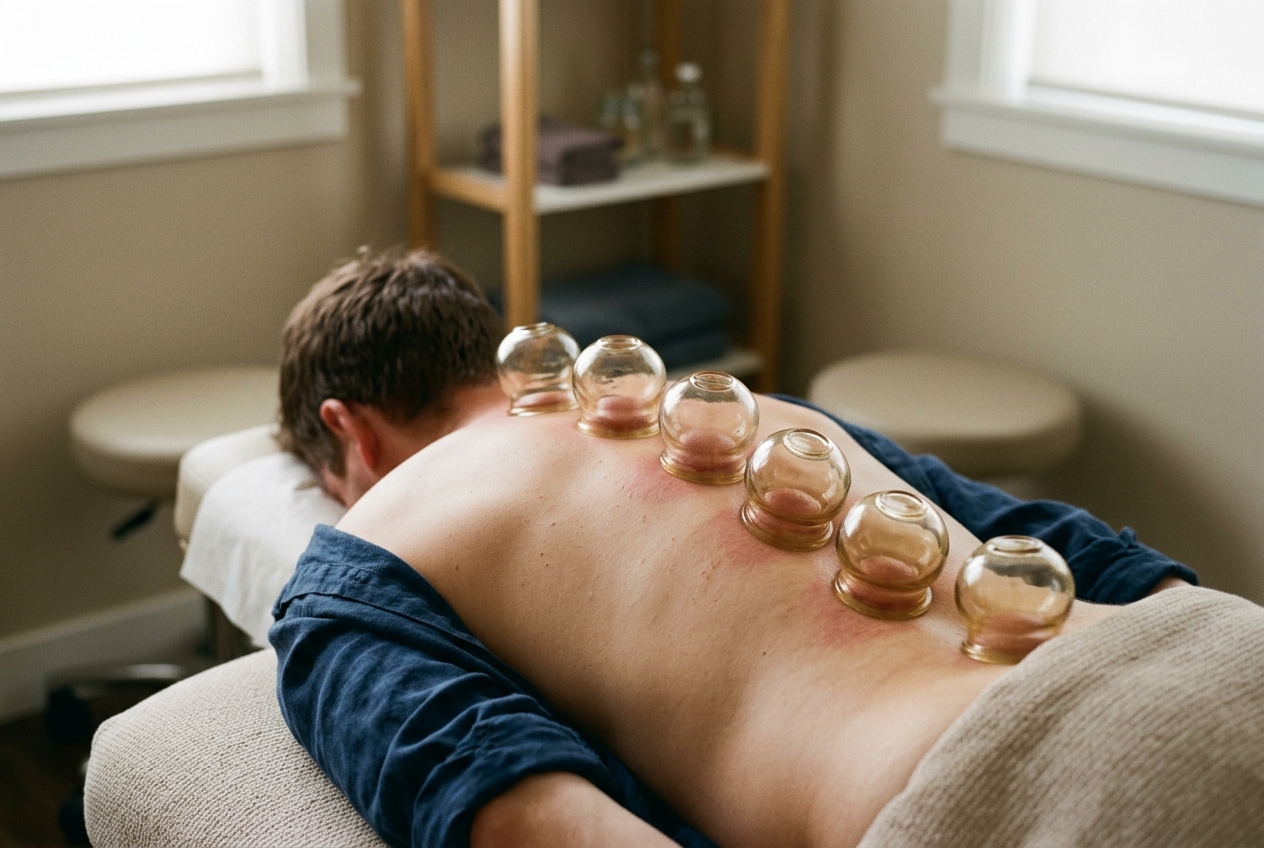
This is the mechanical foundation of Cupping Therapy (Ba Guan Fa, 拔罐法) and targeted acupressure. By creating a controlled, localized vacuum at specific cutaneous and somatic coordinates, this therapy decompresses ischemic capillary beds, lifts dense fascial sheets, and stimulates neural pathways that govern systemic inflammation and autonomic balance. When understood not as an esoteric novelty but as a sophisticated bio-mechanical and neurovascular intervention, the ancient art of cupping provides a remarkably rigorous roadmap for resolving the pervasive physical and neurological tolls of modern sedentary life.
2. The Meridian Path — A Journey Through the Body
To understand how suction applied to the back can rejuvenate systemic vitality, we must map the physiological highway upon which cupping primarily operates: the Foot Taiyang Bladder Meridian (Zu Tai Yang Pang Guang Jing) and its master midline companion, the Governing Vessel (Du Mai).
===================================================================================
                       THE DORSAL SOMATOTOPIC HIGHWAY
===================================================================================

[GV14 / Dazhui] ---> Cervicothoracic Junction (Master Yang Crossroads)
             |
   +---------+---------+
   |                   |
[Inner Bladder Line] [Outer Bladder Line]
 (1.5 cun / ~2 fingers) (3 cun / ~4 fingers)
   |                   |
   |-- BL13 (Lungs)    |-- BL42 (Door of Corporeal Soul)
   |-- BL15 (Heart)    |-- BL44 (Hall of the Spirit)
   |-- BL18 (Liver)    |-- BL47 (Gate of the Ethereal Soul)
   |-- BL20 (Spleen)   |-- BL49 (Abode of Thought)
   |-- BL23 (Kidneys)  |-- BL52 (Residence of Willpower)
   |                   |
   +---------+---------+
             |
       [BL40 / Weizhong] ---> Popliteal Fossa (Command Point of Lumbar Spine)
===================================================================================
The Dorsal Superhighway: Foot Taiyang Bladder Channel
The Bladder meridian represents the longest, most expansive energetic and fascial conduit in human anatomy. In classical terms, it is the Taiyang (Great Yang), forming the body’s outermost protective defensive barrier (Wei Qi).
- The Cranial and Spinal Origin: The pathway commences at the inner corner of the eye socket, arches up over the forehead and crown of the skull, and plunges into the base of the neck.
- The Dual Dorsal Tracks: Upon crossing the upper shoulders, the channel divides into two parallel bilateral columns running down the entire length of the spine:
- The Inner Branch: Runs approximately two finger-widths (1.5 cun) lateral to the spinal midline, passing directly over the Back-Shu (Bei Shu) reflex points.
- The Outer Branch: Traverses four finger-widths (3.0 cun) lateral to the spine, deeply traversing the erector spinae musculature and thoracic fascial planes.
- The Inferior Course: Both branches merge at the sacral base, travel through the center of each buttock cheek, descend down the midline of the hamstrings, enter the hollow crease behind the knee (Weizhong, BL40), run down the outer calf, pass beneath the outer ankle bone, and terminate at the lateral corner of the little toenail.
The Governing Vessel: The Sea of Yang
Running directly between these dual tracks along the posterior midline of the spinal column is the Governing Vessel (Du Mai). Functioning as the primary reservoir for the body's functional, thermogenic, and mobilizing capacities (Yang Qi), the Du Mai courses over the spinous processes from the coccyx up to the upper lip. Its pivotal crossroad at the base of the neck—GV14 (Dazhui)—acts as the master electrical junction box where all Yang meridians converge.
Visceral-Somatic Mapping: The Back-Shu System
The reason dorsal cupping produces profound effects far beyond simple muscular relaxation lies in the somatovisceral architecture of the Back-Shu points. In TCM theory, these points are direct conduits where the metabolic essence of specific internal organs (Zang-Fu) pools and interfaces with the surface of the body.
Neuroanatomically, each Back-Shu point corresponds precisely to the spinal nerve roots and sympathetic chain ganglia that innervate the corresponding viscera: * BL13 (Feishu, T3 level): Lung autonomic reflex (respiratory capacity, cutaneous immunity). * BL15 (Xinshu, T5 level): Heart autonomic reflex (cardiovascular pacing, psycho-emotional grounding). * BL18 (Ganshu, T9 level): Liver autonomic reflex (hepatic blood volume regulation, smooth fascial glide). * BL20 (Pishu, T11 level): Spleen/Pancreas autonomic reflex (digestive transit, muscular nutrient perfusion). * BL23 (Shenshu, L2 level): Kidney/Adrenal reflex (neuroendocrine balance, fluid metabolism, structural lumbar resilience).
Applying negative pressure across these dorsal coordinates simultaneously stimulates the cutaneous nerve branches, alters paraspinal mechanoreceptor firing, and triggers visceral autonomic reflexes via the sympathetic trunk.
3. The Physiological Matrix: Decompression, Heme Oxygenase-1, and Autonomic Signaling
For centuries, cupping was characterized in functional metaphors: "dispelling wind-cold," "resolving phlegm-damp," and "invigorating stagnant blood." Modern translational research—cataloged extensively in biomedical databases such as the NCBI PubMed Central Archive—has elucidated the precise cellular and molecular events underpinning these classical descriptions.
Decompression vs. Compression
Standard massage therapies exert positive, downward mechanical force. While beneficial, deep compressive pressure can cause micro-trauma in hyper-sensitized tissues and further compact congested fascial ground substance. Cupping introduces an inverse vector: negative pressure tensile traction.
A therapeutic vacuum ranging between $-200$ and $-400\text{ mbar}$ lifts the skin, subcutaneous adipose layer, and superficial muscle fascia away from the deeper skeletal frameworks. This mechanical lift accomplishes three immediate physical milestones: 1. Fascial Cleavage & Hydration: It physically separates densified collagenous cross-links and adhesions within the myofascia, permitting hyaluronic acid and interstitial fluids to rehydrate dry, ischemic tissue sheets. 2. Hydrostatic Gradient Realignment: The vacuum alters local Starling forces across the capillary wall, drawing stagnant interstitial fluid, pro-inflammatory cytokines, and cellular debris into the lymphatic drainage network for clearance. 3. Hyperemic Microcirculatory Reperfusion: As the cup is retained or moved, it triggers intense local vasodilation via nitric oxide (NO) endothelial release, followed by an immediate rush of oxygenated, nutrient-dense arterial blood once the suction is released.
The Molecular Cascade: Heme Oxygenase-1 (HO-1) Activation
One of the most remarkable physiological breakthroughs in understanding cupping therapy is the identification of Heme Oxygenase-1 (HO-1) induction, documented in foundational vascular biology research available through NCBI PubMed.
When therapeutic negative pressure draws blood into the microvasculature at high suction, minute amounts of red blood cells (erythrocytes) undergo controlled extravasation—leaking through the intact, dilated capillary endothelial junctions into the subcutaneous tissue space. The body registers this localized presence of extracellular hemoglobin as a potent biological signal: * Heme Catabolism: Macrophages and local fibroblasts upregulate the synthesis of HO-1, an inducible enzyme that rapidly catabolizes the free heme ring. * Bioactive Byproducts: This enzymatic breakdown yields three critical molecules: 1. Biliverdin (rapidly reduced to Bilirubin): A profoundly potent endogenous lipophilic antioxidant that neutralizes lipid peroxidation and limits systemic oxidative stress. 2. Carbon Monoxide (CO): In physiological micro-doses, CO functions as a vital gaseous neurotransmitter that exerts anti-inflammatory, vasodilatory, and anti-apoptotic actions by suppressing NF-$\kappa$B and downregulating pro-inflammatory cytokines (TNF-$\alpha$, IL-1$\beta$, IL-6). 3. Free Ferrous Iron ($Fe^{2+}$): Rapidly sequestered by co-induced ferritin, shielding tissues from iron-catalyzed Fenton reactions and reinforcing long-term cytoprotection.
Consequently, the circular discolored marks left by cupping are not destructive mechanical hematomas or traumatic bruises; they are localized bioreactors of therapeutic heme degradation, triggering sustained anti-inflammatory and cytoprotective cascades throughout the organism.
Neuro-Autonomic Tuning and Vagal Modulation
Beyond local tissue biochemistry, cupping acts as a powerful recalibration tool for the central and autonomic nervous systems. Mechanical suction stimulates large-diameter A-$\beta$ and A-$\delta$ mechanoreceptors in the skin, which transmit high-frequency sensory inputs into the dorsal horn of the spinal cord. In accordance with the classic Pain Gate Control Theory, this barrage of tactile signals inhibits the slower, unmyelinated C-fiber nociceptive pathways, halting pain transmission before it reaches the cerebral cortex.
Simultaneously, somatic afferent stimulation across the paraspinal sympathetic chain downregulates systemic sympathetic tone ("fight-or-flight") and upregulates the dorsal motor nucleus of the vagus nerve. Clinical trials demonstrate a rapid post-treatment increase in Heart Rate Variability (HRV), accompanied by reduced serum cortisol, decreased circulating Substance P, and increased release of endogenous $\beta$-endorphins.
4. Modalities and The Chromatic Diagnostic Map: Interpreting Post-Treatment Marks (Sha)
The therapeutic application of negative pressure is not monolithic. In clinical practice, practitioners adjust technique, duration, and vessel dynamics according to the patient’s constitutional vitality and the acute or chronic nature of their condition.
+---------------------+------------------------------------+------------------------------------------+
| Cupping Modality    | Mechanical Method                  | Primary Clinical Indication              |
+---------------------+------------------------------------+------------------------------------------+
| Retained (Stationary)| Fixed placement for 5–15 minutes   | Deep chronic stasis, Back-Shu reflex     |
| (Liu Guan Fa)       | with glass, plastic, or silicone   | tonification, localized myofascial trigger|
+---------------------+------------------------------------+------------------------------------------+
| Sliding / Moving    | Application of emollient; cup is   | Broad myofascial release, whole-channel  |
| (Zou Guan Fa)       | glided smoothly along channel lines| lymphatic drainage, hypertonic back spams|
+---------------------+------------------------------------+------------------------------------------+
| Flash / Rapid       | Instantaneous suction and removal  | Qi/Blood deficiency, pediatric or        |
| (Shan Guan Fa)      | repeated rapidly over an area      | geriatric patients, acute respiratory onset|
+---------------------+------------------------------------+------------------------------------------+
| Herbal Cupping      | Bamboo cups boiled in herbal decoct| Chronic joint arthralgia, deep Bi-syndromes|
| (Yao Guan Fa)       | applied hot to absorb phytomolecules| cold-damp invasion, intractable sciatica |
+---------------------+------------------------------------+------------------------------------------+
The Historical Continuum: From Ge Hong's Horn to Modern Sports Oncology
Cupping's written clinical lineage traces back to the early 4th century Jin Dynasty scholar-physician Ge Hong (284–346 CE). In his seminal text Zhou Hou Bei Ji Fang (Handbook of Prescriptions for Emergencies), Ge Hong outlined the "Horn Method" (Jiaofa, 角法), utilizing hollowed animal horns to drain purulent toxins, resolve snake bites, and clear recalcitrant blood stasis. Over centuries, these primitive tools evolved into turned bamboo tubes, hand-thrown ceramics, blown glass fire cups, and modern calibrated polycarbonate vacuum systems.
Today, cupping has transitioned seamlessly from monastic antiquity into elite athletic training rooms—where Olympic sprinters and gymnasts utilize sliding cupping for rapid lactate clearance and accelerated fascial remodeling—and integrative oncology units. In modern cancer support settings, gentle stationary and flash cupping protocols are clinically deployed to alleviate cancer-related fatigue, manage post-thoracotomy pain, and mitigate chemotherapy-induced peripheral neuropathy without pharmacologic toxicity, as recognized in integrative clinical guidelines outlined by the World Health Organization (WHO) Traditional Medicine Framework and documented across historical compendiums such as Wikipedia's Fire Cupping Chronology.
The Diagnostic Palette: Decoding Sha Ecchymosis
In TCM diagnostics, the biological response of the skin—the pigment, hue, and quality of the mark (Sha, 痧)—serves as an objective window into the internal micro-environment of the patient.
===================================================================================
                    DIAGNOSTIC CHROMATIC SPECTRUM OF SHA
===================================================================================

[ Light Pink / Pale ] --------> Constitutional Qi & Blood Deficiency; hypoperfusion;
                                empty-cold state requiring gentle tonification.

[ Bright Crimson Red ] -------> Acute Internal Heat; active inflammatory flare;
                                early-stage pathogenic invasion (Wind-Heat).

[ Deep Violaceous / Black ] --> Severe, Long-Standing Blood Stasis (Xue Yu);
                                cellular hypoxia; dense myofascial cross-linking.

[ Mottled Purpuric Spots ] ---> Phlegm-Damp & Blood Stagnation; localized micro-
                                thromboses; chronic intractable pain syndromes.

[ Pale Edema / Condensation ] -> Systemic Dampness or Cold; internal fluid retention;
                                sluggish lymphatic return.
===================================================================================
- Pale, Faint Pink with Rapid Recoil: Indicates an Empty (Xu) pattern characterized by systemic Qi and Blood deficiency. The microvasculature lacks the volume or pressure to extravasate; such patients require restorative, tonifying modalities rather than heavy draining methods.
- Vibrant Crimson Red: Reflects Heat (Re) syndromes or acute microvascular inflammation. Commonly seen in acute sprains, early-stage respiratory infections, or high-stress, hyper-sympathetic states.
- Deep Purple, Dark Indigo, or Charcoal Black: Represents chronic Blood Stasis (Xue Yu) and profound microvascular ischemia. These dark marks signify areas where red blood cells had long been trapped in sluggish, under-perfused fascial capillary networks. As HO-1 catabolizes this extravasated blood over 3 to 7 days, local tissue elasticity and pain thresholds dramatically improve.
- Mottled Grey-Purple with Petechiae: Diagnostics for combined Cold-Damp Congestion and chronic metabolic stagnation.
- Intra-Cup Condensation or Superficial Clear Vesicles: When microscopic water droplets accumulate on the inner walls of the cup (or small clear vesicles form under short durations of low suction), TCM diagnostic theory interprets this as the physical expulsion of pathogenic Dampness (Shi), correlating clinically with localized interstitial lymphedema and extracellular matrix swelling.
5. 2–3 Key Points You Can Press Right Now
While fire or vacuum cupping requires specialized equipment and sterile technique, you can access the very same therapeutic meridian mechanics through precision, non-invasive acupressure. Acupressure applies calibrated mechanical force onto high-density neural and vascular loci, initiating downstream neurochemical and fascial decompression without skin discoloration.
Here are four premier clinical points that mirror and amplify the benefits of cupping therapy, as validated in clinical somatosensory studies indexed on NCBI PubMed.
Point 1: BL40 (Weizhong – Middle of the Crease)
- Location Without Technical Jargon: Sit on the edge of a chair or lie comfortably on your stomach. Bend your knee slightly. Feel the horizontal crease directly on the backside of your knee joint. BL40 sits at the dead center of this crease, directly between the two thick, prominent tendon cords.
- What You Will Feel: When you find the exact notch, you will feel a distinct, dull electrical ache, a slight warm spreading sensation, or a mild tingling running downward toward your calf.
- How to Press: Use the tip of your thumb or middle finger. Apply steady, perpendicular pressure directed slightly upward toward the center of the kneecap. Maintain firm, rhythmic circular pressure for 90 to 120 seconds per leg while taking slow, diaphragmatic breaths.
- Everyday Relief:
- Lower Back Stiffness & Sciatica: As the undisputed "Command Point" for the entire lumbar and sacral region in TCM, stimulating BL40 instantly decreases motor neuron excitability in the paraspinal muscles.
- Knee Joint Tension & Hamstring Tightness: Releases myofascial tension in the posterior kinematic chain.
- Whole-Body Detoxification: Enhances systemic venous and lymphatic return from the lower limbs.
Point 2: GV14 (Dazhui – Great Vertebra)
- Location Without Technical Jargon: Drop your chin down toward your chest and run your fingers down the back of your neck along the center line. You will feel a large, prominent bony knob at the base of your neck where the cervical spine transitions into the upper back (the 7th cervical vertebra). Now, slowly roll your head from side to side; the bone that stays mostly stationary while the one above it swivels is C7. GV14 is located in the soft, dip-like depression immediately below this prominent bony landmark.
- What You Will Feel: A deep, spreading fullness, a mild radiant warmth across the upper trapezius, or a distinct sense of pressure release at the base of the skull.
- How to Press: Use the pads of your index and middle fingers pressed together. Press firmly inwards and slightly upward into the interspinous space. Hold constant, steady pressure for 2 minutes, or apply gentle, small clockwise circles while keeping your shoulders relaxed and dropped away from your ears.
- Everyday Relief:
- Upper Back & "Tech-Neck" Strain: Dissolves the hypertonic muscle knotting where the trapezius, levator scapulae, and rhomboids meet.
- Mental Fatigue & Brain Fog: Stimulates cranial circulation, clears the senses, and elevates systemic Yang alertness.
- Immune Defense & Early Chill: Clears exterior wind-heat pathogens and regulates thermoregulation during seasonal transitions.
Point 3: ST36 (Zusanli – Leg Three Miles)
- Location Without Technical Jargon: Sit with your knees bent at a 90-degree angle. Place the palm of your right hand over your right kneecap so your fingers point straight down your shin. Find the sharp, vertical bony crest of your shinbone. ST36 is located approximately four finger-widths below the bottom edge of your kneecap, and one thumb-width outward (toward the outside of your leg) into the muscular groove of the tibialis anterior.
- What You Will Feel: When pressed firmly, ST36 produces a characteristic heavy, achy sensation (De Qi) that may radiate downward toward the second and third toes or upward into the knee.
- How to Press: Press with the tip of your thumb or a rounded knuckle. Apply firm, pulsing pressure (3 seconds pressing down, 1 second releasing) for 2 to 3 minutes on each leg.
- Everyday Relief:
- Digestive Bloating & Sluggish Transit: Stimulates gastrointestinal motility, enhances vagal signaling, and relieves epigastric discomfort.
- Deep Physical Exhaustion: Historically named "Leg Three Miles" because ancient infantry soldiers pressed it to march three additional miles when utterly depleted.
- Systemic Anti-Inflammatory Reflex: Activates the cholinergic anti-inflammatory pathway via splenic nerve pathways.
6. A Point Combination for One Common Issue: The "Desk-Bound Spinal Reset"
For individuals who sit for hours at a computer and experience the classic triad of a locked cervical spine, an aching lower back, and mid-afternoon cognitive drain, follow this sequential, 8-minute evening decompression ritual.
Step-by-Step Protocol
1. Preparation & Posture (30 Seconds)
Sit comfortably on a firm chair or on a cushion on the floor with your spine erect but not rigid. Take three slow, deep nasal inhalations, allowing your abdomen to expand on the in-breath and your shoulders to drop on the out-breath.
2. Phase 1: Clear the Cranio-Cervical Blockade at GV14 (2 Minutes)
- Action: Place the pads of your index and middle fingers directly on GV14 (just below the large C7 vertebra at the base of your neck).
- Movement: Apply steady, firm inward pressure. As you breathe out, slowly tilt your chin toward your chest, feeling the back of your neck lengthen. As you breathe in, bring your head back to neutral.
- Duration: Continue this gentle rhythmic motion with sustained pressure for 2 full minutes.
3. Phase 2: Warm and Decompress the Lumbar Spine at BL23 (2 Minutes)
- Action: Locate BL23 (Shenshu), situated two finger-widths lateral to the spine at the level of your natural waistline (directly opposite the navel).
- Movement: Instead of pinpoint finger pressure, form loose fists with both hands. Use the flat surface of your knuckles to rub up and down briskly over the BL23 area.
- Duration: Rub vigorously for 2 minutes until you feel a deep, penetrating radiant heat soaking into your lower back and kidneys.
4. Phase 3: Release the Posterior Chain at BL40 (2 Minutes)
- Action: Lean slightly forward and slide your hands behind your knees. Place your thumbs directly into the center of the popliteal crease on both legs simultaneously (BL40).
- Movement: Grip your knees with your fingers resting on the kneecaps while your thumbs sink deeply into the hollow behind the knees. Press firmly upward and inward. Rotate your ankles in slow circles while maintaining this deep pressure.
- Duration: 1 minute in one direction, 1 minute in the opposite direction.
5. Phase 4: Root the Energy and Settle the Core at ST36 (2 Minutes)
- Action: Shift your thumbs or knuckles to ST36 on the outer side of your shinbones.
- Movement: Apply rhythmic, pulsing downward pressure. Synchronize the pulse with your breath: press firmly as you exhale, ease off slightly as you inhale.
- Duration: 2 minutes.
By completing this sequence from the top of the spine downward to the legs, you systematically drain accumulated tension from the head, decompress the central lumbar reservoir, and root systemic circulation back into the lower extremities, as modeled in clinical myofascial pain management strategies outlined in NCBI PubMed's Myofascial Pain Research Compendia.
7. Safety, Sense & Clinical Contraindications
While non-invasive acupressure and therapeutic cupping are exceptionally safe modalities when practiced correctly, strict biological boundaries and clinical contraindications must be honored to prevent adverse events.
Recognizing "Too Much Pressure"
A common misconception is that therapeutic cupping or acupressure must be excruciating to be effective. Therapeutic sensation should register as a deep, satisfying ache, a spreading warmth, or a pleasant sensation of tension release (De Qi).
If you or a client experience: * Sharp, pinching, or burning pain * Cold, clammy sweating or sudden dizziness (Vasovagal syncopal reaction) * Sensation of electrical shooting numbness into the extremities
The cups must be removed immediately by breaking the vacuum seal at the rim, or acupressure pressure must be discontinued. In the case of mild vasovagal lightheadedness, place the patient supine with feet elevated and administer warm water.
Special Precautions: Skin Integrity & Anticoagulation
Never apply suction over thin, atrophic skin, varicose veins, fragile capillaries, or areas recently treated with radiation therapy. Patients taking anticoagulant medications (e.g., Warfarin, Apixaban, Clopidogrel) or high-dose NSAIDs should avoid deep retained or wet cupping due to the heightened risk of uncontrolled subcutaneous hematoma formation.
8. Today's Takeaway: Your 2-Minute Reset
You do not need to wait for a specialized clinical appointment to begin reaping the benefits of meridian decompression. You can shift your autonomic state and release paraspinal rigidity right now before closing this page.
+-------------------------------------------------------------------------------+
|                       THE 2-MINUTE "INSTANT CHAIR" RESET                      |
+-------------------------------------------------------------------------------+
| Coordinate:   BL40 (Popliteal Fossa / Center crease behind both knees)        |
| Target Issue: Midday lumbar ache, tight hamstrings, and postural fatigue      |
| Protocol:     1. Slide both hands behind your knees while seated.             |
|               2. Sink your thumb pads into the dead center of the crease.     |
|               3. Apply firm, steady upward pressure (scale 6/10).             |
|               4. Breathe deeply: Exhale for 4 seconds, inhale for 4 seconds.   |
|               5. Pump your feet up and down gently 10 times under pressure.   |
| Duration:     Exactly 2 minutes.                                              |
+-------------------------------------------------------------------------------+
Take two minutes. Locate the points, apply mindful, firm pressure, and feel the ancient, elegant engineering of your own somatic pathways decompress from within.