Cupping Techniques (Ba Guan Fa) Meridian Dynamics: Governing Negative Pressure Decompression, Microvascular Petechial Extravasation, Myofascial Mobilization, and Pathogenic Toxic Heat-Damp Dispersion in Traditional Chinese Medicine
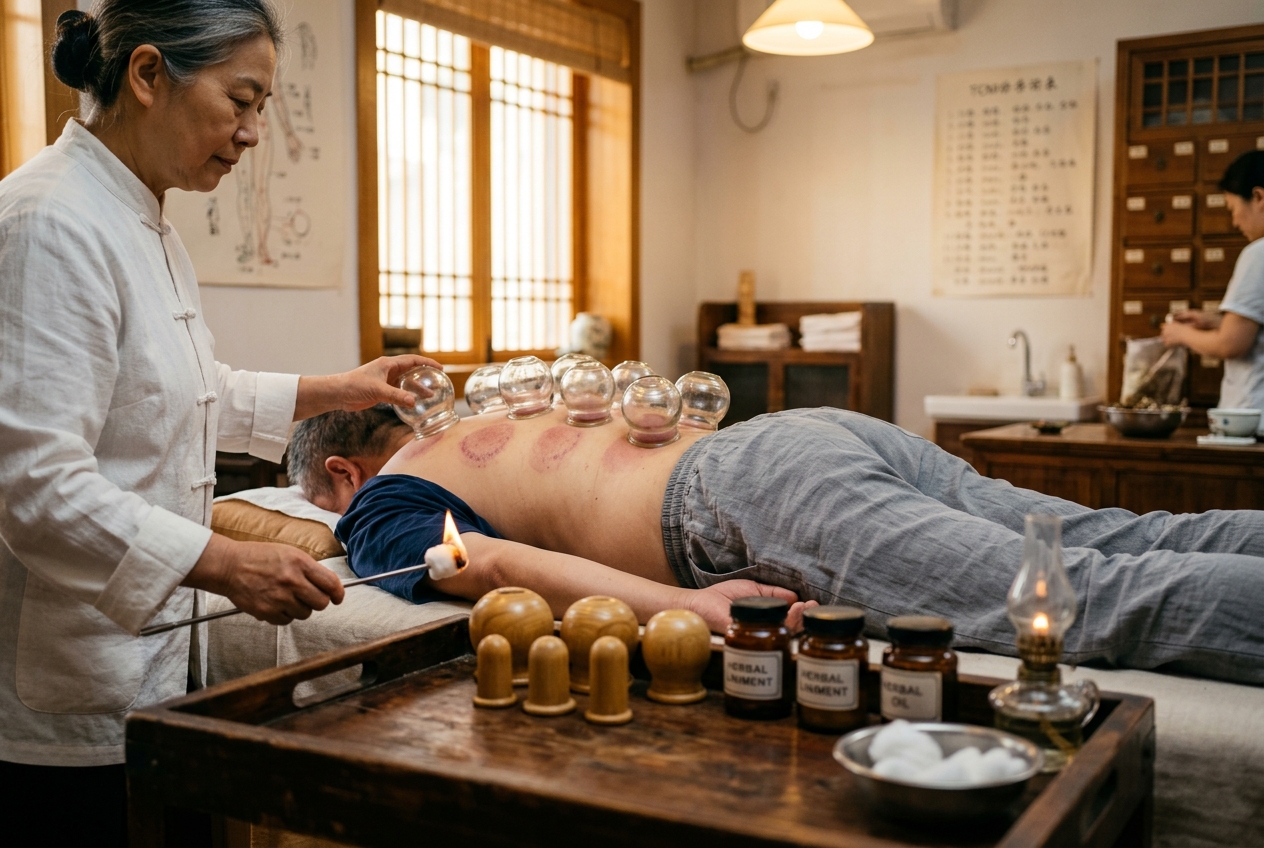
Consider the insidious physical burden of modern sedentary life: you have sat hunched over a backlit keyboard for seven hours straight, and a dull, leaden weight has anchored itself beneath your shoulder blades. Your trapezius muscles feel shrink-wrapped, your neck resists rotation, and a persistent, suffocating ache radiates along the spine. Instinctively, you reach back, digging your knuckles or thumb into the knotted tissue between the spine and the scapula, seeking a fleeting release through compressive force. Yet pressing harder often only compresses an already strangled vascular bed, delivering brief mechanical distraction rather than profound cellular renewal.
+-------------------------------------------------------------------------+
|                  THE THERAPEUTIC PARADIGM SHIFT                         |
|                                                                         |
|  CONVENTIONAL MANUAL THERAPY        NEGATIVE-PRESSURE CUPPING           |
|  [Downward Compressive Force]      [Upward Tensile Decompression]       |
|             |                                     |                     |
|             v                                     ^                     |
|   +-------------------+                 +-------------------+           |
|   | Compresses tissue |                 | Lifts & separates |           |
|   | & microvasculature|                 | myofascial layers |           |
|   +-------------------+                 +-------------------+           |
|             |                                     |                     |
|             v                                     v                     |
|   Temporary ischemia                    Enhanced microperfusion,        |
|                                         extravasation & HO-1 release    |
+-------------------------------------------------------------------------+
In Traditional Chinese Medicine (TCM), this familiar stagnation of the upper back and neck represents a quintessential blockage of Qi (vital bioelectrical and functional momentum) and Xue (nourishing blood) within the dominant kinetic meridian pathways—most notably the Taiyang (Greater Yang) Bladder and Shaoyang (Lesser Yang) Gallbladder channels. For over two millennia, physicians of classical Asian medicine recognized that when tissue is compressed, starved of interstitial movement, or penetrated by external pathogenic factors such as wind (Feng), cold (Han), or dampness (Shi), the solution is not more inward compression, but its radical physical opposite: outward, subatmospheric mechanical traction. This is the therapeutic domain of cupping therapy—known canonically in Chinese medicine as Ba Guan Fa (拔罐法, "the method of pulling jars").
By converting compressive musculoskeletal stress into a three-dimensional tensile lift, cupping draws stagnated interstitial fluid, microvascular cellular debris, and metabolic byproducts outward to the superficial cutaneous layers. The resulting circular marks—often misunderstood as bruises—are in fact the visual signatures of a profound autologous physiological reset, mobilizing systemic immune responses and restoring the uninhibited circulation of life-sustaining energy.
What This Organ System Does: The Bio-Mechanics and Meridian Dynamics of Cupping
To understand Ba Guan Fa, one must conceptualize the human body as an integrated continuum of fascial sheets, microcirculatory networks, and energetic channels rather than a collection of isolated anatomical components. Within the theoretical framework of Traditional Chinese Medicine as recognized by the World Health Organization, the skin, subcutaneous connective tissues, and musculature are governed by the Pi Bu (Cutaneous Regions) and Jing Jin (Sinew Channels). These superficial layers act as the body's primary immunological and thermodynamic shield, housing the protective defensive energy known as Wei Qi. When pathogenic climatic factors penetrate this defensive perimeter, or when emotional stress and repetitive physical strain immobilize the flow of Qi, the underlying connective tissue dehydrates, adheres, and forms painful stagnation matrices (Bi syndromes).
                      +-----------------------------+
                      |   HISTORICAL EVOLUTION OF   |
                      |     CUPPING THERAPEUTICS    |
                      +-----------------------------+
                                     |
                                     v
       +------------------------------------------------------------+
       | 1. EARLY HORN METHOD (Jiao Fa - 角法)                       |
       |    • Documented in Bo Shu (Mawangdui Silk Texts, ~2nd c. BC)|
       |    • Ge Hong's Zhou Hou Bei Ji Fang (4th c. AD)            |
       |    • Animal horns used to aspirate purulent toxins         |
       +------------------------------------------------------------+
                                     |
                                     v
       +------------------------------------------------------------+
       | 2. BAMBOO & CERAMIC CANISTERS (Zhu Guan / Tao Guan)        |
       |    • Tang & Song Dynasties (e.g., Wai Tai Mi Yao)           |
       |    • Integration of herbal decoction boiling (Shui Guan Fa)|
       +------------------------------------------------------------+
                                     |
                                     v
       +------------------------------------------------------------+
       | 3. CLASSICAL FIRE-GLASS MODALITY (Huo Guan Fa)              |
       |    • Qing Dynasty to 20th Century                          |
       |    • Thermal displacement creating negative pressure       |
       +------------------------------------------------------------+
                                     |
                                     v
       +------------------------------------------------------------+
       | 4. MODERN PNEUMATIC & MYOFASCIAL DECOMPRESSION             |
       |    • Calibrated piston/vacuum pumps                        |
       |    • Integration with functional biomodulation & histology |
       +------------------------------------------------------------+
The Historical Evolution: From Animal Horns to Fire-Glass Precision
The therapeutic employment of negative pressure has a profound lineage: * Neolithic to Han Dynasty Origins (Jiao Fa): The earliest documented applications utilized hollowed cattle or water buffalo horns (Jiao Fa, 角法, "horn method"). Archaeological findings and classical texts, including the silk manuscripts excavated from the 2nd-century BCE Han dynasty tomb at Mawangdui (Bo Shu, 帛书), describe horn suction applied directly over skin eruptions and abscesses to draw out venom, purulent drainage, and localized heat toxins. * Classical Codification by Ge Hong: In the 4th-century Jin dynasty manual Zhou Hou Bei Ji Fang (肘后备急方, Handbook of Prescriptions for Emergencies) by the Taoist physician and alchemist Ge Hong, horn suction was formally systematized as a medical intervention for draining deep-seated cutaneous pustules and resolving localized blood stagnation. * The Expansion into Bamboo and Ceramics: By the Tang (618–907 CE) and Song (960–1279 CE) dynasties, as recorded in Wang Tao's monumental compendium Wai Tai Mi Yao (外台秘要, Arcane Essentials from the Imperial Library), suction therapy transitioned to cylindrical bamboo cups (Zhu Guan) and fired ceramic vessels (Tao Guan). This era pioneered the boiling of bamboo canisters in medicinal herbal decoctions prior to application, giving birth to Shui Guan Fa (medicinal water cupping). * The Modern Era: The Qing dynasty (1644–1912 CE) witnessed the widespread adoption of glass cups (Huo Guan), which granted practitioners visual access to the changing cutaneous response during therapy. Today, the art encompasses hand-blown thick glass, calibrated pneumatic suction systems, and medical-grade silicone cups.
               CROSS-SECTION: THE THREE-DIMENSIONAL TENSILE LIFT

                    [       Subatmospheric Vacuum       ]
                    [          Negative Pressure        ]
     ~~~~~~~~~~~~~~~~~~~~\                             /~~~~~~~~~~~~~~~~~~~~
      EPIDERMIS / DERMIS  \                           /   Skin Turgor Lifted
     ----------------------\                         /----------------------
      SUPERFICIAL FASCIA    \                       /     Interstitial
                             \                     /      Hydration Restored
     -----------------------------------------------------------------------
      DEEP MYOFASCIA /        \                   /       Capillary Wall
      MICROVASCULAR BED        \                 /        Extravasation (Sha)
     =======================================================================
      SKELETAL MUSCLE LAYER
The Biophysics of Negative-Pressure Decompression
Contemporary scientific investigations, such as those cataloged in NCBI PMC research on cupping biomechanics, demonstrate that cupping operates through localized mechanical suction, typically generating a subatmospheric pressure differential between -100 mmHg and -400 mmHg. This negative-pressure vector exerts a three-dimensional tensile traction on the cutaneous, subcutaneous, and deep myofascial planes.
- Myofascial Shearing and Viscoelastic Restoration: In chronically congested muscles, the layers of superficial and deep fascia become bound by dehydrated, cross-linked collagen matrices and dense ground substance. Negative pressure physically lifts the skin and subcutaneous adipose layer away from the underlying investing muscular fascia, separating adhered tissue planes. This creates a shearing force that rehydrates the hyaluronic-acid-rich interstitial fluid, decreases resting muscle tone, and breaks the cycle of myofascial pain syndrome.
- Microvascular Extravasation and the Sha Phenomenon: Under strong suction, the transluminal pressure inside cutaneous capillary beds exceeds their mechanical tensile threshold. Endothelial junctions temporarily dilate, leading to controlled diapedesis and petechial microvascular extravasation—a phenomenon termed Sha in Chinese medicine. Red blood cells (erythrocytes) escape the microcirculation and enter the interstitial tissue spaces.
- Lymphatic Decongestion: The localized vacuum dramatically stimulates dermal lymphatic capillaries, accelerating the drainage of stagnant interstitial fluid, lactic acid, substance P, and inflammatory cytokines toward regional lymph nodes.
       +------------------------------------------------------------+
       |        THE HEME OXYGENASE-1 (HO-1) BIOCHEMICAL AXIS        |
       +------------------------------------------------------------+
                                     |
                                     v
       [ Negative-Pressure Suction induces Extravasation of Erythrocytes ]
                                     |
                                     v
       [ Localized Macrophage Infiltration & Hemoglobin Phagocytosis ]
                                     |
                                     v
       [ Cleavage of Intracellular Heme by Heme Oxygenase-1 (HO-1) ]
                                     |
                     +---------------+---------------+
                     |                               |
                     v                               v
         [ BILIVERDIN / BILIRUBIN ]          [ CARBON MONOXIDE (CO) ]
                     |                               |
                     v                               v
         Potent Endogenous Direct            Vasodilation, Suppression
          Antioxidant & Free-Radical          of Pro-Inflammatory NF-κB,
          Scavenging Capacity                 Nociceptive Hyperalgesia Drop
Extravasation and the Molecular Cascade: The HO-1 Axis
The physiological impact of Ba Guan Fa extends far beyond physical tissue separation. When erythrocytes undergo extravasation into the extravascular compartment, the body identifies their presence as a controlled, localized micro-injury. Specialized macrophages immediately infiltrate the area to metabolize the free hemoglobin.
As highlighted in NCBI studies on heme oxygenase-1 expression following cupping, the enzymatic degradation of free heme triggers the robust upregulation of Heme Oxygenase-1 (HO-1), an inducible, cytoprotective heat-shock protein (HSP32). The breakdown of heme by HO-1 yields three potent biologically active molecules: * Biliverdin (subsequently converted to Bilirubin): Serves as one of the body's most formidable endogenous free-radical scavengers, terminating lipid peroxidation cascades. * Carbon Monoxide (CO): In physiological micromolar concentrations, CO acts as a critical gaseous signaling molecule that suppresses pro-inflammatory cytokines (such as TNF-α, IL-1β, and IL-6) via the down-regulation of the NF-κB pathway, while simultaneously promoting microvascular vasodilation. * Free Iron (chelated by Ferritin): Mitigates oxidative stress.
Through this sequence, the local cutaneous petechiae produced by cupping trigger a systemic anti-inflammatory, antioxidant, and tissue-protective response that reverberates across the neuroendocrine-immune axis.
How You Can Feel It — Signs of Balance, Imbalance, and Cutaneous Diagnostics
When your meridian network and fascial sheets are balanced, your spinal column and musculature feel light, supple, and dynamically responsive. You experience free thoracic expansion during respiration, zero resistance during cervical and lumbar rotation, and an absence of localized tenderness along the paravertebral musculature.
When stagnation settles into the tissues, the clinical signs are distinct:
+--------------------------------------------------------------------------------+
|                   SELF-ASSESSMENT: ARE YOU EXPERIENCING                        |
|                       CHANNEL & TISSUE STAGNATION?                             |
+--------------------------------------------------------------------------------+
|  [ ] 1. PARAVERTEBRAL TENSION: Persistent knotting or tightness along the      |
|         upper back, trapezius ridge, or sacral border that defies stretching.  |
|                                                                                |
|  [ ] 2. HEAVINESS & DULL ACHING: A sense that your back or limbs are           |
|         weighed down by damp, cold concrete, particularly in rain or chill.    |
|                                                                                |
|  [ ] 3. FIXED, SHARP DISCOMFORT: Pain localized to specific motor points       |
|         that worsens with stationary postures and improves slightly with heat. |
|                                                                                |
|  [ ] 4. SHALLOW THORACIC MOBILITY: Tight intercostal and thoracic musculature  |
|         inhibiting full, diaphragm-driven breaths.                             |
|                                                                                |
|  [ ] 5. COLD LOCALIZED ZONES: Skin across the lumbar or interscapular region   |
|         feeling palpably colder to the touch than surrounding tissue.          |
+--------------------------------------------------------------------------------+
Reading the Flesh: The Diagnostic Ecchymotic Spectrum
In clinical practice, the cutaneous pigmentary response manifested immediately following cup removal serves as an indispensable, non-invasive diagnostic window into the internal pathophysiological state of the patient's energetic channels and organ systems. Unlike traumatic contusions, which arise from high-energy blunt-force vascular rupture, post-cupping ecchymoses reflect the selective evacuation of stagnant capillary beds.
+------------------------------------------------------------------------------------+
|               DIAGNOSTIC INTERPRETATION OF POST-CUPPING ECCHYMOSIS                 |
+----------------------+-----------------------------+-------------------------------+
| CUTANEOUS PIGMENT /  | CHINESE MEDICINE            | BIOMEDICAL / PHYSIOLOGICAL    |
| MORPHOLOGICAL SIGN   | PATHOLOGY PATTERN           | CORRELATE                     |
+----------------------+-----------------------------+-------------------------------+
| Deep Purple / Black  | Chronic Cold-Blood Stasis   | Severe localized hypoxia,     |
| (Zi Hei Se)          | (Han Ning Xue Yu)           | microvascular congestion,     |
|                      |                             | elevated cellular waste       |
+----------------------+-----------------------------+-------------------------------+
| Bright Scarlet Red   | Excess Heat / Yin           | Capillary engorgement, active |
| (Xian Hong Se)       | Deficiency Internal Heat    | hyperemic inflammation,       |
|                      | (Re Zheng / Yin Xu Huo Wang)| febrile reactivity            |
+----------------------+-----------------------------+-------------------------------+
| Pale Pink / White    | Qi and Blood Deficiency     | Systemic anemia, poor blood   |
| (Dan Hong / Bai Se)  | (Qi Xue Liang Xu)           | volume, hypoperfusion,        |
|                      |                             | tissue exhaustion             |
+----------------------+-----------------------------+-------------------------------+
| Watery Edema /       | Damp-Phlegm Accumulation    | High interstitial fluid       |
| Puffy Turgor         | (Shi Yin Ning Zhi)          | retention, compromised        |
|                      |                             | regional lymphatic drainage   |
+----------------------+-----------------------------+-------------------------------+
| Vesicles / Blisters  | Severe Damp-Heat Stagnation | Extreme localized fluid       |
| (Shui Pao)           | (Shi Re Du)                 | shifts, localized toxin       |
|                      |                             | concentration, porous dermis  |
+----------------------+-----------------------------+-------------------------------+
- Dark Purple to Black Pigment (Zi Hei Se): Indicates longstanding, unyielding blood stasis (Xue Yu) compounded by deep-seated interior cold (Han). This is the hallmark of chronic, intractable musculoskeletal conditions, old traumatic scar tissue, or ischemic muscular contracts.
- Bright Scarlet to Crimson Red (Xian Hong Se): Denotes acute excess internal heat (Re) or constitutional Yin deficiency with blazing fire (Yin Xu Huo Wang). Commonly observed in acute inflammatory flare-ups, febrile illnesses, or hyper-metabolic stress states.
- Pale Pink, Whitish, or Indented Without Color (Dan Bai Se): Reflects profound constitutional deficiency of both Qi and Blood (Qi Xue Liang Xu). The capillary beds lack the pressure and volume to extravasate, manifesting in a pale, sluggish cutaneous response that takes days to regain natural color.
- Watery Edema and Skin Pores Opening Wide (Shui Zhong / Mao Kong Cu Da): The superficial fascia beneath the cup swells with clear, gel-like fluid, and the pores dilate dramatically. This pattern reflects the pathogenic accumulation of internal dampness (Shi) and sluggish lymphatic return.
- Vesicle / Blister Eruption (Shui Pao): When small, clear or yellowish serous blisters manifest on the skin surface beneath the vacuum (without thermal burns), it points to profound pathogenic damp-toxin (Shi Du) stagnation locked within the deep organ networks.
Qigong & Movement Practice: The Flowing Spine and Channel Decompression
Before or between cupping interventions, dynamic mindful movement helps lubricate the myofascial sheaths and prepares the Taiyang Bladder Channel for decompressive therapy. The classical exercise "The Great White Crane Stretches Its Wings to Mobilise the Taiyang Bladder Channel" focuses on active spinal flexion, axial elongation, and posterior fascial-chain stretching.
       [1. Wuji Stance]         [2. Axial Lift / Inhale]     [3. Wave Flexion / Exhale]
             o                            \ o /                          __ o
            /|\                             |                           /  / \
            / \                            / \                         |  /   \
     Grounding through feet       Opening Dazhui & Chest       Decompressing Back-Shu Matrix
Step-by-Step Practice Instructions
- Starting Position and Setup: Stand barefoot or in flat shoes on a level surface. Position your feet shoulder-width apart, parallel to each other. Allow your knees to unlock slightly. Release the sacrum toward the earth, tuck the chin gently to elongate the cervical spine at the base of the skull, and place your hands resting lightly at your sides. Settle your gaze on the horizon. Take three diaphragmatic breaths to root your mind.
- Phase 1: Inhalation and Channel Expansion (4 Seconds): As you draw a smooth, unforced breath in through the nose, slowly rotate your palms outward and sweep your arms upward in a wide arc until they reach overhead. As your hands elevate, gently lift your chest, extend your thoracic spine, and tilt your head back slightly to gaze between your palms. Feel a dynamic, upward tensile stretch originating at the soles of your feet (Kidney 1, Yongquan), traversing up the calves, hamstrings, paravertebral muscles, and extending through the fingertips. This opens Dazhui (GV14) and stretches the Taiyang channel along the dorsal body plane.
- Phase 2: Spinal Articulation and Forward Decompression (6 Seconds): As you exhale smoothly through the nose, begin a segmental forward roll. First, tuck your chin down to the sternum. Next, allow your shoulders to round forward, releasing the thoracic spine vertebra by vertebra, and finally hinging at the hips to lower your torso toward the floor. Let your arms, neck, and head hang completely loose like willow branches. Do not force your knees locked; maintain a soft micro-bend.
- Phase 3: The Interstitial Hold (4 Seconds): In the fully folded position, suspend the breath gently for four seconds. Direct your mental awareness (Yi) into the long vertical lines running alongside your spinal column—the inner and outer branches of the Bladder Channel. Visualize the suction of space entering between every single intervertebral joint.
- Phase 4: Rolling Re-Ascent (6 Seconds): Inhale deeply, press your heels firmly into the floor, and initiate the re-ascent by tucking the tailbone down. Roll the spine upward one vertebra at a time, keeping the head and arms heavy until the torso is fully vertical, with the head arriving last.
- Duration and Repetitions: Execute 8 to 12 continuous cycles, dedicating approximately 6 to 8 minutes to this sequence once or twice daily.
- Somatic Shifts to Observe: Look for a spreading wave of warmth along the interscapular region, accompanied by a subtle tingling sensation across the occiput and down the calves. This signals the activation of Wei Qi and the functional mobilization of the superficial back fascia line.
Acupressure Points & Core Clinical Cupping Modalities
                    CORE CLINICAL CUPPING MODALITIES
                                   |
    +------------------------------+------------------------------+
    |                              |                              |
    v                              v                              v
[ RETAINED CUPPING ]      [ FLASH CUPPING ]            [ MOVING CUPPING ]
  (Liu Guan Fa)             (Shan Guan Fa)               (Zou Guan Fa)
  • Fixed static suction    • Rapid cup application      • Lubricated gliding
  • 5–15 min duration       • Repeated on/off cycle      • Long meridian strokes
  • Deep organ/stasis fix   • Expels wind/deficiency     • Sweeps vast fascia beds
    |                              |
    +------------------------------+
    |                              |
    v                              v
[ WET / BLEEDING CUPPING ] [ MEDICINAL WATER CUPPING ]
  (Ci Luo Ba Guan Fa)        (Yao Guan Fa)
  • Dermal micro-puncture    • Bamboo cups boiled in herbs
  • Evacuates toxic blood    • Delivers thermal phytotherapy
  • Clears acute heat/trauma • Dispels deep cold-damp Bi
The Five Core Clinical Cupping Modalities
- Retained Cupping (Liu Guan Fa, 留罐法): The most fundamental static technique. A glass or pneumatic cup is applied to a specific acupoint or Ashi (trigger) point with mild to strong suction and retained in place for 5 to 15 minutes. This creates deep focal decompression, mobilizes localized Qi and blood, and anchors internal organ balance.
- Flash Cupping (Shan Guan Fa, 闪罐法): A rapid, dynamic technique where a glass fire cup is placed onto the skin and instantly removed with an audible popping sound, repeatedly reapplied across an anatomical region until the skin turns uniformly pinkish-red. Primarily utilized in conditions of severe bodily deficiency (Xu), flaccid paralysis, or in pediatric/elderly patients where prolonged static suction is contraindicated. It warms the meridians and expels superficial exterior wind without depleting underlying energy.
- Moving / Sliding Cupping (Zou Guan Fa / Tui Guan Fa, 走罐法 / 推罐法): A lubricating medium—such as organic sesame, safflower, or almond oil infused with warming herbs—is spread generously over large, muscular anatomical planes (such as the entire back, gluteal region, or iliotibial band). A medium-sized cup is applied with moderate suction and steadily glided along the longitudinal pathway of the meridians. This combines the benefits of negative pressure with intensive broad-spectrum myofascial shearing, clearing multi-segmental stagnation.
- Wet / Bleeding Cupping (Ci Luo Ba Guan Fa, 刺络拔罐法): An advanced clinical intervention wherein the superficial cutaneous layer is lightly pricked with a sterile three-edged lancet or dermal plum-blossom needle (0.5–1.0 mm depth) prior to cup application. The resulting vacuum draws out 1 to 5 mL of dark, highly viscous, microvascular-stagnated blood. This technique is unmatched in its ability to immediately drain acute excess heat, abort acute febrile spikes, relieve severe migraines, and resolve acute traumatic hematomas.
- Medicinal / Herbal Water Cupping (Shui Guan Fa / Yao Guan Fa, 水罐法 / 药罐法): Specialized bamboo cups are simmered in a targeted herbal decoction (often containing warming, damp-dispelling substances such as Ai Ye, Hong Hua, Du Huo, and Tou Gu Cao) for 30 minutes. The hot cups are extracted with forceps, excess liquid is quickly tapped out onto a sterile towel to prevent scalding, and they are immediately seated upon the body. As the internal air and steam cool, a gentle, sustained vacuum forms, driving therapeutic herbal vapors deep into the osteoarticular and sinew layers to treat stubborn cold-damp Bi syndromes.
                   THE TAIYANG BLADDER CHANNEL MATRIX
                AND CEPHALIC/CERVICAL CROSSOVER POINTS

                          ( GV14 - Dazhui )
                       [C7-T1 Spinous Process]
                     "Great Vertebra / Sea of Yang"
                                  |
            ( GB21 - Jianjing )   |   ( GB21 - Jianjing )
          [Midpoint Trapezius]   |   [Midpoint Trapezius]
                                  |
     -----------------------------+-----------------------------
                BLADDER CHANNEL BACK-SHU MATRIX
     -----------------------------------------------------------
     BL13 (Feishu)    --- [T3] --- Respiratory Pathogens / Wei Qi
     BL15 (Xinshu)    --- [T5] --- Shen Regulation / Cardia
     BL18 (Ganshu)    --- [T9] --- Liver Qi Smooth Flow / Sinews
     BL20 (Pishu)     --- [T11]--- Dampness Transformation / Digestion
     BL23 (Shenshu)   --- [L2] --- Essence / Lumbar Anchor / Water
     -----------------------------------------------------------
Essential Meridian Gates and Target Acupoints
To harness these dynamics, clinical cupping and targeted acupressure focus on strategic nodal points along the primary channels as mapped in the comprehensive Wikipedia repository on classical cupping and acupoint theory:
1. Dazhui (GV14 / DU14, 大椎, "Great Vertebra")
- Location: Directly along the posterior midline, in the depression immediately inferior to the spinous process of the seventh cervical vertebra (C7). To locate it easily: drop your chin to your chest and run your finger down the back of your neck until you feel the most prominent, protruding bony landmark; roll your finger into the soft depression just below it.
- Manual and Cupping Protocol: Apply static fire or pneumatic cupping for 8 to 10 minutes, or apply direct manual thumb pressure directed perpendicularly inward with a firm, circular kneading vector for 2 to 3 minutes.
- Clinical Indications: As the supreme intersection point where all six Yang channels of the hand and foot converge with the Governing Vessel (Du Mai), Dazhui is the master switch for regulating systemic thermoregulation. It is indicated for clearing acute upper respiratory wind-heat infections, dispelling lingering cold, alleviating occipital-cervical rigidity, and awakening the central nervous system.
2. Jianjing (GB21, 肩井, "Shoulder Well")
- Location: On the shoulder ridge, precisely at the midpoint of the line connecting the spinous process of C7 (Dazhui) and the lateral acromion process of the scapula. It is easily found at the highest crest of the trapezius muscle belly.
- Manual and Cupping Protocol: Grasp the thick muscular ridge with the thumb and forefinger, or apply sliding/retained cupping along this crest with moderate suction for 5 to 8 minutes. (Acupressure: squeeze and roll the muscle bundle downward with sustained, firm pressure for 90 seconds).
- Clinical Indications: Dispels stubborn neck and shoulder tension, down-regulates counterflow Qi (manifesting as stress headaches, emotional irritability, or clenched jaw), promotes lactation, and restores the smooth descending function of the Gallbladder and Liver channels.
3. The Taiyang Bladder Channel Back-Shu Matrix (Feishu BL13, Pishu BL20, Shenshu BL23)
- Location: Running parallel to the vertebral column at 1.5 cun (approximately two finger-widths) lateral to the inferior borders of the spinal processes:
- Feishu (BL13): Lateral to T3. Controls the Lung, skin, and Wei Qi.
- Pishu (BL20): Lateral to T11. Governs the Spleen, digestive transformation, and dampness resolution.
- Shenshu (BL23): Lateral to L2 (level with the lower border of the rib cage). Anchors the Kidney Jing, lower back vitality, and systemic water metabolism.
- Manual and Cupping Protocol: Sliding cupping (Zou Guan Fa) up and down this entire paravertebral band using herbal oil until a uniform rosy-red hyperemic glow is achieved, followed by retained cupping on specific deficient or excess Shu points for 10 minutes.
- Clinical Indications: Regulates the functional status of their corresponding internal Zang-Fu organs, clears chronic systemic fatigue, calms the autonomic nervous system via the sympathetic trunk, and realigns spinal biomechanics.
4. Localized Ashi Myofascial Trigger Points (阿是穴)
- Location: Anatomical sites of localized hyper-irritability and tenderness, lacking fixed classical names or coordinates. They correlate directly with motor points and neuromuscular junctions that exhibit palpable ischemic taut bands.
- Manual and Cupping Protocol: Retained cupping placed directly over the center of the nodule to disrupt local nociceptive loops, or static pressure applied for 2 minutes to induce post-ischemic reperfusion.
- Clinical Indications: Eliminates localized myofascial pain syndrome, restores resting muscle fiber length, and mobilizes localized blood stasis.
Food, Lifestyle, and Clinical Safety Protocols
+-------------------------------------------------------------------------------+
|                       SYSTEMIC RESOLUTION PROTOCOL                            |
|             ALIGNING NUTRITION, HYDRATION, AND TISSUE INTEGRITY               |
+-------------------------------------------------------------------------------+
|  1. POST-CUPPING THERMAL PRESERVATION                                         |
|     • Skin pores (Mao Kong) remain dilated for 12–24 hours.                   |
|     • Strict avoidance of drafts, cold showers, air-conditioning, swimming.   |
|                                                                               |
|  2. MICROVASCULAR REPERFUSION NUTRITION                                       |
|     • Warm, easily assimilable broths (ginger, scallion white, black sesame). |
|     • Elimination of raw, iced, and damp-engendering foods.                  |
|                                                                               |
|  3. FASCIAL HYDRATION HYGIENE                                                 |
|     • Room-temperature electrolyte-rich fluid intake to replenish ground      |
|       substance in newly decompressed interstitial spaces.                    |
+-------------------------------------------------------------------------------+
Nutritional and Daily Habits for Fluid & Blood Dynamics
Following negative-pressure therapy, the cutaneous pores (Mao Kong) and interstitial spaces remain open and highly vascularized for up to 24 hours. Supporting the body's internal ecology ensures that the mobilized waste products are cleared efficiently without allowing exterior climatic pathogens to invade the vulnerable surface.
- Dietary Additions for Blood and Fluid Dynamism: Emphasize cooked, warm, easily digestible meals that invigorate blood circulation and transform residual dampness. Incorporate fresh ginger rhizome (Sheng Jiang), sliced scallions, lightly toasted black peppercorns, organic bone or shiitake-burdock broths, small amounts of aged black vinegar, turmeric, and adzuki beans.
- Dietary Reductions to Prevent Congestion: Strictly avoid iced water, refrigerated smoothies, refined sugars, excess dairy, and greasy, deep-fried foods for at least 48 hours post-treatment. Cold and damp foods impair the Spleen’s transformative function, directly encouraging fluid retention and hindering microvascular clearance.
- Lifestyle and Thermal Preservation: Keep the cupped regions covered with natural, breathable fabrics. Do not shower in cold water or expose the treated areas to wind, rain, or direct drafts from air conditioning units. Rest quietly to allow macrophages to process the extravasated cellular debris and express therapeutic HO-1 without systemic physical exhaustion.
       +------------------------------------------------------------+
       |             CRITICAL CLINICAL CONTRAINDICATIONS            |
       +------------------------------------------------------------+
                                     |
    +--------------------------------+--------------------------------+
    |                                |                                |
    v                                v                                v
[ ABSOLUTE CONTRAINDICATIONS ] [ REGIONAL ANATOMICAL VETOES ] [ HIGH-RISK PATHOLOGY ]
• Hemorrhagic disorders /      • Abdomen & Lumbosacral area    • Severe active systemic
  anticoagulant therapy          during PREGNANCY                edema / heart failure
• Open wounds, ulcerations,    • Direct application over       • Extreme exhaustion,
  dermatitis, malignancies       major carotid/femoral vessels   cachexia, post-prandial
Clinical Safety Parameters, Thermal Precision, and Strict Contraindications
- Thermal and Vacuum Precision: When practicing fire cupping (Huo Guan Fa), utilize 99% isopropyl alcohol applied sparingly to a tightly wrapped cotton clamp. Introduce the flame into the interior cavity of the glass cup for only 0.5 to 1.0 seconds to consume the ambient oxygen, instantly seating the rim onto the skin. Crucial Safety Rule: Never heat the rim of the cup itself, as hot glass will cause severe thermal contact burns. For pneumatic systems, never exceed two to three manual pump strokes to avoid excessive shear-strain blistering.
- Cup Retention Timeframes: Static cups should be retained for a minimum of 5 minutes and a maximum of 15 minutes. Thin, delicate skin (such as that of the elderly or cervical regions) requires shorter retention times (3 to 5 minutes), whereas thick muscular zones (such as the gluteal and lumbar regions) tolerate 10 to 15 minutes. Over-retention provides no extra clinical benefit and significantly elevates the risk of epidermal-dermal cleavage and unintended bullae formation.
- Absolute Clinical Contraindications: 1. Hemorrhagic Diatheses & Anticoagulant Therapy: Patients diagnosed with hemophilia, severe thrombocytopenia, leukemia, or those on therapeutic doses of pharmaceutical anticoagulants (e.g., Warfarin, direct oral anticoagulants) must never receive cupping due to the high risk of uncontrolled subcutaneous or intramuscular hematoma. 2. Pregnancy: Absolute contraindication of cupping over the lower abdomen, lumbar, and sacral regions, as well as on strong down-bearing acupoints such as Jianjing (GB21), Hegu (LI4), Sanyinjiao (SP6), and Zhaohai (KI6). 3. Compromised Dermatological Integrity: Never apply suction over open wounds, active cutaneous infections, severe eczema, psoriasis plaques, thermal burns, or suspicious vascular/melanocytic lesions. 4. Direct Arterial Zones: Avoid strong negative pressure over major neurovascular bundles, including the carotid triangle of the anterior neck, the femoral triangle in the groin, and the popliteal fossa. 5. Extreme Constitutional Exhaustion: Patients experiencing extreme physical starvation, severe systemic dehydration, profound anemia, or hemodynamic shock should not undergo strong draining cupping modalities.
Today's Takeaway
+-------------------------------------------------------------------------+
|                          5-MINUTE DAILY RESET                           |
|                                                                         |
|  1. Sit tall in an unassisted chair; drop chin gently to chest.         |
|  2. Reach left hand across your chest to find the fleshy muscular       |
|     ridge of the right shoulder (Jianjing - GB21).                      |
|  3. Squeeze and lift the muscle upward away from the bone               |
|     (mimicking negative-pressure decompression).                        |
|  4. Hold with firm, deep pressure while taking 5 diaphragmatic breaths. |
|  5. Slowly rotate head to the left, exhale, and release.                |
|  6. Repeat on opposite shoulder to clear stagnant tension instantly.    |
+-------------------------------------------------------------------------+
The single most effective action you can take right now to relieve upper-body tension requires no equipment and takes less than five minutes: sit tall, gently lower your chin to your chest to elongate the cervical spine, reach your right hand across to the top of your left shoulder ridge, and hook your fingers firmly into the thick belly of Jianjing (GB21). Instead of pressing downward, grasp the muscle tissue and lift it upward away from the underlying scapular bone—mechanically mimicking the negative-pressure fascial lift of cupping. Maintain this firm upward squeeze for five deep, slow diaphragmatic breaths while gently tilting your ear toward the right shoulder. Release slowly, repeat on the opposite side, and notice the immediate rush of warmth, mental clarity, and spacious freedom coursing through your upper back and neck.