Cheng Bao Zhuang Embracing the Tree Stance: Spherical Upper-Limb Tensegrity, Scapular Decompression, and Isometric Rooting in Classical Zhan Zhuang
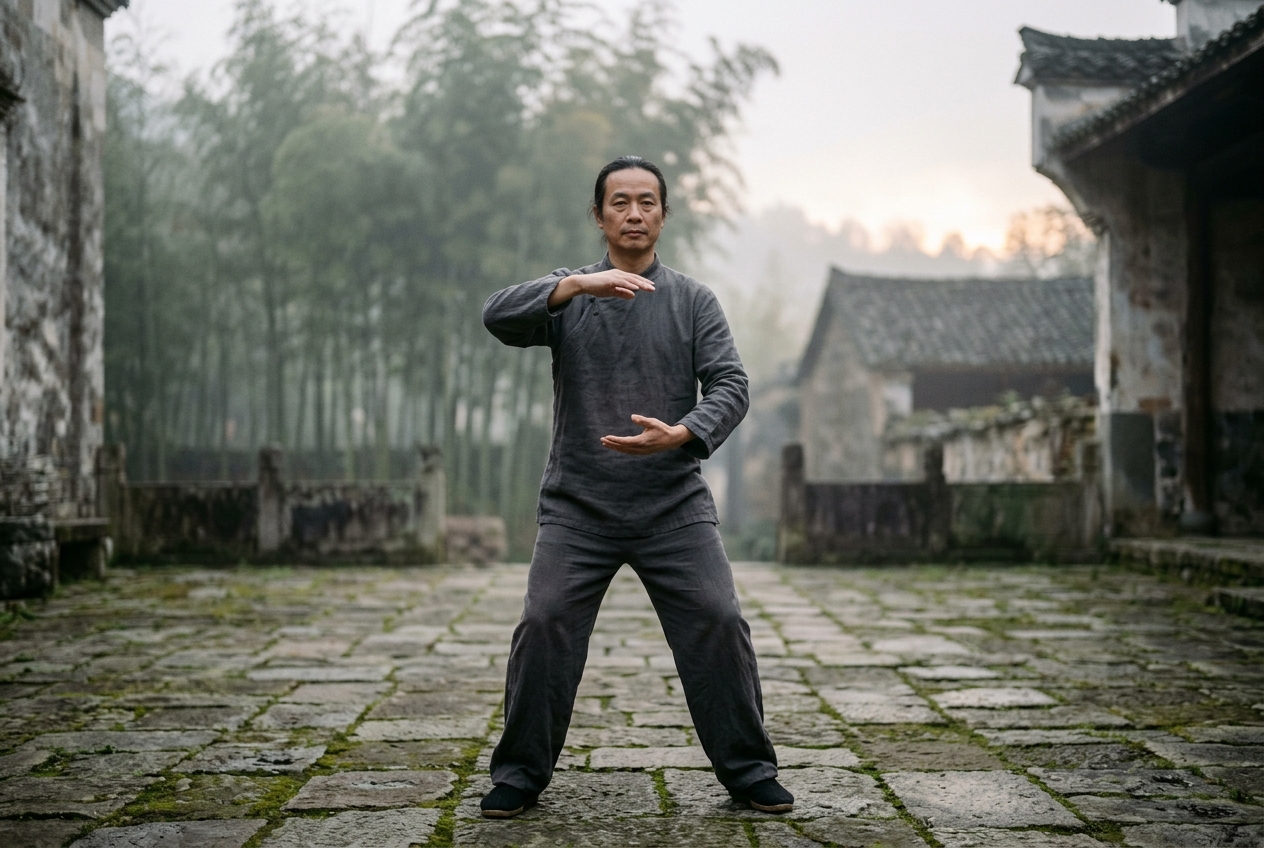
1. Establishing the Base and Grounding Vector
Begin by placing your feet parallel to each other, separated by the exact width of your shoulders, with your toes pointing straight ahead rather than splayed outward. Distribute your body weight evenly across both feet, balancing pressure across the "tripod of the foot"—the base of the big toe, the base of the fifth metatarsal, and the center of the calcaneus (heel). Pay close attention to the soft hollow located just behind the ball of the foot, known in traditional medicine as Yongquan (涌泉, Kidney 1 or "Bubbling Spring"). Ensure this point remains buoyant and receptive, neither clawing the floor with the toes nor rocking back excessively onto the heels.
Unlock your knees, maintaining a subtle micro-flexion so that the joint remains soft and spring-loaded. Crucially, practice Song Kua (松胯)—the deliberate softening and folding of the inguinal crease at the hip joints. Releasing the hips allows the pelvis to settle naturally, causing the tailbone to drop downward as if weighted by a plumb line. This movement gently flattens excessive lumbar lordosis (the inward curve of the lower back), opening the energetic and mechanical gate known as Mingmen (命门, the "Door of Life" at the second and third lumbar vertebrae) and transforming the pelvis into a stable, shock-absorbing basin.
2. The Spherical Upper-Limb Hoop
Once the lower body is rooted, slowly raise your arms until your wrists are roughly level with the center of your chest (Shanzhong, CV17). Shape the arms into an expansive, elliptical hoop. Your elbows must be kept lower than your shoulders and slightly higher than your wrists, creating a gentle descending slope that prevents joint locking. Hollow out the axillae (armpits) so that there is enough space under each arm to cradle a fragile hen's egg without crushing or dropping it.
Your hands should face inward toward your chest, separated by a distance of roughly two to three fist-widths. Extend the fingers naturally, leaving ample space between each digit, while keeping the thumbs gently lifted and the hollow centers of the palms—Laogong (劳宫, Pericardium 8)—soft, open, and slightly concave. The wrists must remain straight and supple, entirely free of angular kinks or rigid flexion.
3. Spinal Decompression and Axial Suspension
At the top of the kinetic chain, apply the classical canon of Xu Ling Ding Jin (虚灵顶劲), the effortless suspension of the crown. Imagine a delicate silk cord attached to Baihui (百会, Governing Vessel 20) at the apex of the skull, gently drawing the cranium upward toward the sky. In response, lightly tuck the chin toward the throat to lengthen the suboccipital region and cervical spine. Rest the tip of the tongue softly against the hard palate behind the upper incisors, bridging the upper circuit of the central energetic pathways. Allow your gaze to rest softly on the horizon or at a 45-degree downward angle, unfocusing the eyes to engage wide peripheral vision.
4. Natural Abdominal Breath Coordination
With the physical frame established, shift your awareness to the breath. Breathe exclusively through the nose in a smooth, silent, and unforced cadence. Allow each inhalation to travel deep into the lower abdomen—the Xia Dantian (下丹田), located approximately two inches below the navel and two inches inward toward the center of gravity. On the inhalation, feel the entire circumference of the lower abdomen, flanks, and lower back expand outward three-dimensionally. On the exhalation, allow the tissues to gently recoil without collapsing the structural integrity of your standing frame. Do not manipulate the breath through muscular force; instead, cultivate a feeling of yielding to the diaphragm's natural descent.
+-----------------------------------------------------------------------------------+
|                        ALIGNMENT AND DIAGNOSTIC CHECKLIST                         |
+------------------------------------+----------------------------------------------+
| Common Structural Defect           | Biomechanical & Somatosensory Correction     |
+------------------------------------+----------------------------------------------+
| Trapezius Hyper-Elevation          | Engage the serratus anterior; slide the      |
| (Shoulders rising toward ears)     | scapulae down the dorsal ribcage.            |
+------------------------------------+----------------------------------------------+
| Lumbar Hyper-Lordosis              | Soften the hip creases (Song Kua); allow     |
| (Anterior pelvic tilt/swayback)    | the sacrum to sink like a weighted pendulum. |
+------------------------------------+----------------------------------------------+
| Genu Valgum / Inward Knee Collapse | Track patellae over the second toes; expand  |
| (Loss of pelvic arch tension)      | the inguinal arch (Dang) outward.            |
+------------------------------------+----------------------------------------------+
| Thoracic Retraction / Puffed Chest | Sink the sternum (Han Xiong); broaden the    |
| (Respiratory locking in apex)      | interscapular region across the back.        |
+------------------------------------+----------------------------------------------+
5. Navigating the Somatosensory Roadmap
As you maintain Cheng Bao Zhuang across several minutes, your nervous system will progress through distinct somatosensory phases, recognized in traditional Daoyin as the Ba Chu (八触) or "Eight Sensations": * Warmth and Erythema: Within three to five minutes, a distinct thermal sensation will emerge in the palms, forearms, and lower abdomen, often accompanied by a rosy flush on the skin. This indicates widespread microvascular vasodilation. * Paresthesia and Tingling: A subtle, electric prickling or sensation of flowing water will manifest along the fingertips, wrists, and down the spine. This marks the uncoupling of habitual motor-unit firing patterns and heightened peripheral nerve sensitivity. * Gravitational Heaviness: The limbs and pelvis will begin to feel dense, as if poured full of liquid lead. This reflects the downward release of superficial muscular tension and the transfer of mechanical load onto the bone structure. * Elastic Buoyancy (Peng Jin): With sustained stillness, heaviness gives way to an expansive, spring-like lightness. The space between the arms and torso feels pressurized, as though resting upon a buoyant sphere submerged in water. * Neuromuscular Tremor: Rapid, involuntary shivering or twitching may arise in the quadriceps, deltoids, or paraspinal muscles. Far from a sign of failure, this tremor marks the exhaustion of fast-twitch, superficial muscles and the necessary activation of deep, postural, slow-twitch motor units alongside fascial remodeling. Breathe through this phase without breaking structural alignment.
The Biomechanics of Tensegrity and Physiological Mechanisms
The profound therapeutic and martial efficacy of Cheng Bao Zhuang is neither mystical nor arbitrary; it is rooted in precise biomechanical principles and neurovascular adaptations documented across contemporary research compiled by the National Center for Biotechnology Information (NCBI).
1. Myofascial Tensegrity and Kinetic Looping
In conventional posture, stability is achieved through continuous, localized muscular contraction, which compresses articular cartilage and taxes the cardiovascular system. Cheng Bao Zhuang operates under the architectural principle of tensegrity (tensional integrity), wherein rigid compression members (bones) float within a continuous, tensioned network of elastic cables (myofascia).
The upper-limb hoop constructed in Cheng Bao Zhuang unites the Deep Front Arm Line (running from the pectoralis minor through the biceps brachii, radial periosteum, and thenar eminence) with the Superficial Back Arm Line (extending from the trapezius through the deltoid, lateral intermuscular septum, and extensor retinaculum of the wrist). By rounding the arms and widening the palms, these opposing myofascial pathways are brought into dynamic equilibrium.
This equilibrium relies heavily on the selective recruitment of the serratus anterior muscle. Originating from the upper eight ribs and inserting along the entire costal surface of the medial border of the scapula, the serratus anterior protracts and upwardly rotates the shoulder blade, drawing it flat against the thoracic rib basket. This action fulfills the classical Neigong maxim Han Xiong Ba Bei (含胸拔背)—sinking the sternum to hollow the chest while broadening the dorsal back into an elastic shield. This broad muscular sling decompresses the subacromial space within the glenohumeral joint, relieving impingement on the supraspinatus tendon and allowing the brachial plexus and subclavian vessels to conduct neural signals and arterial blood flow to the hands without mechanical constriction.
Simultaneously, the lower limb mechanics synthesize the maxim Chen Jian Zhui Zhou (沉肩坠肘, "sink the shoulders, drop the elbows") with Song Kua. The micro-flexion of the coxofemoral joints ensures that gravitational forces and ground reaction vectors bypass the vulnerable lumbar spine and are channeled through the femoral head, down the tibial shafts, and into the plantar vault of the foot at the Yongquan locus.
2. Hemodynamics and Nitric Oxide-Mediated Microvascular Perfusion
Unlike dynamic aerobic exercise, which relies on cyclic muscular pumping to propel venous return, sustained low-threshold isometric loading creates steady, low-pressure mechanical resistance across the microvasculature. As documented in clinical studies indexed on PubMed, sustained isometric contraction triggers fluid shear stress against the vascular endothelial lumen.
This shear stress upregulates the activity of endothelial nitric oxide synthase (eNOS), the enzyme responsible for converting L-arginine into gaseous nitric oxide (NO). Nitric oxide rapidly diffuses into the adjacent vascular smooth muscle cells, stimulating soluble guanylyl cyclase, increasing cyclic guanosine monophosphate (cGMP), and inducing widespread arterial and capillary relaxation.
The resulting surge in microvascular perfusion dramatically increases capillary diameter in peripheral tissues, lowering total systemic peripheral resistance while supplying oxygenated, nutrient-dense blood to deep connective tissues, ligaments, and joint capsules that are typically starved of circulation during sedentary states. This hemodynamic mechanism explains the intense, radiating heat and deep tissue rejuvenation experienced by dedicated practitioners.
3. Autonomic Regulation and Vagal Down-Regulation
Cheng Bao Zhuang acts as a potent reset for the autonomic nervous system. Modern life frequently locks individuals into a state of chronic sympathetic overdrive (the "fight-or-flight" response), marked by shallow thoracic breathing, elevated baseline cortisol, and suppressed vagal tone.
During the motionless standing of Cheng Bao Zhuang, the combination of sustained diaphragmatic descent, steady intra-abdominal pressurization, and axial elongation directly engages the pulmonary stretch receptors and carotid sinus baroreceptors. Afferent neural signals are transmitted via the glossopharyngeal and vagus nerves directly to the nucleus tractus solitarii (NTS) in the brainstem. The brainstem responds by down-regulating sympathetic outflow and enhancing parasympathetic (vagal) activity.
This neuro-energetic shift is measurable via Heart Rate Variability (HRV), specifically through marked increases in the High Frequency (HF) power spectrum and the root mean square of successive differences (RMSSD). Elevated HRV correlates with physiological resilience, enhanced emotional regulation, optimized immune function, and lower systemic inflammatory markers such as interleukin-6 (IL-6) and C-reactive protein (CRP), as recognized in reports on traditional mind-body modalities published by the World Health Organization.
4. Bioelectric Coupling: Laogong (PC8) and Shanzhong (CV17)
Within traditional energetic topography, Cheng Bao Zhuang establishes a primary resonant circuit between the palms and the chest. The center of each palm houses the Laogong (PC8) point, the primary vascular and bioelectric gateway of the Pericardium channel. The center of the chest houses Shanzhong (CV17), the Middle Dantian and the focal gathering point of Zong Qi (ancestral/respiratory energy).
When the arms maintain a rounded, equidistant tensegrity hoop in front of the sternum, the electromagnetic field generated by the microvascular rich tissues of the palms interacts directly with the cardiac electromagnetic field centered at Shanzhong. This structural biofield coupling fosters a subjective feeling of profound heart-centered calm and emotional stability, neutralizing anxiety and rooting scattered mental energy back into somatic presence.
Classical Lineage: The Martial Synthesis of Wang Xiangzhai
The history of Zhan Zhuang spans millennia, with its earliest philosophical and medical roots appearing in the foundational Han Dynasty medical treatise, the Huangdi Neijing (黄帝内经, The Yellow Emperor's Inner Canon). In the opening chapter, the text speaks of the ancient sages who "stood quietly, grasping the cosmos, holding the Yin and Yang, breathing the essence of life, preserving the spirit within, and keeping their muscles and flesh unified." Over centuries, these standing Daoyin gymnastics were preserved inside Daoist hermitic lineages and integrated into martial traditions such as Xingyiquan and Baguazhang.
However, the modern codification and global transmission of Cheng Bao Zhuang is due almost entirely to the martial arts innovator Wang Xiangzhai (王芗斋, 1885–1963). In his youth, Wang was the final indoor disciple of Guo Yunshen, the legendary master of Hebei Xingyiquan. As Wang traveled across China during the early 20th century testing his skills against leading martial masters, he observed that traditional martial arts had become decadent—cluttered with elaborate, theatrical forms (taolu), rigid choreography, and external physical strain that obscured the true essence of martial power and internal health.
In the 1920s, Wang made a revolutionary move: he stripped away all fixed forms, pre-arranged routines, and mechanical weapon drills. In their place, he established Yiquan (意拳, "Mind-Intent Boxing"), later known as Dachengquan (大成拳, "Great Achievement Boxing"). At the heart of this radical system stood Zhan Zhuang—and specifically Cheng Bao Zhuang—as the primary training method.
Wang asserted that dynamic power (Fali) and profound physical health did not arise from muscular hypertrophy or repetitive mechanical movements, but from the cultivation of unified, three-dimensional internal tension (Hun Yuan Li) cultivated through absolute stillness. In his seminal text, the Yiquan Zheng Gui (意拳正轨, Correct Path of Yiquan), Wang wrote:
"Great movement is not as good as small movement; small movement is not as good as stillness. Stillness is the mother of all endless movement."
Under Wang Xiangzhai’s direction, Cheng Bao Zhuang became a celebrated therapeutic discipline throughout hospitals and sanatoriums in Beijing and Baoding. Physicians recognized that patients suffering from chronic cardiovascular conditions, digestive disorders, neurasthenia, and joint degradation experienced remarkable recoveries through the gentle, non-strenuous practice of standing motionless. Through organizations like the National Qigong Association (NQA), this legacy continues to thrive worldwide as a gold standard of somatic medicine and internal martial cultivation.
Internal Visualization: Engaging the Mind-Intent (Yi)
A foundational tenet of Wang Xiangzhai’s pedagogy is that "without intent (Yi), the posture is merely a hollow skeleton; with intent, the posture is alive." To prevent Cheng Bao Zhuang from degrading into lifeless, rigid standing, the practitioner must actively use subtle somatic visualizations to knit the body's tensional network together:
- The Springs Between the Palms: Imagine a sensitive, coiled steel spring connecting the center of your left palm (Laogong) to your right. As you inhale, feel the spring subtly stretch by a millimeter; as you exhale, feel it gently compress, maintaining a continuous magnetic dialogue across the space between your hands.
- The Ribbons to the Earth: Visualize elastic tensile bands running from your wrists down into your knees, and from your hip creases deep into the bedrock beneath the soles of your feet. Every slight upward drift of the upper body is anchored by an equal and opposite downward rooting into the earth.
- The Forest Sphere: Envision yourself resting in a warm, buoyant pool of spring water up to your mid-chest. The water gently supports your elbows, forearms, and wrists, carrying away all muscular weight while your body rests effortlessly suspended in the medium.
Today's Practice Commitment
To experience the physiological and energetic benefits of Cheng Bao Zhuang firsthand, commit to this accessible, five-minute morning immersion:
- When: Tomorrow morning, immediately after getting out of bed and drinking a glass of warm water, before turning on your phone or consuming your morning tea or coffee.
- Where: A quiet space with fresh air and level flooring. Practice barefoot or wearing thin, flat-soled shoes.
- Duration: Exactly 5 minutes (set a gentle timer so you are not watching the clock).
- The Focus: Set up your tripod foot base, release your hip creases (Song Kua), suspend your crown (Xu Ling Ding Jin), and shape your arms into the spacious tree-embracing hoop. Do not fight tension with tension. When an ache arises in your shoulders, consciously widen the base of your shoulder blades, drop your elbows a millimeter, exhale down into your lower abdomen, and smile softly.
After your timer chimes, do not rush away immediately. Slowly lower your hands, place both palms flat over your lower abdomen (left hand over right for women, right over left for men), close your eyes, and take three full, grounding breaths. Notice the tingling warmth in your fingertips, the buoyant steadiness in your legs, and the quiet clarity of your mind. From this foundation of stillness, step forward into your day.