Chen Jian Zhui Zhou Sinking the Shoulders and Dropping the Elbows: Glenohumeral Joint Decompression, Brachial Fascial Elongation, and Kinetic Upper-Limb Rooting in Classical Neigong
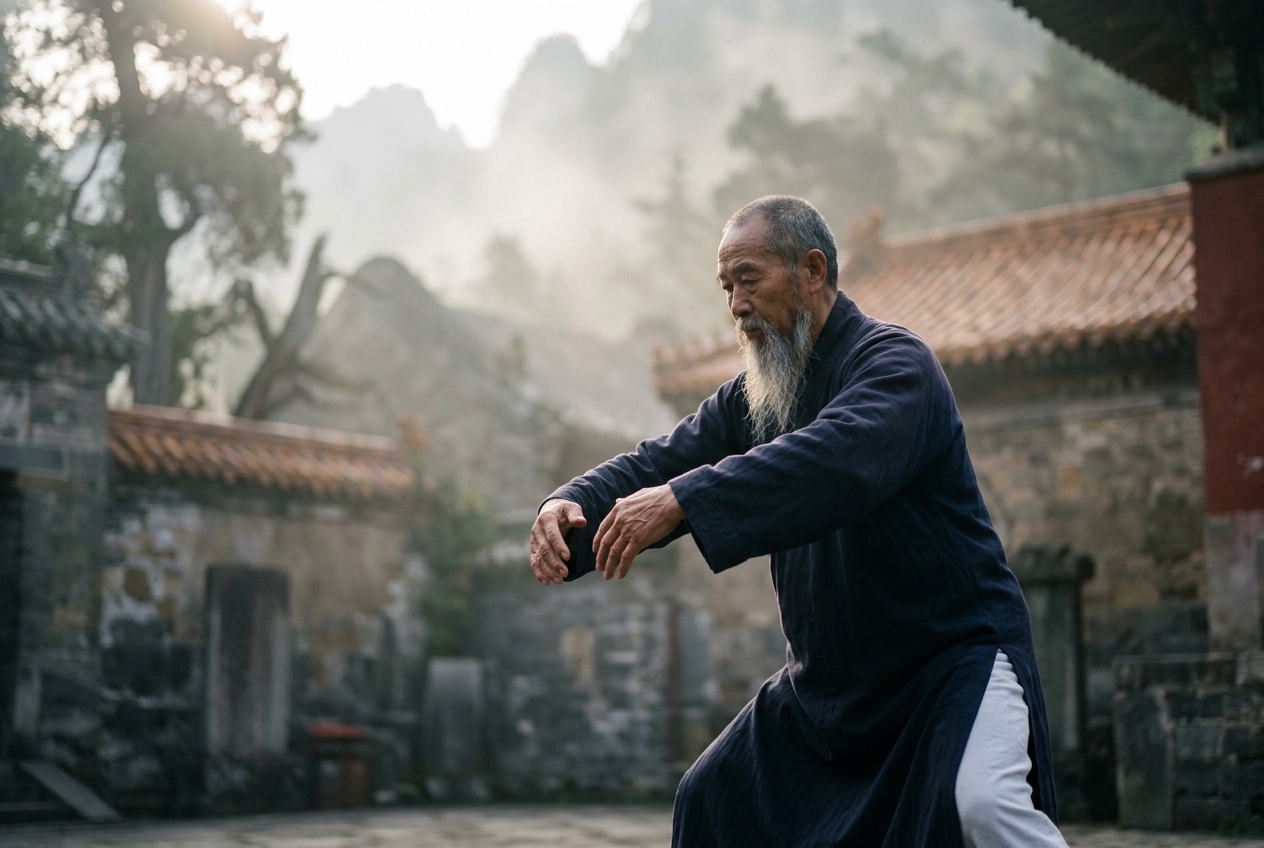
In everyday movement and conventional exercise, people tend to lift their arms by hiking their shoulder blades upward with the trapezius muscles. In internal somatic practices, the opposite occurs. The shoulder girdle is consciously anchored downward through relaxation rather than force, while the elbow joint hangs heavy like an anchor. This creates an open, hollow dome in the armpit—traditionally called Kong Ye (空腋, "empty axilla")—which decompresses the major nerve bundles and blood vessels passing into the arm, allowing the practitioner to breathe deeply into the lower abdomen, known in traditional Chinese medicine as the lower Dantian (丹田, the physical center of gravity located about two inches below the navel). Rather than relying on brute arm strength, your entire upper body becomes an open, responsive kinetic arch.
Step-by-Step Practice Guide: Calibrating the Arm Bow
To experience Chen Jian Zhui Zhou systematically, practitioners use both static standing meditation (Zhan Zhuang) and dynamic Daoyin micro-movements. The following four-stage calibration drill will help you establish this structural alignment at home.
+-------------------------------------------------------------------------+
|                  SOMATIC CALIBRATION BENCHMARK                          |
|                                                                         |
|  * Crown (Baihui): Suspended upward without neck strain                 |
|  * Axilla (Kong Ye): Hollow, 3-finger width clearance                   |
|  * Elbow Tip: Pointing downward at ~45-degree angle                     |
|  * Scapular Base: Broadened, lightly wrapped by serratus anterior       |
|  * Palm (Laogong): Warm, slightly concave, pulsing with microcirculation|
+-------------------------------------------------------------------------+
1. The Wuji Grounding Setup
- Stance: Stand with your feet parallel and hip-width apart. Unlock your knees, allowing them to track directly over the center of your feet without collapsing inward.
- Pelvis & Spine: Gently release your tailbone downward as if sitting on the edge of a high barstool. This flattens the hyper-lordotic curve of your lumbar spine, anchoring your center of mass into your feet.
- Suspended Crown (Xu Ling Ding Jin): Imagine a silk thread lifting the vertex of your skull at the Baihui point (GV-20) toward the ceiling, creating gentle vertical traction through the cervical vertebrae while your chin naturally tucks slightly inward.
2. Raising the Sphere: Embracing the Tree (Cheng Bao Zhuang)
- The Inhalation Ascent: Inhale slowly through your nose into the lower abdomen. Float both hands upward in front of your chest as if lifting a light beach ball floating on water.
- Setting the Height: Bring your hands to the level of your heart or lower sternum (Tanzhong, CV-17), with fingertips pointing toward one another, separated by about four to six inches. The palms face inward toward your chest, slightly concave.
- Dropping the Olecranon Vector: As your hands reach chest height, exhale smoothly and consciously release the tips of your elbows downward. Do not pull your hands toward your chest; keep the circular shape intact. The elbows must always sit lower than the wrists, and the wrists must sit slightly lower than the shoulders. This forms a continuous, gentle cascading slope: Shoulder > Elbow > Wrist > Fingertips.
3. Diagnostic Checks and Failure Mode Corrections
When refining this posture, practitioners frequently encounter four mechanical errors. Use these self-corrections to recalibrate:
- Failure Mode 1: Shoulder Elevation (Trapezius Clamping) * The Error: The shoulders rise toward the ears, shortening the neck and creating instant muscular fatigue. * The Correction: Exhale and consciously slide the inferior angle of your shoulder blades down your back toward your kidneys. Visualize warm water cascading over your collarbones, melting muscular tension down into the earth.
- Failure Mode 2: Hyper-Retraction (Military Chest) * The Error: Squeezing the shoulder blades together behind the spine, which puffs out the chest, compresses the thoracic vertebrae, and impedes diaphragmatic descent. * The Correction: Integrate the companion principle Han Xiong Ba Bei (涵胸拔背, "Contain the Chest, Pluck Up the Back"). Broaden the space between your scapulae, allowing the chest to become soft and slightly concave while the upper back rounds gently like the shell of a turtle.
- Failure Mode 3: Elbow Pinning or Winging * The Error: Either clamping the elbows against the ribcage (collapsing the axilla) or flaring them out horizontally parallel to the shoulders (dislocating the kinetic chain). * The Correction: Maintain the Kong Ye (empty armpit). Keep a space roughly the size of a fist or a small fruit between your upper arm and your lateral ribs. The point of the elbow should hang downward at an angle of roughly 45 degrees relative to the torso.
- Failure Mode 4: Wrist Collapse or Break * The Error: Bending the wrist sharply back or letting it droop limp, which pinches the carpal tunnel and blocks fascial tension. * The Correction: Keep the wrist open and gently rounded. Extend the intention (Yi) through the tendons of the forearm all the way to the center of the palm (Laogong, PC-8), maintaining an unbroken line of elastic tension.
4. Tangible Sensory Cues
When the shoulders are truly sunk and the elbows dropped, specific somatic feedback markers appear within three to five minutes: * The "Lead Arm" Heaviness: A distinct sensation that the arms are heavy, as though cast in lead, yet simultaneously effortless to hold aloft. This indicates that load-bearing has shifted from the phasic neck muscles to the tonic postural fascial system. * Axillary Airflow: A noticeable coolness or spaciousness in the armpits, reflecting the release of compressed skinfolds and myofascial layers. * Palmar Vasodilation & Paresthesia: A sensation of throbbing warmth, fullness, and mild electrical tingling across the palms and fingertips, driven by microvascular dilation and the release of nerve pathways.
Why It Works: The Body Science of Biomechanical Tensegrity
The biomechanical brilliance of Chen Jian Zhui Zhou aligns directly with contemporary understanding of functional anatomy, neurovascular decompression, and myofascial continuity.
===========================================================================
                     BIOMECHANICAL & ANATOMICAL DYNAMICS
===========================================================================
 MUSCULAR ACTION:      Down-regulation of Upper Trapezius / Levator Scapulae
                       --> Activation of Serratus Anterior & Lower Trapezius
                       --> Stabilizes scapula against thoracic wall.
---------------------------------------------------------------------------
 NEUROVASCULAR:        Decompresses the Subcoracoid & Costoclavicular Spaces
                       --> Alleviates pressure on Brachial Plexus (C5-T1)
                       --> Enhances Subclavian Arterial & Venous Perfusion.
---------------------------------------------------------------------------
 FASCIAL CONTINUITY:   Loads Deep Front Arm Line & Superficial Back Arm Line
                       --> Forms the Elastic "Arm Bow" of Five-Bow Tensegrity
                       --> Transmits Ground Reaction Force from Dantian.
===========================================================================
Scapular Kinematics and Neuromuscular Decoupling
In human posture, the scapulothoracic joint is suspended primarily by muscular attachments rather than a bony socket. Chronic psychological stress and sedentary desk habits cause tonic hyper-activation of the upper trapezius and levator scapulae. By deliberately dropping the elbows and sinking the shoulder girdle, you inhibit this upper trapezius dominance and activate the lower trapezius and serratus anterior.
The serratus anterior pulls the medial border of the scapula anteriorly and laterally around the curved ribcage. This "scapular wrap" anchors the shoulder blade flush against the thoracic cage without locking it into retraction. The latissimus dorsi and pectoralis minor further assist in depressing the shoulder girdle, transferring the mechanical load of the arms into the powerful structural framework of the spine, pelvis, and legs.
Decompression of the Thoracic Outlet
The anatomical passageway between the neck, clavicle, and upper arm—known as the thoracic outlet—contains vital structures: the brachial plexus (nerve roots C5–T1), the subclavian artery, and the subclavian vein. When the shoulders are elevated or rounded forward under strain, this space is severely restricted, leading to subclinical thoracic outlet syndrome, manifesting as numbness, cold fingers, and chronic neck ache.
Sinking the shoulders elevates the clavicle away from the first rib, while dropping the elbows opens the subcoracoid space beneath the pectoralis minor tendon. Clinical studies indexed in NCBI PubMed demonstrate that postural corrections restoring normal scapular depression and upward rotation dramatically enhance brachial blood flow and improve nerve conduction velocities down the arm.
The Open Axillary Dome and the Six Arm Meridians
In classical Chinese medical theory, the axilla is a vital crossroads. Sinking the shoulders and maintaining Kong Ye directly clears the pathways for the six arm meridians:
- Three Yin Channels of the Arm (Interior/Anterior): * Lung Channel (Hand Taiyin): Originates in the chest, passes through the subclavicular fossa (Zhongfu, LU-1), traverses the bicep, and terminates at the thumb. * Pericardium Channel (Hand Jueyin): Emerges beside the nipple (Tianchi, PC-1), travels down the midline of the inner arm, through the center of the palm (Laogong, PC-8), to the middle fingertip. * Heart Channel (Hand Shaoyin): Springs directly from the center of the axilla (Jiquan, HT-1) and travels along the inner border of the arm to the little finger.
- Three Yang Channels of the Arm (Exterior/Posterior): * Large Intestine Channel (Hand Yangming): Begins at the index finger, ascends the lateral arm, passes over the shoulder joint (Jianyu, LI-15), to the neck and face. * Sanjiao / Triple Burner Channel (Hand Shaoyang): Ascends the posterior midline of the arm to the shoulder and ear. * Small Intestine Channel (Hand Taiyang): Ascends from the pinky along the posterior-ulnar ridge over the scapular blade (Tianzong, SI-11).
When the shoulder is raised or the elbow is flared out, the Jiquan and Zhongfu portals are physically pinched, obstructing both venous return and energetic circulation. By dropping the elbow, the fascia along these meridians is placed under smooth, balanced tension—a state described in modern biomechanics as optimal fascial pre-load.
Five-Bow Tensegrity and Kinetic Grounding
Internal martial systems model the human body as a tensegrity network composed of five dynamic bows: the central spinal bow, the two leg bows, and the two arm bows. In this model, the bones act as compressive struts floating within a continuous web of tensile fascia and tendons.
In the arm bow: * The tip of the elbow (olecranon) serves as the peak of the arch. * The shoulder joint acts as the root of the bow. * The wrist and palm (Laogong) act as the bowstring tip.
If the elbow floats upward or collapses inward, the bowstring goes slack, and the arch breaks. When the elbow hangs heavy with the shoulder sunk, the deep front and superficial back arm lines of fascia become taut and spring-loaded. Any external force applied to the palm is immediately dispersed across the scapula, down the spine, and rooted into the earth via the legs. Conversely, rotational power generated from the lower Dantian and ground reaction forces can be expressed out through the palm without any localized muscle clamping in the bicep or deltoid.
Parasympathetic Vagal Tone and Autonomic Regulation
Elevating the shoulders is a universal somatic component of the mammalian fight-or-flight startle reflex, governed by sympathetic nervous system activation. Chronically elevated shoulders lock the thoracic cage, forcing shallow, clavicular breathing.
By deliberately down-regulating the upper trapezius and depressing the shoulder girdle, you signal the autonomic nervous system via somatic biofeedback loops that threat levels have decreased. This fosters diaphragmatic excursion, increases vagal nerve stimulation, and optimizes heart rate variability (HRV), moving the practitioner into a restorative parasympathetic state. This aligns with global health initiatives recognizing the therapeutic validity of somatic movement therapies, as detailed by the World Health Organization Traditional Medicine division and educational standards from the National Qigong Association.
Classical Lineage: The Wisdom of the Internal Canon
The structural requirement of Chen Jian Zhui Zhou is not a modern ergonomic discovery; it is a foundational axiom preserved for centuries across Daoist alchemical treatises and the authoritative Taijiquan Classics.
+-------------------------------------------------------------------------+
|                  THE TRIAD OF STRUCTURAL INTEGRITY                      |
|                                                                         |
|  1. Xu Ling Ding Jin (虚灵顶劲)  --> Head Suspended & Empty at Crown    |
|  2. Han Xiong Ba Bei (涵胸拔背)  --> Contain Chest, Pluck Up Back       |
|  3. Chen Jian Zhui Zhou (沉肩坠肘) --> Sink Shoulders, Drop Elbows       |
|                                                                         |
|  * Together, these three principles transform the physical skeleton     |
|    into an elastic, decompressed tensegrity matrix.                     |
+-------------------------------------------------------------------------+
In his seminal work The Ten Essential Principles of Taijiquan, Grandmaster Yang Chengfu (1883–1936) places Chen Jian Zhui Zhou near the very top of his curriculum, explaining the direct relationship between shoulder elevation and energetic disruption:
"Sinking the shoulders means the shoulders relax, open, and hang downward. If you cannot sink them, the shoulders will rise, followed immediately by the Qi, and the entire body will lack power. Dropping the elbows means the elbows hang downward and stay relaxed. If the elbows rise, the shoulders cannot sink, and one cannot emit power to any great distance."
Yang Chengfu emphasized that Chen Jian Zhui Zhou cannot function in isolation; it forms an indivisible tripartite structural system alongside Han Xiong Ba Bei (Contain the Chest, Pluck Up the Back) and Xu Ling Ding Jin (Empty, Suspended Energy at the Crown). If the crown does not suspend upward, the spine compresses; if the chest is not contained, the breath gets trapped in the lungs; if the shoulders and elbows do not sink, the arms remain severed from the spine.
This lineage traces back even further to the foundational Taijiquan Treatises attributed to Wang Zongyue and the Ming-Qing transition masters, as well as Li Yiyu’s Five Character Formula (五字诀). Li Yiyu noted that to achieve true Song (松)—the alert, conscious release of non-essential tension—the practitioner must ensure that every joint maintains its natural open space without deadening collapse.
In Daoist internal alchemical (Neidan) texts, such as those collected in the Daozang (Daoist Canon), dropping the elbows is recognized as a prerequisite for anchoring the breath into the lower cinnabar field (Xia Dantian). When the shoulders drop, the fire of the Heart (Xin Huo) naturally descends to warm the waters of the Kidneys (Shen Shui), establishing the classical state of Kan-Li (water and fire) equilibrium necessary for deep vitality and longevity.
Today’s Practice Commitment: The 7-Minute Morning Reset
To embed the neural pathways of Chen Jian Zhui Zhou into your daily somatic memory, integrate this simple, timed calibration into your morning routine before checking your phone or drinking your first coffee.
+-------------------------------------------------------------------------+
|                      DAILY 7-MINUTE PROTOCOL                            |
|                                                                         |
|  * Minutes 0:00 - 2:00 : Wuji Grounding & Shoulder Release Drops        |
|  * Minutes 2:00 - 5:00 : Static Zhan Zhuang (Embracing the Sphere)     |
|  * Minutes 5:00 - 7:00 : Dynamic Daoyin Opening & Closing Pulses        |
+-------------------------------------------------------------------------+
- Minutes 0–2: Shoulder Release Drops * Stand in Wuji posture. Inhale slowly and gently shrug both shoulders up toward your ears. * Hold the breath for two seconds, noticing the tension in your neck. * Exhale forcefully through your mouth with a soft "Haaaw" sound, letting your shoulder girdle drop completely with gravity. Feel the sudden rush of warmth into your hands. Repeat this four times.
- Minutes 2–5: Static Embracing the Sphere (Cheng Bao Zhuang) * Bring your arms into the rounded tree-hugging posture at mid-chest height. * Close your eyes or maintain a soft downward gaze. Mentally scan for the four anchors: suspended crown, softened chest, empty axillae (Kong Ye), and heavy elbow tips. * Breathe smoothly into your lower abdomen. With every exhalation, release another 5% of muscular holding in your upper trapezius muscles.
- Minutes 5–7: Micro-Expansion Dynamic Pulses * While maintaining the dropped-elbow posture, inhale and subtly expand the circle by one inch, feeling the scapulae wrap gently around your ribs. * Exhale and allow the palms to settle back to their starting position, dropping the elbow tips half an inch deeper toward the floor. * Finish by placing both palms flat over your lower belly, resting your awareness in your lower Dantian for three deep, quiet breaths.
Notice the quality of your physical presence, the clarity of your mental focus, and the ease of your posture as you move into the rest of your day. Sinking the shoulders and dropping the elbows is not an artificial pose to hold—it is a continuous return to your body’s natural state of grounded, open, and effortless structural poise.