Bo's Abdominal Acupuncture: Navigating Tri-Level Fascial Depth, Umbilical Bagua Topography, and Precision Acupressure Protocols
1. Opening — A Problem This Solves Today
If you spend your working hours tethered to a digital workstation, you are likely intimately familiar with a constellation of modern somatic complaints: a persistent, dull ache across the lumbosacral hinge, shallow apical breathing, an afternoon slump characterized by brain fog, and an uneasy, low-grade bloating after meals. In conventional biomechanics, these ailments are often compartmentalized and treated as isolated structural or metabolic defects—ergonomic lumbar strains on one hand, functional dyspepsia or autonomic stress on the other.
Traditional Chinese Medicine (TCM), however, conceptualizes these disparate dysfunctions as interrelated manifestations of central energetic collapse and fascial stagnation. At the absolute nexus of this somatic web lies the anterior abdominal wall.
+-------------------------------------------------------------------------+
|                  THE ABDOMINAL HOLOGRAPHIC PARADIGM                     |
|                                                                         |
|  Prenatal Matrix (CV8 Shenque) ---> Connective Tissue Morphogenesis     |
|  Postnatal Somatotopy         ---> The "Sacred Turtle" Projection       |
|  Tri-Level Depth (San Cai)    ---> Heaven (Soma), Human (Meridian),     |
|                                    Earth (Zang-Fu Viscera)              |
+-------------------------------------------------------------------------+
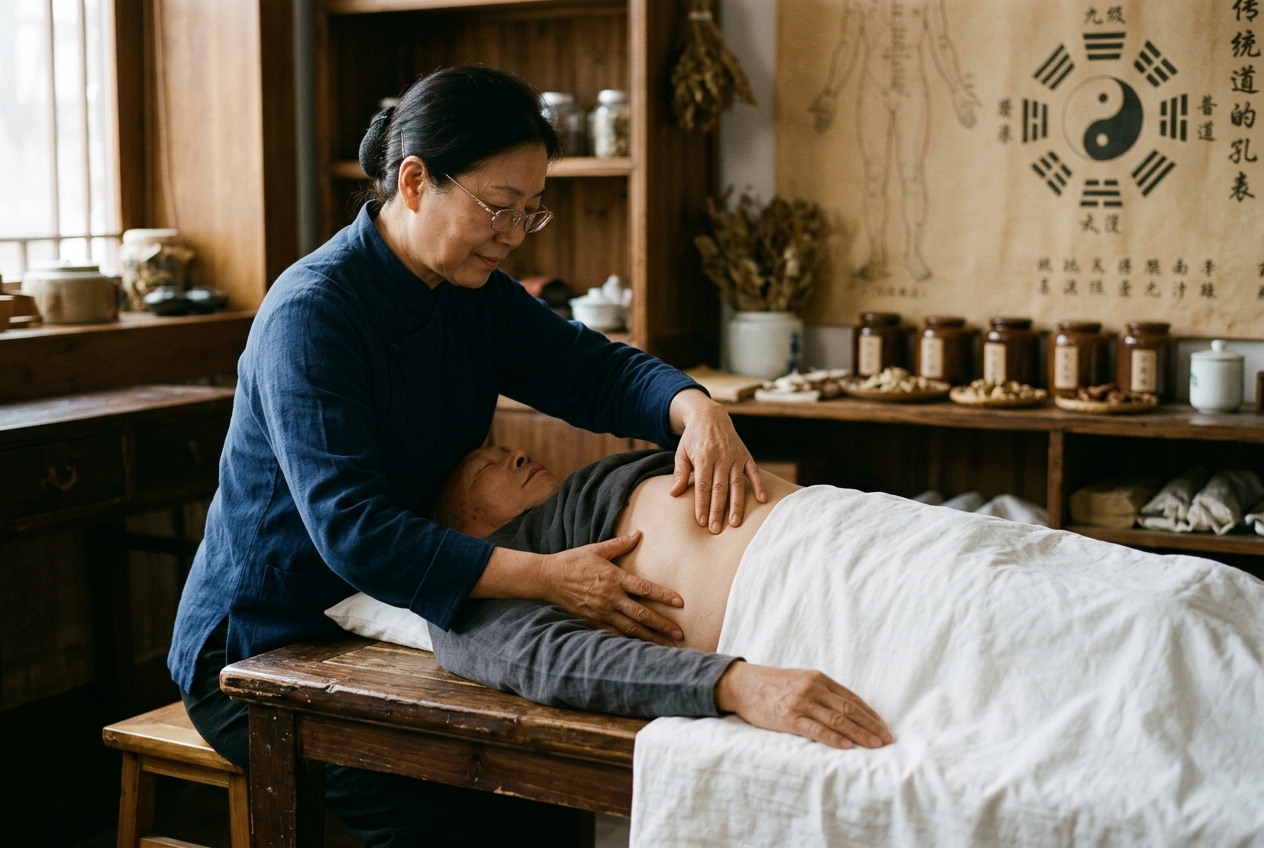
Pioneered in the late 20th century by Professor Bo Zhiyun, Bo’s Abdominal Acupuncture (Fu Zhen, 腹针疗法) revolutionizes traditional meridian theory. Professor Bo discovered that the abdomen does not merely house local acupoints; it constitutes a complete, centralized, holographic micro-system capable of regulating the entire peripheral musculoskeletal framework, the central nervous system, and the internal Zang-Fu organs. By understanding the abdominal topography, we gain access to a remarkably efficient master control panel that resolves recalcitrant physical pain and restores neuro-visceral balance from the body’s true center.
2. The Meridian Path — A Journey Through the Body: Holographic Umbilical Somatotopy and the San Cai Architecture
To understand how stimulating the abdomen can instantly relieve radiating sciatica in the leg or cervical compression in the neck, one must examine the foundational theory of the Prenatal Umbilical Regulatory System. In embryonic development, the umbilicus (Shenque, CV8) serves as the singular conduit for nutrient transport, oxygenation, and physiological morphogenesis. Professor Bo posited that even after the umbilical cord is severed at birth, this primordial vascular-connective network does not vanish; rather, it transitions into a high-conductivity postnatal holographic control system governed by the World Health Organization Acupuncture Benchmarks.
The Somatotopic Map: The Sacred Turtle (Fu Gui) and the Bagua Matrix
Superimposed upon the anterior abdomen is the somatotopic projection known as the Sacred Turtle (Fu Gui). In this anatomical holograph: - The head and neck project along the midline superior to the navel, centering on Zhongwan (CV12) and extending toward Xiawan (CV10). - The vertebral column corresponds directly to the anterior midline trajectory of the Ren Mai (Conception Vessel), mapping from the cervical spine at CV12 down to the lumbosacral junction and coccyx at Qihai (CV6) and Guanyuan (CV4). - The upper extremities (shoulders, elbows, and wrists) radiate bilaterally through the upper abdominal quadrants along the Stomach and Spleen channels, centered around Huaroumen (ST24). - The lower extremities (hips, knees, and ankles) map into the lower abdominal quadrants, anchored around Wailing (ST26) and radiating inferior-laterally toward Dahe (KI12) and Fushe (SP13).
Simultaneously, the energetic distribution aligns with the Postnatal Bagua (Eight Trigrams) matrix, wherein the umbilical center correlates with primordial Earth, distributing regulatory Qi radially to the peripheral hexagrams.
                             [HEAD / CERVICAL]
                               CV12 (Zhongwan)
                                      |
         [R. SHOULDER]                |                [L. SHOULDER]
          ST24 (R)                    |                 ST24 (L)
                   \                  |                /
                    \                 |               /
                     \                |              /
                      ------- CV10 (Xiawan) --------
                                      |
  [UPPER BODY GATES]                  |                  [UPPER BODY GATES]
                                      |
                                 CV8 (Shenque)
                             [THE PRIMORDIAL HUB]
                                      |
                                      |
                      -------- CV6 (Qihai) ---------
                     /                |              \
                    /                 |               \
                   /                  |                \
          ST26 (R)                    |                 ST26 (L)
          [R. HIP/KNEE]               |                [L. HIP/KNEE]
                               CV4 (Guanyuan)
                            [LUMBAR / LUMBOSACRAL]
The San Cai (Three Powers) Tri-Level Depth Architecture
The definitive clinical brilliance of Bo’s system lies in its strict dimensional layering, known as the San Cai (三才) depth architecture. Unlike standard body acupuncture, which targets specific tissue planes based purely on regional anatomy, abdominal acupuncture regulates distinct physiological systems by calibrating needle or acupressure depth across three fascial strata:
+=========================================================================+
|             SAN CAI (THREE POWERS) DEPTH STRATIFICATION                 |
+=========================================================================+
| DEPTH LAYER  | ANATOMICAL STRATUM      | CLINICAL TARGET DOMAIN         |
+--------------+-------------------------+--------------------------------+
| Heaven (Tian)| Superficial Fascia /    | Somatosensory, Motor-Sensory   |
| (天)         | Subcutaneous Adipose    | Reflexes, Musculoskeletal Pain |
+--------------+-------------------------+--------------------------------+
| Human (Ren)  | Intermediate Muscular / | Meridian Transport, Connective |
| (人)         | Interfascial Septa      | Tissue Interstitial Flow       |
+--------------+-------------------------+--------------------------------+
| Earth (Di)   | Deep Pre-Peritoneal     | Enteric Nervous System, Zang-  |
| (地)         | Fascia / Subserosa      | Fu Visceral Autonomic Plexus   |
+=========================================================================+
- Heaven Layer (Tian, 天 — Superficial Stratum): Located within the superficial fascia and subcutaneous dermal interface. Mechanistically, this layer communicates directly with somatic sensory nerves and cutaneous nerve branches. Modulating this stratum exerts rapid, reflexive analgesia on peripheral musculoskeletal pathologies, acute sprains, motor-sensory sinew impairments, and spinal radiculopathies.
- Human Layer (Ren, 人 — Intermediate Stratum): Situated within the investing abdominal muscular fascia (rectus abdominis, obliquus externus) and interfascial planes. This layer serves as the conduit for the traditional meridian-collateral system (Jing-Luo), facilitating bio-electric and interstitial fluid transport between the center and the periphery, as detailed in mechanisms of fascial mechanotransduction in acupuncture.
- Earth Layer (Di, 地 — Deep Stratum): Located immediately anterior to the pre-peritoneal fat and parietal peritoneum. This profound layer interfaces directly with the Enteric Nervous System (ENS), the coeliac and mesenteric autonomic plexuses, and the internal organs (Zang-Fu). It is activated to resolve chronic metabolic depletion, visceral inflammation, and autoimmune dysregulation.
3. Key Points You Can Press Right Now: Deconstructing the Core Abdominal Anchors
To harness this potent system through non-invasive manual acupressure, we focus on the most vital central bio-regulatory points.
===========================================================================
                      CORE ACUPRESSURE RECEPTORS
===========================================================================
 POINT NAME    | LOCATION ANCHOR              | PHYSIOLOGICAL RESONANCE
---------------+------------------------------+----------------------------
 Zhongwan      | Midpoint between navel and   | Gastric ENS modulation,
 (CV12)        | sternal-rib junction         | Cervical/Cranial reflex
---------------+------------------------------+----------------------------
 Guanyuan      | 3 finger-widths above pubic  | Systemic endocrine tonus,
 (CV4)         | bone, on the midline         | Lumbosacral decompression
---------------+------------------------------+----------------------------
 Abdominal     | Bilateral paired points      | Systemic microcirculation,
 Four Gates    | flanking the midline above   | Fascial bio-tensegrity,
 (ST24 & ST26) | and below the navel          | Four-limb motor conduction
===========================================================================
1. Zhongwan (CV12, Center of the Epigastrium)
- Everyday Anatomical Landmark: Place your palm flat on your upper stomach. Locate the midpoint directly between your belly button and the hard angle where your lower ribs meet at the base of your breastbone (the xiphoid process). Zhongwan sits precisely on the vertical midline of your abdomen in this soft indentation.
- Somatic Sensation (Deqi): Upon applying firm, steady inward pressure, you will elicit a distinct, spreading sensation—a combination of dull warmth, deep visceral relaxation, and a mild, therapeutic ache that travels down toward the umbilicus.
- Application Mechanics: Use the cushioned pad of your middle and index fingers held at an perpendicular 90-degree angle. Apply a slow, sustained compression (firm, rhythmic pressure) for 2 to 3 minutes, timing your compression with the exhalation phase of the respiratory cycle.
- Clinical Utility: Functioning as the "Head and Neck" anchor of the Sacred Turtle and the Mu (Alarm) point of the Stomach, Zhongwan regulates upper gastrointestinal motility, mitigates chronic tension headaches, soothes autonomic hyper-reactivity, and relieves structural tension along the cervical spine, supported by research in National Center for Biotechnology Information on Abdominal Acupuncture.
2. Guanyuan (CV4, Gate of Primordial Source)
- Everyday Anatomical Landmark: Place the width of four flat fingers directly below your navel along the midline of the lower abdomen. Guanyuan lies approximately three finger-widths above the superior border of the pubic bone.
- Somatic Sensation (Deqi): Stimulation produces an unmistakable, grounding sensation of deep internal warmth, a heavy spreading tonus throughout the pelvic floor, and relief of low-back compression.
- Application Mechanics: Engage the point using the flat pad of the thumb. Exert a progressive, oblique-perpendicular pressure directed slightly downward into the pelvis. Hold steady for 2 minutes while maintaining continuous, diaphragmatic breathing.
- Clinical Utility: In Bo’s somatotopy, Guanyuan corresponds to the lumbosacral junction, coccygeal base, and primordial Kidney Essence (Yuan Qi). It provides profound therapeutic relief for chronic lumbago, pelvic floor congestion, systemic fatigue, and adrenal depletion.
3. The Abdominal Four Gates (Fu Si Guan: Bilateral Huaroumen ST24 and Wailing ST26)
- Everyday Anatomical Landmark:
- Upper Gates (Huaroumen, ST24): Located two finger-widths to the left and right of the midline, precisely one thumb-width superior to the level of the navel.
- Lower Gates (Wailing, ST26): Located two finger-widths to the left and right of the midline, precisely two finger-widths inferior to the level of the navel.
- Somatic Sensation (Deqi): Palpation reveals small, reactive connective-tissue nodes. When compressed, they emit a distinct radiating tingle that travels outward into the respective shoulder girdles (ST24) and hip/sciatic pathways (ST26).
- Application Mechanics: Using both hands simultaneously, place the thumb and index finger pads over the bilateral pairs. Apply gentle, synchronized, circular micro-rotations at a frequency of approximately 60 cycles per minute for 2 minutes per pair.
- Clinical Utility: The "Four Gates" act as the critical bio-tensegrity conduits for systemic circulation, regulating the transition of neurovascular pathways between the central somatic axis and the peripheral limbs. They effectively disperse stagnation, alleviate peripheral joint stiffness, and facilitate systemic venous return.
4. Point Combinations for Complex Scenarios: Standardized Clinical Protocols
The core clinical efficacy of Bo’s Abdominal Acupuncture relies on two standardized master formulas: Guide Qi Back to Source (Yin Qi Gui Yuan, 引气归元) and the Abdominal Four Gates (Fu Si Guan, 腹四关). When synergized with targeted distal extremity anchors, these core clusters provide profound therapeutic power for systemic pathologies.
===========================================================================
                  STANDARDIZED PROTOCOL ARCHITECTURE
===========================================================================
  CLINICAL COMPONENT               ACUPOINT CLUSTER
---------------------------------------------------------------------------
  Centerline Master Axis          Zhongwan (CV12) + Xiawan (CV10) +
  ("Guide Qi Back to Source")     Qihai (CV6) + Guanyuan (CV4)
---------------------------------------------------------------------------
  Bilateral Peripheral Gates      Bilateral Huaroumen (ST24) +
  ("Abdominal Four Gates")        Bilateral Wailing (ST26)
---------------------------------------------------------------------------
  Distal Kinetic Anchors          Zusanli (ST36), Taichong (LV3),
                                  Hegu (LI4), Sanyinjiao (SP6), Neiguan (PC6)
===========================================================================
Neurobiological Mechanics: Bio-Tensegrity and Autonomic Modulation
The human abdominal wall possesses an exceptionally high density of unmyelinated free nerve endings and mechanoreceptors embedded within the extracellular matrix of the superficial and deep fascial layers. Applying precise tactile calibration across the midline and parasagittal abdominal zones creates widespread downstream effects:
As demonstrated in contemporary studies on the Modulation of the Enteric Nervous System via Somatosensory Reflexes, stimulating these abdominal points directly influences gastrointestinal smooth muscle contractility and suppresses central pro-inflammatory cytokines via vagal parasympathetic afferents.
Step-by-Step Clinical Protocols
Protocol A: Lumbosacral Radiculopathy and Sciatic Neuralgia
Target Pathology: Lumbar disc herniation, facet joint arthropathy, radiating posterior-lateral leg pain.
+-------------------------------------------------------------------------+
|                  LUMBAR RADICULOPATHY PROTOCOL                          |
|                                                                         |
|  [Step 1] Central Alignment: CV12 -> CV10 -> CV6 -> CV4 (Heaven Depth)  |
|  [Step 2] Ipsilateral Gate: ST26 (Wailing) on symptomatic side (Earth)  |
|  [Step 3] Holographic Sciatic Line: 0.5 cun lateral to CV4              |
|  [Step 4] Distal Anchors: Zusanli (ST36) + Taichong (LV3) Sedation      |
+-------------------------------------------------------------------------+
- Patient Positioning: Supine with knees flexed at a 45-degree angle (bolster under knees) to fully slacken the anterior abdominal wall musculature and relax the psoas major.
- Phase 1: Establishing the Central Axis: - Apply continuous perpendicular pressure down the Ren Mai sequence: Zhongwan (CV12) → Xiawan (CV10) → Qihai (CV6) → Guanyuan (CV4). - Depth: Heaven-to-Human layer (superficial-to-intermediate subcutaneous depth, 1–2 cm manual depression). - Rhythm: 60 slow, rhythmic compressions per minute for 2 minutes along the chain to decompress axial spinal tension.
- Phase 2: Opening the Pelvic and Sciatic Gate: - Locate Wailing (ST26) on the affected side. Calibrate pressure to the Earth layer (firm, deep pre-peritoneal focus). - Palpate 0.5 inches lateral to Guanyuan (CV4) along the holographic lumbar-sacral reflex line. Hold steady static pressure for 90 seconds while instructing the patient to perform gentle active ankle dorsiflexion.
- Phase 3: Distal Kinetic Anchoring: - Integrate with Zusanli (ST36) (four finger-widths below the outer kneecap) and Taichong (LV3) (webbing between first and second metatarsals) using dispersion/sedation technique (counter-clockwise friction, 120 seconds) to inhibit spinal dorsal horn nociceptive transmission.
Protocol B: Cerebral Post-Stroke Rehabilitation and Motor Deficit
Target Pathology: Post-stroke hemiparesis, upper/lower limb spasticity, central facial paresis.
+-------------------------------------------------------------------------+
|                    POST-STROKE MOTOR RECOVERY                           |
|                                                                         |
|  [Step 1] Core Awakening: CV12 (Cranial) & CV4 (Basal Yuan Qi) Tonify   |
|  [Step 2] Extremity Gateways: Bilateral ST24 (Arms) & ST26 (Legs)       |
|  [Step 3] Distal Neuro-Modulators: Hegu (LI4) + Sanyinjiao (SP6)        |
+-------------------------------------------------------------------------+
- Phase 1: Regulating Cranial Microcirculation and Vital Essence: - Apply synchronized bilateral pressure to Zhongwan (CV12) (representing the cranial holographic zone) and Guanyuan (CV4) (anchoring motor root vitality). - Tonification Frequency: Clockwise, gentle compression pulses at 40–50 beats per minute for 3 minutes to activate neuroplastic recovery pathways.
- Phase 2: Mobilizing the Extremity Gateways: - Engage the Abdominal Four Gates (ST24 and ST26 bilaterally). - For upper limb hemiparesis, focus deep sustained pressure on the contralateral Huaroumen (ST24); for lower limb spasticity, focus on the contralateral Wailing (ST26).
- Phase 3: Distal Neurological Integration: - Integrate with Hegu (LI4) (dorsal hand between first and second metacarpal) and Sanyinjiao (SP6) (four finger-widths above the medial malleolus) to stimulate corticospinal excitability and reduce muscular hypertonicity, as recognized in the Evidence-Based Neurobiology of Acupoints on Wikipedia.
Protocol C: Chronic Functional Dyspepsia and Enteric Dysbiosis
Target Pathology: Irritable Bowel Syndrome (IBS), epigastric bloating, chronic constipation/diarrhea.
+-------------------------------------------------------------------------+
|                  CHRONIC DIGESTIVE DYSREGULATION                        |
|                                                                         |
|  [Step 1] Enteric Reset: CV12 (Zhongwan) + CV10 (Xiawan) Harmonization  |
|  [Step 2] Intestinal Peristalsis: Bilateral ST25 (Tianshu) (Earth Depth)|
|  [Step 3] Lower Gate Tonification: CV6 (Qihai) Continuous Warmth        |
|  [Step 4] Distal Neuro-Visceral Anchor: Neiguan (PC6) + Zusanli (ST36)  |
+-------------------------------------------------------------------------+
- Phase 1: Enteric Axis Harmonization: - Apply continuous static pressure over Zhongwan (CV12) and Xiawan (CV10) simultaneously using the flat two-finger technique for 2 minutes to regulate the upper gastrointestinal pacemaker.
- Phase 2: Modulating Intestinal Peristalsis: - Place thumbs on Tianshu (ST25), located two thumb-widths directly lateral to the center of the navel (Shenque). Exert deep Earth-level compression (reaching the pre-peritoneal fascial plane) to normalize colonic transit time and calm enteric hypersensitivity.
- Phase 3: Lower Sea Consolidation: - Apply continuous palm friction over Qihai (CV6) and Guanyuan (CV4) until a noticeable thermal sensation permeates the lower hypogastrium.
- Phase 4: Distal Autonomic Anchoring: - Seal the protocol by applying sustained pressure to Neiguan (PC6) (three finger-widths above the wrist crease between the palmaris longus tendons) and Zusanli (ST36) to complete the gut-brain-axis therapeutic loop.
5. Safety & Sense: Clinical Boundaries, Red Flags, and Contraindications
While non-invasive abdominal acupressure avoids the risks associated with sharp needle insertion (such as organ transfixion or peritoneal breach), the abdomen remains a delicate neurovascular zone requiring strict adherence to clinical safety parameters:
+=========================================================================+
|                   CLINICAL SAFETY & CONTRAINDICATIONS                   |
+=========================================================================+
| CATEGORY          | CONTRAINDICATION / RED FLAG                         |
+-------------------+-----------------------------------------------------+
| Absolute Clinical | • Pregnancy: Absolute avoidance of lower abdominal  |
| Contraindications |   points (CV4, CV6, ST26) and distal anchors (SP6,  |
|                   |   LI4) due to uterine contraction risks.            |
|                   | • Acute Abdomen: Suspected appendicitis, acute      |
|                   |   peritonitis, bowel obstruction, or perforation.   |
|                   | • Vascular Pathologies: Known or suspected          |
|                   |   abdominal aortic aneurysm (pulsatile central mass)|
|                   | • Organomegaly: Severe hepatosplenomegaly.          |
+-------------------+-----------------------------------------------------+
| Pressure          | Deep, dull ache (*Deqi*) is normal. Eliciting sharp,|
| Calibration       | stabbing pain, abdominal wall guarding, or rebound  |
| Boundaries        | tenderness indicates excessive depth or pathology.  |
+-------------------+-----------------------------------------------------+
| When to Seek Care | Unexplained rapid weight loss, persistent hematochezia|
|                   | or melena, severe unremitting nocturnal pain.       |
+=========================================================================+
6. Today's Takeaway: The Two-Minute Reset for Umbilical Centering
You do not need an entire clinic session to begin reclaiming your vitality through the abdominal holographic map. If you are experiencing mid-afternoon postural stiffness, neck tightness, or digestive stagnation right now, complete this simple two-minute recalibration:
===========================================================================
                      THE 2-MINUTE UMBILICAL RESET
===========================================================================
  [0:00 - 1:00]  Zhongwan (CV12) Steady Compression (Superficial Depth)
                 • Calms the cranial axis & releases upper neck strain
  [1:00 - 2:00]  Synchronized Palm Warmth over Shenque (CV8) & CV4
                 • Grounds nervous energy & resets visceral microcirculation
===========================================================================
- Step 1 (First Minute): Sit tall in your chair or lie flat on your back. Locate Zhongwan (CV12) (midway between your breastbone base and your belly button). Using the cushioned pads of your middle three fingers, apply steady, firm pressure directed straight back toward your spine. Maintain this steady contact for 60 seconds while taking four slow, deep belly breaths. Feel the release of tension in your suboccipital neck muscles.
- Step 2 (Second Minute): Place your dominant warm palm flat directly over your belly button (Shenque, CV8) with the base of your palm resting over Guanyuan (CV4). Apply light, soothing, clockwise circles over the entire umbilical territory for 60 seconds.
This basic practice stimulates the primordial prenatal conduit, reactivates mesenteric microcirculation, triggers restorative vagal parasympathetic activity, and reconnects your body’s peripheral branches back to its bio-energetic root.