Bai Zheng Fu: Navigating Gao Wu's Classical Point Combinations, Visceral Pathological Matrices, and Precision Acupressure Protocols
1. Opening — A Problem This Solves Today
If you spend your working hours anchored before glowing terminals, navigating the quiet cognitive friction of modern knowledge work, you are likely intimately familiar with a specific somatic pattern: a dull band of tightness across the temples, an unrelenting clench along the upper trapezial ridge, an irritable gastrointestinal flutter following hurried meals, and an undercurrent of low-grade sympathetic hyperarousal. Modern clinical taxonomy parses these symptoms across fragmented disciplines—tension cephalalgia, functional dyspepsia, postural myofascial syndrome, and autonomic dysregulation. Yet, the human nervous and fascial systems experience these not as isolated diagnostic codes, but as a singular, unified state of systemic tension.
Centuries before neurogastroenterology mapped the enteric-brain axis, and long before biomechanists demonstrated how interstitial tensegrity transmits mechanical strain across continuous myofascial planes, the medical scholars of the Ming Dynasty confronted identical constellations of stress-induced somatic collapse. Their diagnostic lens did not segregate the psyche from the soma; instead, it mapped functional relationships across interconnected pathways termed channels or meridians (Jingluo).
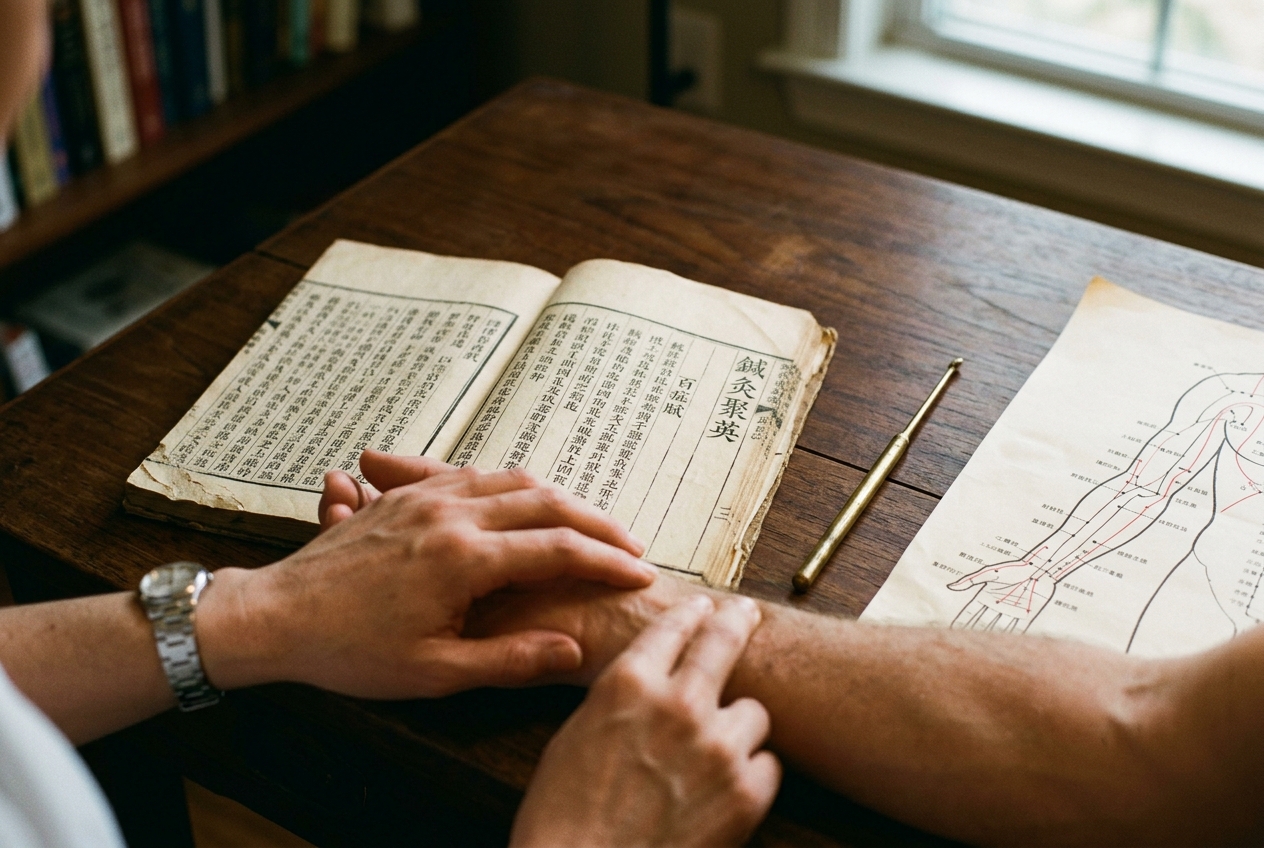
In 1529, the physician-scholar Gao Wu (高武) published a landmark compendium entitled Zhen Jiu Ju Ying (針灸聚英, Collection of Gems in Acupuncture and Moxibustion). Embedded within this masterwork was a didactic, rhymed poetic treatise: the Bai Zheng Fu (百症賦, Ode of One Hundred Diseases). Rather than treating the body as a collection of disjointed symptoms, Gao Wu codified a rigorous, elegant system of multi-point pairings—synergistic point formulas that leverage distant levers on the extremities to liberate deep visceral, neuromuscular, and psycho-emotional gridlocks.
What Gao Wu developed in the sixteenth century offers a remarkably sophisticated blueprint for self-directed somatic regulation today. By translating classical needle-point vectors into non-invasive, precision-targeted acupressure protocols, we uncover an evidence-based method to modulate the autonomic nervous system, release myofascial entrapment, and restore physiological homeostasis directly from our desks.
+-----------------------------------------------------------------------------------+
|                        CLASSICAL CHANNEL PAIRING ARCHITECTURE                     |
|                                                                                   |
|    [Distal Leverage Point]  <==== Functional Channel Axis ====>  [Target Tissue / |
|   (e.g., LI4 Hegu on Hand)                                           Visceral Site]  |
|              |                                                              |     |
|              v                                                              v     |
|   Mechanoreceptive Shear ===> Interstitial Signaling ===> Central Neuromodulation |
+-----------------------------------------------------------------------------------+
2. The Meridian Path & Theoretical Architecture: Gao Wu’s 1529 Treatise and the Biomechanics of Channel Pairing
Historical Genesis: The Scholar-Physician Gao Wu and the Zhen Jiu Ju Ying
The Ming Dynasty (1368–1644) represented a golden age of medical synthesis, canon consolidation, and didactic systematization. The historical expansion of printed texts, documented extensively across Chinese Medical History on Wikipedia, enabled medical masters to synthesize centuries of oral traditions and disparate clinical commentaries into structured curricula. Gao Wu, a literatus-physician (ru yi) hailing from Siming (modern Ningbo, Zhejiang Province), observed that earlier classical texts—such as the Huangdi Neijing (Inner Canon of the Yellow Emperor) and the Zhen Jiu Jia Yi Jing (Systematic Classic of Acupuncture and Moxibustion)—were often preserved in archaic, fragmented prose that hindered reliable clinical memorization and application.
In response, Gao Wu produced the Zhen Jiu Ju Ying in 1529, a comprehensive four-volume encyclopedia. To ensure that students and practitioners could readily internalize complex multi-channel therapeutic combinations, he formulated the Bai Zheng Fu in metric, rhymed verse (fu). This poetic structure was not merely an aesthetic choice; it functioned as an essential cognitive schema, compressing intricate physiological rules, channel correspondences, and empirical clinical pairings into memorable diagnostic couplets.
The Didactic Matrix of the Bai Zheng Fu
The genius of the Bai Zheng Fu lies in its departure from isolated point-to-symptom prescriptions. Instead, Gao Wu established systematic combinatorial pairing paradigms based on three fundamental functional vectors:
- Distal-Local Synergies (Ben Mo Pei Xue / 遠近配穴): Combining a primary distal leverage point situated on an extremity (below the elbows or knees, where sensory afferent density is highest) with a local point at the anatomical site of pain or dysfunction.
- Coupled Host-Guest Pathways (Yuan Luo Pei Xue / 原絡配穴): Pairing the Source (Yuan) point of an affected primary meridian with the Connecting (Luo) point of its interior-exteriorly paired organ system, thereby opening cross-channel collateral drainage.
- Bilateral Balancing and Dynamic Cross-Axes (Si Guan / 四關): Pairing contralateral or bilateral points across upper and lower extremities to re-establish central sensorimotor equilibrium.
+-----------------------------------------------------------------------------------+
|                               GAO WU'S PAIRING PARADIGM                           |
|                                                                                   |
|   1. Distal-Local Vector:    [Extremity Leverage Point] + [Local Symptom Zone]    |
|   2. Host-Guest Vector:      [Primary Source (Yuan)]    + [Coupled Network (Luo)] |
|   3. Bilateral Vector:       [Upper Limb (Yin/Yang)]    + [Lower Limb (Yin/Yang)] |
+-----------------------------------------------------------------------------------+
Neurofascial Signaling, Mechanotransduction, and Purinergic Pathways
Modern biomedical investigations into channel pathways demonstrate that meridians correspond closely with intermuscular and intramuscular connective tissue cleavage planes. Groundbreaking research published in the NCBI PubMed Central Archive on Connective Tissue Transmission by Dr. Helene Langevin and colleagues reveals that mechanical stimulation of classical acupoints initiates a distinct cascade of physical and biochemical events:
- Interstitial Mechanotransduction: Mechanical deformation of the extracellular matrix stretches subcutaneous fibroblasts, inducing cellular remodeling, cytoskeletal reorganization, and actin polymerization.
- Purinergic Purine Cascade: Mechanical shear triggers local cellular release of adenosine triphosphate (ATP), which rapidly hydrolyzes into adenosine. As outlined in landmark studies indexed at NCBI PubMed on Adenosine Receptor Signaling, adenosine binds to local $A_1$ adenosine receptors on sensory nerve terminals, exerting a potent, long-lasting anti-nociceptive (analgesic) effect.
- Axon-Reflex Vasodilation: Sustained tactile compression stimulates low-threshold $A\beta$ and unmyelinated $C$-tactile fibers, promoting the release of calcitonin gene-related peptide (CGRP) and substance P, which dilates local microvasculature, clears metabolic waste, and downregulates dorsal horn nociceptive transmission.
3. Anatomical Cartography & Key Points You Can Press Right Now
To bridge Gao Wu’s sixteenth-century insights into immediate modern application, we examine five foundational loci codified throughout the Bai Zheng Fu. For each point, we strip away opaque terminology in favor of palpable physical landmarks, target sensation profiles, exact application vectors, and modern somatic indications. For international standardization, these points conform to the official World Health Organization (WHO) Standard Acupuncture Nomenclature.
+-------------------------------------------------------------------------------------+
|                      TOPOGRAPHICAL LOCI & POINT SPECIFICATIONS                      |
+-------+---------------------+-------------------------------+-----------------------+
| Point | Classical Name      | Surface Landmark              | Neurological Pathway  |
+-------+---------------------+-------------------------------+-----------------------+
| LI4   | Hégǔ (合谷)         | Webbing between thumb & index | Radial / Median nerve |
| LV3   | Tàichōng (太衝)     | Dorsal valley, 1st/2nd toes   | Deep Peroneal nerve   |
| ST36  | Zúsānlǐ (足三里)    | Lateral shin below kneecap    | Fibular / Tibial axis |
| SP6   | Sānyīnjiāo (三陰交) | Medial lower leg above ankle  | Tibial nerve          |
| PC6   | Nèiguān (內關)      | Volar wrist between tendons   | Median nerve trunk    |
+-------+---------------------+-------------------------------+-----------------------+
1. Large Intestine 4 (Hegu, LI4 — "Joining Valleys")
                 [ Hand Dorsum - LI4 Hegu ]

                 Index Finger Base
                       \
                        \   LI4 Target Site (Focal Tenderness)
                         \    [ * ]
                          \  /   \
                           \/     \
                                   Thumb Base
- Surface Anatomy & Landmark: Look at the back of your hand. Spread your thumb and index finger slightly apart. Locate the soft, muscular mound of the first dorsal interosseous muscle in the web space. Slide your finger into the junction where the bones of the thumb and index finger meet, anchoring your contact against the midpoint of the second metacarpal bone (the index finger bone).
- Target Sensation (Deqi): Upon precise perpendicular-to-bone palpation, you will experience a radiating, dull ache, accompanied by an unmistakable spreading heaviness or light tingling running toward the index finger.
- Manual Vector & Mechanics: Apply sustained, deep circular pressure angled slightly inward toward the index finger bone rather than pressing straight down into the meat of the web. Maintain firm, unyielding pressure (pressure threshold 3–4 kg/cm²) for 90 to 180 seconds.
- Everyday Utility: Primary antidote for front-of-head tension, jaw clenching, temporomandibular tightness, ocular fatigue from screen glare, and sinus congestion.
2. Liver 3 (Taichong, LV3 — "Great Surge")
                 [ Foot Dorsum - LV3 Taichong ]

                    Great Toe      Second Toe
                        \              /
                         \            /
                          \          /
                           \  [ * ] <--- LV3 Target (Bony Notch)
                            \      /
                             \    /
                              \  /
                               \/ (Metatarsal Junction)
- Surface Anatomy & Landmark: Rest your foot flat on the floor. Run your index finger backward along the top of your foot in the groove between your big toe and second toe. As you slide approximately two finger-widths upward toward the ankle, your finger will drop into a distinct, sensitive depression just before the two metatarsal bones converge.
- Target Sensation (Deqi): A sharp, unmistakable tenderness that yields quickly to a spreading warmth; often perceived as an immediate "unclamping" sensation across the foot and lower abdomen.
- Manual Vector & Mechanics: Press with the tip of your thumb directed slightly toward the ankle at a 45-degree angle. Use a rhythmic, oscillating compression (1–2 Hz frequency) for 2 minutes on each foot.
- Everyday Utility: Mitigates acute stress-induced irritability, emotional frustration, tension-related vertex headaches, and somatic manifestations of autonomic hyperarousal.
3. Stomach 36 (Zusanli, ST36 — "Leg Three Miles")
- Surface Anatomy & Landmark: Sit with your knees bent at a 90-degree angle. Place the palm of your hand over your kneecap, fingers pointing downward. Locate the bony prominence of your shinbone. Move four finger-widths below the bottom edge of your kneecap, and one finger-width outward toward the lateral muscular ridge (the tibialis anterior muscle belly).
- Target Sensation (Deqi): A deep, resonant, muscular ache that often radiates down the outer shin into the third toe or upward toward the knee joint.
- Manual Vector & Mechanics: Use the reinforced tip of your thumb or your knuckle. Direct your force perpendicularly into the muscle belly, executing sustained, deep, slow-wave clockwise compressions for 2 to 3 minutes per leg.
- Everyday Utility: Systemic fatigue, post-prandial lethargy, acute and chronic digestive bloating, brain fog, and low physical stamina.
4. Spleen 6 (Sanyinjiao, SP6 — "Three Yin Intersection")
- Surface Anatomy & Landmark: Place four finger-widths (measured across the middle phalanges of your hand) above the highest peak of your inner ankle bone (medial malleolus). Locate the spot directly along the posterior edge of the shinbone (tibia).
- Target Sensation (Deqi): Pronounced somatic tenderness, distinct fullness, and a traveling, gentle sensation ascending along the medial calf.
- Manual Vector & Mechanics: Hook your thumb behind the posterior border of the tibia. Apply steady, horizontal pressure against the bone surface rather than pushing out into the calf muscle. Maintain for 90 to 120 seconds.
- Everyday Utility: Relieves lower abdominal cramping, pelvic congestion, menstrual discomfort, nocturnal restlessness, and insomnia related to over-rumination.
5. Pericardium 6 (Neiguan, PC6 — "Inner Pass")
- Surface Anatomy & Landmark: Turn your palm facing upward. Place three finger-widths of your opposite hand across your inner wrist crease, extending up the forearm. In the center of your forearm, between the two prominent, rope-like cords (the tendons of palmaris longus and flexor carpi radialis), lies the target locus. If you make a tight fist and flex your wrist forward, these tendons will stand out prominently.
- Target Sensation (Deqi): A dull, electric-like nerve propagation spreading toward the middle finger or radiating proximally toward the inner elbow.
- Manual Vector & Mechanics: Press with your thumb perpendicularly between the two tendons. Use a gentle, steady pumping compression (compress for 5 seconds, release slightly for 2 seconds) repeated for 2 to 3 minutes.
- Everyday Utility: Rapid alleviation of situational nausea, motion sickness, epigastric tightness, travel-induced disorientation, and acute chest tightness linked to anxiety.
4. Systematic Couplets & Clinical Formulations for Modern Somatovisceral Distress
In the Bai Zheng Fu, Gao Wu wrote with rhythmic precision:
"When the chest and diaphragm are obstructed with vexation and fullness, seek Neiguan and Zusanli; when the head and eyes are clouded with wind and vexation, open Hegu and Taichong."
To understand why these historical couplets remain exceptionally potent, we must examine their underlying neuro-circuitry and fascial transmission axes. Clinical trials cataloged in PubMed on Acupressure for Pain and Anxiety Management confirm that combining distal points on complementary channels produces synergistic neuromodulatory effects superior to single-point interventions.
+-----------------------------------------------------------------------------------+
|                        GAO WU'S CLASSICAL POINT FORMULAS                          |
+--------------------------+-----------------------+--------------------------------+
| Clinical Formulation     | Point Couplet         | Primary Physiological Action   |
+--------------------------+-----------------------+--------------------------------+
| The "Four Gates"         | LI4 (Hand) +          | Restores balance between       |
| (Sì Guān / 四關)          | LV3 (Foot)            | sympathetic & parasympathetic  |
+--------------------------+-----------------------+--------------------------------+
| The Epigastric /         | PC6 (Arm) +           | Stimulates vagal tone and      |
| Diaphragmatic Axis       | ST36 (Leg)            | gastrointestinal motility      |
+--------------------------+-----------------------+--------------------------------+
| The Metabolic-Somatic    | ST36 (Leg) +          | Modulates gut-associated       |
| Stabilizer               | SP6 (Leg)             | immunity & lowers inflammation |
+--------------------------+-----------------------+--------------------------------+
Formulation A: The "Four Gates" (Si Guan, LI4 + LV3) for Psychoneurotic Tension and Autonomic Hyperarousal
- Classical Premise: Gao Wu identifies the combination of LI4 (Yang channel on the upper limb) and LV3 (Yin channel on the lower limb) as the supreme cross-balancing formula for opening systemic stagnation, resolving internal "wind," and restoring the uninhibited flow of vital Qi throughout the twelve conduits.
- Modern Neurobiological Mechanism: LI4 projects afferent inputs via the superficial radial and median nerves into the cervical spinal cord, while LV3 projects via the deep peroneal nerve into the lumbar spinal cord. Together, this dual-extremity sensory bombardment converges at the nucleus tractus solitarius (NTS) and the periaqueductal gray (PAG) matter in the brainstem. Functional neuroimaging demonstrates that this specific combination induces immediate deactivation of the hyperactive amygdala and normalizes prefrontal cortical dysregulation, breaking the loop of somatic distress and mental hypervigilance.
Step-by-Step Protocol: The Desk-Worker’s 5-Minute Unclench
- Posture: Sit upright in a comfortable chair with feet resting flat on the floor and shoulders relaxed.
- Phase 1 (Right LI4): Grasp your right hand with your left thumb and index finger. Apply 90 seconds of deep, circular compression on right LI4, inhaling slowly for a count of 4 and exhaling for a count of 6.
- Phase 2 (Left LI4): Mirror the application on the left hand for 90 seconds.
- Phase 3 (Bilateral LV3): Kick off your shoes. Place your right heel or thumb onto left LV3 and apply sustained oscillating pressure for 60 seconds; switch to the right foot for 60 seconds.
- Expected Outcome: Marked softening of the suboccipital and temporomandibular musculature, deepening of diaphragmatic excursion, and reduction in perceived psychic urgency.
Formulation B: The Epigastric Axis (PC6 + ST36) for Visceral Dyskinesia and Gastrointestinal Spasm
- Classical Premise: In the Bai Zheng Fu, Gao Wu consistently pairs PC6 (Neiguan) with ST36 (Zusanli) to treat disorders of the upper and middle digestive chambers (Sanjiao), including epigastric fullness, acid regurgitation, and emotional constraint affecting digestion.
- Modern Neurobiological Mechanism: PC6 modulates the median nerve pathway, which sends signals to the vagus nerve nucleus in the medulla, while ST36 stimulates the common peroneal nerve, triggering parasympathetic activation. As detailed in the comprehensive Frontiers in Neuroscience Review on Autonomic Vagal Regulation, this dual point activation enhances gastric electrical slow waves, normalizes delayed gastric emptying, suppresses gastrointestinal smooth muscle spasms, and downregulates the secretion of stress-induced gastric acid.
Formulation C: The Metabolic-Somatic Stabilizer (ST36 + SP6) for Systemic Exhaustion and Orthostatic Fatigue
- Classical Premise: Gao Wu designates the pairing of ST36 (Earth channel) and SP6 (intersection of Spleen, Liver, and Kidney Yin channels) as the premier constitutional tonic, capable of restoring vital essence, enriching marrow, and building metabolic endurance.
- Modern Neurobiological Mechanism: Mechanical co-stimulation of ST36 and SP6 engages the neuro-immune axis. Mechanosensitive channel stimulation prompts the hypothalamic-pituitary-adrenal (HPA) axis to normalize basal cortisol rhythms while stimulating the splenic anti-inflammatory pathway. Vagal nerve efferents suppress pro-inflammatory cytokine production (such as TNF-$\alpha$ and IL-6) from splenic macrophages, directly alleviating systemic neuroinflammation, postural fatigue, and orthostatic heaviness in the lower limbs.
5. Safety, Sensibility, and Physiological Boundaries
While acupressure is an extraordinarily safe, non-invasive therapeutic intervention, its potency demands clear anatomical precision and respect for clinical boundaries.
+------------------------------------------------------------------------------------+
|                          CRITICAL SAFETY & TRIAGE MATRIX                           |
+--------------------+----------------------------+----------------------------------+
| Context            | Restricted Points          | Clinical Rationale               |
+--------------------+----------------------------+----------------------------------+
| Pregnancy          | LI4 (Hegu), SP6 (Sanyinjiao)| Potent uterine contractility &   |
|                    |                            | oxytocinergic induction risks    |
+--------------------+----------------------------+----------------------------------+
| Skin Integrity     | Any point over lesions,    | Risk of micro-trauma, infection, |
|                    | hematomas, or phlebitis    | or mechanical tissue damage      |
+--------------------+----------------------------+----------------------------------+
| Cardiovascular     | Avoid high-force carotid   | Risk of vagal over-activation or |
| Instability        | or deep jugular pressures  | hemodynamic instability          |
+--------------------+----------------------------+----------------------------------+
Obstetric Contraindications
Points such as LI4 (Hegu) and SP6 (Sanyinjiao) are explicitly classified in classical literature as oxytocic and descending agents. Modern obstetrical research indicates that deep mechanical stimulation of these loci can elevate uterine smooth muscle tone and provoke uterine contractions. Consequently, LI4 and SP6 must be strictly avoided throughout pregnancy, except under the direct management of a licensed healthcare provider during labor induction.
Understanding Sensation (Deqi vs. Trauma)
Effective acupressure must never be confused with blunt, damaging force. The goal is to elicit Deqi (得氣)—a sensation characterized by a dull, spreading ache, pleasant soreness, warmth, or mild heaviness. Sharp, lancinating, or burning sensations indicate that you are compressing a superficial nerve trunk or bruising local periosteum. If sharp pain occurs, ease your pressure immediately and shift your vector slightly.
Clinical Triage Red Flags
Acupressure is a self-care strategy for functional, stress-related, and musculoskeletal imbalances; it is not a substitute for emergency medicine. Seek immediate medical evaluation if you experience: * Sudden, severe "thunderclap" headaches or headaches accompanied by stiff neck, fever, or neurological deficits. * Crushing substernal chest pressure, radiation into the jaw or left arm, or shortness of breath. * Unexplained unilateral lower limb edema or calf pain (suspected deep vein thrombosis). * Acute, rigid abdominal pain accompanied by rebound tenderness or hematemesis.
6. Today’s Takeaway: The Two-Minute Reset Protocol
You do not need an hour of leisure or specialized tools to access the neurofascial benefits codified by Gao Wu in 1529. Right now, before closing this window or shifting to your next task, execute this single, two-minute restorative reset.
+------------------------------------------------------------------------------------+
|                         THE 2-MINUTE "JOINING VALLEYS" RESET                       |
|                                                                                    |
|   1. Position: Rest your nondominant hand flat on your desk.                       |
|   2. Locate:   Find LI4 (Hegu) in the web space against the index metacarpal bone. |
|   3. Engage:   Apply firm, circular pressure with your opposite thumb.             |
|   4. Breathe:  Inhale for 4 seconds, exhale slowly for 6 seconds (10 cycles).      |
|   5. Switch:   Repeat seamlessly on the opposite hand.                             |
|                                                                                    |
|   Result: Immediate reduction in ocular strain, jaw clenching, and cranial tension.|
+------------------------------------------------------------------------------------+
- Locate: Place your left hand on your desk. With your right thumb, feel the muscular valley between your thumb and index finger. Press firmly against the side of the long bone leading to your index finger (LI4, Hegu).
- Apply Pressure: Apply a steady, deep circular motion. Angle your force inward against the bone until you feel a distinct, heavy, spreading ache.
- Pace Your Breathing: Close your eyes. Inhale through your nose for a count of 4, feeling your lower belly expand, and exhale slowly through your nose for a count of 6.
- Hold: Maintain this rhythmic pressure for 60 seconds.
- Switch: Shift hands and repeat the exact process on your right hand for 60 seconds.
As you release the point, notice the subtle, immediate shift: the drop of your shoulders away from your ears, the softening of your brow, and the clearing of mental fatigue. In under one hundred and twenty seconds, you have tapped directly into a five-hundred-year-old lineage of somatic medicine—applying the geometric wisdom of the Bai Zheng Fu to master the demands of the modern day.