Auricular Acupuncture Techniques (Er Zhen Fa) Meridian Dynamics: Governing Auriculovagal Nerve Stimulation, Inverted Fetus Somatotopic Mapping, Neuroendocrine Reflex Modulation, and Psychosomatic Homeostasis in Traditional Chinese Medicine
========================================================================================================================
CLINICAL & PHYSIOLOGICAL PROSPECTUS
• Somatotopic Holography: Inverted embryological homunculus projecting the entire organism across the external auricle.
• Neuroanatomical Triad: Convergence of Auricular Vagus (CN X), Auriculotemporal (CN V3), & Great Auricular (C2–C3) nerves.
• Central Neuromodulation: Direct trans-synaptic projections via Nucleus Tractus Solitarii to dampen HPA axis reactivity.
• Evidence-Based Protocols: Clinical mechanics of NADA 5-Point addiction/trauma stabilization and Battlefield Acupuncture.
========================================================================================================================
1. Opening Scene — A Moment You'll Recognise
Consider an acute moment of sensory and emotional overload: your heart accelerates into a rapid, thumping cadence, your breath turns shallow and tight within the upper ribcage, your teeth unconsciously grind together, and a surge of adrenaline tightens every muscle along your neck and shoulders. In the midst of this fight-or-flight crisis, watch what human beings instinctively do. A child in distress rubs their earlobes; an exhausted clinician squeezes the hollow cup of their ear while staring at a monitor; a student sitting before a grueling exam rubs the upper cartilage of their outer ear.
This unconscious, self-soothing gesture is not an arbitrary nervous habit. It is an intuitive activation of the dense neural network embedded within the human auricle (pinna).
In Traditional Chinese Medicine (TCM), the outer ear is regarded not as an inert flap of skin and cartilage designed merely to funnel acoustic waves, but as an energetic switchboard directly plugged into every visceral organ and energetic channel of the body. More than two thousand years ago, the foundational canon of Chinese medicine, the Huangdi Neijing (Ling Shu, Chapter 28), made a bold assertion:
$$\text{“The ear is the gathering place of all twelve primary meridians” (十二经脉,皆通于耳)}$$
Classical physicians observed that whenever an internal organ (Zang-Fu) fell into dysfunction, distinct physical and vascular markers would appear across specific sectors of the external ear.
Today, contemporary neurobiology has caught up with this classical observation. When your fingers compress the central hollow of your ear, you are mechanically stimulating the auricular branch of the tenth cranial nerve—the vagus nerve. In doing so, you tap directly into the central autonomic command centers of the human brainstem, demonstrating how the ear serves as a bidirectional portal linking classical meridian dynamics with modern neurophysiology.
2. What This System Does: Classical Meridians and Neuro-Somatotopic Mapping
                                [ AURICULAR SOMATOTOPIC HOMUNCULUS ]

                                      Superior Crus (Lower Limbs)
                                           /             \
                   Triangular Fossa       /               \   Helix
                 (Pelvis / Ear Shen Men) /                 \  (External Boundaries)
                                        |   Antihelix       |
                                        | (Spine / Trunk)   |
                                       /                     \
                             Cymba    |                       |
                            Conchae   |     Scapha            |
                          (Abdomen)   |   (Upper Limbs)       |
                                       \                     /
                             Cavum      \                   /
                            Conchae      \                 /
                            (Thorax)      \               /
                                           Tragus   Lobule (Head / Facial Region)
                                            (Face)
To understand Auricular Acupuncture (Er Zhen Fa, 耳针法), one must examine how traditional channel theory interfaces with the modern discovery of somatotopic projection. In classical medical philosophy, the ear serves as a microsystem—a self-contained, holographic representation of the entire macrocosmic organism. While systemic acupuncture works by distributing energetic flow (Qi—the bioelectrical and physiological vitality of the body) through long vertical channels running across the extremities and torso, auricular therapy focuses this vast network into a micro-geographic blueprint.
The Evolution of Auricular Somatotopy
While the Huangdi Neijing and subsequent Tang Dynasty texts (such as Sun Simiao’s Thousand Ducat Prescriptions) recorded specific ear points for acute pediatric convulsions, jaundice, and visual disturbances, the structural mapping of the ear was revolutionized in the 1950s by the French physician and neuroscientist Dr. Paul Nogier. Nogier observed that local healers in Lyon cauterized the antihelix of patients to successfully alleviate chronic sciatic pain.
Through rigorous clinical mapping, Nogier realized that the somatic topography of the external auricle corresponds precisely to an inverted embryological fetus suspended head-downward within the womb:
- The Lobule (Ear Lobe): Represents the cranium, facial structures, eyes, and sensory organs.
- The Antihelix (The Curved Cartilaginous Ridge): Maps the vertebral column, with the cervical spine situated inferiorly near the lobe, moving upward into the thoracic vertebrae, and terminating in the lumbar and sacral segments at the superior bifurcation.
- The Superior and Inferior Crura of the Antihelix: Project the lower extremities (hips, knees, ankles, and feet) and the pelvic cavity.
- The Scapha (The Groove Between Helix and Antihelix): Represents the upper extremities, progressing from the shoulders down to the fingers.
- The Tragus and Antitragus: Correspond to the neuroendocrine switchboards, brainstem, thalamic centers, and anterior cranial base.
- The Cavum and Cymba Conchae (The Central Concavities): The lower concha (Cavum) houses the cardiopulmonary and thoracic viscera (Heart and Lungs in TCM), while the upper concha (Cymba) maps the abdominal and digestive viscera (Liver, Spleen, Kidneys, Stomach, and Intestines).
This system was subsequently unified and standardized through consensus by the World Health Organization (WHO) and the World Federation of Acupuncture-Moxibustion Societies (WFAS), establishing a standardized international nomenclature of auricular points.
+--------------------------------------------------------------------------------------------------+
|                              TRI-NEURAL INNERVATION ARCHITECTURE                                |
+----------------------------+-----------------------------------+---------------------------------+
| NERVE BRANCH               | ANATOMICAL AURICULAR ZONE         | SOMATOTOPIC CORRELATION         |
+----------------------------+-----------------------------------+---------------------------------+
| Auricular Branch of Vagus  | Cavum Conchae & Cymba Conchae     | Internal Viscera (Thorax,       |
| (ABVN / Arnold's Nerve)    | (The deep central depressions)    | Abdomen, Pelvic Organs)         |
+----------------------------+-----------------------------------+---------------------------------+
| Auriculotemporal Nerve     | Tragus, Ascending Helix Crus,     | Cranial structures, Head, Face, |
| (Trigeminal Branch CN V3)  | Anterior Helical Border           | Temporomandibular Joint         |
+----------------------------+-----------------------------------+---------------------------------+
| Great Auricular & Lesser   | Lobule, Antihelix, Scapha,        | Vertebral column, Musculo-      |
| Occipital (Cervical C2-C3) | Cranio-auricular Sulcus (Back)    | skeletal limbs, Sensory organs  |
+----------------------------+-----------------------------------+---------------------------------+
Tri-Neural Innervation and Central Neurophysiology
The physiological validity of this ancient somatotopic map is founded upon the unique neuroembryological wiring of the outer ear. The auricle is the only anatomical site on the human surface where the Vagus Nerve (Cranial Nerve X) sends a dedicated cutaneous sensory branch directly to the skin: the Auricular Branch of the Vagus Nerve (ABVN), historically termed Arnold’s Nerve.
The peripheral neural innervation of the auricle operates via a tri-neural convergence:
- The Auricular Branch of the Vagus Nerve (CN X): Exclusively innervates the concha bowls (cavum and cymba conchae).
- The Auriculotemporal Nerve (Branch of the Mandibular Division of Trigeminal Nerve, CN V3): Supplies the tragus, anterior helix crus, and anterosuperior margins.
- The Great Auricular Nerve and Lesser Occipital Nerve (C2–C3 Cervical Plexus): Innervate the lobule, antihelix, scapha, and posterior retroauricular sulcus.
When an acupuncturist inserts a micro-needle or applies a Vaccaria seed to the concha, mechanical and electrical transduction travels along A-beta and C-fibers of the ABVN directly into the Nucleus Tractus Solitarii (NTS) located in the medulla oblongata, as documented by neuroimaging and electrophysiological research on NCBI PubMed.
The NTS serves as the principal sensory clearinghouse for all internal viscera. From the NTS, ascending collateral axons project directly to:
- The Locus Coeruleus (LC): The brain’s central norepinephrine manufacturing plant. Stimulation via the ABVN downregulates LC hyperactivity, extinguishing the biochemical fires of panic, physiological hyperarousal, and somatic anxiety.
- The Hypothalamic-Pituitary-Adrenal (HPA) Axis: By modulating the paraventricular nucleus (PVN) of the hypothalamus, auricular vagal stimulation suppresses excessive release of Corticotropin-Releasing Hormone (CRH) and Adrenocorticotropic Hormone (ACTH), attenuating systemic cortisol spikes.
- The Central Antinociceptive Network: Projections to the Periaqueductal Gray (PAG) and Rostral Ventromedial Medulla (RVM) activate the descending pain-inhibition pathway. This triggers the endogenous release of $\beta$-endorphins, dynorphins, and enkephalins at the dorsal horn of the spinal cord, inducing immediate analgesia.
- The Cholinergic Anti-Inflammatory Pathway: Vagal efferents communicate with the celiac ganglion and the splenic nerve, releasing acetylcholine (ACh), which binds to alpha-7 nicotinic acetylcholine receptors ($\alpha7\text{nAChR}$) on splenic macrophages. This biochemically inhibits the transcription and synthesis of pro-inflammatory cytokines—including Tumor Necrosis Factor-alpha ($\text{TNF-}\alpha$), Interleukin-1 beta ($\text{IL-1}\beta$), and Interleukin-6 ($\text{IL-6}$).
3. How You Can Feel It: Signs of Balance and Imbalance
Because the ear is a dynamic neurovascular mirror of the internal terrain, pathophysiological disruptions in the organs or structural misalignments in the spine project visible and palpable changes onto the outer ear. In clinical practice, practitioners use these diagnostic markers to assess autonomic balance.
+--------------------------------------------------------------------------------------------------+
|                            SOMATIC AND AURICULAR DIAGNOSTIC SIGNS                                |
+------------------------+------------------------------------+------------------------------------+
| CLINICAL CONDITION     | OBJECTIVE AURICULAR MARKER         | SUBJECTIVE BODILY PATTERN          |
+------------------------+------------------------------------+------------------------------------+
| Sympathetic Hyper-     | Elevated electrical conductivity & | Insomnia, resting tachycardia,     |
| arousal / Chronic      | exquisite hyperalgesia at Ear      | shallow breathing, emotional       |
| Stress                 | Shen Men and Sympathetic Point     | irritability, tension headaches    |
+------------------------+------------------------------------+------------------------------------+
| Vertebral Subluxation  | Discrete subcutaneous nodules or   | Localized back/neck stiffness,     |
| / Chronic Back Pain    | ridging along the Antihelix        | radicular nerve pain, restricted   |
|                        | corresponding to specific vertebrae| physical range of motion           |
+------------------------+------------------------------------+------------------------------------+
| Gastrointestinal       | Sebum accumulation, flaking, or    | Bloating, acid reflux, postprandial|
| Stagnation / Dampness  | localized blanching in the Cymba   | fatigue, sluggish metabolism,      |
|                        | Conchae (Spleen/Stomach zone)      | bowel irregularity                 |
+------------------------+------------------------------------+------------------------------------+
| Cardiovascular Strain  | Frank's Sign (diagonal crease      | Exercise intolerance, chronic      |
| / Microvascular Stasis | traversing the lobule from tragus  | hypertension, systemic oxidative   |
|                        | toward the posterolateral edge)    | stress, microvascular congestion   |
+------------------------+------------------------------------+------------------------------------+
Self-Assessment: Evaluating Your Own Auricular Profile
You can perform an immediate diagnostic self-assessment using a mirror and your fingertips:
- Visual Inspection (Skin Topography & Vascularity): Examine the hollow concha bowls and the outer antihelix ridge. Are there areas of sudden redness (Heat/Inflammation in TCM), pale gray patches (Deficiency/Cold), or tiny distended dark blue capillaries (Blood Stasis)? Look at your earlobes: is there a prominent diagonal crease traversing the lobe (Frank's Sign), which modern epidemiological literature associates with coronary and cerebral microvascular changes?
- Palpatory Tenderness (Hyperalgesic Point Identification): Using the rounded tip of a clean probe or the blunt end of an unsharpened pencil, gently press along the anatomical landmarks of the ear with uniform, moderate pressure. A healthy ear presents with a supple, painless resilience. If a specific millimeter-wide locus on the antihelix or concha elicits a sudden, sharp, flinching tenderness (the "Grimace Sign"), you have localized an active reactive point corresponding to an irritated somatic or visceral structure.
- Tissue Texture & Subcutaneous Morphology: Run your thumb and index finger along the cartilaginous curves of the antihelix and triangular fossa. Note whether the cartilage feels elastic and smooth, or if you encounter tiny, grain-like nodules, fibrous bands, or localized spongy edema.
4. Qigong & Movement Practice: The Classical "Beating the Heavenly Drum" (Ming Tian Gu)
To cultivate vagal tone, awaken clear sensory perception, and activate the primary meridian connections of the auricle, ancient Daoist physicians devised the Ming Tian Gu (鸣天鼓 - "Beating the Heavenly Drum") along with Auricular Friction Qigong (Rou Er Gong). This practice combines acoustic resonance, mechanical vagal stretching, and peripheral reflex activation.
Practice Protocol: Step-by-Step
Starting Position and Setup
Sit upright in a quiet space on a chair or cross-legged on a cushion. Align your crown (Baihui, DU-20) toward the ceiling, relax your shoulders, tuck your chin slightly to lengthen the cervical spine, and rest the tip of your tongue against the upper palate. Close your eyes and engage in deep, diaphragmatic breathing: inhale through the nose for a count of four, expand the lower abdomen (Dan Tian), and exhale smoothly for a count of six. Complete three settling breaths before beginning.
Step 1: Frictional Activation of the Auricular Periphery (Rou Er)
- Form a "V" with your index and middle fingers on both hands.
- Place the middle finger in front of the ear (traversing the tragus and the pre-auricular points Tinggong SI-19, Tinghui GB-2, and Ermen SJ-21) and the index finger behind the ear along the cranio-auricular sulcus.
- Rub vigorously up and down with firm, steady friction for 36 full strokes.
- Breath Timing: Inhale for 6 up-and-down strokes; exhale for 6 strokes.
- Mechanism: This induces immediate vasodilation of the superficial temporal and posterior auricular arteries while stimulating the cervical plexus and auriculotemporal nerve.
Step 2: "Beating the Heavenly Drum" (Ming Tian Gu)
- Cover both ears firmly with the palms of your hands, pressing the thenar eminences over the external acoustic meatus to create an airtight seal that silences outside ambient noise.
- Extend your fingers backward around the cranium so they rest over the occipital bone at the base of the skull (targeting the Fengchi GB-20 and Yuzhen BL-9 regions).
- Place your index fingers on top of your middle fingers.
- With a firm, snapping motion, flick the index fingers off the middle fingers so they strike the occipital bone with an audible, resonant thud.
- Perform 36 rhythmic strikes.
- Breath Timing: Maintain slow, unbroken diaphragmatic respiration, striking in a steady rhythm of roughly two beats per second.
- Mechanism: The enclosed air column transfers acoustic shockwaves directly across the tympanic membrane and ossicles, sending vibrational pulses through the petrous temporal bone to stimulate the vestibulocochlear nerve (CN VIII), the cranial vagal pathways, and the cerebellar tentorium.
Step 3: Pneumatic Decompression (Yin Er)
- Keep your palms pressed firmly against your ears, creating gentle inward pressure for three slow seconds.
- Rapidly and cleanly pull both palms away from your ears with an audible "pop" of released negative pressure.
- Repeat this decompression for 9 continuous cycles.
- Mechanism: This mobilizes the tympanic membrane, clears the Eustachian tube (pharyngotympanic tube), and stimulates the deep vagal and glossopharyngeal sensory endings lining the ear canal.
+--------------------------------------------------------------------------------------------------+
|                            SOMATOSENSORY FEEDBACK INDICATORS                                     |
+------------------------------+-------------------------------------------------------------------+
| EXPERIENCED SENSATION        | NEUROPHYSIOLOGICAL & TCM SIGNIFICANCE                             |
+------------------------------+-------------------------------------------------------------------+
| Cranial Clarity & Auditory   | Dispersion of Liver-Fire and clearance of Turbid Dampness from   |
| Sharpness                    | the sensory orifices; enhanced microcirculation to the brainstem. |
+------------------------------+-------------------------------------------------------------------+
| Spontaneous Deep Sighing or  | Sudden activation of the Parasympathetic Nervous System;          |
| Swallowing Reflex            | dampening of the sympathetic fight-or-flight response.           |
+------------------------------+-------------------------------------------------------------------+
| Warm, Tingling Sensation in  | Localized release of nitric oxide (NO) causing microvascular      |
| the Ears & Suboccipital Base | dilation; free flow of channel Qi through Shao Yang channels.     |
+------------------------------+-------------------------------------------------------------------+
5. Acupressure Points You Can Try Today: Master Points and Clinical Protocols
                                [ CLINICAL MASTER POINTS MAP ]

                                     /‾‾‾‾‾‾‾‾‾‾‾‾‾\
                                    /   [SHEN MEN]  \
                                   / (Triangular Fossa)
                                  |                  |
                                  |  [SYMPATHETIC]   |
                                  | (Inferior Crus)  |
                                  |                  |
                                  |  [POINT ZERO]    |
                                  | (Crus of Helix)  |
                                  |                  |
                                  |   [SUBCORTEX]    |
                                  |  (Antitragus)    |
                                  |                  |
                                   \   [ENDOCRINE]  /
                                    \ (Intertragic)/
                                     \___[LOBE]___/
Auricular acupressure allows you to apply precise neural stimulation without puncturing the skin. By targeting specific functional master points, you can modulate acute somatic tension, autonomic dysregulation, and internal pain cascades.
Primary Functional Master Points
1. Ear Shen Men (TF-4, "Gate of the Spirit")
- Anatomical Location: Situated in the lateral third of the Triangular Fossa, precisely at the bifurcating apex where the superior and inferior crura of the antihelix meet.
- How to Press: Place the tip of your index finger in the depression of the triangular fossa on the front of the ear, and support the back of the ear with your thumb. Apply firm, circular pressure while pinching gently. Maintain for 2 to 3 minutes on both ears while breathing deeply.
- Clinical Applications: Ear Shen Men is the premier master point for downregulating sympathetic hyperarousal, mitigating chronic insomnia, soothing systemic anxiety, and raising the pain threshold through central $\beta$-endorphin release.
2. Point Zero (Crus of the Helix Center)
- Anatomical Location: Located in the distinct notch where the cartilaginous root (crus) of the helix rises horizontally from the floor of the concha bowl.
- How to Press: Use the clean edge of a fingernail or the rounded tip of a pen cap to press inward into the root ridge with steady, medium-firm pressure. Hold for 90 seconds.
- Clinical Applications: Considered the "organizer of the brain," Point Zero brings the autonomic nervous system back to homeostatic baseline. It regulates gastrointestinal motility, stabilizes erratic blood pressure, and enhances the therapeutic efficacy of all other stimulated points.
3. Sympathetic Point (AH-6a, "Autonomic Nerve Point")
- Anatomical Location: Located at the intersection of the superior border of the inferior antihelix crus and the internal border of the ascending helix.
- How to Press: Slide your index fingernail or a blunt probe under the cartilaginous shelf of the helix, pressing upward against the inferior crus for 1 to 2 minutes.
- Clinical Applications: Calms smooth muscle spasms across the body. It promotes peripheral vasodilation (improving cold hands and feet), relieves gastrointestinal cramping and biliary colic, and counteracts stress-induced tachycardia.
4. Subcortex (Pizhixia, AT-4) & Endocrine (Neifenmi, CO-18)
- Subcortex: Located on the interior wall of the antitragus; regulates cerebral cortex excitation and inhibition, reducing neuro-inflammatory pain pathways.
- Endocrine: Located in the intertragic notch at the base of the concha; balances the neuroendocrine axis, clears inflammatory dermatological conditions, and regulates metabolic function.
+--------------------------------------------------------------------------------------------------+
|                           STANDARDIZED CLINICAL PROTOCOL MATRIX                                  |
+---------------------------+--------------------------------+-------------------------------------+
| PROTOCOL NAME             | SPECIFIC EAR LOCI INCLUDED     | PRIMARY CLINICAL INDICATIONS        |
+---------------------------+--------------------------------+-------------------------------------+
| NADA 5-Point Protocol     | 1. Ear Shen Men (TF-4)         | Substance addiction, PTSD, severe   |
| (National Acupuncture     | 2. Sympathetic (AH-6a)         | psychological trauma, emotional     |
| Detoxification Assoc.)    | 3. Kidney (Cymba Conchae)      | dysregulation, acute burnout        |
|                           | 4. Liver (Posterior Concha)    |                                     |
|                           | 5. Lung (Cavum Conchae)        |                                     |
+---------------------------+--------------------------------+-------------------------------------+
| Battlefield Acupuncture   | 1. Cingulate Gyrus             | Acute and chronic refractory pain,  |
| (BFA - Col. Niemtzow)     | 2. Thalamus Point              | perioperative pain management,      |
|                           | 3. Omega 2                     | musculoskeletal trauma, rapid       |
|                           | 4. Point Zero                  | opioid-sparing analgesia            |
|                           | 5. Ear Shen Men                |                                     |
+---------------------------+--------------------------------+-------------------------------------+
Deep Dive into Standardized Clinical Protocols
The clinical efficacy of auricular therapy is highlighted by two internationally recognized protocols:
                  [ NADA 5-POINT ADDICTION & TRAUMA PROTOCOL ]

                                      /\
                                     /  \
                       [1. SHEN MEN]/____\
                      (Spirit / Calming)  \
                                           \
                   [2. SYMPATHETIC]         \
                  (Autonomic Relaxation)     \
                                              \
                      [3. KIDNEY]              \
                 (Ancestral Fear / Adrenals)    \
                                                 \
                         [4. LIVER]               \
                   (Anger / Free Qi Flow)          \
                                                    \
                            [5. LUNG]                \
                      (Grief / Oxygenation)           \
                                                       \________
The NADA 5-Point Protocol
Developed in the 1970s at Lincoln Hospital in New York by Dr. Michael Smith, the National Acupuncture Detoxification Association (NADA) protocol was engineered to treat severe opiate withdrawal and psychological trauma without pharmaceuticals.
The protocol targets five specific loci: 1. Shen Men: Anchors the spirit (Shen), relieving agitation, anxiety, and hypersensitivity. 2. Sympathetic: Balances autonomic tone, mitigating visceral spasm, sweating, and rapid pulse. 3. Kidney: Fortifies the foundational reserve (Jing), eases physiological fear, and supports adrenal recovery. 4. Liver: Clears emotional anger and frustration while encouraging the smooth, unimpeded circulation of Qi and blood. 5. Lung: Eases underlying grief and melancholy, boosts respiratory vitality, and promotes systemic detoxification.
Battlefield Acupuncture (BFA)
Designed by United States Air Force radiation oncologist and acupuncturist Colonel Richard Niemtzow, MD, Battlefield Acupuncture is a rapid-intervention protocol employed across military and emergency environments.
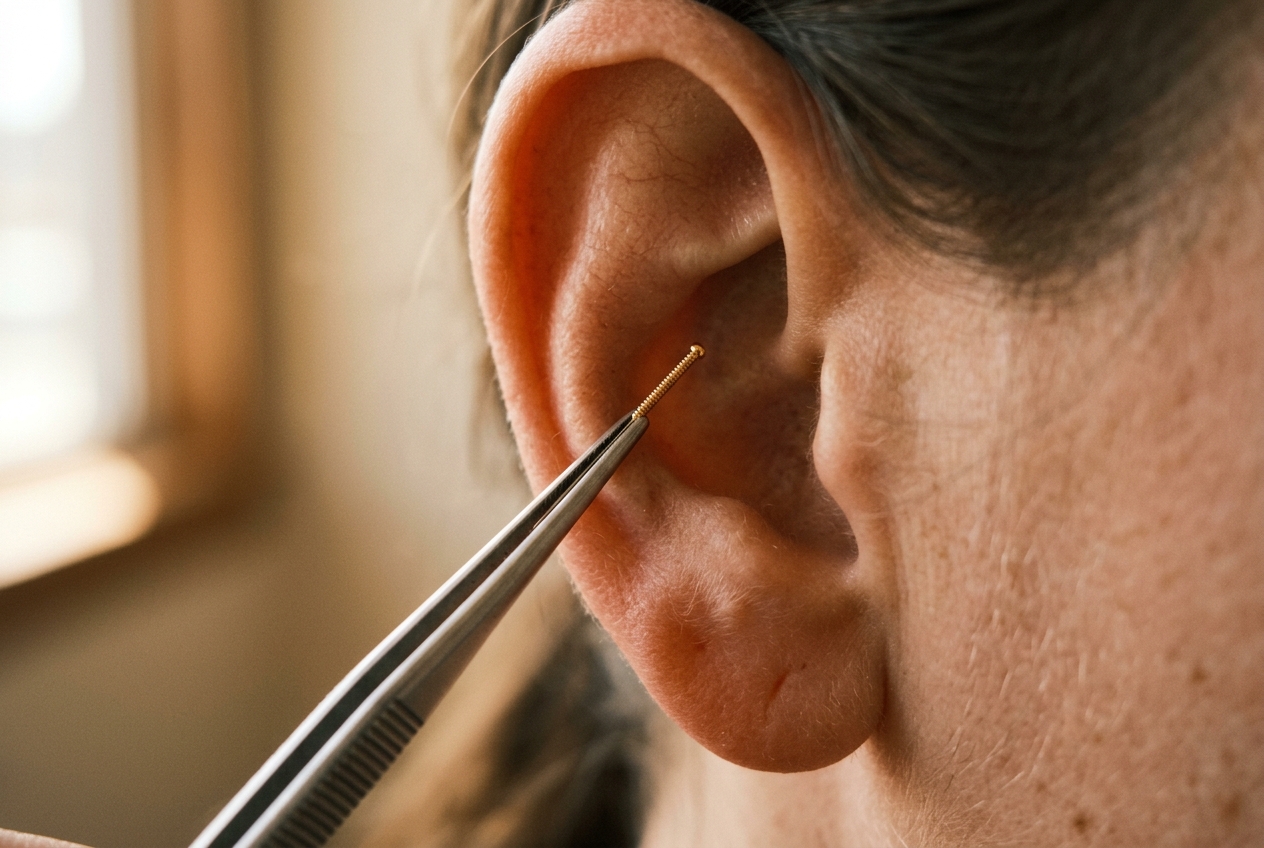
Utilizing semi-permanent, gold-plated ASP (Aiguille Semi-Permanente) needles placed sequentially into Cingulate Gyrus, Thalamus, Omega 2, Point Zero, and Shen Men, BFA disrupts central thalamocortical pain processing within minutes. This induces an immediate, measurable drop in subjective pain scores without causing sedative or cognitive impairment.
+--------------------------------------------------------------------------------------------------+
|                            AURICULAR THERAPEUTIC MODALITIES                                      |
+--------------------------+-------------------------------------+---------------------------------+
| CLINICAL MODALITY        | MECHANISM OF ACTION                 | PRACTICAL ADVANTAGES            |
+--------------------------+-------------------------------------+---------------------------------+
| Filiform Microneedles    | 0.16–0.20mm x 7–15mm sterile steel  | Immediate, intense neuro-       |
| (Traditional Acupuncture)| needles induce local microcurrents  | reflexive stimulation; retained |
|                          | and deqi sensations                 | for 20–45 minutes in clinic     |
+--------------------------+-------------------------------------+---------------------------------+
| Intradermal Press Needles| Minute (0.2–1.5mm) needles secured  | Prolonged, sustained sub-       |
| (*Pi Nei Zhen*)          | with medical adhesive tape          | threshold stimulation over      |
|                          |                                     | 3 to 5 days                     |
+--------------------------+-------------------------------------+---------------------------------+
| Semi-Permanent ASP       | Tiny gold, titanium, or steel dart- | Robust physical retention and   |
| Needles                  | shaped implants designed to naturally| continuous stimulation for      |
|                          | shed after 4 to 7 days              | intractable chronic pain        |
+--------------------------+-------------------------------------+---------------------------------+
| Vaccaria Ear Seeds       | Botanical seeds (*Wang Bu Liu Xing*)| Non-invasive, zero risk of      |
| (*Wang Bu Liu Xing*)     | or magnetic pellets taped on points | chondritis, patient can self-   |
|                          | for manual intermittent stimulation | stimulate throughout the day    |
+--------------------------+-------------------------------------+---------------------------------+
| Transcutaneous Auricular | Non-invasive electrostimulation of  | Clinically proven direct NTS &  |
| Vagus Nerve Stimulation  | the concha using configured bifocal | vagal activation without skin   |
| ([taVNS](https://www.frontiersin.org/journals/neuroscience))| surface electrode clips           | penetration                     |
+--------------------------+-------------------------------------+---------------------------------+
6. Food & Lifestyle: Supporting Autonomic Balance, Vagal Tone, and Clinical Safety
Auricular stimulation is most effective when paired with daily dietary and lifestyle habits that support healthy vagal tone, protect the nervous system, and respect clinical safety guidelines.
Targeted Nutrition for Autonomic and Neural Homeostasis
- Protect the Myelin Sheath and Nerve Conduction: The vagus and cranial nerves require structural lipids and membrane-stabilizing nutrients to maintain swift bioelectrical transmission. Incorporate cold-water wild fish (wild salmon, sardines, mackerel) rich in EPA and DHA, along with pasture-raised egg yolks rich in choline—the dietary precursor for acetylcholine, the primary neurotransmitter of the parasympathetic nervous system.
- Nourish the Gut-Vagal Axis: Because the vagus nerve derives much of its ascending afferent input from the gastrointestinal microbiome, incorporate traditionally fermented foods (unpasteurized sauerkraut, artisanal kimchi, naturally brewed miso, water kefir). These foods deliver short-chain fatty acids (SCFAs) that stimulate enteroendocrine cells to release serotonin and cholecystokinin (CCK), which send calming signals to the brainstem via the vagal pathway.
- What to Reduce: Eliminate refined seed oils high in inflammatory linoleic acid, and avoid excessive refined sugars and energy drinks. High doses of caffeine combined with sugar keep the locus coeruleus locked in noradrenergic overdrive, counteracting the calming benefits of auricular acupressure.
+--------------------------------------------------------------------------------------------------+
|                     CLINICAL SAFETY AND HYGIENE: PREVENTING CHONDRITIS                           |
+--------------------------------------------------------------------------------------------------+
| Cartilage Asepsis Protocol:                                                                      |
| • The auricular cartilage is an avascular structure that relies on its surrounding perichondrium  |
|   for nutrient diffusion. It has poor defense against bacterial infection.                       |
| • Infection with pathogens like Pseudomonas aeruginosa or Staphylococcus aureus can cause        |
|   suppurative auricular chondritis, risking necrosis and permanent deformity ("cauliflower ear"). |
| • Thoroughly disinfect the ear with 70% isopropyl alcohol or chlorhexidine before any puncture.   |
| • Immediately remove any needle, seed, or press tack if localized erythema, heat, throbbing pain,|
|   or purulent discharge develops.                                                                |
+--------------------------------------------------------------------------------------------------+
| Key Contraindications:                                                                           |
| • Pregnancy: Strictly avoid points that stimulate uterine contractility or disrupt neuroendocrine|
|   balance, including Uterus, Endocrine, Abdomen, and Pelvic points.                               |
| • Local Tissue Compromise: Never apply needles, press tacks, or ear seeds over open wounds, burns,|
|   eczematous lesions, or actively inflamed cartilage.                                             |
| • Severe Cardiac Arrhythmias: Exercise caution with aggressive concha or taVNS stimulation in    |
|   patients with unmanaged bradycardia or implanted pacemakers/defibrillators.                    |
+--------------------------------------------------------------------------------------------------+
7. Today's Takeaway: The 3-Minute Vagal Reset
If you take only one practical tool from this exploration of auricular physiology, make it this 3-Minute Reset: whenever you feel a surge of acute anxiety, physical pain, or mental fatigue, sit quietly, place your index fingers directly into the Ear Shen Men hollow in the upper triangular fossa, and rest your thumbs behind the upper rim of your ears. Pinch gently with firm, slow, circular pressure while engaging in rhythmic diaphragmatic breathing—inhaling through your nose for 4 seconds and exhaling smoothly for 6 seconds.
Within two minutes of sustained pressure, the mechanoreceptors in your ear will send calming signals through the vagus and trigeminal pathways into your brainstem. This slows a racing heart, downregulates stress-hormone signaling, and brings your autonomic nervous system back into balance—all using the ancient healing map embedded in the outer ear.
Authoritative References and Scholarly Reading
- World Health Organization: Standardized Auricular Nomenclature
- NCBI: Anatomy, Head and Neck, Auricular Nerve & Nucleus Tractus Solitarii
- Frontiers in Neuroscience: Mechanisms of Transcutaneous Auricular Vagus Nerve Stimulation (taVNS)
- National Center for Complementary and Integrative Health (NIH) - Acupuncture Overview
- National Acupuncture Detoxification Association (NADA) Official Framework
- Wikipedia: Comprehensive Overview of Auriculotherapy and Clinical Microsystems